Transition metal oxide supported on alumina catalysts: a comparative study for the hydrogenation of octanal
Abstract
Monometallic (10 wt.%) Co, Ni and Cu nanoparticles supported on alumina catalysts were prepared using an ultrasonic impreg-nation-cavitation method and characterized using ICPP XRD, physisorption, chemisorption and temperature programmed techniques. The copper catalyst showed higher metal dispersion and greater hydrogen and CO chemisorption capacity when compared to the nickel and cobalt catalysts. Hydrogenation of octanal carried out in a continuous flow high pressure fixed bed reactor showed that the rate of reaction and turnover number of octanol depended on the amount of hydrogen chemisorbed. The copper catalyst showed the lowest activation energy, as well as best catalytic activity. The Cu-Al catalyst which showed higher metal dispersion and low acidity, showed the highest selectivity towards octanol with no C24 acetal formation, when compared to the Ni-Al and Co-Al catalysts.
Octanal hydrogenation; octanol; copper; nickel; cobalt
1. Introduction
Linear α-olefins (LAOs) are an important feedstock for the chemical industry.12 3
From the early 1930s, triglycerides, primarily vegetable oils, have been transformed to fatty alcohols by hydrogenation over Cr-containing Adkins catalysts.43,5 Reports on the selective hydrogenation of aldehydes to alcohols in continuous flow liquid phase systems, under mild conditions are limited.63,7 Catalysts with metals such as nickel,891011
It has been shown that hydrogenation depends on the surface area, pore volume and acid-base character of the support.11-12 High surface area enhances dispersion of supported metals, whereas porosity of the support affects intraparticle diffusion of reactants and products. The acid-base nature of the support is a key parameter to allow or restrict the formation of acetals and diols in the hydrogenation of aldehydes.1,11a Hydrogenation of a long chain aldehyde, e.g. octanal is one of the interesting topics of research in the field of catalysis. In the present study, we report the hydrogenation of 1-octanal to 1-octanol, an important step in an industrial process which ultimately gives 1-octene, over the comparatively inexpensive transition metals cobalt, nickel and copper supported on alumina, prepared by an ultrasonication process.
2. Experimental
The ultrasonic cavitation-impregnation method133)2-3H2O, Sigma-Aldrich), nickel nitrate (Ni(NO3)2-6H2O, Sigma-Aldrich), and copper nitrate (Co(NO3)2-6H2O, ACE ) in distilled water, then adding the solutions to high surface area 1-alumina (1-Al2O3 Alfa-Aesar). Magnetic stirring at 300 rpm, combined with ultrasonic cavita-tion (MRC Ultrasonic System, D150H Model) at 43 kHz were applied at room temperature (25 ± 1 °C) to obtain a homogeneous mixture and uniform dispersion. The slurry was dried by evaporation at 70 °C while stirring continuously. The materials then were dried in an oven for 16 h at 110 °C. The catalysts then were calcined for 5 h at 550 °C to give the 10 wt.% of cobalt, nickel and copper catalysts, denoted as Cu-Al, Ni-Al and Co-Al, respectively.
The Brunauer-Emmett-Teller (BET) surface area was measured using a Micromeritics Tristar II instrument. Inductively coupled plasma (ICP) analyses were carried out with a Perkin Elmer Optical Emission Spectrometer Optima 5300 DV. Powder X-ray diffraction (XRD) was conducted using a Bruker D8 Advance diffractometer equipped with a Cu radiation source (1 = 1.5406 A). NH3-temperature programmed desorption (NH3-TPD) was done on a Micromeritics 2920 Autochem II Chemi-sorption Analyser. In these analyses a mixture of5%NH3 in helium was passed over the reduced catalyst for 60 min. Thereafter, the temperature was increased slowly to 950 °C by ramping at 10 °C min-1 under helium flow.143
The hydrogenation reactions were performed in a fixed bed continuous flow reactor in down-flow mode. The catalyst bed (4 mL volume, pellet sizes ranged between 300 and 600 μm) was diluted with an equal volume of carborundum (24 grit). Prior to the catalytic testing, to ensure that the reactor is free from physical transport limitations, the reactor set-up was checked with varying flows of octanal, pressures and pellet sizes of catalysts. The feed used for all reactions was 10 wt.% octanal in octanol, the latter serving as thermal diluent. Octanol does not affect the reaction. There was no decrease in octanal conversion with increasing dilution, which shows the absence of diluent effects during the reaction.15via aLab Alliance Series II hplc pump. The liquid products were collected in a 500 mL catchpot and the excess hydrogen gas exited through a wet gas flow meter (Ritter Drum-type). The liquid products were collected at regular intervals. They were identified and quantified using a PerkinElmer Clarus 500 GC, with an FID and a Petrolite column. All the reported data points were obtained in duplicate after steady state was achieved. The mass balances for all samples were 100 ± 1 %.
TON, also called turnover number, was defined as the molecules reacting per active site per gram of catalyst. The number of reacting molecules of octanal was calculated using the conversion and mass flow rate data at corresponding reaction temperatures; and the available number of active sites was obtained from the metal dispersion data, measured from chemisorption. The apparent activation energy was calculated using the Arrhenius plot, details of which are found in the supplementary information.
3. Results and Discussion
3.1. Characterisation of the Catalysts
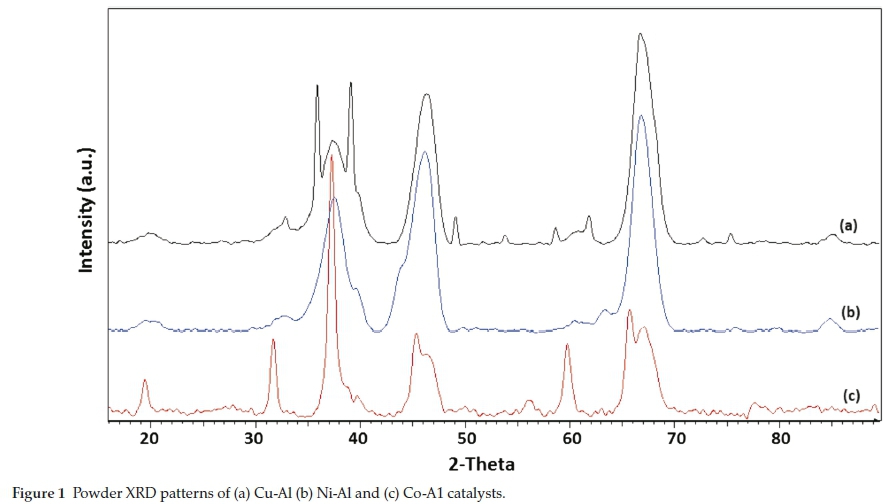
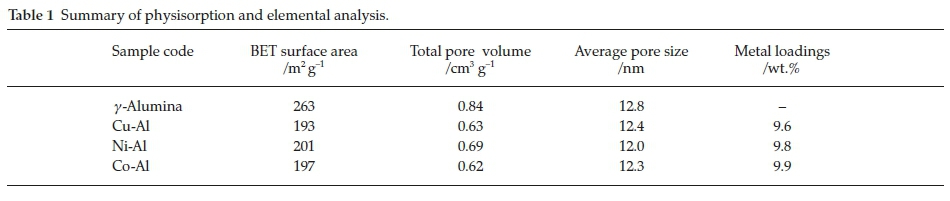
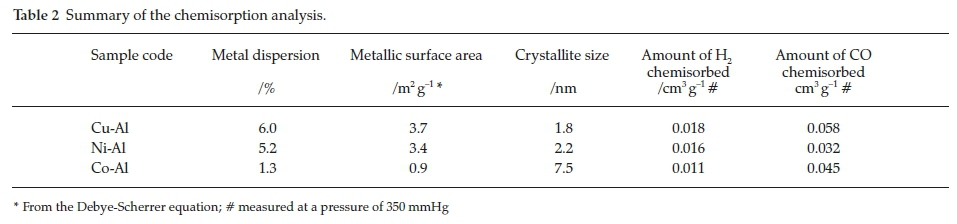
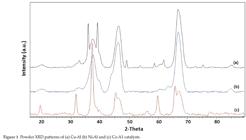
Table 1 shows the results of the physisorption experiments and the elemental analyses of the catalysts. The ICP data of the catalysts showed that the desired metal wt.% was loaded on the alumina. All the catalysts show Type IV adsorption desorption isotherms with a H1 hysteresis loop, which demonstrated the mesoporous nature of the catalysts.14Fig. 1) shows the alumina pattern which is in agreement with the literature24b Among all the catalysts, Co-Al showed the largest crystallite size compared to Cu-Al and Ni-Al (Table 2). In general, the larger crystallite size of the metals leads to lower dispersion of the metal on the surface of the support.15c The same trend is observed in this study. The amount of hydrogen chemisorbed on the surface of the catalysts was in the inverse order to crystallite size.
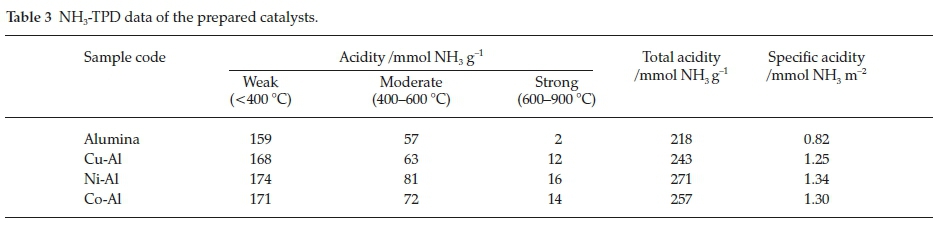
In the TPD analysis data, all catalysts showed three types of acidic sites, i.e. weak (<400 °C), moderate (400-600 °C) and strong (600-900 °C).2Table 3). Cu-Al showed the lowest acidity when compared to other catalysts, but slighter higher acidity than the alumina support. In the TEM images (Fig. S1, supplementary information), alumina appears as irregular-shaped agglomerations of elongated particles. When the Cu, Ni and Co oxides were impregnated, no difference in the overall morphology of the catalysts was observed.
Fig. S1
3.2. Catalytic Results
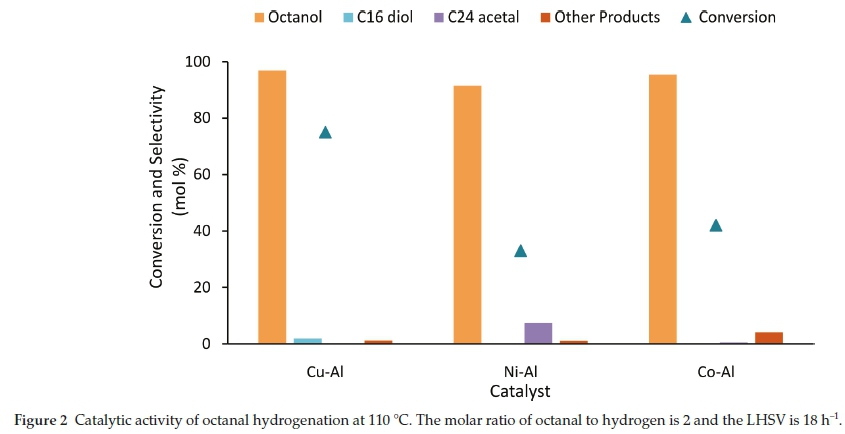
The hydrogenation of octanal was conducted in a continuous flow fixed bed reactor with an octanal to hydrogen molar ratio of 1:2. GHSV and LHSV were maintained at 460 h-1 and 18 h-1, respectively, at temperatures of 110 °C, 150 °C and 180 °C. With an increase in temperature, all the catalysts showed the expected increase in conversion of octanal and also an increased selectivity towards octanol.
Figure 2 shows the conversion of octanal and selectivity towards products at 110 °C. The conversion profile of the catalysts correlates with the amount of hydrogen chemisorbed on the surface of the catalysts (Table 2), which suggests the conversion of the octanal depends on the disassociation of hydrogen on the surface of the catalyst.16Fig. 2). The selectivity profile of octanol is proportional to the quantity of CO chemisorbed on the surface of the catalysts in chemisorption studies, which might imply a correlation with carbonyl group (octanal) adsorption.
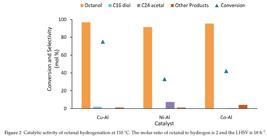
The desired reaction in this study is the hydrogenation of octanal to produce octanol. However, some side reactions do occur to produce the C16 diol and C24 acetal. The C16 diol is produced over the Cu-Al catalyst and occurs through an acid-base catalyzed aldol condensation of two octanal molecules to form the C16 aldol, which is further hydrogenated to form the C16 diol.17
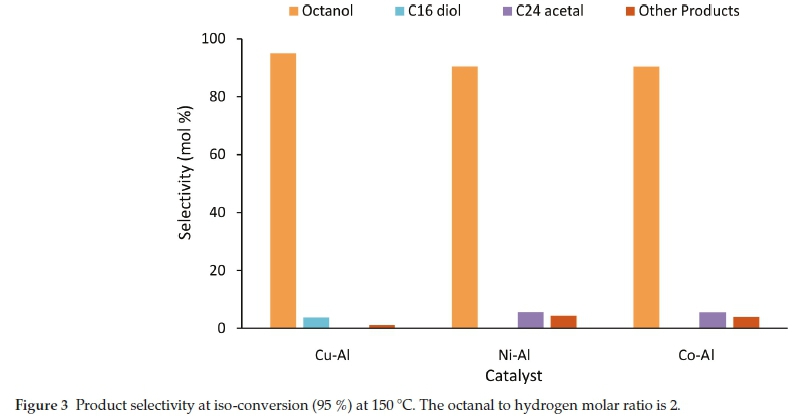
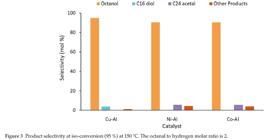
Figure 3 shows the product selectivity at an iso-conversion of 95 %, at a temperature of 150 °C and an octanal to hydrogen molar ratio of 2. The product selectivity at iso-conversion is influenced by the metal dispersion and acidic site distribution of the catalysts. The Cu-Al catalyst which showed higher metal dispersion and low acidity, showed the highest selectivity towards octanol with no C24 acetal formation, when compared to the Ni-Al and Co-Al catalysts. No significant difference is seen in the selectivities towards products for the Ni-Al and Co-Al catalysts, probably due to their similar specific acidities and high acidity when compared to the Cu-Al catalyst.
3.3. Kinetics of the Reaction
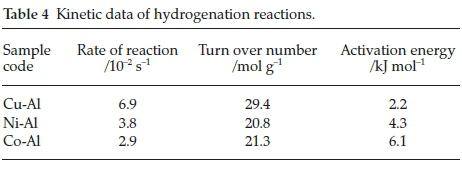
To gain insight into the reaction mechanism in this study, the rate of the reaction of octanal hydrogenation and turnover number toward octanol were calculated. Since all reactions were carried out at 50 bar pressure, it is assumed that there would be no mass transfer limitations of gaseous hydrogen to the liquid phase. It was also assumed that adsorbed hydrogen was effectively at equilibrium and that the rate limiting step of the reaction is the addition of the second hydrogen atom to the organic moiety.151,6 The rate of the reaction of catalytic hydrogenation of octanal was found to be proportional to the metal dispersion of the catalysts (Table 4). The catalyst with highest metal dispersion and lowest acidity, i.e Cu-Al, showed the highest rate and the lowest activation energy. The turnover number toward octanol was greater over the Cu-Al catalyst, than over both the Ni-Al and Co-Al catalysts.
4. Conclusion
All three catalysts showed good catalytic hydrogenation activity, however, the Cu-Al catalyst performed better when compared to the Ni-Al and Co-Al catalysts. Cu-Al showed the highest metal dispersion, whereas Co-Al showed the lowest metal dispersion which directly affects the catalyst performance under hydrogenation. Octanal conversion was dependent on the dispersion of metal on the catalysts. The selectivity profiles match the acidic site distributions of the catalysts at iso-conversion. In addition to octanol, other products such as the C16 diol and the C24 acetal were observed in small amounts, which formed via acid-base catalysis on the surface. Octanal hydrogenation follows first-order kinetics and the rate of the reaction is also dependent on the metal dispersion of the catalysts. Among all the catalysts, Cu-Al showed the lowest activation energy and thus highest activity.
Supplementary Material
Supplementary information is provided in the online supplement.
Acknowledgements
We would like to thank THRIP (Grant TP1208035643), the NRF and SASOL and for financial support. We also thank Dr. N. Prinsloo (SASOL) and the Electron Microscopy Unit at UKZN (Westville campus).
References
- 1 H. Hattori, Heterogeneous basic catalysis, Chem. Rev., 1995, 95, 537-558.
- 2 H. F. Rase, Handbook of Commercial Catalysts: Heterogeneous Catalysts, Taylor & Francis, 2000.
- 3 K. Ralphs, C. Hardacre and S.L. James, Application of heterogeneous catalysts prepared by mechanochemical synthesis, Chem. Soc. Rev., 2013, 42, 7701-7718;
- b) T. Chetty, VD.B.C. Dasireddy, L.H. Callanan and H.B. Friedrich, Continuous flow preferential hydrogenation of an octanal/octene mixture using Cu/Al2O3 catalysts, ACS Omega, 2018, 3, 7911-7924.
- 4 a) A. Vaccari, Clays and catalysis: a promising future, Appl. Clay Sci., 1999, 14, 161-198;
- b) W. Huang, H. Li, B. Zhu, Y. Feng, S. Wang and S. Zhang, Selective hydrogenation of furfural to furfuryl alcohol over catalysts prepared via sonochemistry, Ultrasonics Sonochemistry, 2007, 14, 67-74.
- 5 Y. Li, Q. Fuand M. Flytzani-Stephanopoulos, Low-temperature water-gas shift reaction over Cu- and Ni-loaded cerium oxide catalysts, Appl. Catal. B: Environ., 2000, 27, 179-191.
- 6 a) A. Corma and M.J. Sabater, in Environmental Catalysis over Gold-Based Materials, The Royal Society of Chemistry, 2013, pp. 146-200;
- b) P. Gallezot and D. Richard, Selective hydrogenation of a, β-unsatu- rated aldehydes, Catal. Rev., 1998, 40, 81-126.
- 7 a) F. Studt, F. Abild-Pedersen, Q. Wu, A.D. Jensen, B. Temel, J.-D. Grunwaldt and J.K. N0rskov, CO hydrogenation to methanol on Cu-Ni catalysts: theory and experiment, J. Catal., 2012, 293, 51-60;
- b) G.J. Hutchings, F. King, I.P. Okoye and C.H. Rochester, Influence of chlorine poisoning of copper/alumina catalyst on the selective hydrogenation of crotonaldehyde, Catal. Lett., 1994, 23, 127-133;
- c) V. Gutierrez, M. Dennehy, A. Diez and M.A. Volpe, Liquid phase hydrogenation of crotonaldehyde over copper incorporated in MCM-48, Appl. Catal. A: Gen., 2012,437-438, 72-78.
- 8 J. Zhang, H. Wang and A.K. Dalai, Effects of metal content on activity and stability of Ni-Co bimetallic catalysts for CO2 reforming of CH4, Appl. Catal. A: Gen., 2008, 339, 121-129.
- 9 F. Coloma, A. Sepúlveda-Escribano, J.L.G. Fierro and F. Rodríguez-Reinoso, Gas phase hydrogenation of crotonaldehyde over Pt/acti-vated carbon catalysts. Influence of the oxygen surface groups on the support, Appl. Catal. A: Gen., 1997, 150, 165-183.
- 10 C. Ando, H. Kurokawa and H. Miura, Selective hydrogenation of aldehyde groups in various a, B-unsaturated aldehydes over alumina-supported cobalt(0) catalyst, Appl. Catal. A: Gen., 1999, 185, L181-L183.
- 11 a) M. Sankar, N. Dimitratos, P.J. Miedziak, P.P. Wells, C.J. Kiely and G.J. Hutchings, Designing bimetallic catalysts for a green and sustainable future, Chem. Soc. Rev., 2012,41, 8099-8139;
- b) G. Li, P. Dong, D. Ji, Y Xu, Y. Li and R. Mu, Effect of support materials on liquid-phase hydrogenation ofhydroquinone over ruthenium catalysts, Solid State Sci., 2013, 23, 13-16.
- 12 a) K. Chen, S. Xie, A.T. Bell and E. Iglesia, Structure and properties of oxidative dehydrogenation catalysts based on MoO3/Al2O3, J. Catal., 2001, 198, 232-242;
- b) J. Xue, F. Cui, Z. Huang, J. Zuo, J. Chen and C. Xia, Effect of metal additives on structure and properties of a Co/SiO2 hydrogenation catalyst, Chin. J. Catal., 2012, 33, 1642-1649;
- c) P. López, Mondragón-Galicia, M.E. Espinosa-Pesqueira, D. Mendoza-Anaya, M.E. Fernandez, A. Gómez-Cortés, J. Bonifacio, G. Martínez-Barrera and R. Pérez-Hernández, Hydrogen production from oxidative steam reforming of methanol: effect of the Cu and Ni impregnation on ZrO2 and their molecular simulation stud ies, Int. J. Hydrogen Energy, 2012, 37, 9018-9027.
- 13 J.H. Bang and K.S. Suslick, Applications of ultrasound to the synthe sis of nanostructured materials, Adv. Mater., 2010, 22, 1039-1059.
- 14 C.A. Brebbia and A. Klemm, Materials Characterisation VI: Computational Methods and Experiments, WIT Press, 2013.
- 15 a) T. Chetty, H.B. Friedrich, V.D.B.C. Dasireddy, A. Govender, P.J. Mohlala and W. Barnard, Effect of various Au/Al2O3 preparations on catalytic behaviour during the continuous flow hydrogenation of an octanal/octene mixture, ChemCatChem, 2014, 6, 2384-2393;
- b) S.F. Miller, H.B. Friedrich, C.W. Holzapfel and VD.B.C. Dasireddy, Effects of organic modifiers on a palladium catalyst in the competitive hy-drogenation of 1-octene versus octanal: an evaluation of solid catalysts with an ionic liquid layer, ChemCatChem, 2015, 7, 2628-2636;
- c) J. Valand, V.D.B.C. Dasireddy, S. Singh and H.B. Friedrich, Ternary (Cu, Ni and Co) nanocatalysts for hydrogenation of octanal to octanol: an insight into the cooperative effect, Catal. Lett., 2017, 147, 525-538.
- 16 L. Cervený, Catalytic Hydrogenation, Elsevier Science, 1986.
- 17 a) J. Valand, A.S. Mahomed, S. Singh and H.B. Friedrich, The influence of Montmorillonite K10 as a support in the nickel catalyzed hydrogenation of octanal, J. Porous Mat., 2016, 23, 175-183;
- b) M.D. Farahani, J. Valand, A.S. Mahomed and H.B. Friedrich, A comparative study of NiO/Al2O3 catalysts prepared by different combustion techniques for octanal hydrogenation, Catal. Lett., 2016,146, 2441-2449.
Revised 20 August 2016
Accepted 20 August 2018
† Present address: Department of Materials Science, Sardar Patel University, Vallabh Vidyanagar-388120, Gujarat, India.
* To whom correspondence should be addressed. E-mail: