Pedospheric sorption investigation of sulfonyl urea herbicide Triasulfuron via regression correlation analysis in selected soils
Abstract
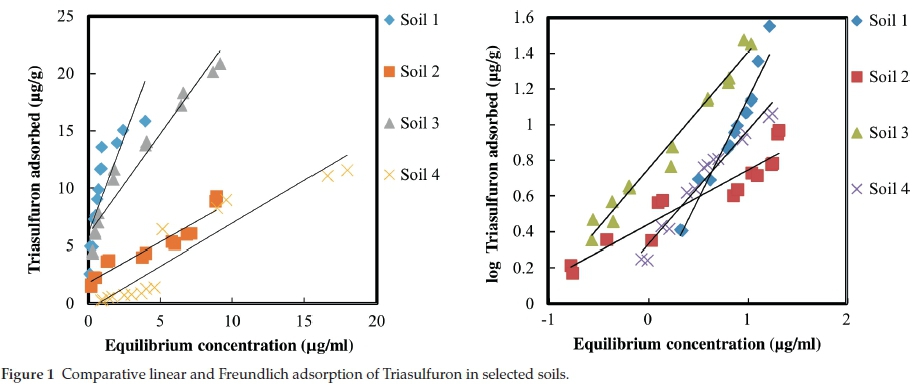
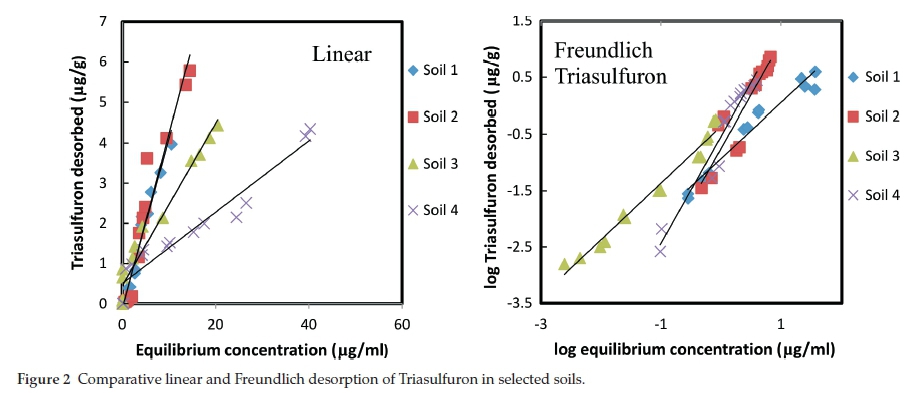
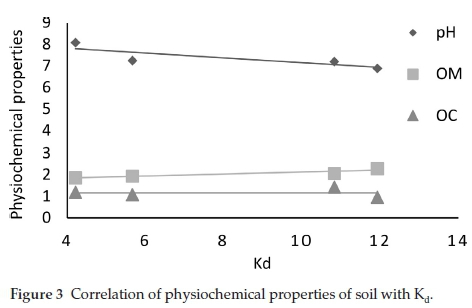
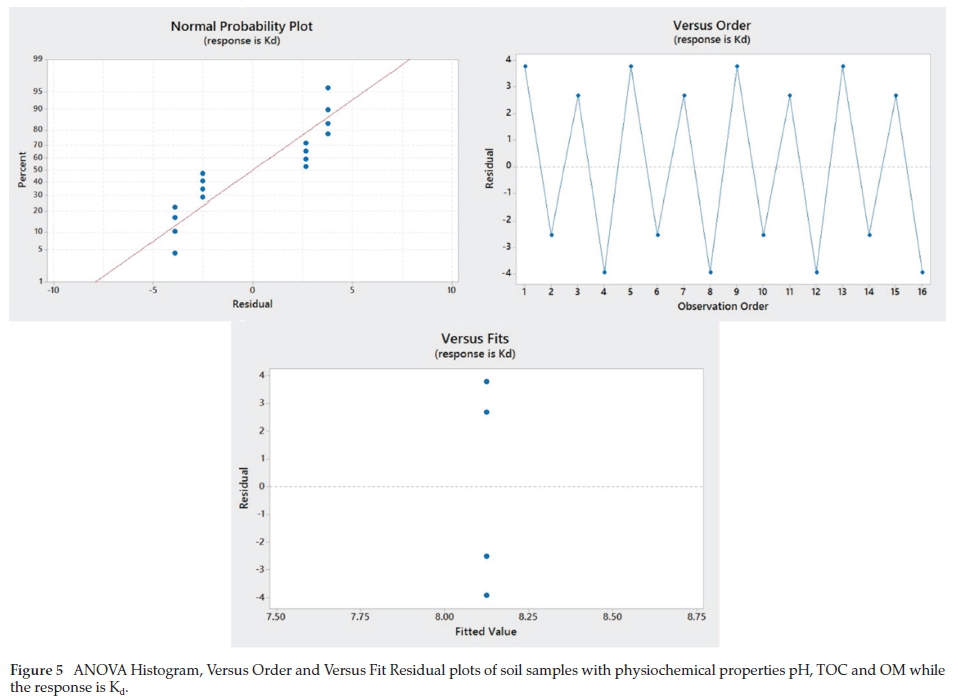
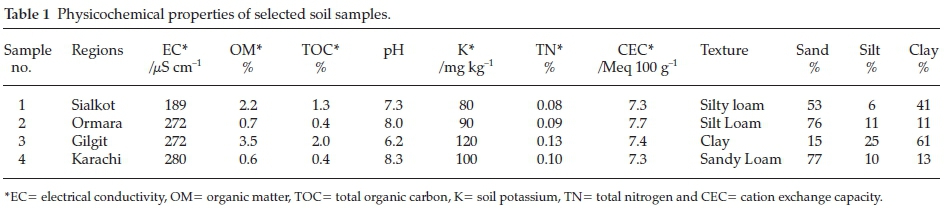
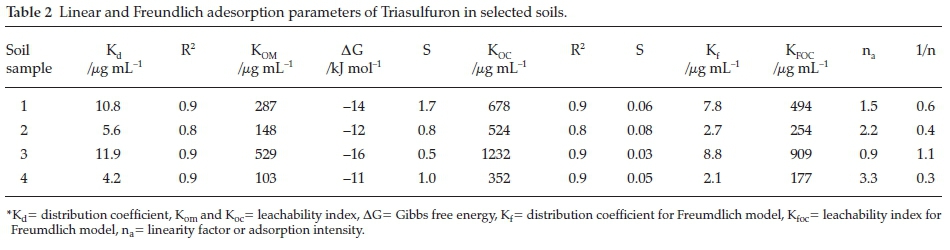
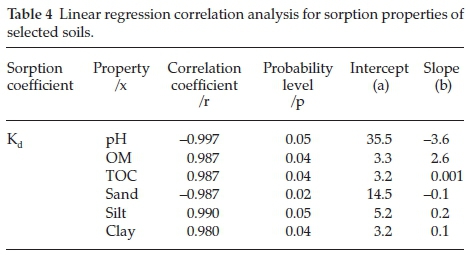
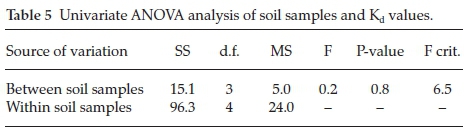
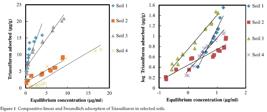
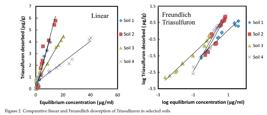
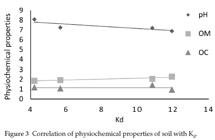
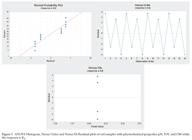
Assessing pesticide fate in agricultural soils requires a detailed understanding of their interaction the with decomposing soil component in the environment. Sulfonyl urea herbicide, Triasulfuron, has been evaluated for its sorption behaviour in selected soils via batch equilibration method run in duplicate involving UV spectrophotometry. Selected soils possessed a variable degree of physicochemical make-up. Sorption of Triasulfuron fitted well with linear and Freundlich models, yielding C-type isotherms. Kd span over a range of 4.2-11.9 mL"1. Correlation and regression analysis proved that pH, organic matter, total organic content and textural properties of soils govern the adsorption and leaching of Triasulfuron. pH and sand expressed negative correlation with Kd (r = -0.997 and r = -0.987) while organic matter, organic content and clay positively impacted Kd (r = 0.987, r = 0.987 and r = 0.980). Negative values of AG vividly proved physical and exothermic adsorption processes. Lower values of AG £ -40 kJ mol-1 exhibited physiosorption of Triasulfuron in selected soils via weak Van der Waal's forces or hydrogen bonding. However, all kinetic values were dependent on the soil physicochemical parameters and demonstrated less adsorption of Triasulfuron for selected soils. Results have been statistically evaluated by ANOVA and the accuracy of fit has been calculated by plotting residual graphs in Minitab. Present study can be further extended to investigation of degradation patterns of Triasulfuron.
Triasulfuron; adsorption; organic matter; correlation; linear
 Thumbnail
 Thumbnail
 Thumbnail
 Thumbnail