Utilisation of bis-chloroacetamide derivative in the synthesis of new biologically active sulfide compounds
Abstract
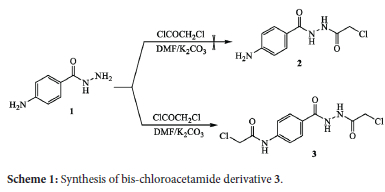
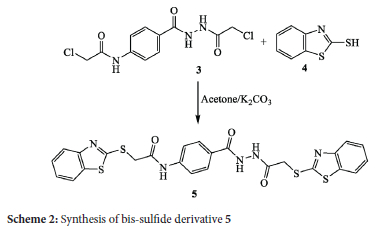
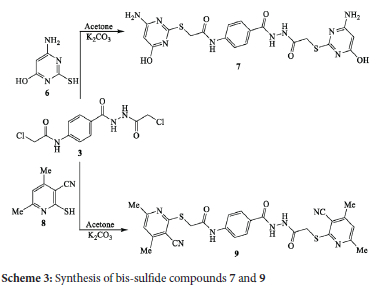
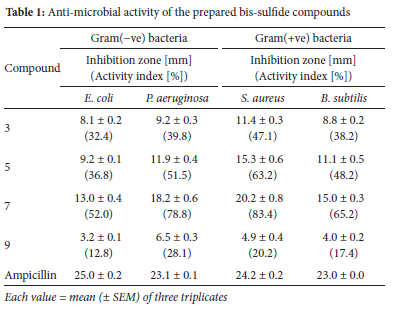
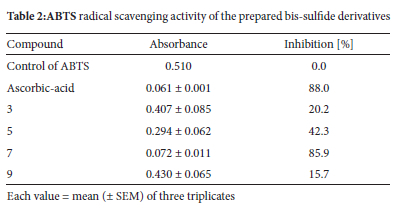
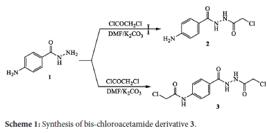
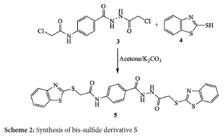
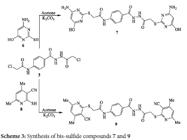
4-Aminobenzohydrazide (1) undergoes chloroacetylation twice, at the primary amine and hydrazide-NH2 functional groups. The conforming bis-chloroacetamide derivative 3 was reacted with different sulfur reagents (namely, 2-mercaptobenzothiazole, 6-amino-2-mercaptopyrimidin-4-ol, and 2-mercapto-4,6-dimethyl-nicotinonitrile) to give new bis-sulfide compounds 5, 7 and 9, respectively. The newly synthesised bis-chloroacetamide and corresponding sulfides were screened for anti-microbial and antioxidant potential. The sulfide derivative 7 exhibited the most potent activity against Staphylococcus aureus and Pseudomonas aeruginosa. It shows inhibition activities of 83.4% and 78.8%, respectively. Moreover, the sulfide derivative 7 showed the highest antioxidant activity with an inhibition ratio of 85.9%, which is close to L-ascorbic acid.
4-aminobenzohydrazide; antibacterial; antioxidantchloroacetamide; sulfide
 Thumbnail
 Thumbnail
 Thumbnail
 Thumbnail