Reaction of hydrazine hydrate with oxalic acid: synthesis and crystal structure of dihydrazinium oxalate
Abstract
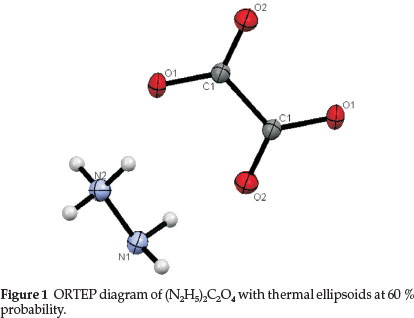
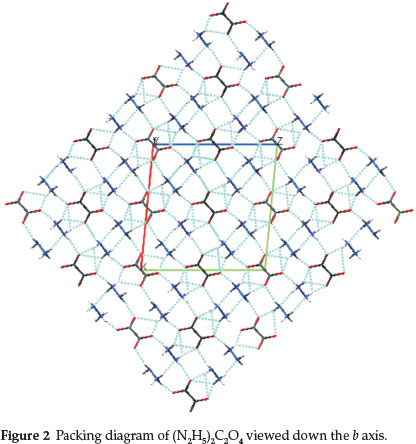
The reaction of oxalic acid with hydrazine hydrate (in appropriate mole ratio) forms the dihydrazinium oxalate under specific experimental condition. The title compound is a molecular salt containing two discrete hydrazinium cations and an oxalate anion. The oxalate anion is perfectly planar and there is a crystallographic centre of symmetry in the middle of the C-C bond. The C-O bond distances are almost equal indicating the presence of resonance in the oxalate ion. The crystal packing is stabilized by intermolecular N-H · O and N-H · N hydrogen bonds. The oxalate ions are linked together end to end through hydrogen bonds (via N2H5+ ions) and run parallel to the [101] direction. It is interesting to note that each oxalate group in the structure is surrounded by six hydrazinium ions through hydrogen bonding. Similarly, each hydrazinium ion is surrounded by three oxalate and one hydrazinium ion.
Hydrazine; oxalic acid; dihydrazinium oxalate; crystal structure
 Thumbnail
 Thumbnail