Adsorption of dyes using different types of sand: A review
Abstract
The threat posed by increasing amount of dyes on daily basis, especially on our ecosystem, has brought a serious search for more efficient low-cost adsorbents. Sand is mixed with cement and water to make concrete, used in the manufacture of brick, glass and other materials, and it can also be used as a medium for the filtration of water. Sand, which is ubiquitous, has been used as an adsorbent because of its enormous availability in the local environment. This review reveals that further research must be conducted to bring to the fore the expansive laboratory, industrial and environmental usage of sand materials as dye adsorbents. Consequently, the usage of different types of sand in the field of adsorption science represents a viable and powerful tool, resulting into the superior improvement in pollution control and environmental preservation.
Adsorption; dyes; low-cost adsorbents; sand
1. Introduction
Several dyes and their break-down products are toxic for living organisms because dyes are not easily degradable and are generally not removed from wastewater by conventional wastewater treatment systems; this makes it difficult to remove dyes from effluent.1,2 Organic dyes are an integral part of many industrial effluents which demand an appropriate method to dispose of them. Commonly suggested methods include biodegradation, photo-catalytic, photolytic and advanced oxidative degradation of these solutions.3-7 Considerable interest has recently been focused on using the adsorption technique for the removal of some dyes from solutions on various adsorbent surfaces such as clays,8-9 fly ash,10-11 peat,1213-14 polymers15-16 and alumina.17-18 The process is known to be simple and efficiently treat dyes in concentrated form.
In practice, adsorption techniques are versatile and easy to adopt but adsorbent materials are costly and some cannot be regenerated for large-scale applications. There is therefore a clear need to use low-cost, renewable and easily available adsorbent material for such purposes, otherwise environmental protection will be in jeopardy. Water-soluble anionic dyes are found in wastewaters produced by the dyeing industries. They are toxic and need to be removed.1920-22
Currently, the textile industry produces a huge quantity of dyed wastewater. The colour and the non-biodegradable nature of the spent dye baths constitute serious environmental problems.
Despite a wide range of wastewater treatment techniques available, there is no single process capable of the adequate treatment for these effluents. Adsorption is an efficient method for the removal of dyes from wastewater and activated carbon is one of the most studied adsorptive materials.23-27 It has been found that the performance of the adsorbents depends on their textural properties (porosity, surface area). The pore size distribution determines the fraction of the structure that can be accessed by a molecule of a given size and shape. More recently, some authors started looking at the surface chemistry of activated carbons in order to interpret some results of dye adsorption experi-ments.25-28 It was shown that the surface chemistry of the activated carbon could play a key role in dye adsorption performance.
Adsorption is a major industrial separation technique for the purification of effluent media. It is a mass transfer operation through which a solid material can selectively remove dissolved components from an aqueous solution by attracting the dissolved solute to its surface. Therefore, it involves the interphase accumulation of concentration of substances at a surface or at the inter phase. This separation technique finds wide application in removal of dye from aqueous media. In particular, it finds application in textile, leather, dyeing, cosmetics, plastics, food and paper industries where water recovery is essential. In order to achieve and sustain this efficient recovery of desired water quality, a careful selection of adsorbent is paramount.1,29,30 However, most adsorbent materials in Nigeria are imported from other countries despite of the abundance of raw materials in Nigeria for the production of the required quantity of adsorbents for local industries.30303132333435,36 oil palm ash,37,38 cocoa pod husks,394038,41-44 periwinkle shell,45-47 coconut shell,48Imperata cylindrica leaf4950
Activated carbon has been successfully used in removing coloured organic species and it is the most widely used adsorbent due to its high capacity for the adsorption of organic materi-als;51-52 and its effectiveness and versatility.5,54 One potential adsorbent material is sand, which can be utilized for such purposes as it can also bring unlimited number of economic and environmental benefits to the industrial waste-water treatment. Much work has been done on the use of sand to remove inorganic ions from solutions;55,56 however, little work has been done on sand surfaces for the removal of dyes.57,58 Therefore, in order to minimize the high cost and the difficulty of regeneration, a search for cheap, effective adsorbents such as sand derivatives is desirable.59
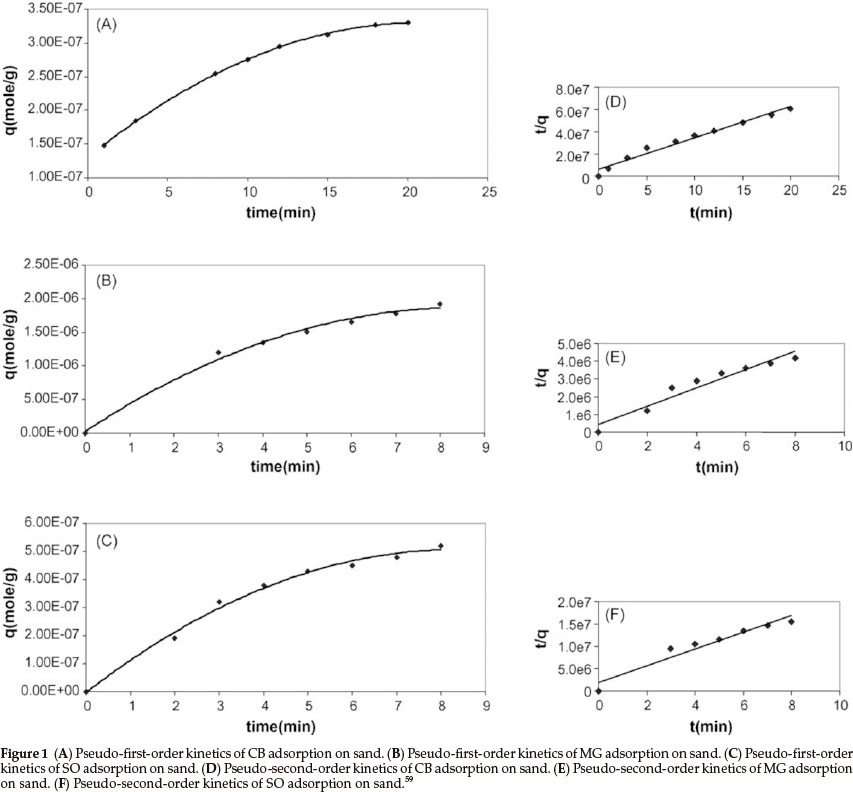
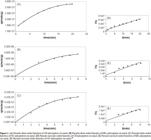
The potential of locally available sand was assessed for the removal of coomassie blue (CB), malachite green (MG) and safranin orange (SO) from aqueous solutions.595959Fig. 1).5959 59
2. Different Types of Sand and their Uses
Depending on their chemical composition, size, grade and shape, sand is classified60,61 as follows:
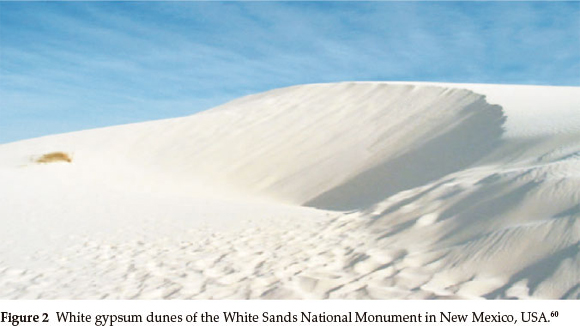
2.1. Gypsum Sand (Fig. 2)
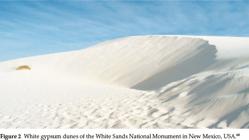
Gypsum is a very soft sulfate mineral composed of calcium sulfate dihydrate, with the chemical formula CaSO4-2H2O.6160
2.2.
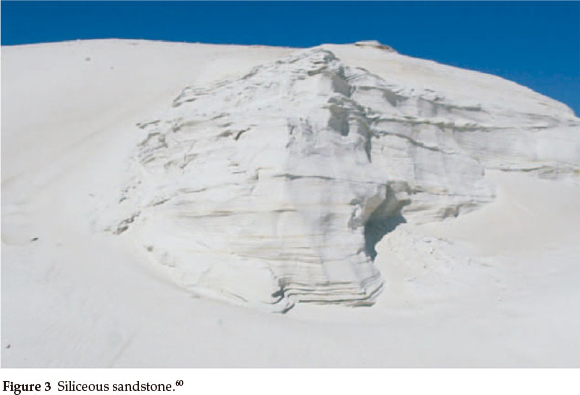
Silica sand (Fig. 3)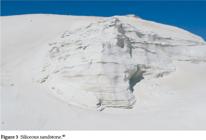
The chemical compound silicon dioxide, also known as silica (from the Latin isle), is an oxide of silicon with the chemical formula SiO265-66 and has been known for its hardness since ancient times. 6768-69. Silica sand is almost pure quartz.606070
Silica is used primarily in the production of glass for windows, drinking glasses, beverage bottles, and many other uses. The majority of optical fibres for telecommunications are also made from silica. It is a primary raw material for many white ware ceramics such as earthenware, stoneware, porcelain, as well as industrial Portland cement.68,71 Silica is a common additive in the production of foods, where it is used primarily as a flow agent in powdered foods, or to absorb water in hygroscopic applications. It is the primary component of diatomaceous68-69 earth, which has many uses ranging from filtration to insect control. It is also the primary component of rice husk ash, which is used, for example, in filtration and cement manufacturing. Thin films of silica grown on silicon wafers via thermal oxidation methods can be quite beneficial in microelectronics, where they act as electric insulators with high chemical stability7273
2.3.
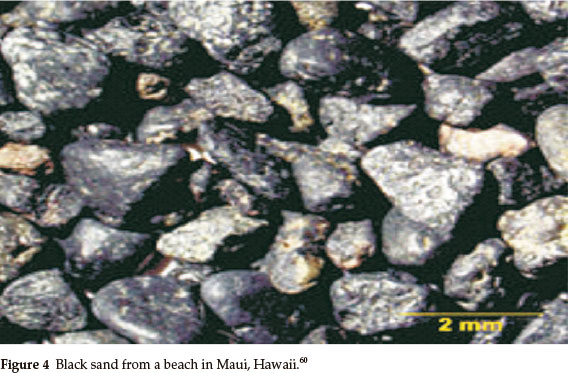
Black Sand (Fig. 4)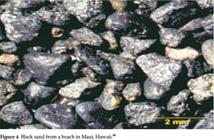
This is sand that is black in colour. There are two types of black sand.6074
Black sands are used by miners and prospectors to indicate the presence of a placer formation. Placer mining activities produce a concentrate that is composed mostly of black sand. Black sand concentrates often contain additional valuables, other than precious metals: rare earth elements, thorium, titanium, tungsten, zirconium and others are often fractionated during igneous processes into a common mineral-suite that becomes black sands after weathering and erosion.74,75
Several gemstones, such as garnet, topaz, ruby, sapphire, and diamond are found in placers and in the course of placer mining, and sands of these gems are found in black sands and concentrates. Purple or ruby-coloured garnet sand often forms a showy surface dressing on ocean beach placers.76
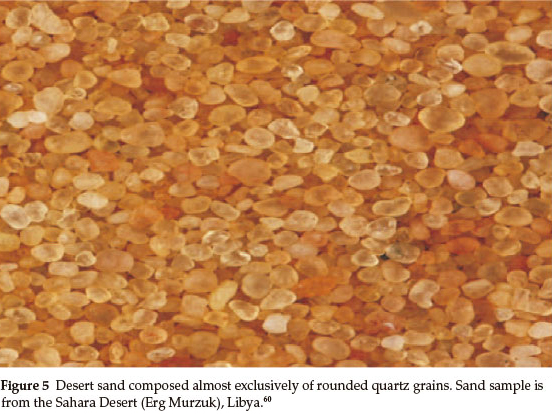
2.4. Desert Sand (Fig. 5)
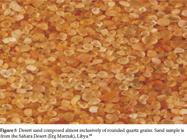
Deserts cover wide areas, mostly between 10 and 30 degrees N and S of the equator.60Figure 5 shows desert sand, which is composed almost exclusively of rounded quartz grains.60
Desert sands are an important carbon sink on earth. Scientists discovered that bacteria living in the sands of the Kalahari desert in Africa help gather and store carbon dioxide from the air. Since carbon dioxide is one of the prime causes of global warming, these desert sands may play a critical role in preventing additional carbon dioxide from entering the atmosphere.7777-78
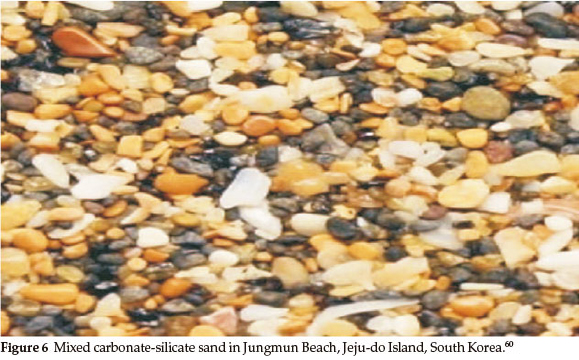
2.5. Mixed Carbonate-Silicate Sand (Fig. 6)
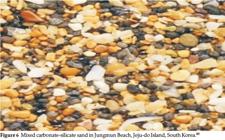
These are calcium carbonate, for example aragonite, which has mostly been created, over the past half billion years, by various forms of life, like coral and shellfish. It is, for example, the primary form of sand apparent in areas where reefs have dominated the ecosystem for millions of years, like the Caribbean. As said earlier, the world of sands can be divided into two major parts - mineral sands and biogenic sands. These sand types occur often separately but they can also mix in all proportions and form hybrid carbonate-silicate sand type.793. The other is commonly called the 'siliciclastic sands', where 'silici-' refers to a chemical composition rich in silicate material and '-clastic' refers to the origin of the grains as clasts or fragments of silicate rocks.60,74
Some of the uses of carbonate sand are: (1) in agriculture: sandy soils are ideal for crops such as watermelons, peaches, and peanuts, and their excellent drainage characteristics make them suitable for intensive dairy farming. (2) Aquaria: sand makes a low-cost aquarium base material which some believe is better than gravel for home use. It is also an absolute necessity for salt-water reef tanks, which emulate environments composed largely of aragonite sand broken down from coral and shellfish. (3) Artificial reefs: geotextile bagged sand can serve as the foundation for new reefs. It also important in beach nourishment in which Governments move sand to beaches where tides, storms or deliberate changes to the shoreline erode the original sand.74
2.6.
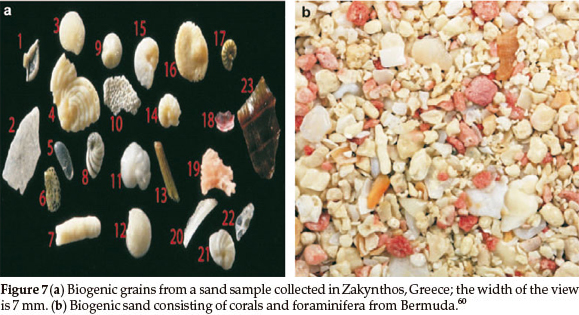
Biogenic Sand (Fig. 7)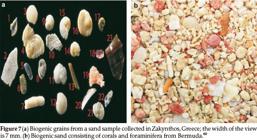
Sand may be composed entirely of tiny skeletons type - sea shells, corals, forams, algae, echinoids, sponges, etc. - and therefore one biogenic sand may greatly differ from another.6079
Biogenic sand is useful in enhancing the aggregation of sand grains, preventing saltation, and reducing wind erosion. Since most sandy soils are located in dry lands where the vegetation is patchy and generally sparse,808182,83
2.7.
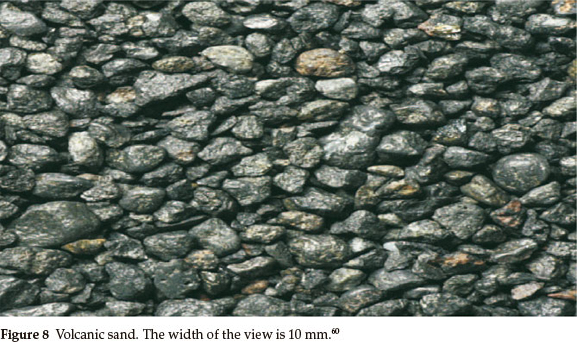
Volcanic Sand (Fig. 8)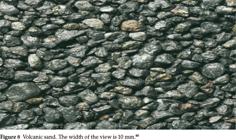
s
Volcanically active regions have their own unique type of generally dark-coloured sand with a characteristic mineral assemblage.608485
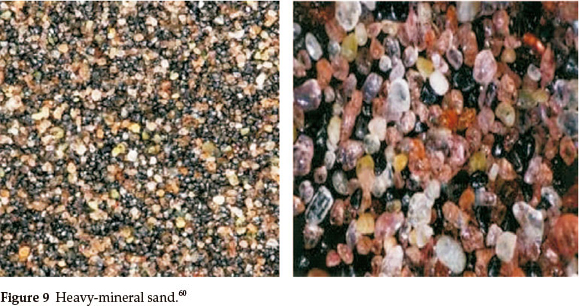
2.8. Heavy Mineral Sand (Fig. 9)
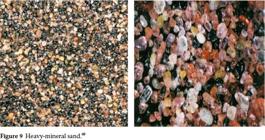
Mineral sands are different to most commodities; however, they share similarities with other commodity types, such as the importance of quality constraints of iron ore and coal or the importance of physical properties of say diamonds. The term 'mineral sands' normally refers to concentrations of heavy minerals in an alluvial (old beach or river system) environ-ment.868760
In today's globalized economy they constitute important resources, employing tens of thousands in the production and international trading of millions of tonnes per year. Heavy minerals are used in the manufacture of very important construction and industrial products. Without ilmenite and rutile there would be no snow-white paints and airplanes; without zircon no control rods for nuclear reactors; without tantalite no transistors; and without cassiterite no tin cans. Some heavy minerals are not easily substituted and are only available in a few countries. Many of them are thus very valuable and rare - wars have been and are still being waged over of them.88
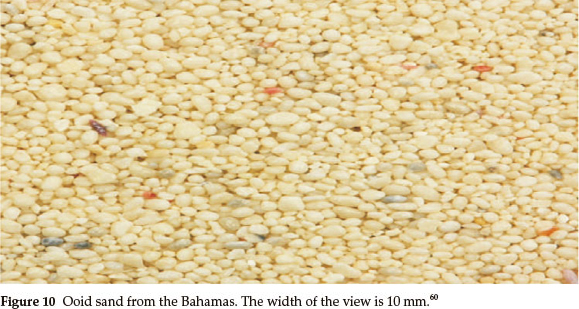
2.9. Ooid Sand (Fig. 10)
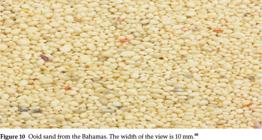
Ooids are rounded pellets formed in shallow wave agitated water.607476
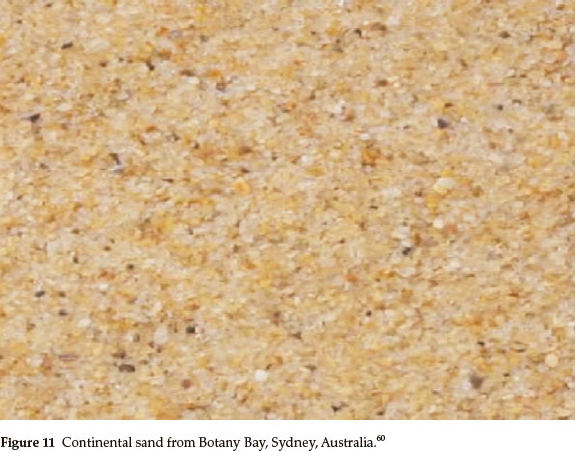
2.10. Continental Sand (Fig. 11)
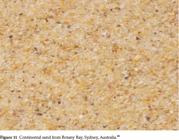
The name says it all. This sand is a common weathering product of the continental landmasses. This sand is usually yellow or light brown and often speckled with dark grains. It is common along passive continental margins and therefore the most widespread sand type on most of the European coasts for example.60899091
3. Sand Materials used as Adsorbents for Dye Treatment
3.1. Gypsum
Gypsum is a commonly available commodity used for treating industrial effluents.929394958-9,96 The treatment of wastewaters by the adsorption process is an excellent choice especially if the sorbent is inexpensive and does not require an additional pre-treatment step before its application. Few reports are available on the use of gypsum as adsorbent for dye removal.92
Commercially obtained gypsum powder (unbranded) was used as an adsorbent material because of its availability in huge quantities, its cheapness and its application without prior treatment. The surface area of the gypsum sample was found by the nitrogen adsorption method using the Quantasorb Autosorb Automated gas sorption system (Quantochrome corporation).9792
Adsorption experiments were carried out by adding a fixed amount of gypsum (0.25 g) to a series of 250 mL conical flasks filled with 100 mL diluted solutions (5-25 mg L-1) of methylene blue dye. The conical flasks were then sealed and placed in a water-bath shaker and shaken at 100 rpm within a required time at 298 K. After pre-determined time intervals, the flasks were then removed from the shaker, and the final concentration of dye in the solution was measured at maximum wavelength of the dye solution (668 nm) by a CARY 50 UV/VIS spectrophotometer, using a 1-cm quartz cell.92
Since the solution pH has a considerable effect on dye removal, the pH of the solution was also changed to monitor the adsorption behaviour of dyes on gypsum samples. Changes in adsorption were then used to calculate the concentration and adsorption of the dye used in the study.92-1) increased with increase in time and then reached equilibrium. The initial dye concentration provides the necessary driving force to overcome the resistances to the mass transfer of MB between the aqueous and solid phases.5898C. grandis) peel1399
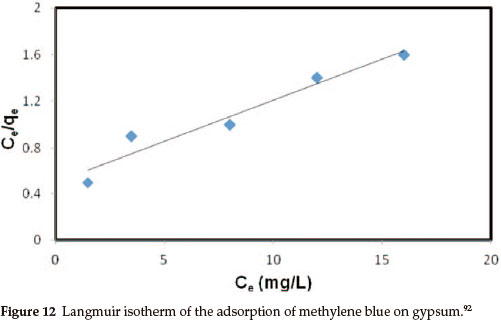
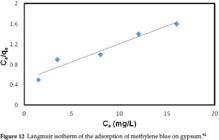
The adsorption of MB on gypsum was also studied as a function of contact time in order to find out the equilibrium time for maximum adsorption. The results showed that equilibrium time required for the adsorption of MB on gypsum ranged from 20 to 40 min. However, the samples were left for 40 min to ensure complete equilibrium. An equilibrium adsorption time of 135 min was reported for the adsorption of methylene blue onto wheat shells10010192e (in mg g-1), was found to be maximum at natural pH (pH = 7.5). The adsorption amount was less in acidic media but remained almost constant in basic conditions. The observed low adsorption rate of MB on the gypsum at pH < 7.5 may be because the surface becomes positively charged, thus making (H+) ions compete effec- tively with dye cations causing a decrease in the amount of dye adsorbed. A similar behaviour was observed for MB adsorption on other adsorbents.102-104 Analyses of data using various adsorption models such as adsorption isotherms was used to relate the adsorbate concentration in the bulk and the adsorbed amount at the interface at equilibrium.92Fig. 12).10592
qt = k1 t1/2 + C ,
where, k1 (mg g-1 min1/2) is the intra-particle diffusion rate constant. If intra-particle diffusion is rate-limited, the plot of qt versus t1/2 is linear and passes through the origin. In this case intra-particle diffusion is the sole rate-limiting step.59106
3.2.
Bentonite-Sand MixBentonite is composed of 74 % clay-sized (2 lm), 9 % sand (4.75 to 0.075 mm) and17 % silt-sized (0.075 to 0.002 mm) fractions. On treatment with HDPy+ ions, the HDPy+B specimen coagulates to sand-sized particles (sand content = 98 %, silt content = 2 %).1072108-110 GMZ bentonite has attracted great interest in China because of its outstanding properties, such as its prominent high swelling and sealing abilities,111112
3.3.
Ooid SandThe utility of ooid sand, also called riverbed sand, lies in availability in ample amounts; it can be an economically viable alternative to costly adsorbents.113114-116
The values of ΔG° were found to be negative at all temperatures which indicate that the adsorption process is spontaneous in nature. As the temperature increases, the values of ΔG° decreases, indicating less driving force127118113
3.4. Desert Sand
Desert sand contains active components that can strongly adsorb positively charged organic material from an aqueous solution. An example is sand in the present Sahara Desert (SaDeS) in Tozeur, Tunisia, the active component of which was related with kyanite, a negatively charged mineral that imparts electrostatic attraction towards cationic material.119120-125 Although this fact is known, there are not many studies in the literature treating adsorption itself, while there are no studies focusing on removal of industrial wastes by the use of SaDeS.126119
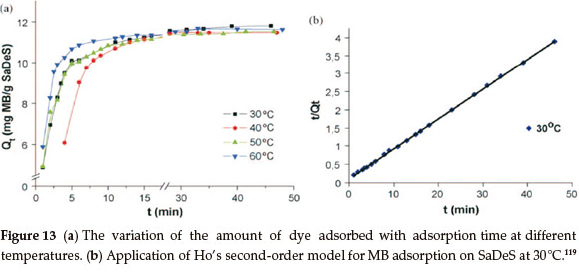
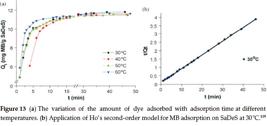
It has been noted that washed SaDeS loses its active component and its original microstructure is lost. More than 90 % of methylene blue may be removed from a 3.5 x 10⁻⁵ M25mL solution with the use of 20 mg of adsorbent. The adsorption is found to be pseudo-second-order.132103,127-129 These models were tested for the adsorption of MB on SaDeS and the best model was selected depending on the linear regression correlation coefficient. The pseudo-first-order model has been described by Lagergren,130131
The thermodynamic parameters, i.e. the Gibbs free energy, enthalpy change and entropy change, were calculated and found to be -6411 J mol-1, -30360 Jmol-1 and -76.58 Jmol-1 K, respectively.15,132 These values indicate that the adsorption of MB onto desert sand has a decreased randomness at the solid-solution interface, and is an exothermic spontaneous process at low temperatures.133119Fig. 13a, b).
3.5. Silica and Quartz Sand
These are natural sands, eroded from mountain rock, which is mined from where it was deposited. The host rock determines the exact mineral composition. Due to its chemical hardness, it is therefore found to be extremely resistant to weathering and breakdown. The sorbent was sediment obtained from Guanting Reservoir (Beijing, China), which contained 25 % sand, 67 % silt, 8 % clay, and 2.06 % organic carbon.1346135136-1 using the Lagergen equation.55137136136
4. Challenges and Future Prospects
The world is currently facing the worst environmental crisis in its entire history. Within the space of a few decades, the huge increase in the production of waste and growing environmental concern have become one of the most challenging topics, and critical consideration should now be given towards the recovery of contaminated resources. Since industrial effluents are always contaminated with various additives such as inorganic salts, it is therefore important to study the effect of these ions on the adsorption property of dye solutions. The adsorption of dye in the presence of anions (added as sodium salts) and cations (added in the nitrate form) should be carried out. One major problem is that the shape, size and grading of sands are impossible to measure and observe collectively since they differ from type to type and use, and so attention should be given to this aspect, both technologically and scientifically. This will go a long way in reducing the amount of stress and time it consumes.
The interaction between adsorbate and the adsorbent should be studied to establish the relationships and roles of functional groups in the dye adsorption process. Critical investigation is needed in studying the adsorptive properties and the molecular structure/surface group (both the size, shape and grading) of the adsorbents. The efficiency of these sand materials with real industrial dye effluents should also be investigated.
Another challenge is that the adsorbate-adsorbent mixture is difficult to separate after adsorption; this limits the practical application of sand materials. Research is currently in progress to find new, modified and practical methods that can not only separate sand materials from water effectively, but also improve the dye removal rate. The process of recycling, regeneration and reuse of sand materials is important.
5. Conclusion
Despite the various drawbacks and challenges identified, great progress in this area can be expected in the near future. Low-cost adsorbents have found use at least at laboratory scale for the treatment of coloured effluents with different degrees of successes. Some materials like periwinkle shells, cocoa pod husks, rubber seed coat, ackee apple seeds, groundnut hull, papaya seeds, etc., have shown considerable adsorption capacity. However, the applications of these materials are limited practically because the adsorbents are not available in large amounts. This shows that, despite having a significant capacity for dye adsorption, most of these materials are not produced in large quantities. Consequently, they are not available in sufficient bulk to be commercialized for full-scale application. Different types of sand can act as an alternative to activated carbon. To be useful, they must have both a high adsorption capacity and be available in bulk at low or no cost. Different sand types, which are available in bulk, have a considerable adsorption capacity for anionic, cationic and nonionic dye removal.
Acknowledgement
The corresponding author acknowledges the support obtained from Third World Academy of Science (TWAS) in the form of a grant; Research Grant number: 11-249 RG/CHE/AF/AC_1_ UNESCO FR: 3240262674
References and Notes
- 1 M.M. Abd El-Latif, M.F. El-Kady, A.M. Ibrahim and M.E. Ossman, Am. J. Sci., 2010, 6(5), 280-292.
- 2 F. Kargi and S. Ozmihci, Enzyme Microb. Technol., 2004, 35, 267-271.
- 3 G.M. Walker, S. Hensen, J.A. Hanna and S.J. Allen, Water Res., 2003, 37, 2081-2089.
- 4 P.M. Malik and S.K. Saha, Sep. Purif. Technol., 2003, 31, 241- 250.
- 5 K.C. Chen, J.Y. Wu, D.J. Liou and S.C. Hwang, J. Biotechnol, 2003, 10, 57-68.
- 6 S.H. Lin and F.C. Peng, Water Res., 1996, 30, 587-593
- 7 M.A. Rauf, S. Ashraf and S.N. Alhadrami, Dyes Pigm, 2005, 66, 197-200.
- 8 S Al-Asheh, F. Banat and L. Abu-Aitah, Adsorp. Sci. Technol., 2003, 21, 451-462.
- 9 M.A. Khraisheh and M.S. Alg-Houti, Adsorp., 2005, 11, 547-549.
- 10 I. Janos, H. Buchtova and M. Ryznarova, Water Res., 2003, 37, 4938-4944.
- 11 D. Mohan, K.P. Singh, G. Singh and K. Kumar, Ind. Eng. Chem. Res, 2002, 41, 3688-3695.
- 12 G. McKay and S.J. Allen, J. Sep. Process Technol., 1983, 4, 1-7.
- 13 S. Wang and H. Li, Dyes Pigm., 2007, 72, 308-314
- 14 I. A.W. Tan, B.H Hameed and A.L. Ahmad, J. Chem. Eng., 2007, 127,111-119.
- 15 M.J. Iqbal and M.N. Ashiq, J. Hazard. Mater., 2007, 139, 57-66.
- 16 E.Y. Ozmen and M. Yilmaz, J. Hazard. Mater., 2007, 2, 42.
- 17 M. Lehocky and A. Mracek, Czech. J. Phys, 2006, 56, 1277-1282.
- 18 R.G. Harris, J.D. Wells and B.B. Johnson, Colloid. Surf. A, 2001, 180, 131-140.
- 19 M. Nakamura, H. Saitoh, Y. Maejima, S.I. Yamagiwa and S. Kaneko, Fresenius J. Anal. Chem., 1989, 335, 573-575.
- 20 E. Eren, J. Turkey, Hazard. Mater., 2009, 162, 1355-1363.
- 21 B.K. Nandi, A. Goswami and M.K. Purkait, Appl. Clay. Sci., 2009, 42, 583-590.
- 22 A.B. Karim, B. Mounir, M. Hachkar, M. Bakasse and A. Yaacoubi, J. Hazard. Mater., 2009, 168, 304-309.
- 23 G.M. Walker and L.R. Weatherley, Sep. Sci. Technol., 2000, 35, 1329-41.
- 24 C. Pelekani and VL.Snoeyink, Carbon, 2001, 39, 25-37.
- 25 M.F.R. Pereira, S.F. Soares, J.J.M. Orfao and J.L. Figueiredo, Carbon, 2003, 41, 811-21.
- 26 K.P. Singh, D. Mohan, S. Sinha, G.S. Tondon and D. Gosh, Ind. Eng. Chem. Res., 2003, 42, 1965-76.
- 27 H. Valdes, M. Sanchez-Polo, J. Rivera-Utrilla and C.A. Zaror, Langmuir, 2002, 18, 2111-6
- 28 Y. Al-Degs, M.A.M. Khraisheh, S.J. Allen and M.N. Ahmad, Wat. Res., 2000, 34, 927-35.
- 29 T.A. Albarins and T.M. Hela, Removal of Dyes from Aqueous Solutions by Adsorption on Mixture of Fly Ash Soil in Batch and Column Techniques. Department of Chemistry, University of Loannins, Loanina, Greece, 1993.
- 30 M.C. Menkiti and O.D. Onukwuli, J. New York Sci., 2011, 4, (2)91-95.
- 31 T. Robinson, B. Chandran and P. Nigam P, Wat. Res., 2002, 36, 2824-2830.
- 32 T. Robinson, G. McMullan, R. Marchant R and P. Nigam, Bioresour. Technol., 2001, 77, 247-253.
- 33 K.S. Low, C.K. Lee and B.F. Tan, Biotechnol. Appl. Biochem., 2000, 87, 233-239.
- 34 O.S. Bello, M.A. Ahmad and N. Ahmad, Chem. Ecol., 2012, 28(2), 153-67.
- 35 O.S. Bello, T.A. Fatona, F.S. Falaye, O.M. Osuolale and V.O. Njoku, Environ. Eng. Sci., 2012, 29(3), 186-94.
- 36 Z. Zawani, C.A. Luqman and T.S.Y. Chong, Euro. J. Sci. Res., 2009, 37(1), 63-71.
- 37 M.B. Hasan, Adsorption ofReactive Azo Dyes on Chitosan/Oil Palm Ash Composite Adsorbent: Batch and Continuous Studies, M.Sc. thesis, Universiti Sains Malaysia, 2008.
- 38 K.Y. Foo and B.H. Hameed, J. Hazard. Mater, 2009, 172, 523-531.
- 39 O.S. Bello and M.A. Ahmad, Toxicol. Environ. Chem., 2011, 93(7), 1298-1308.
- 40 O.S. Bello and M.A. Ahmad, Adsorption of dyes from aqueous solution using chemical activated mango peels. 2nd International Conference on Environmental Science and Technology (ICEST), 2011.
- 41 N.E.M. Yahaya, M.F. Pakir, M. Latiff, I. Abustan, O.S. Bello and M.A. Ahmad, Int. J. Environ. Technol., 2010, 10(06), 132-36.
- 42 N.E.M. Yahaya, M.F. Pakir, M. Latiff, I. Abustan, O.S. Bello and M.A. Ahmad Int. J. Environ. Technol. 10(06) 2010, 47-51.
- 43 N.E.M. Yahaya, M.F. Pakir, M. Latiff, I. Abustan, O.S. Bello and M.A. Ahmad, Int. J. Environ. Technol., 2011, 11(01), 207-11.
- 44 N.E.M. Yahaya, M.F. Pakir, M. Latiff, I. Abustan, O.S.Bello and M.A. Ahmad, Int. J. Environ. Technol, 2011, 11(01), 248-52.
- 45 O.S. Bello and M.A. Ahmad, Sep. Sci. Technol., 2011, 46, 2367-79.
- 46 O.S. Bello and M.A. Ahmad, Chem. Ecol., 2011, 27(5), 481-92.
- 47 O.S. Bello, I.A. Adeogun and J.C. Ajaelu, Chem. Ecol., 2008, 24(4), 285-95.
- 48 O.S. Bello and M.A. Ahmad, Sep. Sci. Technol., 2012b, 47(6), 903-12.
- 49 O.S. Bello and B. Semire, Toxicol. Environ. Chem., 2012; 94(6), 1114-1124.
- 50 O.S. Bello and M.A. Ahmad, Bulgarian J. Sci. Edu, 2012, 21(3), 389-395.
- 51 R.S. Joan, F.C. Wu and R.L. Tseng, 1997, Environ. Technol., 1997, 18, 525-531.
- 52 L. Markovska, V. Meshko, V. Noveski and M. Marinovski, J. Serb. Chem. Soc., 2001, 66, 463^75.
- 53 B. Chen, C.W Hui and G. McKay, Langmuir, 2001, 17, 740-748.
- 54 M.K. Purkait, A. Maiti, S. DasGupta and S. De, J. Hazard. Mater., 2007, 145, 287-295.
- 55 M.A. Rauf, M.J. Iqbal, I. Ellahi and S.M. Hasany, Adsorp. Sci. Technol., 1996, 13(2), 97-104.
- 56 S.I.H. Taqvi, S.M. Hasany and M.I. Bhanger, J. Hazard. Mater., 2007, 141, 37-44.
- 57 S.B. Bukallah, M.A. Rauf andS.S. Al Ali, Dyes Pigm., 2007, 74, 85-87.
- 58 M.A. Rauf, I. Shehadi and W.W. Hassan, Dyes Pigm., 2007, 75, 723-726.
- 59 M.F. Rauf, S.B. Bukallah, F.A. Hamour, A.S. Nasir, J. Chem. Eng., 2008, 137, 238-243
-
60 http://www.sandatlas.org
» http://www.sandatlas.org - 61 K. Cornelis and S.H. Cornelius Jr., Manual ofMineralogy, 20th edn, John Wiley, 1985, 352-353.
- 62 A.E.S. Van Driessche, L.G.Benning, J.D. Rodriguez-Blanco, M. Ossorio, P. Bots andJ.M. García-Ruiz, Science, 2012, 336(6077), 69-72.
- 63 J.D. Oster and H. Frenkel, Soil Sci. Soc. Am. J., 1980, 44(1), 41-45.
- 64 L.C. Urquhart, Civil Engineering Handbook, McGraw-Hill Book Company, New York, 1959.
- 65 B.J. Skinner and D.E. Appleman, Am. Mineral., 1963, 48, 854-867.
- 66 A.F. Holleman and E. Wiberg, Inorganic Chemistry, Academic Press, San Diego, 2001.
- 67 N.N. Greenwood and A. Earnshaw, Chemistry of the Elements, Oxford Pergamon Press, New York, 1984, 393-399.
- 68 R.K. Iler, The Chemistry of Silica, Plenum Press, New York, 1979, ISBN 0-471-02404-X.
- 69 T.W. Lynn Jr., Technol. Culture, 1961, 2, (2), 97-111.
- 70 D. Robert and N. Yoshio, Handbook ofSemiconductor Manufacturing Technology, CRC Press, Boca Raton, 2007.
- 71 A.F. Wright and M.S. Lehmann, J. Solid State Chem., 1981, 36(3), 371-80.
- 72 G.A. Lager, J.D. Jorgensen and F.J. Rotella, J. Appl. Phys, 1982, 53(10), 6751-6756.
- 73 R. Michael, IEEE Spectr., 2007.
- 74 L.C. Peck, Geol. Surv. Bull, 1964, 21, 1170.
- 75 C.S. Cockell and J.A. Raven, Philos. Trans. R. Soc. A., 2007 365 (1856), 1889-1901.
- 76 R. Atkinson and F. Atkinson, Rocks & Minerals (The Observer's Books of London: Bloomsbury), 1992, [1979], 161-162.
- 77 M. Sarnthein, Nature, 1978, 272, (5648), 43-46.
- 78 N. Lancaster Episodes, 1988, 11(1), 79.
- 79 J. Belnap and O.L. Lange, Structure and Functioning of Biological Soil Crusts, Springer, 2001, 80.
- 80 K. PyeandH. Tsoar, Aeolian Sand and Dunes, 2ndedn.,Springer, 1990,
- 81 M. Veste, S.W. Breckle and W. Wucherer, Sustainable Land Use in Deserts, Springer, 2001, 357-367.
- 82 H. Yizhaq, Phys. Rev. Lett, 2007, 98, 188001.
- 83 O. Duran, Phys. Rev. Lett., 2006, 97, 188001.
- 84 I. Iskandar and J. Irwanti, Tanah dan Lingkungan, 2003, 5(1), 23-28.
- 85 A Zojomo, J. Mater. Online, 2006, 2, 1-9.
- 86 J. Greg, BEc, LLB, FAIM, MAICD, Iluka Res. Ltd, [2013], 1-26
- 87 B. Hou and I.R. Warland, MESAJ., 2005, 37, 4-12.
- 88 T.E. Gerner Jr, Geogia. Geol. Surv. Inf. Circ, 1978, 49(8), 25-36.
- 89 K.W. Able, M.P. Fahay, D.A. Witting, R.S. McBride and S.M. Hagan, Estuar. Coast. Shelf Sci., 2006, 66, 280-290.
- 90 M.R. Byrnes, R.H. Hammer, T.D. Thibaut and D.B. Snyder, J. Coast. Res., 2004, 20(1), 25-43.
- 91 B.S. Drucker, W. Waskes and M.R. Byrnes J. Coast. Res., 2004, 20, (1), 1-5.
- 92 Muhammad, A, Rauf, I, Shehadeh, A. Amal & A. Al-Zamly, World Acad. Sci. Eng. Technol., 2009, 55, 609-613.
- 93 M. Boeningo, Carcinogenicity and Metabolism of Azodyes Especially Derived from Benzidine, DNHS (NIOSH) Publication, U.S. Government Printing Office, Washington DC, 1994, 80-119.
- 94 I.A. Alaton, B.H. Gursoy and J.E. Schimidt, Dyes Pigm., 2008, 78, 117-130.
- 95 S.M. Ghoreishi and R. Haghighi, J. Chem. Eng., 2003, 95, 163-169.
- 96 A.R. Cestari, E.F.S. Viera and S.A. Mota, J. Hazard. Mater., 2008, 160, 337-343.
- 97 N.A. Seaton, J.P.R.B. Walton and N. Quirke, Carbon., 1989, 27, 853-861.
- 98 B.H. Hameed, A.T.M. Din and A.L. Ahmed, J. Hazard. Mater., 2007, 141, 819-825.
- 99 Z.N. Ni, S.J. Xia, L.G. Wang, F.F. Xing and G.X. Pan, J. Colloid. Interf. Sci., 2007, 316, 284-291.
- 100 A.E, Ofomaja and Y.S. Ho, Dyes Pigm., 2007, 74, 60-66.
- 101 M.V Sureshkumar and C. Namasivayam, Colloid. Surf. A., 2008, 317, 277-283.
- 102 B.H. Hameed, J. Hazard. Mater., 2009, 162, 344-350.
- 103 Y. Bulut and H. Aydön, Desalin, 2006, 194, 259-267.
- 104 F.A. Pavan, A.C. Mazzocato and Y. Gushikem, Bioresour. Tech., 2008, 99, 3162-3165.
- 105 I. Langmuir, J. Am. Chem. Soc., 1918, 40, 1361-1403.
- 106 W.J. Weber and J.C. Morris, J. Sanit. Eng. Div., Am. Soc. Chem. Eng., 1963, 89, 31-59.
- 107 S. Chegrouche, A. Mellah and S. Telmoune, Water Res., 1997, 31, 1733-1737.
- 108 M. Sudhakar, S. Rao and S. Sivachidambaram, Environ. Earth Sci., 2013, 68(2), 559-566.
- 109 Y.M. Liu and, Z.R. Chen, Acta Mineral Sinica., 2001, 21, 541-543 (in Chinese).
- 110 S.T. Yang, J.X. Li, Y. Lu, Y.X. Chen and X.K. Wang, Appl. Radiat. Isot, 2009, 67, 1600-1608.
- 111 J.X. Li, J. Hu, G.D. Sheng, G.X. Zhao and Q. Huang, Colloid. Surf. A., 2009, 349 195-201.
- 112 B. Qin, Z.H. Chen, Y.M. Liu and J. Wang, Chin. J. Geotech. Eng., 2008, 30, 1005-1010.
- 113 W.M. Ye,M. Wan, B. Chen, Y.G. Chen and Y. Cui, J. Central South Univ. Technol., 2009, 16, 821-826
- 114 N. Rajic, D. Stojakovic, M. Jovanovic,N.Z. Logar, M. Mazaj and V Kaucic, Appl. Surf. Sci., 2010, 257, 1524-1532.
- 115 H.D. Choi, W.S. Jung, J.M. Cho, B.G. Ryu, J.S. Yang and K. Baek, J. Hazard. Mater., 2009, 166, 642-646.
- 116 VK. Gupta, A. Mittal, L. Kurup and J. Mittal, J. Colloid Interf. Sci., 2006, 304(1), 52-57.
- 117 J.C. Moreno-Piraján andL. Giraldo, J. Anal. Appl. Pyrolysis., 2011, 90, 42-47.
- 118. A.N. Kosasih, J. Febrianto, J. Sunarso, Y.H. Ju, N. Indraswati and S. Ismadji, J. Hazard. Mater., 2010, 180, 366-374.
- 119 Y. Sandeep, V. Srivastava, S. Banerjee, G. Fethiye & Y. Sharma, Environ. Sci. Pollut. Res., 2012, 80-93.
- 120 C. Varlikli, V. Bekiari, M. Kus, N. Boduroglu, I. Oner, P. Lianos, G. Lyberatos and I. Siddik, J. Hazard. Mater., 2009, 170, 27-3420.
- 121 A.S. Goudie andN.J. Middleton, Earth Sci. Rev., 2001, 56, 179-204.
- 122 Y.rel,U. Dayan,R. Rabi, Y. RudichandM. Stein,Environ. Sci. Technol., 2006, 40, 2996-3005.
- 123 M. Kocak, N. Mihalopoulos and N. Kubilay, J. Atmos. Environ., 2007, 41, 7351-7368.
- 124 A.C. Saydam and I. Polar, Ecol. Environ, 1999, 36, 742-6.
- 125 C.R. Usher, A.E. Michel and V.H. Grassian, Chem. Rev., 2003, 103, 4883-4939.
- 126 G. Pan, M.D. Krom and B Herut, Environ. Sci. Technol., 2002, 36, 3519-3524.
- 127 A. Zertal, M. Jacquet, B. Lavedrine and T. Sehili, Chemosphere, 2005, 58, 1431-1437.
- 128 A. Gurses, C. Dogar, M. Yalcrn, M. Acikyildiz, R. Bayrak and S.J. Karaca, J. Hazard. Mater., 2006, 131, 217-228.
- 130 M. Dogan and M. Alkan, Chemosphere, 2003, 50, 517-528.
- 131 S. Lagergren, Handlingar, 1898, 24, 1-39.
- 132 Y.S. Ho and G. McKay, J. Chem. Eng., 1998, 70, 115-124.
- 133 V. Ponnusami, S. Vikram and S.N. Srivastava, J. Hazard. Mater., 2008, 152, 276-286.
- 134 M. Zhaoa, Z. Tang and P. Liu, J. Hazard. Mater, 2008, 158, 43-51.
- 135 H.T. Qing and X.T. Hong, Chemosphere, 2004, 56, 31-38
- 136 M.A. Rauf, A.S. Ihsan and H.W. Walaa, Dyes Pigm., 2007, 75,
- 137 W. Shaobin and H. Li, Dyes Pigm., 2007, 72, 308-14.
Revised 7 March 2013
Accepted 13 March 2013