Isolation, characterization and x-ray structure determination of the schiff base ligand: 5-methyl-2-phenyl-4-[phenyl-(4-phenyl-thiazol-2-ylamino)-methylene]-2,4-dihydro-pyrazol-3-one
Abstract
The structure of the amine tautomer of the new Schiff base derived from 4-benzoyl-5-methyl-2-phenyl-2,4-dihydro-pyrazol-3-one (2) and 4-phenyl-thiazol-2-ylamine (3) was confirmed by means of single crystal X-ray diffraction. The title compound (4) was synthesized and crystals were grown from a mixture of dichloromethane and n-hexane (1:3). Single crystal X-ray diffraction analysis show that the structure is primarily stabilized by strong intramolecular N3-H3A-O1 hydrogen bonds [N3-H3A = 0.883(19) Ẳ, H3A-O1 = 1.925(18) Ẳ, N3-O1 = 2.6901(13) A, with an angle for N3-H3A-O1 = 144.1(17) °] and this leads to the formation of a pseudo nine-membered hydrogen bonded pattern. Elemental analysis, FTIR and NMR analyses have been employed to characterize the crystal.
Pyrazolone; thiazole; Schiff base; tautomer; X-ray structure
1. Introduction
The chemistry of pyrazolone derivatives has attracted much attention because of their interesting structural properties and applications in diverse areas.11234567
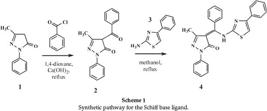
As a part of our ongoing studies into the structure and utility of Schiff base ligands synthesized from pyrazolone and thiazole, we report the synthesis (Scheme 1), spectral properties, crystal structure, tautomerism (Scheme 2), and weak interactions of the Schiff base prepared from the condensation of 4-benzoyl-5-methyl-2-phenyl-2,4-dihydro-pyrazol-3-one (2) and 4-phenyl-thiazol-2-ylamine (3).
2. Experimental
2.1. Materials and Measurements
The compound 5-methyl-2-phenyl-2,4-dihydro-pyrazol-3-one (1) was obtained from Prima Chemicals, Ahmedabad, India. Methanol and dioxane were obtained from SD's Fine Chemical Ltd., India. Absolute alcohol was obtained from Baroda Chem. Industry Ltd. and was used after distillation. Calcium hydroxide and benzoyl chloride were obtained from Samir Tech. Chem. Pvt. Ltd. All the chemicals used were of AR grade. Solvents used in this study were purified following standard procedures. For the synthesis of compound 2, the benzoylation step was carried out in the presence of calcium hydroxide as per a literature method.8
The elemental analysis was obtained by using a Flash Elemental Analyzer-1112. Infrared spectra (IR) were measured with a PerkinElmer Precisely 100 FTIR spectrometer. 1139910111212
2.2. Synthesis of Schiff Base Ligand
5-Methyl-2-phenyl-2,4-dihydro-pyrazol-3-one (1)(2g, 11.5 mmol) was dissolved in hot dioxane (20 mL) in a flask equipped with a stirrer, separating funnel and reflux condenser. Calcium hydroxide (1.7 g, 23 mmol) was added to this solution, followed by benzoyl chloride (3.23 g, 11.5 mmol) added dropwise with precaution, as this reaction was exothermic. During this addition the reaction mass was converted into a thick paste. After the complete addition, the reaction mixture was refluxed for half an hour and then it was poured into dilute hydrochloric acid (50 mL, 2 M). The crude product 4-benzoyl-5-methyl-2-phenyl-2,4-dihydro-pyrazol-3-one (2) obtained was separated by filtration and recrystallized from n-hexane to give a bright yellow crystalline solid (2.5 g, 80 %).
A solution of 2 (1 g, 3.6 mmol) in methanol (30 mL) was added to another solution of 4-phenyl-thiazol-2-ylamine (3) (0.63 g, 3.6 mmol) in methanol (20 mL) under an inert atmosphere. The reaction mixture was refluxed for three hours. Completion of the reaction was monitored by TLC using hexane/ethyl acetate (8:2). The reaction was allowed to cool to room temperature and stirred overnight. A yellow precipitate formed which was then filtered and washed with methanol (10 mL). The crude product was purified by crystallization from ethanol to give brown crystals of the desired product 5-methyl-2-phenyl-4-[phenyl-(4-phenyl-thiazol-2-ylamino)-methylene]-2,4-dihydro-pyrazol-3-one (4) (1.2 g, 77 %), mp. = 199 °C. IR (cm-1): 3153,1616,1591,1540,1516, 1490, 1385, 1353, 1209, 1196, 839, 821, 724, 688; δ,H (400 MHz, CDCl3): 13.73 (0.5H, s, NH), 7.97 (2H, d, J = 7.84 Hz, ArH), 7.71 (2H, d, J = 7.28 Hz, ArH), 7.57 (3H, m, ArH), 7.44 (2H, d, J = 7.24 Hz, ArH), 7.36 (2H, t, J = 7.92 Hz, ArH), 7.32 (2H, t, J = 7.42 Hz, ArH), 7.25 (2H, d, J = 7.16 Hz, ArH), 7.12 (t, J = 6.36 Hz, ArH), 6.84 (1H, s, CH), 4.71 (0.5H, s, OH), 1.48 (3H, s, CH3) ppm; δC (100 MHz, CDCl3): 165.04, 160.88, 159.27, 153.04, 147.55, 138.42, 136.09, 134.47, 131.15, 129.47, 129.34, 126.04, 119.39, 107.58, 103.39, 15.97 ppm.
3. Results and Discussion
3.1. Characterization of the Ligand
The compound was stable at room temperature, non-hygroscopic, insoluble in n-hexane, petroleum ether and toluene, and soluble in chloroform, dichloromethane and ethyl acetate. Analytical data are shown in Table 1.
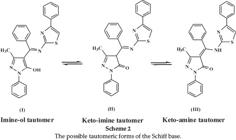
The general structure of these ligands is such that they can exist in three tautomeric forms as shown in Scheme 2. Detailed solution and solid-state studies of the ligand were carried out to establish the predominant tautomer.
3.2.
IR and NMR SpectroscopyThe IR spectra of this family of ligands exhibit two characteristic bands at 3135 and 1616 cm-1, which can either be assigned to v O H and v C=N, respectively, for the tautomeric imine-ol form (Scheme 2, I) or u N-H and u C = O respectively for the keto-amine form (Scheme 2, III) of the ligand. We assigned these two peaks to v N-H and u C=O, respectively, for the latter form in conjunction with the information obtained from crystallographic studies (discussed below).
The 1133 at room temperature and the data are presented in the experimental section. The signals due to methyl protons appear as singlets at δ 1.48 ppm. Another singlet was observed at δ 6.84, which corresponds to the only proton of the thiazole ring. In the aromatic region between δ 7.13 and 7.98 ppm overlapping doublets and multiplets are observed. One broad singlet, corresponding to a single proton, is observed at δ 13.73 ppm. This signal disappeared when a D2O exchange experiment was carried out and integrates exactly for one proton, which suggests that only one tautomeric form of the ligand exists in solution under the experimental conditions. Although no temperature dependent experiments were carried out, comparing with the solid state study, this signal was assigned to NH. However, assignment of this peak to OH cannot be ruled out, provided the solid state structural evidence is not considered. This assignment is not without contention as several researchers have reported the determination of the imine-ol (I) tautomer in solution. For example, in the case where an N-oxime derivative was made, the imine-ol molecule is present exclusively. A mixture of the two tautomers has also been reported in solution.137,14
In the 13
3.3.
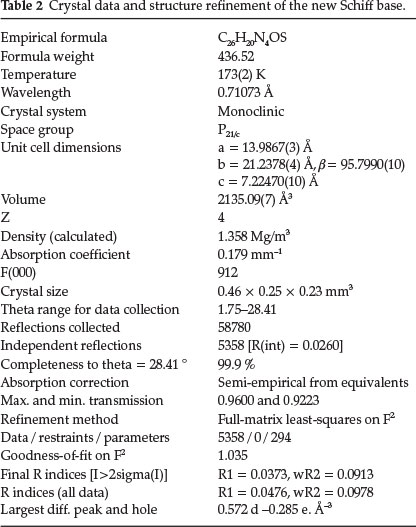
X-ray Crystallography StudiesCrystal data collection parameters are given in Table 2.
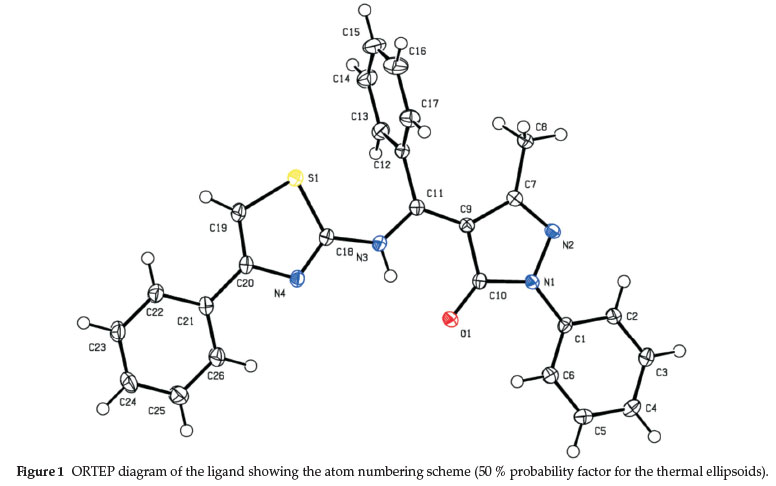
The molecular structure of the ligand (Fig. 1) was determined from single crystal X-ray studies.
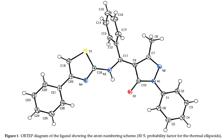
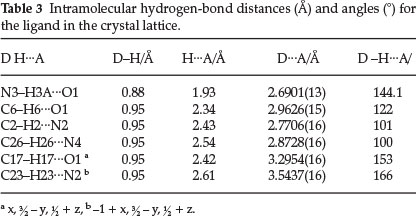
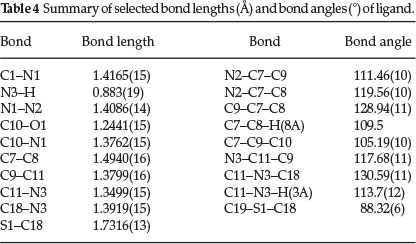
This structure determination gives evidence for the existence of the keto-amine form (in the solid state). An analysis of the structural data shows that the C10-O1 distance in the pyrazolone moiety is 1.244(15) A, which is significantly shorter than the distances found for C OH in some pyrazolone derivatives, 1.341,1.346 A151615171i but similar to that found for C-N (1.339(3) A).18Scheme 2) tautomeric form, rather than the imine-ol (I in Scheme 2) in the solid state. However, the N-H proton is clearly hydrogen bonded with the O1 atom, the N3-O1 distance is 2.690(13) A and the N3-H3A-O1 angle is 144.1(17) ° (Table 3). The possibility of the attachment of H3A with C9 (imine-one form-II) is ruled out on the basis of the angles around C9. The summation of the three angles C7-C9-C10, C7- C9-C11 and C10-C9-C11 is 359.91 and is close to the ideal value of 360 expected from the coplanar C7, C9, C10 and C11 atoms. Selected bond angles and bond lengths are summarized in Table 4.
Thus, the crystal structure study conclusively proves the existence of this compound in the keto-amine (III) form.
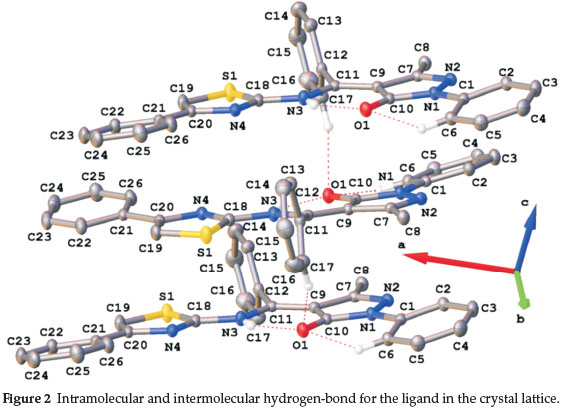
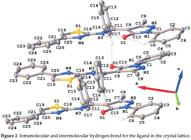
With the help of XRD analysis, the possible weak interactions of the resulting Schiff base were also studied (Fig. 2). The molecular structure is primarily stabilized by a strong intra molecular N3-H3A-O1 hydrogen bond [N3-H3A = 0.883(19) A, H3A-O1 = 1.925(18) Ẳ, N3---O1 = 2.6901(13) Ẳ, and the angle N3-H3A-O1 = 144.1(17) °] and this leads to the formation of a pseudo nine-membered (N1-N2-C7-C9-C11-N3-H3A-O1-C10) hydrogen bonded pattern, thus locking the molecular conformation and eliminating conformational flexibility. However, intermolecular interaction involves C-H-O interactions [the C17-H17-O1, C-O distance being 3.2954(16) A, and the C-H-O angle being 153 °, Fig. 2] which stabilize the packing. Table 4 show the intramolecular and intermolecular hydrogen bond geometry, respectively, for the ligand.
4. Conclusion
There are three possible tautomers for this broad family of compounds. The Schiff bases produced by the reaction between 4-benzoyl-5-methyl-2-phenyl-2,4-dihydro-pyrazol-3-one (2) and 4-phenyl-thiazol-2-ylamine (3) are shown to exist in the keto-amine (III in Scheme 2) form in deuterated chloroform solutions at room temperature by assigning the NMR signal at 13.73 ppm to the NH, although assignment of this signal to OH cannot be ruled out if the solid state structural evidence is not considered. The crystal structure of 5-methyl-2-phenyl-4-[phenyl-(4-phenyl-thiazol-2-ylamino)-methylene]-2,4-dihydro-pyrazol-3-one (4) showed that the synthesized Schiff base exists also in the keto-amine form in the solid state. Furthermore, this solid state structure shows that strong hydrogen bonding between the amine hydrogen and the pyrazolone C10 carbonyl oxygen helps to stabilize the structures of these compounds in the keto-amine form.
Supplementary material
Copies of 113www.ccdc.cam.ac.uk/conts/retrievel.html or from the Cambridge Crystallographic Data Center, 12 Union Road, Cambridge CB2 1EZ, UK; fax +44 1223/336 033; e-mail:
Acknowledgements
The authors wish to thank Mr. Kamlesh Modi, Prima Chemicals, for providing pyrazolone. The authors are also thankful to Dr. Bernard Owaga from the University of KwaZulu-Natal for assistance with the data collection and refinement, and c*change for financial support.
References
- 1 a) D. Gibson, Carbon-bondedbeta-diketone complexes, Coord. Chem. Rev., 1969, 4, 225-240;
- b) J.J. Fortman and R.E. Sievers, Optical and geometrical isomerization of β-diketonate complexes, Coord. Chem. Rev., 1971, 6, 331-375;
- c) M.A. Elmorsi and A.M. Hassanein, Corrosion inhibition of copper by heterocyclic compounds, Corros. Sci., 1999, 41, 2337-2352;
- d) L. Yang, W. Jin and J. Lin, Synthesis, crystal structure and magnetic properties of novel dinuclear complexes of manganese, cobalt and nickel with 4-acetylbispyrazolone, Polyhedron, 2000, 19, 93-98;
- e) T. Ito, C. Goto and K. Noguchi, Lanthanoid ion-selective solvent polymeric membrane electrode based on 1-phenyl-3-methyl-4-octadecanoyl-5-pyrazolone, Anal. Chim. Acta, 2001, 443, 41-51;
- f) T. Ito, Ion-channel-mimetic sensor for trivalent cations based on self-assembled monolayers of thiol-derivatized 4-acyl-5-pyrazolones on gold, J. Electroanal. Chem., 2001, 495, 87-97;
- g) C. Pettinari, F. Marchetti, C. Santini, R. Pettinari, A. Drozdov, S. Troyanov, G.A. Battiston and R. Gerbasi, Structure and volatility of copper complexes containing pyrazolyl-based ligands, Inorg. Chim. Acta, 2001, 315, 88-95;
- h) F. Marchetti, C. Pettinari, A. Cingolani, R. Pettinari, M. Rossi and F. Caruso, Organotin(IV) derivatives of novel β-diketones: Part V. Synthesis and characterization of di- and triorganotin(IV) derivatives of 4-acyl-5-pyrazolones modified in position 3 of the pyrazole. Crystal structure of (1,3-diphenyl-4-benzoyl-pyrazolon-5-ato)triphenyltin(IV), J. Organomet. Chem, 2002, 645, 134-145;
- i) B.-h. Peng, G.-f. Liu, L. Liu, D.-z. Jia and K.-b. Yu, Crystal structure and spectroscopic study on photochromism of 1-phenyl-3-methyl-4-benzal-5-pyrazolone 4-ethylthiosemicarbazone, J. Mol. Struct., 2004, 692, 217-222.
- 2 a) H. Samelson and A. Lempicki, Fluorescence and lifetimes of Eu chelates, J. Chem. Phys, 1963, 39, 110-112;
- b) R.G. Charles and E.P Riedel, Properties of some europium laser chelates derived from benzoyltrifluoroacetone, J. Inorg. Nucl. Chem., 1966, 28, 3005-3018;
- c) E.W. Berg and J. Jaime Chiang Acosta, Fractional sublimation of the β-diketone chelates of the lanthanide and related elements, Anal. Chim. Acta, 1968, 40, 101-113;
- d) C.C. Hinckley, Paramagnetic shifts in solutions of cholesterol and the dipyridine adduct of trisdipivalo-methanatoeuropium(III). A shift reagent, J. Am. Chem. Soc., 1969, 91, 5160-5162;
- e) W.D. Horrocks and J.P. Sipe, Lanthanide shift reagents. Survey, J. Am. Chem. Soc., 1971, 93, 6800-6804.
- 3 a) S. Umetani and H. Freiser, Mixed-ligand chelate extraction of lanthanides with 1-phenyl-3-methyl-4-(trifluoroacetyl)-5-pyra-zolone and some phosphine oxide compounds, Inorg. Chem., 1987, 26, 3179-3181;
- b) A. Tong, Y. Akama and S. Tanaka, Reversed-phase high-performance liquid chromatography of aluminium(III) and indium(III) with 1-phenyl-3-methyl-4-benzoyl-5-pyrazolone, J. Chromatogr. A, 1989, 478, 408-414;
- c) E.C. Okafor and B.A. Uzoukwu, Extraction of Fe(iii) and U(vi) with 1-phenyl-3-methyl-4-acyl-pyrazolones-5 from aqueous-solutions of different acids and complexing agents - separation of Fe(iii) from U(vi), Radiochim. Acta, 1990, 51, 167-172.
- 4 a) G.A. Chmutova, O.N. Kataeva, H. Ahlbrecht, A.R. Kurbangalieva, A.I. Movchan, A.T.H. Lenstra, H.J. Geise and I.A. Litvinov, Derivatives of 1-phenyl-3-methylpyrazol-2-in-5-thione and their oxygen analogues in the crystalline phase and their tautomeric transformations in solutions and in the gas phase, J. Mol. Struct., 2001, 570, 215-223;
- b) O.N. Kataeva, A.T. Gubaidullin, I.A. Litvinov, O.A. Lodochnikova, L.R. Islamov, A.I. Movchan and G.A. Chmutova, The structure of 1-phenyl-3-benzoylamino-4-benzoylpyrazol-2-in-5-one, J. Mol. Struct., 2002, 610, 175-179;
- c) W. Holzer, R.M. Claramunt, M. Pérez-Torralba, D. Guggi and T.H. Brehmer, Spiro-fused (C2)-azirino-(C4)-pyrazolones, a new heterocyclic system. Synthesis, spectroscopic studies and X-ray structure analysis, J. Org. Chem., 2003, 68, 7943-7950;
- d) W. Holzer, K. Hahn, T. Brehmer, R.M. Claramunt and M. Pérez-Torralba, The structure of 4-benzoyl-5-methyl-2-phenylpyrazol-3-one oxime and its methyl derivatives, Eur.J.Org. Chem., 2003, 1209-1219.
- 5 a) K.D. Hargrave, F.K. Hess and J.T. Oliver, N-(4-substituted-thiazolyl)oxamic acid derivatives, new series of potent, orally active antiallergy agents, J. Med. Chem., 1983, 26, 1158-1163;
- b) F. Haviv, J.D. Ratajczyk, R.W. DeNet, F.A. Kerdesky, R.L. Walters, S.P. Schmidt, J.H. Holms, P.R. Young and G.W. Carter, 3-[1-(2-Benzo-xazolyl)hydrazino]propanenitrile derivatives: inhibitors of immune complex induced inflammation, J. Med. Chem., 1988, 31, 1719-1728;
- c) W.C. Patt, H.W. Hamilton, M.D. Taylor, M.J. Ryan, D.G. Taylor, C.J.C. Connolly, A.M. Doherty, S.R. Klutchko and I. Sircar, Structure-activity relationships of a series of 2-amino-4-thiazole-containing renin inhibitors, J. Med. Chem., 1992, 35, 2562-2572;
- d) K. Tsuji and H. Ishikawa, Synthesis and anti-pseudomonal activity of new 2-isocephems with a dihydroxypyridone moiety at C-7, Bioorg. Med. Chem. Lett., 1994, 4, 1601-1606;
- e) F.W. Bell, A.S. Cantrell, M. Hoegberg, S.R. Jaskunas, N.G. Johansson, C.L. Jordan, M.D. Kinnick, P. Lind and J.M. Morin, Phenethylthiazolethiourea (PETT) compounds, a new class of hiv-1 reverse transcriptase inhibitors. 1. Synthesis and basic structure-activity relationship studies of PETT analogs, J. Med. Chem., 1995, 38, 4929-4936.
- 6 a) K.T. Joshi, A.M. Pancholi, K.S. Pandya, K.K. Singh and A.S. Thakar, Synthesis, characterization and antimicrobial activity of Mn(II), Fe(II), Co(II), Ni(II) and Cu(II) complexes of Schiff bases derived from 2-amino-4(4'-methylphenyl)- thiazole and substituted 4-acetyl-1-phenyl-3-methyl-2-pyrazolin-5-ones, Asian J. Chem., 2010, 22, 7706-7712;
- b) A.S. Thakar, K.K. Singh, K.T. Joshi, A.M. Pancholi and K.S. Pandya, Synthesis, characterization and antibacterial activity of Schiff bases and their metal complexes derived from 4-acyl-1-phenyl-3-methyl-2-pyrazolin-5-ones and 2-amino-4(4'-methyl-phenyl)thiazole, E-J. Chem., 2010, 7, 1369-1406;
- c) A.S. Thakar, K.T. Joshi, K.S. Pandya and A.M. Pancholi, Coordination modes of a Schiff base derived from substituted 2-aminothiazole with chromium(III), manganese(II), iron(II), cobalt(II), nickel(II) and copper(II) metal Ions: synthesis, spectroscopic and antimicrobial studieses, E-J. Chem., 2011, 8, 1750-1764;
- d) A.S. Thakar, K.S. Pandya, K.T. Joshi and A.M. Pancholi, Synthesis, characterization and antibacterial activity of novel Schiff bases derived from 4-phenyl-2-aminothiazole and their Mn(II), Fe(II), Co(II), Ni(II) and Cu(II) metal complexes, E-J. Chem., 2011, 8, 1556-1565.
- 7 R.N. Jadeja, J.R. Shah, E. Suresh and P. Paul, Synthesis and structural characterization of some Schiff bases derived from 4-[{(aryl)imino} ethyl]- 3-methyl-1-(4'-methylphenyl)- 2-pyrazolin-5-one and spec-troscopic studies of their Cu(II) complexes, Polyhedron, 2004, 23, 2465-2474.
- 8 B.S. Jensen, The Synthesis of 1-phenyl-3-methyl-4-acyl-pyrazolones-5, Acta Chem. Scand., 1959, 13, 1668-1670.
- 9 Bruker-AXS, APEX2, SAINT (Version 6.02) and SADABS Software Reference Manuals, Madison, Wisconsin, USA, 2008.
- 10 G. Sheldrick, A short history of SHELX, Acta Crystallogr., Sect. A: Found. Crystallogr., 2008, 64, 112-122.
- 11 L. Farrugia, WinGX suite for small-molecule single-crystal crystallography, J. Appl. Crystallogr., 1999, 32, 837-838.
- 12 O.V Dolomanov, L.J. Bourhis, R.J. Gildea, J. A.K. Howard and H. Puschmann, OLEX2: a complete structure solution, refinement and analysis program, J. Appl. Crystallogr, 2009, 42, 339-341.
- 13 M. Gowri, C. Jayabalakrishnan, T. Srinivasan and D. Velmurugan, Crystal structure and characterization of novel Schiff base: (Z)-4-(((2-hydroxy phenyl)amino)(phenyl)methylene)-3-methyl-1-phenyl-1H-pyrazol-5(4H)-one, Mol. Cryst. Liq. Cryst., 2012, 569, 151-161.
- 14 a) B.T. Thaker, K. Surati, S. Oswal, R.N. Jadeja and V. Gupta, Synthesis, spectral, thermal and crystallographic investigations on oxovana-dium(IV) and manganese(III) complexes derived from heterocyclic β-diketone and 2-amino ethanol, Struct. Chem., 2007,18, 295-310;
- b) A.S. Amarasekara, O.S. Owereh, K.A. Lyssenko and T.V Timofeeva, Structural tautomerism of 4-acylpyrazolone schiff bases and crystal structure of 5-methyl-2-phenyl-4-{1-[(pyridin-2-ylmethyl)-amino]-ethylidene}-2,4-dihydro-pyrazol-3-one, J. Struct. Chem., 2009, 50, 1159-1165;
- c) R. Lu, H. Xia, X. Lu and S. Zhao, (Z)-4-[(2-Aminoanilino)(phenyl)methylidene]-3-methyl-1-phenyl-1H-pyraz ol-5(4H)-one, Acta Crystallogr. Sect. E, 2011, 67, o2701;
- d) D. Zou, X. Lu, S. Zhao and X. Liu, (Z)-4-[(2-Amino-4,5-dichloroanilino)(phenyl) methylidene]-3-methyl-1-phenyl-1H-pyrazol-5(4H)-one, Acta Crystallogr. Sect. E, 2012, 68, o3148.
- 15 F. Bechtel, J. Gaultier and C. Hauw, 1-Phenyl-5-methyl-3-pyrazolone. C10H10N2O, Cryst. Struct. Commun., 1973, 2, 473-476.
- 16 F. Bechtel, J. Gaultier and C. Hauw, 1-Phenyl-3-methyl-5-pyrazolone. C10H10N2O, Cryst. Struct. Commun., 1973, 2, 469-472.
- 17 L. Liu, D.-Z. Jia, Y.-L. Ji and K.-B. Yu, Synthesis, structure and photo-chromic properties of 4-acyl pyrazolone derivants, J. Photochem. Photobiol. A, 2003, 154, 117-122.
- 18 C. Arici, M.N. Tahir, D. Ulku and O. Atakol, 4-Chloro-2-(4-oxo-pent-2-en-2-ylamino)phenol, Acta Crystallogr., Sect. C, 1999, 55, 1691-1692.
Revised 20 December 2014
Accepted 23 December 2014