Transitioning from High School to University in Lesotho: The Views and Experiences of First-Year students on chemistry Practical Work
Abstract
Practical work is a critical component of science education, fostering conceptual understanding, skills development, and scientific literacy. However, challenges like limited resources, time constraints, and poorly structured activities often hinder its effectiveness in high schools, particularly in the resource-constrained settings found in most Lesotho high schools. Employing a mixed methods approach, this study sought to explore students' pre-university and first year university experiences with chemistry practical work and their preparedness for university level practical work. A Google Docs questionnaire, containing both closed and open-ended questions, was uploaded to the learning management system, which then distributed email notifications to first-year science students at the National University of Lesotho. In total, 107 students completed the questionnaires. Quantitative and qualitative data were analysed through descriptive statistics and content analysis respectively. The findings revealed significant disparities in students' exposure to practical work during high school, with 16% reporting no practical work experience and 52% having conducted fewer than five practicals. Lack of functional laboratories, apparatus, and consumables as well as the prevalence of teacher demonstrations limit students' engagement with practicals. Digital tools are rarely used to supplement practical work due to lack of access to the internet and electricity, as well as some restrictive school policies. Students faced challenging practical work at university, with many of them feeling unprepared due to inadequate high school training, highlighting the need for improved infrastructure and teacher training. The study suggests priority issues to be addressed to improve chemistry practical work in high schools in Lesotho.
Chemistry education; Practical work; High school to university transition; Student preparedness; LGCSE curriculum
INTRODUCTION
The goals of teaching science may be broadly categorized into learning about science, learning science, and doing science.1,2 Learning about science involves developing an understanding of the nature of science. For instance, when students are learning about science, they focus on issues such as developing conceptions around the history, nature, and philosophy of science, its practices, and knowledge.22,3 These broad goals are complex and challenging to achieve through a single teaching and learning approach.211
Practical work encompasses a variety of activities, such as experiments in and outside laboratories, hands-on activities, and more, each with its strengths and limitations. These activities can promote a balance between learning science and learning about science.11 44 st century skills and competencies so that they are better adapted to contribute to their societies. This adaptation is possible as they acquire essential skills like "...creativity, critical thinking, communication, and collaboration" (p. 20),56
Despite the essential role of practical work in science education, several challenges exist. One major challenge is the narrow understanding ofthe different versions ofpractical work, their potential, and their limitations, which hinders the formulation of effective learning activities.44177,8 Practical work requires substantial time for both preparation and execution. However, most schools in Lesotho do not allocate sufficient time specifically for practical work, which leads some teachers to focus on theory and to neglect practical activities.89
Furthermore, in the context of Lesotho, a small country landlocked by South Africa, these challenges are more pronounced due to low budgets to support schools and limited assistance for teachers in understanding and applying policy reforms.10,11 In addition, reports from the Examinations Council of Lesotho (ECoL) have for many years raised concerns about poor performance of students on examination questions related to practicals.127,8 Despite the reported challenges, the Ministry of Education changed the 5-yr Lesotho General Certificate of Secondary Education (LGCSE) to a 4-yr program thus placing more burden on both teachers and students to cover the same content within a reduced timeframe. It is not clear how schools handle practical work within the four-year period, which was already challenging in the five-year LGCSE program.
It is against this background that the current study sought to explore students' pre-university and first year university experiences with chemistry practical work and their preparedness for university level practical work. By combining quantitative and qualitative approaches, this exploratory study captures both the breadth and depth of students' experiences with practical work during high school and their first year at university. The study offers valuable insights into the links and gaps between high school and first-year university chemistry practical work experiences, as well as the challenges and opportunities for improving chemistry and science practical work in high schools in Lesotho. The findings could have important implications for policymakers, educators, and stakeholders seeking to enhance the quality of practical work and better prepare students for university-level chemistry education. The study addresses the following primary research question:
How do first-year Bachelor of Science students describe their pre-university and first-year university experiences with chemistry practical work, and their preparedness for university-level practical work?
Practical work in science and how it is practiced in high schools
Practical work is widely acknowledged as essential in science education including chemistry, providing students with opportunities to make meaningful links between observations and ideas. This key aim is likely to be achieved when practical activities maintain a balance between manipulation of objects and critically applying ideas to the tasks.1314151617
Duggan and Gott18
Moreover, the activities categorised as enquiry were abstract, challenging and disconnected from students' experiences. As a result, illustration practicals were adopted with the aim to assist students to reach expected results through teacher support and a series of structured activities. Illustrations like enquiry, still received some critique for being too prescriptive. Skills-focused practical works allow students to carry out specified tasks aimed at fostering skills development and acquisition while observation-oriented practical provides opportunities for students to observe phenomena in a scientific way. In a similar dimension, investigations emphasize "...students using and developing skills, concepts and procedural understanding in finding the solution to a problem" (p. 144). In a study by Lewthwaite191919,20 Generally, the categorization of practical work does not illustrate explicit activities but only emphasizes the key focus. Specific focus is essential in practical work to avoid designing complex activities for students where learning may be highly challenged.11
Earlier work by Duggan and Gott18132122
However, if students are deficient in ideas relevant to the practical, they are not likely to benefit much from a practical work session.13 123 232420,25
Student experiences with high school practical work
Positive and negative issues have been highlighted in research literature in relation to students' experiences with high school practical work. For instance, in a study by George and Kolobe722228,20,22 In some practical sessions, such as experiments, students are provided with, readily prepared solutions used during titrations.2220,22
In many educational settings some critical impediments to practical work have been reported. These include timetable constraints, classroom overcrowding, an examination-driven curriculum, limited access to laboratory facilities, materials and equipment.8,26 These barriers have a negative impact on the preparedness of students for higher education. Consequently, first-year university science students may face an adjustment period challenges as they transition from teacher-led, resource poor environment to more autonomous, and rigorous practical work.22
Transition from high school to university-level practical work
For many first-year university students, the transition to university marks a shift in expectations, experiences and academic rigor.2722,27 Students encounter a new environment where they individually need to embrace many responsibilities such as independent learning, managing socializing habits, becoming accustomed to increased workloads and seeking support from others.2827
More specifically, students enrolled in science programs have been found to experience daunting issues. For instance, the study by Lowe and Cook,27222222,29
In many cases, high school practical work activities are done in large groups while at university level, small groups, pairs or individual sessions are common. The university arrangements allow every student to be fully engaged and demonstrate some competencies in planning and carrying out practical activities in a more focused way. Students accustomed to large-group demonstrations often find the university environment demanding, as it requires them to demonstrate a range of skills that were not well developed during high school.22
Sometimes university chemistry practical work activities do not seamlessly connect to theoretical ideas learnt in lectures.30313132
However, Mahaffy33
"...we need to situate chemical concepts, symbolic representations, and chemical substances and processes in the authentic contexts of the human beings who create substances, the culture that uses them, and the students who try to understand them" (p.51).
Thus, practical work which connects to students' real-life experiences has more potential to promote acquisition of essential knowledge competencies and skills in chemistry.
METHODOLOGY
This study employed a mixed-methods approach34
Study context and sample
The study was conducted at the National University of Lesotho (NUL), focusing on purposively selected first-year students enrolled in the Bachelor of Science (BSc) program. These students had completed the Lesotho General Certificate of Secondary Education (LGCSE), which includes physical science (a combination of chemistry and physics) and or biology as part of their high school curriculum. The LGCSE curriculum emphasizes practical work as an essential component of science education, with the expectation that students develop skills in planning investigations, making observations, interpreting data, and evaluating methods. Even though the LGCSE curriculum does not prescribe a specific number of practical work activities, almost all topics include terms such as 'perform experiment,' 'investigate,' 'test,' and 'carry out, etc' which are embedded in the envisaged learning outcomes and can be interpreted as indicators of the need for a practical work session.
At the university level, first-year BSc students engage in practical work sessions across chemistry, biology, and physics courses in two semesters. A semester lasts 12 weeks, with practicals running for 10 weeks. Students typically attend one 3-hour practical per week or on alternate weeks, alongside tutorials, resulting in 5 to 10 practicals (15 to 30 hours of practical work) per semester and 10 to 20 practicals per academic year. Students work in groups of three, occasionally four, in slightly larger cohorts which average more than 60 students per session. The primary objective of these sessions is to reinforce theoretical concepts and develop practical work skills, including the ability to conduct experiments independently, record observations and results, analyse and interpret data, and present results in scientific reports.
Data collection
Data were collected through an online questionnaire distributed to first-year BSc students at NUL. The questionnaire was designed to gather both quantitative and qualitative data on students' experiences with practical work at the high school and university levels. It included the following sections:
•
Biographical information: Questions on gender, high school name and district or location, and whether students completed the 4-year or 5-year LGCSE program.•
High school practical work experiences: Questions on the availability of laboratory facilities, the physical building, apparatus and reagents, the number of practical work activities conducted, the types of practical activities engaged in (e.g., experiments, demonstrations), how students experienced practical work and the use of digital tools to supplement practical work.•
University practical work experiences: Questions on students' perceptions of their preparedness for university-level practical work with reference to their high school experience, the challenges they faced, and their reflections on the transition from high school to university.•
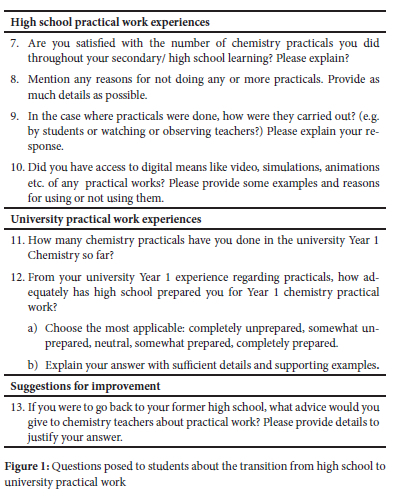
Suggestions for improvement: Students were ultimately asked to provide detailed suggestions (if any) for improving practical work in high schools. Example of questions from the questionnaire relevant to this study are presented in Figure 1.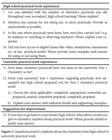
The questionnaire was distributed to 240 first year students enrolled in the BSc program in the 2023/2024 academic year. The questionnaire was distributed online as a Google Doc via the university Learning Management System. A total of 107 students completed the questionnaire.
Data analysis
The data were analysed using a combination of quantitative and qualitative methods. Quantitative data, such as the number of practical work activities conducted and students' self-reported preparedness, were analysed using descriptive statistics (e.g., frequencies and percentages) to identify patterns which were later triangulated with the qualitative data findings to offer a richer understanding.
The qualitative part of the data from open-ended questions were analysed through content analysis.3535361353736,38
Due to the large sample size of participants (N = 107) and the fact that some students came from one school, students from one school were grouped together so that their data could be analysed separately to remove duplications of entries on issues that relate to their schools (for instance, availability of laboratories) before undertaking the overall analysis. The same method was used to assess the validity of the responses as the similarity of the responses would afford a measure of validity.
Ethical considerations
The study adhered to ethical research practices, including obtaining informed consent from participants, ensuring confidentiality, and using data solely for research purposes. Participants were informed of their right to withdraw from the study at any time without penalty. They were also assured that their responses which would remain anonymous in any reporting and would not affect their academic performance. Anonymity was ensured by replacing students' names with coded references. (For instance, ST-1 for student number one).
Limitations
While the study provides valuable insights into students' experiences with practical work, there are some limitations. First, the reliance on self-reported data may introduce bias, as students' recollections of their high school experiences may not always be accurate. Second, the study focused on first-year students at one university, which may limit the generalizability of the findings to other contexts. Future research could address these limitations by incorporating observational data and expanding the sample to include multiple institutions of higher learning.
FINDINGS
Biographical information of participants.Biographical information of the participants who responded to the questionnaire shows that 58% of the respondents are females with males making up 42%. This categorization is important given the global initiatives of promoting inclusive enrolment of males and females in the science, technology, engineering and mathematics (STEM) subjects. Much as this is a very important statistic, it does not necessarily reflect the actual enrolment. The actual enrolment statistics could not be obtained at the time of submission of this manuscript, thus the proportion of females to males in this study may not represent the first-year cohort in chemistry.
Distribution of schools by proprietor
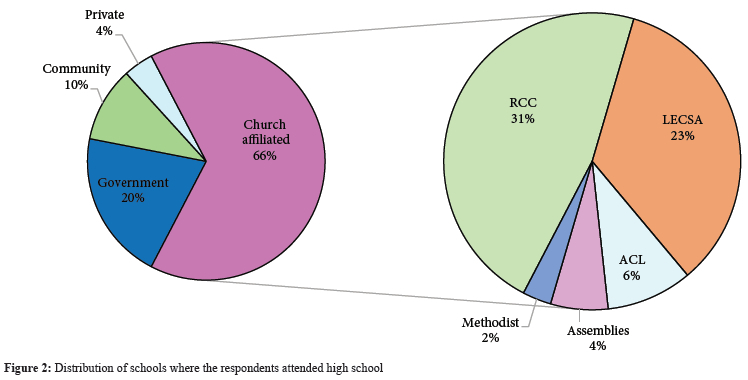
Most schools in Lesotho can be classified as being under the proprietorship of the government, community, private or church affiliated. The churches affiliated schools represented in this study sample include the Roman Catholic Church (RCC), Lesotho Evangelical Church in Southern Africa (LECSA), Anglican Church of Lesotho (ACL), Methodist and Assemblies. Figure 2 shows detailed information on schools' representation in terms of proprietors.
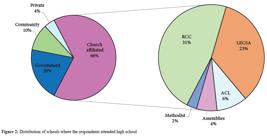
Figure 2 shows the distribution in proprietor of schools where church affiliated schools has the highest representation (66%). Other schools, government (20%), community (10%) and private (4%) had lower representations in the sample. The high representation of church schools is not surprising due to their being widespread across the country.
Students' distribution by location
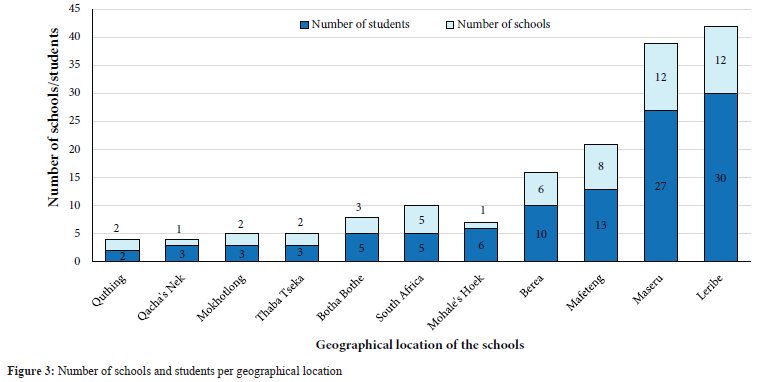
Schools differ from each other in many ways among them is the geographic location. Consequently, the study categorized the respondents by district to gain a broader perspective as some of the districts are more rural than others. Figure 3 shows the categorisation of the respondents' schools by geographic location.
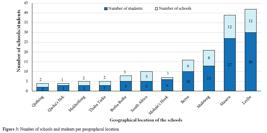
Figure 3 shows that only four districts had representation of ten or more students with schools in Mohale's Hoek and Qachas's Nek providing all the students from those districts. The remaining districts reflect a low number of schools and students who proceed to tertiary studies. These findings may indicate that some schools struggle to prepare students who qualify for programs in the Faculty of Science and Technology. Interestingly, none of the schools represented in Figure 3 was a former junior secondary (those schools which used to offer only a junior certificate). It may be inferred that that such schools are still struggling to keep up with the demands of the LGCSE hence their students are not able to join advanced university programs.
Schools: Physical facilities, apparatus and consumables
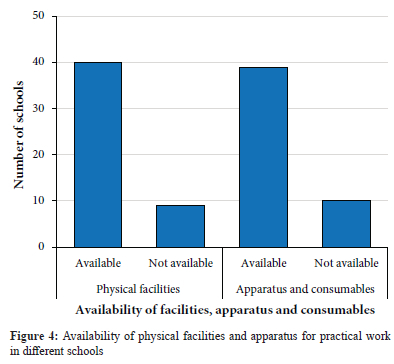
Since the main objective of the study was to investigate the practical work experience, Figure 4 presents the respondents' assessment of their former schools in terms of the availability of laboratories (facilities) and the appropriate apparatus including reagents and chemicals. Students were grouped into schools they attended in order to extract data for this part. A total of 49 schools was recorded. Five schools in South Africa are excluded in this section and rest of the analysis as the study focussed on the transition from high school to university in Lesotho.
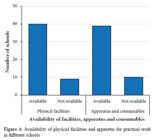
Despite the reported availability ofphysical facilities and consumables in Figure 4, further analysis of qualitative data lead to identification of two categories, providing more insights as described below.
Condition of physical infrastructure, apparatus and equipment
This category refers to the overall state and usability of the physical laboratory building(s), including the presence or absence of basic facilities and apparatus. Within this category, many participants (62%) stated that most physical facilities were old, dysfunctional and not fit for chemistry practical work - see the excerpts from some participants:
"The laboratories were there but with damaged apparatus." ST-62
"It [School] had laboratory facilities but they were very poor so I might as well just say it didn't have one" ST-81
"Yes, but they were few, some of the apparatus were not there" ST-90
State and usability of chemicals and reagents
This category focuses on the state and suitability of chemical substances available for use in practical work activities, specifically focusing on issues related to their shelf-life. Similar issues to infrastructure, apparatus and equipment were raised by many students (77%) regarding the available consumables, namely that they were available in limited quantities, had expired and were no longer in a usable state:
"Yes, they were there but chemicals had expired therefore we were unable to perform experiments involving chemicals" ST-44
These students' remarks are consistent with the findings of prior studies on the availability of resources in Lesotho schools.7,8 The findings are not new, but demonstrate a dire situation which has not improved in more than ten years since George and Kolobe8
Schools with no physical facilities, apparatus and consumables
Within this category, insights of what happens in schools where there are no physical facilities and consumable are provided. Some schools lack facilities (18%), apparatus and consumables (20%) and as a result, their students are mostly exposed to the theoretical aspects of chemistry as some students indicated. For instance, one student asserted:
"No, there were no laboratories in my former school, we were just taught without doing any experiments" ST-95
Another student mentioned that, details of practical work were done theoretically by writing.
"...we were taught theory as the backbone of chemistry...we did experiments in terms of writing not doing them physically" ST-79.
This statement by ST-79 possibly points to situations where practical work procedures, envisaged results and conclusions are discussed and noted so that students memorize them. While the LGCSE curriculum emphasises the importance of practical work, the findings shows that a lot of work still needs to be done for high school students to do practical work with few or no constraints.
Proportion of students and the estimated number of practicals done in high school
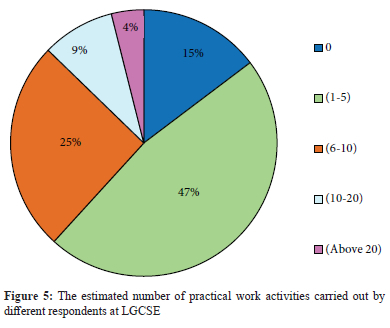
Given the statements that most of the existing laboratories were not in a functional state, with limited or expired chemicals, it was important to estimate the number of practical work activities carried out under these contextual constraints as reported by students. These practical work activities include those done by students as well as demonstrations by teachers (see Figure 5).
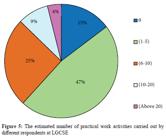
From Figure 5, about 47% of respondents stated having done a bare minimum of practical work activities in the range of 1-5, 25% and 9% of students did roughly 6-10 and 10-20 practical work activities, respectively. A very small percentage of students (4%) carried out more than 20 practicals. Notably, 15% of students had no experience of practical work in chemistry during their high school education.
The use of supplementary digital means to facilitate practical work in chemistry
There are few research reports exploring the use of ICT tools, such as videos and virtual experiments to support and complement physical experimentation in schools in Lesotho.12,39 Furthermore, some teachers still believe science should be taught through physical experiences; hence they do not support the use of digital demonstrations and simulations.40
Use of digital audio-visual tools
This category encompasses the use of digital audio-visual tools such as video, animations, and simulations which teachers could use to supplement practical work activities or use as substitutes where physical engagement in practical work is not possible. Some students reported that videos from YouTube as well as animations were used to support practical work. However, the frequency of use was low (25%). One responded (ST-65) highlighted:
"Yes, videos were provided to us by teachers. Examples are a few YouTube videos showcasing the experiment being carried out." ST-65
The rest of the students (75%) who attempted the question on audio-visual tools mentioned that they had no experience of any digital means to support practical work in chemistry.
"No, we did not have such because of lack of devices such phones and laptops or flash drives so there was no way we could have videos" ST-59
Contextual and practice impediments
This category refers to the issues which act as barriers and act as challenges to the possibility of using digital supplementary resources for practical work. In addition to lack of pre-requisite infrastructure like electricity as well as digital resources to supplement physical practical work, schools are also negatively affected by some of their own practices such as a 'no cell phone policy' and priorities.
"No, phones were not allowed at school. Students were forbidden from bringing phones to school. The computer lab at that time had no internet connection. The only connected office was that of the principal." ST-97
"There were no digital devices, well until 2021 and I was already in Form E, there was no electricity." ST-54
It is a reality that schools operate with no or with very limited technology resources. Furthermore, some other issues need to be urgently revisited, for example, practices such as a 'no cell phone policy, was mentioned by several students. These schools need to regulate access and the use of cell phones for academic purposes especially during this era of the fourth industrial revolution. The issue of internet connectivity being the principal's privilege had been noted in a previous study.8
Students' university experience and reflections on their preparedness at high school
Students were asked to share their experiences of first year university practical work with respect to their preparedness from their pre-university training.
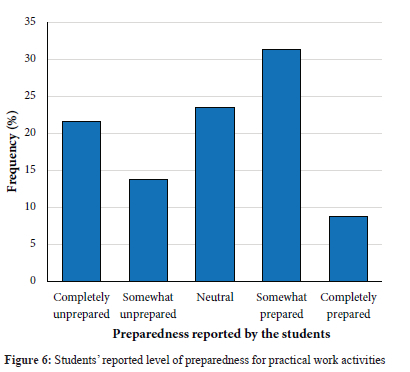
It should be noted that the first-year students, on average, did ten 3-hour general chemistry practical work sessions, an average of 30 hours of practical work. This intensive and extensive engagement in practical sessions was a new experience for many students who had never engaged in any practical work or those who were engaged for a very limited time during their pre-university education. A Likert scale question was used to assess the respondents perceived preparedness they received from their pre-university education (see Figure 6).
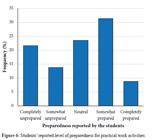
Figure 6 shows that only 9% respondents stated that they were completely prepared for the University practical work while 31% indicated that they were somewhat prepared. Of concern is the 36% students (students who were completely unprepared or who were somewhat unprepared) felt that they were not ready to engage in university practical work in chemistry. The remaining 24% respondents remained neutral on the issue. The interesting question is whether the respondents who reported having done an estimate of 5 or fewer experiments in their pre-university education, would report that they were adequately prepared for the experimental work at university level? This issue requires its own interrogation to assess what preparedness implied, and the role of instructors in preparing the students for the practical work. Students who had attended the same school, chose relatively similar ratings of preparedness, perhaps due to similar experiences they had in their high school. Further analysis of qualitative responses of students who were unprepared, neutral and prepared gave rise to important issues regarding their experiences with practical work during high school as described by the categories in following sections.
Experience in a laboratory environment
This category includes students' experience in relation to handling laboratory apparatus, instruments and equipment as well as how to work in a science laboratory environment. The respondents who felt unprepared and somewhat unprepared (36%) mentioned some critical issues related to contexts of schools and how arrangements for practicals (where done occasionally) and which significantly affected their preparedness for tertiary practical work. The extract below highlights some of the issues students raised.
"Completely unprepared because using some of the apparatus was a struggle because I only knew them from the pictures and I somehow failed to relax in a lab, instead I had this fear of doing anything wrong just because I am not familiar with it." ST-81
The lack of resources in schools deprives students of opportunities to learn the skill to handle instruments and improve self-efficacy in carrying out practical work. Similar sentiments were reported by those who felt that they were somewhat unprepared. One extract below shows provides insights:
"Somewhat unprepared because yes we dealt with chemicals but with no proper attire (e.g. lab coats were not worn). We were taught about precautions, but most were not practiced as the attire that girls wore revealed more of their skin (girls wore skirts only). Most students would go to the lab without knowing what they are actually going to do in the lab as teacher did nothing compulsory to see to it that at least students have an idea about what they are to do in the lab (e.g. pre lab questions and a necessity or requirement to write a summary and objective of the experiments). Further students would not submit anything related to the experiments they conducted (e.g. lab report with observations or any results obtained, discussion and conclusion regarding the objectives). Again, going to the lab was only for grade 11 students still they did not have effective lab sessions as they happened once in a while." ST-31
The extract above illustrates several points about the necessity of ensuring first-hand experience of practical work for students to be better equipped with skills and knowledge requisite for university and other fields. University practical work involves activities such as setting up apparatus in some cases, recording observations, data analysis and interpretation of results, and report writing. It seems, however, that some students are not well exposed to such essential practices during their high school education. Many students (77%) highlighted that teacher demonstrations were dominant in their high school chemistry practical work sessions. An excerpt from one student illustrates this:
"Experiments were performed by teachers due to shortage of some of the materials in the lab. Learners would watch as the Experiment is being performed and take notes and discuss the results." ST-84
The shortage of material further forced teachers to work with large groups during practical work sessions. In some cases, group sizes reached as many as ten students. One student highlighted:
"The lack of apparatus and equipment in general example when experimenting there would be about 8-10 in just one group." ST-89
The issues raised by students who selected the neutral option as shown in Fig 6, overlapped with those raised by students who were somewhat prepared and those who were somewhat unprepared. However, their responses demonstrated some effects of challenges encountered during practical work as described below.
Positive influence of some exposure to practical work activities
This category refers to the ways in which some exposure to practical work manifests in students' feelings of preparedness to engage in practical work activities. For instance, one student said:
"Neutral I'd say. This is because though we had limited resources, we knew how to behave in the lab and what to expect. For example, if lab coats and gloves were randomly given to use we would know why we must put them on not just for the sake of being fancy. Also, upon my arrival as a year 1 in the lab, I already knew not to taste anything in the lab and how to use laboratory apparatus including the fume chamber. However, it became a challenge to use some of the apparatus as back in high school, the teacher would simply illustrate how to use the apparatus in a class of 50 students whereas here, each and every student gets to use the apparatus." ST-77
A smaller number of students (9%) indicated that they were prepared during their high school education to engage in chemistry practical work. The topics they raised to support their feeling of preparedness highlighted the importance of prior experiences. For instance, one student pointed out that some of the experiments they did in high school were similar to the ones they did during their first year in university.
"Completely prepared, because I know how to navigate or use the apparatus and some of the experiments done, I had already done in high school." ST-16
While not all schools prepare students to make sense of practical work activities, some students mentioned that they were assessed on practical activities, which somehow prepared them to develop analytical skills.
"I was somewhat prepared. Teachers would ask questions regarding the experiments we performed in tests and quizzes, which forced us to analyse everything critically"' ST-41
In addition to analytical skills, some schools made efforts to familiarise students with laboratory apparatus and how to use them. As a results students acknowledge being equipped with necessary skills to handle apparatus.
"Somewhat prepared. I had basic knowledge of names of apparatus and how to properly handle them as well as how to work with certain chemicals during experiments, e.g. using fume cupboard when experimenting on chemicals that produce harmful gases. I had no idea on things like lab reports and proper analysis on results obtained'' ST-61
Students' preparedness appears to emphasize different areas: some felt more confident in analytical skills, others in handling apparatus, while laboratory reports writing seems to receive comparatively less attention. Those who felt unprepared also made reference to not having to submit laboratory reports. One student mentioned that,
"...Further students would not submit anything related to the experiments they conducted (e.g. lab report with observations or any results obtained, discussion and conclusion regarding the objectives)". ST-31
Basically, the findings show students' varying experiences which provide some evidence that, there are some gaps between high school and first year university chemistry practical work. Moreover, the amount of practical work done does not seem to adequately prepare students to engage in first-year university practical work. As noted in this study some students who reported to have done twenty and more practicals in high school, mentioned that they were unprepared due to high prevalence of teacher-led activities. Interestingly, those who reported to have done between 6 and 10 practical work activities indicated that they were prepared. This varying experiences of students on the number of practical work sessions could be attributed to importance of balancing between quality and the number of practical work sessions.
Suggestions from students on how high school practical work experiences can be improved
The responses of students to the issue of improving high school practical work activities gave rise to three categories. The categories provide some insights in relation to number of practical work activities, availability and state of resources as well as writing of laboratory reports.
More practical work activities
Many students (67%) suggested that more practical work activities need to be made available for students and students need to be provided with opportunities to carry out the tasks. One student stated:
"I would advise the chemistry teachers do more experiments and let students do experiments themselves as to practice them." ST-23
Availability and improvement of resources
This category refers to students' suggestions (74%) regarding availability of physical infrastructure, material, instruments, apparatus, chemicals and reagents. It also includes improvement of existing infrastructure. ST- 54 mentioned that:
"I would not really advice the teachers since it's not their fault that the school did not have the equipment, teacher did their job very well in explaining everything even though there were no experiments. I would advise the ministry of education to take a look at the rural school and improve there. Moreover, ministry of education should help in providing those equipments." ST-54
Introduction to scientific reports
A few respondents raised the issue of laboratory report writing (7%) and made suggestions related to report writing in chemistry as part of practical work. An extract from ST-75 illustrates this:
"Teach students an introduction of experimental work, this will include writing a lab report and skills needed in order to do a laboratory work." ST-75
Overall, students' suggestions further reflect their responses on limited exposure to practical work due to several constraints. While many students point to issues of resources and number of practical work activities, an important issue about laboratory reports is raised by a few (7%). Writing reports is crucial as part of practical work as it can serve as a form of assessment and preparation on further engagement in scientific report writing. Students have provided insights that the experiences of high school students regarding practical work in chemistry might be improved if the issues they raised above are addressed.
DISCUSSION, CONCLUSION AND RECOMMENDATIONS
Discussion
This study explored the experiences of first-year university students in Lesotho with practical work in chemistry, focusing on their pre-university (high school), university-level experiences and their preparedness for university level practical work. The findings highlight significant challenges in the implementation of practical work at the high school level, which have profound implications for students' preparedness for university-level chemistry education. Practical work is a cornerstone of science education, aimed at fostering conceptual understanding, developing scientific skills, and promoting scientific literacy.1,2 However, the study reveals that many students in Lesotho enter university with limited or no hands-on experience in practical work, largely due to resource constraints, poorly structured activities, and an overreliance on teacher demonstrations.7,8
There is a striking disparity in students' exposure to practical work during high school with 16% of respondents reporting no practical work experience and 52% having conducted fewer than five experiments over the entire high school education. This lack of engagement with practical activities undermines the development of essential practical skills and building of confidence which are crucial for success in university-level science programs.13,17 Furthermore, there is limited use of digital tools that could supplement practical work due to some restrictive school policies (e.g., 'no cell phone' rules), some teachers still hold the belief that science should be taught through physical methods rather than using digital tools.38
At the university level, students encounter a more rigorous and autonomous approach to practical work that requires skills in experimental work, data analysis, and scientific reporting.30,31 While some students felt adequately prepared, possibly due to prior exposure to similar experiments and apparatus, many reported feeling unprepared, citing limited hands-on experience, lack of familiarity with laboratory protocols, insufficient training in critical thinking and overdominance of teachers' demonstration as primary teaching approach.26,27 These findings align with prior research highlighting similar challenges in the transition from high school to university-level science education, particularly in contexts where practical work is either undermined, constrained by contextual factors, or poorly implemented at the high school level.22,29
In light of the findings, this study therefore underscores the importance of aligning high school and university curricula to ensure a seamless transition for students. While the LGCSE curriculum emphasizes essential practical skills, the implementation of practical work is still hindered by systemic challenges that include inadequate infrastructure, limited resources, time management, and insufficient teacher training.7,10,11 Addressing these challenges requires a concerted effort from all stakeholders such as the Ministry of Education, teachers, researchers and institutions of higher learning in order to improve the quality of science education in Lesotho. This is especially so, given that Lesotho is about to introduce a qualification higher than the LGCSE. It is critical that practical work is given equal consideration if not more than the theoretical aspects as the expectation would be that the students would not have the same entry point into the university as those with the LGCSE qualification.
Conclusion
The findings of this study show that not much has been done to improve students' engagement in practical work since George and Kolobe's8
Recommendations
As much as this study focused on chemistry as a subject, the following recommendations are proposed for the improvement of the quality of practical work in science education in general to enhance students' preparedness for university-level science programs. The government and relevant stakeholders should prioritize investment in the construction and maintenance of functional laboratories in high schools, ensuring that students have access to the necessary facilities and resources for practical work.41
The LGCSE curriculum needs to be implemented to provide more opportunities for practical work. This would help to ensure a seamless transition for students into university-level science programs. Emphasis should be placed on developing essential hands-on skills and basic scientific processes. This foundation will allow university training to focus on higher-level competencies such as experimental design, data analysis, and scientific reporting, rather than addressing students' anxieties. Schools should also try to adopt flexible timetables to allocate sufficient time for practical work so that it does not feel like a burden to conduct practical sessions by the science teachers.
AUTHOR CONTRIBUTIONSMosotho J. George: Conceptualization, methodology, investigation, formal analysis, writing original draft, writing; reviewing & editing. Lereko G. Mohafa: Conceptualization, methodology, investigation, formal analysis, writing original draft, writing; reviewing & editing.
DECLARATION OF COMPETING OR FINANCIAL INTERESTSThere is no competing or financial interest in this study.
DECLARATION OF GENERATIVE AI AND AI-ASSISTED TECHNOLOGIES
No generative AI and Al-assisted technologies were used in this study.
AUTHOR ORCID IDS*Lereko G. Mohafa - https://orcid.org/0000-0001-6057-8750
#George J. Mosotho - https://orcid.org/0000-0003-3217-5641
REFERENCES
ACKNOWLEDGEMENTS
The authors would like to thank all first-year students who participated in this study for their willingness to share their high school and first year university experiences with practical work in chemistry.
LITERATURE REVIEW
- 1. Millar R. The role of practical work in the teaching and learning of science. Commissioned paper for the Committee on High School Science Laboratories: Role and Vision. Washington DC: National Academy of Sciences. 2004;308:1-21.
-
2. Hodson D. Learning science, learning about science, doing science: different goals demand different learning methods. Int J Sci Educ. 2014;36(15):2534-2553. https://doi.org/10.1080/09500693.2014.899722.
» https://doi.org/10.1080/09500693.2014.899722 -
3. Kidman G, Casinader N. Inquiry-based teaching and learning across disciplines. London: Palgrave Pivot. 2017. https://doi.org/10.1057/978-1-137-53463-7.
» https://doi.org/10.1057/978-1-137-53463-7 -
4. Hodson D. Experiments in science and science teaching. Educ Philos Theory. 1988;20(2):53-66. https://doi.org/10.1111/j.1469-5812.1988.tb00144.x.
» https://doi.org/10.1111/j.1469-5812.1988.tb00144.x -
5. Latta L. Evaluating the Effects of STEM Out-of-school Time Programming on the Development of STEM Attitudes and 21st Century Skills of Community School Students. Oklahoma, USA: University of Oklahoma; 2019. [ PhD thesis]]. https://hdl.handle.net/11244/321135.
» https://hdl.handle.net/11244/321135 -
6. Turiman P, Tengku Wook TSM, Osman K. 21st Century skills mastery amongst science foundation programme students. Int J Adv Sci Eng Inf Technol. 2019;9(1):46-53. https://doi.org/10.18517/ijaseit.9.1.6431.
» https://doi.org/10.18517/ijaseit.9.1.6431 -
7. George MJ, Kolobe M. Exploration of the potential of using a virtual laboratory for chemistry teaching at secondary school level in Lesotho. S Afr J Chem. 2014;67(1):113-117. https://scielo.org.za/pdf/sajc/v67/21.pdf.
» https://scielo.org.za/pdf/sajc/v67/21.pdf -
8. George MJ. Assessing the level of laboratory resources for teaching and learning of chemistry at advanced level in Lesotho secondary schools. S Afr J Chem. 2017;70:154-162. https://doi.org/10.17159/0379-4350/2017/v70a22.
» https://doi.org/10.17159/0379-4350/2017/v70a22 -
9. Makhechane M, Qhobela M. Understanding how chemistry teachers transform stoichiometry concepts at secondary level in Lesotho. S Afr J Chem. 2019;72:59-66. https://doi.org/10.17159/0379-4350/2019/v72a9.
» https://doi.org/10.17159/0379-4350/2019/v72a9 - 10. Letsie M. Policy reforms and their impact on science education in Lesotho. Afr J Educ Policy. 2019;15(3):89-102.
-
11. Rakolobe KA. The Impact of the Lesotho Language Policies on Indigenous and Former Colonial Languages Usage in Public Domains in Lesotho. In: Lisanza EM, Muaka L, editors. The Palgrave Handbook of Language Policies in Africa. Springer International Publishing; 2024. p. 625-644. https://doi.org/10.1007/978-3-031-57308-8_29.
» https://doi.org/10.1007/978-3-031-57308-8_29 -
12. Bohloko M, Makatjane TJ, George MJ, Mokuku T. Assessing the Effectiveness of using YouTube Videos in Teaching the Chemistry of Group I and VII Elements in a High School in Lesotho. Afr J Res Math Sci Technol Educ. 2019;23(1):75-85. https://doi.org/10.1080/18117295.2019.1593610.
» https://doi.org/10.1080/18117295.2019.1593610 -
13. Abrahams I, Millar R. Does Practical Work Really Work? A study of the effectiveness of practical work as a teaching and learning method in school science. Int J Sci Educ. 2008;30(14):1945-1969. https://doi.org/10.1080/09500690701749305.
» https://doi.org/10.1080/09500690701749305 -
14. Cooper MM, Stowe RL. Chemistry education research-from personal empiricism to evidence, theory, and informed practice. Chem Rev. 2018;118(12):6053-6087. https://doi.org/10.1021/acs.chemrev.8b00020.
» https://doi.org/10.1021/acs.chemrev.8b00020 -
15. Laohapornchaiphan J, Chenprakhon P. A review of research on learning activities addressing the submicroscopic level in Chemistry. J Chem Educ. 2024;101(11):4552-4565. https://doi.org/10.1021/acs.jchemed.4c00156.
» https://doi.org/10.1021/acs.jchemed.4c00156 -
16. Johnstone AH. Teaching of chemistry-logical or psychological? Chem Educ Res Pract. 2000;1(1):9-15. https://doi.org/10.1039/A9RP90001B.
» https://doi.org/10.1039/A9RP90001B - 17. Taber KS. The role of "practical" work in teaching and learning chemistry. Sch Sci Rev. 2015;96(357):75-83.
-
18. Duggan S, Gott R. The place of investigations in practical work in the UK National Curriculum for Science. Int J Sci Educ. 1995;17(2):137-147. https://doi.org/10.1080/0950069950170201.
» https://doi.org/10.1080/0950069950170201 -
19. Lewthwaite B. Thinking about practical work in chemistry: teachers' considerations of selected practices for the macroscopic experience. Chem Educ Res Pract. 2014;15(1):35-46. https://doi.org/10.1039/C3RP00122A.
» https://doi.org/10.1039/C3RP00122A -
20. Iyamuremye A, Nsabayez E, Ngendabanga C, Hagenimana F. Effectiveness of hands-on practical activities in teaching and learning chemistry: an exploration of students' engagement, experience, and academic performance. Afr J Educ Stud. Math Sci. 2023;19(1):97-107. https://doi.org/10.4314/ajesms.v19i1.7.
» https://doi.org/10.4314/ajesms.v19i1.7 -
21. Millar R, Abrahams I. Practical work: making it more effective. Sch Sci Rev. 2009;91(334):59-64. http://www.gettingpractical.org.uk/documents/RobinSSR.pdf.
» http://www.gettingpractical.org.uk/documents/RobinSSR.pdf -
22. Hyde J, Wright JS, Xie A. Progression from Chinese High School onto a TransNational Chinese-UK University joint BSc degree in chemistry; an international study focussing on laboratory practical skills. Chem Educ Res Pract. 2024;25(1):151-170. https://doi.org/10.1039/D3RP00099K.
» https://doi.org/10.1039/D3RP00099K -
23. Paterson DJ. Design and evaluation of integrated instructions in secondary-level chemistry practical work. J Chem Educ. 2019;96(11):2510-2517. https://pubs.acs.org/doi/10.1021/acs.jchemed.9b00194. https://doi.org/10.1021/acs.jchemed.9b00194.
» https://pubs.acs.org/doi/10.1021/acs.jchemed.9b00194. https://doi.org/10.1021/acs.jchemed.9b00194 -
24. Ramnarain U. Teachers' use of questioning in supporting learners doing science investigations. S Afri J Educ. 2011;31(1):91-101. https://doi.org/10.15700/saje.v31n1a410.
» https://doi.org/10.15700/saje.v31n1a410 -
25. Shana ZJ, Abulibdeh ES. Science practical work and its impact on students' science achievement. J Technol Sci Educ. 2020;10(2):199-215. https://doi.org/10.3926/jotse.888.
» https://doi.org/10.3926/jotse.888 -
26. Hofstein A, Lunetta VN. The laboratory in science education: foundations for the twenty-first century. Sci Educ. 2004;88(1):28-54. https://doi.org/10.1002/sce.10106.
» https://doi.org/10.1002/sce.10106 -
27. Lowe H, Cook A. Mind the gap: are students prepared for higher education? J Furth High Educ. 2003;27(1):53-76. https://doi.org/10.1080/03098770305629.
» https://doi.org/10.1080/03098770305629 -
28. Thompson M, Pawson C, Evans B. Navigating entry into higher education: the transition to independent learning and living. J Furth High Educ. 2021;45(10):1398-1410. https://doi.org/10.1080/0309877X.2021.1933400.
» https://doi.org/10.1080/0309877X.2021.1933400 -
29. Russell CB, Weaver GC. A comparative study of traditional, inquiry-based, and research-based laboratory curricula: impacts on understanding of the nature of science. Chem Educ Res Pract. 2008;9(2):149-161. https://doi.org/10.1039/B8RP90006K.
» https://doi.org/10.1039/B8RP90006K -
30. Rollnick M, Zwane S, Staskun M, Lotz S, Green G. Improving pre-laboratory preparation of first year university chemistry students. Int J Sci Educ. 2001;23(10):1053-1071. https://doi.org/10.1080/09500690110038576.
» https://doi.org/10.1080/09500690110038576 -
31. Reid N, Shah I. The role of laboratory work in university chemistry. Chem Educ Res Pract. 2007;8(2):172-185. https://doi.org/10.1039/B5RP90026C.
» https://doi.org/10.1039/B5RP90026C - 32. Abdussyukur NF, Saat RM, Alias N. Teaching and learning practices in chemistry practical work of Malaysian matriculation programme: a needs analysis. Malays Online J Educ Manag. 2021;9(4):13-26.
-
33. Mahaffy P; Union Carbide Award for Chemical Education. Moving chemistry education into 3D: A tetrahedral metaphor for understanding chemistry. Union Carbide Award for Chemical Education. J Chem Educ. 2006;83(1):49. https://doi.org/10.1021/ed083p49.
» https://doi.org/10.1021/ed083p49 - 34. Creswell JW. Research design: qualitative, quantitative, and mixed methods approaches. 4th ed. California, United States: SAGE Publications Inc.; 2014.
-
35. Hsieh HF, Shannon SE. Three approaches to qualitative content analysis. Qual Health Res. 2005;15(9):1277-1288. https://doi.org/10.1177/1049732305276687.
» https://doi.org/10.1177/1049732305276687 -
36. Mayring P. Qualitative content analysis: theoretical foundation, basic procedures and software solution. Social Science Open Access Repository (SSOAR). Klagenfurt; 2014. https://nbn-resolving.org/urn:nbn:de:0168-ssoar-395173
» https://nbn-resolving.org/urn:nbn:de:0168-ssoar-395173 -
37. Forman J, Damschroder L. Qualitative content analysis. In: Jacoby L, Siminoff L, eds. Empirical methods for bioethics: A primer. Leeds: Emerald Group Publishing Limited, 2007; pp. 39-62. https://doi.org/10.1016/S1479-3709(07)11003-7.
» https://doi.org/10.1016/S1479-3709(07)11003-7 -
38. Graneheim UH, Lindgren BM, Lundman B. Methodological challenges in qualitative content analysis: A discussion paper. Nurse Educ Today. 2017;56:29-34. https://doi.org/10.1016/j.nedt.2017.06.002.
» https://doi.org/10.1016/j.nedt.2017.06.002 -
39. Mohafa LG, Qhobela M, George MJ. Evaluating the influence of interactive simulations on learners' academic performance in stoichiometry. S Afr J Chem. 2022;76:1-8. https://doi.org/10.17159/0379-4350/2022/v76a01.
» https://doi.org/10.17159/0379-4350/2022/v76a01 -
40. Mohafa L, George MJ. Assessing pre-service science teachers' perceptions about online teaching and learning. IJSE. 2023;6(1):93-111. https://doi.org/10.52134/ueader.1245351.
» https://doi.org/10.52134/ueader.1245351 -
41. Oguoma E, Jita L, Jita T. Teachers' concerns with the implementation of practical work in the physical sciences curriculum and assessment policy statement in South Africa. Afr J Res Math Sci Technol Educ. 2019;23(1):27-39. https://doi.org/10.1080/18117295.2019.1584973.
» https://doi.org/10.1080/18117295.2019.1584973
Revised 5 June 2025
Accepted 11 July 2025