Combining Alkali and Peroxide for Pretreatment of Sugarcane Wastes, Bagasse and Trash, for Bioethanol Synthesis
Abstract
The use of agricultural waste material in the production of bioethanol can provide an alternative to fossil fuels that is renewable and readily available. This research sought to use a combination of chemical pretreatments to make available reducing sugars from sugarcane bagasse and trash for fermentation into bioethanol. A combination of alkali and peroxide was used. These results indicate that pretreatment with alkali peroxide is quite effective in reducing the levels of hemicellulose sugars and lignin in particular. The slight changes in cellulose quantities are an indication that alkali peroxide preatreatment conserves the quantities of cellulose and does not result in a loss in cellulose as compared to other pretreatment processes such as acid hydrolysis. The drawback is that this can also mean that the crystalline structure of the cellulose was not disturbed, which could slow down downstream processes of enzyme hydrolysis and subsequent fermentation. The pretreated bagasse contained significantly higher levels cellulose of 48 % and 63 % after pretreatment with 3 % and 5 % alkali peroxide, respectively. This represents a 28 % increase and a 70 % increase, respectively, in available exposed cellulose for use in further processes of enzyme hydrolysis and fermentation.
Pretreatment; bagasse; renewable energy; alkali peroxide
1. Introduction
Research into application of renewable resources for the generation of biofuels continues to grow. Production of first generation bioethanol from sugar and starch based food crops is a well established process.122 3,4 The main challenge facing second-generation bioethanol production is the absence of cost-effective, efficient and environmentally conscious methods for industrial production pretreatment.5667
2. Methods
2.1.
MaterialsThe reagents and chemicals for this research were all of analytical grade and purchased from Sigma-Aldrich (USA), Merck (Germany) and some purchased through Total Laboratory (S.A.) suppliers. The main substrate, the agricultural residues, that is the sugarcane bagasse and sugarcane trash (material) were supplied by TSB Malalane Mill at Mhlathi Farm, Malelane, in South Africa.8
2.2.
Alkali Peroxide Pretreatment and Hydrolysis MethodsIn alkali-peroxide pretreatment sodium hydroxide (NaOH) was combined with hydrogen peroxide. High yields of glucose from 7 % hydrogen peroxide pretreatment of 691 mg g-1 of bagasse have been obtained.228
2.3. Cellulase Enzyme Hydrolysis
Commercial cellulase enzyme of cellulolysin® type was used in the hydrolysis of alkali peroxide pretreatment hydrolysates enabling the generation of reducing sugars. The IUPAC (International Union of Pure and Applied Chemistry) method for determining reducing sugar quantities present in hydrolysates by using dinitrosalicylic (DNS) acid.98,9 The pH was maintained at pH 4.8 by using a citrate buffer. Application of enzyme hydrolysis offers an advantage over acid hydrolysis in that equipment does not need to be expensive corrosion resistant material.10-1 which has been cited to achieve high levels of glucose in an acceptable time of 48-72 h.9,8,11
3. Characterization
Raw and pretreated sugarcane leaves and tops-trash as well as the bagasse were characterized using the Chesson method for percentage composition comparisons before and after pretreat-ment. Reducing sugar estimates after pretreatment were obtained by following International Union of Applied Physicists and Chemists (IUPAC) method, the dinitrosalicylic-acid (DNS) method, as it is laid out by T.K. Ghose.9
4. Results and Discussion
4.1. Material Percentage Compositions
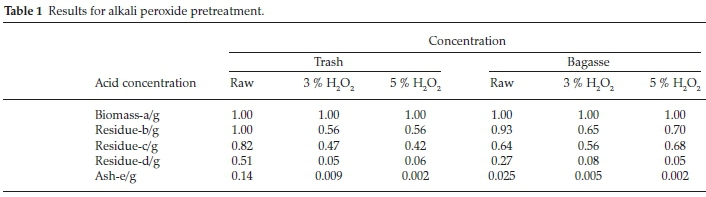
Lignocellulosic bagasse and trash were pretreated with alkali peroxide. The raw untreated material as well as the pretreated material's compositions were characterized for percentage composition by using Chesson method.1Table 1. Each experiment was done in a minimum of duplicates and the results averaged and recorded.
The calculations for the respective percentage compositions of lignin, cellulose and hemicellulose were carried out using the following equations:
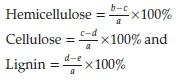
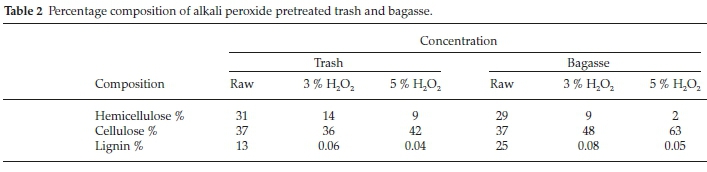
The equations above were used to convert the results into the percentage composition results of the raw untreated and treated sugarcane leaves and tops (trash) as well as the compositions of the bagasse. These results are indicated in Table 2.
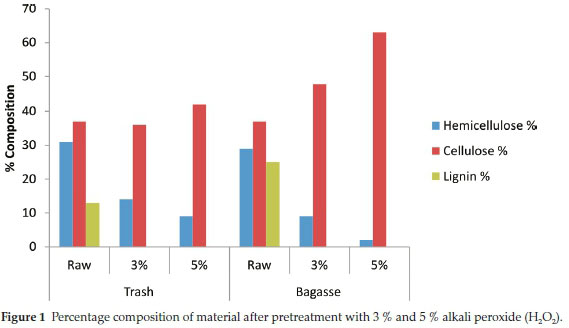
Results in Table 2 indicate the raw trash before pretreatment had been effected consisted of 31 % of hemicellulose, 37 % of cellulose and 13 % of lignin content. These percentages changed considerably after pretreatment with 3 % and 5 % alkali peroxide concentrations. Pretreatment with 3 % and 5 % alkali peroxide resulted in the hemicellulose content being reduced to 14 % and9%ofthepretreatment residue, with hemicellulose being also reduced to 0.06 % and 0.04 % of the pretreatment residue, respectively. Cellulose content on the other hand increased slightly after 5 % alkali peroxide pretreatment to 42 % of the pretreatment residue indicating a 13.5 % increase. However there wasa1%decrease in cellulose fraction after pretreatment with 3 % alkali peroxide. Pretreatment of trash with 3 % alkali peroxide resulted in lower changes than when compared to pretreatment with 5 % alkali peroxide. Delignification of sugarcane bagasse was also higher for pretreatment with 5 % hydrogen peroxide than pretreatment with 3 % hydrogen peroxide.
Results for raw untreated bagasse indicate that there were almost similar fractions of hemicellulose and cellulose in bagasse as in the trash of 29 %, 37 % but with a higher fraction of lignin of 25 %, respectively. The pretreated bagasse contained significantly higher levels cellulose of 48 % and 63 % after pretreatment with 3 % and 5 % alkali peroxide, respectively. This represents a 28 % increase and a 70 % increase, respectively, in available exposed cellulose for use in further processes. As the amount of lignin decreased, this resulted in higher percentages of cellulose available therefore indicating the more effective the pretreat-ment method. The same results of biomass composition are indicated in the form a bar graph in Fig. 1.
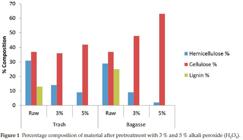
These results indicate that pretreatment with alkali peroxide is quite effective in reducing the levels of hemicellulose sugars and lignin in particular. The slight changes in cellulose quantities are an indication that alkali peroxide preatreatment conserves the quantities of cellulose and does not result in a loss in cellulose as compared to other pretreatment processes such as acid hydrolysis. The drawback is that this can also mean that the crystalline structure of the cellulose was not disturbed, which could slow down downstream processes of enzyme hydrolysis and subsequent fermentation.
4.2. FTIR Results of Peroxide Pretreatment
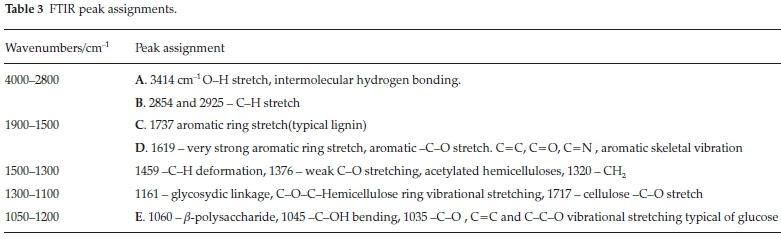
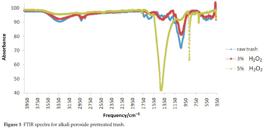
FTIR was also used to analyze the results of peroxide treatment and these are shown in the following figures. The following peak assignments in Table 3 are linked to corresponding infrared absorption at corresponding frequencies12
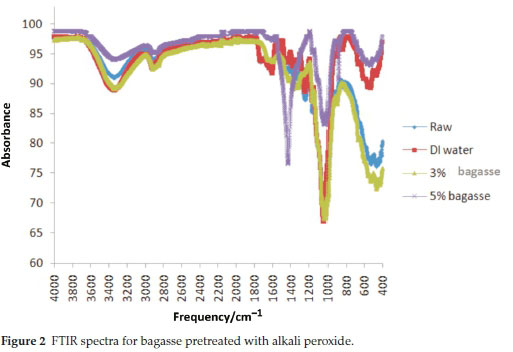
FTIR analysis results for bagasse that was pretreated with hydrogen peroxide are indicated in Fig. 2.
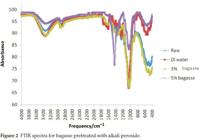
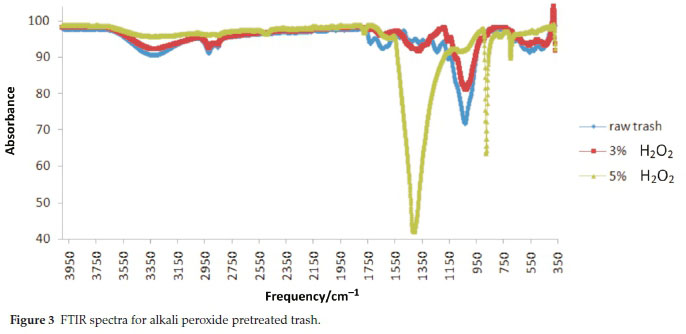
FTIR spectra for the pretreatment of bagasse and trash pretreatment results are given in Fig. 2 and Fig. 3, respectively. There was a gradual decrease in the -C-O-vibrations typical of glucose at 1035 cm-1 to 1080 cm-1with increase in pretreatment concentration from raw untreated material, to 3 % and 7 % peroxide pretreatment. This was coupled with an increase in the -CH3- vibrational stretch at 1440 cm-1 which was more pronounced after pretreament with 5 % alkali peroxide. This is due to the decrease in the quantities of hemicellulose present after pretreatment.
4.3. Thermogravimetric Analysis Results for Trash
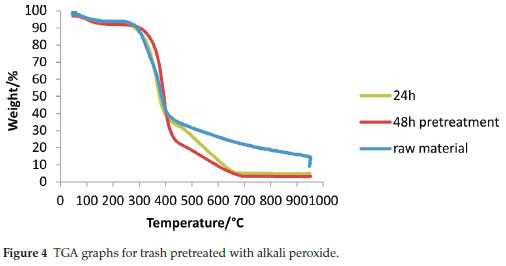
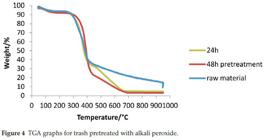
Thermogravimetric analysis on trash which was pretreated with alkali peroxide also revealed changes in behaviour after pretreatment as indicated in Fig. 4. There was a major drop in percentage weight for material that was pretreated for 48 h between 300 °C and 400 °C more than 24 h pretreatment and raw material which also exhibited a similar drop within the same temperature range. DTG graphs also indicate there were two peaks at 300 °C and 400 °C for the original (O.G.) raw untreated material whereas there appeared to be one major peak for the pretreated materials. The two peaks at 320 °C and 360 °C are attributed to hemicellulose and cellulose, respectively.13
4.4. SEM of Alkali Peroxide Pretreated Material
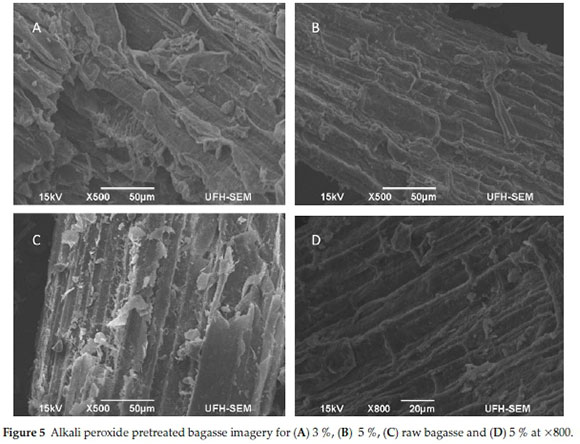
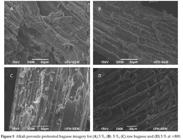
Scanning electron microscopy images for bagasse which was pretreated with alkali peroxide indicate there was an increase in visibility of individual cells with an increase in percentage concentration as shown in Fig. 5. The raw untreated bagasse (C) did not have clearly visible cellular division as compared to 3 % and 5 % alkali peroxide pretreated bagasse (A) and (B), respectively. This increase in cellular outline visibility can be attributed to the swelling of the material upon pretreat-ment.
4.5. EDS Results for Peroxide Pretreatment
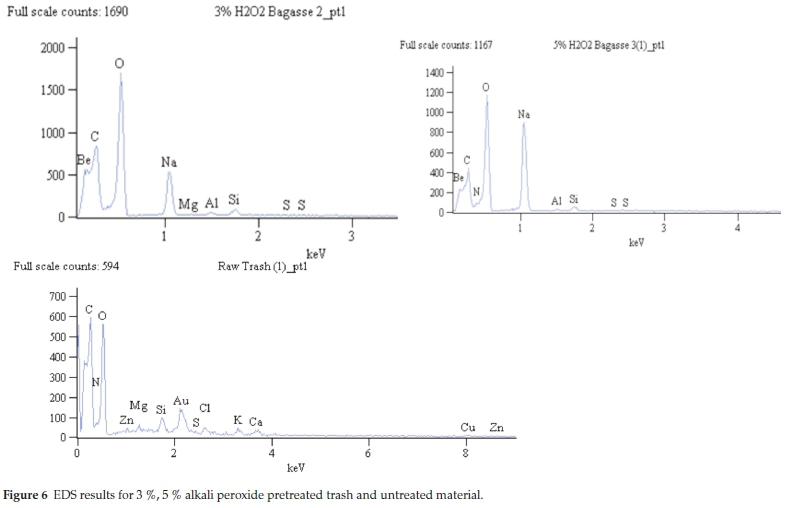
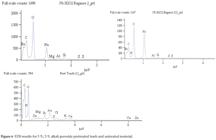
EDS results indicated there was an increase in the amount of available oxygen sites on the surface of the material after pretreatment as indicated in Fig. 6. There was also some residue of the element sodium (Na) present in the material after pre-treatment indicating that sodium hydroxide had been adsorbed on to the material. This explains the increase in mass of material observed after pretreatment.
5. Conclusions
A two-step approach to pretreatment by combining pretreat-ment methods was successful in disrupting the lignocellulose structure. There was quite a significant reduction in the quantities of lignin in particular with also some reduction in hemi-cellulose. Pretreatment of bagasse yielded significantly higher cellulose levels after pretreatment with low concentrations of alkali peroxide. This represents an increase in available exposed cellulose for use in further processes of enzyme hydrolysis and fermentation. The drawback is that this increase in cellulose percentage fraction can also mean that the crystalline structure of the cellulose was not disturbed, which could slow downstream processes of enzyme hydrolysis and subsequent fermentation. However, these slight changes in cellulose quantities are also an indication that alkali peroxide pretreatment conserves the quantities of cellulose and does not result in a loss in cellulose as compared to other pretreatment processes such as acid hydrolysis. Thus follow-up processes of enzyme hydrolysis and subsequent fermentation will yield higher levels of reducing sugars and bioethanol, respectively.
Supplementary Material
Supplementary information is provided in the online supplement.
ORCID iD
C.M. Dodo: orcid.org/0000-0002-4947-0550
Acknowledgements
The funding for this research was provided by the Fort Hare Institute of Technology in partnership with the Govan Mbeki Research and Development Centre.
References
- 1 R. Maryana, D. Ma'rifatn, A.I. Wheni, K.W. Satriyo and W. Angga Rizal, Alkaline pretreatment on sugarcane bagasse for bioethanol production, Energy Procedia, 2014,47, 250-254.
- 2 S.C. Rabelo, N.A. Amezquita Fonseca, R.R. Andrade, R. Macielfilho and A.C. Costa, Ethanol production from enzymatic hydrolysis of sugarcane bagasse pre-treated with lime and alkaline hydrogen peroxide, Biomass Bioenergy, 2011, 30, 1-8.
- 3 N. Sarkar, S.K. Ghosh, S. Bannerjee and K. Aikat, Bioethanol production from agricultural wastes: an overview, Renewable Energy, 2012, 37, 19-27.
- 4 V.S.H. Suhardi, B. Prasai, D. Samaha and R. Boopathy, Evaluation of pretreatment methods for lignocellulosic ethanol production from energy cane variety L 79-1002, inf. Biodeterior. Biodegrad., 2013, 85, 683-687.
- 5 L. Viikari, J. Vehmaanperä and A. Koivula, Lignocellulosic ethanol: from science to industry, Biomass Bioenergy, 2012, 46, 13-24.
- 6 E. van der Pol, R. Bakker, A. van Zeeland, D. S. Garcia, A. Punt and G. Eggink, Analysis of by-product formation and sugar monomeriza-tion in sugarcane bagasse pretreated at pilot plant scale: differences between autohydrolysis, alkaline and acid pretreatment, Bioresour Technol, 2015,181, 114-123.
- 7 V. Menon and M. Rao, Trends in bioconversion of lignocellulose: biofuels, platform chemicals and biorefinery concept, Prog. Energy Combust. Sci, 2012, 38, 522-550.
- 8 C.M. Dodo, S. Mamphweli and O. Okoh, Bioethanol production from lignocellulosic sugarcane leaves and tops, J. Energy Southern Afr, 2017, 28(3), 1-11.
- 9 T.K. Ghose, Measurement of cellulose activities, Pure Appl. Chem, 1987, 59(2), 259-268.
- 10 S.J.B. Duff and W.D. Murray, Bioconversion of forest products industry wastes cellulosics to fuel ethanol: a review, Bioresour. Technol., 1996, 55, 1-33.
- 11 J. Gregg,A.BoussaidandJ.N.Saddler,Techno-economicevaluations of a generic wood-to-ethanol process, effect of increased cellulose yields and enzyme recycle, Bioresour. Technol., 1998, 63, 7-12
- 12 P.K. Adapa, L.G. Tabil, G.J. Schoenau, T. Canam and T. Dumonceaux, Quantitative analysis of lignocellulosic components of non-treated and steam exploded barley, canola, oat and wheat straw using Fourier transform infrared spectroscopy, J. Agric. Sci. Technol. B, 2011, 1, 177-188.
- 13 W. Chen, Y. Tu and H. Sheen, Disruption of sugarcane bagasse ligno-cellulosic structure by means of dilute sulphuric acid pre-treatment with microwave-assisted heating, Appl. Energy, 2011, 88, 2726-2734.
Revised 26 June 2019
Accepted 10 July 2019