The analysis of alcohol content in hand sanitisers (in the Durban region) using gas chromatography-mass spectrometry during the COVID-19 pandemic
Abstract
The COVID-19 pandemic has resulted in an unprecedented surge in the demand for alcohol-based hand sanitisers (ABHS). The Centre for Disease Control (CDC) and World Health Organisation (WHO) recommend alcohol, i.e., isopropanol or ethanol, at a 60-95% concentration in ABHS for sufficient antiviral protection. Consumers need to be vigilant of substandard hand sanitisers being marketed to the public. The frequent exposure of microorganisms to alcohol concentrations below the recommended range for infection prevention may lead to resistant mutations, and above the range may be ineffective. Therefore, this study aimed to verify the stated alcohol content in hand sanitisers from their respective labels. We analysed 50 hand sanitiser samples available to our region in Durban, KwaZulu-Natal, South Africa, using a Shimadzu GC-MS-QP2010 Ultra equipped with a Zebron ZB-wax capillary column. The hand sanitisers analysed had a range of 44-93% alcohol content. The data from our study also revealed that 32% (16) of hand sanitisers did not adhere to the stated alcohol indicated on their labels. 16% (8) contained >80% and 12% (6) contained <60%, while 6% (3) of the ABHS contained 1-propanol and ethyl acetate as contaminants, respectively. This study clearly emphasises manufacturers' exploitation of the pandemic and the need for stricter guidelines and regulations for consistency amongst ABHS manufacturers. The public should also be more alert to the % alcohol stated (ideal range 60-80%) on the sanitizer bottle and note one needs to rub their hands together until it feels dry.
alcohol-content; ethanol; gas chromatography-mass spectrometry; hand sanitiser; 2-propanol (isopropanol)
INTRODUCTION
The novel severe acute respiratory syndrome coronavirus 2 (SARS-CoV-2) has resulted in the COVID-19 pandemic, which has caused unprecedented challenges to the health care systems globally.1 223 4 411,5 Washing hands regularly is one of the measures used to reduce the spread of COVID-19.657,81,,5The main components of accepted alcohol-based hand sanitisers are isopropanol, ethanol, or a mixture of the alcohol as mentioned above.9-12
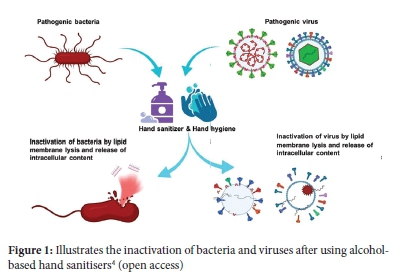
According to the WHO and CDC, the ABHSs should contain approximately 60-95% alcohol.1,4,9,13 The inactivation of viruses using alcohol is illustrated in Figure 1. Ideally, commercially available hand sanitisers should comply with the range above to provide effective antimicrobial activity. These hand sanitisers should also be manufactured using good manufacturing practices (GMP) standards.9148
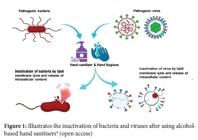
Another concern is that exposure to low alcohol levels in ABHS can increase alcohol tolerance, virulence, and pathogenicity of microorganisms evident in Enterococcus faecium 15Acinetobacter bauannii mutants found in hospitals.1615, 17 Bacteria acquire alcohol tolerance from gene mutations if coupled with extensive drug resistance this will create booms of robust nosocomial infections and eventually result in the formation of 'superbugs'.1718,192010211322 823
The rationale of our study is firstly to investigate the amount of the key active ingredients (ethanol or isopropanol) present within the hand sanitisers using gas chromatography mass spectrometric (GC-MS) . Secondly, verify the labels (alcohol content and or other ingredients) of commercially available hand sanitisers as part of a public awareness campaign to determine if the sanitisers meet the aforementioned WHO and CDC requirements to fully inactivate the corona virus.
MATERIALS AND METHODS
Chemicals and GC column
HPLC grade ethanol, isopropanol and acetonitrile were purchased from Merck (Germany). Ultrapure water was obtained from WaterPro PS Polishing Systems (Labconco, USA). 2 mL HPLC glass vials and caps were purchased from Agilent (USA).
Preparation of calibration standards
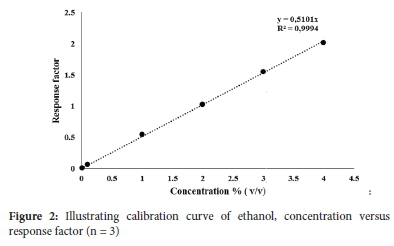
Stock solutions (10% v/v) of ethanol and isopropanol were prepared, with acetonitrile used as an internal standard (IS); 1 mL of the analyte and 200 ||L of the IS were added to a 10 ml volumetric flask which was made up to the mark using H2O. Ethanol and isopropanol calibration standards were prepared from 0.01-4%, respectively with a 2% internal standard (acetonitrile). Samples were capped and vortexed. All samples were injected in triplicate (n = 3).
Sample preparation
The samples were acquired from public sites and commercially available stores in Durban, South Africa. The sample preparations were conducted according to a similar method from an Agilent application note based on GC of hand sanitisers122O. The samples were all vortexed prior to GC analysis. All samples were injected in triplicate (n = 3).
Gas Chromatography-mass spectrometry (GC-MS) detection conditions
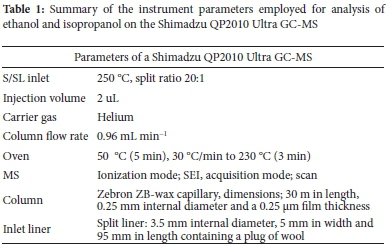
GC-MS was utilised to analyse and quantify alcohol content in hand sanitisers. A GC-MS-QP2010 Ultra (Shimadzu, Japan) equipped with a MS detector and an AOC-20i auto injector (Shimadzu, Japan) coupled to an Edwards E2M1.5 Rotary Vacuum Pump (Edwards, United Kingdom). A Zebron ZB-wax capillary GC column (Phenomenex, USA) was used for GC analysis with the following dimensions 30 m in length, 0.25 mm internal diameter, and a 0.25 µm film thickness. Helium baseline 5.0 was used as a carrier gas (Afrox, South Africa) at a column flow rate of 0.96 mL min-1 and total flow of 23 mL min-1. The ion source temperature was 200 °C; the interface temperature and injection port temperature were both 250 °C. The acquisition mode was set on scan and the ionization mode was standard electron impact ionisation (SEI). The column oven was initially held at a temperature of 50 °C for five minutes thereafter it was increased to 230 °C at a ramping rate of 30 °C min-1 and held at that temperature for 3 minutes. The total run time was 14 minutes. The injection volumes were 0.2 µL utilising a 10 µL syringe (Shimadzu, Japan) which was injected into a split/spitless injector. The injection mode was split injection with a split ratio of 20:1 and a split liner with the following dimensions: 3.5 mm internal diameter, 5 mm in width and 95 mm in length containing a plug of wool. The GC analytical parameters are displayed in Table 1.
Data acquisition and quantitation
The quantitation and data acquisition were conducted using the GCMS solution version 4.45 software. A correlation coefficient (r2
Data analysis
Results were analysed on Microsoft* Excel*. All ABHS samples were analysed in triplicate (n = 3), and the data were represented as the mean ± relative standard deviation (RSD).
RESULTS AND DISCUSSION
The fundamental and accepted constituents in hand sanitisers are ethanol and isopropanol.24241,13,2524Figures 2 and 3).
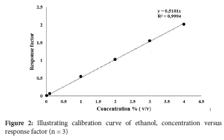
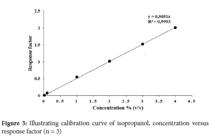
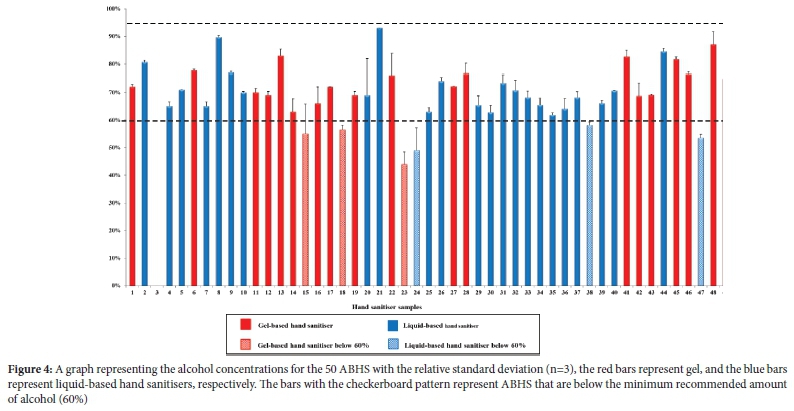
The form in which hand sanitisers are administered also affects its efficiency in killing the Coronavirus.1125Figure 4 and Table S1 in the supplementary section.
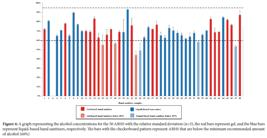
The ABHS comprised of 22 gel and 28 liquid-based hand sanitisers, of which three contained isopropanol and 46 contained ethanol as the key active ingredient, while one contained 1-propanol. Sixteen of the ABHS did not comply with the indicated alcohol percentages on their labels (refer to Figure 4, Figures S1-S4 and Table S1).
The results from this study indicated that the liquid ABHS had a range of 49-93%, and the gel ABHS had approximately 44-87%. A study conducted by Gunter et al., 2010 2111,26
The GC results indicated that Sample 23 (gel based hand sanitiser) had only 44% alcohol content. This is of great concern since it is well below the required range for infection control. This was also observed in a study conducted by Berardi et al., 2020, whereby gels contained approximately 40% alcohol and these ABHS should be used for cosmetic use only and not as a biocide.13
In our study, approximately 68% of commercially available hand sanitisers comply with the aforementioned recommended range of alcohol (60-95%). In contrast, the remainder, 32%, did not adhere to the regulations above and alcohol percent indicated on their respective labels (four were above and six were below the specified amounts, refer to Figure 4 and Table S1). Interestingly, this study found that 16% (4 gel and 4 liquid ABHS) contained >80%. None of the ABHS samples analysed in our study contained more than 95% alcohol, which is an imperative finding as above this, would not result in adequate denaturation of the virus. According to a review conducted by Villa and Russo 2021, hand sanitisers require a mixture of water and alcohol as key active ingredients to achieve effective protein denaturation of viruses.55,22
Herein this study, the data revealed that 12% (3 gels and 3 liquid ABHS) contained <60%. This is of great concern since a minimum of 60% alcohol is needed to act as a microbicide, virucide, or bactericide.4,10,11Figure 4), the general trend is that the samples contained around 60% alcohol. If the alcohol content in hand sanitisers is below the aforementioned requirement, this will limit the growth of pathogens instead of killing them.1017,20
The US FDA allows ethanol and isopropanol as the key active ingredients for ABHS, and ingredients such as 1-propanol and methanol are classified as toxic.8b As such, they recently recalled hand sanitisers based on possible methanol contamination.8b Hand sanitiser sample 3 contained neither ethanol nor isopropanol; however it contained 1-propanol, and sample 33 contained trace amounts of 1-propanol (refer to Figures S5-S7). In additonan, 1-propanol is a toxic ingredient if ingested.7b,8d,16 It also causes mild central nervous system depression (narcosis) and skin irritation.8d,22231717
CONCLUSION
There is currently a paucity of literature on the most effective alcohol concentration in hand sanitisers from governing authorities; there is merely a range stated (60-95%). As such, this study employed a Shimadzu GC-MS-QP2010 Ultra coupled with Zebron ZB-wax capillary GC column to analyze 50 ABHS. Our study also discovered the use of two toxic contaminants (1-propanol and ethyl acetate) in three samples. Consumers must be wary and vigilant regarding the alcohol concentrations in ABHS because substandard products could be marketed to the public. The usage of ABHS with lower alcohol levels is not virucidal and can also result in the development ofhighly virulent "superbugs" with resistant mutations. Hand sanitiser manufacturers should ideally comply with the alcohol content indicated on their product labels and display which regulations/guidelines were followed during their production process. It is imperative that South Africa implement stricter regulations to eliminate the use of substandard hand sanitisers as long-term exposure can cause deleterious health effects. The public should also be more alert to the % alcohol stated (ideal range 60-80%) on the sanitizer bottle and note one needs to rub their hands together until it feels dry.
SUPPLEMENTARY MATERIAL
Supplementary information for this article is provided in the online supplement.
ORCID IDs
Kamini Govender - https://orcid.org/0000-0002-1610-3456
Sipho Mdanda - https://orcid.org/0000-0003-0146-0538
Sooraj Baijnath - https://orcid.org/0000-0001-7860-1779
Gert Kruger - https://orcid.org/0000-0003-0606-2053
Thavendran Govender - https://orcid.org/0000-0003-2511-2503
Tricia Naicker - https://orcid.org/0000-0002-7134-6258
Acknowledgements
This study was made possible through financial support from the School of Health Sciences, University of KwaZulu-Natal, and the National Research Foundation (NRF) of South Africa.
REFERENCES
- 1. Golin AP, Choi D, Ghahary A. Hand sanitizers: A review of ingredients, mechanisms of action, modes of delivery, and efficacy against coronaviruses. Am J Infect Control. 2020 Sep;48(9):1062-1067.
-
2. Worldometer, Covid-19 Corona Virus Pandemic. 2021. https://www.worldometers.info/coronavirus/country/south-africa (accessed 10 October 2021).
» https://www.worldometers.info/coronavirus/country/south-africa - 3. Dhand R, Li J. Coughs and Sneezes: Their Role in Transmission of Respiratory Viral Infections, Including SARS-CoV-2. Am J Respir Crit Care Med. 2020 Sep 1;202(5):651-659.
- 4. Jing JLJ, Pei Yi T, Bose RJC, McCarthy JR, Tharmalingam N, Madheswaran T. Hand Sanitizers: A Review on Formulation Aspects, Adverse Effects, and Regulations. Int J Environ Res Public Health. 2020 May 11;17(9):3326.
- 5. Villa C, Russo E. Hydrogels in Hand Sanitizers. Materials (Basel). 2021 Mar 24;14(7):1577.
- 6. Beiu C, Mihai M, Popa L, Cima L, Popescu MN. Frequent Hand Washing for COVID-19 Prevention Can Cause Hand Dermatitis: management Tips. Cureus. 2020 Apr 2;12(4):e7506.
- 7. Mary B, Jacolin M, Aaron U, William M, Walter A comparison of measurement methods for alcohol-based hand sanitizers. National Institute of Standards and Technology February 2021;(Internal Report 8342):63;
-
8. Bruin W, Korsten L. South Africans Aren't being protected from fake sanitisers: What needs to be done. https://theconversation.com/south-africans-arent-being-protected-from-fake-sanitisers-what-needs-to-be-done-148128 (accessed 9 September 2021).
» https://theconversation.com/south-africans-arent-being-protected-from-fake-sanitisers-what-needs-to-be-done-148128 - 9. Boyce JM, Pittet D. Healthcare Infection Control Practices Advisory Committee. Society for Healthcare Epidemiology of America. Association for Professionals in Infection Control. Infectious Diseases Society of America. Hand Hygiene Task Force. Guideline for Hand Hygiene in Health-Care Settings: recommendations of the Healthcare Infection Control Practices Advisory Committee and the HICPAC/SHEA/APIC/IDSA Hand Hygiene Task Force. Infect Control Hosp Epidemiol. 2002 Dec;23(12) Suppl:S3-S40.
-
10 Sissons B. How Much alcohol, or ethanol, should hand sanitizer contain? https://www.medicalnewstoday.com/articles/how-much-alcohol-should-hand-sanitizer-contain#efficacy (accessed October 10 2021)
» https://www.medicalnewstoday.com/articles/how-much-alcohol-should-hand-sanitizer-contain#efficacy -
11 Charmary JV. How Much Alcohol Do You Really Need in Hand Sanitizer? https://www.forbes.com/sites/jvchamary/2020/07/31/coronavirus-alcohol-based-hand-sanitiser/?sh=7c53bee03a6f (accessed 10 October 2021)
» https://www.forbes.com/sites/jvchamary/2020/07/31/coronavirus-alcohol-based-hand-sanitiser/?sh=7c53bee03a6f -
12 U.S. Food and Drug Administration. Is Your hand sanitizer on FDA's list of products you should not use? https://www.fda.gov/consumers/consumer-updates/your-hand-sanitizer-fdas-list-products-you-should-not-use (accessed 10 October 2021).
» https://www.fda.gov/consumers/consumer-updates/your-hand-sanitizer-fdas-list-products-you-should-not-use - 13. Berardi A, Cenci-Goga B, Grispoldi L, Cossignani L, Perinelli DR. Analysis of commercial hand sanitisers amid CoViD-19: Are we getting the products that we need? AAPS PharmSciTech. 2020 Oct 15;21(7):286.
-
14. Omarjee M. Regulatory and Licensing Requirements for Sanitisers. https://ctfa.co.za/wp-content/uploads/2020/09/Presentation_regulatory-and-licensing-requirements_sanitisers_02092020_Momeena.pdf (accessed 9 September 2021).
» https://ctfa.co.za/wp-content/uploads/2020/09/Presentation_regulatory-and-licensing-requirements_sanitisers_02092020_Momeena.pdf -
15. Pidot SJ, Gao W, Buultjens AH, Monk IR, Guerillot R, Carter GP, Lee JYH, Lam MMC, Grayson ML, Ballard SA, et al. Increasing tolerance of hospital Enterococcus faecium to handwash alcohols. Sci Transl Med. 2018 Aug 1;10(452):eaar6115. https://doi.org/10.1126/scitranslmed.aar6115.
» https://doi.org/10.1126/scitranslmed.aar6115 - 16. Edwards J, Patel G, Wareham DW. Low concentrations of commercial alcohol hand rubs facilitate growth of and secretion of extracellular proteins by multidrug-resistant strains of Acinetobacter baumannii. J Med Microbiol. 2007 Dec;56(Pt 12):1595-1599.
- 17. Perera M. Is There Any Commonality between Transmition of Antimicrobial Resistant Genes and Alcohol Tolerant Genes from One Bacterium to Another. Academia Letters; 2021. p. 2.
-
18 Schreiber M. Some bacteria are becoming 'more tolerant' of hand sanitizers, study finds. https://www.npr.org/sections/goatsandsoda/2018/08/02/635017716/some-bacteria-are-becoming-more-tolerant-of-hand-sanitizers-study-finds (accessed 9 September 2021).
» https://www.npr.org/sections/goatsandsoda/2018/08/02/635017716/some-bacteria-are-becoming-more-tolerant-of-hand-sanitizers-study-finds - 19 Pinholt M, 0stergaard C, Arpi M, Bruun NE, Schenheyder HC, Gradel KO, Segaard M, Knudsen JD, Network DCB; Danish Collaborative Bacteraemia Network (DACOBAN). Incidence, clinical characteristics and 30-day mortality of enterococcal bacteraemia in Denmark 2006-2009: a population-based cohort study. Clin Microbiol Infect. 2014 Feb;20(2):145-151.
- 20. Assefa D, Melaku T. Commercial Hand Sanitizers use amid COVID-19 Pandemic: the Concerns of Antimicrobial Resistance. Infect Drug Resist. 2021 Jun 10;14:2183-2185.
-
21. Matatiele P, Southon B, Dabula B, Marageni T, Poongavanum P, Kgarebe B. Monitoring quality of alcohol-based hand sanitizers used in Johannesburg area during the Covid-19 pandemic. [Preprint]. 2021. Sci Rep https://doi.org/10.21203/rs.3.rs-612413/v1.
» https://doi.org/10.21203/rs.3.rs-612413/v1 - 22. Tse TJ, Purdy SK, Shen J, Nelson FB, Mustafa R, Wiens DJ, Reaney MJT. Toxicology of alcohol-based hand rubs formulated with technical-grade ethanol. Toxicol Rep. 2021 Apr 2;8:785-792.
-
23. Yusuf AA. Determination of alcohols in hand sanitisers: are off-the-shelf hand sanitisers what they claim to be? S Afr J Sci. 2021;117(11/12). https://doi.org/10.17159/sajs.2021/9328.
» https://doi.org/10.17159/sajs.2021/9328 - 24. Zhang J. Hand sanitizer analysis using the Agilent 8860 Gc Configured with a flame ionization detector. USA: Agilent Technologies, Inc.; 2020. p. 1-8.
- 25. Gold NA, Mirza TM, Avva U. Statpearls. Treasure Island (FL): StatPearls Publishing LLC; 2021. Alcohol Sanitizer.
- 26. Kampf G, Marschall S, Eggerstedt S, Ostermeyer C. Efficacy of ethanol-based hand foams using clinically relevant amounts: a cross-over controlled study among healthy volunteers. BMC Infect Dis. 2010 Mar 26;10(1):78.
-
27. National Center for Biotechnology Information. Pubchem Compound Summary for Cid 1031, Propanol. https://pubchem.ncbi.nlm.nih.gov/compound/Propanol. (accessed 10 October 2021).
» https://pubchem.ncbi.nlm.nih.gov/compound/Propanol -
28. National Center for Biotechnology Information. Pubchem compound summary for cid 8857, ethyl acetate. https://pubchem.ncbi.nlm.nih.gov/compound/Ethyl-acetate. (accessed 10 October 2021).
» https://pubchem.ncbi.nlm.nih.gov/compound/Ethyl-acetate
Revised 01 December 2021
Accepted 01 December 2021