Fabrication, characterization and mechanical properties of hematite (a-Fe2O3) filled natural rubber/low-density polyethylene composites
Abstract
In this study, natural rubber (NR) and low-density polyethylene (LDPE) were melt blended in a 2-roll mill to fabricate NR/LDPE composites with liquid natural rubber (LNR) and hematite (a-Fe2O3) as compatibilizer and filler respectively. The effects of liquid natural rubber (LNR) on the mechanical properties and morphology of NR/LDPE composites were investigated. NR/LDPE composites were prepared in three different compositions of 70/30, 50/50 and 30/70, with filler content at varying concentrations (3, 5 and 7 g) while LNR was kept at 10 g for the modified composites. Results obtained showed increment in the tensile strength, tensile modulus, compressive and flexural properties but with decrease in the elongation at break the a-Fe2O3 and LDPE contents increase. The modification of the composites with LNR further enhanced the mechanical properties. FTIR spectrum of LNR revealed a peak at 3395 cm-1 suggesting the hydroxyl (OH) end group attached to the LNR chain due to the photochemical degradation of NR to yield LNR. FTIR spectra of the selected composites showed the presence of iron oxide bond (Fe-O) at 571 cm-1, 467 cm-1 and 463 cm-1 due to the incorporation of a-Fe2O3 filler particles in the composites. SEM images showed improved matrix/filler interfacial adhesion induced by the LNR compatibilizer.
hematite; liquid natural rubber; low-density polyethylene; mechanical properties; natural rubber
INTRODUCTION
Materials made by the combination of two or more different types of fillers are known as hybrid composites. The purpose of filler is to provide the rubber mixes with the suitable processing and functional properties of the composites.1
By proper selection of fillers the material cost can be significantly reduced.2345 464,7 sensors8,9 and for chemical reactions drug delivery systems 101112-15
Low-density polyethylene (LDPE) is a thermoplastic polymer produced from ethylene monomer by a free radical polymerization process. It has a density range of 0.910-0.940 g cm-3 and high degree long chains which give molten LDPE the unique and desirable flow properties. LDPE is suitable for packaging roofing agricultural electrical cable and other applications.161718,19 These shortcomings are a major barrier to using NR in many industrial applications. Hence, the need to modify NR to improve its service and properties.20,21
Thermoplastic natural rubber (TPNR) describes a polymeric blend that is composed of natural rubber (NR) and thermoplastic, such as polypropylene, polystyrene, polyethylene, etc.2222,23 Moreover, owing to the form of the TPNR, it has drawbacks in certain physical and mechanical properties due to the challenge encountered in blending the constituent polymers. Due to the poor interfacial adhesion between NR and LDPE, LNR amongst other compounds has been employed as a compatibilizer, hence enhancing the mechanical properties of the TPNR blends. These compatibilizing agents serve to enhance the miscibility of the constituent polymers by lowering the interfacial tension between the different segments, thereby promoting the interlinking ofthe segments.24,25 In addition, the mechanical properties of TPNR like all other polymeric materials are improved by the infusion of fillers.26,27 The capability of fillers to have physical and/or chemical interconnection with TPNR compounds in proper conditions is also a significant aspect of reinforcement. While the physical and chemical makeup of the infused filler substance will determine its potency as a reinforcement material, the measure to which this occurs is dependent on several factors such as the filler-polymer interconnection, filler amount present and possibly filler-filler interconnection.28,29 Furthermore, uniform distribution and proper dispersion of the filler substances are important for the mechanical strengthening of every polymer including TPNR.303O4), a-Fe2O3, aluminium oxide (Al2O3), titanium oxide (TiO2) silicon dioxide (SiO2) and lead oxide (PbO) when added into a polymer matrix may result to a marked enhancement of various mechanical properties of the resultant composites.28,31-34
Nurhajati et al.352O3) filler resulted in depreciation of the tensile strength and elongation at break of linear low-density polyethylene/natural rubber (LLDPE/NR) composites. Ramlee et al.362 nanofillers caused an improvement in the tensile strength and hardness of polyvinylchloride/epoxidized natural/ titanium oxide (PVC/ENR/TiO2) nanocomposites. Jiang et al.37 3O4 nanoparticles displayed a marked increase in tensile strength and elastic recovery upon infusion of Fe3O4 nanoparticles.
According to Mirjalili et al.382O3 filler particles (1 to 4 wt.) in the PP matrix brought about enhancements in the tensile strength flexural strength and flexural modulus of the resultant composites. On the other hand further increase in the a-Al2O3 loading yielded a decrease in the aforementioned investigated mechanical properties of the composites owing to agglomeration of a-Al2O3 particles. Altan et al.39 2 and ZnO nanoparticles as fillers in increasing amounts (1%, 3% and 5%) into the PP matrix led to an increase in yield strength tensile strength and elastic modulus of the resultant composites. However, elongation of the composites decreased with increase in the aforementioned metal oxides. Piffer et al.402O3 in composites of PP and maleic anhydride grafted PP increased the elastic modulus. On the other hand the ultimate tensile, strength elongation, at, break and impact strength of the composites declined with increasing IOT loading. Lin et al.41
Not much has been done in the use of a-Fe2O3 particles as filler for matrix based on NR/LDPE. Hence this work presents the preparation of NR/LDPE composites filled with particles of locally sourced hematite (a-Fe2O3). Also we attempt to characterized and investigate some mechanical properties of the resultant NR based composites filled with hematite (a-Fe2O3) filler particles. To the best of our knowledge the use of hematite from Katsina State in Nigeria as a filler for NR/LDPE in the presence of LNR as a compatibilizer has not been reported.
MATERIALS AND METHODS
Materials
NR latex was obtained from the Rubber Research Institute of Nigeria (RRIN), Nigeria. Ribbed smoked sheet natural rubber with plasticity retention of 64 was supplied by Stevemoore Chemical Co. (Zaria, Nigeria). Zinc oxide (ZnO), stearic acid, sulphur, mecarptobenzothiazole (MBT), 1, 2-dihydro-2, 2, 4-trimethylquinoline (TMQ), toluene and hydrogen peroxide (H2O2), all of the analytical grades were also purchased from Stevemoore Chemical Co., Zaria. LDPE with a density of 0.92 g cm-3, melt flow index (MFI) of 2.4 g per 10 min and crystalline melting temperature of 115 °C was purchased from Ceeplast Industries Nig. Limited, Aba, Nigeria. Hematite lumps were obtained from natural deposits in Kastina State, Nigeria and were crushed to 10 |im size particles.
Preparation of liquid natural rubber (LNR) compatibilizer
The preparation of LNR followed a method adopted by Ngo et al.25 2O2 was introduced into the solution of NR latex and toluene and stirred for 15 min. The resultant mixture was placed into a dish and kept in a UV irradiation box for 1h. LNR produced was removed from the UV irradiation box and the supernatant layer of toluene was decanted. The prepared LNR was rinsed with distilled water and dried in an oven at 70 °C for 24 h.
Preparation of NR/LDPE/hematite composites
NR/LDPE/Hematite composites were made according to the method adopted by Mokhtar et al.462O3) particles were incorporated into the admixture and left to mix for 3 min. Finally sulphur was introduced and the mixture was left to mix for another 3 min. Thereafter the resultant admixture was placed in a 3 mm thick mould and compressed in a compression moulding machine at 140 °C and 4 MPa for 7 min. The compressed sheets were stored for further use.
Preparation of NR/LDPE/LNR/hematite composites
The fabrication of NR/LNR/LDPE/Hematite composites was accomplished according to the methods used by Suaysom and Keawwattana4725
In all the compounding formulations, material composition comprises NR/LDPE (70/30, 50/50, 30/70), Hematite (3, 5 7 g), LNR (10 g), ZnO (5 g), sulphur (2 g), stearic acid (2 g), MBT (1.5 g) and TMQ (1 g) as the case maybe.
Chemical composition analysis of hematite (a-Fe2O3)
Chemical analysis of the as-obtained hematite (a-Fe2O3) filler sample was achieved with the aid of EDX-720 X-ray Fluorescence (XRF) spectrometer.
Mechanical properties test
Tensile compression and flexural properties were determined using an Instron Universal Testing Machine (Instron ID No. 3369K1781) having a capacity of 50 kN (11 250 lb). Investigation of the tensile properties was done in line with ASTM D638. Compressive strength and compressive modulus of the samples were investigated in line with ASTM D3410/D3410 M. Flexural properties of the composite samples were investigated in line with ASTM D7264/ASTM D7264 M-07. Three samples representing three measurements were used for each test and an average of the results was taken as the resultant value.
Characterization of, NR/LDPE/LNR/hematite, composites
The physicochemical properties of NR, LNR and NR/LDPE/LNR/ Hematite composites were analyzed using SEM and FTIR. Fourier Transform Infrared Spectroscopic analysis (FTIR) of NR LNR and selected composites were studied with the aid of Shimadzu FTIR-8400S machine in the range of 400-400 cm-1 with a resolution of 4 cm-1. The dispersion of the filler particles in the matrix was studied with the aid of the Carl Zeiss Scanning Electron Microscopy (SEM) machine Model EVO LS10. Samples were fractured in liquid nitrogen and coated with thin carbon film to avoid charge built up due to their low conductivity.
RESULTS AND DISCUSSION
XRF analysis of hematite (a-Fe2O3) filler
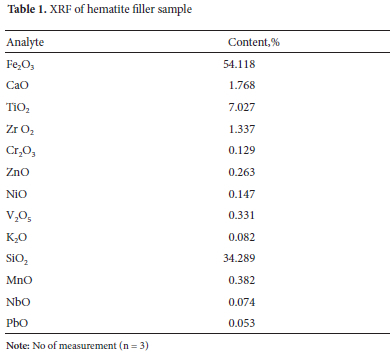
Table 1 presents the result of the chemical analysis of iron ore from Katsina state using XRF in weight per cent. The ore contains 54.118% Fe2O3 and 34.289% SiO2 as major constituents with 7.027% TiO2, 1.768% CaO, 1.337% ZrO2, 0.382% MnO, 0.331% V205, 0.263% ZnO, 0.147% NiO and 0.129% Cr2O3 as minor constituents and K2O, NbO and PbO as traces. It is important to note that the quality of raw iron ore and its sustainability for commercial utilization is largely determined by its chemical composition.484950
Mechanical properties of the NR/LDPE filled composites
The mechanical properties of composite materials are greatly dependent on some factors such as the filler content filler orientation filler length properties of the filler reinforcement and matrix and processing method and condition. Hence, the effect of LNR, filler and LDPE contents on the mechanical properties of the prepared NR/ LDPE composites has been evaluated below.
Tensile strength and tensile modulus
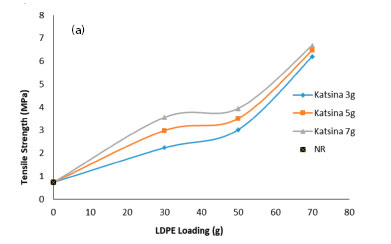
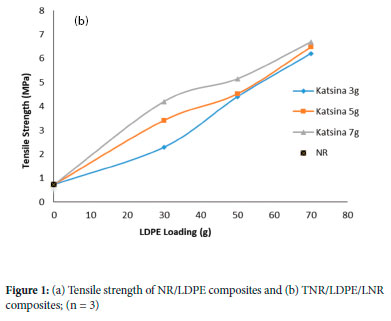
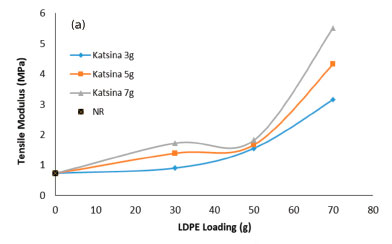
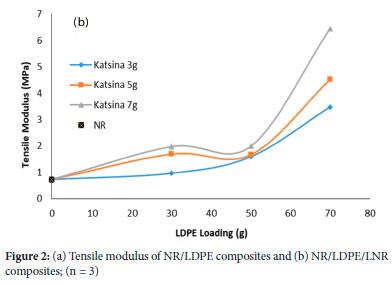
Effect of Filler Content: It was observed that a rise in the filler content resulted in the increment of the tensile strength (TS) and tensile modulus (TM) of the composites (Figures 1 and 2). The composites achieved peak values of TS and TM at 7 g filler content. Then increase in the filler content was believed to generate adequate stress transfer and amplification in the reinforcement experienced therefore causing an increase in TS and TM of the composites. These results are in agreement with previous research works by Alam and Choi,51525351522O3 particulate filled hybrid composites at three different filler content of 6, 8 and 10%. They reported that the filled composites exhibited high tensile strength compared to the unfilled composites. It was revealed that the composite with 6% Hematite ore (filler) of 40% iron content showed the highest tensile strength (249.17 N mm-2) compared with the rest. The performance could be linked to improving particle dispersion and strong polymer/filler interface adhesion ensuring effective stress transfer. Channapagoudra et al.5354
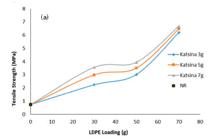
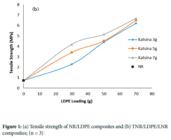
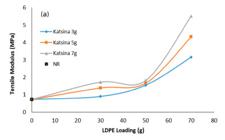
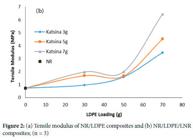
Considering the LDPE content in the NR/LDPE Composites there is an increment in the TS and TM of the prepared composites as the LDPE content increases (Figures 1 and 2). As expected the increment in the amount of LDPE is believed to confer on the composite improved strength and stiffness.55562556 253O4-Ag hybrid nanoparticles and natural rubber-polyethylene blends reported that the addition of the HDPE component to the NR matrix produced a higher tensile strength value than neat NR and further increased when the NR/HDPE composites was treated with compatibilizer. Effect of LNR: From Figures 1(a) and 2(a) it can be seen that the composites without LNR displayed low values of TS and TM when compared with composites with LNR (Figures 1(b) and 2(b)). The results show that the incorporation of LNR promoted vulcanization with improved filler dispersion and good interfacial bonding between NR and LDPE thus attaining remarkable improvements in the TS and TM of the NR/LDPE composites. The strong adhesion was assumed to promote improved stress transferability due to increasing matrix/ filler interphase interlocking in the composites. For instance at 7g filler content the values of TS and TM increased from 6.48 MPa and 5.52 MPa to 6.69 MPa and 6.45 MPa respectively. It is expected the active sites present on LNR like -OH, -OOH and -OR would improve the matrix-matrix and fibre-matrix interactions.5758 595860
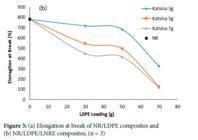
Elongation at break
Effect of Filler Content:
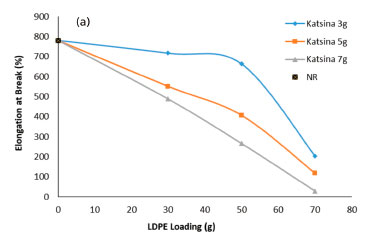
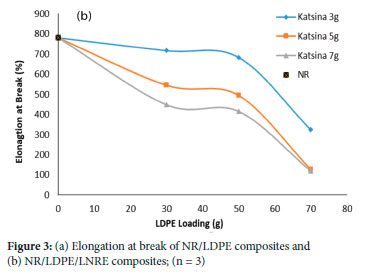
Figure 3 reveals that increment in the filler content brought a downward trend in the elongation at break of the composites. Then, the decrease experienced could be attributed to the consequential rise in the degree of reinforcement occasioned by the rising filler content. This resulted in the uncoiling of the molecular chains of the makeup of the composite. The report is in line with the study done by Piffer et al.61Figure 3). The result is expected because LDPE as a thermoplastic polymer possesses greater rigidity and lower measure of elasticity6256 Effect of LNR: Composites without LNR (Figure 3(a)) recorded lower values for elongation at break than those with LNR as illustrated in Figure 3(b). As earlier advanced the intermolecular and interfacial interactions between the various component of the composites are made possible by the presence of an LNR compatibilizer.2563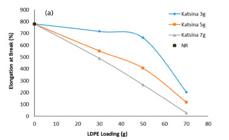
Compressive properties
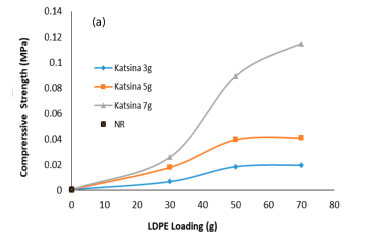
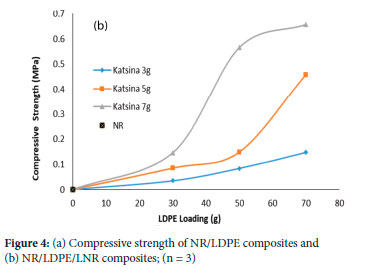
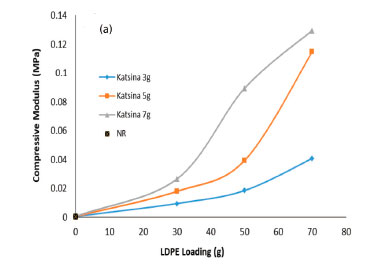
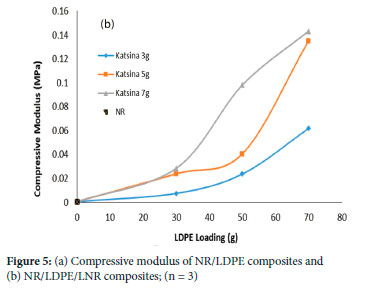
The effect of LNR, filler and LDPE contents on the compressive strength and compressive modulus for modified and unmodified NR/ LDPE composites are presented in Figures (4 and 5). Effect of Filler Content: From Figures 4a and 5a it is observed that the compressive strength (CS) and compressive modulus (CM) of the composites showed a direct relationship with the addition of filler. The behaviour suggests that the increase in filler content increases the properties under study. As previously acknowledged this observed situation could be linked to good filler-matrix interaction and enhanced stress transfer. These reports are in agreement with the reports put forward by Gencel et al.646564Figures 4(a) and 5(a) reveal that there is a corresponding increase in CS and CM of the composites as LDPE content in the composite is increased. This observation was also attributable to the steady increase in the semi-crystalline LDPE nature and the synchronous decline in the amorphous nature of the elastomeric NR.66
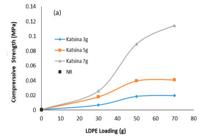
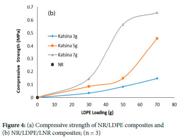
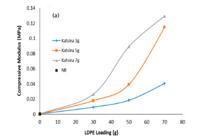
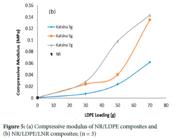
Effect of LNR: The effect of LNR on the CS and CM of the NR/LDPE composites are shown in Figures (4(b) and 5(b)). It is evident from the figures that the addition of LNR to the composites further enhanced the compressive strength and compressive modulus. The results showed that at 5 g filler content the values of CS and CM increased from 0.041 MPa and 0.115 MPa to 0.046 MPa and 0.135 MPa, respectively. As earlier reported the increase in values of the properties under study was a result of improved intermolecular cohesion and interfacial bonding of NR and LDPE portions owing to the presence of LNR.2567
Flexural properties
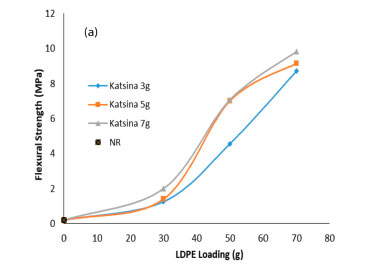
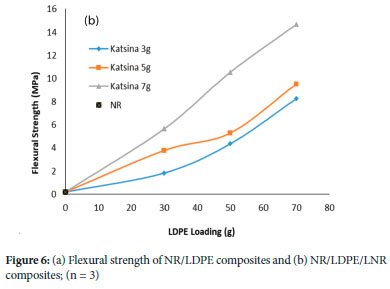
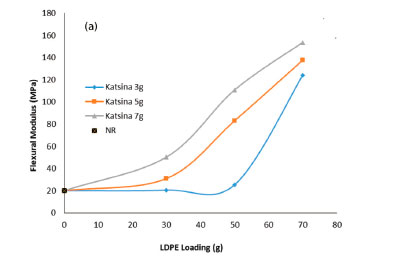
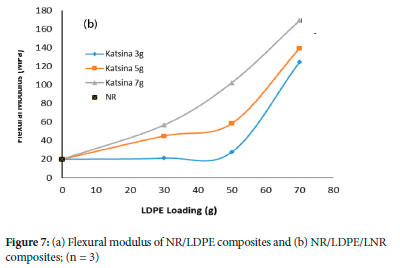
The flexural strength (FS) and flexural modulus (FM) of NR composites filled with hematite filler and low-density polyethylene have been investigated (Figures 6 and 7). Also, the effect of the addition of liquid natural rubber to composites on flexural properties was evaluated. Effect of filler content: The flexural strength (FS) and flexural modulus (FM) behaviour of the NR/LDPE composites on the addition of hematite filler are illustrated graphically in Figures 6(a) and 7(b) respectively. It is evident from the figures that the incorporation of the filler gave rise to an increase in the values of the FS and FM. It is reasonable to state that the hematite filler acted as a reinforcing filler. The rise in the FS and FM also indicated that there was a satisfactory mix of the matrix and filler particles as the filler content increased.64 6853525368522O3 particulate filled hybrid composites and reported that the addition of hematite ore had a strong and positive effect on the properties.
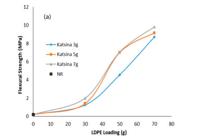
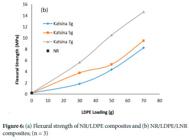
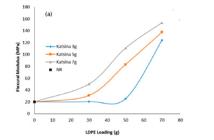
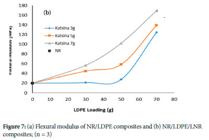
Also from Figures 6(a) and 7(a) the rise in FS and FM as the LDPE content increases was noticed. It is observed that the incorporation of LDPE in NR resulted in an increase in the flexural strength of the composites. The increase in FS could be ascribed to the existence of LDPE as a rigid component in NR. However such a hard fraction acts as a filler thus increasing the FS of the component. Simply put the flexural strength of rubber vulcanizates usually rises due to the addition of polyethylene to natural rubbers.695655 Effect of LNR: It is evident that the FS and FM of the composites with LNR exhibited higher improvement than the composites without LNR (Figures 6(b) and 7(b)). For instance at 7 g filler content the values of FS and FM increased from 9.82 MPa and 153.67 MPa to 14.66 MPa and 169.26 MPa respectively. The outcome is due to the bonding role played by LNR which led to improved filler dispersion and interfacial adhesion of NR and LDPE domains. Other researchers have reported a similar trend involving NR-based blend/composites compatibilized with LNR.24,25,63,70,71
Physicochemical characterization of NR, LNR and NR/LDPE composites
FTIR analysis
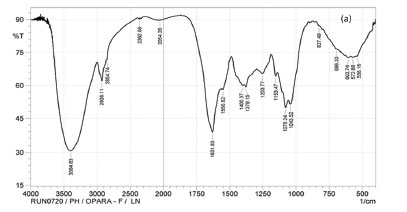
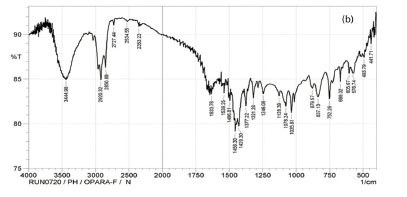
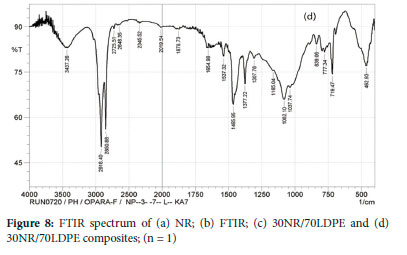
The FTIR spectra of NR and LNR are illustrated in Figures 8(a) and 8(b) respectively. As expected Figure 8(a) displayed some characteristic peaks of NR such as carbon-carbon double bond (C=C) stretch at 1634 cm-1; CH2 and CH3 deformation at 1456 cm-1; and 837 cm-1 for C-H out of plane bending vibration.72Figure 9(b), specific new peaks were observed indicating possible degradation of NR leading to the formation of LNR. Such peaks include 1400 cm-1 denoting methylene (CH2) and methyl (CH3) deformation 1632 cm-1 denoting carbon-carbon double bond (C=C) stretch. Moreover a broad peak at 3395 cm-1 suggests hydroxyls (OH) stretching and vibration. The presence of the OH group is attributed to the photochemical degradation of NR.25
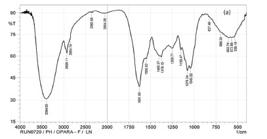
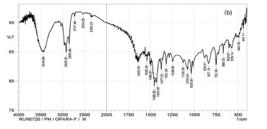
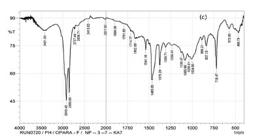
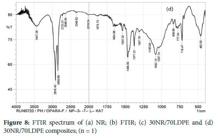
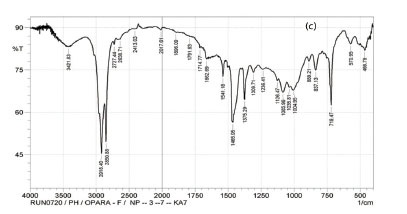
The 30NR/70LDPE and 30NR/70LDPE/LNR composites for 7 g Hematite content were used as representative samples for this study. The FTIR spectra of these samples are presented in Figures 8(c) and 8(d). From the figures, it is evident that selected composites contain the characteristic peaks of NR and LDPE. Some of the NR characteristic peaks in the composites as shown in Figures 8(c) and 8(d) include 1663 cm-1 and 1655 cm-1 for C=C stretch; 837 cm-1 and 839 cm-1 for C-H out of plane bending vibration 72-1 for C-H bends.25Figures 9(c and d) are 2918 cm-1 and 2851 cm-1 for CH stretch in backbone of the polymer chain; 1466 cm-1 form ethylene (CH2) bend; 1375 cm-1 and 1377 cm-1 for methyl (CH3) bend; and 719 cm-1 for CH2 rock.73,74
The FTIR spectrum of 30NR/70LDPE composite containing hematite filler showed characteristic peaks of hematite at 571 cm-1
and 467 cm-1 which suggest an iron oxide bond (Fe-O) stretching and vibration respectively. The spectrum of 30NR/70LDPE/LNR composite filled with hematite gave a characteristic peak of hematite at 463 cm-1 indicating Fe-O vibration.75Figures 8(a) and 8(b). The absence of this type of peak further confirms the presence of hematite in the composite samples prepared. Moreover the band between 2727.44 cm-1 and 1897 cm-1 in Figure 8(c) reduced in intensity in Figure 8(d) (2725 cm-1 and 1879 cm-1). The scenario reflects the presence of a compatibilizer.76777879
SEM Morphological analysis
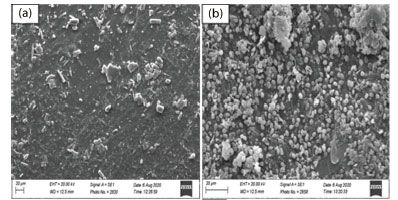
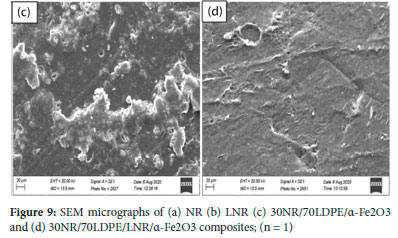
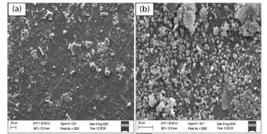
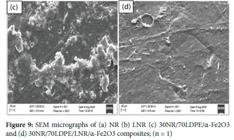
The micrographs and phase behaviour of the LNR modified NR/ LDPE system were obtained from the SEM images of fracture surfaces. The representative SEM images of NR LNR and NR/LDPE composites are presented in Figure 9 As stated before 30NR/70LDPE and 30NR/70LDPE/LNR composites for 7 g Hematite content. It is evident that in Figures 9(a) and 9(b) latex particles of NR before photochemical degradation are not as conspicuous as latex particles of LNR after the same degradation process. It is also evident that the LNR latex particles appear as clear spherical shaped particles. A similar report has been reported by Ibrahim et al.80Figures 9(c) and 9(d) represent NR/LDPE and NR/LDPE/LNR filled with hematite particles at 7 g content respectively. As evident in the figure a-Fe2O3 filler particles are presented as distinguishable white spots dispersed in the matrix. Belgin and Aycik 79Figure 9(c) displays a disjointed system owing to interfacial tension existing between NR and LDPE segments brought about by the absence of a compatibilizer. On the other hand Figure 9(d) shows a homogeneous interface between NR and LDPE constituents and to a reasonable degree the filler particles. The observed scenario could be attributed to the presence of LNR; thus performing its role as a compatibilizer in ensuring improved matrix/filler interaction with a reduction in the interfacial tension between NR and LDPE segments. The improvement in the interfacial adhesion between matrix and fillers using compatibilizers such as LNR has been reported by Ngo et al.25817879
CONCLUSION
The result shows that liquid natural rubber (LNR) has been demonstrated to be a good compatibilizer for natural rubber blends. LDPE and LNR jointly enhanced the property performance of NR/ LDPE composites. Tensile strength, tensile modulus compressive and flexural properties were found to improve significantly with the addition of hematite (a-Fe2O3) fillers however with a reduction in the elongation at break. The composites containing LNR were homogeneous and with optimum mechanical properties found around the 7 g filler content. Morphology of the composites revealed apparent compatibility of NR and LDPE in the presence of LNR compatibilizer with further confirmation shown by the FTIR spectra.
CONFLICT OF INTERESTThe authors declare no conflict of interest.
ORCID IDs
Henry Chinedu Obasi: https://orcid.org/0000-0003-1989-2507
Franklin Anaele Opara: https://orcid.org/0009-0004-5307-0990
Genevive Chinyere Onuegbu: https://orcid.org/0000-0001-7347-124X
Kate Oluchi Chike: https://orcid.org/0000-0003-3495-1368
Godwin Nkemjika Onyeagoro: https://orcid.org/0000-0001-9432-7060
ACKNOWLEDGEMENT
Support from the Department of Polymer and Textile Engineering, Federal University of Technology, Owerri, Nigeria, is gratefully acknowledged.
REFERENCES
-
1. Wypych G. Fillers-origin, chemical composition, properties and morphology. Hand. Fillers. 2016;(4(266)):13. https://doi.org/10.1016/B978-1-895198-91-1.50004-X
» https://doi.org/10.1016/B978-1-895198-91-1.50004-X -
2. Sreekala M, George J, Kumaran M, Thomas S. The mechanical performance of hybrid phenol-formaldehyde-based composites reinforced with glass and oil palm fibres. Compos. Sci. Tech. 2002;62(3):339-353. https://doi.org/10.1016/S0266-3538(01)00219-6
» https://doi.org/10.1016/S0266-3538(01)00219-6 -
3. Fröhlich J, Niedermeier W, Luginsland H-D. The effect of filler-filler and filler-elastomer interaction on rubber reinforcement. Composites Part A: Appl. Sci. Manufact. 2005;36(4):449-460. https://doi.org/10.1016/j.compositesa.2004.10.004
» https://doi.org/10.1016/j.compositesa.2004.10.004 -
4. Kim JY, Magesh G, Youn DH, Jang J-W, Kubota J, Domen K, Lee JS. Single-crystalline, wormlike hematite photoanodes for efficient solar water splitting. Sci. Rep. 2013;3(1):1-8. https://doi.org/10.1038/srep02681
» https://doi.org/10.1038/srep02681 -
5. Lu X, Zeng Y, Yu M, Zhai T, Liang C, Xie S, Balogun MS, Tong Y. Oxygen-deficient hematite nanorods as high-performance and novel negative electrodes for flexible asymmetric supercapacitors. Adv. Mater. 2014;26(19):3148-3155. https://doi.org/10.1002/adma.201305851
» https://doi.org/10.1002/adma.201305851 -
6. Jubb AM, Verreault D, Posner R, Criscenti LJ, Katz LE, Allen HC. Sulfate adsorption at the buried hematite/solution interface investigated using total internal reflection (tir)-raman spectroscopy. J. Coll. Inter. Sci. 2013;400:140-146. https://doi.org/10.1016/j.jcis.2013.02.031
» https://doi.org/10.1016/j.jcis.2013.02.031 -
7. Sivula K, Zboril R, Le Formal F, Robert R, Weidenkaff A, Tucek J, Frydrych J, Gratzel M. Photoelectrochemical water splitting with mesoporous hematite prepared by a solution-based colloidal approach. J. Amer. Chem. Soc. 2010;132(21):7436-7444. https://doi.org/10.1021/ja101564f
» https://doi.org/10.1021/ja101564f -
8. Gong J, Wang L, Zhao K, Song D. One-step fabrication of chitosan-hematite nanotubes composite film and its biosensing for hydrogen peroxide. Electr. Comm. 2008;10(1):123-126. https://doi.org/10.1016/j.elecom.2007.10.017
» https://doi.org/10.1016/j.elecom.2007.10.017 -
9. Picasso G, Kou MS, Vargasmachuca O, Rojas J, Zavala C, Lopez A, Irusta S. Sensors based on porous pd-doped hematite (a-fe2o3) for lpg detection. Microp. Mesop. Mater. 2014;185:79-85. https://doi.org/10.1016%2Fj.micromeso.2013.11.014
» https://doi.org/10.1016%2Fj.micromeso.2013.11.014 -
10. Wu M, Xia X-M, Cui C, Yu P, Zhang Y, Liu L, Zhuo R-X, Huang S-W. Highly efficient loading of amorphous paclitaxel in mesoporous hematite nanorods and their in vitro antitumor activity. J. Mater. Chem. B. 2013;1(12):1687-1695. https://doi.org/10.1039/c3tb00472d
» https://doi.org/10.1039/c3tb00472d -
11. Wysokowski M, Motylenko M, Walter J, Lota G, Wojciechowski J, Stöcker H, Galli R, Stelling AL, Himcinschi C, Niederschlag E. Synthesis of nanostructured chitin-hematite composites under extreme biomimetic conditions. RSC Adv. 2014;4(106):61743-61752. https://doi.org/10.1039/C4RA10017D
» https://doi.org/10.1039/C4RA10017D -
12. Kausar A. Polymeric materials filled with hematite nanoparticle: Current state and prospective application. Polym.-Plast. Tech. Mater. 2020;59(3):323-338. https://doi.org/10.1080/25740881.2019.1647238
» https://doi.org/10.1080/25740881.2019.1647238 -
13. Chandrakumara G, Dissanayake D, Mantilaka M, De Silva R, Pitawala H, de Silva K. Eco-friendly, green packaging materials from akaganeite and hematite nanoparticle-reinforced chitosan nanocomposite films. J. Nanomater. 2019;1049142. https://doi.org/10.1155/2019/1049142
» https://doi.org/10.1155/2019/1049142 -
14. Bogdanovic G, Kovac T, Dzunuzovic E, Spirkova M, Ahrenkiel SP, Nedeljkovic J. Influence of hematite nanorods on the mechanical properties of epoxy resin. J. Serb. Chem. Soc. 2017;82(4):437-447. https://doi.org/10.2298/JSC160707017B
» https://doi.org/10.2298/JSC160707017B -
15. Keskisaari A, Kãrki T. Utilization of industrial wastes from mining and packaging industries in wood-plastic composites. J. Polym. Environ. 2018;26:1504-1510. https://doi.org/10.1007/s10924-017-1052-z
» https://doi.org/10.1007/s10924-017-1052-z -
16. Sampath W, Sandaruwan P, Edirisinghe D, Sudusingha Y. Effect of artocarpus heterophyllus latex on properties of calcium carbonate filled natural rubber/low density polyethylene/waste polyethylene composites. Phy. Sci. Biophys. J. 2020;4(1). https://doi.org/10.23880/PSBJ-16000140
» https://doi.org/10.23880/PSBJ-16000140 - 17. Eng A, Ong E. 2000. Hevea natural rubber, in plastics engineering: Handbook of Elastomers. New York: Marcel Dekker.
- 18. Schweitzer PA. 1988. Development and application of elastomers. Corrosion and Corrosion Protection Handbook, 2nd Edn. Boca Raton: CRC Press, 1988.
- 19. Roff WJ, Scott JR. 1971. Fibres, films, plastics and rubbers: A handbook of common polymers. Ist edn. eBook. Elsevier.
- 20. Sethuraj MR, Mathew N (eds). 1992. Natural rubber: Biology, cultivation and technology. 1st Edn. eBook. Elsevier.
- 21. Azahar N, Hassan N, Jaya R, Kadir M, Yunus N, Mahmud M. An overview on natural rubber application for asphalt modification. Int. J.Agric., Fores. Plant. 2016;2:212-218.
-
22. Kahar A, Sarifuddin N, Ismail H. Structural, thermal and physico-chemical properties of high density polyethylene/natural rubber/modified cassava starch blends. Ir. Polym. J. 2017;26(2):149-159. https://doi.org/10.1007/s13726-017-0507-3
» https://doi.org/10.1007/s13726-017-0507-3 -
23. Yu L-J, Ahmad SH, Kong I, Tarawneh MA, Flaifel MH. Preparation and characterisation of nizn ferrite/multiwalled nanotubes thermoplastic natural rubber composite. Int. J. Mater. Eng. Innov. 2. 2013;4(3-4):214-224. https://doi.org/10.1504/IJMATEI.2013.057149
» https://doi.org/10.1504/IJMATEI.2013.057149 -
24. Dahlan H, Khairul Zaman M, Ibrahim A. Liquid natural rubber (lnr) as a compatibilizer in nr/lldpe blends. J. Appl. Polym. Sci. 2000;78(10):1776-1782. https://doi.org/10.1002/1097-4628(20001205)78:10%3C1776::AID-APP90%3E3.0.CO;2-G
» https://doi.org/10.1002/1097-4628(20001205)78:10%3C1776::AID-APP90%3E3.0.CO;2-G -
25. Ngo TD, Le TMH, Nguyen TV, Nguyen TA, Le TL, Nguyen TT, Tran TTV, Le TBT, Doan NH. Antibacterial nanocomposites based on fe3o4-ag hybrid nanoparticles and natural rubber-polyethylene blends. International J. Polym. Sci. 2016;7478161. https://doi.org/10.1155/2016/7478161
» https://doi.org/10.1155/2016/7478161 -
26. Likozar B, Major Z. Morphology, mechanical, cross-linking, thermal and tribological properties of nitrile and hydrogenated nitrile rubber/multi-walled carbon nanotubes composites prepared by melt compounding: The effect of acrylonitrile content and hydrogenation. Appl. Surf. Sci. 2010;257(2):565-573. https://doi.org/10.1016/j.apsusc.2010.07.034
» https://doi.org/10.1016/j.apsusc.2010.07.034 -
27. Pal K, Rajasekar R, Kang DJ, Zhang ZX, Pal SK, Das CK, Kim JK. Effect of fillers on natural rubber/high styrene rubber blends with nano silica: Morphology and wear. Mater. Desi. 2010;31(2):677-686. https://doi.org/10.1016/j.matdes.2009.08.014
» https://doi.org/10.1016/j.matdes.2009.08.014 -
28. El-Nemr K, Balboul M, Ali M. Electrical and mechanical properties of manganese dioxide (magnetite) filled nbr rubber blends. Arab J. Nucl. Sci. Appl. 2014;47(1):75-85. https://doi.org/10.1177/0892705714533372
» https://doi.org/10.1177/0892705714533372 - 29. Katbab A, Anaraki M, Nazokdast H. Polypropylene/nbr thermoplastic elastomers: Mechanics, rheology, crystallinity. Iranian Journal of Polym. Sci. Tech. 1993;2(1):12-18.
-
30. Bokobza L. Natural rubber nanocomposites: A review. Nanomaterials. 2018;9(1):12. https://doi.org/10.3390/nano9010012
» https://doi.org/10.3390/nano9010012 -
31. Chatterjee A, Islam M. Fabrication and characterization of TiO2-epoxy nanocomposite. Mater. Sci. Eng.: A. 2008;487(1-2):574-585. https://doi.org/10.1016%2Fj.msea.2007.11.052
» https://doi.org/10.1016%2Fj.msea.2007.11.052 -
32. Mahrholz T, Stângle J, Sinapius M. Quantitation of the reinforcement effect of silica nanoparticles in epoxy resins used in liquid composite moulding processes. Compos. Part A: Appl. Sci. Manufact.. 2009;40(3):235-243. https://doi.org/10.1016/jxompositesa.2008.11.008
» https://doi.org/10.1016/jxompositesa.2008.11.008 -
33. Wetzel B, Rosso P, Haupert F, Friedrich K. Epoxy nanocomposites-fracture and toughening mechanisms. Eng. Fract. Mech. 2006;73(16):2375-2398. https://doi.org/10.1016/j.engfracmech.2006.05.018
» https://doi.org/10.1016/j.engfracmech.2006.05.018 -
34. Mahmoud ME, El-Khatib AM, Badawi MS, Rashad AR, El-Sharkawy RM, Thabet AA. Recycled high-density polyethylene plastics added with lead oxide nanoparticles as sustainable radiation shielding materials. J. Clean. Prod. 2018;176:276-287. https://doi.org/10.1016/j.jclepro.2017.12.100
» https://doi.org/10.1016/j.jclepro.2017.12.100 -
35. Nurhajati DW, Lestari UR, Setyorini I. Effect of Bi2O3 on the properties of linier low density polyethylene (lldpe)/natural rubber compound (nrc) composites. Majalah Kulit, Karet, dan Plastik. 2020;36(1):17-24. https://doi.org/10.20543/mkkp.v36i1.6128
» https://doi.org/10.20543/mkkp.v36i1.6128 -
36. Nur AR, Chantara TR, Alias NH, Mohd TAT. Effect of TiO2 nanofillers on mechanical properties of pvc/enr/TiO2 nanocomposites. Adv. Mater. Res.; 2014: Trans Tech Publ. https://doi.org/10.4028/www.scientific.net/AMR.911.105
» https://doi.org/10.4028/www.scientific.net/AMR.911.105 - 37. Jiang F, Zhang Y, Wang Z, Wang W, Xu Z, Wang Z. Combination of magnetic and enhanced mechanical properties for copolymer-grafted magnetite composite thermoplastic elastomers. ACS Appl. Mater. Interf. 2015;7 (19):10563-10575.
-
38. Mirjalili F, Chuah L, Salahi E. Mechanical and morphological properties of polypropylene/nano a-al2o3 composites. The Sci. World J. 2014;718765. https://doi.org/10.1155/2014/718765
» https://doi.org/10.1155/2014/718765 - 39. Altan M, Yildirim H, Uysal A. Tensile properties of polypropylene/metal oxide nano composites. The On. J. Sci. Techn. 2011;1(1):25-30.
-
40. Piffer V, Soares K, Galdino AJCPBE. Evaluation of mechanical and thermal properties of pp/iron ore tailing composites. Compos. Part B: Eng. 2021:109001. https://doi.org/10.1016/jxompositesb.2021.109001
» https://doi.org/10.1016/jxompositesb.2021.109001 -
41. Lin OH, Akil HM, Mahmud S. Effect ofparticle morphology on the properties of polypropylene/nanometric zinc oxide (pp/nanozno) composites. Adv. Compos. Lett. 2009;18(3). https://doi.org/10.1177/096369350901800302
» https://doi.org/10.1177/096369350901800302 -
42. Teoh PY, Abdulbaset ME, Cao XV, Du Ngoc UL. Effects of filler incorporation routes on mechanical properties of low density polyethylene/ natural rubber/silica (ldpe/nr/si) composites. Appl. Mech. Mater.; 2014. https://doi.org/10.4028/www.scientific.net/AMM.679.154
» https://doi.org/10.4028/www.scientific.net/AMM.679.154 -
43. Wickramaarachchi W, Walpalage S, Egodage S. Effect of particulate fillers on natural rubber/high-density polyethylene blends for roofing application. Polym. Polym. Compos. 2021; 29(6):763-769. https://doi.org/10.1177/0967391120934615
» https://doi.org/10.1177/0967391120934615 -
44. Sampath W, Egodage S, Edirisinghe D. Effect of an organotitanate coupling agent on properties of calcium carbonate filled low-density polyethylene and natural rubber composites. J. Nat. Sci. Found. Sri Lanka. 2018;47(1):17-27. https://doi.org/10.4038/jnsfsr.v47i1.8923
» https://doi.org/10.4038/jnsfsr.v47i1.8923 -
45. Ahmad I, Latif N, Abdullah I. Effects of clay and lnr on mechanical properties and morphology of nr/hdpe-aramid composites. Polym. J.. 2005;37(11):866-869. https://doi.org/10.1295/polymj.37.866
» https://doi.org/10.1295/polymj.37.866 - 46. Mokhtar N, Abdullah MH, Ahmad SH. Structural and magnetic properties of type-m barium ferrite-thermoplastic natural rubber nanocomposites. Sains Malay. 2012;41(9):1125-1131.
- 47. Suaysom W, Keawwattana W. Thermal ageing of thermoplastic elastomeric natural rubber-low density polyethylene blends. Agric. Nat. Res. 2006;40(1):148-157.
-
48. Muwanguzi AJ, Karasev AV, Byaruhanga JK, Jönsson PG. Characterization of chemical composition and microstructure of natural iron ore from muko deposits. ISRN Mater. Sci. 2012;174803. https://doi.org/10.5402/2012/174803
» https://doi.org/10.5402/2012/174803 - 49. Agava A, Murina R, Abdurrahman A, Egbe E, Thomas D. Determination of chemical, mineralogical composition and liberation size of ochokochoko iron ore, kogi state. Nig. J. Eng. 2016;23(1):77-86.
- 50. Salawu A, Yaro S, Thomas D. Determination of chemical composition and liberation size of gujeni iron ore deposit, kaduna state, nigeria. Nig. Min. J.2015;13(1):62-67.
-
51. Alam MN, Choi JJCC. Highly reinforced magneto-sensitive natural-rubber nanocomposite using iron oxide/multilayer graphene as hybrid filler. Compos. Comm. 2022;101169. https://doi.org/10.1016/jxoco.2022.101169
» https://doi.org/10.1016/jxoco.2022.101169 -
52. Chavan VR, Dinesh K, Veeresh K, Algur V. Fabrication and evaluation of mechanical properties of fe2o3 particulate filled hybrid composites. J. Adv. Res. Mech. Civil Eng. 2015;2(3):81-85. https://doi.org/10.53555/nnmce.v2i3.360
» https://doi.org/10.53555/nnmce.v2i3.360 - 53. Channapagoudra M, Joshi AG, Thaned S, Patil M. Effect of hematite filler material on mechanical properties of glass/epoxy composites. Int. J. Innov. Res. Sci., Eng. Tech. 2013;2(11):6229-6234.
-
54. Ismail H, Khoon TB, Hayeemasae N, Husseinsyah S. Effect of oil palm ash on the properties of polypropylene/recycled natural rubber gloves/oil palm ash composites. BioRes. 2015;10(1):1495-1505. https://doi.org/10.15376/biores.10.1.1495-1505
» https://doi.org/10.15376/biores.10.1.1495-1505 -
55. Wickramaarachchi W, Walpalage S, Egodage S. Identification of the polyethylene grade most suitable for natural rubber-polyethylene blends used for roofing applications. Eng.: J. Inst. Eng., Sri Lanka. 2016;49(4):7233. https://doi.org/10.4038/engineer.v49i4.7233
» https://doi.org/10.4038/engineer.v49i4.7233 -
56. Ahmed K. An investigation on chloroprene-compatibilized acrylonitrile butadiene rubber/high density polyethylene blends. J. Adv. Res. 2015;6(6):811-817. https://doi.org/10.1016/j.jare.2014.06.003
» https://doi.org/10.1016/j.jare.2014.06.003 -
57. Ibrahim A, Dahlan M. Thermoplastic natural rubber blends. Prog. Polym. Sci.. 1998;23(4):665-706. https://doi.org/10.1016/S0079-6700(97)00052-X
» https://doi.org/10.1016/S0079-6700(97)00052-X -
58. Bijarimi M, Ahmad S, Alam A. Toughening effect of liquid natural rubber on the morphology and thermo-mechanical properties of the poly (lactic acid) ternary blend. Polym. Bull. 2017;74(8):3301-3317. https://doi.org/10.1007/s00289-016-1889-7
» https://doi.org/10.1007/s00289-016-1889-7 -
59. Jamil MS, Ahmad I, Abdullah I. Effects of rice husk filler on the mechanical and thermal properties of liquid natural rubber compatibilized high-density polyethylene/natural rubber blends. J. Polym. Res. 2006;13(4):315-321. https://doi.org/10.1007/s10965-005-9040-8
» https://doi.org/10.1007/s10965-005-9040-8 -
60. Ahmad S, Abdullah I, Sulaiman CS, Kohjiya S, Yoon J. Natural rubber-hdpe blends with liquid natural rubber as a compatibilizer. I. Thermal and mechanical properties. J. Appl. Polym. Sci. 1994;51(8):1357-1363. https://doi.org/10.1002/app.1994.070510801
» https://doi.org/10.1002/app.1994.070510801 -
61. Piffer V, Soares K, Galdino A. Evaluation of mechanical and thermal properties of pp/iron ore tailing composites. Compos. Part B: Eng. 2021;109001. https://doi.org/10.1016/jxompositesb.2021.109001
» https://doi.org/10.1016/jxompositesb.2021.109001 -
62. Mastalygina E, Varyan I, Kolesnikova N, Gonzalez MIC, Popov A. Effect of natural rubber in polyethylene composites on morphology, mechanical properties and biodegradability. Polym. 2020;12(2):437. https://doi.org/10.3390/polym12020437
» https://doi.org/10.3390/polym12020437 -
63. Nakason C, Nuansomsri K, Kaesaman A, Kiatkamjornwong S. Dynamic vulcanization of natural rubber/high-density polyethylene blends: Effect of compatibilization, blend ratio and curing system. Polym. Test. 2006;25(6):782-796. https://doi.org/10.1016/j.polymertesting.2006.05.001
» https://doi.org/10.1016/j.polymertesting.2006.05.001 -
64. Gencel O, Brostow W, Martinez-Barrera G, Gok MS. Mechanical properties of polymer concretes containing different amount of hematite or colemanite. Polim. 2012;57(4):276-283. https://doi.org/10.14314/polimery.2012.276
» https://doi.org/10.14314/polimery.2012.276 -
65. Dankwah JR. Waste epoxy modified iron oxide-polymer composite pellets: Green strength development and oxide reactivity in ironmaking technology. Ghana Min. J. 2018;18(2):48-55. https://doi.org/10.4314/gm.v18i2.6
» https://doi.org/10.4314/gm.v18i2.6 -
66. Hrdlicka Z, Kuta A, Hajek J. Thermoplastic elastomer blends based on waste rubber and low-density polyethylene. Polim. 2010;55(11-12):832-838. https://doi.org/10.14314/polimery.2010.832
» https://doi.org/10.14314/polimery.2010.832 -
67. Varyan I, Mastalygina E, Kolesnikova N, Popov A. Physical-mechanical properties of polyethylene-natural rubber blends. J. Phy: Conf. Ser.; 2018;012036. https://doi.org/10.1088/1742-6596/1129/1/012036
» https://doi.org/10.1088/1742-6596/1129/1/012036 - 68. Chauhan VR, Dinesh K, Veeresh K, Algur V, Shettar M. Analysis of mechanical properties of glass/orthophthalic polyster resin with hematite ore filled composites. Int. J. Res. 2014;1(7):167-171.
- 69. Utracki LA, Favis B. Polymer alloys and blends. Hand. Polym. Sci. Tech. 1989;4:121-185.
-
70. He F, Yuan T, Li C, Sun L, Liao S. Interfacial interactions and properties of natural rubber-silica composites with liquid natural rubber as a compatibilizer and prepared by a wet-compounding method. J. Appl. Polym. Sci. 2018;135(30):46457. https://doi.org/10.1002/app.46457
» https://doi.org/10.1002/app.46457 -
71. Idris MSF, Mustaffarizan NM, Yusoff SFM. Hydrogenated liquid natural rubber for compatibility enhancement of poly (lactic acid) and natural rubber blends. Sains Malay. 2021;50(10):3003-3014. https://doi.org/10.17576/jsm-2021-5010-14
» https://doi.org/10.17576/jsm-2021-5010-14 -
72. Joly S, Garnaud G, Ollitrault R, Bokobza L, Mark J. Organically modified layered silicates as reinforcing fillers for natural rubber. Chem. Mater. 2002;14(10):4202-4208. https://doi.org/10.1021/cm020093e
» https://doi.org/10.1021/cm020093e -
73. Asensio RC, Moya MSA, de la Roja JM, Gómez M. Analytical characterization of polymers used in conservation and restoration by atr-ftir spectroscopy. Analy. Bioanaly. Chem. 2009;395(7):2081-2096. https://doi.org/10.1007/s00216-009-3201-2
» https://doi.org/10.1007/s00216-009-3201-2 - 74. Nishikida K, Coates J. Infrared and raman analysis of polymers. In: Handbook of Plastics Analysis. 2003: CRC Press. pp.201-340.
-
75. Saravanakumar B, Jansi Rani B, Ravi G, Sakunthala A, Yuvakkumar R. Influence of reducing agent concentration on the structure, morphology and ferromagnetic properties of hematite (a-fe2o3) nanoparticles. J. Mater. Sci.: Mater. Elect. 2017;28(11):8093-8100. https://doi.org/10.1007/s10854-017-6515-4
» https://doi.org/10.1007/s10854-017-6515-4 -
76. Hamour N, Boukerrou A, Djidjelli H, Maigret J-E, Beaugrand J. Effects of mapp compatibilization and acetylation treatment followed by hydrothermal aging on polypropylene alfa fibre composites. Int. J. Polym. Sci. 2015;451691. https://doi.org/10.1155/2015/451691
» https://doi.org/10.1155/2015/451691 -
77. Mensah EE, Abbas Z, Azis RaS, Ibrahim NA, Khamis AM. Complex permittivity and microwave absorption properties of opefb fiber-polycaprolactone composites filled with recycled hematite (a-Fe2O3) nanoparticles. Polym. 2019;11(5):918. https://doi.org/10.3390/polym11050918
» https://doi.org/10.3390/polym11050918 -
78. Mussatti E, Merlini C, Barra GMdO, Güths S, Oliveira APNd, Siligardi C. Evaluation of the properties of iron oxide-filled castor oil polyurethane. Mater. Res. Bull. 2013;16(1):65-70. https://doi.org/10.1590/S1516-14392012005000143
» https://doi.org/10.1590/S1516-14392012005000143 -
79. Belgin E, Aycik G. Effect of particle size of mineral fillers on polymer-matrix composite shielding materials against ionizing electromagnetic radiation. J. Rad. Nucl. Chem. 2017;311(3):1953-1961. https://doi.org/10.1007/s10967-016-5156-z
» https://doi.org/10.1007/s10967-016-5156-z -
80. Ibrahim S, Othman N, Yusof NH. Preparation, characterization and properties of liquid natural rubber with low non-rubber content via photodegradation. Polym. Bull. 2020:1-17. https://doi.org/10.1007/s00289-019-03030-4
» https://doi.org/10.1007/s00289-019-03030-4 -
81. Guo Z, Zhang D, Wei S, Wang Z, Karki AB, Li Y, Bernazzani P, Young DP, Gomes J, Cocke DL. Effects of iron oxide nanoparticles on polyvinyl alcohol: Interfacial layer and bulk nanocomposites thin film. J. Nanopart. Res. 2010;12(7):2415-2426. https://doi.org/10.1007/s11051-009-9802-z
» https://doi.org/10.1007/s11051-009-9802-z
Revised 21 April 2023
Accepted 24 April 2023