Application of quaternized activated carbon derived from Macadamia Nutshells for the removal of hexavalent chromium from aqueous solutions
Abstract
In this paper, the feasibility of quaternized activated carbon derived from Macadamia nutshells was explored in the removal of hexavalent chromium (Cr(VI)) from aqueous solutions. The amino-modified activated carbon was achieved by cross-linking native Macadamia activated carbon (MAC) with epichlorohydrin and grafting diethylenetriamine and triethylamine (EDT) on the surface and the product was labelled as MAC-EDT. The adsorbent was characterized by Fourier transform infrared spectros-copy (FTIR), Bruemer-Emmett-Teller (BET), scanning electron microscope (SEM) and the CHNS analyzer. The optimum parameters for Cr(VI) removal found were pH (5), contact time (120 min) and sorbent mass (0.10 g) where removal efficiencies were >90 % in all cases. Langmuir model fitted the data best and the adsorption capacity was 145.5 mg g-1 after surface modification with EDT. The Cr(VI) ion was found to be adsorbed more as compared to other anions, and the sorption order was: SO42- <PO43- ≈ NO3- < Cr2O72. The removal mechanism involved adsorption of Cr(VI) and/or subsequent reduction of Cr(VI) to Cr(III).
Activated carbon; amination; Macadamia; chromium(VI); adsorption; reduction
1. Introduction
Petroleum refining, electroplating, chrome mining, leather tanning, paint and pigments manufacturing industrial activities may generate chromium waste.123,4 Like other metal pollutants, chromium is non-biodegradable and toxic. In the environment, chromium may exhibit different oxidation states ranging from +2 to +6, but the trivalent (Cr(III)) and hexavalent (Cr(VI)) oxidation states are the most prevalent. These forms of chromium have different mobilities and levels of toxicity in aqueous environment.546789
The World Health Organization (WHO) has set rules for the maximum tolerable concentration limits of 0.05 mg L-1 of Cr(VI) in drinking water and 0.1 mg L-1 in inland surface water.10,11 A variety of methods including chemical precipitation,121314151617
ACs derived from various agricultural waste and biomass including Moringa oleífera seed powder,181920212223,24 ACs can be produced by either chemical or physical activation, and it is common that oxidizing conditions are employed in order to impart the surface oxygen groups to the carbon252627
Therefore, in this study, the AC was modified by amination to increase the -NH which at low pH might lead to protonation and subsequent electrostatic attraction of anionic Cr(VI) as well as adding the quaternary functionality, -N+(CH2CH3)3Cl-,on the surface. No study has been reported on the use of amino-functionalized AC produced from Macadamia nutshells for the removal of Cr(VI) from aqueous solutions, as far as we know. The removal mechanism of Cr(VI) by activated carbon is complex and may include adsorption of Cr(VI) onto carbon surface followed by subsequent reduction of Cr(VI) to Cr(III), and release back into the solution of reduced Cr(III) or adsorption of Cr(III) onto the carbon surface.28
2. Materials and Methods
2.1.
Chemicals and InstrumentationPotassium dichromate (K2Cr2O7) sodium hydroxide (NaOH) and hydrochloric acid (HCl) were purchased from Merck Chemical Co (Johannesburg, South Africa). Epichlorohydrin, diethylenetriamine, triethylamine, N,N-dimethylformamide and 1,5-diphenylcarbazide were purchased from Sigma-Aldrich (Johannesburg, South Africa). Commercial Macadamia activated carbon (MAC) was supplied by Innovation Carbon FILTATECH (Johannesburg, South Africa).
Ultrapure water from LaboStar equipment by Siemens (Warrendale, Pennsylvia, USA) was used to make all solutions.
The pH of solutions was monitored by the ADWA AD111 OPRpH meter from Adwa Instruments (Szeged, Hungary). A Multichannel stirrer MS-53M model Jeio Tech (Seoul, Korea) was used for stirring solutions in batch adsorptions. Atomic absorption spectrophotometer AA7000 from Shimadzu (Kyoto, Japan) was used for measuring total chromium concentration in solutions whilst Cr(VI) was determined by UV-VIS (T80+) supplied by PG Instruments. CL10 ThermoScientific centrifuge supplied by Labotec (Johannesburg, South Africa) was utilized for centri-fugation. KyPlot 2.0 software (Quasi-Newton algorithm) was used to plot the data for isotherm and kinetic models.
Elemental analysis of activated carbon was determined on a Thermo Flash 2000 series CHNS/O Organic Elemental Analyser. The surface area was measured on a Micromeritics Flow Prep 060 from Tristar instrument. Proximate and component analysis was done following a method reported by Li et al.29
2.2.
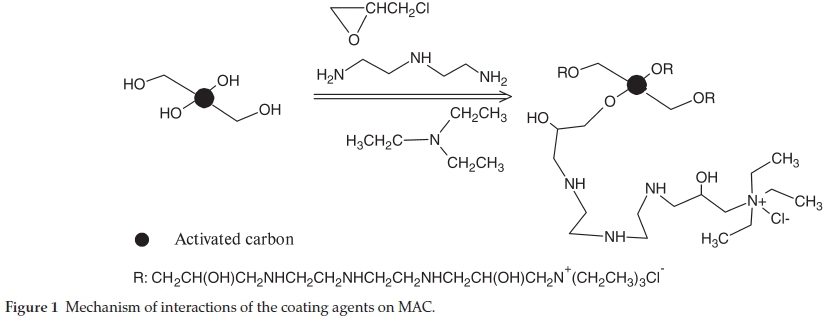
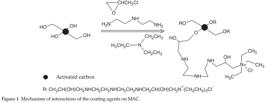
Preparation of Amino-modified Activated CarbonA method described by Xu et al.30Fig. 1 shows the general scheme for the synthesis of MAC-EDT.
2.3.
Preparation of Stock and Standard SolutionsChromium(VI) stock solution of 1000 mg L-1 was prepared by dissolving pre-dried K2Cr2O7 in ultrapure water. Working and standard solutions were prepared from serial dilutions of the stock solution. All chemical reagents used were of high-purity analytical grade.
2.4.
Determination of pH of Point of Zero ChargeThe point of zero charge (pHpzc) of MAC-EDT was determined by a method from literature.313 (0.02 M; 45 mL) was transferred into each of six different 100 mL glass beakers. Dilute solutions of HCI (0.1 M) or NaOH (0.1 M) were used to adjust the pH such that each beaker had a different pH from pH 2 to 12. Following pH adjustments, KNO3 solution was used to make up the final volume in each beaker to 50 mL. The initial (pHi) in each beaker was recorded. In each beaker, 0.1 g MAC-EDT powder was then added and the solutions were stirred for 24 h at ambient temperature. The final pH (pHf) of the stirred solution was recorded. The pHpzc was obtained by plotting the change in pH (∆pH) versus the initial pH.
2.5.
Adsorption StudiesThe effects of adsorption-controlling parameters such as the solution pH, contact time, metal ion initial concentration and adsorbent dosage play a critical role in pollutant sequestration by ACs.32,33 Hence, the influence of these parameters on the removal of Cr(VI) by MAC-EDT was investigated in the present study. All adsorption experiments were carried out at room temperature while stirring the solution at 300 rpm. Solutions of HCl and NaOH were used to adjust the initial pH of solution (pH 2-11). The initial concentration of Cr(VI) was varied from 10-180 mg L-1 while the adsorbent mass was varied from 0.02-0.12 g and stirring time range studied was from 10-240 min. Binary solutions of Cr(VI) and competing anions were prepared to evaluate the effect of co-existing anions on the removal of Cr(VI) by MAC-EDT. All experiments were conducted in duplicate and the reported results are averages. Following completion of adsorption reactions, the mixtures were centrifuged and Cr(VI) concentration of one part of the supernatant was determined by UV-Vis spectrophotometer (λmax 540 nm). The chromogenic agent used to develop colour was the 1,5-diphenylcarbazide (DPC) reagent (0.2 mL of 10 % H2SO4 solution and 2 mL DPC) as per the previously reported method.34


where, qe is the adsorbed Cr(VI) (mg g-1 adsorbent) on the sorbent, m is the weight of sorbent (g), V is the volume of metal solution (L), Co is the initial concentration (mg L-1), and Ce is the final concentration (mg L-1) of Cr(VI).
2.6.
Adsorption ModellingAdsorption isotherms are used to predict the mechanism of pollutant removal and the adsorption capacity. This is crucial in order to know when the adsorption sites will be exhausted during prolonged use of an adsorbent, say in industrial scale. The equilibrium Cr(VI) concentration (Ce) data together with calculated adsorption (qe) data were modelled by the non-linear forms of Langmuir and Freundlich isotherms. The Langmuir isotherm relates to a monolayer coverage of a homogeneous surface by an adsorbate with restricted number of identical sites,35L) as described by Equation (4) is used to predict the favourability or unfavourability of an adsorption process. When the RL values lie between 0 and 1 they indicate favourable adsorption while if the RL is greater than 1, then an unfavourable adsorption is predicted.36,37


where, b is the Langmuir isotherm constant (L mg-1), qm represents maximumCr(VI) uptake (mgg-1),qeis the calculated Cr(VI) uptake (mg g-) and Ce is the equilibrium Cr(VI) concentration (mg L-1). The Freundlich model relates to a multilayer uptake of an adsorbate on a heterogeneous surface.38

where, KF is the Freundlich constant (L g-1) and 1/n is the Freundlich exponent. The Freundlich constant Kf is related to adsorption capacity and the exponent 1/n is a measure of the sorption intensity or surface heterogeneity.39
2.7.
Kinetic ModellingPseudo-first-order (PFO) and pseudo-second-order (PSO) kinetic equations were used to evaluate the processes controlling adsorption of Cr(VI) by MAC-EDT and the rate of mass transfer. The PFO and PSO equations for the models are given in their linearized forms in Equations (6) and (7), respectively.40


where, qt (mg g-1) is the metal ion sorption capacity at time t, k1 (min-1) is the PFO rate constant and k2 (g mg-1 min-1) is the PSO rate constant.
3. Results and Discussion
3.1. Characterization of Macadamia Activated Carbon
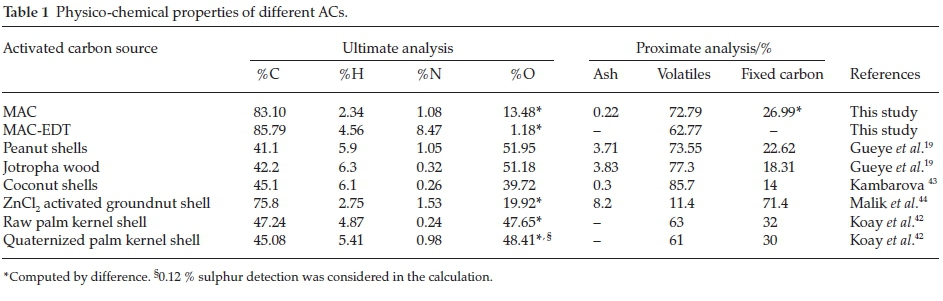
Proximate and ultimate analysis results of MAC-EDT and other ACs found in literature are displayed in Table 1. The higher % C in MAC-EDT shows that Macadamia nutshells are very carbonaceous. The higher % N confirms that nitrogen groups from ethylenediamine and triethylamine were grafted on the surface of MAC-EDT. Accordingly, the % O content of MAC-EDT decreased due to loss of H2O as moisture during the grafting of epichlorohydrin on the surface of MAC. Therefore, this implied MAC-EDT had a low ratio of acidic functional groups on its surface. Proximate analysis showed that ash, volatile and fixed carbon contents of MAC were comparable with other ACs in literature. The fixed carbon content (26.99 %) was slightly higher compared to most ACs and this was related to the higher % C value obtained by the CHNS analyzer. The high percentage of fixed carbon was due to lignin content observed in plant materials, while the cellulose and hemicellulose make up for the volatile matter.4119%) as compared to other biomass activated carbons. Low values are always favourable since their presence inhibits surface area development.20Table 1). For example, there was evident increase in the % N (8.47 %) due to presence of diethylenetriamine and triethylamine on the surface of MAC. The ash content increased after functionalization while the volatile content decreased. Also, the BET surface area decreased from 689 to 0.518 m2-1 signifying the closure of pores by the cross-linking reagent. The decrease of BET after functionalization has also been observed in literature.42
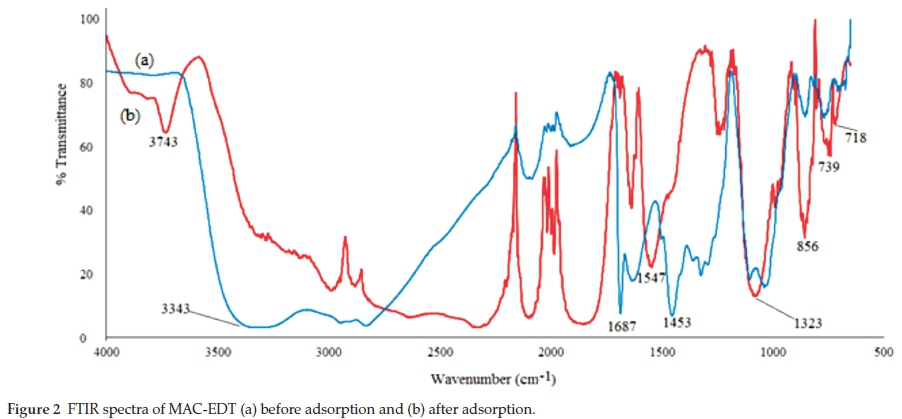
Figure 2 shows the FTIR spectra of MAC-EDT before and after adsorption of Cr(VI). Distinct differences between the spectra, particularly in the region of 1600-1000 cm-1 were observed. These differences signified that the AC surface was modified or changed after being in contact with Cr(VI) due to oxidation of certain functional groups. The characteristic broad peak at 3343 cm-1 is normally associated with the -OH group of biomaterials and sometimes it overlaps with the -NH group (Fig. 2a). Upon contact with Cr(VI), the intensity of the band decreased which signified its involvement in chromium removal (Fig. 2b). The grafting of amino groups on the surface of activated carbon can be confirmed by the presence of various peaks between 1687 and 1150 cm-1. The vibrational peaks at 1687, 1582 and 1453 cm-1 were attributed to C=O of activated carbon structure, NR3+ asymmetric bending and the C-N stretching of CH2-N+R3 group, respectively.7,45 The difference in the peaks at 1323 and 1150 cm-1 between the Cr(VI)-loaded and unloaded MAC-EDT spectra could be attributed to the symmetric deformation of C-H bands of CH2 group and the symmetric C-O-(H) stretching vibrations, respectively.7,45 However, upon contact with Cr(VI) the C-O-H group was oxidized leading to the formation of new peaks at 1547 and 1323 cm-1. The peak at 1547 cm-1could be due to the formation of the carboxylate ion due to oxidation of alcohol structure by Cr(VI). Also, elsewhere,46-1 which were characteristic of C-N stretching vibration region, signified their involvement in metal uptake. Therefore, the observed changes in the spectra of MAC-EDT after contact with Cr(VI) showed that the removal mechanism was not simply adsorption but it also involved transformation of some functional groups because of the oxidative nature of Cr(VI), which was later reduced to Cr(III).
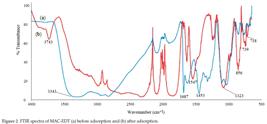
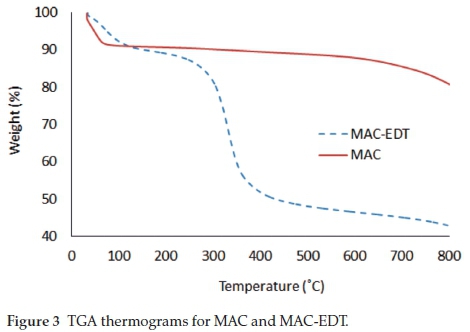
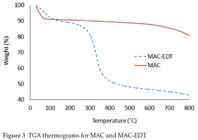
Figure 3 depicts the TGA thermograms of the native (MAC) and the modified activated carbon (MAC-EDT). It was observed that both materials had a moisture content of approximately 10 %. The thermal stability of the raw MAC was evident as it was not degradable even at high temperatures (>100 °C). However, for the MAC-EDT, there was drastic weight loss at around 325 °C which was as a result of the degradation. After 600 °C, there remained 46 % which was the native MAC content. This, after removing the water content, translated to a loading capacity of 440 mg g-1 for the coating organic moiety (EDT).
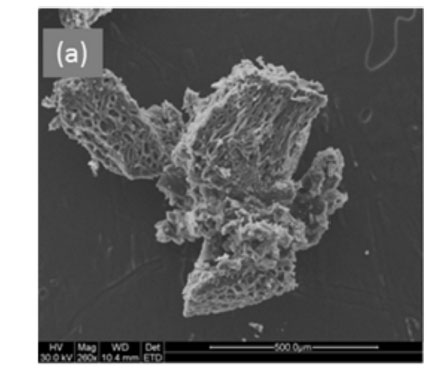
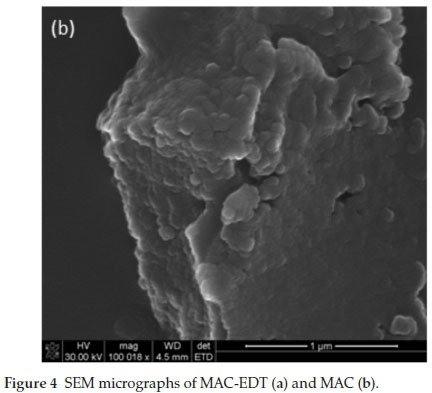
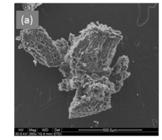
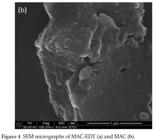
The morphological properties and texture of MAC-EDT were evaluated using SEM and the micrographs are shown in Fig. 4a. The porosity of the material is evident with interconnected networks. A closer look at the surface shows that pores are actually elongated which confirmed that MAC-EDT retained the structure of lignocellulose-based plant materials proving that the activation process removed more of the non-carbon materials.212-1) due to the coating of MAC by EDT. The uncoated MAC material (Fig. 4b) shows well-defined crystal clusters33
3.2. Effect of pH on Adsorption of Chromium(VI)
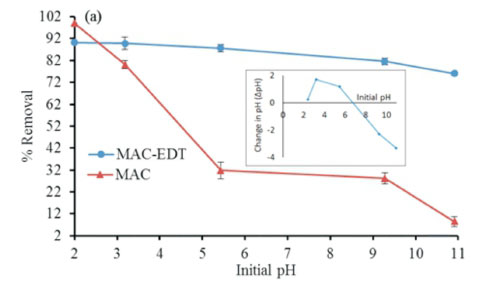
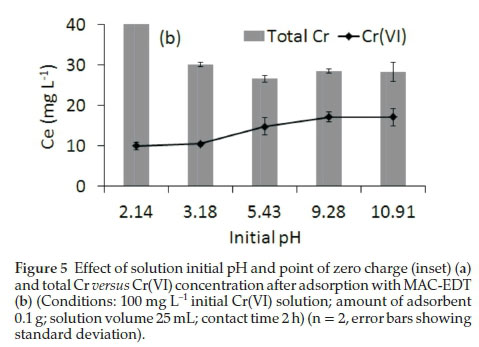
The influence of solution pH on adsorption of Cr(VI) was investigated by varying the pH from 2 to 11 while other parameters were kept constant. Fig 5a shows the percentage removal of Cr(VI) by MAC-EDT and MAC. Removal of Cr(VI) by MAC-EDT did not show a strong pH dependence. Only about 10 % decrease in removal efficiency was observed as the pH was increased from pH 2 to 11. This was attributed to the EDT modification that introduced a permanent positive charge on the MAC-EDT resulting in electrostatic attraction and/or ion exchange mechanism. Similar trends were observed else-where.18,21,27 The optimal removal of chromium(VI) occurred at pH 2, but pH 5 was used for subsequent experiments as optimum pH due to observed high reduction of Cr(VI) to Cr(III) occurring at pH 2 (Fig. 5b). In relation to Cr(VI) removal by MAC-EDT, there was not much difference at pH 2 and pH 5 but the amount of Cr(III) left in solution as a result of reduction informed the decision to use pH 5 as the optimum. On the other hand, the removal of Cr(VI) by MAC showed a strong dependence on pH as the percentage removal decreased with increase in pH. The lower removal efficiency from pH 5 to 11 by MAC compared to MAC-EDT was attributed to competition of binding sites by Cr2O42- and OH- species (from NaOH used for pH adjustment). The different trends in Cr(VI) removal by MAC and MAC-EDT implied that the surface modification of MAC by EDT influenced the removal mechanism of Cr(VI) by the carbons.
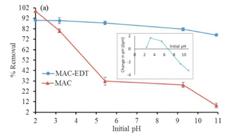
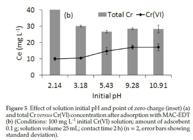
Cr(VI) is an oxyanionic species, hence the observed high percentage removal at low pH was due to surface attraction of negatively charged Cr(VI) anion to positively charged MAC-EDT surface which was positive at pH < pHpzc (MAC-EDT was 6.83, Fig. 5a insert) and subsequent reduction of Cr(VI) to Cr(III). On the other hand, presence of hydroxyl ion at basic pH is known to interfere with the removal of Cr(VI) species, hence the decreased removal efficiency at higher pH. Furthermore, the surface of the material tends to be largely negative at pH > pHpzc resulting in repulsion of negatively charged chromium(VI) species.
Total chromium concentration was measured before and after adsorption of Cr(VI) by MAC-EDT to elucidate any reduction potential of Cr(VI) to Cr(III). Fig. 5b displays the results of equilibrium chromium concentration after adsorption from a 100 mg L-1 initial concentration. Cr(VI) undergoes reduction to Cr(III) at very acidic conditions47,48 and this was observed in Fig. 4b at pH 2. The amount of total chromium in solution after adsorption was high, implying that the formed Cr(III) was repelled into solution by the positively charged groups on MAC-EDT surface, particularly at pH 2.
The basicity character of ACs which is responsible for the reduction of Cr(VI) to Cr(III), is attributable to the presence of heteroatoms such as sulfur and nitrogen on the surface of ACs.49494-transforms to its dimerized form Cr2O72-.50
3.3. Effect of Adsorbent Dosage on Adsorption of Chromium(VI) Ion
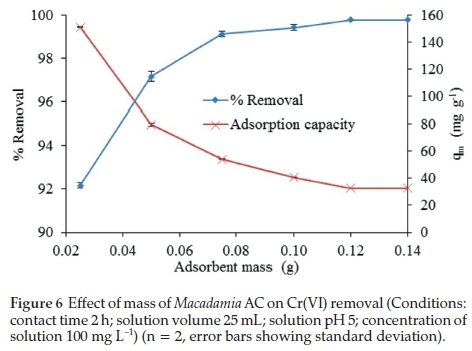
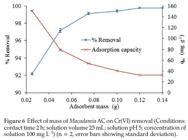
Figure 6 displays the percentage removal of chromium(VI) as a function of adsorbent mass (0.02 to 0.14 g). It can be observed that the percentage removal increased from 92 % to 100 % when the sorbent dosage was increased from 0.02 to 0.10 g. This is because the number of the adsorption sites increased as the mass of the MAC-EDT was increased.51%, as it is known that up to a certain weight, the sorbent will reach equilibrium where no appreciable removal extraction will be registered.51-1) generally decreases with increase in adsorbent mass and this can be explained by the inverse proportionality relationship between qe and m in Equation (2).
3.4. Effect of Initial Concentration and Adsorption Modelling
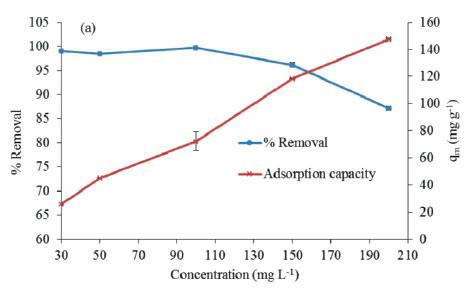
The effect of initial solution concentration on the removal of Cr(VI) by MAC-EDT was evaluated by changing the concentration, while maintaining other parameters uniform. Almost 100 % removal efficiency was achieved up to 100 mg L-1 and then a decrease to 87 % at 200 mg L-1 was observed (Fig. 7a). The removal efficiency at higher concentrations decreased due to higher ratio of Cr(VI) ions present in solution as opposed to the number of available adsorption sites on the MAC-EDT.451,52
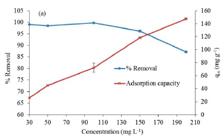
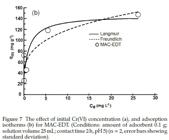
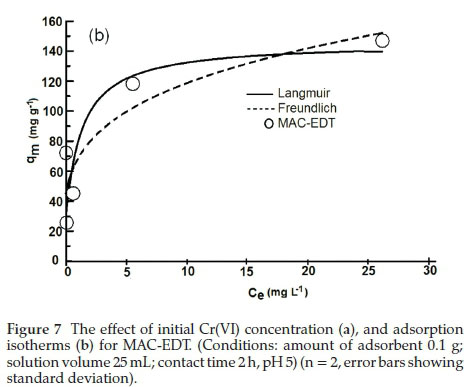
Figure 7b shows the trends obtained by fitting the adsorption experimental data to Freundlich and Langmuir isotherms. Langmuir isotherm fitted the MAC-EDT data best. Grafting of amino functionality onto MAC resulted in monolayer adsorption mechanism for Cr(VI).
The Langmuir constant b (described in Equation 3) is related to the free energy change of sorption, ∆G (kJ/mol) according to the following formula:

where R is the universal gas constant (8.314 J mol-1 K-1)andTis the temperature in Kelvin. Since the AG value was in the range of -80 and -400 kJ mol-1, the sorption was concluded to be chemisorption. A value between -20 and 0 kJ mol-1 would have meant a physiosorption adsorption mechanism.5354
Table 2 summarizes the Langmuir and Freundlich constants. Although the coefficient of determination for the Freundlich model (R22Fvalue (64.34) which is an indication of the adsorption capacity, was very low as compared to the experimental (qm). In contrast, the Langmuir adsorption capacity calculated value (qe, 147.57 mg g-1) was close to the experimental value (qm, 145.49 mg g-1). Therefore, it was deduced that MAC-EDT data was better described by the Langmuir model. Also, the Langmuir separation constant (RL) values lied between 0.01 and 0.05, signifying favourable adsorption of Cr(VI) by MAC-EDT.
3.5. Effect of Contact Time and Kinetic Modelling
The effect of contact time (10-240 min) (graph not presented) was investigated while keeping other parameters such as initial concentration (100 mg L-1), pH (5) and sorbent dosage (4 g L-1)at constant. For the first 30 min, the percentage removal of Cr(VI) by MAC-EDT was observed to increase steadily then reached equilibrium at about 60 min. However, 120 min was used as optimum to allow the reactions to reach completion.
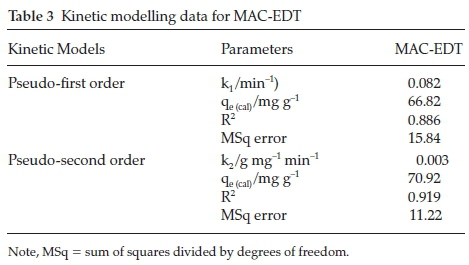
Table 3 shows the results obtained by fitting time dependency data into PFO and PSO kinetic models. The PSO kinetic model fitted the MAC-EDT data better due to the observed higher R217,18 that the sorption of Cr(VI) by ACs followed the PSO kinetic rate model.
3.6.
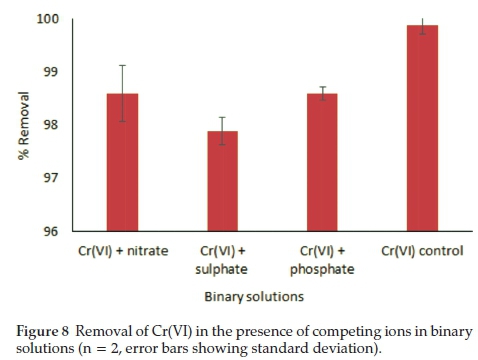
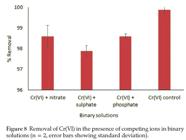
Effect of Other Coexisting AnionsThe influence of competing anions, phosphate, sulphate and nitrate, was investigated in a batch mode by using binary solutions with Cr(VI). In all solutions, the initial anion concentration was 100 mg L-1, solution pH 5, contact time was 2 h, adsorbent mass used was 0.1 g and volume of solution used was 25 mL. Following completion of reaction time, Cr(VI) remaining in solution was measured by the UV-Vis method. The removal efficiency of Cr(VI) in the presence of competing ions decreased compared to the control (Fig. 8). The interaction between the Cr(VI) species and the adsorbent is through ionic bonding due to the opposite charges on the adsorbent and adsorbate. Therefore, it is not surprising that the removal efficiency of Cr(VI) decreased a bit in the presence of other competing anions due to the fact that these competing ions also carry a negative charge while the adsorbent is positively charged. The order of removal of the anions was SO42- <PO43- ≈ NO3- <Cr2O72-. It was generally found that the size of the anion played a key role in the suppression of the adsorption of the target Cr(VI). The biggest competitor, the sulphate ion, was seen to be preferentially adsorbed as compared to the phosphate and nitrate ions owing to the similarity of shapes and size between Cr(VI) species (CrO42-) and SO42-. This sorption order was almost similar to what was observed by other researchers52Fig. 8 also illustrates that high recoveries of Cr(VI) were obtained, implying that the grafting of amine groups improved the selective removal of Cr(VI). All the values for the percentage removals were >97 %, further signifying MAC-EDT was effective in adsorbing Cr(VI) in the presence of competing ions in binary solutions.
3.7.
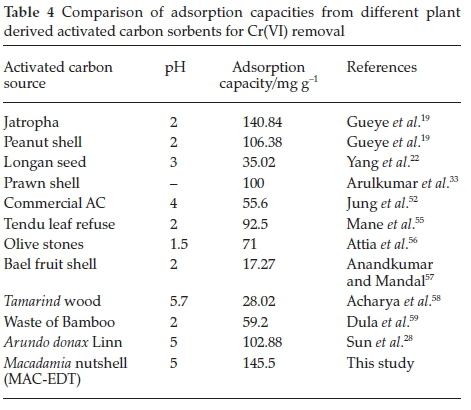
Comparison of MAC-EDT Adsorption Capacity with Other ACsTable 4 shows the comparison of adsorption capacity, optimum pH and initial concentrations of different AC adsorbents. As can be seen in Table 4, the adsorption capacity of MAC-EDT was amongst the highest when compared to other ACs produced from agricultural waste materials. The effect of grafting EDT on the MAC which resulted in quaternization improved MAC-EDT adsorption capacity due to stronger electrostatic interaction taking place between the positively charged MAC-EDT surface and the negatively charged Cr(VI) ions.
4. Conclusions
Functionalized AC derived from Macadamia nutshells (MAC-EDT) was investigated for the adsorption of chromium(VI) from aqueous solutions. It was demonstrated in this study that MAC-EDT could be used as an effective adsorbent for Cr(VI) and optimum conditions found were pH 5, sorbent mass (0.1 g), initial concentration (100 mg L-1), and contact time (2 h). It was further revealed that during Cr(VI) adsorption by MAC-EDT, fraction of the Cr(VI) was reduced to Cr(III) in almost the entire pH range evaluated. The implications were that MAC-EDT possessed functional groups (electron donors) that were capable of reducing Cr(VI) to Cr(III). While the amount of Cr(VI) left at pH 2 was lesser, the total Cr left at pH 2 was higher in relation to other pH's indicating that adsorption and reduction took place. However, the amount of Cr(VI) at pH 2 and pH 5 was similar but the amount of total chromium left at pH 5 was lesser than pH 2. Therefore, pH 5 was chosen as optimum pH since it showed less reduction and similar adsorption of Cr(VI) as was observed at pH 2. Characterization of the MAC-EDT with FTIR before and after Cr(VI) adsorption revealed changes of material surface functional groups due to their involvement in chromium removal. The removal efficiency of Cr(VI) in the presence of competing anions was >98 % for all anions studied, PO43-,NO3-and SO/- but Cr(VI) sequestration was affected most in the presence of sulphate ions. When compared to other plant based activated carbons in recent literature, MAC-EDT displayed a higher Langmuir adsorption capacity of 145.5 mg g-1 which puts MAC-EDT as an alternative adsorbent for the sequestration of Cr(VI) from aqueous solutions. Overall, MAC-EDT is an alternative adsorbent for the removal of Cr(VI) ions from aqueous solutions.
Acknowledgements
The financial support from the Vaal University of Technology and the National Research Foundation (NRF) of South Africa (TTK13061018779) is gratefully appreciated.
References
- 1 K. Anupam, M. Mayer, L. Lakatos and K. Dokkenk, Adsorptive removal of chromium(VI) from aqueous solution over powdered activated carbon: optimization through response surface methodology, Chem. Eng. J., 2011, 173, 135-143.
- 2 N. Serpone, E. Borgarello, E. Pelizzeti and E. Schiavello (Eds.), Photocatalysis and Environment, Kluwer Academic, The Netherlands, 1988.
- 3 O.J. Nriagu and E. Nieboer, Chromium in the natural and human environment. Wiley, New York, USA, 1988.
- 4 Z. Kowalski, Treatment of chromic tannery wastes, J. Hazard. Mater, 1994, 37, 137-144.
- 5 F.T. Stanin, The transport and fate of chromium (VI) in the environment, in Chromium(VI) Handbook, (J. Guertin, J.A. Jacobs and C.P. Avakian, eds.,), CRC Press, Florida, USA, 2005.
- 6 T.S. Anirudhan, J. Nima and P.L. Divya, Adsorption of chromium(VI) from aqueous solutions by glycidylmethacrylate-grafted-densified cellulose with quaternary ammonium groups, Appl. Surf. Sci., 2013, 279, 441-449.
- 7 K. Selvarag, S. Manonmani and S. Pattabhi, Removal of hexavalent chromium using distillery sludge, Bioresour. Technol., 2003,89207-211.
- 8 E. Browning, Chromium in Toxicity of Industrial Metals, 2nd edn., Butterworths and Co, London, 1969, 76-96.
- 9 M. Cieslak-Golonka, Toxic and mutagenic effects of chromium(VI), Polyhedron, 1995, 15 3667-3689.
- 10 J. Hu, I.M.C. Lo and G. Chen, Comparative study of various magnetic nanoparticles for Cr(VI) removal, Sep. Purif. Technol., 2007, 56, 249-256.
- 11 T.S. Anirundhan, S. Jalajamony and P.S. Suchithra, Improved performance of a cellulose-based anion exchanger with tertiary amine functionality for the adsorption of chromium(VI) from aqueous solutions, Colloids Surf. A, 2009, 335, 107-113.
- 12 R.C. Thomson and M.K. Miller, Carbide precipitation in martensite during the earlry stages of tempering Cr- and Mo-containing low alloy steels, Acta Mater., 1998, 46, 2203-2213.
- 13 J.A.S. Tenorio and D.C.R. Spinosa, Treatment of chromium plating process effluents with ion exchange resins, Waste Manage., 2001, 21, 637-642.
- 14 L. Lin, X. Xu, C. Papelis, T. Cath and P. Xu, Sorption of metals and metalloids from reverse osmosis concentrate on drinking water treatment solids, Sep. Purif. Technol., 2014, 134, 37-45.
- 15 F. Di Natale, A. Erto, A. Lancia and D. Musmarra, Equilibrium and dynamic study on hexavalent chromium adsorption onto activated carbon, J. Hazard. Mater., 2015, 281, 47-55.
- 16 J.C. Seaman, P.M. Bertsch and L. Schwallie, In situ Cr(VI) reduction within coarse textured, oxide-coated soil and aquifer systems using Fe(II) solutions, Environ. Sci. Technol., 1999, 33, 938-944.
- 17 P. Rana and C. Mohan, Electrochemical removal of chromium from wastewater by carbon aerogel electrodes, Water Res., 2004, 38, 2811-2820.
-
18 N.T. Tavengwa, E. Cukrowska and L. Chimuka, Application of raw and biocharred Moringa oleifera seed powder for the removal of nitrobenzene from aqueous solutions, Desalin. Water Treat., 2016, DOI: 10.1080/19443994.2016.1151381, in press.
» https://doi.org/10.1080/19443994.2016.1151381, in press - 19 M. Gueye, Y. Richardson, F.T. Kafack and J. Bli, High efficient activated carbons from African biomass residues for the removal of chromium(VI) from wastewater, J. Environ. Chem. Eng., 2014, 2, 273-281.
- 20 K.J. Silgado, G.D. Marrugo and J. Puello, Adsorption of chromium(VI) by activated carbon produced from oil palm endocarp, Chem. Eng. Trans., 2014, 37, 721-726.
- 21 Y. Zhang, J. Ou, Z. Duan, Z. Xing and Y. Wang, Adsorption of Cr(VI) on bamboo bark-based activated carbon in the absence and presence of humic acid, Colloids Surf. A, 2015, 481, 108-116.
- 22 J. Yang, M. Yu and W. Chen, Adsorption of hexavalent chromium from aqueous solution by activated carbon prepared from logan seed: kinetics, equilibrium and thermodynamics, J. Ind. Eng. Chem., 2015, 21, 414-422.
- 23 A. Deryío-Marczewska, J. Goworek, A. Swiatkowski and B. Buczek, Influence of differences in porous structure within granules of activated carbon on adsorption of aromatics from aqueous solutions, Carbon, 2004, 42, 301-306.
- 24 T.J. Bandosz, Effect of pore structure and surface chemistry of virgin activated carbons on removal of hydrogen sulfide, Carbon, 1999, 37, 483-491.
- 25 G.D. Sheng, D.D. Shao, X.M. Ren, X.Q. Wang, J.X. Li, Y.X. Chen and X.K. Wang, Kinetics and thermodynamics of adsorption of ionizable aromatic compounds from aqueous solutions by as-prepared and oxidized multiwalled carbon nanotubes, J. Hazard. Mater., 2010, 178, 505-516.
- 26 S. Liu and R. Wang, Modified activated carbon with an enhanced nitrobenzene adsorption capacity, J. Porous Mater., 2011, 18, 99-106.
- 27 L. Velasco and C. Ania, Understanding phenol adsorption mechanisms on activated carbons, Adsorption, 2011, 17, 247-254.
- 28 Y. Sun, Q. Yue, B. Gao, Y. Gao, Q. Li and Y. Wang, Adsorption of hexavalent chromium on Arundo donax Linn activated carbon amine-crosslinked copolymer, Chem. Eng. J., 2013, 217, 240-247.
- 29 S. Li, S. Xu, S. Liu, C. Yang and Q. Lu, Fast pyrolysis of biomass in free-fall reactor for hydrogen-rich gas, Fuel Process. Technol., 2004, 85, 1201-1211.
- 30 X. Xu, Y. Gao, B. Gao, X. Tan, Y.-Q. Zhao, Q. Yue and Y. Wang, Characteristics of diethylenetriamine-crosslinked cotton stalk/wheat stalk and their biosorption capacities for phosphate, J. Hazard. Mater., 2011, 192, 1690-1696.
- 31 I.D. Mall, V.C. Shrivastava, G.VA. Kumar and I.M. Mishra, Characterization and utilization of mesoporous fertilizer plant waste carbon for adsorptive removal of dyes from aqueous solution, Colloids Surf. A Physicochem. Eng. Aspects, 2006, 278, 175-187.
- 32 K.J. Cronje, K. Chetty, M. Carsky, J.N. Sahu and B.C. Meikap, Optimization of chromium(VI) sorption potential using developed activated carbon from sugarcane bagasse with chemical activation by zinc chloride, Desalination, 2011, 275, 276-284.
- 33 M. Arulkumar, K. Thiramaldi and T. Palvannan, Rapid removal of chromium from aqueous solution using novel prawn shell activated carbon, Chem. Eng. J., 2012, 186, 178-186.
- 34 A.E. Greenberg, L.S. Clescerl and A.D. Eaton, Standard method for the examination of water and wastewater. Washington, DC: American Public Health Association, American Water Works Association and Water Environmet Federation,1992.
- 35 I. Langmuir, The adsorption of gases on plane surfaces of glass, mica and platinum, J. Am. Chem. Soc., 1918, 40, 1361-1403.
- 36 Y.A. Aydin and N.D. Aksoy, Adsorption of chromium on chitosan: optimization, kinetics and thermodynamics, Chem. Eng. J., 2009, 151, 188-194.
- 37 S. Rangabhashiyam and N. Selvaraju, Evaluation of the biosorption potential of a novel Caryota urens inflorescence waste biomass for the removal of hexavalent chromium from aqueous solutions, J. Taiwan Inst. Chem. Eng., 2015, 47, 59-70.
- 38 H. Freundlich and W. Helle, On adsorption in solution, J. Am. Chem. Soc., 1939, 61, 2228-2230.
- 39 E. Pehlivan, B.H. Yanik, G. Ahmetli and M. Pehlivan, Equilibrium isotherm studies for the uptake of cadmium and lead ions onto sugar beet pulp, Bioresour. Technol., 2008, 99, 3520-3527.
- 40 F. Haghseresht and G. Lu, Adsorption characteristics of phenolic compounds onto coal-reject-derived adsorbents, Energy Fuel, 1998, 12, 1100-1107.
- 41 J.F Gonzalez, J.M. Encinar, J.L. Canito, E. Sabio and M. Chacón, Pyrolysis of cherry stones: energy uses of the different fractions and kinetic study, J. Anal. Appl. Pyrolysis, 2003, 67, 165-190.
- 42 Y.S. Koay, I.S. Ahamad, M.M. Nourouzi, L.C. Abdullah and T.S.Y. Choong, Development of novel low cost quaternized adsorbent from palm oil agriculture for reactive dye, BioResources, 2014, 9, 66-85.
- 43 G.S.S. Kambarova, Preparation of activated charcoal from walnut shells, Solid Fuel Chem., 2008, 42, 183-186.
- 44 R. Malik, D.S. Ramteke and S.R. Wate, Physico-chemical and surface characterization of adsorbent prepared from groundnut shell by ZnCl2 activation and its ability to adsorb colour, Ind. J. Chem. Eng., 2006, 13, 319-328.
- 45 T.S. Anirudhan and P.S. Suchithra, Synthesis and characterization of iron(III)-coordinated amine-modified poly(glycidylmethacrylate)-grafted densified cellulose and its applicability in defluoridation from industry effluents, Ind. Eng. Chem. Res., 2010, 49, 1225412262.
- 46 T. Zhu and K.H. Row, Preparation of amino-modified active carbon cartridges and their use in the extraction of quercetin from Oldenlandia diffusa, J. Pharm. Biomed. Anal., 2011, 56, 713-720.
- 47 J.C. Seaman, P.M. Bertsch and L. Schwallie, In situ Cr(VI) reduction within coarse-textured, oxide-coated soil and aquifer systems using Fe(II) solutions, Environ. Sci. Technol., 1999, 33, 938-944.
- 48 C. Selomulya, V. Meeyoo and R. Amal, Mechanisms of Cr(VI) removal from water by various types of activated carbons, J. Chem. Technol. Biotechnol., 1999, 74, 111-122.
- 49 M. Valix, W.H. Cheung, and K. Zhang, Role of heteroatoms in activated carbon for removal of hexavalent chromium from waste waters, J. Hazard. Mater., 2006, B135, 395-405.
- 50 C.F. Baes Jr. and R.E. Mesmer, The hydrolysis of cations. Wiley-Inter-science Publication, New York, 1976.
- 51 Z.N. Azwa and B.F. Yousif, Thermal degradation study of kenaf fibre/epoxy composites using thermogravimetric analysis, in M.M. Noor, M.M. Rahman and J. Ismail (eds), 3rd Malaysian postgraduate conference (MPC2013) 4-5 July 2013, Sydney, New South Wales, Australia. Paper ID: MPC2013-16, 256-264.
- 52 C. Jung, J. Heo, J. Han, N. Her, S. Lee, J. Oh, J. Ryu and Y. Yoon, Hexavalent chromium removal by various adsorbents: powdered activated carbon, chitosan, and single/multi-walled carbon nano-tubes, Sep. Purif. Technol., 2013, 106, 63-71.
- 53 A. Bhat, G.B. Megeri, C. Thomas, H. Bhargava, C. Jeevitha, S. Chandrashekar and G.M. Madhu, Adsorption and optimization studies of lead from aqueous solution using y-alumina, J. Environ. Chem. Eng., 2015, 3, 30-39.
- 54 M.S. Karmacharya, V.K. Gupta, I. Tyagi, S. Agarwal and V.K. Jha, Removal of As(III) and As(V) using rubber tire derived activated carbon modified with alumina composite, J. Mol. Liq., 2016, 216, 836-844.
- 55 P.C. Mane, A.B. Bhosle, P.D. Deshmukh and C.M. Jangam, Chromium adsorption onto activated carbon derived from Tendu (Diospyros melanoxylon) leaf refuse: influence of metal/carbon ratio, time and pH, Adv. Appl. Sci. Res., 2000, 1, 212-221.
- 56 A.A. Attia, S.A. Khedr and S.A. Elkholy, Adsorption of chromium ion (VI) by acid activated carbon, Braz. J. Chem. Eng., 2010, 27, 183-193.
- 57 J. Anandkumar and B. Mandal, Removal of Cr(VI) from aqueous solution using bael fruit (Aegle marmelos correa) shell as an adsorbent, J. Hazard. Mater., 2009, 168, 633-640.
- 58 J. Acharya, J.N. Sahu, B.K. Sahoo, C.R. Mohanty and B.C. Meikap, Removal of chromium(VI) from wastewater by activated carbon developed from Tamarind wood activated with zinc chloride, Chem. Eng. J., 2009, 150, 25-39.
- 59 T. Dula, K. Siraj and S.A. Kitte, Adsorption of hexavalent chromium from aqueous solution using chemically activated carbon prepared from locally available waste of bamboo (Oxytenanthera abyssinica), ISRN Environ. Chem., 2014, 2014, 1-9.
Revised 23 June 2016
Accepted 29 June 2016