Optimization of Silica Extraction from Diatomaceous Earth using the Central Composite Design of Response Surface Methodology
Abstract
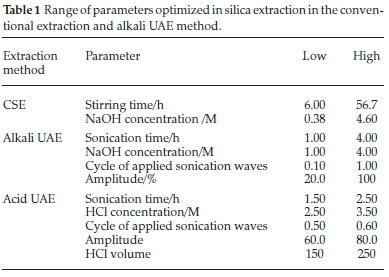
This work evaluated the extraction efficiency of silica from diatomaceous earth (DE) by conventional solvent extraction (CSE) and ultrasound-assisted extraction (UAE) under basic and acidic (HCl) conditions utilizing response surface methodology (RSM). A common statistical model was used to get the best percentage yield and percentage purity using RSM. Experimental parameters such as stirring time, NaOH concentration (for CSE), sonication time, NaOH/HCl concentration, cycle and amplitude (for UAE methods) were optimized using central composite design (CCD). The analytical responses, that is, percentage yield and percentage purity, were analyzed using ANOVA and regression analysis. The linear coefficient of determination, R2, was high and precise. The overall yield and purity were highest for the UAE method under acid condition (pH 1-2, approximately), making it the most effective silica extraction method from DE. For this method, the optimal conditions for extracting Si from DE were 2 h of sonication, 220 mL of 2.82 M HCl as a leaching/extracting medium, 0.524 cycles and 72.6 % of amplitude. Under these conditions, 82 % of silica was yielded with a purity of about 95 %. The experimental results indicate that high-quality silica can be produced from DE in high yield so that DE can be an alternative silica source.
Diatomaceous earth; silica; response surface methodology; ultrasound-assisted extraction; conventional solvent extraction
 Thumbnail
 Thumbnail
 Thumbnail
 Thumbnail
 Thumbnail