Understanding the Link Between the Detection Limit and the Energy Stability of Two Quercetin-Antimony Complexes by Means of Conceptual DFT
Abstract
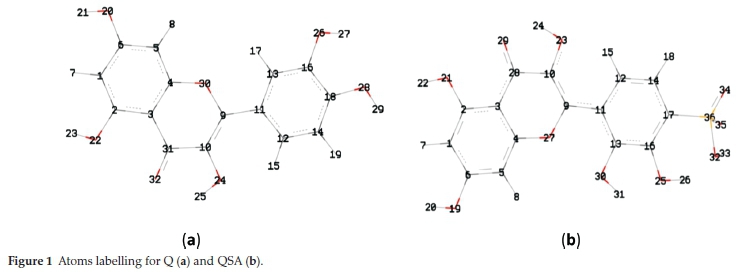
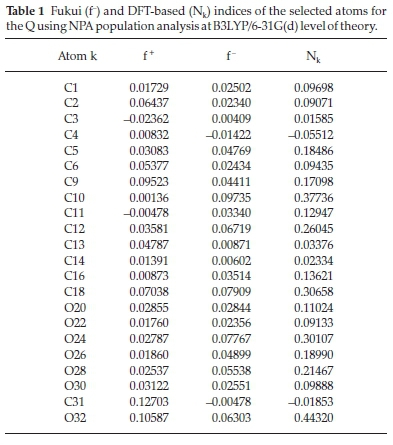
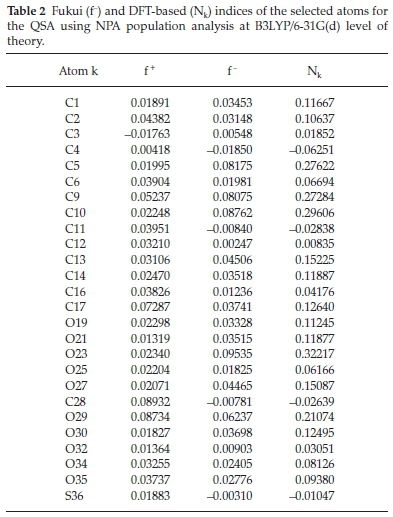
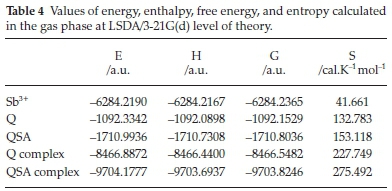
In view of the importance of quercetin and its derivatives in trace metal analyses, two organometallic complexes formed between quercetin (Q) and quercetin-5-sulfonic acid (QSA) with antimony metal, were theoretically studied via density functional theory (DFT) calculations. In this study, the concept of detection limit in electroanalysis was correlated to quantum chemical calculations for antimony trace analysis in aqueous solution by using Q and QSA as ligands. Based on two previous reports, the study was carried out experimentally using polarography where the working electrode was a dropping mercury electrode. The DFT calculations were performed with B3LYP and LSDA functionals as implemented in Gaussian 09 program and by employing the 6-31G(d) and 3-21G(d) basis sets, respectively. The results show a very strong relationship between the total energy of antimony complexes and the detection limit; thus, the more stable complex has a better detection limit value. Based on the Fukui functions, the calculated parameters such as local nucleophilicity indices and HOMO-1 electronic density of the ligands show a high interaction of antimony ion (III) with quercetin-5-sulfonic acid than that with quercetin. This finding was in good accord with the experimental results.
Antimony complexes; quercetin derivatives; detection limit; Fukui indices; DFT calculations
 Thumbnail