Structural Transformations of Northcom Transvaal and Libby Montana Vermiculite Clay Produced by Firing: Mossbauer Study
Abstract
Two samples of vermiculite clay, which are known by the names Libby Montana and Northcom Transvaal, were subjected to a firing treatment from 100 to 1000 °C. The structural transformation was monitored by observing the changes that occur in the structural iron and the change in the Mossbauer data. 57Fe Mossbauer spectra indicate the presence of both Fe2+ and Fe3+ sites, and the main feature of the Mossbauer parameters of the two fired samples is that when the firing temperature is increased, the quadrupole splitting of the Fe3+ and to some extent Fe2+ doublet increases, indicating a distorted structure. There is no apparent correlation between the firing temperature and the isomer shift in both samples. The linewidth has also increased, indicating that more than one site is occupied. The complete oxidation of Fe2+ in the Northcom Transvaal sample occurred at 300 oC, while for the Libby Montana sample occurred at 600 oC.
Vermiculite; Libby Montana; Northcom Transvaal; Mossbauer; Firing
INTRODUCTION
Vermiculite is a silicate mineral that belongs to the phyllosilicate subclass. Its structure corresponds to that of the 2:1 group where it consists of two tetrahedral silicate sheets interlayered by an octahedral sheet that contains aluminum and iron.1 Vermiculite can undergo hydration-dehydration reactions due to the existence of water and OH groups, which are dependent on a variety of parameters such as temperature, pressure, particle size, relative humidity, and chemical composition.2 Vermiculite has been studied extensively due to its unique physical and chemical features, which include low thermal conductivity and density, refractory behavior, and high cation exchange capacity, all of which lead to a wide range of commercial uses.3-8
Many studies on the effect of firing of clays have been carried out. It was found that between 500 and 800 °C, the clay mineral undergoes dehydroxylation. Above 800 °C, there occurs a disintegration of the clay mineral structure, followed by recrystallization in an iron-rich phase, most likely in the form of very small particles.9 A significant increase in the volume of vermiculite is observed as a result of firing.10 When heated to 650 - 950 °C, vermiculite can swell up to 30 times its original volume. Low thermal conductivity, low bulk density, endurance, chemical inertness, and a relatively high melting point are some of the promising qualities of expanded vermiculite. Expanded vermiculite has a wide range of uses in civil engineering, chemical industry, and agriculture.11 Due to its outstanding thermal performance and non-combustibility, expanded vermiculite is a novel alternative to traditional fire-resistance materials.12 The process of heat energy absorption by vermiculite was investigated, and the firing module's optical-geometric parameters were determined.13 Under heat radiation, a method is considered for evaluating the absorption-reflection properties of a single grain ofvermiculite and a dense single-layer array of intumescent vermiculite situated on a planar surface.14
Mossbauer spectroscopy has proved to be important in mineralogical and geochemical applications. The method has been widely applied to investigate the iron electronic environments found in clay minerals. Mossbauer study was conducted to assess the clay iron content in a variety of clay samples.15-18 An early Mossbauer study on fired vermiculite collected from different regions of India was carried out at firing temperature up to 1100 °C.19 The valence states and coordination behavior of iron in vermiculite were also studied by Mossbauer spectroscopy.20 The technique used to assess the tetrahedral Fe3+, octahedral Fe3+, and Fe2+ of vermiculites.3 In a study, it was shown that the oxidation of iron occurs mainly in octahedral sites. It was suggested that migration and oxidation of the Fe2+ ions from the octahedral sites to the tetrahedral sites may occur during the transformation process.21 The heat-resistant properties of fire clay make them ideal for many industrial applications such as pottery, brick-making, and cement production.22 The aim of the study is to characterize the iron content of the two original samples and to understand the effect of firing temperature on the two iron sites. Furthermore, adding new data related to vermiculite clay firing to temperatures from 100 to 1000 oC.
EXPERIMENTALThe investigated vermiculite samples were obtained from Ward's Natural Science Establishment, namely Libby Montana and Northcom Transvaal vermiculite samples, the chemical composition shown in Table 1. Using 57Co as a source, Mossbauer spectra were obtained on a Canberra Multichannel Analyzer. The source was a rhodium matrix containing 25-mCi cobalt-57 obtained from the Radiochemical Centre, Amersham.
The two vermiculite clay samples were used without any pretreatment, and when subjected to thermal treatment for 60 minutes within the range of 100 to 1000°C under air, the Libby Montana sample's small green crystalline slabs preserved their green color up to around 300 oC, after which the green slabs began to convert to a golden color and took on a spongy shape. The golden color darkened as the temperature was raised, eventually becoming a brown-gold color.
Firing the Northcom Transvaal sample, which is in the form of large brownish-green flakes, over 300 oC caused the flakes to split into several spongy layers in contact with each other. They had a golden color, the golden color getting darker on further firing. Each clay sample undergoes major physical and chemical changes and the yield after thermal process is ceramic.
Mossbauer spectra of the unfired and fired samples were taken at 77 oK.
RESULTS AND DISCUSSIONS
The information that can be obtained from the data of Mossbauer spectroscopy is the characterization of the oxidation states of iron (e.g. Fe2+ or Fe3+), the electronic configuration of the iron (e.g. low or high spin), the coordination symmetry about the iron atom (e.g. tetrahedral or octahedral) and any distortion from such tetrahedral or octahedral symmetry. The chemical composition of the two samples appears similar, with few differences in the proportions of the components that make up the composition.
Mossbauer spectra of the samples
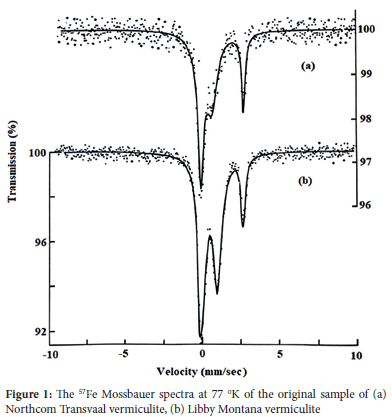
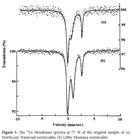
Mossbauer spectra of the original samples are shown in Figure 1. The spectra were fitted to two doublets corresponding to high spin Fe3+ and Fe2+ sites. The isomer shift of the Fe3+ in the Northcom Transvaal is 0.32(1) mms-1 and 1.25(2) mms-1 for Fe2+, and the quadrupole splittings are 0.78(1) mms-1 for Fe3+ and 2.80(3) mms-1 for Fe2+. While isomer shifts of the Libby Montana vermiculite sample are 0.47(1) mms-1 for Fe3+ and 1.22(1) mms-1 for Fe2+, and the quadrupole splittings are 0.96(1) mms-1 for Fe3+ and 2.80(1) mms-1 for Fe2+. The parameters are close to some room temperature values reported by other researchers23 which are 0.37(1) mms-1 for the Fe3+ isomer shift and 1.13(8) mms-1 for Fe+2, and quadrupole splittings of 0.64(3) mms-1 for Fe3+ and 2.71(18) mms-1 for Fe2+ (Table A1). The spectra are also nearly simliar to that reported for another vermiculite samples (Table A2).15
The quadrupole splitting values for Fe in both vermiculite samples are larger than that found for montmorillonite, which also belongs to the 2:1 layer group, reported in previous work24 which are 0.65(2) mms-1 for Fe3+ and 3.03(1) for Fe2+ (Table A3), indicating that the Fe3+ octahedra are distorted in the former samples. The Libby Montana vermiculite sample shows quadrupole splitting for Fe3+ larger than that found in the Northcom Transvaal, indicating that this site is more distorted in the former sample.
In the quadrupole splitting equation 1,

the

where λα and R are empirical constants, QS is quadrupole splitting, eQ is the nuclear quadrupole moment, eq is the electrostatic field gradient and η is the symmetry parameter.
The electronic configuration of high spin Fe3+ in clay minerals is spherically symmetrical, (t2g)3 (eg)2. qvalence = 0 in this case. As a result, the larger the quadrupole splitting value, the greater the distortion. For Fe2+ which is not a spherically symmetrical ion (t2g)4 (eg )2, the value of qvalence term cannot be neglected. In this case the smaller the value of the quadrupole splitting, the greater the distortion.25
The Fe2+ quadrupole splitting values in vermiculite samples are smaller than those reported for montmorillonite,24 indicating that the Fe2+ octahedra in vermiculite are more distorted than in montmorillonite. As a result, the electronic environment of both Fe2+ and Fe3+ are more distorted in vermiculite than in montmorillonite.
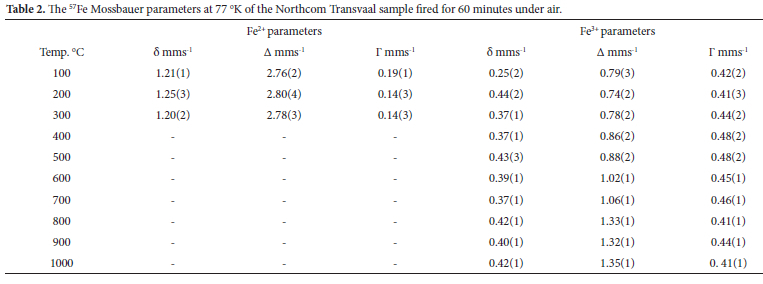
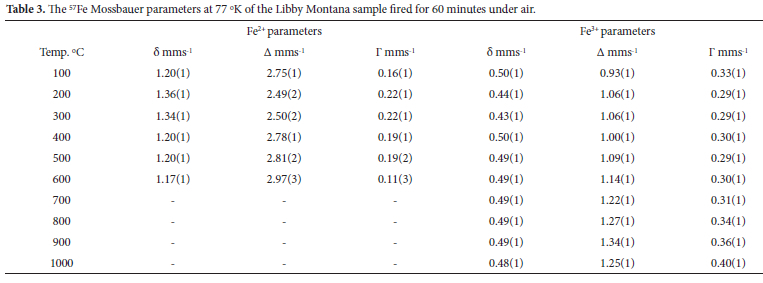
The Mossbauer parameters of the two samples fired for 60 minutes are listed in Tables 2 and 3. There is no apparent correlation between the firing temperature and the isomer shift in both samples. It was observed that decomposition of octahedral iron in vermiculite occurs before complete dihydroxylation.26 The dioctahedral clay, like montmorillonite, dehydroxylates at lower temperatures than trioctahedral clay, like vermiculite.27 Furthermore, the amount of iron present in the matrix of the clay sample has some effect on the temperature required for the Fe2+ oxidation process upon firing.28 The amount of iron in the Libby Montana sample is more than that of the Northcom Transvaal sample. This has a clear effect on the process of oxidation of Fe2+ to Fe3+. The greater the amount of iron, the higher the temperature the sample needs to complete the oxidation process.
Two terms can explain the firing process, below 600 oC the main term is the oxidation of Fe2+, and above 600 oC the main term is dehydroxylation of the lattice. The proposed mechanism29, 30 for the oxidation of Fe2+ in the presence of ambient oxygen is:

and in the absence of oxygen:

Because oxygen molecules are too big to enter the lattice at low temperatures, the second reaction dominates, even in the presence of ambient oxygen. Firing to a higher temperature causes the decomposition of the hydroxyl groups to an oxygen ion and water in the neighborhood of a vacancy.26

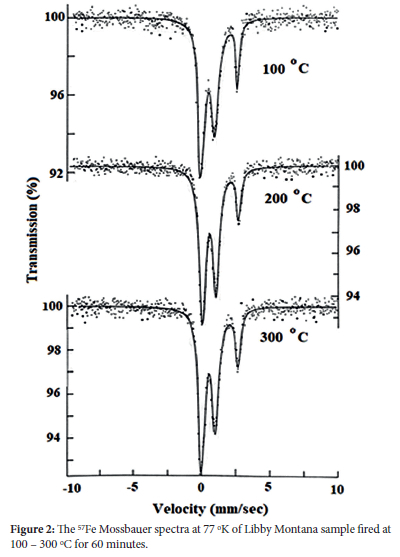
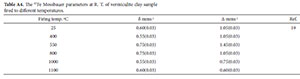
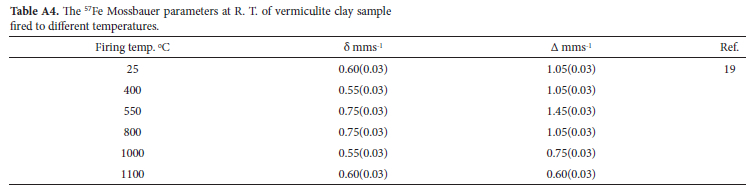
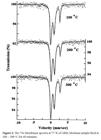
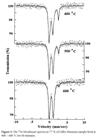
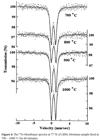
The main feature of the Mossbauer parameters of the two fired samples is the increase in the quadrupole splitting of the Fe3+ and to some extent Fe2+ doublets as the firing temperature are raised, which indicates a distorted structure. There has also been an increase in linewidth, indicating that more than one site is occupied. The temperature of Fe2+ oxidation is higher in both samples than in the montmorillonite clay.24 The Libby Montana sample had complete oxidation of Fe2+ at 600 oC, while the Northcom Transvaal sample had complete oxidation at 300 oC. Figure 2, 3, and 4 show the Mossbauer spectra of the fired Libby Montana vermiculite sample. The behavior of the two samples upon firing appears similar to the behavior of another vermiculite sample studied in the same field.19 There was an increase in quadrupole splitting (Table A4).
CONCLUSIONS
Firing the Northcom Transvaal and Libby Montana vermiculite clay causes a change in their color as well as their physical appearance. A significant increase in the volume is observed as a result of firing. The main characteristic of the Mossbauer parameters of the two fired samples is that as the firing temperature rises, the quadrupole splitting of the Fe3+ and, to a lesser extent, Fe2+ doublet increases, indicating a distorted structure. In both samples, there appears to be no link between the firing temperature and the isomer shift. The linewidth has also increased, indicating that more than one site is occupied. The entire oxidation of Fe2+ in the Northcom Transvaal sample occures at 300 oC, while in the Libby Montana sample it occures at 600 oC.
ORCID IDSJasim H. Hassen: https://orcid.org/0000-0002-5250-9891
Jack Silver: https://orcid.org/0000-0001-8669-9673
REFERENCES
- 1. Mathieson AM, Walker GF. Crystal structure of magnesium-vermiculite. Am Min. 1954;39(3-4):231-255.
-
2. Marcos C, Medoro V, Adawy A. Modified vermiculite as adsorbent of hexavalent chromium in aqueous solution. minerals (Basel). 2020;10(9):749. https://doi.org/10.3390/min10090749.
» https://doi.org/10.3390/min10090749 -
3. Marcos C, Rodríguez I. Expansion behaviour of commercial vermiculites at 1000°C. Appl Clay Sci. 2010;48(3):492-498. https://doi.org/10.1016/j.clay.2010.02.012.
» https://doi.org/10.1016/j.clay.2010.02.012 -
4. Hou L, Xing B, Kang W, Zeng H, Guo H, Cheng S, Huang G, Cao Y, Chen Z, Zhang C. Aluminothermic reduction synthesis of porous silicon nanosheets from vermiculite as high-performance anode materials for lithium-ion batteries. Appl Clay Sci. 2022;218:106418. https://doi.org/10.1016/j.clay.2022.106418.
» https://doi.org/10.1016/j.clay.2022.106418 -
5. Shi C, Liu H, Wang J, Yang M, Zhao J, Zhang L, Song Y, Ling Z. Vermiculite aerogels assembled from nanosheets via metal ion induced fast gelation. Appl Clay Sci. 2022;218:106431. https://doi.org/10.1016/j.clay.2022.106431.
» https://doi.org/10.1016/j.clay.2022.106431 -
6. Wen R, Huang Z, Huang Y, Zhang X, Min X, Fang M, Liu Y, Wu X. Synthesis and characterization of lauric acid/expanded vermiculite as form-stabilized thermal energy storage materials. Energy Build. 2016;116:677-683. https://doi.org/10.1016/j.enbuild.2016.01.023.
» https://doi.org/10.1016/j.enbuild.2016.01.023 -
7. Antao VC, Larson TC, Horton DK. Libby vermiculite exposure and risk of developing asbestos-related lung and pleural diseases. Curr Opin Pulm Med. 2012;18(2):161-167. https://doi.org/10.1097/MCP.0b013e32834e897d.
» https://doi.org/10.1097/MCP.0b013e32834e897d -
8. Li M, Zhao Y, Ai Z, Bai H, Zhang T, Song S. Preparation and application of expanded and exfoliated vermiculite: A critical review. Chem Phys. 2021;550:111313. https://doi.org/10.1016/j.chemphys.2021.111313.
» https://doi.org/10.1016/j.chemphys.2021.111313 -
9. Simopoulos A, Kostikas A, Sigalas I, Gangas NH, Moukarika A. Mossbauer study of transformations induced in clay by firing. Clays Clay Miner. 1975;23(5):393-399. https://doi.org/10.1346/CCMN.1975.0230512.
» https://doi.org/10.1346/CCMN.1975.0230512 -
10. Vlasov O, Kulinskaya E. Reduction of iron content in vermiculite. Refract Ind Ceram. 2010;51(4):247-249. https://doi.org/10.1007/s11148-010-9298-1.
» https://doi.org/10.1007/s11148-010-9298-1 -
11. Rashad AM. Vermiculite as a construction material - A short guide for civil engineer. Constr Build Mater. 2016;125:53-62. https://doi.org/10.1016/j.conbuildmat.2016.08.019.
» https://doi.org/10.1016/j.conbuildmat.2016.08.019 -
12. Liu J, Zhuge Y, Ma X, Liu M, Liu Y, Wu X, Xu H. Physical and mechanical properties of expanded vermiculite (EV) embedded foam concrete subjected to elevated temperatures. Case Stud Constr Mater. 2022;16:e01038. https://doi.org/10.1016/j.cscm.2022.e01038.
» https://doi.org/10.1016/j.cscm.2022.e01038 -
13. Nizhegorodov AI. Theory and practical use of modular-pouring electric furnaces for firing vermiculite. Refract Ind Ceram. 2015;56(4):361-365. https://doi.org/10.1007/s11148-015-9848-7.
» https://doi.org/10.1007/s11148-015-9848-7 -
14. Zvezdin AV, Bryanskikh TB, Nizhegorodov AI. Analytical model of absorption-reflection properties of vermiculite under thermal radiation conditions. Refract Ind Ceram. 2017;58(1):19-24. https://doi.org/10.1007/s11148-017-0047-6.
» https://doi.org/10.1007/s11148-017-0047-6 -
15. Badreddine R, Vandormael D, Fransolet A, Long G, Stone W, Grandjean F. A comparative X-ray diffraction, Mossbauer and NMR spectroscopic study of the vermiculites from Béni Bousera, Morocco and Palabora, Republic of South Africa. Clay Miner. 2002;37(2):367-376. https://doi.org/10.1180/0009855023720040.
» https://doi.org/10.1180/0009855023720040 -
16. Ericsson T, Wappling R, Punakivi K. Mossbauer spectroscopy applied to clay and related minerals. Geol Foren Stockh Forh. 1977;99(3):229-244. https://doi.org/10.1080/11035897709455018.
» https://doi.org/10.1080/11035897709455018 -
17. Soro N, Aldon L, Olivier-Fourcade J, Jumas JC, Laval JP, Blanchart P. Role of Iron in Mullite Formation from Kaolins by Mossbauer Spectroscopy and Rietveld Refinement. J Am Ceram Soc. 2003;86(1):129-134. https://doi.org/10.1111/j.1151-2916.2003.tb03289.x.
» https://doi.org/10.1111/j.1151-2916.2003.tb03289.x -
18. Arguelles A, Khainakov SA, Rodríguez-Fernández J, Leoni M, Blanco JA, Marcos C. Chemical and physical characterization of iron-intercalated vermiculite compounds. Phys Chem Miner. 2011;38(7):569-580. https://doi.org/10.1007/s00269-011-0429-0.
» https://doi.org/10.1007/s00269-011-0429-0 -
19. Gupta DC, Nath N. Temperature dependence in vermiculite: A Mossbauer study. Jpn J Appl Phys. 1979;18(11):2093-2096. https://doi.org/10.1143/JJAP.18.2093.
» https://doi.org/10.1143/JJAP.18.2093 - 20. Dipak G, Bahel BM, Raman KV. Studies on valence states and co-ordination behaviour of iron in biotite and vermiculite using Mossbauer spectroscopy. J Indian Soc Soil Sci. 1978;26(4):397-398.
-
21. Badreddine R, Grandjean F, Vandormael D, Fransolet A, Long G. An 57Fe Mossbauer spectral study of vermiculitizzation in the Palabora Complex, Republic of South Africa. Clay Miner. 2000;35(4):653-663. https://doi.org/10.1180/000985500547115.
» https://doi.org/10.1180/000985500547115 -
22. Topçu iB, Içikdag B. Manufacture of high heat conductivity resistant clay bricks containing perlite. Build Environ. 2007;42(10):3540-3546. https://doi.org/10.1016/j.buildenv.2006.10.016.
» https://doi.org/10.1016/j.buildenv.2006.10.016 -
23. Goodman A, Wilson MJ. A Study of the weathering of a biotite using the Mossbauer effect. Mineral Mag. 1973;39(304):448-454. https://doi.org/10.1180/minmag.1973.039.304.07.
» https://doi.org/10.1180/minmag.1973.039.304.07 -
24. Hassen JH, Silver J. Reduction of the structural Iron in montmorillonite by electron transfer from catechol and its derivatives. J Turk Chem Soc. Chem. 2021;8(4):1167-1178. https://doi.org/10.18596/jotcsa.908713.
» https://doi.org/10.18596/jotcsa.908713 -
25. Rozenson I, Heller-Kallai L. Mossbauer spectra of dioctahedral smectites. Clays Clay Miner. 1977;25(2):94-101. https://doi.org/10.1346/CCMN.1977.0250204.
» https://doi.org/10.1346/CCMN.1977.0250204 -
26. Tripathi RP, Chandra U, Chandra R, Lokanathan S. A Mossbauer study of the effects of heating biotite, phlogopite and vermiculite. J Inorg Nucl Chem. 1978;40(7):1293-1298. https://doi.org/10.1016/0022-1902(78)80037-2.
» https://doi.org/10.1016/0022-1902(78)80037-2 - 27. Vedder W, Wilkins RWT. Dehydroxylation and rehydroxylation, oxidation and reduction of micas. Am Mineral. 1969;54(3-4):482-509.
-
28. Stçpkowska ET, Jefferis SA. Influence of microstructure on firing colour of clays. Appl Clay Sci. 1992;6(4):319-342. https://doi.org/10.1016/S0169-1317(09)90007-2.
» https://doi.org/10.1016/S0169-1317(09)90007-2 -
29. Addison CC, Addison WE, Neal GH, Sharp JH. 278. Amphiboles. Part I. The oxidation of crocidolite. J Chem Soc. 1962;0:1468-1471. https://doi.org/10.1039/jr9620001468.
» https://doi.org/10.1039/jr9620001468 -
30. Rimsaite J. Structural formulae of oxidized and hydroxyl-deficient micas and decomposition of the hydroxyl group. Contrib Mineral Petrol. 1970;25(3):225-240. https://doi.org/10.1007/BF00371132.
» https://doi.org/10.1007/BF00371132
Revised 11 February 2023
Accepted 3 March 2024
APPENDICES