People and person factors in building brand admiration and leadership for African brands
Abstract
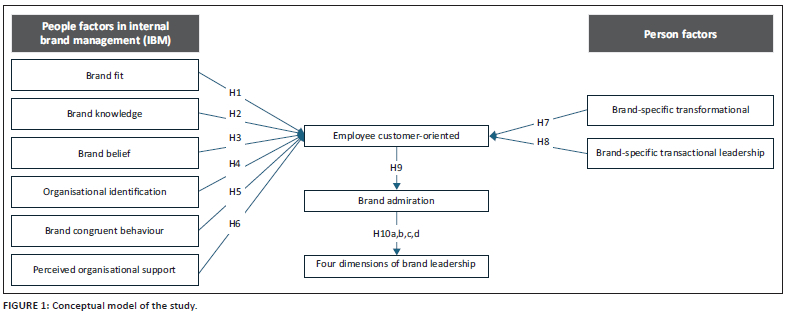
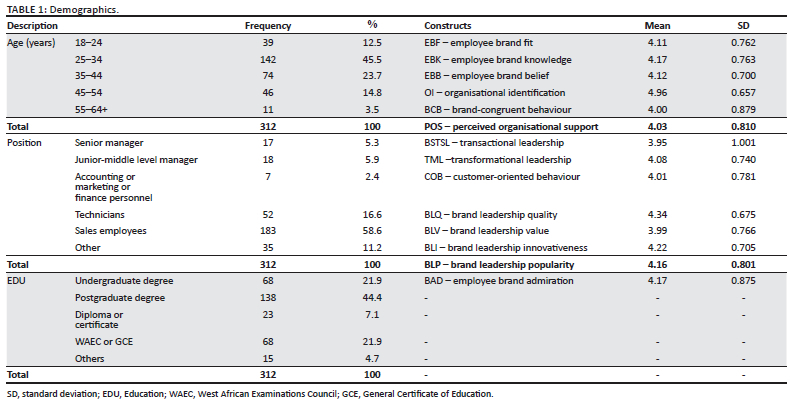
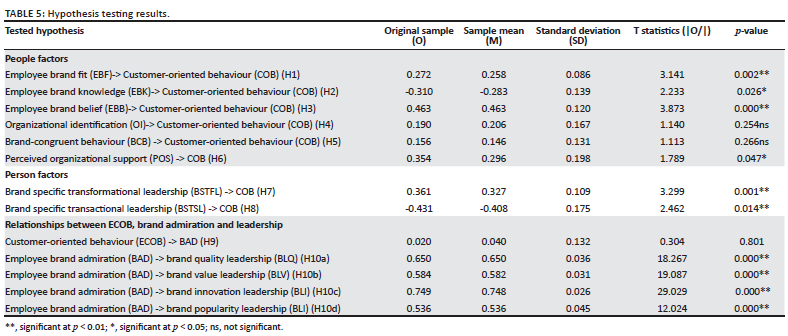
PURPOSE: Brand leadership studies focus on validating their four dimensions of brand innovativeness, value, popularity and quality but neglect their predictors. This study was based on three theories and integrated ideas from three models, examining people and person factors that influence brand admiration and leadership through employee-customer-oriented behaviour DESIGN/METHODOLOGY/APPROACH: The study hypothesises that person and people factors affect brand leadership dimensions through employee-customer-oriented behaviour and brand admiration. Quantitative methods were employed to collect data from 312 employees, including managers of two leading African brands. The hypotheses were examined with partial least squares structural equation modelling FINDINGS/RESULTS: The findings showed that four of the people factors and all two person factors significantly affected customer-oriented behaviour. In addition, brand admiration had a significant effect on all four brand leadership dimensions PRACTICAL IMPLICATIONS: African brands striving to be leaders can use our findings to understand that brand admiration and leadership do not only come from customers' positive response to brands but also from the top person's leadership style and internal brand management strategies around people ORIGINALITY/VALUE: The study is based on theories and perspectives from brand management, human resources management, internal brand management and leadership to provide an interdisciplinary explanation of four brand leadership dimensions, whose explanation is not only sparse in the literature but also for leading brands in Africa
brand leadership; brand admiration; transactional leadership; transformational leadership; customer-oriented behaviour; people and person factors
 Thumbnail