'Encore, encore!' - secondary use of health data for research: A practical guide to POPIA
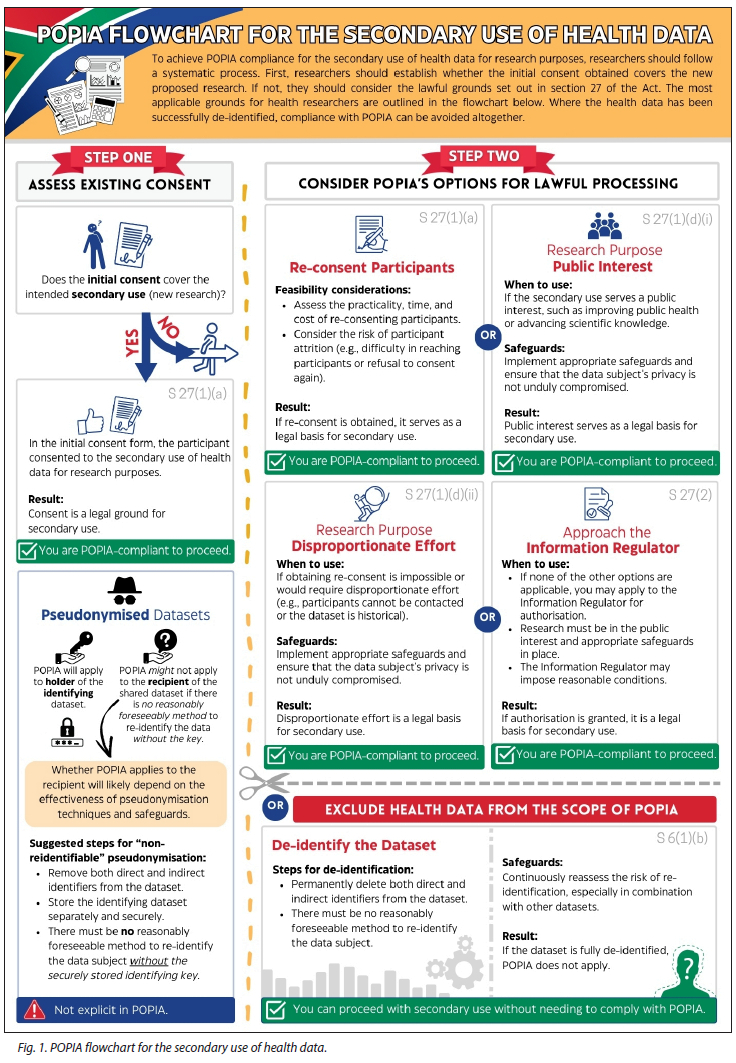
Health data hold immense potential for advancing medical science and informing public health strategies; however, their secondary use for research purposes has been poorly exploited, partly due to uncertainty and compliance concerns brought about by the Protection of Personal Information Act (POPIA). Researchers often assume that re-consent is the only option for secondary use. Yet POPIA provides several lawful grounds for processing special personal information, which includes health data, without necessarily obtaining re-consent. The present article serves as a practical guide for researchers navigating POPIA's requirements for the secondary use of health data for research. A systematic approach is recommended: first, researchers should establish whether the original consent encompasses the intended secondary use. If it does not, they should determine which lawful grounds for processing special personal information best suit their context and can be relied upon. Options include obtaining re-consent, relying on a research purpose, or seeking authorisation from the Information Regulator. In addition, researchers may consider de-identifying the dataset, which would exempt it from the ambit of POPIA. Situations where pseudonymisation might achieve a similar outcome are also unpacked. By taking proactive, well-documented steps, researchers can better capitalise on existing health datasets to advance vital health research in South Africa.
South African Journal of Bioethics and Law
 Thumbnail