Words matter: Using the Framework Method to analyse the definitions of 'anonymise', 'pseudonymise', 'de-identify', and 'not de-identified'
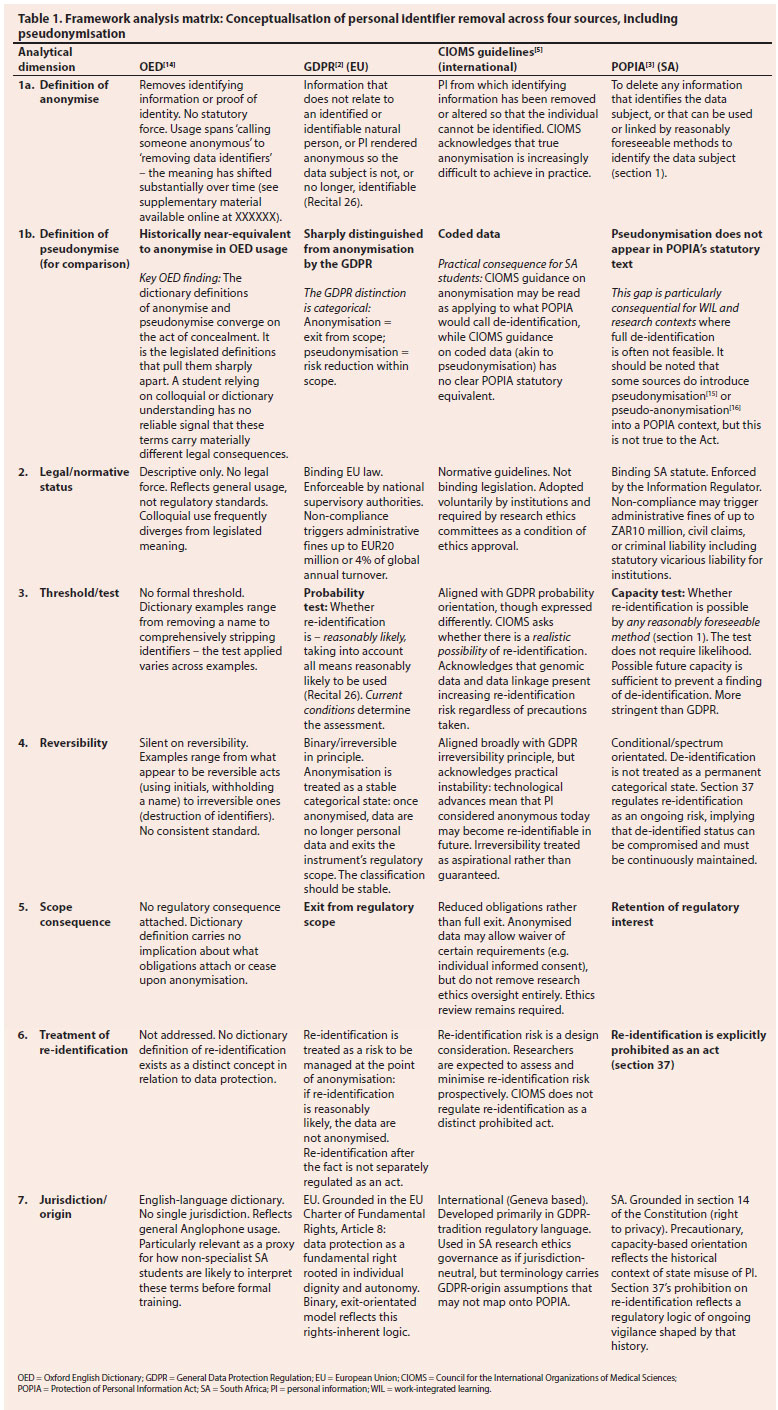
A significant number of students handle personal information (PI) during work-integrated learning and supervised research, requiring compliance with both South African (SA) law and internationally derived research ethics instruments. Where these instruments use different terminology, students face barriers to understanding, reflecting not only linguistic differences but materially distinct legal standards and regulatory consequences. Using the Framework Method across seven analytical dimensions, this study examined the conceptual equivalence of key PI protection terms across four sources: the Oxford English Dictionary, the European Union General Data Protection Regulation (GDPR), the Council for the International Organizations of Medical Sciences (CIOMS) ethical guidelines for human research, and SA's Protection of Personal Information Act 4 of 2013 (POPIA). Three findings emerged. First, GDPR's 'anonymisation' and POPIA's 'de-identification', although similar in stated purpose, apply different threshold tests: GDPR uses a probability test (whether re-identification is reasonably likely), while POPIA applies a capacity test (whether re-identification is possible by any reasonably foreseeable method). A data set compliant under GDPR may therefore not satisfy POPIA. Second, the instruments diverge on regulatory scope: GDPR treats anonymisation as an exit from regulation, whereas POPIA imposes ongoing obligations on de-identified data, including an explicit re-identification prohibition absent from GDPR. Third, CIOMS and POPIA are more conceptually compatible with each other than either is with GDPR, yet CIOMS employs GDPR-tradition terminology, creating misleading signals of equivalence for SA students. These divergences reflect fundamentally different conceptions of PI and the rationale for its protection. Students, educators and institutional governance structures must address these distinctions explicitly, rather than assuming terminological equivalence across instruments.
de-identification; anonymisation; POPIA; work-integrated learning; research ethics; Framework Method; conceptual equivalence; GDPR
 Thumbnail