Effects of ascorbic acid supplementation on the post-thaw quality of epididymal bull spermatozoa
Abstract
Cryopreservation of bovine semen supports artificial insemination by allowing the long-term storage and dissemination of genetic material; however, it also causes oxidative stress and structural damage to spermatozoa, decreasing motility and fertilising capacity. This study evaluated the effects of vitamin C, an antioxidant, on the post-thaw quality of bull epididymal spermatozoa. Sperm samples from 14 Holstein-Friesian bulls were cryopreserved in a Tris-based extender supplemented with vitamin C at 0, 25, 50, 100, and 200 µg/mL. After thawing, sperm motility parameters were assessed using computer-assisted sperm analysis to determine the optimal vitamin C concentration. Moderate supplementation levels (50-100 µg/mL) significantly improved total and progressive motility compared with the control, whereas 25 µg/mL did not and 200 µg/mL significantly reduced sperm motility. Average path velocity values were significantly higher at 50 and 100 µg/mL than at the other concentrations tested. In addition, while more sperm were motile at 50 μg/mL, they moved with greater speed and directionality at 100 μg/mL. At all concentrations (particularly 100 μg/mL), the curvilinear velocity was higher than the straight-line velocity, indicating a natural swimming pattern that is highly oscillatory rather than linear. A pronounced decline in all evaluated parameters was observed at 200 μg/mL, particularly in straight-line velocity, which was ±50% lower than that of the control group. This may suggest that excessive vitamin C concentrations impair progressive sperm movement, leading to more erratic or circular motility rather than effective forward progression. These findings indicate that vitamin C can enhance bovine epididymal spermatozoa cryo-survival at optimal concentrations, while excessive supplementation may be detrimental.
bovine semen; cryopreservation; motility; vitamin C
Introduction
Cattle are widely recognised as valuable research models owing to their economic importance and their association with assisted reproductive technologies. Assisted reproductive technologies comprise techniques that influence the physiological processes and cellular structures involved in ovulation, fertilisation, and embryonic development, ultimately improving reproductive efficiency and offspring quality (Velazquez, 2008). Artificial insemination is a leading assisted reproductive technology in livestock and allows controlled breeding, faster genetic improvement, and lower disease transmission (Binyameen et al., 2019; Oliveira, 2024). Artificial insemination has spread desirable genetic traits across herds, increased productivity, and provided a reliable platform for studies in bovine reproductive physiology (Mckimmie et al., 2025). Thus, artificial insemination is vital to commercial breeding programmes and research into reproductive biology and semen cryopreservation.
The cryopreservation of bovine semen is central to artificial insemination programmes. It enables the long-term storage and transport of elite bull genetics, and thus allows the establishment of semen banks and the use of selective mating without moving animals (Evans et al., 2020). However, cryopreservation also creates several challenges, including physical, chemical, and osmotic stresses that compromise sperm function. Freezing and thawing cause structural and biochemical alterations, such as changes in plasma membrane fluidity, mitochondrial activity, and acrosomal integrity, which can negatively affect motility, viability, and fertilisation potential (Benko et al., 2022). Spermatozoa are especially vulnerable because of their high polyunsaturated fatty acid content and limited cytoplasm, which restrict their intrinsic protection. Maintaining sperm function after cryopreservation remains a major concern in bovine reproductive management (Ugur et al., 2019; Upadhyay et al., 2021).
To reduce damage during cryopreservation, researchers have investigated supplementing semen extenders with protective compounds, including antioxidants. These compounds have the potential to preserve sperm integrity by stabilising membranes, preventing lipid peroxidation, and supporting mitochondrial function, which is critical for successful fertilisation (Bansal & Bilaspuri, 2010). Of the non-enzymatic antioxidants, vitamin C (ascorbic acid) has received substantial attention because of its low molecular weight, water solubility, and minimal toxicity (Singh et al., 2024). Vitamin C is a carbohydrate-derived γ-lactone of 2,3-dehydro-L-gulonic acid (C6H8O6) that contains a stabilising five-membered lactone ring, enhancing its chemical stability and protective properties (Janda et. al., 2015). In seminal plasma, vitamin C occurs both intracellularly and extracellularly and is recognised for its capacity to maintain sperm membrane integrity, preserve mitochondrial activity, and protect the acrosome from structural damage during handling and storage (Zhang, 2020). Moreover, vitamin C plays multiple biological roles relevant to reproduction beyond its direct protective effects. It is involved in collagen synthesis, peptide and steroid hormone production, and the maintenance of overall cellular homeostasis within the reproductive tract (Gulcin, 2025). Within sperm cells, vitamin C contributes to stabilising plasma membranes, which is essential for maintaining motility and fertilisation competence after cryopreservation (Oliveira, 2024). Additionally, it supports mitochondrial function, a key determinant of sperm energy metabolism and motility. The acrosome, which contains enzymes necessary for oocyte penetration, is also highly sensitive to physical and chemical stress (Singh et al., 2024). Supplementation with vitamin C has been shown to protect acrosomal integrity, thereby ensuring that spermatozoa retain the capacity for successful fertilisation (Qamar, 2022).
Semen extenders enriched with vitamin C may have considerable potential to protect spermatozoa during cryopreservation. By counteracting oxidative stress, vitamin C could help preserve sperm motility, maintain membrane integrity, support mitochondrial function, and improve post-thaw viability (Oliveira et al., 2024). These effects may result in higher fertilisation potential and general reproductive efficiency in bulls (Singh et al., 2020). Incorporating antioxidants into extenders could be especially useful in epididymal sperm preservation, where cells are more susceptible to cryo-induced damage. Optimising extender composition with protective compounds such as vitamin C is a promising strategy to enhance the quality, functionality, and longevity of preserved sperm for artificial insemination and breeding programmes. Moreover, DNA fragmentation and structural abnormalities may be reduced, contributing to higher fertilisation potential and improved reproductive outcomes in artificial insemination programmes. Nonetheless, excessive concentrations of vitamin C may lead to unintended effects, such as osmotic imbalances or interference with the extender's chemical composition, stressing the importance of defining optimal supplementation levels (Eulenberger et al., 2009). Previous research has reported variable results, with dose-dependent effects on motility, viability, acrosomal integrity, and fertilisation capacity, highlighting the need for the systematic evaluation of vitamin C concentrations (Patel et al., 2016). Determining the optimal concentration of vitamin C for protecting bovine sperm during cryopreservation is essential for developing standardised extenders and enhancing reproductive efficiency in both commercial and research applications (Hu et al., 2010).
Therefore, the present study aimed to evaluate the effects of different concentrations of vitamin C added to semen extender on post-thaw bovine epididymal sperm motility, movement metrics, and sperm morphology. We hypothesised that supplementation with an optimal concentration would significantly enhance sperm quality after thawing, whereas excessively high concentrations might exert negative effects by altering osmotic conditions or extender composition. By addressing these questions, this study aims to provide practical recommendations for formulating semen extenders and improving bovine cryopreservation protocols, ultimately enhancing both research applications and commercial breeding outcomes. At the same time, it offers a focused contribution to the understanding of dose-dependent responses to vitamin C under the specific experimental conditions examined here, rather than positioning itself as a fundamentally novel mechanistic investigation.
Materials and methods
Spermatozoa were collected from the epididymides of 14 Holstein-Friesian bulls slaughtered for commercial purposes at a local abattoir (IAMA, Angra do Heroísmo, Portugal). The bulls were not slaughtered specifically for research purposes and as the study did not involve any live animal handling or experimental procedures performed directly on animals, prior ethical approval for animal experimentation was not required. Moreover, all animal procedures were performed by a professional holding a Category C qualification in Laboratory Animal Science, duly trained and authorised to carry out procedures involving animals used for scientific purposes, in accordance with the applicable national legislation and institutional animal welfare regulations.
Testes were excised immediately post-mortem, placed in sterile plastic bags, kept at room temperature, and transported to the laboratory soon after collection. Upon arrival, the epididymides were carefully dissected from surrounding tissues. For the extraction of spermatozoa from the cauda epididymides, the epididymis was carefully separated from the testis and placed in a sterile Petri dish. The cauda region was then finely minced using a sterile scalpel to release spermatozoa from the epididymal tubules. A small volume of semen extender was added to gently rinse the tissue and facilitate sperm recovery. Subsequently, the minced tissue was transferred onto a sterile strainer and washed thoroughly with additional extender to maximise spermatozoa recovery. The resulting sperm suspension was collected in a sterile tube and diluted with extender to a final volume of 45 mL. The suspension was gently mixed to maintain homogeneity while minimising mechanical damage to the sperm cells. Before adding antioxidants, the semen was evaluated by a computer-assisted sperm analysis (CASA) system using AndroVision software and the following settings: counting chamber depth of 20 µm, stage temperature of 38.0 °C, seven fields or sperm cells evaluated per sample, and frame rate of 50-60 Hz (frames per second).
The semen extender was prepared by dissolving the following reagents in distilled water: Tris (45.43 g/L; Sigma-Aldrich, St. Louis, MO, USA), citric acid monohydrate (26.06 g/L; Merck KGaA, Darmstadt, Germany), glucose (7.42 g/L; Sigma-Aldrich, St. Louis, MO, USA), glycerol (50 mL/L; Sigma-Aldrich, St. Louis, MO, USA), and egg yolk (90 mL/L). All components were thoroughly mixed until complete dissolution and homogenisation were achieved. The extender was then aliquoted into sterile 50 mL tubes and stored frozen until use. A stock solution of vitamin C was prepared by dissolving 0.2 g of ascorbic acid in 20 mL of semen extender until completely dissolved. The solution was then aliquoted into sterile 100 µL Eppendorf tubes and stored frozen until required for experimental use.
For each bull, five experimental tubes were prepared, each containing 2 mL of the base extender and appropriate volumes of the vitamin C stock solution to achieve final concentrations ranging from 0 µg vitamin C/mL (control) to 200 µg vitamin C/mL, allowing the assessment of dose-dependent effects. Subsequently, 1 mL of the semen suspension was added to each tube. All samples were thoroughly mixed to ensure homogeneity before use in sperm cryopreservation experiments.
Semen samples were loaded into 0.25 mL French straws, including control samples without vitamin C (Control) and treatments supplemented with vitamin C at final concentrations of 25 µg/mL (T1), 50 µg/mL (T2), 100 µg/mL (T3), and 200 µg/mL (T4). The straws were manually filled to ensure the exact allocation of each sample and to minimise mechanical stress on the spermatozoa during handling. After loading, the straws were equilibrated at 5 °C for 2 hours to allow the proper permeation of glycerol and other cryoprotective components of the extender into the sperm cells. Following equilibration, the straws were positioned on a rack approximately 5 cm above the liquid nitrogen (−196 °C) surface for 20 minutes to allow gradual cooling to reduce the formation of intracellular ice crystals. After vapour exposure, the straws were plunged directly into liquid nitrogen and stored in the tank for long-term preservation. Straws were maintained under these conditions for at least 48 hours before thawing, to allow assessments of post-thaw sperm quality.
Thawing was performed in a water bath maintained at 38 °C for 7 seconds to ensure rapid, uniform warming. Post-thaw sperm motility was also evaluated using a CASA system. All measurements were performed in triplicate for each sample to increase the reliability and reproducibility of the data. Motility parameters were expressed as percentages of the total sperm population, enabling standardised comparisons across treatments. All procedures were conducted under standardised conditions to ensure repeatability and comparability among treatments. Parameters evaluated after thawing included the total and progressive motility, curvilinear velocity (VCL), linear velocity (VSL), and average path velocity (VAP), as well as sperm morphology parameters, namely the occurrence of proximal and distal semen droplets and bent tails. Data collected before freezing were not included or considered in the analysis because of the extent of variation for each bull.
All statistical analyses were performed using IBM SPSS Statistics version 30. The effect of vitamin C concentration on sperm parameters was evaluated using a linear mixed model, with vitamin C treatment as a fixed effect and bull as a random effect to account for the dependence of observations obtained from different treatments within the same bull. The individual bull was considered the experimental unit, as epididymal sperm samples from each bull were divided into aliquots assigned to the different vitamin C treatments. Triplicate measurements obtained for each treatment within each bull were considered technical replicates and were averaged before statistical analysis. Thus, the treatment comparisons were based on the mean values for each bull and treatment, with the model accounting for the repeated measurements across treatments within bulls. Statistical significance was set at p < 0.05.
Results and discussion
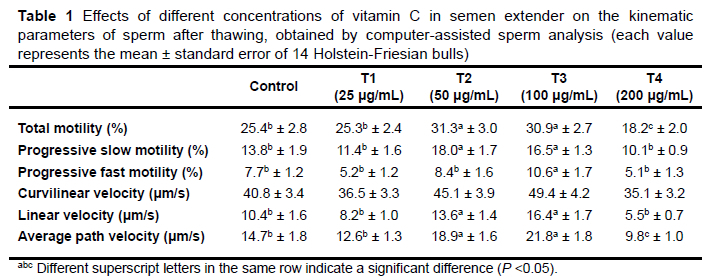
Table 1 shows the effects of the different vitamin C treatments on sperm kinematic performance. Treatment 2 (50 μg/mL) showed the highest total motility (31.3%), whereas T3 (100 μg/mL) showed higher values for selected sperm movement parameters, including the VCL, VSL, and VAP.
This suggests that while more sperm were moving in the 50 μg vitamin C/mL group, they moved with greater speed and directionality at 100 μg/mL. In all groups, the VCL was higher than the VSL. For example, in the control group, the VCL was 40.8 μm/s while the VSL was only 10.4 μm/s. This is indicative of a natural swimming pattern that is highly oscillatory rather than linear. This phenomenon was most pronounced in the 100 µg/mL group, where the VCL peaked at 49.4 μm/s. The decrease in performance in the 200 μg/mL group was drastic across all parameters, but particularly for the VSL (5.5 μm/s), which was nearly 50% lower than that of the control. These findings suggest that higher concentrations of vitamin C may impair progressive sperm motility.
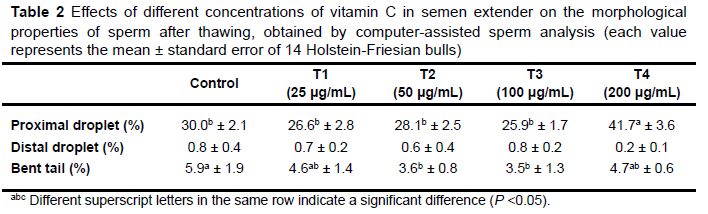
The results presented in Table 2 provide insights into the structural abnormalities that likely underpinned the kinetic changes observed in Table 1. The presence of proximal droplets was the most prevalent defect across all groups.
Moderate vitamin C concentrations (25-100 µg/mL) slightly reduced the percentage of spermatozoa with proximal droplets compared with the control, whereas 200 μg vitamin C/mL resulted in a marked and significant increase to 41.7%. Since proximal droplets are commonly associated with immature spermatozoa or incomplete epididymal maturation, this increase at the highest vitamin C concentration may indicate structural instabilities or reduced protection against freeze-thaw-induced damage. In contrast, the percentage of spermatozoa with bent tails was lowest at 50 µg/mL (3.6%) and 100 µg/mL (3.5%), suggesting that vitamin C supplementation at moderate concentrations may help preserve tail morphology.
Since the tail is the engine of sperm motility, this reduction in defects is directly associated with the improved velocity and motility metrics observed in Table 1 for these specific groups. These results can be explained by the fact that the semen was obtained directly from the epididymis and not by natural ejaculation, since the removal of the cytoplasmic droplet occurs progressively throughout sperm maturation during epididymal transit. In this type of collection, a proportion of spermatozoa may not yet have completed maturation, which explains the higher percentage of cytoplasmic droplets, compared with semen collected by ejaculation. These outcomes are consistent with the physiology of sperm maturation and with observations previously described in the literature (Leites et al., 2026). Unlike proximal droplets, the prevalence of distal droplets remained consistently low (<1%) and did not appear to be significantly influenced by treatment, suggesting they are a less sensitive biomarker for this specific experimental setup.
Overall, the results present a positive correlation between improved kinematics and morphology in the 50-100 μg vitamin C/mL range. These groups exhibited not only the fastest and most motile sperm but also the lowest percentage of tail defects. The data also consistently identified 200 μg/mL as an inhibitory or toxic concentration. The significant drop in motility and velocity metrics reported in Table 1 aligns with the marked increase in morphological abnormalities (proximal droplets) reported in Table 2. The lowest concentration (25 μg/mL) remained largely comparable to the control group across both kinematics and morphological parameters, suggesting that this dose is insufficient to produce physiological changes.
Vitamin C is a potent water-soluble antioxidant that directly scavenges superoxide anions, hydrogen peroxide, and hydroxyl radicals, thereby limiting reactive oxygen species (ROS) accumulation during freezing and thawing (Hungerford et al., 2024). In addition to its direct antioxidant action, vitamin C plays a key role in regenerating other antioxidants, such as vitamin E, and supporting the activity of endogenous antioxidant enzymes, including catalase and superoxide dismutase (Lykkesfeldt et al., 2025). By these mechanisms, vitamin C contributes to the preservation of membrane integrity, mitochondrial function, and cellular energy metabolism (Zhitkovich, 2020).
The significant improvements observed at intermediate vitamin C concentrations (50-100 µg/mL) are consistent with previous reports for ejaculated bovine sperm (Shepherd et al., 2024), buffalo sperm (Ivanova et al., 2020), and ram spermatozoa (Rather et al., 2016), where moderate supplementation with vitamin C resulted in enhanced post-thaw motility and overall sperm quality. These results indicate that the protective effects of vitamin C are conserved across ruminant species and sperm sources. However, the optimal concentration may vary depending on species, extender composition, cryopreservation protocol, and sperm origin.
In contrast, the absence of beneficial effects at the lowest concentration tested (25 µg/mL) possibly indicates that this dose was insufficient to counteract the oxidative stress induced by cryopreservation. This hypothesis supports the concept of a minimum effective antioxidant threshold, below which ROS-scavenging capacity is insufficient to prevent lipid peroxidation and mitochondrial damage. Similar data have been reported for other antioxidants, in which suboptimal concentrations failed to improve post-thaw sperm quality, underscoring the importance of precise dose selection (Kozlov et al., 2024).
A particularly important finding of this study is the marked reduction in both total and progressive motility observed at the highest concentration of vitamin C tested. At excessive levels, vitamin C may shift from an antioxidant to a pro-oxidant role, especially in the presence of transition metals such as iron or copper, by promoting the formation of highly reactive hydroxyl radicals through Fenton-type reactions (Chen et al., 2000). This pro-oxidant activity can exacerbate oxidative damage rather than alleviate it, leading to impaired sperm function. Moreover, excessive antioxidant supplementation may disrupt physiological ROS-mediated signalling pathways that are essential for normal sperm function (Younus et al., 2024). Although high ROS levels are detrimental, low, tightly regulated ROS levels are required for key processes such as sperm motility regulation, capacitation, hyperactivation, and the acrosome reaction. The over-scavenging of ROS can therefore impair these physiological processes, resulting in reduced sperm functionality despite apparent protection against oxidative damage (Du Plessis et al., 2015). This dual aspect of ROS highlights the fine balance between oxidative stress and redox signalling in sperm biology. Similar dose-dependent detrimental effects of high antioxidant concentrations have been reported in bovine (Younus et al., 2024), ovine (Riesco et al., 2021), and human (Kowalczyk, 2022) sperm cryopreservation studies. In several cases, moderate antioxidant supplementation improved post-thaw sperm quality, whereas higher doses reduced motility, altered membrane properties, or decreased the activity of endogenous antioxidant enzymes (Bathgate, 2011).
The composition of the cryopreservation extender also plays a major role in modulating the effects of antioxidant supplementation. Milk-based extenders contain casein and other components with intrinsic antioxidant properties, which may partially mask the effect of added antioxidants (Foote et al., 2002). In contrast, Tris and egg yolk extenders, such as the one used in the present study, lack strong inherent antioxidant protection (Kumar et al., 2024). This characteristic may have contributed to the pronounced response to vitamin C supplementation observed and highlights the importance of considering extender composition when optimising cryopreservation protocols.
Epididymal spermatozoa may be even more susceptible to cryo-induced oxidative stress than ejaculated sperm, as they are not naturally exposed to the antioxidant-rich seminal plasma that accompanies ejaculation (Agarwal et al., 2014). Seminal plasma contains enzymatic and non-enzymatic antioxidants, including superoxide dismutase, catalase, glutathione peroxidase, vitamin C, and vitamin E, which help buffer oxidative insults (Kowalczyk, 2022). The absence of this protective environment makes epididymal sperm an especially relevant model for evaluating the efficacy of exogenous antioxidant supplementation during cryopreservation.
From a practical perspective, the present findings have important implications for cattle breeding and artificial insemination programmes. Improving post-thaw sperm motility is directly associated with enhanced fertilisation potential and higher pregnancy rates, particularly when using cryopreserved semen (Palomar Rios et al., 2018). The use of epididymal sperm is especially relevant in cases of unexpected bull death or genetic conservation programmes, where maximising post-thaw sperm quality is critical (Rodrigues Silva et al., 2024). Vitamin C is an inexpensive, readily available, and easily implementable additive that can significantly improve cryo-survival when used at optimised concentrations (Hungerford et al., 2024).
However, it is important to acknowledge the inter-individual variation among bulls in sperm cryotolerance. Differences in membrane lipid composition, endogenous antioxidant enzyme activity, and genetic background can influence the response to cryopreservation and antioxidant supplementation (Oktanella et al., 2026; Simsek et al., 2025). Bulls are often classified as having high or low cryotolerance, and the optimal antioxidant dose may therefore vary between individuals (Younus et al., 2024). This variability indicates the need for further studies evaluating personalised or bull-specific cryopreservation strategies.
Future research should extend the evaluation of vitamin C supplementation beyond parameters evaluated by CASA to include membrane integrity, mitochondrial membrane potential, acrosomal status, chromatin structure, and DNA fragmentation. Assessing fertilisation outcomes following artificial insemination or in vitro fertilisation would also be essential to determine whether the observed improvements in motility translate into enhanced reproductive performance.
Conclusions
In conclusion, this study shows that supplementing cryopreservation media with 50-100 µg vitamin C/mL significantly improves the post-thaw fertilisation potential of epididymal spermatozoa. In contrast, concentrations below or above this range are ineffective or detrimental. These results emphasise the importance of precise dose optimisation that takes into account the dual antioxidant and pro-oxidant nature of vitamin C. When appropriately applied, vitamin C is a promising and affordable tool for improving sperm cryopreservation outcomes in bovine reproduction.
Authors' contributions
Z.J., J.S., J.P.-L., and M.H.M. da S. performed the experiments and were involved in manuscript writing and initial data analysis. Z.J., J.S., and M.H.M. da S., together with F.M. da S., designed the experiments and are responsible for manuscript writing. F.M. da S. corrected the final manuscript.
Conflict of interest declaration
The authors declare no conflicts of interest related to this paper.
Acknowledgements
This work was supported by national funds through the Fundação para a Ciência e a Tecnologia (FCT), I.P., under the multiannual funding of the R&D Unit UID/153/2025 (https://doi.org/10.54499/UID/00153/2025), Institute of Agricultural and Environmental Research and Technology (IITAA), and University of the Azores, as well as UID/PRR/00153/2025 (https://doi.org/10.54499/UID/PRR/00153/2025) and UID/PRR2/00153/2025 (https://doi.org/10.54499/UID/PRR2/00153/2025).
References
-
Agarwal, A., Tvrda, E., & Sharma, R., 2014. Relationship amongst teratozoospermia, seminal oxidative stress and male infertility. Reproductive Biology and Endocrinology, 12:45. DOI: https://doi.org/10.1186/1477-7827-12-45
» https://doi.org/10.1186/1477-7827-12-45 -
Bansal, A.K. & Bilaspuri, G.S., 2011. Impacts of oxidative stress and antioxidants on semen functions. Veterinary Medicine International, 2011:686137. DOI: https://doi.org/10.4061/2011/686137
» https://doi.org/10.4061/2011/686137 -
Bathgate, R., 2011. Antioxidant mechanisms and their benefit on post-thaw boar sperm quality. Reproduction in Domestic Animals, 46:23-25. DOI: https://doi.org/10.1111/j.1439-0531.2011.01826.x
» https://doi.org/10.1111/j.1439-0531.2011.01826.x -
Benko, F., Mohammadi-Sangcheshmeh, A., Ďuračka, M., Lukáč, N., & Tvrdá, E., 2022. In vitro versus cryo-induced capacitation of bovine spermatozoa, part 1: Structural, functional, and oxidative similarities and differences. PLoS One, 17:e0276683. DOI: https://doi.org/10.1371/journal.pone.0276683
» https://doi.org/10.1371/journal.pone.0276683 -
Binyameen, M., Saleem, M., & Riaz, A., 2019. Recent trends in bovine reproductive biotechnologies. CABI Reviews, 14:1-10. DOI: https://doi.org/10.1079/PAVSNNR201914052
» https://doi.org/10.1079/PAVSNNR201914052 -
Chen, K., Suh, J., Carr, A.C., Morrow, J.D., Zeind, J., & Frei, B., 2000. Vitamin C suppresses oxidative lipid damage in vivo, even in the presence of iron overload. American Journal of Physiology - Endocrinology and Metabolism, 279:E1406-E1412. DOI: https://doi.org/10.1152/ajpendo.2000.279.6.E1406
» https://doi.org/10.1152/ajpendo.2000.279.6.E1406 -
Du Plessis, S.S., Agarwal, A., Halabi, J., & Tvrdá, E., 2015. Contemporary evidence on the physiological role of reactive oxygen species in human sperm function. Journal of Assisted Reproduction and Genetics, 32:509-520. DOI: https://doi.org/10.1007/s10815-014-0425-7
» https://doi.org/10.1007/s10815-014-0425-7 -
Eulenberger, K., Schäfer-Somi, S., & Aurich, C., 2009. Effect of different concentrations of ascorbic acid on motility, membrane integrity and chromatin status of frozen-thawed canine spermatozoa within six hours of storage at 37 °C. Reproduction in Domestic Animals, 44:354-358. DOI: https://doi.org/10.1111/j.1439-0531.2009.01417.x
» https://doi.org/10.1111/j.1439-0531.2009.01417.x -
Evans, H.C., Dinh, T.T.N., Ugur, M.R., Hitit, M., Sajeev, D., Kaya, A., Topper, E., Nicodemus, M.C., Smith, G.D., & Memili, E., 2020. Lipidomic markers of sperm cryotolerance in cattle. Scientific Reports, 10:20192. DOI: https://doi.org/10.1038/s41598-020-77089-9
» https://doi.org/10.1038/s41598-020-77089-9 -
Foote, R.H., Brockett, C.C., & Kaproth, M.T., 2002. Motility and fertility of bull sperm in whole milk extender containing antioxidants. Animal Reproduction Science, 71:13-23. DOI: https://doi.org/10.1016/S0378-4320(02)00018-0
» https://doi.org/10.1016/S0378-4320(02)00018-0 -
Gulcin, İ., 2025. Antioxidants: A comprehensive review. Archives of Toxicology, 99:1893-1997. DOI: https://doi.org/10.1007/s00204-025-03997-2
» https://doi.org/10.1007/s00204-025-03997-2 -
Hu, J.H., Tian, W.Q., Zhao, X.L., Zan, L.S., Wang, H., Li, Q.W., & Xin, Y.P., 2010. The cryoprotective effects of ascorbic acid supplementation on bovine semen quality. Animal Reproduction Science, 121:72-77. DOI: https://doi.org/10.1016/j.anireprosci.2010.04.180
» https://doi.org/10.1016/j.anireprosci.2010.04.180 -
Hungerford, A.J., Bakos, H.W., & Aitken, R.J., 2024. Addition of vitamin C mitigates the loss of antioxidant capacity, vitality and DNA integrity in cryopreserved human semen samples. Antioxidants, 13:247. DOI: https://doi.org/10.3390/antiox13020247
» https://doi.org/10.3390/antiox13020247 -
Ivanova, M., Abadjieva, D., Gradinarska, D., Kandil, O., Abdoon, A., Taushanova, P., & Georgiev, B., 2020. Post-thaw treatment of frozen buffalo semen with antioxidants vitamin C and 2-mercaptoethanol. Biotechnology & Biotechnological Equipment, 34:1315-1322. DOI: https://doi.org/10.1080/13102818.2020.1837013
» https://doi.org/10.1080/13102818.2020.1837013 -
Janda, K., Kasprzak, M., Wolska, J., & Stachowska, K.E., 2015. Witamina C - budowa, właściwości, funkcje i występowanie. Pomeranian Journal of Life Sciences, 61:419-425. DOI: https://doi.org/10.21164/pomjlifesci.427
» https://doi.org/10.21164/pomjlifesci.427 -
Kowalczyk, A., 2022. The role of the natural antioxidant mechanism in sperm cells. Reproductive Sciences, 29:1387-1394. DOI: https://doi.org/10.1007/s43032-021-00795-w
» https://doi.org/10.1007/s43032-021-00795-w -
Kozlov, A.V., Javadov, S., & Sommer, N., 2024. Cellular ROS and antioxidants: Physiological and pathological role. Antioxidants, 13:5. DOI: https://doi.org/10.3390/antiox13050602
» https://doi.org/10.3390/antiox13050602 -
Kumar, A., Prasad, J.K., Srivastava, N., & Ghosh, S.K., 2019. Strategies to minimize various stress-related freeze-thaw damages during conventional cryopreservation of mammalian spermatozoa. Biopreservation and Biobanking, 17:603-612. DOI: https://doi.org/10.1089/bio.2019.0037
» https://doi.org/10.1089/bio.2019.0037 -
Kumar, D., Khasatiya, C.T., Chaudhary, S.S., & Singh, V.K., 2024. Evaluation of antioxidant potential of taurine in Tris egg yolk citrate extender in Surti buck semen preserved at refrigerated temperature. Asian Journal of Dairy and Food Research, 43:95-99. DOI: https://doi.org/10.18805/ajdfr.DR-1936
» https://doi.org/10.18805/ajdfr.DR-1936 -
Leites, I., Diniz, P., Fardilha, M., Santiago, J., Ferreira-Dias, G., Lopes da Costa, L., & Silva, E., 2026. Proteomic dynamics of bull sperm during post-testicular maturation. BMC Genomics, 27:281. DOI: https://doi.org/10.1186/s12864-026-12614-0
» https://doi.org/10.1186/s12864-026-12614-0 -
Lykkesfeldt, J., Carr, A.C., & Tveden-Nyborg, P., 2025. The pharmacology of vitamin C. Pharmacological Reviews, 77:100043. DOI: https://doi.org/10.1016/j.pharmr.2025.100043
» https://doi.org/10.1016/j.pharmr.2025.100043 -
Mckimmie, C., Forutan, M., Tajet, H.M., Ehsani, A., Hickford, J., & Amirpour, H., 2025. Impact of implementing female genomic selection and the use of sex-selected semen technology on genetic gain in a dairy herd in New Zealand. International Journal of Molecular Sciences, 26:990. DOI: https://doi.org/10.3390/ijms26030990
» https://doi.org/10.3390/ijms26030990 -
Oktanella, Y., Mustofa, I., Susilowati, S., Widjiati, W., Purwantara, B., Akintunde, A.O., Hernawati, T., Suprayogi, T.W., Utama, S., & Hestianah, E.P., 2026. Comparative efficacy of endogenous versus exogenous antioxidants in small ruminants sperm cryopreservation. Trends in Sciences, 23:12196. DOI: https://doi.org/10.48048/tis.2026.12196
» https://doi.org/10.48048/tis.2026.12196 -
Oliveira, W., Mota, M.F., Pinto Neto, A., Benvegnú, D.M., Cattelam, J., Martinez, A.C., Trenkel, C.K.G., & Zandonaide, J.P.B., 2024. In vitro viability of bovine semen cryopreserved with addition of vitamin C and Trolox to the extender medium. Semina: Ciências Agrárias, 45:1349-1366. DOI: https://doi.org/10.5433/1679-0359.2024v45n5p1349
» https://doi.org/10.5433/1679-0359.2024v45n5p1349 -
Palomar Rios, A., Gascón, A., Martínez, J.V., Balasch, S., & Molina Botella, I., 2018. Sperm preparation after freezing improves motile sperm count, motility, and viability in frozen-thawed sperm compared with sperm preparation before freezing-thawing process. Journal of Assisted Reproduction and Genetics, 35:237-245. DOI: https://doi.org/10.1007/s10815-017-1050-z
» https://doi.org/10.1007/s10815-017-1050-z -
Patel, H.A., Siddiquee, G.M., Chaudhari, D.V., & Suthar, V.S., 2016. Effect of different antioxidant additives in semen diluent on cryopreservability (−196 °C) of buffalo semen. Veterinary World, 9:299-303. DOI: https://doi.org/10.14202/vetworld.2016.299-303
» https://doi.org/10.14202/vetworld.2016.299-303 -
Qamar, A.Y., Naveed, M.I., Raza, S., Fang, X., Roy, P.K., Bang, S., Tanga, B.M., Saadeldin, I.M., Lee, S., & Cho, J., 2023. Role of antioxidants in fertility preservation of sperm-A narrative review. Animal Bioscience, 36:385-403. DOI: https://doi.org/10.5713/ab.22.0325
» https://doi.org/10.5713/ab.22.0325 -
Raseona, A.M., Ntswane, T.L., & Motiang, D.B., 2017. Viability of bull semen extended with commercial semen extender and two culture media stored at 24 °C. South African Journal of Animal Science, 47:49-55. DOI: https://doi.org/10.4314/sajas.v47i1.8
» https://doi.org/10.4314/sajas.v47i1.8 -
Rather, H.A., Islam, R., Malik, A.A., & Lone, F.A., 2016. Addition of antioxidants improves quality of ram spermatozoa during preservation at 4 °C. Small Ruminant Research, 141:24-28. DOI: https://doi.org/10.1016/j.smallrumres.2016.06.007
» https://doi.org/10.1016/j.smallrumres.2016.06.007 -
Riesco, M.F., Alvarez, M., Anel-Lopez, L., Neila-Montero, M., Palacin-Martinez, C., Montes-Garrido, R., Boixo, J.C., de Paz, P., & Anel, L., 2021. Multiparametric study of antioxidant effect on ram sperm cryopreservation-from field trials to research bench. Animals, 11:283. DOI: https://doi.org/10.3390/ani11020283
» https://doi.org/10.3390/ani11020283 -
Rodrigues Silva, A., Maria da Silva, A., Parente dos Santos, R., Glória Pereira, A., & Roberto Tavares Dantas, M., 2024. Biobanking and use of epididymal sperm - an alternative for wildlife germplasm conservation. In: Theriogenology - Recent Advances in the Field. Eds: Rodrigues Silva, A., Fernandes Pereira, A., & Liana Pusta, D., IntechOpen, Rijeka, Croatia. DOI: https://doi.org/10.5772/intechopen.115465
» https://doi.org/10.5772/intechopen.115465 -
Shepherd, M.J., Gonzalez-Castro, R.A., & Herickhoff, L.A., 2024. Application of antioxidants in extender on bull sperm cryopreservation to reduce the male effect in dairy fertility. Journal of Dairy Science, 107:10027-10040. DOI: https://doi.org/10.3168/jds.2024-24872
» https://doi.org/10.3168/jds.2024-24872 -
Simsek, S., Hitit, M., Bodu, M., & Memili, E., 2025. Sperm cell membranes of bulls and bucks associated with sperm fertility and freezability. Animals, 15:3248. DOI: https://doi.org/10.3390/ani15223248
» https://doi.org/10.3390/ani15223248 -
Singh, N., Patel, A., Kumar, S., Pande, M., Singh, V., & Siddique, R.A., 2024. Studies on effect of supplementation of ascorbic acid on post-thaw sperm acrosome integrity of Frieswal bull spermatozoa. International Journal of Pharmaceutical Sciences, 2:23-26. DOI: https://doi.org/10.5281/zenodo.10775237
» https://doi.org/10.5281/zenodo.10775237 -
Singh, P., Agarwal, S., Singh, H., Singh, S., Verma, P.K., Butt, M.S., & Sharma, U., 2020. Effects of ascorbic acid as antioxidant semen additive in cryopreservation of cross-bred cattle bull semen. International Journal of Current Microbiology and Applied Sciences, 9:3089-3099. DOI: https://doi.org/10.20546/ijcmas.2020.907.364
» https://doi.org/10.20546/ijcmas.2020.907.364 -
Ugur, M.R., Saber Abdelrahman, A., Evans, H.C., Gilmore, A.A., Hitit, M., Arifiantini, R.I., Purwantara, B., Kaya, A., & Memili, E., 2019. Advances in cryopreservation of bull sperm. Frontiers in Veterinary Science, 6:268. DOI: https://doi.org/10.3389/fvets.2019.00268
» https://doi.org/10.3389/fvets.2019.00268 -
Upadhyay, V.R., Ramesh, V., Dewry, R.K., Kumar, G., Raval, K., & Patoliya, P., 2021. Implications of cryopreservation on structural and functional attributes of bovine spermatozoa: An overview. Andrologia, 53:e14154. DOI: https://doi.org/10.1111/and.14154
» https://doi.org/10.1111/and.14154 -
Velazquez, M.A., 2008. Assisted reproductive technologies in cattle: Applications in livestock production, biomedical research and conservation biology. Annual Review of Biomedical Sciences, 10:36-62. DOI: https://doi.org/10.5016/1806-8774.2008.v10p36
» https://doi.org/10.5016/1806-8774.2008.v10p36 -
Younus, A., Yamanaka, T., & Shimada, M., 2024. The protective effects of antioxidants against endogenous and exogenous oxidative stress on bull sperm. In Vitro Cellular & Developmental Biology - Animal, 60:969-982. DOI: https://doi.org/10.1007/s11626-024-00944-w
» https://doi.org/10.1007/s11626-024-00944-w -
Zhang, P.P., Wang, J.J., Li, C.Y., Hao, H.S., Wang, H.Y., Du, W.H., Zhao, X.M., & Zhu, H.B., 2020. Protective effect of vitamin C and lycopene on the in vitro fertilization capacity of sex-sorted bull sperm by inhibiting oxidative stress. Reproduction in Domestic Animals, 55:1103-1114. DOI: https://doi.org/10.1111/rda.13748
» https://doi.org/10.1111/rda.13748 -
Zhitkovich, A., 2020. Nuclear and cytoplasmic functions of vitamin C. Chemical Research in Toxicology, 33:2515-2526. DOI: https://doi.org/10.1021/acs.chemrestox.0c00348
» https://doi.org/10.1021/acs.chemrestox.0c00348
Accepted 05 October 2026
Published 03 November 2026