Effects of in ovo injection of naringin into fertile broiler chicken eggs on hatchability and hatchling weight and length
Abstract
Naringin is an important flavonoid found in the fruit or peels of fruit from species of the Rutaceae family, such as grapefruit. The aim of this study was to investigate the effects of in ovo naringin injection on hatchability, hatchling weight, and hatchling length. A total of 180 fertilised Ross 308 broiler eggs were purchased from broiler flocks and randomly assigned to control (no in ovo injection), negative control (injection of 0.1 mL deionised water), and naringin (injection of 15 mg naringin in 0.1 mL deionised water) treatment groups. The eggs were incubated at 37.5 °C and 56% relative humidity and in ovo injections were made on the 18th day of incubation. Data were analysed using SPSS version 13.0, with the chi-square test used to determine the effects on hatchability, and hatchling weight and length compared using analysis of variance. The hatchability rates of the eggs in the control, negative control, and naringin treatment groups were 83.3%, 80%, and 88.3%, respectively, indicating that 15 mg naringin provided a 6% increase in hatchability. Hatchling weights were 46.26 g, 46.83 g, and 46.56 g, and hatchling lengths were 16.95 cm, 17.17 cm, and 17.28 cm, in the control, negative control, and naringin groups, respectively. In ovo injection with naringin insignificantly decreased hatchling weight, while significantly increasing hatchling length and insignificantly increasing hatchability compared to the control group. Additional research is needed to determine the most effective naringin level to obtain optimum results from in ovo injection during the incubation process.
broiler chicken; chick length; hatchability; in ovo injection; naringin
Introduction
The poultry sector makes an important and continuous contribution to human nutrition, and reproductive and feeding models in poultry farming therefore try to produce the healthiest product in the shortest possible time (Inci et al., 2014; Inci et al., 2016). The in ovo injection technique was first used in the late 1970s and has been an important research topic in recent years. This technology has become widespread, particularly for vaccination against Newcastle disease, and in ovo injection has become the standard procedure for the embryonic vaccination of broiler chickens for the Marek's disease virus and infectious bursal disease in the United States (Sharma & Burmester, 1984; Johnston et al., 1997; Gagic et al., 1999; Williams, 2007). In ovo injection provides advantages in fields such as disease control, as it can facilitate management practices, save labour, and improve hatchability results (Oladokun & Adewole, 2020; Tainika & Şekeroğlu, 2020; Shehata et al., 2021; Arain et al., 2022). In ovo injection, as one of the early feeding methods in poultry farming, also allows the investigation of the biological effects of phytobiotics, as well as other nutrients such as vitamins, carbohydrates, and proteins.
Naringin is an important flavonoid found in the fruits and peels of fruit from species of the Rutaceae family, such as grapefruit, and contributes to the bitter taste of citrus fruits (Li et al., 2018). Citrus fruit extracts contain large amounts of flavonoids and are the most important sources of flavonoids such as nobiletin, hesperidin, narirutin, naringenin, and naringin. Naringin, a flavone glycoside, is a product of the combination of the flavone naringenin and the disaccharide neohesperidose (El-Hady et al., 2024). In vivo and in vitro studies have shown that these citrus flavonoids have anti-inflammatory and antioxidant activities (Tripoli et al., 2007). Furthermore, flavonoids, which are compounds obtained from vegetables and fruits, are claimed to have positive effects on human health because of their biochemical and pharmacological properties (Lautraite et al., 2002; Türkoğlu et al., 2019). Flavonones such as naringin and naringenin are also strong scavengers of free radicals and prevent lipid peroxidation (Cavia-Saiz et al., 2010; Guimarães et al., 2010; Ranjbar et al., 2019).
In recent years, numerous scientific studies have reported the beneficial health effects of naringin as a supplement and feed additive. These effects have included improving production and meat quality by regulating lipid metabolism, increasing antioxidant capacity, and producing a favourable fatty acid profile, which are desirable characteristics in the broiler production industry (Goliomytis et al., 2015; Jiang et al., 2020; Hager-Theodorides et al., 2021; Bao et al., 2022). When examining published research on the supplementation of naringin to poultry, Hamady (2024) found that the addition of naringin to the diet at 1.25 and 1.5 g/kg improved body weight and feed utilisation at four and five weeks of age. Additionally, an increase in live weight was achieved by the addition of 0.2% Chelidonium majus or Lonicera japonica extract, containing 7.75 and 12.16 mg/kg naringin, respectively, to the diets of broilers (Park et al., 2014). Furthermore, Goliomytis et al. (2019) reported that the addition of naringin to the diets of laying hens could improve egg yolk colour without any adverse effects on other egg quality traits. Wong et al. (2013) also reported that naringin stimulated cell proliferation and the differentiation of osteoblasts.
The injection of plant-derived phytochemicals into poultry eggs has shown various benefits, including increased weight gain, feed efficiency, and growth rate, and decreased morbidity and mortality of embryos, as well as increased immunity and improved health status (Arain et al., 2022). Nonetheless, few studies have investigated the effects of naringin supplementation during incubation. The aim of this study was thus to evaluate the effect of the in ovo injection of naringin on hatchability results.
Materials and methods
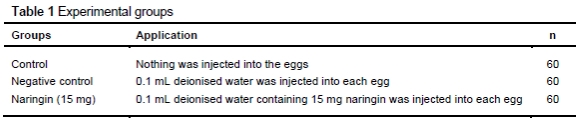
Ethical approval for this study was obtained from the Afyon Kocatepe University Animal Experiments Local Ethics Committee (approval number: AKU HADYEK-33-22). Fertile chicken eggs (Ross 308) were purchased from broiler flocks and incubated at 37.5 °C and 56% relative humidity. On the 18th day of incubation, they were divided into the control (60 eggs), negative control (60 eggs), and naringin treatment groups (60 eggs). The eggs in the three groups were treated as described in Table 1. Before the injection process, the blunt end of each egg was cleaned with alcohol and a small hole was opened using a micromotor. The air sac was detected with the help of a light, and the relevant solutions were injected into the air sac through the hole opened by the micromotor using a syringe. The hole in the shell was then closed with paraffin wax. After the injection process, the eggs were transferred to the hatching section.
The hatchability percentage was calculated as the number of live chicks hatched after 21 days of incubation, divided by the number of fertile eggs that were in ovo injected, multiplied by 100 (Joshua et al., 2016). Hatchling weight (g) was determined by weighing the chicks on a digital scale with a sensitivity of 0.01 g. Hatchling length (cm) was determined by lying the chick on a ruler and measuring the distance between the tip of the beak and the tip of the toe (Wolanski et al., 2005). Data were analysed using SPSS version 13.0 software, with the chi-square (Χ2) test being used to determine the effects on hatchability, while chick weight and length were compared using analysis of variance. The threshold for significance was P <0.05.
Results and discussion
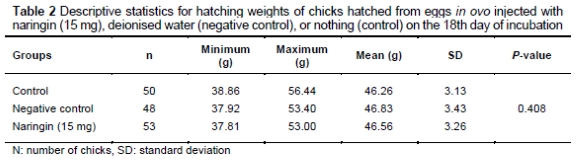
There were no significant differences in hatchling weights between the treatment groups (Table 2). However, the mean weights of the chicks in the control, negative control, and naringin groups were 46.26, 46.83, and 46.56 g, respectively.
Hatching weight and length are factors used to predict marketing weight in chicks (Ranjbar et al., 2019). Previous studies have reported that the injection of various nutrients into eggs had no effect on hatchling weight (Hajati et al., 2014; Al-Shamery & Al-Shuhaib, 2015; Joshua et al., 2016; Abdulqader et al., 2018; Şentürk et al., 2018; Groff-Urayama et al., 2019; Maman et al., 2019). However, Tangara et al. (2010) and Zhai et al. (2011) reported that carbohydrate (glucose, fructose, sucrose, maltose, and dextrin) injections increased chick weight. Furthermore, Ranjbar et al. (2019) reported that the in ovo injection of 30 mg naringin improved chick weight by stimulating the development of the embryo. Similarly, Surai (1999) reported that natural antioxidants given externally to the breeder chicken embryo will affect the embryo, and thus higher-quality and healthier chicks will be obtained. However, hatchling weight is affected by egg weight, incubation temperature and humidity, dosage of the injected nutrient, and day of injection (Ohta et al., 2001; Ferket et al., 2005), and these factors could be responsible for the contradicting results of previous studies. Hristakieva et al. (2017) reported that egg weight had a significantly positive effect on hatchling weight, while there was a negative correlation between the weight loss during incubation and the relative hatchling weight. Sklan et al. (2003) observed that heavier eggs produced heavier chicks and heavier broilers at slaughter at 41 days of age.
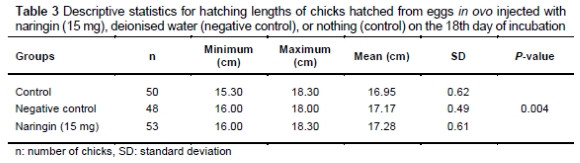
Significant differences between the groups were found for hatchling lengths (Table 3), with the mean lengths of the hatchlings in the control, negative control, and naringin groups being 16.95, 17.17, and 17.28 cm, respectively. Ranjbar et al. (2019) injected 15 to 30 mg naringin/egg into the amniotic fluid on days 14 and 17.5 of incubation, and found that naringin injection significantly improved the blood concentration of antioxidant enzymes and biochemical indices; increased the height, bone length, and thyroid hormone levels of the day-old chicks; and stimulated antioxidant enzymes such as superoxide dismutase and alkaline phosphatase. Flavonoid injection also positively affected chondrocyte proliferation and bone growth, and increased hatchling length (Swarnkar et al., 2012; Karimian et al., 2013). These results concur with the results of this study.
Hatchling length reflects embryo development at hatching, and has been found to be positively correlated with performance at later ages. Hatchling length is also an indicator of yolk absorption rate and may vary depending on parent stock age, hatchling weight, or incubation conditions (such as temperature and humidity) (Gharahveysi & Kenari, 2018). According to the literature, hatching weight and length are the main factors for predicting marketing weight in chickens (Wolanski et al., 2006; Willemsen et al., 2008). However, chick length is more important than chick weight in predicting the growth performance of broilers because chick weight is biased by the presence of unabsorbed residual yolk in the abdomen (Patbandha et al., 2017). It has therefore been recommended that hatchling length be used as a rapid, repeatable, and harmless method of determining chick quality and predicting performance (Wolanski et al., 2006). Furthermore, the number of saleable chicks is very important for the hatchery. It is thus important for hatcheries to not only have a high hatchability rate, but also to have good quality day-old chicks. According to research, there is a positive correlation between hatchling length and hatchling weight up to seven days of age. This relationship may indicate that the organs of taller chicks are better developed, and previous research has shown that the heart, liver, and spleen weights of tall chicks are higher than those of short chicks, and that the digestive system is better developed in tall chicks (Molenaar et al., 2007; Petek et al., 2008; Willemsen et al., 2008; Meijerhof, 2009; Şeremet, 2012; Sözcü & İpek, 2013; Mukhtar et al. 2013; Kamanlı & Durmuş, 2014; Gharahveysi & Kenari 2018; Peşmen, 2023). This suggests that in ovo naringin injection improved the quality of the chicks produced.
The average hatchability values in the control, negative control, and naringin groups were 83.3%, 80.0%, and 88.3%, respectively, and the chi-square test indicated that there were no significant differences in hatchability between the groups. Nonetheless, the naringin group had the highest hatchability, while the negative control group had the lowest hatchability, and 15 mg in ovo naringin provided a 6% increase in hatchability in this study. No negative effect of in ovo naringin application on hatchability was thus observed. Ranjbar et al. (2019) reported similar results, with the injection of 15 mg naringin on the 17.5th day of incubation causing a 4.33% increase in hatchability. In other studies, hatchability was improved by the in ovo injection of nutrients such as histidine (Xu et al., 2019), grape seed extract (Hajati et al., 2014), naringin (Ranjbar et al., 2019), arginine (Hazim & Salih, 2012), vitamin C (Zhu et al., 2020), and carbohydrates (Dong et al., 2013). In contrast, Beck et al., (2019), Ncho et al., (2021), Khaligh et al., (2018), and Coşkun et al., (2014b) reported that the injection of probiotics, γ-aminobutyric acid, quercetin, and pollen into eggs did not affect hatchability. These contrasting results may have been caused by differences in the injection site used, the time of injection (Moosanezhad et al., 2011), or the dosage of the nutrient used. In addition, administering different substances to the egg via in ovo injection may create nutritional imbalances in the egg, which may lead to embryo death (Alsadoon & Aygün; 2022). According to Ricks et al. (1999), the effectiveness of in ovo application depends on the incubation conditions, the equipment used, and the level of hygiene in solution preparation and application. Moosanezhad et al. (2011) further reported that the most appropriate time for the injection of various nutrients is between the 17th and 18th days of the incubation period. Since the fluids contained in different areas of the egg have different functions and contents, the response of the embryo can also vary depending on the site of in ovo injection (Williams, 2008). Coşkun et al. (2017) reported that the most important factor in the profitability of commercial poultry production is hatchability, and if the hatchability rate decreases after in ovo injection, the scientific results have no commercial significance (Coşkun et al., 2017). This emphasises the importance of the lack of negative effects on hatchability of in ovo naringin injection found in this study.
Conclusion
In ovo injection with naringin insignificantly decreased hatchling weight, significantly increased hatchling length, and insignificantly increased hatchability compared to the control group and negative control group. The study thus concluded that in ovo-administered naringin can be used to increase chick quality; however, the effect of different concentrations of naringin needs to be investigated to reach definitive conclusions. Knowledge of the value of the in ovo injection technique is rapidly progressing, as the effect of injecting different nutrients is determined. Nonetheless, further research needs to be conducted to determine standardised methods for in ovo injection (in terms of injection time and location, and the injected amount) for each nutrient (for example, carbohydrates, proteins, probiotics, or flavonoids).
Conflict of interest declaration
The author declares no conflicts of interest.
Data availability statement
Derived data supporting the findings of this study are available from the corresponding author, Günnur Peşmen, on request.
Funding information
There was no specific funding for this study.
References
-
Abdulqader, A.F.A., Olgun, O., & Yıldız, A.Ö., 2017. In ovo besleme. Hayvansal Üretim, 58(2):58-65. DOI: 10.29185/hayuretim.338989
» https://doi.org/10.29185/hayuretim.338989 -
Abdulqader, A.F., Aygün, A., Maman, A.H., & Olgun, O., 2018. The effect of in-ovo injection of Lactobacilla rhamnosus on hatching traits and growth parameters of quails. Selcuk Journal of Agriculture and Food Science, 32(2):174-178. DOI: 10.15316/SJAFS.2018.82
» https://doi.org/10.15316/SJAFS.2018.82 - Alsadoon, M.K.K. & Aygün, A., 2022. Effects of in ovo application of resveratrol on hatchability, hatching time, yolk sac weight and chick performance in quail. Poultry Studies, 19(1):19-24.
-
Al-Shamery, N.J. & Al-Shuhaib, M.B.S., 2015. Effect of in ovo injection of various nutrients on the hatchability, mortality ratio and weight of the broiler chickens. IOSR Journal of Agriculture and Veterinary Science, 8(1 Ver. II):30-33. DOI: 10.9790/2380-08123033
» 10.9790/2380-08123033 -
Arain, M.A., Nabi, F., Shah, Q.A., Alagawany, M., Fazlani, S.A., Khalid, M., Soomro, F., Khand, F.M. & Farag, M.R., 2022. The role of early feeding in improving performance and health of poultry: herbs and their derivatives. World's Poultry Science Journal, 78(2):499-513. DOI: 10.1080/00439339.2022.2043133
» https://doi.org/10.1080/00439339.2022.2043133 -
Bao, T., Yao, J., Zhou, S., Ma, Y., Dong, J., Zhang, C., & Mi, Y., 2022. Naringin prevents follicular atresia by inhibiting oxidative stress in the aging chicken. Poultry Science, 101(7). DOI: 10.1016/j.psj.2022.101891
» https://doi.org/10.1016/j.psj.2022.101891 -
Beck, C.N., McDaniel, C.D., Wamsley, K.G., & Kiess, A.S., 2019. The potential for inoculating Lactobacillus animalis and Enterococcus faecium alone or in combination using commercial in ovo technology without negatively impacting hatch and post-hatch performance. Poultry Science, 98(12):7050-7062. DOI: 10.3382/ps/pez441
» https://doi.org/10.3382/ps/pez441 -
Cavia-Saiz, M., Busto, M.D., Pilar-Izquierdo, M.C., Ortega, N., Perez-Mateos, M., & Muñiz, P., 2010. Antioxidant properties, radical scavenging activity and biomolecule protection capacity of flavonoid naringenin and its glycoside naringin: A comparative study. Journal of the Science of Food and Agriculture, 90:1238-1244. DOI: 10.1002/jsfa.3959
» https://doi.org/10.1002/jsfa.3959 -
Coşkun, İ., Erener, G., Şahin, A., Karadavut, U., Altop, A., & Ağma Okur, A., 2014a. Impacts of in ovo feeding of DL-methionine on hatchability and chick weight. Turkish Journal of Agriculture - Food Science and Technology, 2(1):47-50. DOI: 10.24925/turjaf.v2i1.47-50.64
» https://doi.org/10.24925/turjaf.v2i1.47-50.64 - Coşkun, İ., Çayan, H., Yılmaz, Ö., Taskın, A., Tahtabiçen, E., & Samli, H.E., 2014b. Effects of in ovo pollen extract injection to fertile broiler eggs on hatchability and subsequent chick weight. Türk Tarım ve Doğa Bilimleri 33 Dergisi, 1(4):485-489.
- Coşkun, İ., Korkmaz, F., Altop, A., Cayan, H., Filik, G., Sahin A., Samli, H.E., & Erener, G., 2017. The effects of in ovo pollen extract injection on growth parameters, ileal histomorphology and caecal microflora in fasted broiler chicks. Indian Journal of Animal Research, 51(6):1033-1037.
-
Dong, X., Jiang, Y., Wang, M., Wang, Y., & Zou, X., 2013. Effects of in ovo feeding of carbohydrates on hatchability, body weight, and energy status in domestic pigeons (Columba livia). Poultry Science, 92(8):2118-2123. DOI: 10.3382/ps.2013-03091
» https://doi.org/10.3382/ps.2013-03091 - El-Hady, H.A., Hamady, G.A.A., Abu-Taleb, A.M., & Abdel-Moneim, A.E., 2024. Influence of dietary naringin supplementation on productive performance and some blood parameters of broiler. Al-Azhar Journal of Agricultural Research, 49(1).
- Ferket, P.R., Foye, O., De Oliveira, J., Tako, E., & Uni, Z., 2005. In ovo nutrition: Impact on gene expression, gut development and growth performance. In: Proceedings of Arkansas Annual Animal Nutrition Conference Arkansas USA. pp. 147-150.
- Gagic, M., Hill, C.St., & Sharma J.M., 1999. In ovo vaccination of specific-pathogen free chickens with vaccines containing multiple antigens. Avian Diseases, 43:293-301.
-
Gharahveysi, S. & Kenari, T.A., 2018. Compare the chick length and weights of the Ross broiler breeder in different ages and farms. Egyptian Journal of Veterinary Sciences, 49(1 ):43-47. DOI: 10.21608/ejvs.2018.3069.1030
» https://doi.org/10.21608/ejvs.2018.3069.1030 -
Groff-Urayama, P., Padilha, J., Einsfeld, S., Pertile, S., Gorges, M., Andrade, M., Domenico, A., Midori Maeda, E., Takahashi, S., & Plaizier, J., 2019. Performance, intestinal morphometry, and incubation parameters of broiler chickens submitted to in ovo feeding with different techniques and amino acids. Canadian Journal of Animal Science, 99(4):732-740. DOI: 10.1139/CJAS-2018-0131
» https://doi.org/10.1139/CJAS-2018-0131 -
Goliomytis, M., Kartsonas, N., Charismiadou, M.A., Symeon, G.K., Simitzis, P.E., & Deligeorgis, S.G., 2015. The influence of naringin or hesperidin dietary supplementation on broiler meat quality and oxidative stability. PLOS One, 10:e0141652. DOI: 10.1371/journal.pone.0141652
» 10.1371/journal.pone.0141652 - Goliomytis, M., Simitzis, P., Papalexi,A., Veneti, N., Hager-Theodorides, A.L., Charismiadou, M.A., & Deligeorgis, S.G., 2019. Influence of citrus flavonoids on laying hen performance, inflammatory immune response, egg quality and yolk oxidative stability. Nutrition and Metabolism, 60(3):272-278.
-
Guimarães, R., Barros, L., Barreira, J.C.M., Sousa, M.J., Carvalho, A.M., & Ferreira, I.C.F.R., 2010. Targeting excessive free radicals with peels and juices of citrus fruits: Grapefruit, lemon, lime and orange. Food and Chemical Toxicology, 48:99-106. DOI: 10.1016/j.fct.2009.09.022
» https://doi.org/10.1016/j.fct.2009.09.022 -
Hamady, G.A.A.A.M., 2024. Influence of dietary naringin supplementation on productive performance and some blood parameters of broiler. Al-Azhar Journal of Agricultural Research, 49(1):166-176. DOI: 10.21608/AJAR.2024.247595.1293
» 10.21608/AJAR.2024.247595.1293 -
Hager-Theodorides, A.L., Massouras, T., Simitzis, P.E., Moschou, K., Zoidis, E., Sfakianaki, E., Politi, K., Charismiadou, M., Goliomytis, M., & Deligeorgis, S., 2021. Hesperidin and naringin improve broiler meat fatty acid profile and modulate the expression of genes involved in fatty acid β-oxidation and antioxidant defense in a dose dependent manner. Foods, 10:739. DOI: 10.3390/foods10040739
» https://doi.org/10.3390/foods10040739 - Hajati, H., Hassanabadi, A., Golian, A., Nassiri-Moghaddam, H., & Nassiri, M.R., 2014. The effect of in ovo injection of grape seed extract and vitamin C on hatchability, antioxidant activity, yolk sac absorption, performance and ileal micro flora of broiler chickens. Research Opinions in Animal and Veterinary Sciences, 4:633-638.
-
Hazim, J.A-D. & Salih, A.M., 2012. The influence of dietary arginine supplementation on blood traits of broiler chickens. Pakistan Journal of Nutrition, 11:258-264. DOI: 10.3923/pjn.2012.258.264
» https://doi.org/10.3923/pjn.2012.258.264 - Hristakieva, S.P., Oblakova, M., Mncheva, N., Lalev, M., & Kaliasheva, K., 2017. Phenotypic correlations between the egg weight, shape of egg, shell thickness, weight loss and hatchling weight of turkey. Slovak. Journal of Animal Science, 50(2):90-94.
- Inci, H., Karakaya, E., Şengül, T., & Söğut B., 2014. Bingöl ilinde kanatlı eti tüketiminin yapısı. Turk Tarım ve Doğa Bilimleri Dergisi, 1(1):17-24.
-
Inci, H., Ozdemir, G., Sogut, B., Sengul, A.Y., Sengul, T., & Taysi, M.R., 2016. Comparison of growth performance and carcass traits of Japanese quails reared in conventional, pasture, and organic conditions. Revista Brasileira de Zootecnia, 45(1):8-15. DOI: 10.1590/S1806-92902016000100002
» https://doi.org/10.1590/S1806-92902016000100002 -
Jiang, X., Li, A., Wang, Y., Iqbal, M., Waqas, M., Yang, H., Li, Z., Mehmood, K., Qamar, H., & Li, J., 2020. Ameliorative effect of naringin against thiram-induced tibial dyschondroplasia in broiler chicken. Environmental Science and Pollution Research, 27:11337-11348. DOI: 10.1007/s11356-020-07732-5
» 10.1007/s11356-020-07732-5 - Johnston, P.A., Liu, H., O'Connell, T., Phelps, P., Bland, M., Tyczkowski, J., Kemper, A., Harding, T., Avakian, A., Haddad, E., Whitfill, C., Gildersleeve, R., & Ricks, C.A., 1997. Applications in in ovo technology. Poultry Science, 76:165-178.
-
Joshua, P.P., Valli, C., & Balakrishnan, V., 2016. Effect of in ovo supplementation of nano forms of zinc, copper, and selenium on post-hatch performance of broiler chicken. Veterinary World, 9(3):287-294. DOI: 10.14202/vetworld.2016.287-294
» https://doi.org/10.14202/vetworld.2016.287-294 - Kamanlı, S. & Durmuş, K., 2014. Civciv kalitesi değerlendirme yöntemleri ve civciv kalitesinin iyileştirilmesi konusundaki son yaklaşımlar. Tavukçuluk Araştırma Dergisi, 11(1):40-44.
-
Karimian, E., Tamm, C., Chagin, A.S., Samuelsson, K., Kjartansdóttir, K.R., Ohlsson, C., & Sävendahl, L., 2013. Resveratrol treatment delays growth plate fusion and improves bone growth in female rabbits. PLOS One, 8:67859. DOI: 10.1371/journal.pone.0067859
» https://doi.org/10.1371/journal.pone.0067859 -
Khaligh, F., Hassanabadi, A., Nassiri-Moghaddam, H., Golian, A., & Kalidari, G.A, 2018. Effects of in ovo injection of chrysin, quercetin and ascorbic acid on hatchability, somatic attributes, hepatic oxidative status and early post-hatch performance of broiler chicks. Journal of Animal Physiology and Animal Nutrition. 102(1):e413-e420. DOI: 10.1111/jpn.12760
» https://doi.org/10.1111/jpn.12760 -
Lautraite, S., Musonda, A.C., Doehmer, J., Edwards, G.O., & Chipman, J.K., 2002. Flavonoids inhibit genetic toxicity produced by carcinogens in cells expressing CYP1A2 and CYP1A1. Mutagenesis, 17(1):45-53. DOI: 10.1093/mutage/17.1.45
» 10.1093/mutage/17.1.45 -
Li, C., Zhang, J., Lv, F., Ge, X., & Li, G., 2018. Naringin protects against bone loss in steroid-treated inflammatory bowel disease in a rat model. Archives of Biochemistry and Biophysics, 650:22-29. DOI: 10.1016/j.abb.2018.05.011
» 10.1016/j.abb.2018.05.011 - Maman, A.H., Aygün, A., Yildirim, İ., & Alsadoon, M.K.K., 2019. Effects of in ovo injection of D3 vitamin on hatchability and supply organ weights in quail hatching eggs. Journal of Bahri Dagdas Animal Research, 8(1):21-27
- Meijerhof, R., 2009. The influence of incubation on chick quality and broiler performance. In: 20th Annual Australian Poultry Science Symposium. 9-11 February 2009, Sydney, New South Wales.
- Molenaar R., Reijrink I., Meijerhof R., & Brand H.V.D., 2007. Relationship between chick length and chick weight at hatch and slaughter weight and breast meat yield in broilers. In: Proceedings of the 3rd Combined Workshop on Fundamental Physiology and Perinatal Development in Poultry. 5-10 October 2007, Berlin, Germany.
-
Mukhtar, N., Khan, S.H., & Anjum, M.S., 2013. Hatchling length is a potential chick quality parameter in meat type chickens. World's Poultry Science Journal, 69(4):889-896. DOI: 10.1017/S0043933913000883
» 10.1017/S0043933913000883 - Moosanezhad, M., Salahi, A., & Mashayekhi, S., 2011. The best time for in ovo solution injection in old broiler breeder flock eggs. In: Proceedings of the XIV European Symposium on the Quality of Eggs and Egg Products, XX Symposium on the Quality of Poultry Meat. 4-8 September 2011, Leipzig, Germany.
-
Ncho, C.M., Goel, A., Jeong, C.M., Youssouf, M., & Choi, Y.H., 2021. In ovo injection of GABA can help body weight gain at hatch, increase chick weight to egg weight ratio, and improve broiler heat resistance. Animals, 11/1364. DOI: 10.3390/ani11051364
» https://doi.org/10.3390/ani11051364 -
Ohta, Y., Kidd, M.T., & Ishibashi, T., 2001. Embryo growth and amino acid concentration profiles of broiler breeder eggs, embryos, and chicks after in ovo administration of amino acids. Poultry Science, 80:1430-1436. DOI: 10.1093/ps/80.10.1430
» https://doi.org/10.1093/ps/80.10.1430 -
Oladokun, S. & Adewole, I. , 2020. In ovo delivery of bioactive substances: an alternative to the use of antibiotic growth promoters in poultry production-a review. Journal of Applied Poultry Research, 29(3):744-763. DOI: 10.1016/j.japr.2020.06.002
» https://doi.org/10.1016/j.japr.2020.06.002 - Park, J., Kang, S., Chu, G., & Jin, S., 2014. Growth performance, blood cell profiles, and meat quality properties of broilers fed with Saposhnikovia divaricata, Lonicera japonica, and Chelidonium majus extracts. Livestock Science, 165:87-94.
- Patbandha, T.K., Garg, D.D., Marandi, S., Vaghamashi, D.G., Patil, S.S., & Savsani, H.H., 2017. Effect of chick weight and morphometric traits on growth performance of coloured broiler chicken. Journal of Entomology and Zoology Studies, 5(6): 1278-1281.
- Petek, M., Orman, A., Dikmen, S., & Alpay, F., 2008. Relations between day-old chick length and body weight in broiler, quail and layer. Bursa Uludag University Journal of Faculty of Veterinary Medicine, 27(1-2):25-28.
-
Pesmen, G., 2023. Research on the relations between some parameters for daily aged domestic goose chick. Journal of Radiation Research and Applied Sciences, 16(4):100709. DOI: 10.1016/j.jrras.2023.100709
» 10.1016/j.jrras.2023.100709 -
Ranjbar, Z., Torki, M., & Torshizi, K., 2019. In ovo injection of flavanone on bone quality characteristics, biochemical parameters and antioxidant enzyme status of blood in daily chicks. Journal of Animal Physiology and Animal Nutrition, 103:1418-1426. DOI: 10.1111/jpn.13132
» https://doi.org/10.1111/jpn.13132 -
Ricks, C.A., Avakian, A., Bryan, T., Gildersleeve, R., Haddad, E., Ilich, R., King, S., Murray, L., Phelps, P., Poston, R., Whitfill, C., & Williams, C., 1999. In ovo vaccination technology. Advances in Veterinary Medicine, 41:495-515. DOI: 10.1016/S0065-3519(99)80037-8
» 10.1016/S0065-3519(99)80037-8 - Sharma, J.M. & Burmester, B.R., 1984. Disease control in avian species by embryonal vaccination. U.S. Patent No. 4,458,630.
-
Shehata, A.M., Paswan, V.K., Attia, Y.A., Abdel-Moneim, A.M.E., Abougabal, M.S., Sharaf, M., Elmazoudy, R., Alghafari, W.T., Osman, M.A., Farag, M.R., & Alagawany, M., 2021. Managing gut microbiota through in ovo nutrition influences early-life programming in broiler chickens. Animals, 11:3491. DOI: 10.3390/ani11123491
» https://doi.org/10.3390/ani11123491 -
Sklan, D., Heifetz, S., & Halevy, O., 2003. Heavier chicks at hatch improves marketing body weight by enhancing skeletal muscular growth. Poultry Science, 82:1778-1786. DOI: 10.3382/japr.2009-00038
» https://doi.org/10.3382/japr.2009-00038 - Sözcü, A. & İpek, A., 2013. Kuluçka koşullarının Civciv kalitesi ve broiler Performansı Üzerine Etkileri. Uludağ Üniversitesi Ziraat Fakültesi Dergisi, 27(2):139-146.
- SPSS Inc., 2004. SPSS 13.00 Computer Software. SPSS Inc, Chicago, Illinois, USA.
- Surai, P.F., 1999. Tissue-specific changes in the activities of antioxidant enzymes during the 953 development of the chicken embryo. British Poultry Science, 40:397-405.
-
Swarnkar, G., Sharan, K., Siddiqui, J.A., Mishra, J.S., Khan, K., Khan, M.P., & Chattopadhyay, N.A., 2012. Naturally occurring naringenin derivative exerts potent bone anabolic effects by mimicking oestrogen action on osteoblasts. British Journal of Pharmacology, 165:1526-1542. DOI: 10.1111/j.1476-5381.2011.01637.x
» https://doi.org/10.1111/j.1476-5381.2011.01637.x -
Şentürk, E.T., Aygün, A., Olgun, O., & Yıldız, A.Ö., 2018. Effects of in-ovo injection of manganese on some organ weights and lengths in quail hatching eggs. Selcuk Journal of Agriculture and Food Sciences, 32(3):345-348. DOI: 10.15316/SJAFS.2018.104
» https://doi.org/10.15316/SJAFS.2018.104 - Şeremet, Ç., 2012. Civciv kalitesini etkileyen etmenler ve değerlendirme yöntemleri. Hayvansal Üretim, 53(1):38-43.
-
Tainika, B. & Şekeroğlu, A., 2020. In ovo feeding technology for optimization of incubation and hatching in broiler chickens. Turkish Journal of Agriculture-Food Science and Technology, 8(sp1):183-186. DOI: 10.24925/turjaf.v8isp1.183-186.4086
» 10.24925/turjaf.v8isp1.183-186.4086 -
Tangara, M., Chen, W., Xu, J., Huang, F., & Peng, J., 2010. Effects of in ovo feeding of carbohydrates and arginine on hatchability, body weight, energy metabolism and perinatal growth in duck embryos and neonates. British Poultry Science, 51(5):602-608. DOI: 10.1080/00071668.2010.520303
» https://doi.org/10.1080/00071668.2010.520303 -
Tripoli, E., La Guardia, M., Giammanco, S., Di Majo, D., & Giammanco, M., 2007. Citrus flavonoids: Molecular structure, biological activity and nutritional properties: A review. Food Chemistry, 104:466-479. DOI: 10.1016/j.foodchem.2006.11.054
» https://doi.org/10.1016/j.foodchem.2006.11.054 -
Türkoğlu, E.A., Kuzu, M., Ayasan, T., Inci, H., & Eratak, S.V., 2019. Inhibitory effects of some flavonoids on thioredoxin reductase purified from chicken liver. Brazilian Journal of Poultry Science, 21(2):1 -7. DOI: 10.1590/1806-9061-2018-0982
» https://doi.org/10.1590/1806-9061-2018-0982 - Williams, C.J., 2007. In ovo vaccination for disease prevention. International Poultry Production, 15:7-9.
-
Williams, C.J., 2008. International Poultry Production. 15(8):7-9. http://pfizerglobalpoultry.com/articles/Pfizer_15_8.pdf.
» http://pfizerglobalpoultry.com/articles/Pfizer_15_8.pdf -
Willemsen, H., Everaert, N., Witters, A., De Smit, L., Debonne, M., Verschuere, F., & Bruggema, V., 2008. Critical assessment of chick quality measurements as an indicator of posthatch performance. Poultry Science, 87:2358-2366. DOI: 10.3382/ps.2008-00095
» https://doi.org/10.3382/ps.2008-00095 - Wolanski, N.J., Luiten, E., Meijerhof, R., & Vereijken, A.L.J., 2005. Yolk utilisation and chick length as parameters for embryo development. Avian and Poultry Biology Reviews, 15:233-239.
-
Wolanski, N., Renema, R., Robinson, F., Carney, V., & Fancher, B., 2006. Relationship between chick conformation and quality measures with early growth traits in males of eight selected pure or commercial broiler breeder strains. Poultry Science, 85:1490-1497. DOI: 10.1093/ps/85.8.1490
» https://doi.org/10.1093/ps/85.8.1490 -
Wong, K-C., Pang, W-Y., Wang, X-L., Mok, S-K., Lai, W-P., Chow, H-K., Leung, P-C., Yao, X-S., & Wong, M-S., 2013. Drynaria fortunei-derived total flavonoid fraction and isolated compounds exert oestrogen-like protective effects in bone. British Journal of Nutrition, 110(3): 475-485. DOI: 10.1017/S0007114512005405.
» https://doi.org/10.1017/S0007114512005405 -
Xu, Q.Q., Zhang, X.Y., Zou, X.T., & Dong, X.Y., 2019. Effects of in ovo injection of L-histidine on hatch performance and post-hatch development in domestic pigeons (Columba livia). Poultry Science, 98(8):3194-3203. DOI: DOI: 10.3382/ps/pez046
» https://doi.org/10.3382/ps/pez046 - Zhai, W., Rowe, D.E., & Peebles, E.D., 2011. Effects of commercial in ovo injection of carbohydrates on broiler embryogenesis. Poultry Science, 90:1295-1301.
-
Zhu, Y., Li, S., Duan, Y., Ren, Z., Yang, X., & Yang, X., 2020. Effects of in ovo feeding of vitamin C on post-hatch performance, immune status and DNA methylation-related gene expression in broiler chickens. British Journal of Nutrition, 124(9):903-911. DOI: 10.1017/S000711452000210X
» https://doi.org/10.1017/S000711452000210X
Accepted 14 July 2025
Published 25 July 2025