Comparative analysis of the rumen microbiota of Brown Hanwoo, Jeju Black, and Brown Hanwoo × Jeju Black cross-bred steers
Abstract
This study examined the rumen microbiota of Brown Hanwoo, Jeju Black, and Brown Hanwoo × Jeju Black cross-bred steers reared under the same dietary and environmental conditions. Nine steers were included in the study, with three animals per genetic type, and all animals were fed the same total mixed ration. Rumen samples were collected using the stomach-tubing method, and total community DNA was extracted using the repeated bead-beating plus column method. The V3-V4 hypervariable region of the 16S rRNA gene was amplified and sequenced on the Illumina MiSeq platform. The composition of the rumen microbiota was analysed using QIIME 2 for sequence processing and MicrobiomeAnalyst for statistical visualisations. Alpha diversity indices revealed no significant differences in microbial richness or evenness between the three groups. In contrast, beta-diversity analysis revealed significantly distinct microbial community structures. Patescibacteria, Monoglobus, Shuttleworthia, and Lachnospiraceae_UCG-004 were more abundant in the Brown Hanwoo steers than in the steers of the other two genetic types. These findings suggest a possible breed effect on the rumen microbiota composition under controlled dietary conditions.
16S rRNA gene sequencing; Korean native cattle; microbial community structure; total mixed ration
Introduction
Beef cattle are an important protein source for humans, and the demand for beef continues to grow with population expansion. Thus, efficient beef cattle production and management have become critical for improving farm profitability. Ruminants possess a unique digestive system in which ingested feed is fermented by microbes in the rumen, producing volatile fatty acids (VFAs) (Kim et al., 2011; Kim et al., 2017; Kim, 2023). These VFAs are absorbed from the rumen and serve as the primary energy source for the host animal (Mahboubi et al., 2026).
The rumen microbial community contributes substantially to nutrient utilisation and overall host performance (Firkins & Yu, 2015). Its composition is influenced by multiple factors, including diet, environment, and host genetic background (Kim et al., 2011). Previous studies have reported that the composition of the rumen microbiota varies among cattle breeds (Paz et al., 2016; Islam et al., 2021; Kang et al., 2024), and interactions between the host breed genotype and the rumen microbiome may influence animal productivity (Li et al., 2019). Consequently, findings from one breed may not be directly applicable to other breeds, and breed-specific studies are needed.
In South Korea, the Brown Hanwoo breed accounts for more than 95% of beef cattle production, with Brindle Hanwoo, Black Hanwoo, and Jeju Black cattle making up the remaining 5% (Lee et al., 2014). Jeju Black steers produce meat with a higher nutritional value, in terms of fatty acid composition, and superior organoleptic properties than meat from Brown Hanwoo steers (Park et al., 2014). However, Jeju Black steers have disadvantages such as a smaller body size, a slower growth rate, lower intramuscular fat deposition, and reduced average daily gain (Strucken et al., 2015). Therefore, cross-breeding between Brown Hanwoo and Jeju Black has been employed to improve Jeju Black productivity. Cross-bred steers (F1) exhibit intermediate meat quality characteristics between Brown Hanwoo and Jeju Black (Cho et al., 2024), suggesting that cross-breeding improves palatability. Similarly, cross-breeding Jeju Black with Charolais beef cattle results in higher average daily gains relative to purebred Jeju Black cattle (Lee et al., 2007).
Although previous studies have compared the rumen microbiota composition of different breeds of beef cattle (Henderson et al., 2015; Li et al., 2019), comparative analyses focusing specifically on Hanwoo breeds and their crosses under controlled dietary conditions remain limited. Therefore, this study aimed to analyse the rumen microbiota composition of Brown Hanwoo, Jeju Black, and Brown Hanwoo × Jeju Black cross-bred steers using 16S rRNA gene amplicon sequencing. It was hypothesised that the rumen microbial community structure may differ between the three genetic groups under identical dietary conditions.
Materials and methods
All experimental protocols were reviewed and approved by the Institutional Animal Care and Use Committee of Chonnam National University, Korea (CNU IACUCYB-2020-7), and all methods were conducted in accordance with the relevant guidelines and regulations.
Animals and diets
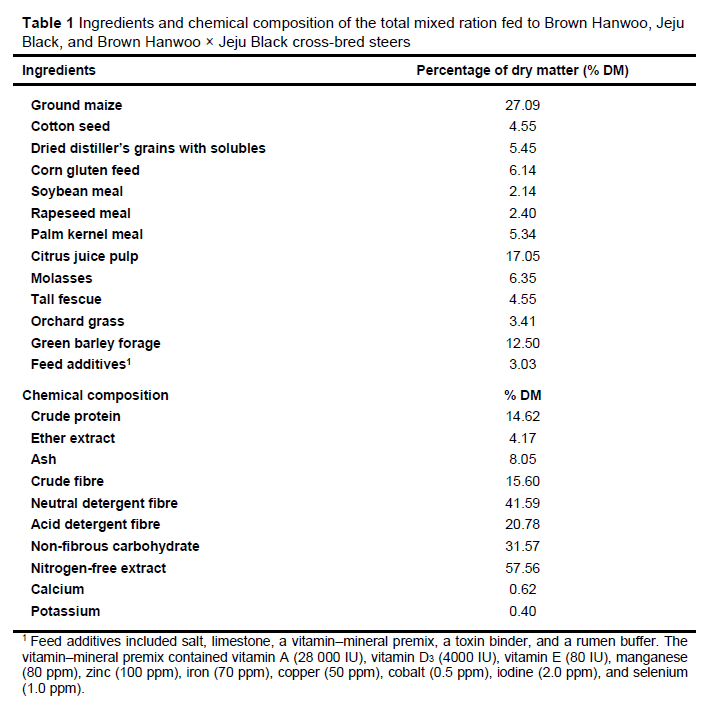
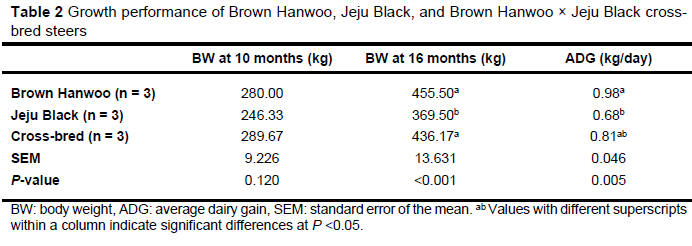
Nine 16-month-old steers were used to investigate the composition of the rumen microbiota: Brown Hanwoo (456 ± 11 kg, n = 3), Jeju Black (370 ± 21 kg, n = 3), and Brown Hanwoo × Jeju Black cross-breeds (436 ± 5 kg, n = 3) produced by crossing Jeju Black sires with Brown Hanwoo dams. All steers had been raised on the same farm and fed the same total mixed ration (TMR) from 10 months of age under uniform management conditions to minimise potential dietary and regional effects on the rumen microbiota. At the initiation of TMR feeding at 10 months of age, the mean body weights (BW) were 280 ± 16 kg for the Brown Hanwoo, 246 ± 27 kg for the Jeju Black, and 290 ± 24 kg for the cross-bred steers. The TMR was provided under the same restricted feeding programme for all animals, and the offered ration was almost completely consumed, with no apparent differences in feed refusal among the three breeds. Water was supplied ad libitum.
The ingredients and chemical composition of the TMR are provided in Table 1. The dry matter (DM, method #934.01), crude protein (CP, #976.05), ether extract (EE, #920.39), ash (#942.05), crude fibre (CF, #978.10), and acid detergent fibre (ADF, #973.18) concentrations were analysed according to the corresponding methods of the Association of Official Analytical Chemists (AOAC, 2019). The neutral detergent fibre (NDF) concentration was determined using the method described by Van Soest et al. (1991). The non-fibrous carbohydrate (NFC) and nitrogen-free extract (NFE) concentrations in the TMR diet were calculated using following equations:
NFC = [100 − CP − EE − ash − NDF]
NFE = [100 − CP − EE − ash − CF]
Ruminal sampling
Rumen samples were collected from all nine steers two hours after feeding using the stomach-tubing method described previously (Song et al., 2018). Briefly, the first 100 mL of each sample was discarded to avoid potential saliva contamination. Subsequently, 200 mL samples of the rumen contents were obtained using a vacuum pump (2515C-75 Suction Pump, Welch Vacuum, USA), and were transferred into sterile 50 mL conical tubes. Samples were immediately stored at −80 °C until total community DNA extraction.
DNA extraction and sequencing
Total community DNA was extracted from the collected samples using the repeated bead-beating plus column method described by Yu & Morrison (2004). The purity and concentration of the extracted DNA were assessed using an Eppendorf BioSpectrometer fluorescence system (Eppendorf AG, Hamburg, Germany).
The V3-V4 region of the 16S rRNA gene was amplified using universal primers 341F (5ʹ-CCTACGGGNGGCWGCAG-3ʹ) and 805R (5ʹ-GACTACHVGGGTATCTAATCC-3ʹ) (Herlemann et al., 2011). The resultant amplicons were sequenced on the Illumina MiSeq platform (Illumina, San Diego, CA, USA). The 16S rRNA gene sequence data were processed and analysed using Quantitative Insights into Microbial Ecology 2 (QIIME 2, version 2023.05) (Bolyen et al., 2019). Denoising and chimera removal were performed using the Divisive Amplicon Denoise Algorithm 2 (DADA2) program in QIIME 2 (Callahan et al., 2016). Amplicon sequence variants (ASVs) were derived from the high-quality sequences and classified into taxa using a naïve Bayes taxonomy classifier trained on the Silva database (NR 138 version) (Quast et al., 2013). Taxa with a relative abundance of at least 0.05% across the three genetic types were included in statistical comparisons between the three groups, whereas taxa representing at least 2% of the total sequences were considered major taxa for visualisation. Alpha diversity was analysed using the observed ASVs, Chao1, the abundance-based coverage estimator (ACE), and Shannon, Simpson, and Fisher indices. Beta diversity was assessed using principal coordinate analysis (PCoA) based on weighted and unweighted UniFrac distance metrics. Visualisations were generated using MicrobiomeAnalyst (Dhariwal et al., 2017).
Statistical analysis
Growth performance data, including initial BW, final BW, and average daily gain (ADG), were compared between the three genetic groups using analysis of variance, followed by Tukey's honestly significant difference test for multiple comparisons in R (version 4.1.2; R Core Team, Vienna, Austria). Differences in alpha diversity indices between the three genetic groups were analysed using the Kruskal-Wallis test. Beta diversity was compared using permutational multivariate analysis of variance. Phyla and genera represented by at least 0.05% of the total sequences were compared across the three genetic groups using the linear discriminant analysis (LDA) effect size (LEfSe) (Segata et al., 2011).
Results and discussion
The growth performance data of the three genetic types are presented in Table 2. The initial BW did not differ significantly between the three groups. However, the Jeju Black steers had a significantly lower final BW than both the Brown Hanwoo and cross-bred steers, and the ADG was significantly lower in the Jeju Black than in the Brown Hanwoo. These results suggest that genetic background contributes to the differences in growth performance between breeds. Host genetic variation is known to influence the rumen microbial composition, which may subsequently affect nutrient utilisation and feed efficiency in ruminants (Li et al., 2019). The similar performance of the cross-bred and Brown Hanwoo groups further suggests that cross-breeding with Brown Hanwoo may improve the growth performance of Jeju Black steers.
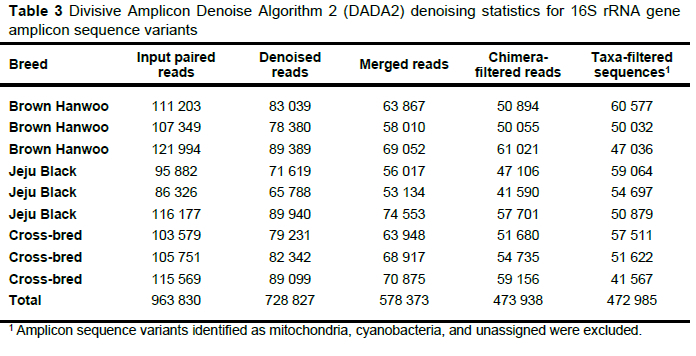
Sequencing depth and quality metrics are summarised in Table 3. A total of 936 830 raw paired-end reads were obtained from the nine samples. After DADA2 processing, 728 827 reads were retained following denoising, 578 373 reads were successfully merged, and 473 938 reads remained after chimera removal. Subsequent filtering to remove sequences assigned to mitochondria, cyanobacteria, and unassigned taxa resulted in 472 985 reads for downstream analyses. These sequences were assigned to 24 phyla, 39 classes, 77 orders, 123 families, and 256 genera.
At the phylum level, Bacteroidota and Firmicutes were the major phyla, accounting for the majority of the total sequences across all three groups (Figure 1A), whereas other phyla were present at relatively low abundances, each representing less than 2% of the total sequences. These two phyla have been identified as the core dominant phyla in cattle rumens regardless of diet and breed, reflecting their fundamental roles in overall rumen fermentation (Kim et al., 2011).
At the genus level, Prevotella was the most abundant known genus, accounting for 25% of total sequences across the three groups, followed by Ruminococcus (3.5%) (Figure 1B). The remaining genera were present at relatively low abundances, each accounting for less than 2% of the total sequences. Prevotella and Ruminococcus have been reported as core dominant genera in cattle rumens (Kim et al., 2011; Henderson et al., 2015). In the present study, the predominance of these taxa further supports their roles as core members of the rumen microbiota.
The LEfSe analysis showed that Patescibacteria, which contributed 1.5% of the total sequences, were more abundant in Brown Hanwoo than in the other two groups (LDA >2.0, P <0.05; Figure 2A). Although Patescibacteria are a low-abundance phylum in the rumen, a recent study reported a positive association between Patescibacteria abundance and daily growth in Japanese Black steers (Lee et al., 2024). In the present study, the relatively greater ADG observed in the Brown Hanwoo steers suggests a possible association with the higher abundance of this phylum, rather than a causal relationship. Further studies are needed to clarify the relationship between Patescibacteria abundance and growth performance.
At the genus level, Monoglobus, Shuttleworthia, and Lachnospiraceae_UCG-004 were more abundant in the Brown Hanwoo steers than in the other two groups (LDA >2.0, P <0.05; Figure 2B). Monoglobus has been reported to degrade pectin in the human gut (Kim et al., 2019). It has also been detected in Japanese Black steers, where its abundance was greater under high-forage feeding conditions, suggesting a potential association with rumen fibre degradation (Lee et al., 2024). Therefore, Monoglobus may be associated with fibre fermentation in all three genetic types, with its higher abundance in Brown Hanwoo indicating a potentially greater contribution in this group. However, the specific metabolic role of Monoglobus in the rumen remains unclear and requires further investigation.
Shuttleworthia was highly abundant in lambs and goats fed a forage-based diet (Zhang et al., 2017; Gebeyew et al., 2024), indicating a possible association with fibre fermentation, although its functional role remains unclear. Members of the Lachnospiraceae, including UCG-004, have been associated with fibre degradation (Xu et al., 2025) and improved feed efficiency (Myer et al., 2015; Li & Guan, 2017), suggesting its potential association with structural carbohydrate fermentation. A previous in vitro study exhibited greater ruminal digestibility in Brown Hanwoo than Jeju Black steers (Kang et al., 2024). Although digestibility was not evaluated in the present study, the higher abundance of these fibre-associated taxa in the Brown Hanwoo steers may be related to previously reported differences in ruminal digestibility. However, this study does not demonstrate a direct relationship, and further studies are needed to clarify this association.
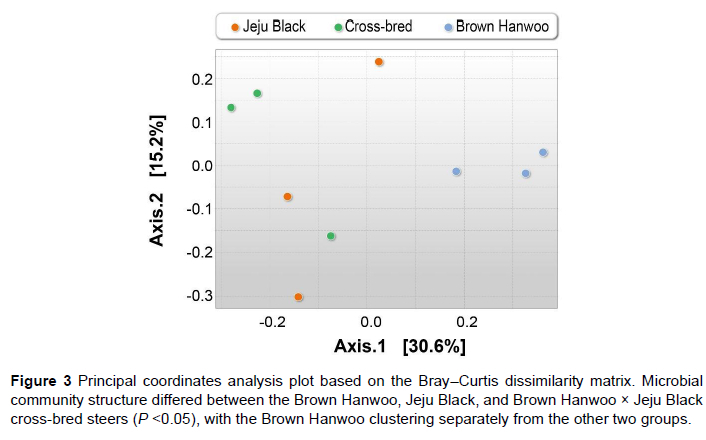
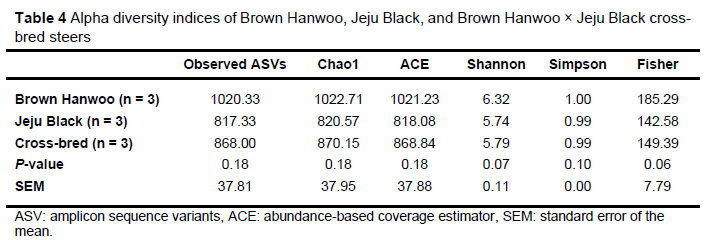
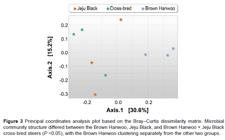
Although Shannon and Fisher index values tended to be higher in the Brown Hanwoo steers (P <0.1), no significant differences in overall alpha diversity indices were observed between the three groups (P >0.05; Table 4), suggesting limited breed effects on rumen microbial diversity. This finding is consistent with previous studies (Gleason & White, 2018; Li et al., 2019). In contrast, beta-diversity analysis revealed significant differences in overall microbial community structure based on Bray-Curtis dissimilarity (Figure 3). The PCoA plot showed a distinct separation of the Brown Hanwoo group from the other two groups, whereas the Jeju Black and cross-bred steers clustered closely (Figure 3). Notably, the cross-bred group did not occupy an intermediate position between the Brown Hanwoo and Jeju Black groups. Instead, the rumen microbial communities of the cross-breeds were more similar to those of the Jeju Black steers (the sire breed) than the Brown Hanwoo steers (the dam breed), suggesting a potential paternal influence on rumen microbial inheritance. Further studies with larger sample sizes are required to validate these findings. Collectively, these findings suggest that breed differences influence rumen microbiota composition but not microbial diversity or richness. Importantly, the present findings highlight the need to consider host genetic background when evaluating rumen microbial ecosystems, and suggest that breed-associated microbiota may contribute to optimising feeding management and promoting sustainable beef production.
Despite these findings, several limitations should be considered. The number of animals used in this study was relatively small, which may limit the generalisability of the observed microbial differences between the genetic types. Therefore, future studies involving larger animal populations and integrated functional analyses are required to confirm the biological significance of these findings.
Conclusions
The Brown Hanwoo steers exhibited a distinct rumen microbial community structure compared to the Jeju Black and cross-bred steers. The higher abundance of taxa such as Patescibacteria, Monoglobus, Shuttleworthia, and Lachnospiraceae_UCG-004 in the rumens of the Brown Hanwoo may be associated with enhanced fibre degradation and energy metabolism, potentially supporting greater feed efficiency and growth performance. The absence of an intermediate microbiota profile in the cross-bred steers suggests the influence of host genetics on rumen microbiota composition. Overall, these findings emphasise the importance of host genetic background in shaping rumen microbial ecosystems. Further studies with larger sample sizes and functional validation are needed to confirm these breed-associated differences in rumen microbiota composition.
Authors' contributions
S.J.: Data curation, formal analysis, methodology, software, investigation, and writing (original draft). C.P.: Data curation, software, and investigation. J.S.: Formal analysis and methodology. Y.K.K.: formal analysis and investigation. M.K.: Conceptualisation, methodology, validation, and writing (review and editing).
Conflict of interest declaration
The authors have no conflicts of interest to declare.
Acknowledgements
This work was supported by the Research Centre for Production Management and Technical Development for High-Quality Livestock Products (grant number: 71500307), through the Agriculture, Food and Rural Affairs Convergence Technologies Programme for Educating Creative Global Leaders, Ministry of Agriculture, Food and Rural Affairs.
References
- AOAC, 2019. Official Methods of Analysis of AOAC International (21st edition), Volume 1. Ed: Latimer, G.W., AOAC International, Gaithersburg, Maryland, USA.
-
Bolyen, E., Rideout, J.R., Dillon, M.R., Bokulich, N.A., Abnet, C.C., Al-Ghalith, G.A., Alexander, H., Alm, E.J., Arumugam, M., Asnicar, F., Bai, Y., Bisanz, J.E., Bittinger, K., Brejnrod, A., Brislawn, C.J., Brown, C.T., Callahan, B.J., Caraballo-Rodríguez, A.M., Chase, J., Cope, E.K., Da Silva, R., Diener, C., Dorrestein, P.C., Douglas, G.M., Durall, D.M., Duvallet, C., Edwardson, C.F., Ernst, M., Estaki, M., Fouquier, J., Gauglitz, J.M., Gibbons, S.M., Gibson, D.L., Gonzalez, A., Gorlick, K., Guo, J., Hillmann, B., Holmes, S., Holste, H., Huttenhower, C., Huttley, G.A., Janssen, S., Jarmusch, A.K., Jiang, L., Kaehler, B.D., Kang, K.B., Keefe, C.R., Keim, P., Kelley, S.T., Knights, D., Koester, I., Kosciolek, T., Kreps, J., Langille, M.G.I., Lee, J., Ley, R., Liu, Y-X., Loftfield, E., Lozupone, C., Maher, M., Marotz, C., Martin, B.D., McDonald, D., McIver, L.J, Melnik, A.V., Metcalf, J.L., Morgan, S.C., Morton, J.T., Naimey, A.T., Navas-Molina, J.A., Nothias, L.F., Orchanian, S.B., Pearson, T., Peoples, S.L., Petras, D., Preuss, M.L., Pruesse, E., Rasmussen, L.B., Rivers, A., Robeson, M.S., Rosenthal, P., Segata, N., Shaffer, M., Shiffer, A., Sinha, R., Song, S.J., Spear, J.R., Swafford, A.D., Thompson, L.R., Torres, P.J., Trinh, P., Tripathi, A., Turnbaugh, P.J., Ul-Hasan, S., van der Hooft, J.J.J., Vargas, F., Vázquez-Baeza, Y., Vogtmann, E., von Hippel, M., Walters, W., Wan, Y., Wang, M., Warren, J., Weber, K.C., Williamson, C.H.D., Willis, A.D., Xu, Z.Z., Zaneveld, J.R., Zhang, Y., Zhu, Q., Knight, R., & Caporaso, J.G., 2019. Reproducible, interactive, scalable and extensible microbiome data science using QIIME 2. Nature Biotechnology, 37(8):852-857. DOI: https://doi.org/10.1038/s41587-019-0209-9
» https://doi.org/10.1038/s41587-019-0209-9 -
Callahan, B.J., McMurdie, P.J., Rosen, M.J., Han, A.W., Johnson, A.J., & Holmes, S.P., 2016. DADA2: High-resolution sample inference from Illumina amplicon data. Nature Methods, 13(7):581-583. DOI: https://doi.org/10.1038/nmeth.3869
» https://doi.org/10.1038/nmeth.3869 -
Cho, S.H., Hoa, V.B., Song, D.H., Kim, D.K., Kim, Y.S., Kim, H.W., Bae, I.S., Sung, P.N., Park, J., Song, S., Cheong, H., Du, L., Im, C., & Kim, G.D., 2024. Comparison of muscle fiber and meat quality characteristics of beef strip loin, tenderloin, and round cuts among Jeju Black cattle, Hanwoo, and their crossbreeds. Food Science of Animal Resources, 44(5):1181-1194. DOI: https://doi.org/10.5851/kosfa.2024.e73
» https://doi.org/10.5851/kosfa.2024.e73 -
Dhariwal, A., Chong, J., Habib, S., King, I.L., Agellon, L.B., & Xia, J., 2017. MicrobiomeAnalyst: a web-based tool for comprehensive statistical, visual and meta-analysis of microbiome data. Nucleic Acids Research, 45(W1):W180-188. DOI: https://doi.org/10.1093/nar/gkx295
» https://doi.org/10.1093/nar/gkx295 -
Firkins, J.L. & Yu, Z., 2015. Ruminant nutrition symposium: How to use data on the rumen microbiome to improve our understanding of ruminant nutrition. Journal of Animal Science, 93(4):1450-1470. DOI: https://doi.org/10.2527/jas.2014-8754
» https://doi.org/10.2527/jas.2014-8754 -
Gebeyew, K., Mi, H., Liu, Y., Liu, Y., Wang, B., Feyera, T., Zhiliang, T., & He, Z., 2024. Differential immunological responses in lamb rumen and colon to alfalfa hay and wheat straw in a concentrate-rich diet: insights into microbe-host interactions. mSystems, 9(10):e0048324. DOI: https://doi.org/10.1128/msystems.00483-24
» https://doi.org/10.1128/msystems.00483-24 -
Gleason, C.B. & White, R.R., 2018. Variation in animal performance explained by the rumen microbiome or by diet composition. Journal of Animal Science, 96(11):4658-4673. DOI: https://doi.org/10.1093/jas/sky332
» https://doi.org/10.1093/jas/sky332 -
Henderson, G., Cox, F., Ganesh, S., Jonker, A., Young, Global Rumen Census Collaborators, & Janssen P.H., 2015. Rumen microbial community composition varies with diet and host, but a core microbiome is found across a wide geographical range. Scientific Reports, 5:14567. DOI: https://doi.org/10.1038/srep14567
» https://doi.org/10.1038/srep14567 -
Herlemann, D.P., Labrenz, M., Jurgens, K., Bertilsson, S., Waniek, J.J., & Andersson, A.F., 2011. Transitions in bacterial communities along the 2000 km salinity gradient of the Baltic Sea. The ISME Journal, 5(10):1571-1579. DOI: https://doi.org/10.1038/ismej.2011.41
» https://doi.org/10.1038/ismej.2011.41 -
Islam, M., Kim, S.H., Ramos, S.C., Mamuad, L.L., Son, A.R., Yu, Z., Lee, S.S., Cho, Y.I., & Lee, S.S., 2021. Holstein and Jersey steers differ in rumen microbiota and enteric methane emissions even fed the same total mixed ration. Frontiers in Microbiology, 12:601061. DOI: https://doi.org/10.3389/fmicb.2021.601061
» https://doi.org/10.3389/fmicb.2021.601061 -
Kang, R., Lee, H., Seon, H., Park, C., Song, J., Park, J.K., Kim, Y.K., Kim, M., & Park, T., 2024. Effects of diets for three growing stages by rumen inocula donors on in vitro rumen fermentation and microbiome. Journal of Animal Science and Technology, 66(3):523-542. DOI: https://doi.org/10.5187/jast.2023.e109
» https://doi.org/10.5187/jast.2023.e109 -
Kim, C.C., Lunken, G.R., Kelly, W.J., Patchett, M.L., Jordens, Z., Tannock, G.W., Sims, I.M., Bell, T.J., Hedderley, D., Henrissat, B., & Rosendale, D.I., 2019. Genomic insights from Monoglobus pectinilyticus: a pectin-degrading specialist bacterium in the human colon. The ISME Journal, 13(6):1437-1456. DOI: https://doi.org/10.1038/s41396-019-0363-6
» https://doi.org/10.1038/s41396-019-0363-6 -
Kim, M., Morrison, M., & Yu, Z., 2011. Status of the phylogenetic diversity census of ruminal microbiomes. FEMS Microbiology Ecology, 76(1):49-63. DOI: https://doi.org/10.1111/j.1574-6941.2010.01029.x
» https://doi.org/10.1111/j.1574-6941.2010.01029.x -
Kim, M., Park, T., & Yu, Z., 2017. Metagenomic investigation of gastrointestinal microbiome in cattle. Asian-Australasian Journal of Animal Sciences, 30(11):1515-1528. DOI: https://doi.org/10.5713/ajas.17.0544
» https://doi.org/10.5713/ajas.17.0544 -
Kim, M., 2023. Assessment of the gastrointestinal microbiota using 16S ribosomal RNA gene amplicon sequencing in ruminant nutrition. Animal Bioscience, 36(2):364-373. DOI: https://doi.org/10.5713/ab.22.0382
» https://doi.org/10.5713/ab.22.0382 -
Lee, W.S., Oh, W.Y., Lee, S.S., Khan, M.A., Ko, M.S., Kim, H.S., & Ha, J.K., 2007. Growth performance and carcass evaluation of Jeju native cattle and its crossbreds fed for long fattening period. Asian-Australasian Journal of Animal Sciences, 20(12):1909-1916. DOI: https://doi.org/10.5713/ajas.2007.1909
» https://doi.org/10.5713/ajas.2007.1909 -
Lee, S.H., Park, B.H., Sharma, A., Dang, C.G., Lee, S.S., Choi, T.J., Choy, Y.H., Kim, H.C., Jeon, K.J., Kim, S.D., Yeon, S.H., Park, S.B., & Kang, H.S., 2014. Hanwoo cattle: origin, domestication, breeding strategies and genomic selection. Journal of Animal Science and Technology, 56:2. DOI: https://doi.org/10.1186/2055-0391-56-2
» https://doi.org/10.1186/2055-0391-56-2 -
Lee, H.S., Kim, M.J., Masaki, T., Ikuta, K., Iwamoto, E., Nishihara, K., Nonaka, I., Ashihara, A., Baek, Y., Lee, S., Uemoto, Y., Haga, S., Terada, F., & Roh, S., 2024. Assessing the impact of three feeding stages on rumen bacterial community and physiological characteristics of Japanese Black cattle. Scientific Reports. 14(1):4923. DOI: https://doi.org/10.1038/s41598-024-55539-y
» https://doi.org/10.1038/s41598-024-55539-y -
Li, F. & Guan, L.L., 2017. Metatranscriptomic profiling reveals linkages between the active rumen microbiome and feed efficiency in beef cattle. Applied and Environmental Microbiology, 83(9):e00061-17. DOI: https://doi.org/10.1128/AEM.00061-17
» https://doi.org/10.1128/AEM.00061-17 -
Li, F., Hitch, T.C.A., Chen, Y., Creevey, C.J., & Guan, L.L., 2019. Comparative metagenomic and metatranscriptomic analyses reveal the breed effect on the rumen microbiome and its associations with feed efficiency in beef cattle. Microbiome, 7(1):6. DOI: https://doi.org/10.1186/s40168-019-0618-5
» https://doi.org/10.1186/s40168-019-0618-5 -
Mahboubi, A., Holmström, K., Parchami, M., Uwineza, C., Agnihotri, S., Jomnonkhaow, U., Nadeau, E., & Taherzadeh, M.J., 2026. Volatile fatty acids in ruminants and their role as feed additives: a review. Journal of Applied Animal Research, 54(1):2630934. DOI: https://doi.org/10.1080/09712119.2026.2630934
» https://doi.org/10.1080/09712119.2026.2630934 -
Myer, P.R., Smith, T.P., Wells, J.E., Kuehn, L.A., & Freetly, H.C., 2015. Rumen microbiome from steers differing in feed efficiency. PLoS One, 10(6):e0129174. DOI: https://doi.org/10.1371/journal.pone.0129174
» https://doi.org/10.1371/journal.pone.0129174 -
Park, K.S., Park, H.S., Choi, Y.J., Lee, J.S., Park, S.S., & Jung, I.C., 2014. Comparison of fatty acid and nutritional composition of Korean native black cattle and Hanwoo. Korean Journal of Food and Cookery Science, 30(5):556-563. DOI: https://doi.org/10.9724/kfcs.2014.30.5.556
» https://doi.org/10.9724/kfcs.2014.30.5.556 -
Paz, H.A., Anderson, C.L., Muller, M.J., Kononoff, P.J., & Fernando, S.C., 2016. Rumen bacterial community composition in Holstein and Jersey cows is different under same dietary condition and is not affected by sampling method. Frontiers in Microbiology, 7:1206. DOI: https://doi.org/10.3389/fmicb.2016.01206
» https://doi.org/10.3389/fmicb.2016.01206 -
Paz, H.A., Hales, K.E., Wells, J.E., Kuehn, L.A., Freetly, H.C. Berry, E.D., Flythe, M.D., Spangler, M.L., & Fernando, S.C., 2018. Rumen bacterial community structure impacts feed efficiency in beef cattle. Journal of Animal Science, 96(3):1045-1058. DOI: https://doi.org/10.1093/jas/skx081
» https://doi.org/10.1093/jas/skx081 -
Quast, C., Pruesse, E., Yilmaz, P., Gerken, J., Schweer, T., Yarza, P., Peplies, J., & Glockner, F.O., 2013. The SILVA ribosomal RNA gene database project: improved data processing and web-based tools. Nucleic Acids Research, 41(Database issue):D590-596. DOI: https://doi.org/10.1093/nar/gks1219
» https://doi.org/10.1093/nar/gks1219 -
Segata, N., Izard, J., Waldron, L., Gevers, D., Miropolsky, L., Garrett, W.S., & Huttenhower, C., 2011. Metagenomic biomarker discovery and explanation. Genome Biology, 12(6):R60. DOI: https://doi.org/10.1186/gb-2011-12-6-r60
» https://doi.org/10.1186/gb-2011-12-6-r60 -
Song, J., Choi, H., Jeong, J.Y., Lee, S., Lee, H.J., Baek, Y., Ji, S.Y., & Kim, M., 2018. Effects of sampling techniques and sites on rumen microbiome and fermentation parameters in Hanwoo steers. Journal of Microbiology and Biotechnology, 28(10):1700-1705. DOI: https://doi.org/10.4014/jmb.1803.03002
» https://doi.org/10.4014/jmb.1803.03002 -
Strucken, E.M., Lee, S.H., Jang, G.W., Porto-Neto, L.R., & Gondro, C., 2015. Towards breed formation by island model divergence in Korean cattle. BMC Evolutionary Biology, 15:284. DOI: https://doi.org/10.1186/s12862-015-0563-2
» https://doi.org/10.1186/s12862-015-0563-2 -
Van Soest, P.J., Robertson, J.B., & Lewis, B.A., 1991. Methods for dietary fiber, neutral detergent fiber, and nonstarch polysaccharides in relation to animal nutrition. Journal of Dairy Science, 74(10):3583-3597. DOI: https://doi.org/10.3168/jds.S0022-0302(91)78551-2
» https://doi.org/10.3168/jds.S0022-0302(91)78551-2 -
Xu, H., Wang, G., Gao, Q., Liu, Z., Jia, J., Xu, Y., Chen, Z., Li, B., & Li, C., 2025. Microbial insights into ruminal fiber degradation and feed efficiency of Hu sheep. Frontiers in Microbiology, 16:1561336. DOI: https://doi.org/10.3389/fmicb.2025.1561336
» https://doi.org/10.3389/fmicb.2025.1561336 -
Yu, Z. & Morrison, M., 2004. Improved extraction of PCR-quality community DNA from digesta and fecal samples. Biotechniques, 36(5):808-812. DOI: https://doi.org/10.2144/04365ST04
» https://doi.org/10.2144/04365ST04 -
Zhang, R., Ye, H., Liu, J., & Mao, S., 2017. High-grain diets altered rumen fermentation and epithelial bacterial community and resulted in rumen epithelial injuries of goats. Applied Microbiology and Biotechnology, 101(18):6981-6992. DOI: https://doi.org/10.1007/s00253-017-8427-x
» https://doi.org/10.1007/s00253-017-8427-x
Accepted 31 March 2026
Published 27 April 2026