Risk factors for non-adapting weaner lambs entering South African feedlots
Abstract
A growing concern in South African feedlot systems is the increased prevalence of non-adapting weaner lambs. This study aimed to identify on-farm risk factors associated with poor adaptation using retrospective production data and a structured questionnaire administered to 80 lamb-rearing farms across South Africa. Risk factors were estimated using Poisson regression to calculate risk ratios and 95% confidence intervals. Of the farmers interviewed, 56% (45/80) did not supply creep feed to their pre-weaned lambs in any form, whereas 75% (60/80) supplied additional feed to their ewes. A lack of creep feed supplementation, extensive lamb rearing, and lambs being born in seasons other than summer were significant risk factors for non-adapting lambs. Spatial clustering of high-death locations was also observed. Creep feeding offers critical benefits, including improved rumen development, increased weight gain, earlier weaning, and improved feedlot adaptability. Lamb-producing areas in South Africa occur in semi-arid regions with low carrying capacities, favouring extensive management systems. Creep feed is often infrequently offered or omitted in extensive rearing systems, owing to logistical challenges. The weaner lamb price, typically determined by feedlots, is rarely influenced by on-farm managerial practices such as creep feed supplementation. As a result, producers may view creep feeding as an unnecessary expense, because of the lack of financial incentives. Promoting awareness of the production and economic benefits of creep feeding, improving communication between feedlots and lamb producers, and encouraging the implementation of good agricultural practices would encourage farmers to adopt specified production and management practices to improve lamb adaptability in South African feedlots.
creep feed; poor-doers; Poisson regression; rumen development
Introduction
The world sheep population is approximately 1.36 billion head (Food and Agriculture Organization of the United Nations, 2025), with the major sheep farming areas located between 35 and 55 degrees north in Europe and Asia, and between 30 and 45 degrees south in South America, Australia, and New Zealand (Morris, 2017). Sheep production is important in subtropical climates, including Australia, Brazil, China, South Africa, Spain, and Uruguay (Poli et al., 2020), with both temperate and tropical pastures in overlapping seasons providing year-round forage (Poli et al., 2020).
Weaner lambs can be raised on pasture, which has a low input cost; however, the seasonal availability of pastures and risk of internal parasite infestations (Tontini et al., 2019) make pasture finishing a risky and unreliable proposition (Meat and Livestock Australia, 2020). Alternatively, weaner lambs can be raised more intensively, in feedlots, in an attempt to produce a carcass of optimal weight and fat coverage for maximal income (Van der Merwe et al., 2020).
Feedlot systems create high stress for weaner lambs (Navarro et al., 2019). Upon arrival at the feedlot, lambs from different farms are often grouped in pens (co-mingled), potentially exposing animals to health risks and behavioural stressors (Cooke, 2017). Ovine respiratory complex (Gonzalez et al., 2016) is one of the primary diseases affecting lambs in many countries (Navarro et al., 2019), and is associated with laboured breathing, pyrexia, nasal discharge, and coughing (Alley, 2002; Bell, 2008). Sudden changes in diet, particularly increasing the plane of nutrition and feeding readily fermentable carbohydrates, can lead to enterotoxaemia caused by Clostridium perfringens type D exotoxins (Wise, 1957), as well as ruminal acidosis (Fanning et al., 2018). Weaner lambs are at risk of developing ruminal acidosis despite the mechanisms being relatively well understood and adaptation methods for the safe transition of lambs to grain-based diets being available (Bowen et al., 2006).
Creep feeding, a pre-weaning nutrition strategy in livestock management, supplies young animals with readily fermentable carbohydrates that promote starch fermentation and decreased rumen pH, fostering bacterial growth for increased butyrate production and rumen papillary development (Warner & Flatt, 1964). The omission of creep feed might delay rumen development, leading to compromised lambs arriving at feedlots that are unable to adapt to these rations. Creep feeding promotes the establishment of ruminal fermentation, leading to both the physical and metabolic development of the rumen (Baldwin et al., 2004), which could help improve the adaptation of lambs to grain-based diets.
Parasitic and infectious conditions can also compromise lamb development and health. Haemonchus contortus causes severe anaemia, weight loss, and abomasal lesions, while lambs infected with Cryptosporidium parvum exhibit significant small intestinal damage, hindering nutrient digestion and absorption (Angus et al.,1982; Delano et al., 2002; Carioto, 2014; Flay et al., 2022). Decreased milk intake and reduced nutrient digestion and absorption in lambs could potentially induce a catabolic, cachectic, and hypothermic state, negatively affecting rumen development by hindering rumen microbial colonisation. Triplet-born lambs have lower rectal temperatures at birth, reduced colostrum intake, and placental insufficiency, making them more susceptible to metabolic compromise, which may also delay rumen development (Barlow et al., 1987; Dwyer et al., 2005).
These risk factors highlight common challenges faced by sheep farmers globally, including factors and conditions that could predispose suckling lambs to metabolic compromise before weaning. While previous studies have examined the growth, survivability, and health of lambs prior to weaning, limited research has been done regarding flock-level risk factors associated with non-adaptation in feedlot environments, highlighting a critical knowledge gap.
Another potential risk factor is inappetence, or shy feeding, with lambs not adapting to the feedlot environment. This behaviour cannot be predicted by feedlot operators, researchers, or feedlot consultants (Keogh et al., 2021). Non-adapters or poor-doers typically present with lethargy, dullness, and depression, and have a severely indented left paralumbar fossa, indicating poor feed consumption. Globally, an estimated 5% to 20% of sheep entering feedlots fail to adapt to both the feed and the environment (Kirby et al., 2004; Jolly & Wallace, 2007).
Inappetence/shy feeding leading to the maladaptation of lambs is believed to be caused by neophobia (a fear of anything new) towards feed and the environment (Savage et al., 2008), as well as competition with other animals for feeding space (Rice et al., 2016). Neophobia is a persistent problem in both the live export industry and intensive lamb finishing systems (Jolly & Wallace, 2007). Another potential stressor leading to maladaptation is transport stress, which can be induced by long transport durations, high environmental temperatures, poor road conditions, and high stocking densities on transportation vehicles (Fisher et al., 2005; Rioja-Lang et al., 2019; Goetz et al., 2022).
The combination of transport stress, change in environment, and shift in social hierarchy among lambs in feedlot pens might lead to certain lambs not adapting to feedlot conditions and being classified as 'poor-doers'. These non-adapting lambs often require special attention and management to ensure survival, such as separating vulnerable animals and placing them in a pen with a lower stocking density (Davis, 2003), or placing them onto pastures or fodder crops to reduce social stress (Duddy et al., 2016).
It was hypothesised that lambs from flocks where creep feed was excluded, flocks with ineffective control of neonatal H. contortus and C. parvum infections, and flocks with a high incidence of twins and triplet births would have an increased prevalence of non-adapting weaner lambs. The objective of this study was to estimate flock-level risk factors for non-adapting lambs entering South African feedlots.
Materials and methods
The study was conducted across lamb-rearing farms within South Africa. Lamb-rearing farms were located in the Free State (28.4541°S, 26.7968°E; predominantly grassland and Nama Karoo biomes), Northern Cape (29.0467°S, 21.8569°E; Nama Karoo biome), Western Cape (33.2278°S, 21.8569°E; fynbos biome), Eastern Cape (32.2968°S, 26.4194°E; a combination of thicket, savannah, and grassland biomes), Mpumalanga (25.5653°S, 30.5279°E; grassland biome), Kwa-Zulu Natal (28.5306°S, 30.8958°E; savannah biome), and Gauteng (26.2708°S, 28.1123°E; predominantly grassland biome). The climate of these areas ranges from a Mediterranean type in the Western and Eastern Cape to a semi-arid and semi-desert climate in the Northern Cape and Free State provinces (Red Cross Climate Centre, 2021).
Sheep farming is practiced throughout the country but is more common in the arid regions (Department of Agriculture Land Reform and Rural Development, 2021). A total of 80 farmers from seven provinces spread across South Africa were selected for questionnaire administration and the collection of production data. These 80 farms were distributed across the following provinces: Gauteng (1/80), Free State (27/80), Kwa-Zulu Natal (2/80), Mpumalanga (2/80), Northern Cape (25/80), Eastern Cape (22/80), and Western Cape (1/80).
The study protocol was approved by the Research and Animal Ethics Committee of the Faculty of Veterinary Science at the University of Pretoria (reference: REC019-24). In addition, ethical clearance for research involving human participants (questionnaire administration) was obtained from the Faculty of Humanities, University of Pretoria (reference: HUM 027/0524). All personal information disclosed by farmers during the completion of the questionnaire was handled in strict confidence.
The sample size was calculated using Open-Source Epidemiologic Statistics for Public Health (Kelsey et al., 1996) (https://www.openepi.com), assuming a 20% prevalence of disease in the unexposed group, an estimated odds ratio of four, equal group sizes for a dichotomised risk factor, an alpha error rate of 5%, and a power of 80%. The calculated sample size was 80 farms to achieve statistical significance. For traceability purposes and because of the threat of certain controlled diseases currently present in South Africa, feedlots keep records of all lamb suppliers (specifically their geographical location) when receiving lambs into their feedlots. Based on these supplier lists, simple random sampling was used to select lamb-rearing farms to participate in the study.
Farm visits were scheduled and questionnaires administered by the principal author over an approximately 11-week period (June to August 2024). Lamb batches from selected lamb-rearing farms completed their 60-day feedlot production cycles across several feedlots between March and June 2024. On average, 20 days elapsed between post-slaughter data collection for a batch of lambs and the administration of the questionnaire to the respective lamb supplier. Farm locations were also mapped to the nearest municipality to evaluate the spatial clustering of disease.
Risk factor information was collected using a questionnaire. The questionnaire consisted of five sections: feed management and nutrition, rearing system and pasture management, disease control, internal parasite control, and production parameters (questionnaire available on request from the author). The questionnaire was pre-tested with a pilot study among commercial lamb producers in Bothaville, Free State Province, during a farmers' day (n = 7), and questions were modified for clarity based on the pre-test results. Farmers involved in the pre-testing were not eligible for inclusion in the study. The questionnaire was administered in person to farm managers or owners who agreed to participate after providing informed consent (consent form available on request from the author). The consent form, which explained the background and overall aim of the research, was reviewed with each participant prior to questionnaire completion.
Participants were recruited telephonically, and farm visits were scheduled to facilitate questionnaire administration. Interviews were conducted in English or Afrikaans according to the farmer's preference and took approximately 15-20 minutes to complete. The principal author's bilingual proficiency in both languages facilitated clear communication throughout the interview process. Questionnaires were completed manually, and the data were subsequently entered electronically into an Excel spreadsheet (Excel 2007; Microsoft Corp., Redmond, WA, USA). Access to the dataset was restricted to the research team, and all data were handled confidentially.
Weaner lambs supplied to feedlots were separated into supplier-specific batches to ensure traceability, as well as to measure morbidity and mortality rates, live feedlot performance, and carcass characteristics for lambs from each supplier. Feedlots monitor these factors so that they can continuously identify and source lambs from suppliers whose lambs perform well under feedlot conditions. When a batch of lambs originating from a lamb producer selected by simple random sampling was slaughtered, morbidity and mortality data were extracted from feedlot records. The time interval from batch data collection post-slaughter to questionnaire administration was recorded and was mainly influenced by farmer availability.
For descriptive presentation, farms were classified into two categories: high mortality (affected) and low mortality (unaffected), based on the median mortality proportion of selected lamb batches. Risk factors for non-adapting lambs and general lamb mortality rates were estimated using Poisson regression, yielding risk ratios (RR) and 95% confidence intervals (95% CI). Evaluated outcomes were the number of mortalities with evidence of non-adaptation (poor body condition score and poor rumen fill) at necropsy out of the total number of lambs in the batch, and the overall mortality rate (number of deaths out of total batch size).
Univariate models were used initially to screen potential risk factors, and Spearman's rank correlation coefficient (rho) was used to assess collinearity among potential predictors. Variables with Spearman's rho >0.7 or <-0.7 were considered collinear, and only the variable with the strongest apparent association with the outcome was retained for multivariable modelling. For exposures with multiple codings, a single variable was selected for inclusion in the multivariable model (because of collinearity), with the remaining related variables accounted for through this choice. All non-collinear variables with Wald P-values of <0.2 were included in the multivariable Poisson regression model.
Multivariable analyses were performed using a backward elimination approach through the removal of variables with the largest Wald P-values. Variables were excluded systematically, one-by-one, until only variables with P-values of less than 0.05 (P <0.05) remained. Statistical analysis was conducted using commercial software (IBM SPSS Statistics version 29; International Business Machines Corp., Armonk, NY, USA). Spatial clustering was evaluated using the Cuzick-Edwards test (Cuzick & Edwards, 1990), considering only the first nearest neighbour.
Farms were geolocated to the nearest municipality and average mortalities were calculated for municipalities with more than one farm. Median values were used to classify municipalities as high (greater than the median) or low mortality. The determination of nearest neighbours and calculation of the test statistic were performed in a spreadsheet (Excel 2007; Microsoft Corp., Redmond, WA, USA). Statistical results were interpreted at a 5% level of significance.
Results
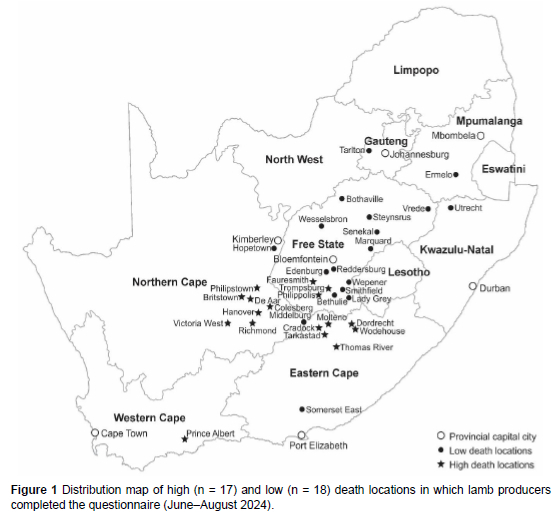
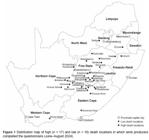
There was significant spatial clustering of high-death locations, based on the Cuzick-Edwards Z-score (Z) of 2.62 (P = 0.009). The pins in the legend (Figure 1) represent the nearest large town to the sampled farms.
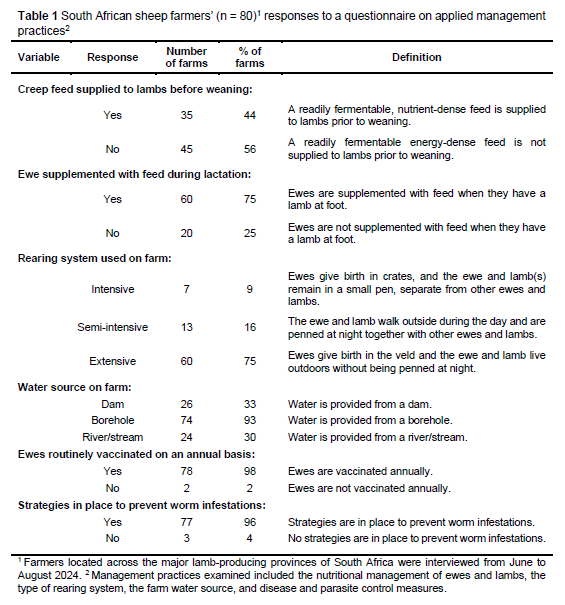
Of the 80 farmers who completed the questionnaire, 56% (45/80) did not supply creep feed to their pre-weaned lambs (Table 1). The remaining 44% (35/80) of producers provided creep feed to their lambs using various methods, including buckets, feed gates, or other feeding systems. With regards to the nutritional supplementation of the ewes on the sampled farms, 75% (60/80) supplied feed in the form of a total mixed ration or pelleted ration to their lactating ewes, whereas 25% (20/80) did not provide additional feed supplementation during lactation.
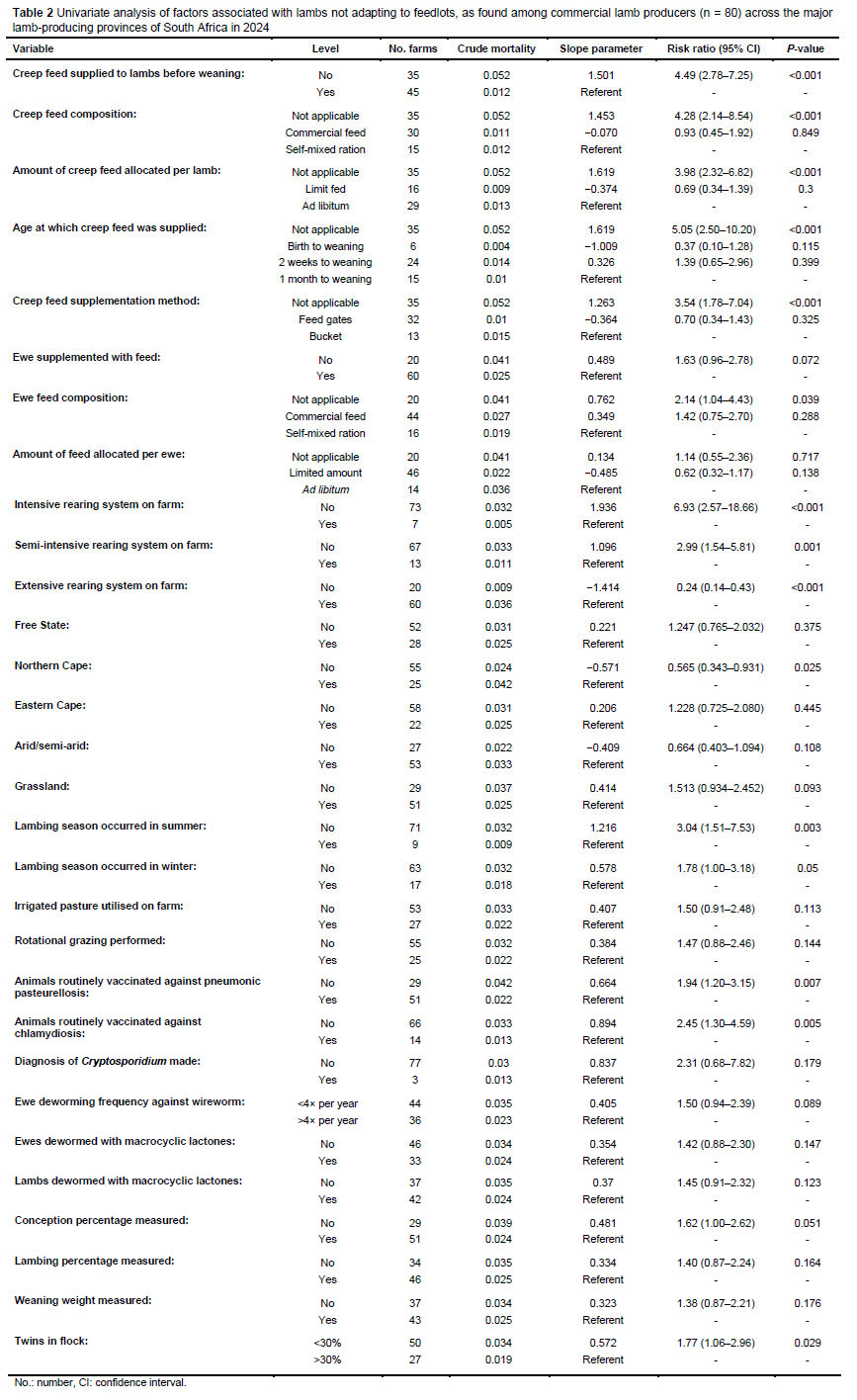
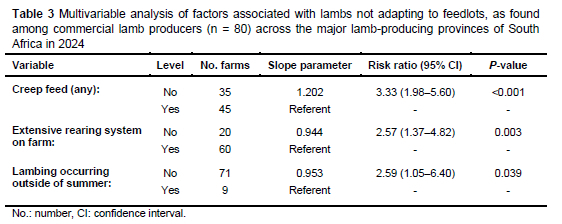
A lack of creep feed supplementation, a lack of intensive or semi-intensive rearing, the use of extensive rearing systems, lambs not raised in summer, lambs not raised in winter, a lack of routine vaccinations against pneumonic pasteurellosis and chlamydiosis, and flocks with fewer than 30% twins were significantly associated with non-adapting lambs on univariate analysis (Table 2). In the final multivariable model (Table 3), a lack of creep feed supplementation (RR: 3.33, 95% CI: 1.98-5.60, P <0.001), extensive lamb rearing (RR: 2.57, 95% CI: 1.37-4.82, P = 0.003), and lambs not raised during the summer (RR: 2.59, 95% CI: 1.05-6.40, P = 0.039) remained significant risk factors for non-adapting lambs arriving in South African feedlots.
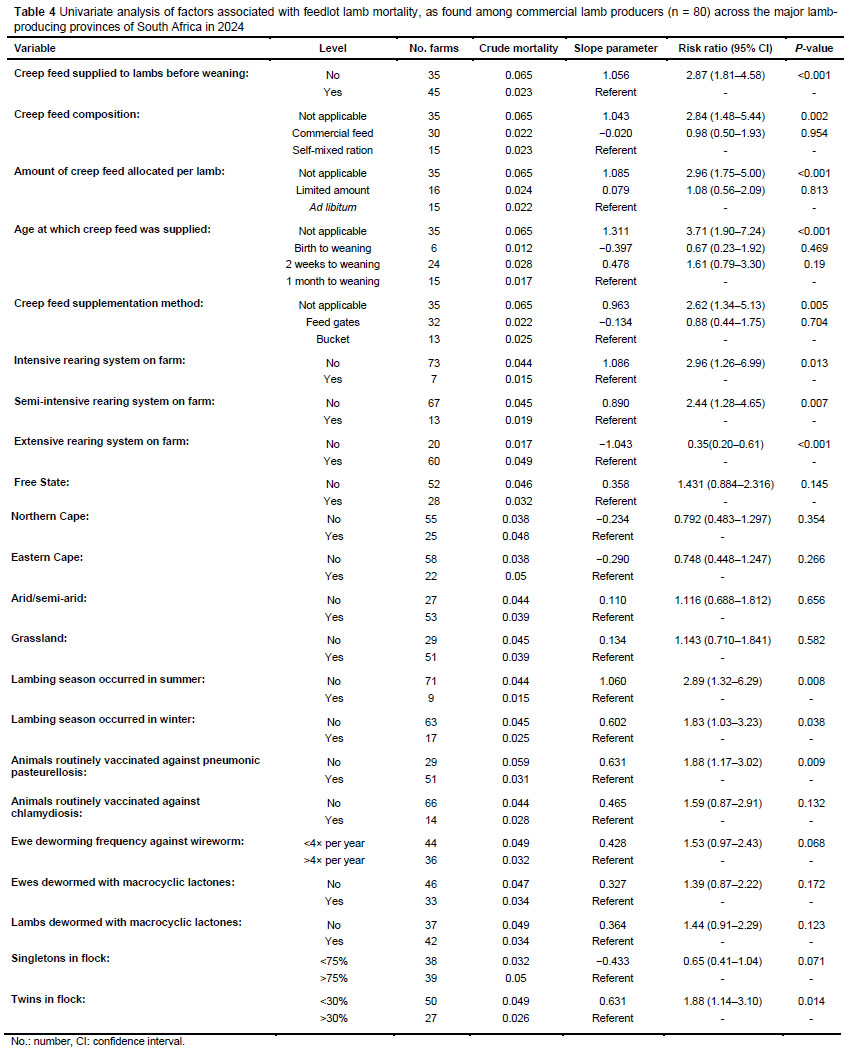
A lack of creep feed supplementation, a lack of intensive and semi-intensive rearing, the use of extensive rearing, lambs not raised in summer, lambs not raised in winter, a lack of routine vaccinations against pneumonic pasteurellosis, and flocks with fewer than 30% twins were significantly associated with general lamb mortality on univariate analysis (Table 4).
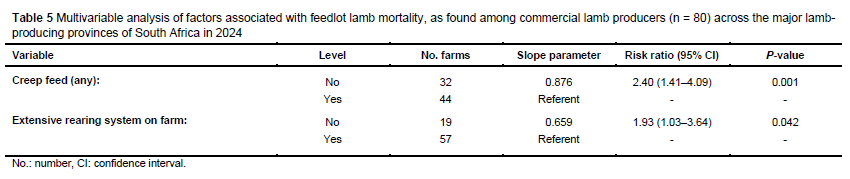
In the final multivariable model (Table 5), both the lack of creep feed supplementation (RR: 2.40, 95% CI: 1.41-4.09, P = 0.001) and the use of extensive rearing conditions (RR: 1.93, 95% CI: 1.03-3.643, P = 0.042) were significant risk factors associated with general lamb mortality upon or soon after arrival at South African feedlots.
Discussion
As with lamb feedlots in other parts of the world, lambs also fail to adapt to the feedlot environment under South African conditions. Anecdotal reports (based on personal practical experience, discussions with multiple experienced production animal veterinarians currently practising in South Africa, and discussions with feedlot managers and owners) suggest that the prevalence of these non-adapting lambs has increased. Veterinarians specialising in feedlot health and production further report that currently available management procedures aimed at ensuring the survival of non-adapter lambs in feedlots appear to be ineffective.
In the present study, the omission of creep feed supplementation increased the risk of lambs becoming non-adapters in intensive feedlot environments by 3.33 times (P <0.001). This substantial effect size indicates that pre-weaning nutrition is a critical determinant of lamb feedlot adaptability under South African conditions. The possible effect of the absence of creep feed supplementation on the likelihood of lambs becoming non-adapters in feedlot systems may be linked to the effect of solid feed intake on rumen development during the pre-weaning phase. The initiation of voluntary intake of dry matter rich in readily fermentable carbohydrates in the post-natal period (commonly referred to as creep feeding), leads to the rumen undergoing substantial changes, including the growth of the smooth muscle layer, epithelial growth, the formation of visible papillae, and the establishment of diverse microbial communities (Sun et al., 2021). Lambs in the present study that did not receive creep feed in the pre-weaning phase would therefore have consumed lower amounts of readily fermentable carbohydrates, which could have limited their rumen epithelial development prior to the transition to high-concentrate feedlot diets.
The physical form and particle size distribution of feed are known to exert an important influence on the anatomical and microbial development of the rumen (Beharka et al., 1998; Pazoki et al., 2017). For example, calves fed a ground diet had shorter papillae with a smaller surface area than calves fed an unground diet, and this coincided with a shift in the rumen microbial population from predominantly cellulolytic to predominantly amylolytic species (Beharka et al., 1998). These findings suggest that solid feed intake in the form of creep feed promotes rumen development by stimulating epithelial growth, regardless of the physical form of the diet.
At birth, the rumen is devoid of any bacteria, protozoa, and fungal species because of the sterile nature of the uterus (Maynard et al., 2012). Following the establishment of the microbial population, rumen fermentation as a result of the bacterial, fungal, and protozoal metabolism of feedstuffs increases in conjunction with increased dry matter intake by the neonate and leads to the production of three main volatile fatty acids (VFAs): acetate, propionate, and butyrate (Judd & Kohn, 2018). Once the VFAs have been absorbed, acetate and butyrate are oxidised into ketones, which play key roles in energy transport (Zhuang et al., 2024), while propionate serves as a major substrate for hepatic gluconeogenesis (Dijkstra, 1994).
Of the VFAs produced, butyrate is particularly crucial for stimulating rumen papillary development, followed by propionate and then acetate (Tamate et al.,1962; Baldwin et al., 2004). Butyrate positively influences short-chain fatty acid absorption (Malhi et al., 2013; Dengler et al., 2015), rumen papillary blood flow (Storm et al., 2011), and rumen motility (Kendall & McLeay, 1996). The intraruminal infusion of sodium butyrate increases papillae length, width, and surface area, as well as the thickness of the stratum corneum (Liu et al., 2019). In addition, butyrate regulates rumen epithelial cell proliferation and survival by modulating gene networks and the expression of genes that promote cell division (Connor et al., 2013; Malhi et al., 2013; Lin et al., 2022), while inhibiting apoptosis (Liu et al., 2019). Given the significant risks associated with creep feed omission in the pre-weaning phase, insufficient rumen epithelial development as a result of a lack of chemical stimulation by butyrate may lead to limited rumen function at the point of feedlot entry, thereby limiting the capacity of these lambs to adapt and perform under intensive feedlot conditions.
Lambs raised under extensive rearing systems were 2.57 times more likely to not adapt to intensive feedlot conditions (P = 0.003). In extensive systems in South Africa, the creep feeding of lambs or supplemental feeding of ewes is often provided inconsistently and only at convenient, accessible locations, such as near camp gates. Consistent intake of creep feed is essential to stimulate rumen microbial activity and increase the production of VFAs, especially butyrate, which plays a key role in promoting rumen papillae growth and enhancing the absorptive surface area of the papillae (Liu et al., 2019). The sporadic supply of creep feed under extensive conditions fails to maintain a continuous intake of readily fermentable carbohydrates, potentially limiting microbial activity and butyrate production. Furthermore, the absorption rates of VFAs are influenced by rumen papillary surface area (Dirksen et al., 1984; Gäbel et al., 1991a,b), suggesting that as the rumen papillary surface area increases, the rate of VFA absorption could exceed production, particularly when creep feed intake is inconsistent.
In addition, irregular or limited creep feed intake, as observed in this study, might shift fermentation towards milk- or roughage-based substrates. The ratios of acetate, propionate, and butyrate produced in the rumen are influenced by forage type and the species and quantity of rumen bacteria (Alstrup et al., 2016; Bharanidharan et al., 2018). The forage-to-concentrate ratio had no effect on total VFA production but influenced the acetate-to-butyrate ratio (Zhang et al., 2017). Therefore, a higher roughage diet would result in the production of more acetate and less butyrate, potentially slowing rumen papillary development and limiting rumen function. Lambs reared extensively with minimal supplementation may therefore experience a rumen fermentation profile that is not conducive to promoting rumen papillary development prior to weaning, contributing to the inability of extensively raised lambs to adapt and perform in South African feedlots. Along with the physiological implications associated with the omission or inconsistent provision of creep feed, animal welfare might also be impacted, as nutrient levels on cultivated pastures might not meet the nutritional needs of lambs during critical developmental stages, and may thus lead to poor growth rates (Brand et al., 1999). Therefore, creep feeding is particularly beneficial when low pasture quality or quantity limits ewe milk production or when ewes are in poor body condition prior to lambing, both of which can hinder lamb performance (Alcock, 2006).
Lambs raised outside of the summer season were also 2.59 times more likely to not adapt to feedlot systems (P = 0.039). Seasonal variation in pasture quality and availability can affect ewe nutrition, milk production, and subsequent lamb growth prior to weaning (Inyangala et al., 1992). During the colder months, when pasture productivity is naturally lower and ewe milk production is reduced, lambs may not receive adequate nutrition from either the pasture or suckling from the dam, potentially compromising early growth. During the pre-weaning phase of a ruminant's life, the rumen is colonised by bacteria, archaea, fungi, and protozoa, which play important roles in diet fermentation and thus the host's energy supply (Lin et al., 2019). Rumen microbial inoculation and colonisation are crucial in aiding the transition of the animal from a functional monogastric to a ruminant. As a result of reduced nutrient digestion and absorption in lambs during months outside of summer, a catabolic, cachectic, and hypothermic state could be induced, negatively affecting rumen development by hindering rumen microbial colonisation and subsequent fermentation, and ultimately influencing feedlot adaptability post-weaning (Furman et al., 2020; Guo et al., 2020).
In addition to creep feed supplementation, extensive lamb rearing, and lambs raised outside the summer season, other variables that were significant in the univariate analyses included lambing season, the proportion of twins in the flock, and routine vaccination against pneumonic pasteurellosis, despite these factors not being retained in the multivariable model. This indicates that multiple nutritional, management, and health-related factors can influence lamb adaptation and survival in an intensive feedlot environment.
Geographically, non-adapting lambs were distributed across four provinces in South Africa, with the Free State, Northern Cape, Eastern Cape, and Western Cape having a higher prevalence of non-adapting lambs (Figure 1). Additional univariate analyses for regional factors (semi-arid/arid versus grassland biomes) were performed but were not significant, indicating that the observed clustering cannot be explained by broad ecological regions. The significant clustering of non-adapting lambs (Z: 2.62, P = 0.009) therefore suggests that provincial-level factors, rather than regional factors alone, might contribute to the development of high-risk lambs. Importantly, the Cuzick-Edwards test used to assess clustering accounts for the baseline distribution of farms in the study area and is not influenced by provincial boundaries. One possible explanation is the higher density of lamb producers in these provinces, which are traditionally South Africa's largest lamb-producing areas and are all located in semi-arid regions. These areas can only support low numbers of livestock units per hectare, resulting in more extensive farming systems where animals rely on natural veld, as opposed to a continuous supplemental feeding strategy. These large areas and low stocking densities make consistent management and close monitoring difficult, limiting the early identification of poorly performing lambs.
Extensive farming systems are popular among South African farmers and are commonly used for several reasons, including their lower capital input requirements compared to intensive operations, which require high cash inputs (Karthik et al., 2021). Despite the popularity of extensive systems, they pose challenges for livestock production, including poor seasonal pasture quality that compromises animal nutrition (Goddard et al., 2006; Dwyer, 2009; Villalba et al., 2016), and increased neonatal mortalities resulting from inadequate ewe-lamb bonding (Dwyer, 2008), leading to the starvation-mismothering-exposure complex (Celi & Bush, 2010). Despite the common perception that extensive systems promote animal welfare, they can also pose welfare risks, including nutritional deficiencies, loss of body condition, chronic hunger, and increased susceptibility to internal parasites (Temple & Manteca, 2020). The present study suggests that lamb rearing systems require a gradual shift towards more semi-intensive or intensive management, with closer monitoring of pre-weaned lambs and consistent, timely creep feed supplementation prior to weaning. These practices would have long-term benefits for rumen development, improve lamb performance, and minimise the risk of non-adapter lambs entering South African feedlots. That being said, in the South African context, lamb producers are strongly profit-orientated and focus on minimising input costs to maximise their profit margins. Providing creep feed to lambs prior to weaning is one of the largest expenses for farmers who sell weaner lambs to feedlots.
The benefits associated with creep feed supplementation are well known, as seen in the studies performed by Hayes et al. (2019) and Ramli et al. (2025), where supplying creep feed during the pre-weaning stage significantly improved the weaning weights and average daily gains of Dorper lambs and goat kids. However, the market price for weaner lambs, which is typically determined by the feedlot, is rarely influenced by on-farm managerial practices such as creep feed supplementation, despite this practice resulting in younger, heavier weaner lambs. As a result, producers may view creep feeding as an unnecessary expense owing to the lack of financial incentives.
While this study provides valuable insights, the findings should be interpreted in light of several potential limitations. Lamb batches were raised on selected farms for approximately four months before being sold to feedlots, where they were fed for 60 days. The three-week interval between abattoir data collection and questionnaire administration may have introduced recall bias, and complete management records were not always available. Other limitations include the relatively small sample size and the inability to adjust for unmeasured confounding variables. For example, individual ewe- and lamb-specific data, such as ewe age, ewe nutritional status, ewe body condition score at lambing, lamb birthweight, and lamb health status during the pre-weaning period, are all important factors that could not be accounted for in this study. Variables such as age at weaning and lamb-ewe contact on pasture were not included in the questionnaire and may represent additional risk factors that could be considered in future studies. In addition, variations between feedlots, including the feed used, the transport distances, and the different management systems at each feedlot site were not controlled for in this study. Furthermore, despite the bilingual proficiency of the principal author in English and Afrikaans, if one of these languages was not a farmer's first language, this could have introduced information bias owing to the potential misunderstanding of questions during questionnaire administration.
Conclusion
This study identified key risk factors associated with non-adapting lambs, providing valuable insights into farming practices that predispose these high-risk animals to poor performance upon feedlot entry in South Africa. Lambs that have not been provided with creep feeding, that have been raised under extensive systems, and that have been raised outside of the summer months should be regarded as high risk and managed accordingly at the feedlot. A major contributing factor appears to be the lack of communication between weaner lamb producers and feedlot buyers. Both parties operate under strongly profit-driven motives, and in the absence of a standardised pricing system that rewards producers for implementing good agricultural practices such as proper nutrition and timely vaccinations, there is little incentive to improve pre-feedlot management. Until such a system is adopted, cost-cutting practices are likely to persist, perpetuating the cycle of poor adaptation and associated livestock losses.
Author contributions
J.D.M. was involved in investigation, formal analysis, writing (original draft preparation), visualisation, and data curation. G.F. designed the study, analysed the data, and revised the manuscript. S.J.C. was involved in the supervision of the study and reviewing the manuscript. L.O. and E.C.W. were involved in the revision of the manuscript.
Conflict of interest declaration
The authors declare no financial, personal, or other relationships with individuals or organisations that could inappropriately influence this work. This study did not recieve any external funding.
Acknowledgements
The authors thank all the farmers for their participation in the data collection during questionnaire administration.
References
-
Alcock, D., 2006. Creep feeding lambs. Primefact, 224:1-4. Available: https://www.dpi.nsw.gov.au/animals-and-livestock/sheep/management/general-information/creep-feeding-lambs [17 April 2025].
» https://www.dpi.nsw.gov.au/animals-and-livestock/sheep/management/general-information/creep-feeding-lambs -
Alley, M., 2002. Pneumonia in sheep in New Zealand: an overview. New Zealand Veterinary Journal, 50:99-101. DOI: https://doi.org/10.1080/00480169.2002.36281
» https://doi.org/10.1080/00480169.2002.36281 -
Alstrup, L., Soegaard, K., & Weisbjerg, M.R., 2016. Effects of maturity and harvest season of grass-clover silage and of forage-to-concentrate ratio on milk production of dairy cows. Journal of Dairy Science, 99:328-340. DOI: https://doi.org/10.3168/jds.2015-9802
» https://doi.org/10.3168/jds.2015-9802 -
Angus, K.W., Tzipori, S., & Gray, E.W., 1982. Intestinal lesions in specific pathogen free lambs associated with a Cryptosporidium from calves with diarrhoea. Veterinary Pathology, 19:67-78. DOI: https://doi.org/10.1177/030098588201900110
» https://doi.org/10.1177/030098588201900110 -
Baldwin, R.L., McLeod, K.R., Klotz, J.L., & Heitmann, R.N., 2004. Rumen development, intestinal growth and hepatic metabolism in the pre- and postweaning ruminant. Journal of Dairy Science, 87:55-65. DOI: https://doi.org/10.3168/jds.s0022-0302(04)70061-2
» https://doi.org/10.3168/jds.s0022-0302(04)70061-2 -
Barlow, R.M., Gardiner, A.C., Angus, K.W., Glimour, J.S., Mellor, D.J., Cuthbertson, J.C., Newlands, G., & Thompson, R., 1987. Clinical, biochemical, and patholgical study of perinatal lambs in a commercial flock. Veterinary Record, 120:357-362. DOI: https://doi.org/10.1136/vr.120.15.357
» https://doi.org/10.1136/vr.120.15.357 -
Beharka A.A., Nagaraja T.G., Morrill, J.L., Kennedy G.A., & Klemm R.D., 1998. Effect of form of the diet on anatomical, and fermentative development of rumen of neonatal calves. Journal of Dairy Science, 81:1946-1955. DOI: https://doi.org/10.3168/jds.s0022-0302(98)75768-6
» https://doi.org/10.3168/jds.s0022-0302(98)75768-6 -
Bell, S., 2008. Respiratory disease in sheep. 2. Treatment and control. In Practice, 30:278-283. DOI: https://doi.org/10.1136/inpract.30.5.278
» https://doi.org/10.1136/inpract.30.5.278 -
Bharanidharan., R., Arokiyaraj, S., Kim, E.B., Lee, C.H., Woo, Y.W., Na, Y., & Kim, R.H., 2018. Ruminal methane emissions, metabolic, and microbial profile of Holstein steers fed forage and concentrate, seperately or as a total mixed ration. PloS One, 13:e0202446. DOI: https://doi.org/10.1371/journal.pone.0202446
» https://doi.org/10.1371/journal.pone.0202446 - Bowen, M.K., Ryan, M., Jordan, D., Beretta, V., Kirby, R., Stockman, C., Mcintyre, B., & Rowe, J., 2006. Improving sheep feedlot management. International Journal of Sheep and Wool Science, 54:27-34.
- Brand, T.S., Van der Merwe, G.D., & Coetzee, J., 1999. Performance and nutritional status of lambs receiving either a protein-enriched whole barley, creep pellets or no creep feed while grazing a dryland mixed grass pastures. Elsenberg Abstracts of Progress Reports. pp.155-168
- Carioto, L., 2014. Pathologic basis of veterinary disease, 5th editon. Canadian Veterinary Journal, 55(4):372.
- Celi, P. & Bush, R., 2010. Pregnancy, lambing and survival. In: International Sheep and Wool Handbook. Ed: Cottle, D.J., University Press, Nottingham, UK. pp. 223-257
-
Connor, E.E., Baldwin, R.L.T., Li, C.J., Li, R.W., & Chung, H., 2013. Gene expression in bovine rumen epithelium during weaning identifies molecular regulators of rumen development and growth. Functional and Integrative Genomomics, 13:133-142. DOI: https://doi.org/10.1007/s10142-012-0308-x
» https://doi.org/10.1007/s10142-012-0308-x -
Cooke, R.F., 2017. Nutritional and management considerations for beef cattle experiencing stress-induced inflammation. The Professional Animal Scientist, 33:1-11. DOI: https://doi.org/10.15232/pas.2016-01573
» https://doi.org/10.15232/pas.2016-01573 - Cuzick, J. & Edwards, R., 1990. Spatial clustering for inhomogenous populations. Journal of the Royal Statistical Society: Series B (Methodological), 52:73-104.
- Davis, J., 2003. Feedlotting Lambs: A Producers Guide. Landlinks Press, CSIRO Publishing, Collingwood, Australia.
-
Delano, M.L., Mischler, S.A., & Underwood, W.J., 2002. Chapter 14 - Biology and diseases of ruminants: sheep, goats and cattle. In: Laboratory Animal Medicine (Second Edition). Eds: Fox, J.G., Anderson, L.C., Loew, F.M., & Quimby, F.W., Academic Press, Elsevier, Cambridge, Massachusetts. pp. 519-614. DOI: https://doi.org/10.1016/B978-012263951-7/50017-X
» https://doi.org/10.1016/B978-012263951-7/50017-X -
Dengler, F., Rackwitz, R., Benesch, F., Pfannkuche, H., & Gäbel, G., 2015. Both butyrate incubation and hypoxia upregulate genes involved in the ruminal transport of SCFA and their metabolites. Journal of Animal Physiology and Animal Nutrition, 99:379-390. DOI: https://doi.org/10.1111/jpn.12201
» https://doi.org/10.1111/jpn.12201 -
Department of Agriculture, Land Reform, and Rural Development, 2021. A profile of the South African mutton market value chain. Available: http://webapps1.daff.gov.za/AmisAdmin/upload/Mutton%20Market%20Value%20Chain%20Profile%202023%20.pdf [21 January 2025].
» http://webapps1.daff.gov.za/AmisAdmin/upload/Mutton%20Market%20Value%20Chain%20Profile%202023%20.pdf -
Dijkstra, J., 1994. Production and absorption of volatile fatty acids in the rumen. Livestock Production Science, 39:61-69. DOI: https://doi.org/10.1016/0301-6226(94)90154-6
» https://doi.org/10.1016/0301-6226(94)90154-6 - Dirksen, G., Liebich, H.G., Brosi, G., Hegemeister, H., & Mayer, E., 1984. Morphology of the rumen mucosa and fatty acid absorption in cattle - important factors for health and production. Zentralblatt fur Veterinarmedizin, 31:414-430.
-
Dwyer, C.M., Calvert, S.K., Farish, M., Donbavand, J., & Pickup, H.E., 2005. Breed, litter and parity effects on placental weight and placentome number, and consequences for the neonatal behaviour of the lamb. Theriogenology, 63:1092-1110. DOI: https://doi.org/10.1016/j.theriogenology.2004.06.003
» https://doi.org/10.1016/j.theriogenology.2004.06.003 -
Dwyer, C.M., 2008. The welfare of the neonatal lamb. Small Rumininant Research, 76:31-41. DOI: https://doi.org/10.1016/j.smallrumres.2007.12.011
» https://doi.org/10.1016/j.smallrumres.2007.12.011 -
Dwyer, C.M., 2009. Welfare of sheep: Providing for welfare in an extensive environment. Small Rumininant Research, 86:14-21. DOI: https://doi.org/10.1016/j.smallrumres.2009.09.010
» https://doi.org/10.1016/j.smallrumres.2009.09.010 -
Duddy, G., Shands, C., Bell, A., Hegarty, R., & Casburn, G., 2016. Feedlotting lambs. Primefact, 523:1-13. Available: chrome-extension://efaidnbmnnnibpcajpcglclefindmkaj/https://www.dpi.nsw.gov.au/_data/assets/pdf_file/0020/193313/Feedlotting-lambs.pdf [7 May 2026].
» chrome-extension://efaidnbmnnnibpcajpcglclefindmkaj/https://www.dpi.nsw.gov.au/_data/assets/pdf_file/0020/193313/Feedlotting-lambs.pdf -
Food and Agriculture Organization of the United Nations (FAO), 2025. FAOSTAT Statistical Database: Crops and Livestock Products. FAO, Rome, Italy. Available: https://www.fao.org/faostat/en/#data/QCL [29 April 2026].
» https://www.fao.org/faostat/en/#data/QCL -
Fanning, J.P., Hynd, P.I., & Cockraft, P.D., 2018. The relative roles of ruminal fluid and epithelium in the aetiology of ruminal acidosis. Small Rumininant Research, 162:57-62. DOI: https://doi.org/10.1016/j.smallrumres.2018.03.005
» https://doi.org/10.1016/j.smallrumres.2018.03.005 -
Fisher, A.D., Stewart, M., Duganzich, D.M., Tacon, J., & Matthews, L.R., 2005. The effects of stationary periods and external temperature and humidity on thermal stress conditions within sheep transport vehicles. New Zealand Veterinary Journal, 53:6-9. DOI: https://doi.org/10.1080/00480169.2005.36461
» https://doi.org/10.1080/00480169.2005.36461 -
Flay, K.J., Hill, F.I., & Muguiro, D.H., 2022. A review: Haemonchus contortus infection in pasture-based sheep production systems, with a focus on the pathogenesis of anaemia and changes in haemotological parameters. Animals, 12:1238. DOI: https://doi.org/10.3390/ani12101238
» https://doi.org/10.3390/ani12101238 -
Furman, O., Shenhav, L., Sasson, G., Kokou, F., Honig, H., Jacoby, S., Hertz, T., Cordero, O.X., Halperin, E., & Mizrahi, I., 2020. Stochasticity constrained by deterministic effects of diet and age drive rumen microbiome assembly dynamics. Nature Communications, 11:1904. DOI: https://doi.org/10.1038/s41467-020-15652-8
» https://doi.org/10.1038/s41467-020-15652-8 -
Gäbel, G., Bestmann, M., & Martens, H., 1991a. Influence of diet, short-chain fatty acids, lactate and chloride on bicarbonate movement across the reticulorumen wall of sheep. Zentralblatt fur Veterinarmedizin, 38:523-529. DOI: https://doi.org/10.1111/j.1439-0442.1991.tb01043.x.
» https://doi.org/10.1111/j.1439-0442.1991.tb01043.x -
Gäbel, G., Vogler, S., & Martens, H., 1991b. Short-chain fatty acids and CO2 as regulators of Na+ and Cl- absorption in isolated sheep rumen mucosa. Journal of Comparitive Physiology, 161:419-426. DOI: https://doi.org/10.1007/BF00260803
» https://doi.org/10.1007/BF00260803 -
Goddard, P., Waterhouse, T., Dwyer, C., & Stott, A., 2006. The perception of the welfare of sheep in extensive systems. Small Rumininant Research, 62:215-225. DOI: https://doi.org/10.1016/j.smallrumres.2005.08.016
» https://doi.org/10.1016/j.smallrumres.2005.08.016 -
Goetz, H.M., Winder, C.B., Costa, J.H.C., Creutzinger, K.C., Uyama, T., Kelton, D.F., Dun, J., & Renaud, D.L., 2022. Characterizing the literature surrounding transportation of young dairy calves: A scoping review. Journal of Dairy Science, 105:1555-1572. DOI: https://doi.org/10.3168/jds.2021-21211
» https://doi.org/10.3168/jds.2021-21211 -
González, J.M., Bello, J., Rodriguez, M ., Navarro, T., Lacosta, D., Fernández, A., & De las Heras, M., 2016. Lamb feedlot production in Spain: most relevant health issues. Small Rumininant Research, 142:83-87. DOI: https://doi.org/10.1016/j.smallrumres.2016.02.020
» https://doi.org/10.1016/j.smallrumres.2016.02.020 -
Guo, C.Y., Ji, S.K., Yan, H., Wang, Y.J., Liu, J.J., Cao, Z.J., Yang, H.J., Zhang, W.J., & Li, S.L., 2020. Dynamic change of the gastrointestinal bacterial ecology in cows from birth to adulthood. Microbiology Open, 9:e1119. DOI: https://doi.org/10.1002/mbo3.1119
» https://doi.org/10.1002/mbo3.1119 -
Hayes, E.G., Lourençon, R.V., & Browning, R., 2019. Effects of creep feeding and its interactions with other factors on the performance of meat goat kids, and dams when managed on pasture. Translational Animal Science, 3:1466-1474. DOI: https://doi.org/10.1093/tas/txz122
» https://doi.org/10.1093/tas/txz122 - Inyangala, B.A.O., Rege, J.E.O., & Itulya, S., 1992. Growth traits of the dorper sheep. I. Factors influecning growth traits. In: Proceedings of the first Biennial Conference of the African Small Ruminant Research Network, Nairobi, Kenya.
-
Jolly, S. & Wallace, A., 2007. Best Practice for Production Feeding of Lambs: A Review of the Literature. Meat & Livestock Australia Limited, North Sydney, New South Wales, Australia. Available: https://www.mla.com.au/research-and-development/reports/2007/best-practice-for-production-feeding-of-lambs-a-review-of-the-literature/ [7 May 2026].
» https://www.mla.com.au/research-and-development/reports/2007/best-practice-for-production-feeding-of-lambs-a-review-of-the-literature/ -
Judd, L.M. & Kohn, R.A., 2018. Test of conditions that affect in vitro production of volatile fatty acids and gases. Journal of Animal Science, 96:694-704. DOI: https://doi.org/10.1093/jas/skx082
» https://doi.org/10.1093/jas/skx082 -
Karthik, D., Suresh, J., Ravindra Reddy, Y., Sharma. G.R.K., Ramana, J.V., Gangaraju, G., Pradeep Kumar Reddy, Y., Yasaswini, D., Adegbeye, M.J., & Ravi Kanth Reddy, P., 2021. Farming systems in sheep rearing: Impact on growth and reproductive performance, nutrient digestibility, disease incidence and heat stress indices. PloS One, 16:e0244922. DOI: https://doi.org/10.1371/journal.pone.0244922
» https://doi.org/10.1371/journal.pone.0244922 - Kelsey, J.L., Whittemore, A.S., Evans, A.S., & Thompson, W.D., 1996. Methods in Observational Epidemiology, Second Edition. Oxford University Press, New York.
-
Kendall, P.E. & McLeay, L.M., 1996. Excitatory effects of volatile fatty acids on the in vitro motility of the rumen of sheep. Research in Veterinary Science, 61:1-6. DOI: https://doi.org/10.1016/S0034-5288(96)90101-0
» https://doi.org/10.1016/S0034-5288(96)90101-0 - Kirby, R.M., Jones, F.M., Ferguson, D.M., & Fisher, A.D., 2004. Adaptation to grain feeding. In: Feeding Grain for Sheep Meat Production. Ed: Chapman, H.M., Australian Sheep Industry Cooperative Research Centre, Armidale, New South Wales, Australia. pp. 81-97.
-
Keogh, T., Mcgrath, S., Oddy, V., Hernandez-Jover, M., Dickson, H., Allworth, M., & Greer, A., 2021. Are there opportunities to improve lamb feedlot production efficiency. A cross sectional survey. Animal Production Science, 62:381-391. DOI: https://doi.org/10.1071/AN21309
» https://doi.org/10.1071/AN21309 -
Lin, L., Xie, F., Sun, D., Liu, J., Zhu, W., & Mao, S., 2019. Ruminal microbiome-host crosstalk stimulates the development of the ruminal epithelium in a lamb model. Microbiome, 7:83. DOI: https://doi.org/10.1186/s40168-019-0701-y
» https://doi.org/10.1186/s40168-019-0701-y -
Lin, Y., Wang, Y., & Li, P.F., 2022. PPAR alpha: An emerging target of metabolic syndrome, neurodegenerative and cardiovascular diseases. Frontiers in Endocrinology, 13:1074911. DOI: https://doi.org/10.3389/fendo.2022.1074911
» https://doi.org/10.3389/fendo.2022.1074911 -
Liu, L., Sun, D., Mao, S., Zhu, W., & Liu, J., 2019. Infusion of sodium butyrate promotes rumen papillae growth and enhances expression of genes related to rumen epithelial VFA uptake and metabolism in neonatal twin lambs. Journal of Animal Science, 97:909-921. DOI: https://doi.org/10.1093/jas/sky459
» https://doi.org/10.1093/jas/sky459 -
Malhi, M., Gui, H., Yao, L., Aschenbach, J.R., Gäbel, G., & Shen, Z., 2013. Increased papillae growth and enhanced short-chain fatty acid absorption in the rumen of goats are associated with transient increases in cyclin D1 expression after ruminal butyrate infusion. Journal of Dairy Science, 96:7603-7616. DOI: https://doi.org/10.3168/jds.2013-6700
» https://doi.org/10.3168/jds.2013-6700 -
Maynard, C.L., Elson, C.O., Hatton, R.D., & Weaver, C.T., 2012. Reciprocal interactions of the intestinal microbiota and immune system. Nature, 13:231-241. DOI: https://doi.org/10.1038/nature11551
» https://doi.org/10.1038/nature11551 -
Meat and Livestock Australia (MLA), 2020. Lamb finishing: is it worth it? Available: https://www.mla.com.au/ [21 April 2025].
» https://www.mla.com.au/ -
Morris, S.T., 2017. Chapter 2 - Overview of sheep production systems. In: Advances in Sheep Welfare, First Edition. Eds: Ferguson, D., Lee, C., & Fisher, A. Woodhead Publishing Series in Food Science, Technology and Nutrition, Elsevier, Cambridge, United Kingdom. pp. 19-35. DOI: https://doi.org/10.1016/B978-0-08-100718-1.00002-9
» https://doi.org/10.1016/B978-0-08-100718-1.00002-9 -
Navarro, T., Ramos, J.J., Figueras, L., & Gonzales, J.M., 2019. Epidemiology of ovine respiratory complex in lambs. Small Rumininant Research, 179:70-74. DOI: https://doi.org/10.1016/j.smallrumres.2019.09.002
» https://doi.org/10.1016/j.smallrumres.2019.09.002 -
Pazoki, A., Ghorbani, G.R., Kargar, S., Sadeghi-Sefidmazgi, A., Drackley, J.K., & Ghaffari, M.H., 2017. Growth performance, nutrient digestibility, ruminal fermentation, and rumen development of calves during transition from liquid to solid feed: Effects of physical form of starter feed and forage provision. Animal Feed Science and Technology, 234:173-185. DOI: https://doi.org/10.1016/j.anifeedsci.2017.06.004
» https://doi.org/10.1016/j.anifeedsci.2017.06.004 -
Poli, C.H.E.C., Monteiro, A.L.G., Devincenzi, T., Henrique, F., de Albuquerque, M.A.R., da Motta, J.H., Borges, L.I., & Muir, J.P., 2020. Management strategies for lamb production on pasture based systems in subtropical regions: A review. Frontiers in Veterinary Science, 7:543. DOI: https://doi.org/10.3389/fvets.2020.00543
» https://doi.org/10.3389/fvets.2020.00543 -
Ramli, M.Z., Adam, M.A., & Kalam, M.A., 2025. The effects of creep feed and commercial concentrates on growth performance of pre-weaning dorper lambs. Journal of Tropical Resources and Sustainable Science, 13:167-172. DOI: https://doi.org/10.47253/jtrss.v13i1.1381
» https://doi.org/10.47253/jtrss.v13i1.1381 -
Red Cross Climate Centre (RCRC), 2021. Climate Profiles of Countries in Southern Africa: South Africa. RCRC, The Hague, Netherlands. Available: chrome-extension://efaidnbmnnnibpcajpcglclefindmkaj/https://www.climatecentre.org/wp-content/uploads/Climate-Profiles-of-Countries-in-Southern-Africa-South-Africa.pdf [7 May 2026].
» chrome-extension://efaidnbmnnnibpcajpcglclefindmkaj/https://www.climatecentre.org/wp-content/uploads/Climate-Profiles-of-Countries-in-Southern-Africa-South-Africa.pdf -
Rice, M., Jongman, E.C., Butler, K.L., & Hemsworth, P.H., 2016. Relationships between temperament, feeding behaviour, social interactions, and stress in lambs adapting to a feedlot environment. Applied Animal Behaviour Science, 183:42 -50. DOI: https://doi.org/10.1016/j.applanim.2016.07.006
» https://doi.org/10.1016/j.applanim.2016.07.006 -
Rioja-Lang, F.C., Brown, J.A., Brockhoff, E.J., & Faucitano, L. A., 2019. Review of swine transportation research on priority welfare issues: a Canadian perspective. Frontiers in Veterinary Science, 6:36. DOI: https://doi.org/10.3389/fvets.2019.00036
» https://doi.org/10.3389/fvets.2019.00036 -
Savage, D.B., Ferguson, D.M., Fisher, A.D., Hinch, G.N., Mayer D.G., Duflou, E., Le a., J.M., Baillie, N.D., & Raue, M., 2008. Preweaning feed exposure and different feed delivery systems to enhance feed acceptance of sheep. Animal Production Science, 48:1040 -1043. DOI: https://doi.org/10.1071/EA08055
» https://doi.org/10.1071/EA08055 -
Storm, A.C., Hanigan, M.D., & Kristensen, N.B., 2011. Effects of ruminal ammonia and butyrate concentrations on reticuloruminal epithelial blood flow and volatile fatty acid absorption kinetics under washed reticulorumen conditions in lactating dairy cows. Journal of Dairy Science, 94:3980-3994. DOI: https://doi.org/10.3168/jds.2010-4091
» https://doi.org/10.3168/jds.2010-4091 -
Sun, D., Yin, Y., Guo, C., Liu, L., Mao, S., Zhu, W., & Liu, J., 2021. Transcriptomic analysis reveals the molecular mechanisms of rumen wall morphological and functional development induced by different solid diet introduction in a lamb model. Journal of Animal Science and Biotechnology, 12. DOI: https://doi.org/10.1186/s40104-021-00556-4
» https://doi.org/10.1186/s40104-021-00556-4 -
Tamate, H., McGilliard, A.D., Jacobson, N.L., & Getty, R., 1962. Effect of various dietaries on the anatomical development of the stomach in the calf. Journal of Dairy Science, 454:408-420. DOI: https://doi.org/10.3168/jds.s0022-0302(62)89406-5
» https://doi.org/10.3168/jds.s0022-0302(62)89406-5 -
Tontini, J.F., Poli, C.H.E.C., da Silva Hampel, V., Fajardo, N.M., Martins, A.A., Minho, A.P., & Muir, J.P., 2019. Dispersal and concentration of sheep gastrointestinal nematode larvae on tropical pastures. Small Rumininant Research, 174:62-68. DOI: https://doi.org/10.1016/j.smallrumres.2019.03.013
» https://doi.org/10.1016/j.smallrumres.2019.03.013 -
Van Der Merwe, D.A., Brand, T.S., & Hoffman, L.C., 2020. Premium lamb production of South African sheep breed types under feedlot conditions. South African Journal of Animal Science, 50:578-587. DOI: https://doi.org/10.4314/sajas.v50i4.9
» https://doi.org/10.4314/sajas.v50i4.9 -
Villalba, J.J., Manteca, X., Vercoe, P.E., Maloney, S.K., & Blache, D., 2016. Integrating nutrition and animal welfare in extensive systems. In: Nutrition and the Welfare of Farm Animals. Ed: Phillips, C.J.C., Springer International Publishing, Switzerland. pp.135-163. DOI: https://doi.org/10.1007/978-3-319-27356-3_7
» https://doi.org/10.1007/978-3-319-27356-3_7 - Warner, R.G. & Flatt, W.P., 1964. Anatomical development of the ruminant stomach. In: Physiology of Digestion in the Ruminant. Eds: Dougherty, R.W., Allen, R.S., Burroughs, W., Jacobson, N.L., & McGilliard, A.D., Butterworths, Washington D.C.
-
Wise, D., 1957. Enterotoxamia of sheep. Iowa State University Veterinarian, 2:107-110. Available: chrome-extension://efaidnbmnnnibpcajpcglclefindmkaj/https://dr.lib.iastate.edu/server/api/core/bitstreams/b54b73dd-6ba2-4407-9db0-1add917bb8fd/content [7 May 2026].
» chrome-extension://efaidnbmnnnibpcajpcglclefindmkaj/https://dr.lib.iastate.edu/server/api/core/bitstreams/b54b73dd-6ba2-4407-9db0-1add917bb8fd/content -
Zhuang, Y., Abdelsattar, M.M., Fu, Y., Zhang, N., & Chai, J., 2024. Butyrate metabolism in rumen epithelium affected by host and diet regime through regulating microbiota in the goat model. Animal Nutrition, 19:41-55. DOI: https://doi.org/10.1016/j.aninu.2024.04.027
» https://doi.org/10.1016/j.aninu.2024.04.027 -
Zhang, J., Shi, H., Wang, Y., Li, S., Cao, Z., Ji, S., & Zhang, H., 2017. Effect of dietary forage to concentrate ratios on dynamic profile changes and interactions of ruminal microbiota and metabolites in Holstein heifers. Frontiers in Microbiology, 8:2206-2214. DOI: https://doi.org/10.3389/fmicb.2017.02206
» https://doi.org/10.3389/fmicb.2017.02206
Accepted 04 May 2026
Published 12 May 2026