Effects of nettle content and delivery route on performance, nutrient digestibility, intestinal morphology, immune response, and antioxidant capacity of heat-stressed broiler chickens
Abstract
This study was conducted to assess the effect of nettle supplementation on heat-stressed broiler performance and physiology. A total of 540 Ross-308 broiler chicks were randomly assigned to nine treatments each with six replications of 10 birds. Three contents of nettle were offered in either a fermented or unfermented (0, 1.5, and 3 g/kg) diet or in the drinking water (0, 1.5, and 3 g/L). At day 10, feed intake and FCR increased with nettle content in the diet. Heat-stressed birds that received powdered nettle had a better FCR. At day 35, increasing nettle improved the FCR. Nettle-supplemented broilers had increased dry matter, protein, and fat digestibility. The interaction of factors indicated that a higher NDV titre in birds that received 3% nettle in all forms. A higher NDV titre was found in birds that received fermented nettle, whereas a lower titre was found given the nettle extract. Unfermented nettle substantially increased the immunoglobulin titre of heat-stressed broilers. The interaction of factors indicated an increased total antioxidant capacity (TAC) in birds that received 3% of either fermented or unfermented nettle. The TAC was higher with fermented nettle. The activity of glutathione peroxidase increased with fermented nettle supplementation. Villi length and villous height/crypt depth increased with the supplementation of nettle and was higher in birds that received the unfermented nettle. In addition to its growth promoting properties, this study indicates nettle as a potential agent against heat stress in broiler production.
antibody titre; anti-stress; broilers; digestion; jejunum histology; Urtica dioica
Introduction
Nowadays, the effect of climate change is becoming a serious threat to agriculture and food production globally. The most common environmental stressor in poultry production is heat stress. Climate change and rising global temperatures have intensified the effects of heat stress on most poultry enterprises (Lian, 2020). Therefore, adaptation to the current environmental changes with the consistent, efficient production has emerged a new challenge for the industry. Rapid growth rate due to genetic manipulation for efficient productivity, as well as heat loss limitations caused by feathering, sweat glands absenteeism, in addition to intensive production systems, have increased the sensitivity of modern broilers to rising temperatures (Emami et al., 2020). Broiler chickens are well-known for their high feed consumption and metabolic rates. In response to high environmental temperatures, birds reduce their physical activity and feed intake to limit heat production (Renaudeau et al., 2012). The consequence of reducing feed intake is insufficient nutrient uptake and utilization, thus decreasing the rate of production, causing massive economic problems in poultry businesses (Shokryazdan et al., 2017). In addition to the adverse effects on production parameters, heat stress also induces marked physiologic and metabolic alterations in the body (Brugaletta et al., 2022). Impaired endocrine and metabolism, suppressed immunity (Wang et al., 2018; Hamidi et al., 2022), and acid-base imbalances are among the most reported physiological responses of broilers to heat stress. The oxidative stress caused by heat stress increases the vulnerability of broilers to various diseases (Rahmani et al., 2017). Heat stress also suppresses anti-oxidant defence mechanisms and decreases the antioxidant status of poultry (Sahin, 2015). These physiological and biological responses to heat stress lead to reduced weight gain and feed intake, increased mortality, and impair the general health status and productive performance of birds (Abdel-Moneim et al., 2021).
Synthetic antioxidants and immunopotentiators have potential to improve the productivity of heat-stressed birds. However, due to the side-effects of the residues and metabolites on consumer health, the use of synthetic chemicals has been banned in animal nutrition after public concern about the safety and quality of food of animal origin (Mokhtarzadeh et al., 2022). In accordance, the use of natural products with direct or indirect antioxidant properties, particularly phytogenic products and medicinal plants, has attracted interest to ameliorate heat stress in poultry production.
Stinging nettle (Urtica dioica) is a medical herb that has been frequently added to poultry diets as a phytogenic feed additive due to its high pharmacological and nutritional properties (Loetscher et al., 2013). Nettle has been confirmed to be of great nutritional value due to its well-balanced protein, mineral, and vitamin contents. In addition to its nutritional properties, nettle has garnered medicinal attention due to its content of polyphenols (kaempferol, quercetin, caffeic acid, coumarins, and other flavonoids) and pigments (beta-carotene) (Said et al., 2015). The nettle plant has been recognized for its antioxidant, anti-inflammatory, and antimicrobial properties due to its high content of biological and phytochemical active compounds. Dietary supplementation of nettle does improve the welfare and general health status of broiler chickens (Kregiel et al., 2018). Various researchers have noticed an improvement in performance and antioxidant indices when stinging nettle is added at 2-4% of broiler diets (Sharma et al., 2018).
The broad aim of this study was to assess the efficacy of different contents and the form of supplementation of nettle on the performance, antioxidant capacity, and subsequent physiology of broiler chickens under cyclic heat stress.
Materials and Methods
This study was conducted at the poultry facilities of the Animal Production department, College of Agricultural Engineering Sciences, University of Duhok. The experiment was approved by the Animal Ethics Committee of the Department of Animal Production, College of Agricultural Engineering Sciences, University of Duhok (Approval No.: UoD AEC120120221).
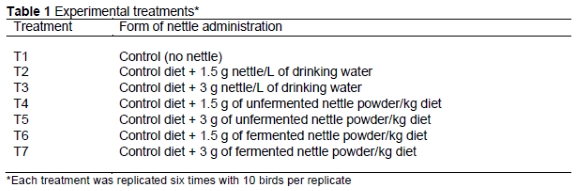
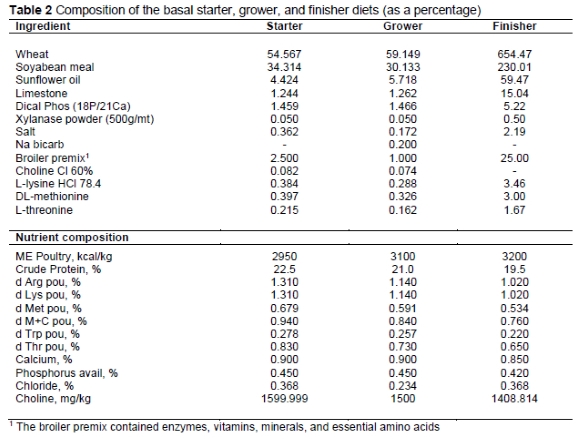
This experiment was designed to investigate the effect of nettle supplementation on heat-stressed broiler performance and physiology. Three levels of nettle were offered in either a fermented or unfermented form (0, 1.5, and 3 g/kg diet) or in the drinking water (0, 1.5, and 3 g/L) of broilers (Table 1). Birds were fed on the standard starter (1 -10 d), grower (11 -24 d), and finisher (25-35 d) broiler diets (Table 2). The nutrient profile of all diets was identical and formulated to meet broiler specifications (Aviagen, 2007). A total of 540 Ross 308, day-old broiler chicks were allocated randomly to nine treatments that were replicated six times with 10 birds per replicate. Chicks were reared in wood-shaving-bedded floor pens (100 × 100 cm) and subjected to cyclic heat stress. Throughout the 35 d experimental period, the room temperature was fixed at 34 °C for 10 h (from 07:00 to 17:00). Thereafter, the temperature was set according to the Ross-308 management guide. Six hours of darkness were provided in a day throughout the experimental, apart from days 1 to 7 when 1 h of darkness was provided. Ad libitum feed and water were provided to the birds. On days 10 and 35, the residual feed and the birds were weighed to measure feed intake (FI), body weight (BW), body weight gain (BWG), and feed conversion ratio (FCR). Mortalities were recorded as they occurred and FCR was adjusted accordingly. On day 24, approximately 5 ml of blood were collected from the jugular vein of two randomly selected birds in each replicate to measure serum lipid profile and antioxidant indices. Then the two selected birds were killed by cervical dislocation, the body cavity was opened, and the internal organs were removed. Tissue samples were collected from the flushed proximate jejunum and fixed in 10% formalin for the study of intestinal morphology. Excreta samples were collected in each replicate to measure the apparent digestibility of nutrients.
Two grams of freeze dried Lactobacillus bacteria were mixed with 1000 ml of distilled water and 30 grams of table sugar and incubated at 39 °C for 24 h. Fresh nettle plant was collected, chopped, dried, and ground and transferred into vacuumed bags. Thereafter, samples were inoculated with the prepared bacterial suspension at 10 ml /kg (10% cfu/g), sealed, and left for anaerobic fermentation for 48-96 h. Fresh nettle plant was boiled in water for 10 min. After cooling, the water was filtered and offered to the birds at the exact experimental levels.
The collected blood samples were centrifuged and serum was obtained. An ELISA assay was used to measure the serum total antioxidant capacity (TAC) and activities of glutathione peroxidase (GSH-Px), catalase (CAT), and super oxide dismutase (SOD), following the instructions of the corresponding commercial kits produced by Kiazist (Kiazist Life Sciences, Hamedan, Iran). After the harvesting of serum, the antibody titres against infectious bronchitis (IBV) and Newcastle Disease Virus (NDV) were measured at day 24 using a hemagglutination-inhibition test. For this test, two-fold serial dilutions of heat-inactivated (at 56 °C) serum were made in U-bottom microtitre plates with phosphate-buffered saline (PBS) (0.01 mol/L; pH 7.4) for total antibody determination.
On days 33, 34, and 35, excreta samples of each replicate were collected in a plastic container and immediately frozen and stored until analysis. All samples were analysed in duplicate. The Agri check method using near infrared was applied to determine the protein content of feed samples (AOAC, 1990) for undigested samples. Nitrogen content of samples was determined using a Kjeldahl nitrogen analyser and converted to equivalent CP by a numerical factor of 6.25. The nutrients (dry matter, protein, and fat) and apparent digestibility values were determined by subtracting the nutrient content in faeces from that of feed.
Approximately 1 cm of proximal jejunum tissue was taken, flushed with buffered saline, and preserved in 10% neutral buffered formalin for morphological study. After being embedded in paraffin wax, tissue samples underwent haematoxylin and eosin staining. Thereafter, samples were sectioned and photographs were taken under a microscope using a digital camera at 10× magnification (Dino-Eye Microscope Eyepiece Camera). The morphometric indices of tissue samples were ascertained using Dino-Eye software. The villus height and crypt depth were measured using digital images of 7 -10 well-oriented villi in each jejunal section. The apparent absorptive surface area of the villus was determined using the formula (Iji et al., 2001):

To determine the main effect of each of the experimental factors and their interactions, the General Linear Model (GLM) procedure of Minitab v17 was used (Minitab Inc., Pennsylvania, PA, USA). Duncan's multiple range test was used to determine the differences between mean values.
Results
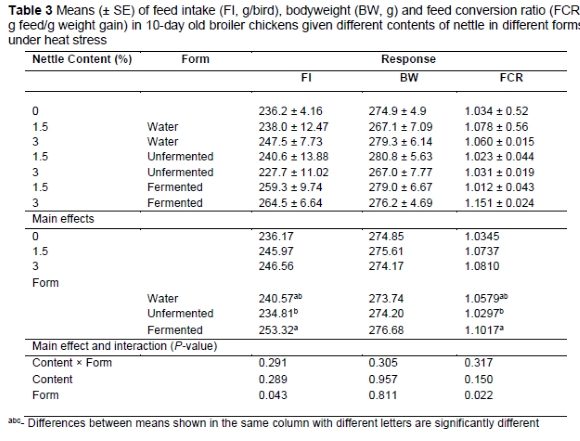
There was no interaction between the experimental factors for the feed intake (FI) body weight (BW) and feed conversion ratio (FCR) of 10 day-old broiler chickens (Table 3). The content of nettle had no marked effect on the above-mentioned performance parameters. However, feed intake and FCR values increased with increasing nettle content in the diet. Heat-stressed birds that received unfermented nettle consumed less feed (P = 0.043) and had better (P = 0.022) FCR than those that were offered the fermented nettle; both groups and the water-supplemented group were similar. Higher FI and FCR were recorded in birds that were supplemented with fermented nettle powder.
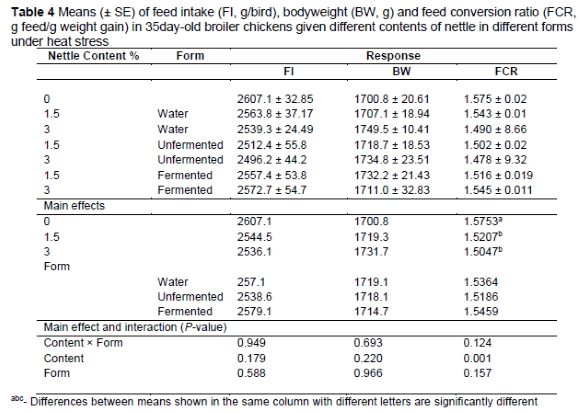
When assessed over the 35-d experimental period, FI and BW were not affected by experimental factors or their interaction (Table 4). Although not statistically significant, BW tended to increase in all nettle-supplemented birds compared to the control group. Considering the main effect, increasing supplementation of nettle improved (P = 0.001) the FCR of broiler chickens.
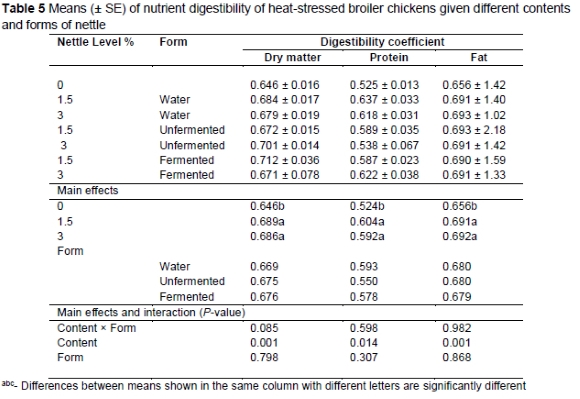
The interaction of experimental factors tended (P = 0.085) to increase the coefficient of digestibility of dry matter in all nettle-supplemented birds compared to the control (Table 5). Regardless of the for of nettle supplementation, the apparent digestibility of dry matter increased (P = 0.001) in nettle- supplemented broilers. The form of nettle supplementation had no effect on the digestibility of dry matter. The interaction of experimental factors had no effect on the digestibility coefficients of protein and fat. Irrespective of the form of nettle supplementation, protein (P = 0.014) and fat (P = 0.001) digestibility increased in nettle-supplemented broiler chickens. Form of nettle supplementation had no marked effect on the digestibility of both protein and fat.
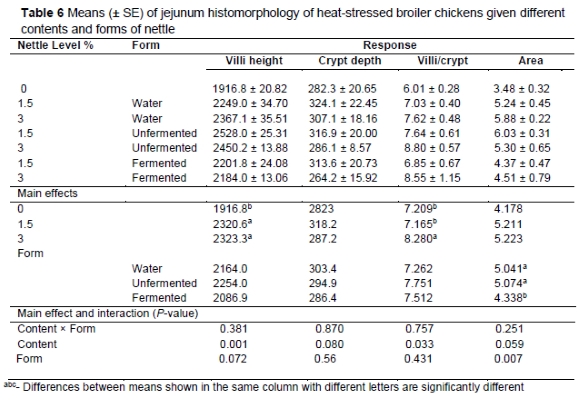
Jejunum histomorphology of heat-stressed birds on different supplementation and forms is shown in Table 6. No interaction was detected between the experimental factors with respect to villous height. However, villus length increased (P = 0.001) when the nettle supplementation increased. Form of nettle supplementation had no effect on villi length but birds on diets supplemented with fermented nettle powder tended (P = 0.072) to have shorter jejunal villi than other groups. Neither the interaction of experimental factors nor the form of nettle supplementation had any marked effect on the crypt depth. However, crypt area tended (P = 0.08) to get deeper in birds that received 1.5% nettle, followed by those that were on diets containing 3% nettle. The villous height/crypt ratio was not influenced by the treatments and the form of nettle supplementation. However, the ratio of villous height/crypt depth increased (P = 0.033) on the highest supplementation. Although the interaction of experimental factors was not statistically significant, the absorptive surface area of villi increased in all treatments compared to the control; increasing nettle levels tended (P = 0.059) to increase the absorptive surface area of villi. The surface area of absorption was higher (P = 0.007) in birds that received the unfermented nettle powder and its extract compared to those that were on diets supplemented with fermented nettle powder.
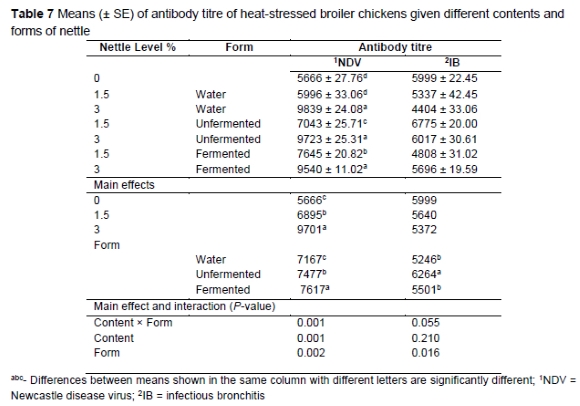
An interaction (P = 0.001) occurred between the NDV titre in birds that received 3% of nettle in their drinking water (9839), followed by those that given 3% of unfermented (9723) or fermented nettle (9540) (Table 7). Excluding the 1.5% nettle in the drinking water, supplementation of nettle in all forms increased the NDV titre of heat-stressed birds. Increasing nettle content increased (P = 0.002) the NDV titre of heat-stressed broilers independent of the form. A higher NDV titre (P = 0.001) was found in birds that received fermented nettle whereas a lower NDV titre was found in those that were offered nettle in their drinking water. The content and the form of nettle tended to interact (P = 0.055) with the IB titre. A higher IB titre was detected in birds that were supplemented with both contents of nettle powder, followed by the control group. The interaction of experimental factors tended to decrease the IB titres in birds that were offered nettle in their drinking water or as a fermented powder. Although not statistically significant, the IB titre decreased with increasing nettle supplementation. Regardless of the nettle content, unfermented nettle powder increased (P = 0.016) the IB titre of heat-stressed broilers compared to those that were received nettle in their drinking water or as fermented powder.
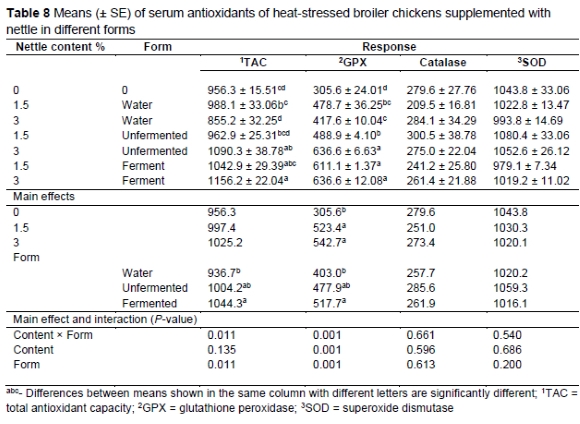
There was an interaction (P = 0.011) between experimental factors indicating a higher total antioxidant capacity (TAC) in birds that received 3% fermented nettle powder, followed by those on 3% unfermented nettle powder (Table 8). In general, TAC was higher in all nettle-supplemented birds, compared to the control. Total antioxidant capacity increased with increasing nettle level, but not statistically. The TAC increased (P = 0.011) in birds that were supplemented with fermented nettle compared to those that received the nettle extract in their drinking water. A higher glutathione peroxidase (GPX) was found in birds that received 1.5% and 3% fermented and 3% unfermented nettle powder (P = 0.001). The activity of GPX was higher (P = 0.001) in birds that received 1.5% nettle powder compared to the control group and those that received 3% nettle extract in their drinking water. The GPX was higher (P = 0.001) in birds that received 1.5% nettle, compared to the control. As a main effect, GPX activity increased (P = 0.001) with nettle supplementation. The activity of GPX increased (P = 0.001) in birds that were supplemented with fermented nettle compared to those that received nettle extract in their drinking water. Experimental factors and their interaction did not affect the activity of catalase and superoxide dismutase (SOD) in the serum of heat-stressed broiler chickens.
Discussion
This experiment assessed the supplementation of nettle in the diet or in the drinking water of heat-stressed broilers. The results of the current study clearly demonstrated the positive effects of nettle supplementation on broiler performance under heat stress. Although not significant at the earlier ages, body weight, weight gain, and FCR of heat-stressed broiler chickens improved when the accumulative effect of nettle supplementation was assessed throughout the experimental period. This concurred with the findings of Meimandipour et al. (2017), who reported that the addition of nano-encapsulated nettle extract in diet substantially improved feed conversion efficiency in broiler chickens. Increased body weight was also reported by Kwiecien & Mieczan (2009) when 2% nettle was added to the broiler diet. In contrast, Seyed et al. (2018) found that supplementation of nettle leaf extract had no marked effect on the performance of broiler chickens. The negative impact of heat stress was obvious on the control group. This was reflected in lower body weight, weight gain, and poor FCR.
Performance and blood metabolites of animals can be modified by heat stress (Habashy et al., 2017). The consequences of heat stress in broilers are high mortality, decreased body weight, poor FCR, and inefficient production (Uerlings et al., 2018). Elevation of the core body temperature, sharp increase in the circulation of blood and peripheral blood flow, and low blood flow to the visceral organs are some of the physiological responses of birds to heat stress. These physiological effects may limit feed efficiency and nutrient utilization and subsequently decrease the production performance of heat-stressed birds (Mashaly et al., 2004). Heat stress may also make the body secrete excessive glucocorticoids, which can promote the body's decomposition of proteins and thus cause cell damage.
Nettle is a good source of vitamin C, which can regulate the secretion of glucocorticoids and relieve the cell damage caused by heat stress (Yin et al., 2013). Dietary supplementation of phytogenics has demonstrated an anti-stress effect through the restoration of serum corticosterone, heterophil/ lymphocyte ratio, and the thermoregulatory mechanism in heat-stressed broilers (Ramasamy et al., 2018).
In the current study, there was an improvement in the digestibility of dry matter, protein, and fat due to the supplementation of nettle to heat-stressed broilers. Dietary herbal plants and their extracts have been confirmed to improve the secretion and activity of digestive enzymes and increase the intestinal digestion and utilization of nutrients (Marzoni et al., 2014). The inclusion of medicinal herbs reduces the proliferation of pathogenic bacteria in the gastrointestinal tract, which increases intestinal health and favours higher digestibility of nutrients (Hassan et al., 2015). The results disagree with Aroche et al., (2018) who found that dietary inclusion of phytochemical components has no effect on the total and apparent ileal digestibility of dry matter and nitrogen in broilers. Rebekah et al. (2022) reported that the ileal digestibility of dry matter was highest in birds offered the recommended nutrient specification diet, compared to that of birds offered medicinal plants. Poor nutrient digestibility was obvious in the control in the current study. Poor digestibility of protein, fat, and starch was observed in heat-stressed broilers (Bonnet et al., 1997). The negative impacts of heat stress on nutrient digestibility can be explained by decreasing the expression and the activity of most digestive enzymes such as trypsin, chymotrypsin, lipase, amylase, and maltase in broilers (Al-Zghoul et al., 2019).
In the present study, nettle supplementation was effective in improving the intestinal morphology of birds under heat-stress conditions. It is well known that intestinal damage is a primary response to heat stress, including compromised intestinal integrity and barrier function (Varasteh et al., 2015). This was confirmed in the current study in which the heat-stressed group of broilers recorded poorer jejunum morphology. Nettle supplementation reduced the negative impacts of heat stress on the intestinal morphology. This was evidenced by longer villi and a higher absorptive surface area of villi of heat-stressed broilers supplemented with nettle. Urtica dioica possess phytochemicals such as phenolic compounds, which have been shown to be effective in scavenging free radicals (Akbay et al., 2003). Dietary antioxidants protect gut epithelial cells from pro-apoptotic oxidant stress, which results in increased epithelial cell growth (Miller et al., 2001). The improved development of intestinal morphology due to nettle consumption can be attributed to greater efficiency in the utilization of feed (Apajalahti et al., 2004). The findings concur with those of Hedayati & Manafi (2018), who reported that villus height increased and crypt depth decreased in the ileum and jejunum of medicinal plant-supplemented broilers. Furthermore, longer ileal villi were found in medicinal plant-supplemented broilers (Fascina et al., 2017).
In the present study, nettle supplementation to heat-stressed birds improved antibody production against NDV and IB. Dietary supplementation of phytogenics enhances immune responses, thereby increasing bursal cortical area and antibody titres against NDV and reducing gut lipid oxidation (Fascina et al., 2017). The higher antibody titres may be attributed to the impact of antioxidants and essential amino acids (Ahmad et al., 2018). Phenolic compounds, such as thymol and carvacrol, which are present in plants, enhance the immune response of broilers (Manafi, 2015). Lans et al. (2011) reported that nettle can enhance immune responses in poultry. Similar immune enhancement due to nettle consumption has been noticed in fish (Ngugi et al., 2015). In contrast, Hashemi et al. (2018) reported that antibody titres of broilers against diseases were not influenced by dietary supplementation of nettle. Similar results have been reported by Seyed et al. (2018), where the extract of nettle leaves was offered to broilers. Sharma et al. (2018) found that nettle had no effect on antibody titres against ND.
Poor antibody production was evidenced in the non-supplemented, control group of broilers. This concurred with Mashaly et al. (2004), who reported that high temperatures adversely influenced the immune functions of layer chickens, reducing the total count of white blood cells and inhibiting antibody production. Heat stress decreases immunocompetence in chickens, including a decline in the weight of immune organs (Calefi et al., 2016) and decreasing antibody production against antigens immunized (Hajializadeh et al., 2017). Heat stress also deteriorates the morphology of the thymus cortex and bursal follicles, which are the primary sites of T and B cell functional maturation. B cells and CD3+ T cells were severely depressed and an undeveloped germinal centre, which is critical for the proliferation of B cells, were reported in the spleen of heat-stressed broilers (Hirakawa et al., 2020).
Heat stress promotes the production of reactive oxygen species (ROS), which causes oxidative damage and decrease antioxidant capacity (Song et al., 2018). High ambient temperatures disrupts lipid metabolism in broilers, thereby inducing oxidative injury in liver tissues (Emami et al., 2020). Free radicals increase, whereas antioxidant enzymes activities and free radical scavenging capacity decline in heat-stressed broilers (Miao et al., 2020). Supplementation with exogenous antioxidants, such as herbal plants, can support the endogenous antioxidant system to prevent health disorders (Ognik et al., 2016). In the current study, nettle supplementation markedly increased the TAC and the activity of GPx in heat-stressed broilers. Phytochemicals have a strong effect on heat stress as natural antioxidants.
Polyphenols are abundant in a variety of plants and have been used for various purposes because of their strong antioxidant ability (Crozier et al., 2009). The presence of phenolic compounds in the extract or essential oil of these herbal medicines often demonstrates their potent antioxidant and antimicrobial properties. Herbal medicines are often preferred due to their lower toxicity and side effect -free nature, as compared to synthetic antimicrobial agents. Bioavailability is the primary essential measure for assessing the health benefit of herbs. It has been reported that the stinging nettle extract contains antioxidants (Gülcin, 2004). The results concur with Toghyani et al. (2015), who found that serum antioxidant capacity of broilers was substantially elevated by nettle or ginger. Daramola (2019) reported that lipid peroxidation decreased and the activity of GSH increased when herbs or medicinal plants were offered to broiler chickens. In contrast, Daramola (2019) found that herbs or medicinal plant intake increased the activity of catalase and SOD in the serum of broiler chickens. Heat stress may also make the body secrete excessive glucocorticoids, which can promote the decomposition of proteins and thus cause cell damage. Nettle it is a good source of vitamin C, which can regulate the secretion of glucocorticoids and relieve the cell damage caused by heat stress (Yin et al., 2013).
Conclusions
The present study indicated that nettle supplementation was effective in improving the productive performance of heat-stressed broiler chickens, thus reducing the negative impacts of heat stress. Nutrient digestibility and intestinal morphology of heat-stressed broiler were also improved by nettle supplementation. Antibody production against NDV and IB improved with nettle supplementation. The achieved outcomes of this study suggest that nettle would be beneficial to ameliorate the negative impacts of heat stress by efficiently enhancing the performance, nutrient digestibility, intestinal morphology, and antioxidant indices of heat-stressed broilers. In addition to its growth promoting properties, this study indicates nettle as a potential agent against heat stress in broiler production.
Conflict of interest
The authors declare no conflict of interest in the presentation of this research.
References
-
Abdel-Moneim, A.E., Shehata, A.M., Khidr, R.E., Paswan, V.K., Ibrahim, N.S., El-Ghoul, A.A., Aldhumri, S.A., Gabr, S.A., Mesalam, N.M., Elbaz, A.M., Elsayed, M.A., Wakwak, M.M. & Ebeid, T.A., 2012. Nutritional manipulation to combat heat stress in poultry - A comprehensive review. J. Therm. Biol. 98,102915. doi.org/10.1016/j.jtherbio.2021.102915
» https://doi.org/doi.org/10.1016/j.jtherbio.2021.102915 -
Akbay, P., Basaran, A.A, Undeger, U. & Basaran, N., 2003. In vitro immunomodulatory activity of flavonoid glycosides from Urtica dioica L. Phytother. Res. 17, 34-37. doi.org/10.1002/ptr.1068
» https://doi.org/doi.org/10.1002/ptr.1068 -
Al-Zghoul, M.B., Alliftawi, A.R.S., Saleh, K.M.M. & Jaradat, Z.W., 2019. Expression of digestive enzyme and intestinal transporter genes during chronic heat stress in the thermally manipulated broiler chicken. Poult. Sci. 98, 4113-4122. doi.org/10.3382/ps/pez249
» https://doi.org/doi.org/10.3382/ps/pez249 -
Bonnet, S., Geraert, P.A., Lessire, M., Carre, B. & Guillaumin, S.,1997. Effect of high ambient temperature on feed digestibility in broilers. Poult. Sci. 76, 857-863. doi.org/10.1093/ps/76.6.857
» https://doi.org/doi.org/10.1093/ps/76.6.857 -
Calefi, A.S., de Siqueira, A., Namazu, L.B., Costola-de-Souza, C., Honda, B.B., Ferreira, A.J., Quinteiro-Filho, W.M., da Silva Fonseca, J.G. & Palermo-Neto, J., 2016. Effects of heat stress on the formation of splenic germinal centres and immunoglobulins in broilers infected by Clostridium perfringens type A. Vet. Immunol. Immunopathol. 171, 38-46. doi.org/10.1016/j.vetimm.2016.02.004
» https://doi.org/doi.org/10.1016/j.vetimm.2016.02.004 -
Crozier, A., Jaganath, I.B. & Clifford, M.N., 2009. Dietary phenolics: Chemistry, bioavailability, and effects on health. Nat. Prod. Rep. 26, 1001-1043. doi.org/10.1039/b802662a
» https://doi.org/doi.org/10.1039/b802662a - Daramola, O.T., 2019. Medicinal plants leaf meal supplementation in broiler chicken diet: Effects on performance characteristics, serum metabolites, and antioxidant status. Anim. Res. Int. 16, 3334-3342.
-
Emami, N.K., Jung, U., Voy, B. & Dridi, S., 2020. Radical response: Effects of heat stress-induced oxidative stress on lipid metabolism in the avian liver. Antioxidants (Basel). 10, 35. doi.org/10.3390/antiox10010035
» https://doi.org/doi.org/10.3390/antiox10010035 -
Fascina, V.B., Pasquali, G.A.M., Carvalho, F.B., Muro, E.M., Vercese, F., Aoyagi, M.M., Pezzato, A.C., Gonzales, E. & Sartori, J.R., 2017. Effects of phytogenic additives and organic acids, alone or in combination, on the performance, intestinal quality, and immune responses of broiler chickens. Bra. J. Poult. Sci. 19, 497-508. doi.org/10.1590/1806-9061-2016-0422
» https://doi.org/doi.org/10.1590/1806-9061-2016-0422 -
Hamidi, O., Chamani, M., Ghahri, H., Sadeghi, A.A., Malekinejad, H. & Palangi, V., 2022. Effects of supplemental chromium nanoparticles on IFN-y expression of heat-stressed broilers. Biol Trace Elem Res. 200(1), 339-347. doi: 10.1007/s12011-021-02634-0.
» https://doi.org/10.1007/s12011-021-02634-0 - Hashemi, S.M., Soleimanifar, A., Sharifi, S.D. & Vakili, N., 2018. Growth promoting effects of dried nettle extracts and its impact on hematology and antibody titter in broiler chickens. Int. J. Anim. Sci. 2, 1016-1021.
-
Hassan, H.M.A., Youssef, A.W., Ali, H.M. & Mohamed, M.A., 2015. Adding phytogenic material and/or organic acids to broiler diets: Effect on performance, nutrient digestibility, and net profit. Asian. J. Poult. Sci. 9, 97-105. doi.org/10.3923/ajpsaj.2015.97.105
» https://doi.org/doi.org/10.3923/ajpsaj.2015.97.105 -
Hirakawa, M.P., Krishnakumar, R., Timlin, J.A., Carney, J.P. & Butler, K.S., 2020. Gene editing and CRISPR in the clinic: Current and future perspectives. Biosci. Rep. 40, BSR20200127. doi.org/10.1042/bsr20200127
» https://doi.org/doi.org/10.1042/bsr20200127 -
Lans, C. & Turner, N., 2011. Organic parasite control for poultry and rabbits in British Columbia, Canada. J. Ethnobiol. Ethnomed. 7, 1-10. doi.org/10.1186/1746-4269-7-21
» https://doi.org/doi.org/10.1186/1746-4269-7-21 -
Lian, P., Braber, S., Garssen, J., Wichers, H.J., Folkerts, G., Fink-Gremmels, J. & Varasteh, S., 2020. Beyond heat stress: Intestinal integrity disruption and mechanism-based intervention strategies. Nutrients. 12, 734. doi.org/10.3390/nu12030734
» https://doi.org/doi.org/10.3390/nu12030734 -
Manafi, M., 2015. Comparison study of a natural non-antibiotic growth promoter and a commercial probiotic on growth performance, immune response, and biochemical parameters of broiler chicks. J. Poult. Sci. 52, 274-281. doi.org/10.2141/jpsa.0150027
» https://doi.org/doi.org/10.2141/jpsa.0150027 - Marzoni, M., Chiarini, R., Castillo, A., Romboli, I., De Marco, M. & Schiavone, A., 2014. Effects of dietary natural antioxidant supplementation on broiler chicken and Muscovy duck meat quality. Anim. Sci. Pap. Rep. 32, 359-368.
-
Mashaly, M.M., Hendricks, G.L., Kalama, M.A., Gehad, A.E., Abbas, A.O. & Patterson, P.H., 2004. Effect of heat stress on production parameters and immune responses of commercial laying hens. Poult. Sci. 83, 889-894. doi.org/10.1093/ps/83.6.889
» https://doi.org/doi.org/10.1093/ps/83.6.889 -
Miao, Q., Si, X., Xie, Y., Chen, L., Liu, Z., Liu, L., Tang, X. & Zhang, H., 2020. Effects of acute heat stress at different ambient temperature on hepatic redox status in broilers. Poult. Sci. 99, 4113-4122. doi.org/10.1016/j.psj.2020.05.019
» https://doi.org/doi.org/10.1016/j.psj.2020.05.019 -
Miller, M.J., Angeles, F.M., Reuter, B.K., Bobrowski, P. & Sandoval, M., 2001. Dietary antioxidants protect gut epithelial cells from oxidant-induced apoptosis. BMC Complement. Altern. Med. 1, 11. doi.org/10.1186/1472-6882-1 -11
» https://doi.org/doi.org/10.1186/1472-6882-1 -11 -
Mokhtarzadeh, S., Nobakht, A., Mehmannavaz, Y., Palangi, V., Eseceli, H. & Lackner, M., 2022. Impacts of continuous and intermittent use of bovine colostrum on laying Japanese quails: Egg performance and traits, blood biochemical and antioxidant status. Animals. 12, 2811. doi.org/10.3390/ani12202811
» https://doi.org/doi.org/10.3390/ani12202811 -
Ngugi, C.C., Oyoo-Okoth, E., Mugo-Bundi, J., Orina, P.S., Chemoiwa, E.J. & Aloo, P.A., 2015. Effects of dietary administration of stinging nettle (Urtica dioica) on the growth performance, biochemical, hematological, and immunological parameters in juvenile and adult Victoria Labeo (Labeo victorianus) challenged with Aeromonas hydrophila. Fish. Shellfish. Immunol. 44, 533-541. doi.org/10.1016/j.fsi.2015.03.025
» https://doi.org/doi.org/10.1016/j.fsi.2015.03.025 -
Ognik, K., Stępniowska, A., Cholewińska, E. & Kozłowski, K., 2016. The effect of administration of copper nanoparticles to chickens in drinking water on estimated intestinal absorption of iron, zinc, and calcium. Poult. Sci. 95, 2045-2051. doi.org/10.3382/ps/pew200
» https://doi.org/doi.org/10.3382/ps/pew200 -
Rahmani, M., Abolghasem, G., Hassan, K. & Mohammad, R.B., 2017. Effects of curcumin or nanocurcumin on blood biochemical parameters, intestinal morphology, and microbial population of broiler chickens reared under normal and cold stress conditions. J. Appl. Anim. Res. 46, 200-209. doi.org/10.1080/09712119.2017.1284077
» https://doi.org/doi.org/10.1080/09712119.2017.1284077 -
Renaudeau, D., Collin, A., Yahav, S., de Basilio, V., Gourdine, J.L. & Collier, R.J., 2012. Adaptation to hot climate and strategies to alleviate heat stress in livestock production. Animal. 6, 707-728. doi.org/10.1017/s1751731111002448
» https://doi.org/doi.org/10.1017/s1751731111002448 -
Sahin, K., 2015. Modulation of nf-Kb and nrf2 pathways by lycopene supplementation in heat- stressed poultry. Worlds Poult. Sci. J. 71, 271-284. doi.org/10.1017/S0043933915000288
» https://doi.org/doi.org/10.1017/S0043933915000288 - Said, A.H., El Otmani, I.S., Derfoufi, S., & Benmoussa, A., 2015. Highlights on nutritional and therapeutic value of stinging nettle (Urtica dioica). Int. J. Pharm. Pharm. Sci. 7, 8-14
-
Sharma, S., Singh, D.K., Gurung, Y.B., Shrestha, S.P. & Pantha, C., 2018. Immunomodulatory effect of stinging nettle (Urtica dioica) and Aloe vera (Aloe barbadensis) in broiler chickens. Vet. Anim. Sci. 6, 56-63. doi.org/10.1016/j.vas.2018.07.002
» https://doi.org/doi.org/10.1016/j.vas.2018.07.002 -
Shokryazdan, P., Jahromi, M.F., MdSaadand, S., Ebrahimi, M., Idrus, Z., Zhou, H., Diao, X.P. Liang, J.B., 2017. Chinese herbal medicines as potential agents for alleviation of heat stress in poultry. Scientifica (Cairo). 2017, 8208261. doi.org/10.1155/2017/8208261
» https://doi.org/doi.org/10.1155/2017/8208261 -
Song, Z.H., Cheng, K., Zheng, X.C., Ahmad, H., Zhang, L.L. & Wang, T., 2018. Effects of dietary supplementation with enzymatically treated Artemisia annua on growth performance, intestinal morphology, digestive enzyme activities, immunity, and antioxidant capacity of heat-stressed broilers. Poult. Sci. 97, 430-437. doi.org/10.3382/ps/pex312
» https://doi.org/doi.org/10.3382/ps/pex312 -
Uerlings, J., Song, Z.G., Hu, X.Y., Wang, S.K., Lin, H., Buyse, J. & Everaert, N., 2018. Heat exposure affects jejunal tight junction remodeling independently of adenosine monophosphate-activated protein kinase in 9-day-old broiler chicks. Poult. Sci. 97, 3681-3690. doi.org/10.3382/ps/pey229
» https://doi.org/doi.org/10.3382/ps/pey229 -
Varasteh, S., Braber, S., Akbari, P., Garssen, J. & Fink-Gremmels, J., 2015. Differences in susceptibility to heat stress along the chicken intestine and the protective effects of galacto-oligosaccharides. PLoS One. 10, e0138975. doi.org/10.1371/journal.pone.0138975
» https://doi.org/doi.org/10.1371/journal.pone.0138975 -
Yin, L.L., Zhang, Y., Guo, D.M., An, K., Yin, M.S. & Cui, X., 2013. Effects of zinc on interleukins and antioxidant enzyme values in psoriasis-induced mice. Biol. Trace. Elem. Res. 155, 411-415. doi.org/10.1007/s12011-013-9799-0
» https://doi.org/doi.org/10.1007/s12011-013-9799-0
Accepted 8 May 2024
Published 30 May 2024