The effects of phytogenic supplementation on growth performance, blood metabolites, and diarrhoea occurrence in pre-weaned Holstein calves
Abstract
This study evaluated the effects of thymol and cinnamaldehyde (T+C) supplementation on growth performance, selected blood metabolites, and diarrhoea occurrence in pre-weaned Holstein calves. Forty Holstein calves (20 females and 20 males) were initially enrolled, with 10 calves assigned to each treatment × sex combination. Three calves died during the experimental period, leaving 37 calves for the final growth-performance analyses (control: 9 females and 9 males; T+C: 9 females and 10 males). Growth performance (average daily gain, solid-feed dry matter intake, solid-feed conversion ratio, and weaning body weight) was not affected by treatment, sex, or their interaction. Serum phosphorus at birth and blood urea nitrogen at weaning showed nominal sex-associated differences, but neither remained significant after Benjamini-Hochberg false discovery rate correction. The proportion of calves with diarrhoea was numerically lower in the T+C group than in the control group (8/19 versus 11/18), but the difference was not statistically significant. Thus, under the conditions of this study, T+C supplementation did not significantly affect growth performance, measured biochemical variables, or diarrhoea occurrence.
calf; cinnamaldehyde; diarrhoea; phytogenic additive; serum biochemistry; thymol
Introduction
Pre-weaning is a time in the livestock management of a dairy calf when the optimisation of nutrition will benefit both long-term survival and health. Early growth is closely related to the well-coordinated growth of both the gastrointestinal tract and immune system (Edwards & Renaud, 2025). This phase is marked by large physiological changes, especially movement from a milk-based dietary pattern to functional rumen development. As such, proper nutritional approaches have to be taken to ensure that rumen maturation and immune competence are addressed, while also ensuring proper growth performance (Donovan et al., 1998; Khan et al., 2011). While calf management has improved, enteric disorders, including neonatal diarrhoea, continue to be some of the main causes of morbidity and mortality in pre-weaned calves.
Antimicrobials have historically been employed to control these diseases and augment performance, but increasing concerns about antimicrobial resistance have prompted the development of more sustainable alternatives (Cho & Yoon, 2014; World Health Organization, 2014). One such alternative is the addition of phytogenic feed additives, including plant-derived essential oils such as thymol and cinnamaldehyde, to feeds. These products have received increasing attention as bioactive nutritional interventions. Phytogenic compounds have been investigated for their potential effects on microbial activity, rumen fermentation, and nutrient utilisation (Greathead, 2003; Calsamiglia et al., 2007).
However, responses to phytogenic supplementation in pre-weaned calves remain inconsistent. Some reports have indicated improved feed efficiency and a decreased frequency of diarrhoea, while others have reported little or no effect (Jahani-Azizabadi et al., 2022; Nora et al., 2024). Recent studies suggest that liquid diets containing essential oil blends could modulate immune and antioxidant parameters while having only slight effects on body weight gain (Nora et al., 2024; Velázquez-Cruz et al., 2025). There is also limited information on sex-related differences in metabolic responses during early development.
Although phytogenic supplementation has previously been investigated in dairy calves, comparatively little information is available on whether responses differ between female and male calves. Therefore, the objective of this study was to determine whether supplementary thymol and cinnamaldehyde administered through milk affects growth performance, selected serum biochemical variables, and diarrhoea occurrence in pre-weaned Holstein calves. Treatment × sex interactions were also evaluated to determine whether responses differed between female and male calves.
Materials and methods
Ethical approval and experimental location
This study was conducted at the Dairy Research and Application Farm of Çukurova University (Adana, Türkiye; 37.00° N, 35.32° E) between October and December 2024. All animals were managed in accordance with institutional guidelines for the care and use of laboratory animals (reference number: 2, dated 20 May 2024).
Animals and experimental design
The study initially included 40 newborn Holstein calves (20 females and 20 males). On day 4, calves were blocked by birth date and initial body weight and allocated to the two dietary treatments in a 2 × 2 factorial arrangement (treatment × sex), with 10 calves initially assigned to each treatment × sex combination. During the experimental period, three calves died: one control female, one control male, and one thymol and cinnamaldehyde (T+C) female. Consequently, 37 calves completed the study and were available for the final growth-performance analyses (control: n = 18, 9 females and 9 males; T+C: n = 19, 9 females and 10 males). The control group received no phytogenic supplementation, whereas the T+C group received the same feeding regimen supplemented with a thymol and cinnamaldehyde product, as described below.
Calf management
Immediately following parturition, calves were separated from their dams to minimise pathogen transmission and control colostrum intake. Each calf received 2 L of high-quality colostrum (immunoglobulin G >50 g/L) via a nipple bottle within the first 2 hours of life, followed by an additional 2 L within 24 hours. To ensure passive immunity transfer, standard health management protocols were strictly followed, including navel disinfection with a 7% iodine solution and the administration of prophylactic serum according to the established farm veterinary programme. Calves were housed in individual pens (1.1 × 2.3 m) designed to prevent physical contact between animals while maintaining visual social interaction. The pens were bedded with clean wheat straw that was fully replaced twice daily to maintain dry and hygienic conditions.
Feeding management
Calves were routinely fed 4 L of whole milk (3.78% crude protein, 3.71% fat) per day from day 4 until weaning, divided into two equal feedings at 06:00 and 18:00 and delivered in individual buckets. Starter feed was formulated to meet or exceed the nutrient requirements of pre-weaned calves, according to the National Academies of Sciences, Engineering, and Medicine (NASEM, 2021). Starter feed was provided in pelleted form to ensure uniform intake and prevent selective sorting. Lucerne hay, the sole forage source, was chopped to 2-3 cm to stimulate rumination and support rumen development. Water and lucerne hay were provided ad libitum throughout the study.
Phytogenic supplementation consisted of 6 g/day of a commercial product containing thymol and cinnamaldehyde (MenoherbTM, Menon, Shangai, China), administered by dissolving 3 g of the product into each milk-feeding ration. This provided daily intakes of 1089.6 mg cinnamaldehyde and 91.8 mg thymol, which were maintained throughout the experimental period. The stability of the phytogenic blend in milk and its palatability were not formally evaluated. Milk refusals were not systematically recorded during the experimental period.
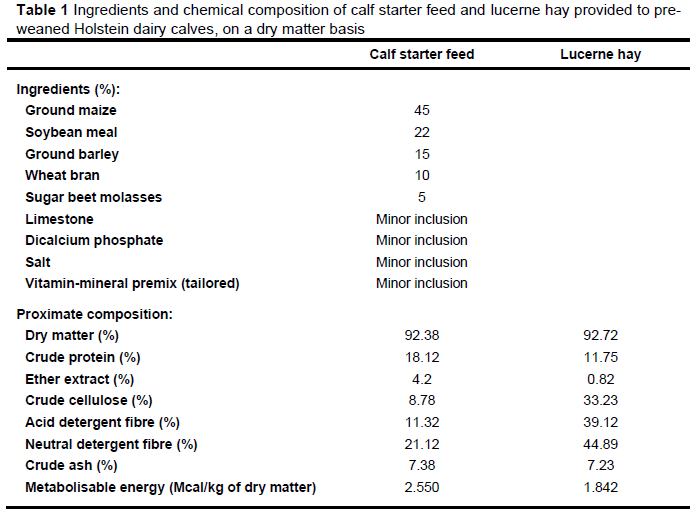
The chemical composition and metabolisable energy content of the calf starter feed and lucerne hay are provided in Table 1. The calf starter feed and lucerne hay were ground through a 1-mm screen, dried, and analysed in triplicate using Association of Official Analytical Chemists (AOAC, 2005) methodology to determine the dry matter (AOAC 930.15), ash (AOAC 942.05), ether extract (AOAC 920.39), and crude protein (Kjeldahl method, AOAC 984.13) content. The neutral detergent fibre (NDF) and acid detergent fibre (ADF) were evaluated according to Van Soest et al. (1991), including heat-stable α-amylase and residual ash. Metabolisable energy values were calculated from chemical fractions and total digestible nutrients using NASEM (2021) equations.
Growth-performance measurement
Body weight was measured weekly from birth until 8 weeks of age using a digital scale (Ata Scale, Türkiye). Average daily gain (ADG) was calculated as the difference between initial and final body weight divided by the total number of experimental days. Individual feed intake was determined daily before the morning provision of calf starter feed and lucerne hay at 08:00. Ad libitum calf starter feed and chopped lucerne hay were available, with the amounts modulated daily for approximately 10% refusals. A digital scale (0.1 g readability) was used to weigh forage and starter feed refusals separately to determine individual intake. Solid-feed dry matter intake (DMI) was calculated as the combined DMI of calf starter feed and lucerne hay. Milk intake was not included in this calculation. Accordingly, the solid-feed conversion ratio (SFCR) was calculated as the solid-feed DMI (kg dry matter/day) divided by the ADG (kg/day). This ratio therefore represents the efficiency of solid-feed use rather than the total dietary feed conversion rate.
Blood sampling and biochemical analysis
Blood samples were collected via jugular venepuncture at birth and at weaning prior to the morning provision of solid feed at 08:00, to ensure consistency in metabolic state. Samples were allowed to clot at room temperature before being centrifuged at 4000 rpm for 15 min at 4 °C, and serum was aliquoted and stored at −20 °C until analysis. Serum concentrations of aspartate aminotransferase (AST), gamma-glutamyl transferase (GGT), glucose, cholesterol, calcium, phosphorus, magnesium, total protein, albumin, and blood urea nitrogen (BUN) were determined using commercial diagnostic kits (Mindray Bio-Medical Electronics Co., Shenzhen, China). Analyses were performed using a Mindray BS-120 automated biochemical analyser following the manufacturer's instructions and standard clinical chemistry procedures (Rifai et al., 2018). Catalogue numbers for the assays were: AST (105-000443-00), GGT (105-000448-00), glucose (105-000450-00), cholesterol (105-000446-00), BUN (105-000463-00), total protein (105-000461-00), albumin (105-000441-00), calcium (105-000444-00), phosphorus (105-000459-00), and magnesium (105-000458-00).
Diarrhoea assessment
Faecal consistency was scored daily for each calf at 08:00 by the same trained observer to reduce inter-observer variation. A standardised four-point system (0-3) adapted from McGuirk (2008) was used: 0 = firm, well-formed; 1 = soft or semi-formed; 2 = loose, non-formed; 3 = watery, potentially containing mucus or blood. A calf was classified as having diarrhoea when a faecal score of ≥2 was recorded during the experimental period. Calves with diarrhoea received supportive therapy according to standard farm veterinary protocols, including oral rehydration therapy and non-steroidal anti-inflammatory drugs if pyrexia (>39.5 °C) or systemic illness occurred. Formal blinding of faecal scoring and laboratory analyses to treatment allocation was not implemented, and no separate allocation-concealment procedure was used.
Statistical analysis
Data were analysed using a two-way analysis of variance (ANOVA) in a 2 × 2 factorial design, with treatment (control versus T+C), sex (female versus male), and their interaction included as fixed effects. The individual calf was considered the experimental unit. Growth-performance endpoints, including ADG, weaning body weight, solid-feed DMI, and SFCR, were analysed using the same factorial structure. Weekly body weights were used to monitor growth during the experimental period; inferential analyses reported in the present manuscript were based on the predefined growth-performance endpoints. Baseline serum biochemical variables measured at birth were compared between sexes using one-way ANOVA because these measurements preceded treatment administration. Serum biochemical variables measured at weaning were analysed using the 2 × 2 factorial model including treatment, sex, and treatment × sex interaction. All statistical analyses were performed using jamovi software (The jamovi project, Sydney, Australia; version 2.6.19.0). Model assumptions were assessed by inspection of residual quartile-quartile plots and residual-versus-fitted plots, together with the Shapiro-Wilk test of residuals. Missing biochemical observations were not imputed; analyses were conducted using the available observations for each endpoint. The proportion of calves classified as having diarrhoea was compared between treatment groups using a two-sided Fisher's exact test. To account for multiple comparisons among biochemical endpoints, P-values were adjusted using the Benjamini-Hochberg false discovery rate (FDR) procedure. Both nominal P-values and FDR-adjusted P-values (q-values) were considered, and findings that did not remain significant after FDR correction were interpreted as exploratory. Statistical significance was set at P <0.05. A sensitivity analysis based on the final treatment group sizes (n = 18 and n = 19), a two-sided α of 0.05, and 80% power indicated a minimum detectable standardised between-group difference of approximately Cohen's d = 0.95. Thus, the study had limited power to detect small-to-moderate treatment effects.
Results and discussion
Growth performance
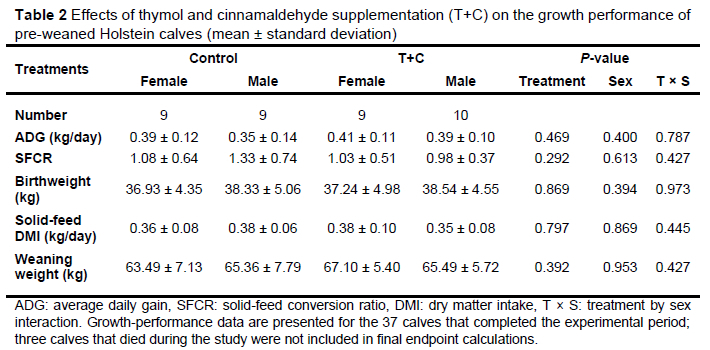
Of the 40 calves initially enrolled, 37 completed the experimental period. Three calves died during the study (two in the control group and one in the T+C group), resulting in final group sizes of 18 and 19 calves, respectively. Table 2 presents the descriptive statistics for the effects of thymol and cinnamaldehyde supplementation during the pre-weaning period on growth performance in Holstein calves.
No statistically significant differences were observed between the control and treatment groups (Table 2). The observed ADG values were below the expected growth targets of 600-800 g/day for Holstein calves (Van Amburgh & Drackley, 2005). This relatively low ADG should be interpreted in the context of the fixed milk allowance of 4 L/day used under the farm management protocol. This feeding level also limits the direct extrapolation of the present findings to calves managed under higher milk-feeding programmes. Drackley (2008) reported that ADG values of 0.30-0.45 kg/day may result from limited liquid feeding regimes relative to the calves' maintenance requirements. Furthermore, Khan et al. (2011) suggested that an ADG below 0.40 kg/day in the pre-weaning period could arise from early transitions to starter feed or the use of low-quality milk replacers. For instance, Göncü & Gökçe (2004) reported pre-weaning ADG values ranging from 253.83 to 367.55 g/day for Holstein calves raised in different hutch types, without significant differences between the groups. Moreover, Göncü & Özkütük (1998) stressed that the growth rate in the region could range from 511 to 613 g/day, depending on the hutch material and environmental stressors. These results are consistent with those of Vakili et al. (2013), who reported that phytogenic compounds are often unable to affect growth performance under conditions of reduced rations. These results are also in line with previous research indicating that essential oils do not enhance growth performance under controlled feeding conditions (Benchaar et al., 2008; Santos et al., 2015). Minimal effects of thyme oil or cinnamaldehyde supplementation on nutrient utilisation and production responses in dairy cattle have also been reported in the literature (Benchaar et al., 2008). Similarly, Vakili et al. (2013) found no improvement in performance parameters in calves treated with thyme and cinnamon essential oils. Nonetheless, the influence of phytogenic additives may vary by dosage, diet, and animal health status (Greathead, 2003; Calsamiglia et al., 2007).
Diarrhoea occurrence
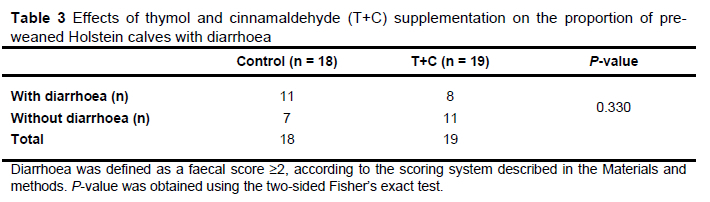
Diarrhoea cases are summarised in Table 3. Diarrhoea was recorded in 11 of 18 calves (61.1%) in the control group and 8 of 19 calves (42.1%) in the T+C group. Although the proportion was numerically lower in the supplemented group, the difference was not statistically significant (two-sided Fisher's exact test, P = 0.330). Therefore, the present study does not provide sufficient evidence to conclude that T+C supplementation reduced diarrhoea occurrence. Diarrhoea was evaluated as a calf-level occurrence endpoint in the present study. Pathogen identification, dehydration scoring, faecal microbiology, and other detailed clinical measures were not evaluated; therefore, the findings should not be interpreted as a comprehensive assessment of gastrointestinal health. The numerical difference should be interpreted cautiously, particularly given the limited sample size. The absence of formal blinding during faecal scoring should also be considered when interpreting the health-related outcomes.
In past studies, the incidence of diarrhoea was reduced after the supplementation of essential oils in calves (Windisch et al., 2008), and in other related studies, modest or varying effects were found (Vakili et al., 2013). Due to the limited sample size, the statistical power to detect significant differences may have been limited. The lower numerical proportion of diarrhoea occurrence in the supplemented group should be interpreted with caution because the between-group difference was not statistically significant and the study had limited power to detect small-to-moderate effects. Therefore, the present results do not demonstrate a protective effect of T+C against diarrhoea.
Blood metabolites
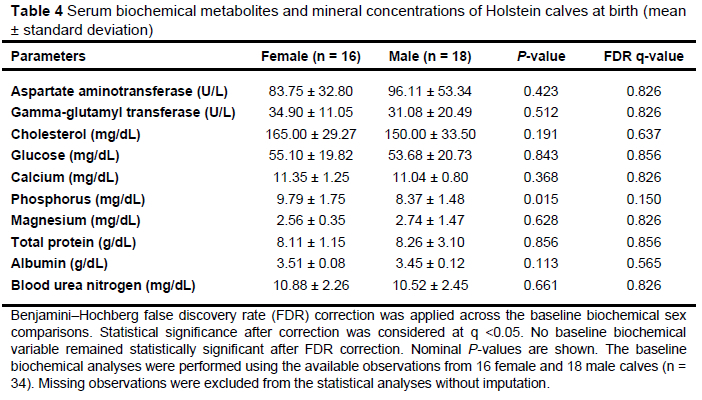
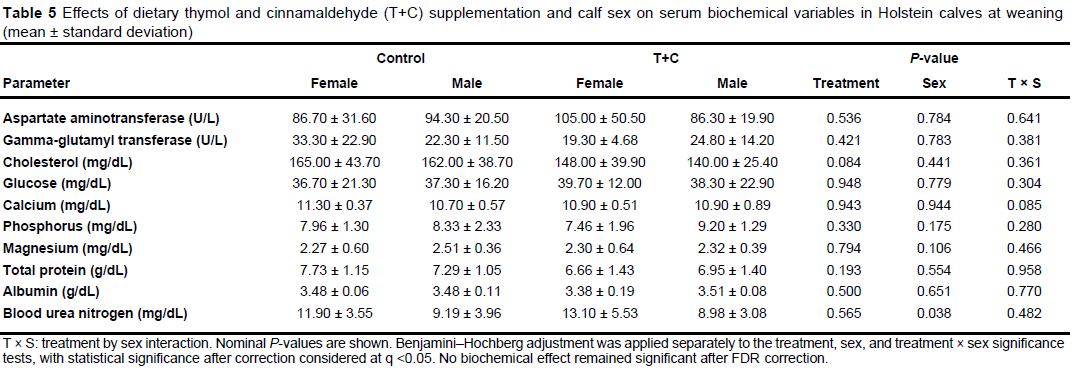
Table 4 presents the comparative analysis of blood metabolites between female and male calves at birth, while Table 5 provides the comparative analysis of blood metabolites between the four experimental groups at weaning.
Serum phosphorus concentrations were higher in female than in male calves (9.79 ± 1.75 versus 8.37 ± 1.48 mg/dL), reaching nominal statistical significance (P = 0.015). However, this difference did not remain significant after Benjamini-Hochberg correction for multiple comparisons (q = 0.150) and was therefore considered exploratory. No other baseline biochemical variable showed a significant sex-associated difference. Similarly, Gökçe et al. (2021) reported that differences in total protein, albumin, urea, BUN, beta-hydroxybutyrate, non-esterified fatty acids, total cholesterol, alanine aminotransferase, AST, GGT, calcium, phosphorus, and magnesium concentrations in Holstein calves were not statistically significant. In contrast, Göncü et al. (2023) noted that while blood parameter differences between milk replacer groups were not statistically significant, this was with the exception of GGT. They also indicated that the interaction effects between average values of total protein and cholesterol were significant. Nonetheless, all measured values were within physiological reference ranges for healthy Holstein calves (Mohri et al., 2007).
The biochemical data recorded at weaning indicate that the majority of the parameters investigated remained stable across the groups, with no statistically significant differences observed between the T+C treatment group and the control group (Table 5). The biochemical profile observed in this study suggests that most parameters remained within physiological limits, consistent with the findings of Gökçe et al. (2021), who observed that blood parameters in Holstein calves undergo specific fluctuations during early developmental stages.
At weaning, BUN values showed a nominal sex-associated effect (P = 0.038); however, this association did not remain significant after Benjamini-Hochberg FDR correction (q = 0.380) and was therefore considered exploratory. None of the treatment, sex, or treatment × sex effects on the measured biochemical variables remained statistically significant after FDR adjustment.
Conclusions
Under the conditions of this study, thymol and cinnamaldehyde supplementation did not significantly improve growth performance or alter the measured serum biochemical variables in pre-weaned Holstein calves. Nominal sex-associated differences observed for selected biochemical variables did not remain significant after correction for multiple comparisons and should therefore be interpreted with caution. The proportion of calves with diarrhoea was numerically lower in the T+C group, but the difference was not statistically significant. Thus, the present data do not provide sufficient evidence for a growth-promoting or protective health effect of T+C supplementation at the dose evaluated. Larger studies are needed to determine whether treatment effects occur under different feeding and management conditions.
Authors' contributions
Conceptualisation: Ş.E., methodology: A.E., investigation: A.E. and S.G., data curation: A.E. and C.A.O., writing (original draft preparation): A.E., writing (review and editing): Ş.E., supervision: Ş.E. All authors have read and agreed to the published version of the manuscript.
Conflict of interest declaration
The authors have no conflicts of interest to declare.
Acknowledgements
The authors thank the staff of the Çukurova University Dairy Research Farm for animal care and technical assistance. The authors also acknowledge Makrovit (Konya, Türkiye) for providing the phytogenic product used in this study.
References
- Association of Official Analytical Chemists (AOAC), 2005. Official methods of analysis, 18th edition. Association of Official Analytical Chemists, Gaithersburg, MD, USA.
-
Benchaar, C., Calsamiglia, S., Chaves, A.V., Fraser, G.R., Colombatto, D., McAllister, T.A., & Beauchemin, K.A., 2008. A review of plant-derived essential oils in ruminant nutrition and production. Animal Feed Science and Technology, 145(1-4):209-228. DOI: https://doi.org/10.1016/j.anifeedsci.2007.04.014
» https://doi.org/10.1016/j.anifeedsci.2007.04.014 -
Calsamiglia, S., Busquet, M., Cardozo, P.W., Castillejos, L., & Ferret, A., 2007. Essential oils as modifiers of rumen microbial fermentation. Journal of Dairy Science, 90(6):2580-2595. DOI: https://doi.org/10.3168/jds.2006-644
» https://doi.org/10.3168/jds.2006-644 -
Cho, Y.I. & Yoon, K.J., 2014. An overview of calf diarrhea - infection etiology, diagnosis, and intervention. Journal of Veterinary Science, 15(1):1-17. DOI: https://doi.org/10.4142/jvs.2014.15.1.1
» https://doi.org/10.4142/jvs.2014.15.1.1 -
Donovan, G.A., Dohoo, I.R., Montgomery, D.M., & Bennett, F.L., 1998. Calf and disease factors affecting growth in female Holstein calves in Florida, USA. Preventive Veterinary Medicine, 33(1-4):1-10. DOI: https://doi.org/10.1016/S0167-5877(97)00059-7
» https://doi.org/10.1016/S0167-5877(97)00059-7 -
Drackley, J.K., 2008. Calf nutrition from birth to breeding. Veterinary Clinics of North America: Food Animal Practice, 24(1):55-86. DOI: https://doi.org/10.1016/j.cvfa.2008.01.001
» https://doi.org/10.1016/j.cvfa.2008.01.001 -
Edwards, K.Y. & Renaud, D.L., 2025. A framework for comprehensive dairy calf health investigations. Animals, 15(2):181. DOI: https://doi.org/10.3390/ani15020181
» https://doi.org/10.3390/ani15020181 -
Gökçe, G., Göncü, S., & Ergül, A., 2021. The change in blood parameters with age in Holstein calves. International Journal of Scientific and Technology Research, 7(9):31-37. DOI: https://doi.org/10.7176/JSTR/7-09-04
» https://doi.org/10.7176/JSTR/7-09-04 -
Göncü, S. & Gökçe, G., 2004. Effect of different calf hutch types on black and white calf performances. Pakistan Journal of Biological Sciences, 7: 389-392. DOI: https://doi.org/10.3923/pjbs.2004.389.392
» https://doi.org/10.3923/pjbs.2004.389.392 - Göncü, S. & Özkütük, K., 1998. Üç ayrı tip materyalden yapılan buzağı kulübelerinde buzağı büyütme [Rearing calves in calf hutches made from three different types of materials]. In: Proceedings of the II. Ulusal Zootekni Bilim Kongresi [2nd National Animal Science Congress]. 22-25 September 1998, Bursa, Turkey. 1(1):83-92.
-
Göncü, S., Yeşil, M.İ., & Görgülü, M., 2023. The effect of different milk replacers on Holstein calf performances, health, blood parameters, and economy. Journal of Dairy, Veterinary and Animal Research, 12(2):86-90. DOI: https://doi.org/10.15406/jdvar.2023.12.00329
» https://doi.org/10.15406/jdvar.2023.12.00329 -
Greathead, H., 2003. Plants and plant extracts for improving animal productivity. Proceedings of the Nutrition Society, 62(2):279-290. DOI: https://doi.org/10.1079/PNS2002197
» https://doi.org/10.1079/PNS2002197 -
Jahani-Azizabadi, H., Baraz, H., Bagheri, N., & Ghaffari, M.H., 2022. Effects of a mixture of phytobiotic-rich herbal extracts on growth performance, blood metabolites, rumen fermentation, and bacterial population of dairy calves. Journal of Dairy Science, 105:5062-5073. DOI: https://doi.org/10.3168/jds.2021-20687
» https://doi.org/10.3168/jds.2021-20687 -
Khan, M.A., Weary, D.M., & von Keyserlingk, M.A.G., 2011. Invited review: effects of milk ration on solid feed intake, weaning, and performance in dairy heifers. Journal of Dairy Science, 94(3):1071-1081. DOI: https://doi.org/10.3168/jds.2010-3733
» https://doi.org/10.3168/jds.2010-3733 -
McGuirk, S.M., 2008. Disease management of dairy calves and heifers. Veterinary Clinics of North America: Food Animal Practice, 24(1):139-153. DOI: https://doi.org/10.1016/j.cvfa.2007.10.003
» https://doi.org/10.1016/j.cvfa.2007.10.003 -
Mohri, M., Sharifi, K., & Eidi, S., 2007. Hematology and serum biochemistry of Holstein dairy calves: Age related changes and comparison with blood composition in adults. Research in Veterinary Science, 83(1):30-39. DOI: https://doi.org/10.1016/j.rvsc.2006.10.017
» https://doi.org/10.1016/j.rvsc.2006.10.017 -
National Academies of Sciences, Engineering, and Medicine (NASEM), 2021. Nutrient Requirements of Dairy Cattle: Eighth Revised Edition. National Academies Press, Washington, DC, USA. DOI: https://doi.org/10.17226/25806
» https://doi.org/10.17226/25806 -
Nora, L., Marcon, C., Deolindo, G.L., Signor, M.H., Muniz, A.L., Bajay, M.M., Copetti, P.M., Bissacotti, B.F., Morsch, V.M., & da Silva, A.S., 2024. The effects of a blend of essential oils in the milk of suckling calves on performance, immune and antioxidant systems, and intestinal microbiota. Animals, 14(24):3555. DOI: https://doi.org/10.3390/ani14243555
» https://doi.org/10.3390/ani14243555 - Rifai, N., Horvath, A.R., & Wittwer, C.T., 2018. Tietz Textbook of Clinical Chemistry and Molecular Diagnostics, 6th edition. Elsevier, St. Louis, MO, USA.
-
Santos, F.H.R., De Paula, M.R., Lezier, D., Silva, J.T., Santos, G., & Bittar, C.M.M., 2015. Essential oils for dairy calves: effects on performance, scours, rumen fermentation and intestinal fauna. Animal, 9(6):958-965. DOI: https://doi.org/10.1017/S175173111500018X
» https://doi.org/10.1017/S175173111500018X -
Vakili, A.R., Khorrami, B., Danesh Mesgaran, M., & Parand, E., 2013. The effects of thyme and cinnamon essential oils on performance, rumen fermentation and blood metabolites in Holstein calves consuming high concentrate diet. Asian-Australasian Journal of Animal Sciences, 26(7):935-944. DOI: https://doi.org/10.5713/ajas.2012.12636
» https://doi.org/10.5713/ajas.2012.12636 - Van Amburgh, M.E. & Drackley, J.K., 2005. Current perspectives on the energy and protein requirements of the pre-weaned calf. In: Principles of Rearing the Modern Dairy Heifer from Calf to Calving. Ed: Garnsworthy, P.C., Nottingham University Press, Nottingham, UK. pp. 67-82.
-
Van Soest, P.J., Robertson, J.B., & Lewis, B.A., 1991. Methods for dietary fiber, neutral detergent fiber, and non-starch polysaccharides in relation to animal nutrition. Journal of Dairy Science, 74(10):3583-3597. DOI: https://doi.org/10.3168/jds.S0022-0302(91)78551-2
» https://doi.org/10.3168/jds.S0022-0302(91)78551-2 -
Velázquez-Cruz, L.A., Mendoza-Martínez, G.D., Hernández-García, P.A., Espinosa-Ayala, E., Díaz-Galván, C., Vázquez-Silva, G., Orzuna-Orzuna, J.F., Razo-Ortíz, P.B., & de la Torre-Hernández, M.E., 2025. Growth performance, health parameters, and blood metabolites of dairy calves supplemented with a polyherbal phytogenic additive. Animals, 15(4):576. DOI: https://doi.org/10.3390/ani15040576
» https://doi.org/10.3390/ani15040576 -
Windisch, W., Schedle, K., Plitzner, C., & Kroismayr, A., 2008. Use of phytogenic products as feed additives for swine and poultry. Journal of Animal Science, 86(suppl_14):E140-E148. DOI: https://doi.org/10.2527/jas.2007-0459
» https://doi.org/10.2527/jas.2007-0459 - World Health Organization, 2014. Antimicrobial resistance: global report on surveillance. World Health Organization, Geneva, Switzerland. ISBN 9789241564748.
Accepted 13 October 2026
Published 10 November 2026