Can repeated superovulation and embryo recovery in Boer goats limit donor participation in a MOET programme?
Abstract
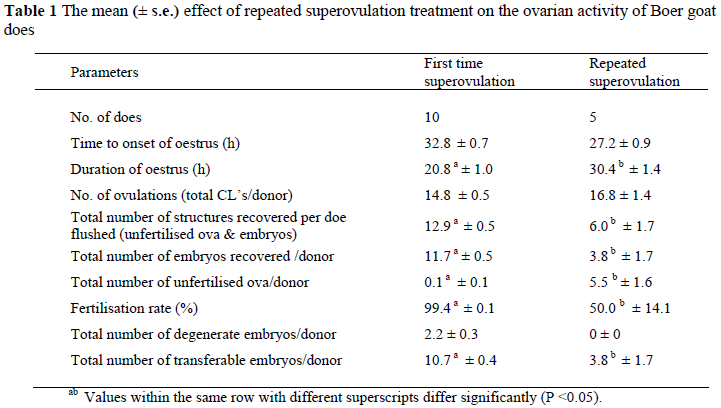
This study evaluated the effect of repeated superovulation and embryo recovery in 15 Boer goat does. Does were synchronised for oestrus using CIDR's for 17 days and superovulated with pFSH during the natural breeding season (autumn). Cervical inseminations with fresh undiluted semen were performed 36 h and 48 h following CIDR removal and the embryos surgically flushed six days after the second AI. Does superovulated for the first time recorded a shorter mean (± s.e.) induced duration of oestrus (20.8 ± 1.0 h), when compared to those repeatedly superovulated (30.4 ± 6.7 h). The mean (±s.e.) number of structures and embryos recovered were significantly lower in does treated repeatedly (6.0 ± 1.7 and 3.8 ± 1.7) than does superovulated for the first time (12.9 ± 0.5 and 11.7 ± 0.5), respectively. The mean (±s.e.) number of unfertilised ova per donor was significantly higher in repeatedly superovulated does (5.5 ± 1.6), compared to does superovulated for the first time (0.1 ± 0.1). The fertilisation rate and the number of transferable embryos were significantly lower in does treated repeatedly, compared to does superovulated for the first time. These results indicate that the number of times that a Boer goat doe can be utilised as the embryo donor may be limited to three times.
Boer goats; superovulation; MOET