Growth performance, survival rates, and reproductive traits of Awassi sheep raised under normal farm conditions in Türkiye
Abstract
This study determined the selected reproductive traits and growth and survival rates from birth to weaning of Awassi sheep raised in the Adıyaman province of Türkiye between 2016 and 2018 within the scope of the National Sheep and Goat Breeding Project of Türkiye. A total of 9356 Awassi sheep were included in the three-year breeding programme, with the birthweights of 12 816 lambs and the weaning weights of 11 452 lambs being analysed. According to the three years' worth of data, the birthweights, weaning weights, and average daily gain of the lambs were 4.01 ± 0.006 kg, 22.78 ± 0.049 kg, and 208.51 ± 0.529 g, respectively. The effects of the examined environmental factors, including the year of birth, month of birth, dam's age, birth type, and sex, were determined to be statistically significant. The overall average survival rate of lambs at weaning was 89.36%. The effect of year of birth, month of birth, dam's age, and birth type on survival rate was significant, whereas lamb sex did not affect the survival rate. In this study, the number of lambs born per ewe and the average twinning rate were found to be 1.113 and 11.3%, respectively. The results of this study show that the environmental factors measured should be taken into account when selecting Awassi breeding sheep in the region.
Awassi sheep; environmental factors; growth; reproductive traits; survival rate
Introduction
Animal production plays an important role in Türkiye's agricultural industry and, because of the climate, vegetation, and geographical structure of the country, sheep and goat breeding are particularly important livestock industries (Boran & Torun, 2018). Türkiye's sheep and goat populations rank first in Europe and eleventh in the world, with a total of 56.3 million head (approximately 11.6 million goats and 44.7 million sheep). A large part of the sheep population (91.1%) consists of native sheep breeds (Food and Agriculture Organization of the United Nations, 2022; Turkish Statistical Institute, 2022). Awassi sheep, one of the native breeds of Türkiye, are generally bred in regions with Mediterranean climates and are most intensively farmed in the southeastern Anatolia region. Although they are considered a multi-purpose breed, they are mostly known for their dairy traits (Republic of Türkiye, Ministry of Agriculture and Rural Affairs, General Directorate of Agricultural Research, 2009). In addition, Awassi sheep are considered an important genetic resource for the sheep industry in the Middle East and in more than 30 countries worldwide, as they have very desirable properties in terms of resistance to nutritional changes, tolerance to extreme temperatures, and resistance to diseases and parasites (Galal et al., 2008; BenSouf et al., 2025).
The Awassi breed has been included in the National Sheep and Goat Breeding Project by the Ministry of Agriculture and Forestry since 2002 to ensure its sustainability as a local genetic resource and to increase its productivity by selection. The majority of the income from sheep farming is obtained from meat yield and meat processing, especially in lamb production, and foods of animal origin such as meat and milk play a major role in human nutrition (Oyan et al., 2024). In recent studies on Awassi sheep, lambs performed well in terms of their average daily gain (ADG) (Ipek, 2012; Boran & Torun, 2018; Türkyılmaz et al., 2021; Salman et al., 2024). These results show that the Awassi breed can be considered a meat breed as well as a dairy breed.
Many factors affect the growth of lambs, including birth type, sex, season of birth, and dam age, with Şireli et al. (2015) reporting that many non-genetic factors play important roles in determining quantitative trait outcomes. Of the growth characteristics, birthweight is an important selection criterion because of its linear relationship with mature body weight and weaning weight in sheep (Kuchtík & Dobeš, 2006). Weaning weight is an important production characteristic in sheep, and in the selection process for any yield trait, understanding the effects of environmental factors is crucial (Yılmaz et al., 2007; Şireli et al., 2015). Nonetheless, in sheep farming, one of the most important factors determining the profitability of production is fertility, and fertility is considered the physiological basis for all yield traits (Bingöl & Aygün, 2013). Parameters such as litter size, survival rate, single lambing rate, and twinning rate must therefore be taken into consideration when managing a profitable sheep farming enterprise (Al-Moman et al., 2020). Fertility in sheep varies according to the breed, herd, and individual, and to optimise fertility in sheep breeding, both the prenatal and postnatal survival rates should be high, in addition to having a high twinning rate (Sarı et al., 2014). The postnatal survival rate of the lamb is closely related to the lamb's birthweight and the number of lambs born per ewe (i.e. the litter size). Furthermore, the fattening performance of sheep is influenced by both genetic and environmental factors (Atasoy, 2016; Dağdelen et al., 2024).
This study aimed to measure selected reproductive traits, as well as the growth characteristics and survival rate from birth to weaning, of Awassi sheep raised under standard farm conditions in the Adıyaman province using three years' worth of data (2016-2018). This is the first study conducted on Awassi sheep in this province using this amount of data.
Materials and methods
This study used data collected by herd managers and project technical staff in the Adıyaman province of Türkiye (37° 47' N and 38° 07' E), as part of the National Awassi Sheep Breeding Project, conducted by the Ministry of Agriculture and Forestry, General Directorate of Agricultural Research and Policies (project number: TAGEM/02İVE2012-01). No procedures were performed on animals purely for the purposes of this study. A total of 9356 Awassi sheep were included in the breeding programme and the data collected included the birth records of 12 816 lambs and the weaning weights (at 90 days of age) of 11 452 lambs from 75 herds in 44 villages located in the central district over a three-year period, between 2016 and 2018.
The region examined in this study serves as a bridge between the eastern and southeastern Anatolia regions. However, it also has the characteristics of a Mediterranean climate, with winters generally being cold and rainy, and summers hot and dry. While the average annual temperature is 17.7 °C, the average maximum temperature is 38.7 °C in July and the average minimum temperature is 1.8 °C in January. Furthermore, the average annual total precipitation in the region is 729.5 mm, with the highest monthly precipitation being 142.0 mm in December and the lowest being 1.9 mm in July (Meteoroloji Genel Müdürlüğü, Türkiye, 2025). The vegetation is thus typical of the region.
In the study area, Awassi sheep are generally farmed in semi-extensive systems in suitable enclosures. Awassi herds are grazed on pastures and stubble around the villages from the early morning (5 am) until the evening (6 pm) between April and October. These pastures generally consist of grasses that vary depending on the type of vegetation and the season. Awassi sheep are also grazed on shrublands containing species such as Aleppo oak (Quercus infectoria), Kermes oak (Quercus coccifera), and black chaparral (Paliurus spina-christi Miller), and on pastures dominated by astragalus (Astragalus gummifera). Herds are taken out to graze when weather conditions are suitable in winter and, in addition to the pasture, receive approximately 0.5-0.6 kg/head of mixed fodder and 1-2 kg/head of hay per day. On days when weather conditions are not suitable, sheep are kept in barns and fed crushed barley, hay, and wheat straw. A free mating system is applied between 15 August and 15 October, which is the mating period in the region, with a ratio of 20 ewes to each ram.
Lambs born during the lambing season were weighed within 24 hours of birth using a digital scale with a 50 kg capacity and 10 g sensitivity, and birth registration information (dam's ear tag number, date of birth, birth type, and sex) was recorded. Lambs are traditionally weaned at 90 days of age and are nursed by their dams in the morning and evening during this period. After approximately 20 to 30 days of age, lambs are fed small amounts of dry grass (lucerne or meadow grass), as well as concentrate feed (16% crude protein, 2500 kcal/kg metabolisable energy), with the amount of concentrate feed being gradually increased to adapt them to the diet. After 60 days of age, lambs are allowed to graze on pasture.
The weaning weights of the Awassi lambs were obtained using a digital cage scale with a capacity of 600 kg and a sensitivity of 100 g. Average daily gain was calculated using the birthweights and weaning weights. Weaning weights were adjusted to 90 days of age using the formula below (Mellado et al., 2016):

The effects of year of birth, month of birth, birth type, dam's age, sex, village, and herd (village) - the environmental factors investigated in this study - on birthweight and growth were determined using the least squares method. The statistical significance of effects on mean values was analysed using variance analysis, and differences were examined using Tukey's multiple comparison test. Two- or three-way interactions between the factors were assumed to be negligible because of the scarcity of data in the subgroups. The survival rates and fertility traits of the Awassi sheep were analysed and compared using the chi-square (χ2) test. The χ2 and general linear model procedures in the Minitab version 18 program package were used for the statistical analysis of the data (Minitab, 2017).
The model used to analyse the factors affecting the birthweights of lambs was:

Where:
yijklmnpr = the lamb's birthweight in the ith year and jth month, with the kth dam's age, lth birth type, and mth sex, in the nth village and pth herd (village);
μ = the overall (expected) average;
ai = the effect of the year of birth (with i = 2016, 2017, or 2018);
bj = the effect of the month of birth (with j = January, February, or March);
ck = the effect of the dam's age (with k = 2-7+);
dl = the effect of the birth type (with l = a single or multiple birth);
fm = the effect of sex (with m = female or male);
gn = the effect of the village (with n = one of 44 different villages);
hp = the effect of the herd nested within the village (with p = one of 75 herds); and
eijklmnpr = the random error, which is assumed to be independent (if the test of significance is to be made then it is essential to assume that the errors (eijklmnpr) are normally distributed, i.e. N (0, σ2)).
The model used to analyse the factors affecting the weaning weights of the lambs and the ADG from birth to weaning was:

Where:
μ, ai, bj, ck, dl, fm, gn, hp, and eijklmnpr are the same as indicated for the model above;
b = the regression coefficient for the partial regression of weaning weight and ADG by birthweight; and Xijklmnpr = the ith year of birth, jth month of birth, kth dam's age, lth birth type, mth sex, nth village, pth herd-village, and rth birthweight of the lamb.
It should be noted that the effect of herd, nested per village, was determined to be significant (P <0.001), but has not been reported because the number of herds relative to the number of villages was high (44 villages, 75 herds).
The reproductive traits measured for the Awassi sheep included the following (Güngör et al., 2021):
-
• Litter size = (number of lambs at birth) ÷ (number of ewes lambing)
-
• Single lambing rate (%) = (number of ewes producing a single lamb) ÷ (number of ewes lambing) × 100.
-
• Twinning rate (%) = (number of ewes producing twin/multiple lambs) ÷ (number of ewes lambing) × 100.
-
• Survival rate (%) = (number of lambs alive at weaning) ÷ (number of lambs born alive) × 100.
Results
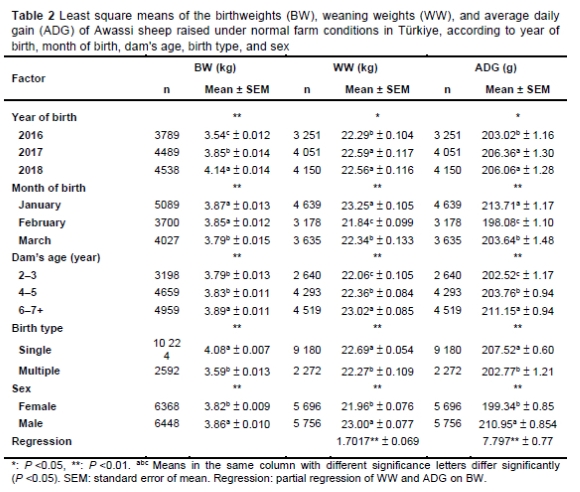
The descriptive statistics for the live weights of the Awassi lambs are reported in Table 1, and the results obtained according to the environmental factors affecting growth performance are reported in Table 2. The birthweights, weaning weights, and ADG of the lambs were 4.01 ± 0.006 kg, 22.78 ± 0.049 kg, and 208.51 ± 0.529 g, respectively. The effects of the examined environmental factors (year of birth, month of birth, dam's age, birth type, and sex) were determined to be statistically significant.
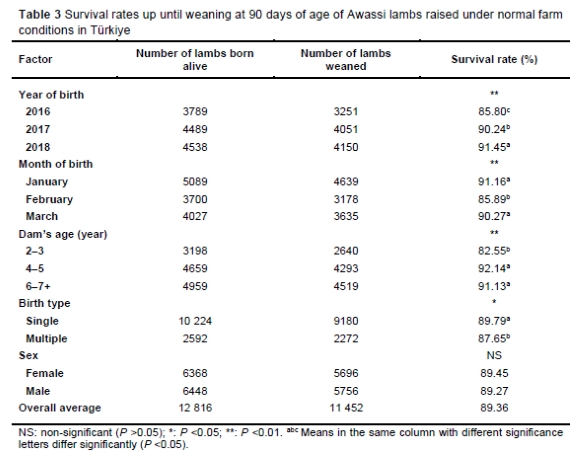
The survival rates of the Awassi lambs at weaning are reported in Table 3, with an overall average of 89.36%. All the environmental factors investigated, apart from sex, were found to significantly affect the lamb survival rate.
The selected reproductive traits of Awassi ewes, according to the year of parturition and dam age, are reported in Table 4. The proportions of single and multiple lambings were not significantly affected by either the year of parturition or the dam age. The overall average litter size was 1.113, and single and multiple lambing rates were 88.7%, and 11.3%, respectively.
Discussion
The average birthweight of the Awassi lambs included in this study was 4.01 ± 0.006 kg (Table 1). This value is consistent with the results of studies on Awassi lambs conducted by Al-Momani et al. (2020) in Jordan (3.99 ± 0.66 kg) and by Özbeyaz et al. (2018) in Eskişehir province; Türkiye (3.97 ± 0.06 kg). However, it exceeds the range of birthweight values (3.34-3.87 kg) reported for Awassi lambs in Erzurum, Kilis, Elazığ, and Osmaniye, in Türkiye (Gül & Ekici, 2020; Türkyılmaz et al., 2021; Hızlı et al., 2022) and in Iraq (Al-Samarai et al., 2015). In contrast, the average birthweight recorded in this study is lower than the values (4.1-4.81 kg) reported in studies conducted in Iraq, and in Eskişehir, Diyarbakır, Kilis, Elazığ, Erzurum, Şanlıurfa, and Gaziantep in Türkiye (Kul & Akcan, 2002; Al-Jalili et al., 2006; Ipek, 2012; Üstüner & Oğan, 2013; Şireli et al., 2015; Biçer et al., 2019; Şireli, 2019; Gül et al., 2020). The differences between the birthweights of Awassi lambs reported in the literature and the current research results may be owing to differences in geographical structure, ram effect, and herd management conditions in the researched regions.
In this study, the lowest birthweight (3.54 ± 0.012 kg) was recorded in 2016, and the highest (4.14 ± 0.014 kg) was recorded in 2018. This increase in birthweight over time may have resulted from the experience gained by the farmers and the consequent improvement in the care and feeding conditions of the Awassi flocks. Studies on Awassi sheep by Hızlı et al. (2022) in Osmaniye, and by Al-Samarai et al. (2015) in Iraq similarly reported that birthweight increased from year to year.
In this study, lambs born in January (3.87 ± 0.013 kg) and February (3.85 ± 0.012 kg) were heavier at birth than those born in March (3.79 ± 0.015 kg) (Table 2). Al-Samarai et al. (2015) similarly reported that Awassi lambs born in January and February were heavier than those born in March in Iraq. This can be attributed to the changes in the amount and quality of the feed consumed by the dams, especially during the last months of gestation. It is therefore important that farmers improve their management and provide ewes with better care and nutrition, as pastures are insufficient for grazing in winter, which coincides with the last third of gestation. This is an important time for the development of the lamb, and proper ewe nutrition is thus important for the birthweight and later performance of the lamb.
In this study, lambs from 2-3-year-old dams had the lowest birthweights (3.79 ± 0.013 kg), and lambs from ≥6-7-year-old dams had the highest birthweights (3.89 ± 0.011 kg), with the birthweight increasing progressively from 2-3 years of age to ≥6-7 years of age (Table 2). These results concur with those reported for Awassi sheep by Üstüner & Ogan (2013) in Eskişehir and Şireli et al. (2015) in Diyarbakır, and those reported for Romanov × Awassi cross-bred sheep by Türkyılmaz et al. (2021) in Erzurum. These results can be attributed to the increase in the Awassi ewe's reproductive abilities and performance with age. The birthweight of a ewe's first lamb is lower than that of later lambs because young ewes have to expend energy on both their own continued development and their lamb's growth and development. Furthermore, lambs from ewes that have already produced two or more lambs are heavier at birth because of the improved physiological development of the ewe's uterus, cervix, and birth canal.
Single lambs (4.08 ± 0.007 kg) in this study were heavier at birth than lambs born as twins or multiples (3.59 ± 0.013 kg). Hızlı et al. (2022) similarly reported that single lambs were heavier (4.20 kg) than twin lambs (3.55 kg), and many other studies on Awassi sheep have reported results that are consistent with those of this study (Al-Samarai et al., 2015; Özbeyaz et al., 2018; Şireli, 2019; Al-Moman et al., 2020). Male lambs had a birthweight of 3.86 ± 0.010 kg, and female lambs had a birthweight of 3.82 ± 0.009 kg. These results concur with those of Özbeyaz et al. (2018) on Awassi sheep in Eskişehir (male: 4.10 kg, female: 3.84 kg) and those of other studies on the breed (Üstüner & Oğan, 2013; Şireli et al., 2015; Hızlı et al., 2022).
The effects of birth year, birth month, dam's age, sex, and birth type on birthweight were statistically significant (P <0.01, Table 2). The significant effect of the year of birth is compatible with most previous research (Al-Jalili et al., 2006; Üstüner & Oğan, 2013; Al-Samarai et al., 2015; Hızlı et al., 2022), as is the significant effect of the month of birth (Al-Samarai et al., 2015; Şireli et al., 2015). The significant effect of dam's age is compatible with the results of some previous studies on Awassi sheep (Şireli et al., 2015; Türkyılmaz et al., 2021; Hızlı et al., 2022), whereas the significant effect of birth type on birthweight is compatible with most previous research (Özbeyaz et al., 2018; Al-Moman et al., 2020; Türkyılmaz et al., 2021). The effect of sex on birthweight found in this study is compatible with the results of some studies (Şireli et al., 2015; Özbeyaz et al., 2018; Hızlı et al., 2022), but inconsistent with the results reported by İpek (2012) for the Şanlıurfa GAP Agricultural Research Institute.
The average weaning weight of the Awassi lambs included in this study was 22.78 ± 0.049 kg (Table 1). This is higher than the average weaning weight reported by Özbeyaz et al. (2018) in Eskişehir (21.77 kg), but similar to the values reported by Al-Jalili et al. (2006) in Iraq (22.68 kg) and by Şireli et al. (2015) in Diyarbakır (22.99 kg) for Awassi lambs. It is lower than the weaning weights reported by Gül & Ekici (2020) in Kilis (24 kg), by İpek (2012) in Şanlıurfa (23.59 kg), and by Hızlı et al. (2022) in Osmaniye (24.49 kg). These differences in weaning weights may have been caused by differences in climatic conditions, shelter conditions, herd sizes, and management practices in the various regions.
The highest weaning weights were found in 2017 (22.59 ± 0.117 kg) and 2018 (22.56 ± 0.116 kg). This can be attributed to the training and support provided to the farmers during this period, which increased the farmers' breeding knowledge, improved the care and feeding of the animals, and enhanced the selection of breeding stock.
In this study, significant differences in weaning weight were found between the lambs born in January, February, and March, with lambs born in January (23.25 ± 0.105 kg) reaching the highest weaning weight. This can be explained by the fact that early-born (January) lambs have easier access to pastures in spring than late-born lambs. The lowest weaning weight was found for lambs born to 2-3-year-old ewes (22.06 ± 0.105 kg) and the highest for lambs born to ≥6-7-year-old ewes (23.02 ± 0.085 kg), with the weaning weight generally increasing with the dam's age. These results concur with those of Özbeyaz et al. (2018) on Awassi sheep in Eskişehir and those of Türkyılmaz et al. (2021) on Awassi and Romanov × Awassi cross-bred sheep in Erzurum. The average weaning weights of single and multiple Awassi lambs in this study were 22.69 ± 0.054 kg and 22.27 ± 0.109 kg, respectively, with single lambs having higher weaning weights than twin/multiple lambs. Similarly, Kul & Akcan (2002) reported weaning weights of 14.59 kg (single lambs) and 12.50 kg (twin lambs) for Awassi sheep in Elazığ. In addition, Şireli et al. (2015) reported weaning weights for single and multiple lambs of 22.85 kg and 21.29 kg, respectively, in a study on Awassi sheep in Diyarbakır, which concurs with the results of this study. Male and female Awassi lambs in this study had weaning weights of 23.00 ± 0.077 kg and 21.96 ± 0.076 kg, respectively. These weaning weights are higher than those reported by Şireli et al. (2015) in Diyarbakır (males: 22.85 kg, females: 21.29 kg), and those reported by Kul & Akcan (2002) in Elazığ (male: 14.44 kg, female: 13.75 kg). In contrast, the weaning weights found in this study are lower than those reported by Hızlı et al. (2022) in Osmaniye (male: 24.65 kg, female: 24.17 kg).
In this study, the effects of birth year, birth month, dam's age, birth type, and sex on weaning weight were statistically significant (P <0.01). The significant effect of the year of birth on weaning weight
is compatible with most previous studies (Al-Jalili et al., 2006; Al-Moman et al., 2020; Hızlı et al., 2022), while the significant effect of the month of birth on weaning weight is consistent with the results of Şireli et al. (2015) and Al-Samarai et al. (2015). The significant effect of dam's age on weaning weight concurs with the results of Şireli et al. (2015) and Hızlı et al. (2022), but is inconsistent with the results reported in some other studies (Özbeyaz et al., 2018; Al-Moman et al., 2020). The significant effect of birth type on weaning weight is compatible with most previous literature (Üstüner & Oğan, 2013; Al-Samarai et al., 2015; Şireli et al., 2015; Hızlı et al., 2022) but inconsistent with the results of Al-Jalili et al. (2006). The significant effect of sex on weaning weight concurs with the results of most previous studies (Şireli et al., 2015; Al-Moman et al., 2020; Hızlı et al., 2022) but is inconsistent with the results reported by İpek (2012).
The effects of the year and month of birth are directly related to environmental conditions, as factors such as forage crop availability, climate (temperature and precipitation), pasture productivity, and heat and cold stress vary across years and months. For example, lambs born in summer are often more susceptible to drought or heat stress, which can negatively impact growth performance. The season of birth also impacts the dam's feed availability during gestation (e.g. feed scarcity in winter), and maternal nutrition during gestation can affect foetal development, which can, in turn, affect weaning weight. For example, a study by Heinzen et al. (2023) reported that ADG and weaning weights were lower for groups of lambs born in summer than for those born in other seasons. Male lambs generally reach higher weaning weights than female lambs because of hormonal differences, greater muscle development potential, and growth potential. Dam age can influence weaning weight through its effects on milk production and caregiving ability, with very young and very old ewes potentially having poorer performance, resulting in disadvantages for their offspring. Heinzen et al. (2023) reported differences in weaning weights between lambs from ewes of different age groups, with offspring from very young and very old dams being weaned at lower weights.
The overall ADG from birth to weaning of the Awassi lambs included in the study was 208.51 ± 0.529 g (Table 1). This is lower than the ADG reported by Şireli et al. (2015) (201.67 g) in their report on the performance of 1271 head of Awassi sheep farmed at the Research Institute in Diyarbakir, and is also lower than the ADG reported by Gül & Ekici (2020) (228.8 g) for 105 head of Awassi sheep on a private farm in Kilis. However, it is similar to the ADG reported by İpek (2012) (210.88 g) for 90 Awassi lambs reared at the Research Institute in Şanlıurfa. Differences in the ADG may be due to differences in the geographical situation of the study area, the prevailing pasture conditions, the number of animals included in the study, and the nature of the farm on which the lambs were raised (i.e. on a private farm or at a research institute). While the ADG is generally higher in intensive systems and lower in extensive (pasture-only) systems, it has been reported that the ADG increases significantly in controlled-ration barns (Karthik et al., 2021). Geographic location and climate directly affect forage production and the animal's energy needs, with both cold and extreme heat stress reducing lamb appetite and decreasing the ADG, and with higher ADG values being observed in temperate, continuously green areas. Pasture quality (protein and energy content, and botanical diversity) has one of the most significant effects on ADG, with high ADG values occurring on well-maintained, mixed-legume-forage pastures and low ADG values occurring on overgrazed or arid pastures. Furthermore, grazing large numbers of sheep and lambs on the same plot and pasture at a high stocking density reduces the ADG of individual lambs because of the resultant forage availability limitations, the increased competition between ewes and lambs, and the decrease in forage quality (Fernandez-Turren et al., 2020). In this study, the highest ADG values were found in 2017 (206.36 ± 1.30 g) and 2018 (206.06 ± 1.28 g). This may have been due to the improved care and attention given to lamb management and nutrition, along with the positive effects of the training provided to the breeders. The higher ADG of the lambs born in January (213.71 ± 1.17 g) can be attributed to the fact that newborn lambs are well-fed indoors and that the early (January) lambs have easier access to pastures than the late (February and March) lambs.
In this study, the ADG until weaning was 207.52 ± 0.60 g for singletons and 202.77 ± 1.21 g for multiples, with single lambs having higher ADG values than multiples. This concurs with the results of previous research (Al-Samarai et al., 2015; Şireli et al., 2015; Al-Moman et al., 2020). Male lambs (210.95 ± 0.854 g) also had higher ADG than female lambs (199.34 ± 0.85 g), with these values exceeding those reported for male (200.04 g) and female Awassi lambs (182.78 g) by Şireli et al. (2015) in Diyarbakır. However, the ADG found in this study was lower than that reported by İpek (2012) for male Awassi lambs (224.99 g) in Şanlıurfa, but higher than that reported for female Awassi lambs (191.63 g) in the same study.
The effects of birth year, birth month, dam's age, birth type, and sex on ADG until weaning were statistically significant. The significance of the effect of birth type and birth year is compatible with some previous studies (Al-Samarai et al., 2015; Şireli et al., 2015), but is inconsistent with the results reported by Al-Moman et al. (2020). The significant effect of birth month on ADG is consistent with the reports of Şireli et al. (2015) and Al-Samarai et al. (2015). However, the significant effect of dam age is compatible with the results of Şireli et al. (2015) but inconsistent with the results of Al-Moman et al. (2020). While the significant effect of sex is compatible with the results of some studies (Al-Samarai et al., 2015; Şireli et al., 2015), it is inconsistent with the results of İpek (2012) in Şanlıurfa.
In this study, the highest survival rates for the weaned Awassi lambs were 91.45% (for lambs born in 2018), 91.16% (for lambs born in January), 92.14% (for lambs born to 4-5-year-old dams), 89.79% (for single lambs), and 89.45% (for female lambs) (Table 3). The average survival rate from birth to weaning was 89.36%. This survival rate is higher than that reported by Ali (2020) in Iraq (79.32%) and similar to the results of İpek (2012) in their study in Şanlıurfa (89.87%) for the same weaning period, but lower than that reported by Ali (2020) for Turkish Awassi sheep (91.70%) in Iraq. Moreover, it is similar to the results reported by Özbeyaz et al. (2018) in Eskişehir (89.31%) and Tekerli et al. (2002) in Afyon (89.66%).
All the examined environmental factors, except sex, had statistically significant effects on the survival rate. The significant effect of the year of birth is inconsistent with the results of Üstüner & Oğan (2013), and the significant effects of birth type and dam's age are inconsistent with the results of Özbeyaz et al. (2018) and Ali (2020). The non-significant effect of sex was consistent with some studies (Ipek, 2012; Özbeyaz et al., 2018) but inconsistent with the results reported by Üstüner & Oğan (2013).
Low survival rates were observed in lambs born in 2016, in February, and in twin lambs born in 2016.
This low survival rate, particularly in February and in twin lambs born in winter, may have been due to inadequate care and feeding conditions in the region. In addition to low birthweight, early lamb losses may be caused by factors such as stress, injuries, illness, and hunger. Susic et al. (2005) similarly reported that the season of birth has a significant impact on perinatal lamb mortality, with values of 1.0% and 2.0% for lambs born in autumn and spring, respectively, and 11.0% and 20.0% for lambs born in winter and summer, respectively.
The reproductive traits of the Awassi ewes included in this study are reported in Table 4. The average litter size was 1.113 over the three years during which data were collected. This value is higher than the results for Awassi sheep reported by Özbeyaz et al. (2018) in Eskişehir (1.086) and Türkyılmaz et al. (2021) in Erzurum (1.04), but lower than the results for Romanov × Awassi sheep reported by Türkyılmaz et al. (2021) in Erzurum (1.56) and for Awassi sheep reported by Üstüner & Oğan (2013) in Eskişehir (1.20). However, the litter size found in this study is similar to that reported by Şireli (2019) for ewes in Diyarbakır (1.11).
In this study, the highest rates of multiple births were 11.7% (lambs born in 2018) and 11.9% (lambs born to 2-3-year-old dams). The overall average twinning rate was 11.3%, which is higher than that reported by Özbeyaz et al. (2018) for Awassi sheep in Eskişehir (8.61%) and by Türkyılmaz et al. (2021) for Awassi sheep in Erzurum (4%), but lower than that reported by Üstüner & Oğan (2013) in Eskişehir (20.5%), by Şireli (2019) in Diyarbakır (17%), and by Türkyılmaz et al. (2021) in Erzurum (55.9%) for Romanov × Awassi sheep. It can therefore be seen that the values of reproductive traits vary widely between studies for Awassi sheep. These differences may be caused by differences in the climatic conditions in the various regions, differences in the flock sizes of the various enterprises, and differences in the management methods applied.
Conclusions
In conclusion, this study on Awassi flocks in the Adıyaman region of Türkiye provides information on the growth and survival rate until weaning and selected reproductive parameters of Awassi sheep. The survival rate and litter size were found to be consistent with the results of previous studies. In light of these results, it is particularly important that sheep farmers consider these factors when selecting Awassi breeding sheep in the region. Farmers should also plan mating seasons to increase the number of lambs born in January and February, and should provide better care, feeding, and management to twin lambs until weaning. It is recommended that selection practices to increase productivity in community-based Awassi flocks in the region be conducted with these findings in mind.
Author contributions
R.D. and İ.G. designed the study and collected data. K.A., İ.G., and Y.K. performed the statistical analysis and interpreted the results. K.A. and İ.G. edited and wrote the manuscript.
Conflicts of interest
The authors declare that they have no conflicts of interest.
Acknowledgments
This study used data collected as part of the Adıyaman Province Awassi Sheep National Breeding Project, which was conducted by the General Directorate of Agricultural Research and Policies (TAGEM) of the Ministry of Agriculture and Forestry (project number: TAGEM/02İVE2012-01). We would like to thank TAGEM and the Adıyaman Sheep and Goat Breeders' Association for their contributions.
References
-
Meteoroloji Genel Müdürlüğü (General Directorate of Meteorology), Turkiye, 2025. Resmi İklim İstatistikleri (Official Climate Statistics). Available: https://www.mgm.gov.tr/veridegerlendirme/il-ve-ilceleristatistik.aspx?k=H & m=ADIYAMAN [3 October 2025].
» https://www.mgm.gov.tr/veridegerlendirme/il-ve-ilceleristatistik.aspx?k=H & m=ADIYAMAN -
Ali, M.A., 2020. Comparison of Awassi sheep lambs livability and the effects of effects of genetic and environmental factors. IOP Conference Series: Earth and Environmental Science, 553(1):012038. DOI: https://doi.org/10.1088/1755-1315/553/1/012038
» https://doi.org/10.1088/1755-1315/553/1/012038 -
Al-Jalili, Z.F., Al-Azzawi, W.A.R., & Mohammed, Q.S., 2006. The effect of type of birth of both ewe and lambs and other factors on lamb birth and weaning weights. Egyptian Journal of Sheep, Goat and Desert Animals Sciences, 1(1):31-40. DOI: https://doi.org/10.21608/EJSGS.2006.28072
» https://doi.org/10.21608/EJSGS.2006.28072 -
Al-Moman, A.Q., Ata, M., & Al-Najjar, K.A., 2020. Evaluation of weight and growth rates of Awassi sheep lambs. Asian Journal of Research in Animal and Veterinary Sciences, 3(2):116-122. DOI: https://doi.org/10.9734/ajravs/2020/v3i2114
» https://doi.org/10.9734/ajravs/2020/v3i2114 -
Al-Samarai, F.R., Mohammed, F.A., Al-Anbari, N.N., Al-Zaydi, F.H., & Abdulrahman, Y.K., 2015. BLUP values of birth to weaning growth traits of Awassi lambs in Iraq. Russian Journal of Biological Research, 5(3):116-123. DOI: https://doi.org/10.13187/ejbr.2015.5.116
» https://doi.org/10.13187/ejbr.2015.5.116 - Atasoy, F., 2016. Koyunlarda dölverimi ve kuzu ölümleri [Fertility and lamb mortality in sheep]. Cumhuriyet Üniversitesi Sağlık Bilimleri Enstitüsü Dergisi, 1(1):15-21.
- Biçer, O., Keskin, M., Gül, S., Gündüz, Z., Oflaz, N.Z., & Behrem, S., 2019. Comparison of yield characteristics of brown and black headed Awassi sheep. Mustafa Kemal University Journal of Agricultural Sciences, 24(1):58-61.
-
BenSouf, I., Salman, M., & M'hamdi, N., 2025. Genetic characteristics and improvement strategies of Awassi and Assaf sheep farming in Palestine. In: Agricultural Sciences: Techniques and Innovations Vol. 1. Ed: AbdelRaheem, M., BP International, West Bengal, India. pp. 17-29. DOI: https://doi.org/10.9734/bpi/asti/v1/4923
» https://doi.org/10.9734/bpi/asti/v1/4923 - Bingöl, E. & Aygün, T., 2013. Hakkari'de yetiştirilen Karakaş koyunlarında bazı döl verim özellikleri [Some reproductive characteristics of Karakaş sheep raised in Hakkari]. Iğdır Üniversitesi Fen Bilimleri Enstitüsü Dergisi, 3(2):113-118.
- Boran, Ö. & Torun, O., 2018. Çukurova üniversitesi ziraat fakültesi araştirma ve uygulama çiftliğinde yetiştirilen Ivesi ve Çukurova et koyunlarinin döl verimi ile kuzularinin büyüme performansinin araştirilmasi [The study on reproduction and lamb growth performances of Awassi and Cukurova meat sheep raised in research and application farm of Faculty of Agriculture in Çukurova University]. Çukurova Üniversitesi Fen ve Mühendislik Bilimleri Dergisi, 36(9):107-116.
-
Dağdelen, Ü., Türkyılmaz, D., & Esenbuga, N., 2024. Effect of parity and pasture period on milk lipid composition in Awassi sheep. Journal of Agricultural Production, 5(2):91-96. DOI: https://doi.org/10.56430/japro.1464473
» https://doi.org/10.56430/japro.1464473 -
Food and Agriculture Organization of the United Nations, 2022. Crops and livestock products. Available: https://www.fao.org/faostat/en/#data/QCL.
» https://www.fao.org/faostat/en/#data/QCL -
Galal, S., Gürsoy, O., & Shaat, I., 2008. Awassi sheep as a genetic resource and efforts for their genetic improvement-A review. Small Ruminant Research, 79(2-3):99-108. DOI: https://doi.org/10.1016/j.smallrumres.2008.07.018
» https://doi.org/10.1016/j.smallrumres.2008.07.018 -
Fernandez-Turren, G., Repetto, J.L., Arroyo, J.M., Pérez-Ruchel, A., & Cajarville, C., 2020. Lamb fattening under intensive pasture-based systems: A review. Animals, 10(3):382. DOI: https://doi.org/10.3390/ani10030382
» https://doi.org/10.3390/ani10030382 -
Gül, S. & Ekici. H., 2020. İvesi koyunlarında farklı yaşta sütten kesimin kuzularda büyüme ve süt verimi üzerine etkisi [The effect of weaning at different ages on growth and milk yield in lambs of Awassi sheep]. Journal of Animal Science and Products, 3(2):95-103. URL: https://izlik.org/JA27RY65AM
» https://izlik.org/JA27RY65AM -
Gül, S., Keskin, M., Biçer, O., Gündüz, Z., & Behrem, S., 2020. Effects of different lambing season on some reproductive characteristics of ewes and growth performance of lambs in Awassi sheep. Lalahan Hayvancılık Araştırma Enstitüsü Dergisi, 60(1):32-36. DOI: https://doi.org/10.46897/lahaed.779729
» https://doi.org/10.46897/lahaed.779729 -
Güngör, İ., Alkoyak, K., Öz, S., & Koncagül, S., 2021. Growth, survival rate, and some reproductive characteristics of Hair goat under breeder conditions in Kahramanmaraş Province. Turkish Journal of Veterinary & Animal Sciences, 45(6):1022-1029. DOI: https://doi.org/10.3906/vet-2104-51
» https://doi.org/10.3906/vet-2104-51 -
Heinzen, B.C., Weber, S.H., Maia, D., & Sotomaior, C.S., 2023. Productive performance of lambs born in different seasons of the year. Open Veterinary Journal, 13(7):932-941. DOI: https://doi.org/10.5455/OVJ.2023.v13.i7.13
» https://doi.org/10.5455/OVJ.2023.v13.i7.13 -
Hızlı, H., Takma, Ç., & Yazgan, E., 2022. Comparison of different models for estimation of direct and maternal genetic parameters on body weights in Awassi sheep. Archives Animal Breeding, 65(1):121-128. DOI: https://doi.org/10.5194/aab-65-121-2022
» https://doi.org/10.5194/aab-65-121-2022 - İpek, P., 2012. Farklı sürelerde sütten kesilen ivesi kuzularda büyüme, yaşama gücü ve vücut ölçüleri [Growth, viability, and body measurements in Awassi lambs weaned at different times]. MSc thesis, Fırat University, Elazığ, Turkey. pp. 34-60
-
Karthik, D., Suresh, J., Reddy, Y.R., Sharma, G.R.K., Ramana, J.V., Gangaraju, G., Pradeep Kumar Reddy, Y., Yasaswini, D., Adegbeye, M.J., & Reddy, P.R.K., 2021. Farming systems in sheep rearing: Impact on growth and reproductive performance, nutrient digestibility, disease incidence and heat stress indices. PloS One, 16(1):e0244922. DOI: https://doi.org/10.1371/journal.pone.0244922
» https://doi.org/10.1371/journal.pone.0244922 - Koyuncu, M., Tuncel, E., & Kara, Ş., 2001. Karacabey merinosu koyunlarında doğum ağırlığı ve gebelik süresine bazı çevre faktörlerinin etkileri ve genetik parametreler [The effects of some environmental factors and genetic parameters on birth weight and gestation period in Karacabey Merino sheep]. Atatürk Üniversitesi Ziraat Fakültesi Dergisi, 32:163-167.
-
Kuchtík, J. & Dobeš, I., 2006. Effect of some factors on growth of lambs from crossing between the Improved Wallachian and East Friesian. Czech Journal of Animal Science, 51(2):54-60. DOI: https://doi.org/10.17221/3909-CJAS
» https://doi.org/10.17221/3909-CJAS - Kul, S. & Akcan, A., 2002. İvesi ve Ost-Friz × İvesi melez (F1) kuzularda besi performansı, kesim ve karkas özellikleri [Feeding performance, slaughter and carcass characteristics in Awassi and Ost-Friesian × Awassi hybrid (F1) lambs]. Uludag University Journal of Faculty of Veterinary Medicine, 21:1-7.
-
Mellado, J., Marín, V., Reyes-Carrillo, J.L., Mellado, M., Gaytán, L., & De Santiago, M.A., 2016. Effects of nongenetic factors on preweaning growth traits in Dorper sheep managed in intensively in central Mexico. Ecosistemas y Recursos Agropecuarios, 3(8):229-235. URL: https://www.scielo.org.mx/scielo.php?pid=S2007-90282016000200229 & script=sci_arttext & tlng=en
» https://www.scielo.org.mx/scielo.php?pid=S2007-90282016000200229 & script=sci_arttext & tlng=en - Minitab, 2017. Minitab Statistical Software, version 18.1. MINITAB statistical software Inc., Pennsylvania, USA.
-
Oyan, O., Şenyüz, H.H., & Arköse, C.Ç., 2024. Comparison of carcass weight and carcass characteristics in some cattle breeds. Research and Practice in Veterinary and Animal Science, 1(1):1-8. DOI: https://doi.org/10.69990/repvas.2024.1.1.1
» https://doi.org/10.69990/repvas.2024.1.1.1 -
Özbeyaz, C., Bilgiç, Ö.F., Kocakaya, A., & Ünal, N., 2018. Eskişehir'de yetiştirici koşullarındaki İvesi koyunlarında bazı özelliklerin incelenmesi [Examination of certain characteristics of Awassi sheep under breeding conditions in Eskişehir]. Lalahan Hayvancılık Araştırma Enstitüsü Dergisi, 58(1):1-6. URL: https://izlik.org/JA29WA58WP
» https://izlik.org/JA29WA58WP -
Republic of Turkey, Ministry of Agriculture and Rural Affairs, General Directorate of Agricultural Research, 2009. Türkiye evcil hayvan genetik kaynakları tanıtım kataloğu [Catalogue of Turkish domestic animal genetic resources]. Available: https://www.tarimorman.gov.tr/TAGEM/Belgeler/yayin/Katalog%20T%C3%BCrk%C3%A7e.pdf [15 April 2024].
» https://www.tarimorman.gov.tr/TAGEM/Belgeler/yayin/Katalog%20T%C3%BCrk%C3%A7e.pdf -
Saatci, M., Dewi, I.A., & Ulutas Z., 1999. Variance components due to direct and maternal effects and estimation of breeding values for 12-week weight of Welsh Mountain lambs. Animal Science, 69(2):345-352. DOI: https://doi.org/10.1017/S1357729800050918
» https://doi.org/10.1017/S1357729800050918 -
Salman, M., Khnissi, S., Souf, I.B., Abdallah, J., Halaweh, W., Meydan, H., Rashaydeh, F.S., & M'Hamdi, N., 2024. Evaluation of performance and estimation of genetic parameters for milk yield and reproductive traits in Awassi and Asaf sheep breeds and crosses in the Palestinian territory. Tropical Animal Health and Production, 56(8):297. DOI: https://doi.org/10.1007/s11250-024-04146-0
» https://doi.org/10.1007/s11250-024-04146-0 - Sarı, M., Önk, K., Aksoy, A.R., Tilki, M., & Işık, A.S., 2014. Hemşin kuzularda büyüme ve bazı vücut ölçülerinin belirlenmesi [Growth and determination of certain body measurements in Hemşin lambs]. Lalahan Hayvancılık Araştırma Enstitüsü Dergisi, 54(1):15-20.
-
Susic, V., Pavic, V., Mioc, B., Stokovic, I., & Kabalin, A.E., 2005. Seasonal variations in lamb birth weight and mortality. Veterinarski Arhiv, 75:375-381. URL: https://hrcak.srce.hr/31725
» https://hrcak.srce.hr/31725 -
Şireli, H.D., Vural, M.E., Karataş, A., Nalan, A., Koncagül, S., & Tekel, N., 2015. Birth and weaning weights of Awassi lambs raised in the GAP International Agricultural Research and Training Center. Ankara Üniversitesi Veteriner Fakültesi Dergisi, 62(2):139-145. DOI: https://doi.org/10.1501/Vetfak_0000002671
» https://doi.org/10.1501/Vetfak_0000002671 - Şireli, H.D., 2019. İvesi Koyunlarında koyun doğum ağırlıkları ile vücut kondisyon skorunun, kuzu doğum ağırlığı üzerine etkisinin belirlenmesi [Determining the effect of ewe birth weight and body condition score on lamb birth weight in İvesi sheep]. Dicle Üniversitesi Veteriner Fakültesi Dergisi, 12(1):20-24.
-
Tekerli, M., Gündoğan, M., Akıncı, Z., & Akcan, A., 2002. Akkaraman, Dağlıç, Sakız ve İvesi koyunlarının Afyon koşullarındaki verim özelliklerinin belirlenmesi I-döl verimi ve yaşama gücü [Determination of the performance characteristics of Akkaraman, Dağlıç, Sakız and Awassi sheep under Afyon conditions, I. Reproductive performance and viability]. Lalahan Hayvancılık Araştırma Enstitüsü Dergisi, 42(2):29-36. URL: https://izlik.org/JA56CH95FF
» https://izlik.org/JA56CH95FF -
Turkish Statistical Institute, 2022. Turkish Statistical Institute home page. Available: http://www.turkstat.gov.tr/Start.do
» http://www.turkstat.gov.tr/Start.do -
Türkyılmaz, D., Özyürek, S., Dağdelen, Ü., Esenbuğa, N., & Yaprak, M., 2021. İvesi ve Romanov×İvesi Melez koyunların bazı döl verim özellikleri, kuzularının yaşama gücü ve büyüme gelişme özelliklerinin incelenmesi [Investigation of some reproductive characteristics, lamb viability and growth and development characteristics of Awassi and Romanov×Awassi hybrid sheep]. Journal of Animal Science and Products, 4(2):127-135. DOI: https://doi.org/10.51970/jasp.1033764
» https://doi.org/10.51970/jasp.1033764 -
Üstüner, H. & Oğan, M.M., 2013. Main productive performance of Awassi sheep in the Central Anatolian Region of Turkey. Turkish Journal of Veterinary and Animal Sciences, 37(3):271-276. DOI: https://doi.org/10.3906/vet1205-13
» https://doi.org/10.3906/vet1205-13 -
Yılmaz, O., Denk, H., & Bayram, D., 2007. Effects of lambing season, sex and birth type on growth performance in Norduz lambs. Small Ruminant Research, 68:336-339. DOI: https://doi.org/10.1016/j.smallrumres.2005.11.013
» https://doi.org/10.1016/j.smallrumres.2005.11.013
Accepted 24 March 2026
Published 22 April 2026