Chemical composition, true metabolisable energy content and amino acid availability of grain legumes for poultry
Abstract
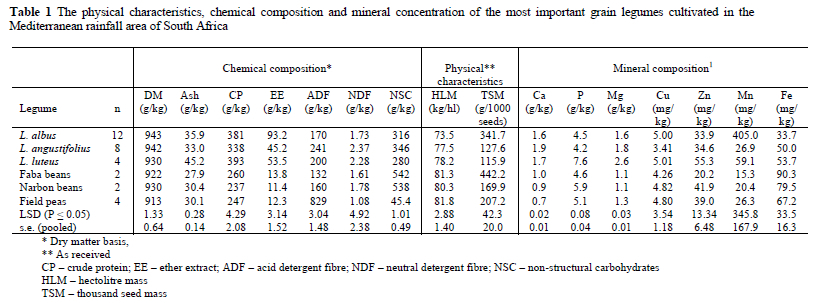
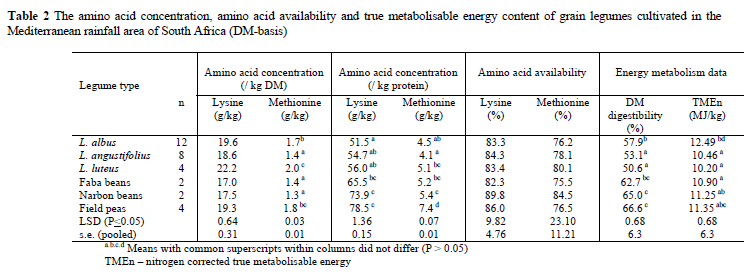
Samples of sweet yellow lupins (Lupinus luteus; n = 4), broad leaf lupins (Lupinus albus; n = 12), narrow leaf lupins (Lupinus angustifolius; n = 8), faba beans (Vicia faba; n = 2), field peas (Pisum sativum; n = 4) and narbon beans (Vicia narbonensis; n = 2) were collected over a two-year period. The physical characteristics (thousand seed and hectolitre mass), chemical composition (dry matter, ash, crude protein (CP), ether extract, acid detergent fibre, neutral detergent fibre and mineral content), energy values (nitrogen corrected true metabolisable energy content (TMEn for roosters)) as well as the lysine and methionine availability (with roosters) of the samples were determined. Lupinus albus had the highest TMEn (12.49 MJ/kg), followed by field peas (11.35 MJ/kg) and narbon beans (11.25 MJ/kg), faba beans (10.90 MJ/kg), L. angustifolius (10.46 MJ/kg) and L. luteus (10.20 MJ/kg). Lupinus luteus had the highest CP concentration (393.6 g/kg) followed by L. albus (381.9 g/kg), L. angustifolius (338.9 g/kg), faba beans (260.0 g/kg), field peas (247.4 g/kg) and narbon beans (237.6 g/kg) (values on a dry matter basis). Lupinus luteus had the highest lysine concentration (22.2 g/kg), followed by L. albus (19.6 g/kg), field peas (19.3 g/kg), L. angustifolius (18.6 g/kg), narbon beans (17.5 g/kg) and faba beans (17.0 g/kg).
Lupins; faba beans; field peas; narbon beans; energy content; amino acid availability; poultry