How does ewe age affect reproductive performance relative to rainfall conditions?
Abstract
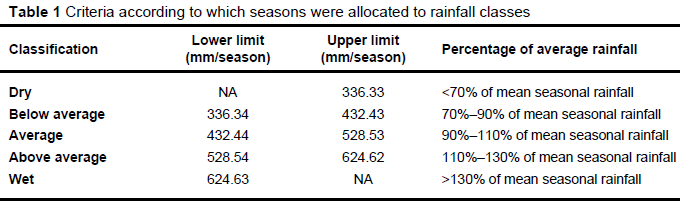
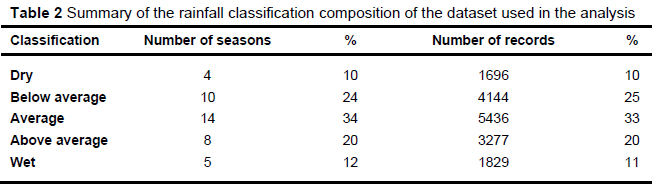
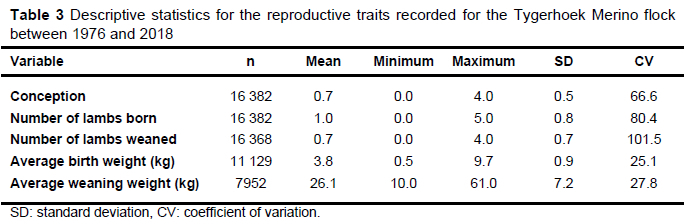
With climate change and its associated impacts on weather patterns being an inescapable reality, livestock producers will have to explore management and mitigation strategies to maintain production levels under adverse weather conditions. It is well-documented that ewe age affects reproductive performance, but it is unclear whether this phenomenon can be utilised to mitigate the effects of adverse environments. This study aimed to determine whether certain ewe age groups are better adapted to reproduce under specific rainfall conditions. Historical rainfall data collected on Tygerhoek Research Farm, South Africa, between 1975 and 2018 was used to group production seasons into five rainfall classes: dry, below average, average, above average, and wet. Ewe performance traits (conception rate, number of lambs born, number of lambs weaned, average birthweight, and average weaning weight) were calculated for each age group (2-6 years) across all seasons and within each rainfall class. Age group performance for each trait in each rainfall class was compared to the overall trend to see if any marked differences existed. Overall, reproduction rate was maximal at three to four years of age, and this trend was largely repeated for each rainfall class. Birthweight increased with age except in wet seasons, when no discernible trend was present, while weaning weight was highest in three- and four-year-old ewes. In dry seasons, however, there was a clear trend for weaning weight to increase as ewes aged. It was concluded that flock age structure cannot be used to mitigate environmental impacts if a flock is already structured to optimise reproduction.
age effects; climate change; environmental effects; Merino; reproduction