Short communication: Genetic predisposition to wet carcass syndrome in sheep - evidence from a SNP-based heritability analysis
Wet carcass syndrome (WCS) is a defect that occurs in sheep and is characterised by a wet, translucent appearance of the carcass, resulting in condemnation and industry losses. This defect is undetectable until the carcass has been chilled after slaughter, and genetic improvement has thus been proposed as a potential mitigation strategy. This study estimated the single nucleotide polymorphism-based heritability of WCS using a case-control population of South African Dorper, merino-type, and cross-bred sheep genotyped using the Illumina OvineSNP50 BeadChip. After quality control, 32 077 single nucleotide polymorphisms and 540 animals (164 cases, 376 controls) were retained. A genomic relationship matrix was constructed, and heritability was estimated using genomic-relatedness-based restricted maximum likelihood on the observed and liability scales. The liability-scale heritability was 0.30 ± 0.03, demonstrating a substantial additive genetic component underlying WCS susceptibility. These results provide foundational evidence that susceptibility to WCS has a genetic component and support future genome-wide association studies and genomic selection aimed at reducing the prevalence of this economically important condition.
GREML; meat quality; ovine genomics; SNP-based heritability estimate
Short communication: Genetic predisposition to wet carcass syndrome in sheep - evidence from a SNP-based heritability analysis
B. Bhika KooverjeeI, II,; P. SomaI; M.A. van der NestIII; M.D. MacNeilI; F.W.C. NeserII
IAgricultural Research Council Animal Production, Irene, South Africa
IIDepartment of Animal Sciences, University of the Free State, Bloemfontein, South Africa
IIIForestry and Agricultural Biotechnology Institute, University of Pretoria, South Africa
IVDelta G, 145 Ice Cave Road, MT 59301, Miles City, USA
Wet carcass syndrome (WCS) is a defect that occurs in sheep and is characterised by a wet, translucent appearance of the carcass, resulting in condemnation and industry losses. This defect is undetectable until the carcass has been chilled after slaughter, and genetic improvement has thus been proposed as a potential mitigation strategy. This study estimated the single nucleotide polymorphism-based heritability of WCS using a case-control population of South African Dorper, merino-type, and cross-bred sheep genotyped using the Illumina OvineSNP50 BeadChip. After quality control, 32 077 single nucleotide polymorphisms and 540 animals (164 cases, 376 controls) were retained. A genomic relationship matrix was constructed, and heritability was estimated using genomic-relatedness-based restricted maximum likelihood on the observed and liability scales. The liability-scale heritability was 0.30 ± 0.03, demonstrating a substantial additive genetic component underlying WCS susceptibility. These results provide foundational evidence that susceptibility to WCS has a genetic component and support future genome-wide association studies and genomic selection aimed at reducing the prevalence of this economically important condition.
Keywords: GREML, meat quality, ovine genomics, SNP-based heritability estimate
Wet carcass syndrome (WCS) was first reported in South African Dorper and Dorper cross-bred sheep in 1981 (Brock et al., 1983). It only presents after slaughter, and is characterised by fluid accumulation that produces a carcass with a wet, translucent, and unaesthetic appearance (Van der Westhuizen et al., 2019). Animals are therefore classified post-mortem as either affected or unaffected by WCS. Affected carcasses are considered unsuitable for human consumption (primarily to protect public health from zoonotic diseases, chemical residues, and food pathogens), with the meat consequently diverted to processed or pet-food markets, resulting in financial losses across the value chain (Hatting, 2023). Affected animals appear clinically normal before slaughter, making early diagnosis and management interventions infeasible. Recent reports indicate an increase in WCS cases over the past five years (National Animal Health Disease Information System, 2024), highlighting its growing significance. Although initially thought to be specific to the Dorper breed, WCS has now been observed in several South African breeds, such as merino-types, Meatmasters, and cross-bred sheep (Kooverjee et al., 2025).
Van der Westhuizen et al. (2019) were the first to investigate the possibility of a genetic mechanism causing WCS. This relatively small study discovered two genetic markers associated with the condition, implying that genetics may contribute to the occurrence of WCS in South African sheep. The degree to which WCS is heritable is unknown. Heritability - the proportion of trait variation attributable to additive genetic effects - is central to the efficacy of selection (Yang et al., 2017). For breeders, an estimate of heritability allows the prediction of the response to selection for desirable traits, including disease resistance. The advent of genomic technologies enables the estimation of heritability based on the analysis of single nucleotide polymorphism (SNP) genotypes using genomic relationship matrices. Methods such as genomic-relatedness-based restricted maximum likelihood (GREML), implemented in genome-wide complex trait analysis (GCTA), are now used for complex traits, including disease susceptibility (Yang et al., 2011). Unlike pedigree-based approaches, SNP-based heritability does not rely on recorded kinships to form a relationship matrix, but instead uses relationships predicted from shared alleles.
Heritability estimates for several economically important disease and fitness traits have shown the value of genetic improvement. For example, reports have indicated that resistance to gastrointestinal nematodes (commonly assessed using faecal egg counts, h2 = 0.2-0.4) and foot rot (h2 = 0.2-0.3) have low to moderate levels of heritability, indicating meaningful additive genetic variation and potential response to selection (Bishop & Morris, 2007; Nieuwhof et al., 2008). More recently, genome-wide SNP studies have further supported the genetic basis of parasite resistance and flystrike susceptibility, enabling genomic selection approaches in sheep breeding programmes (Forbes et al., 2014; Pickering et al., 2015). Bovine congestive heart failure, like WCS, is only observed after slaughter and has an estimated heritability of approximately 0.36 (Buchanan et al., 2023). These examples support the broader principle that disease incidence may be reduced through selection when additive genetic variance exists, particularly when genomic information is combined with phenotypes recorded from relatives or at slaughter.
Wet carcass syndrome was analysed as a binary trait because carcasses are classified at inspection as either affected or unaffected, resulting a dichotomous phenotype suitable for case-control analysis. For such traits, observed-scale heritability is affected by ascertainment bias when cases are oversampled (Srivastava et al., 2023). Case-control datasets are typically enriched for affected individuals, resulting in the observed phenotypic variance being skewed. This bias can be corrected using GREML, which assumes an underlying normally distributed liability for the disease (Yang et al., 2017). This allows the transformation of heritability estimates from the observed scale to the liability scale, yielding biologically meaningful values that reflect population-level risk (Lee et al., 2011).
Despite the economic implications of WCS, its underlying genetic architecture remains poorly understood. In particular, it is unclear whether susceptibility to WCS is influenced by additive genetic effects that could be exploited through selection. Therefore, the aim of this study was to quantify the SNP-based heritability of WCS in South African sheep using genome-wide SNP data, in order to determine the extent to which additive genetic variation contributes to the condition. It was hypothesised that WCS susceptibility is influenced by additive genetic effects captured by SNP markers, resulting in the SNP-based heritability being significantly greater than zero. Establishing the magnitude of heritability for WCS is an essential first step towards evaluating selection as a mitigation strategy. This short communication reports the first estimate of SNP-based heritability for WCS in sheep.
A case-control design combined with SNP-based GREML was chosen to enable the robust estimation of the additive genetic variance for this relatively rare condition that manifests post slaughter, while accounting for ascertainment bias and leveraging realised genomic relationships. For this purpose, the genotype data of a population that included both sheep that exhibited WCS and sheep that were unaffected were used to estimate the heritability on both the observed and liability scales using the GREML method. The results provide the foundational evidence needed to assess the potential for genetic solutions to this costly industry problem.
Ethical approval was granted by the Agricultural Research Council Animal Production Ethics Committee (APIEC 23/07). This study included the genotypic data of 164 sheep confirmed with WCS post-slaughter, 82 contemporaneous unaffected controls (as classified during carcass inspection), and 294 additional genotyped reference animals from external pure-bred populations with no recorded evidence of WCS. The confirmed WCS sheep and their contemporaries originated from multiple South African regions (Northern Cape, Free State, Mpumalanga, Eastern Cape, and Gauteng) and represented several breeds. These included Dorper (n = 150), Meatmaster (n = 1), Van Rooyen (n = 2), White Dorper (n = 2), South African Mutton Merino (n = 2), and Merino sheep (n = 41). Cross-breeds such as Dorper × Meatmaster and additional cross-bred animals (n = 47) whose breed composition was unknown were also included. All animals were under 12 months of age and were classified as A-grade lambs.
Data for an additional 294 animals with SNP genotypes were obtained from the Grootfontein Agricultural Development Institute and Dzomba et al. (2021). These data were from presumably unafflicted animals and included Afrino (n = 51), Black Head Persian (n = 14), Dohne Merino (n = 50), Dorper (n = 12), Meatmaster (n = 48), Merino (n = 91), Namakwa-Afrikaner (n = 10), South African Merino (n = 8), and South African Mutton Merino (n = 10) sheep. The Ovis aries Oar_v4.0 (GCF_000298735.2) genomic sequence was selected as the reference genome for all analyses. The sample size (>500 animals) is comparable to previous SNP-based heritability studies (Arzik et al., 2022) and is sufficient to detect moderate additive genetic variance using GREML, although larger datasets would improve precision. Using the genomic relationship matrix accounted for population structure potentially arising from multiple breeds and regions, with approximately normal distribution of relatedness values indicating minimal stratification bias.
All animals were genotyped using the Illumina OvineSNP50 BeadChip, as described by Kooverjee et al. (2025). Quality control was performed in PLINK v1.9 (Purcell et al., 2007) and GCTA v1.93 (Yang et al., 2011). Single nucleotide polymorphisms (SNPs) that exhibited a minor allele frequency <0.01, a genotype call rate <95%, or significant deviation from Hardy-Weinberg equilibrium (P <1 × 10⁻⁶) were excluded. Individuals were removed if their genotype call rate was below 90%. After quality control, 32 077 SNPs and 540 animals remained for subsequent analyses. To reduce redundancy due to linkage disequilibrium, linkage disequilibrium-pruning was applied using a sliding window approach (50 kb window, 10-SNP step, r2 = 0.2 threshold).
A genomic relationship matrix (GRM) was constructed using autosomal SNPs following the approach of Yang et al. (2011):
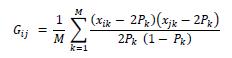
where: Gj represents the genetic relationship between individuals i and j, Xik is the genotype of individual i at SNP k (coded as 0, 1, or 2), Pk is the allele frequency of SNP k, and M is the number of SNPs.
The SNP-based estimate of heritability was calculated using the GREML approach, implemented in GCTA via a linear mixed model including batch effects as fixed effects (Yang et al., 2011). The linear mixed model assumes that the phenotype (disease status) is influenced by an additive genetic component and residual variance, as in Henderson (1984):

where: y is the phenotype vector (0 = control, 1 = case), Χβ represents the fixed effects (genotyping batch), g is the random genetic effect distributed as N (0,  ), and e is the residual term distributed as N (0,
 ).
The significance of the estimated genetic variance component  was assessed using a likelihood ratio test (LRT), comparing the full model to a null model without the genetic effect. Statistical significance was set at α = 0.05.
For quantitative traits, the scale of measurement is the same as the scale on which heritability is expressed. For disease traits, however, the phenotypes (afflicted and unafflicted cases) were measured on the 0 to 1 scale and heritability is most readily interpreted on a scale of liability (Lee et al., 2011). Liability models facilitate an understanding and comparison of the relative importance of genetic and environmental risk factors that shape different clinically important outcomes, through the estimation of the liability-scale heritability (Ojavee et al., 2022). The liability model is a statistical convention, not a proven biological mechanism for WCS.
Since the trait has a binary distribution, heritability was first estimated on the observed scale (h2Obs) and then transformed to the liability scale (h2L) to account for the ascertainment bias resulting from the oversampling of afflicted cases that is inherent in case-control studies. This transformation assumes an underlying normally distributed liability for disease, with a threshold corresponding to the population disease prevalence (Lee et al., 2011):
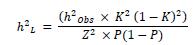
where: K is the population prevalence (K = 0.05), P is the sample prevalence (P = 154/540 = 0.3048), and z is the standard normal density at the liability threshold.
The value of K was calculated from data presented in reports of the National Animal Health Disease Information System for ten years from 2015 to 2024. The number of cases is likely to have been underreported, and the size of the relevant population is unknown. Thus, the value of h2L that is reported herein is probably an underestimate of its true value.
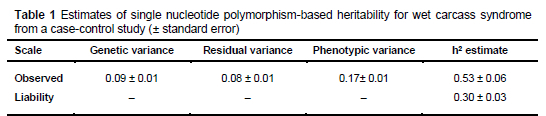
The GRM displayed an approximately normal distribution of pairwise relatedness values, indicating minimal close relatedness and a suitable population structure for GREML application. Heritability estimated on the observed scale was 0.53 ± 0.06 (Table 1), indicating that a substantial proportion of variation in WCS status within the case-control sample is explained by additive genetic effects captured by SNP markers. After transforming to the liability scale, the estimate of heritability was reduced to 0.30 ± 0.03, indicating that nearly 30% of the variation in WCS susceptibility is attributable to additive genetic effects captured by common SNPs. This moderate heritability suggests that genetic factors contribute meaningfully to WCS risk, although environmental influences and other non-additive effects also play a substantial role. Thus, additive genetic factors may have a role in determining whether or not an individual sheep develops WCS.
The LRT provided strong evidence for a significant genetic component (LRT statistic = 141.859, P <1 × 10⁻¹⁰). These findings indicate that variation in WCS occurrence is not solely explained by random processes, but that additive genetic factors contribute to susceptibility and can be detected using genomic markers. Transformation to the liability scale adjusts for the over-representation of cases in the case-control sample, providing an estimate of underlying risk that is more comparable to the broader population (Ojavee et al., 2022). However, this framework assumes a common latent susceptibility across animals, whereas the true risk for WCS may also differ according to breed composition, management system, physiological status, and environmental conditions. Consequently, the heritability estimate should be interpreted as an average population-level parameter rather than a uniform risk across all sheep.
This study provides the first estimate of heritability for WCS in sheep and demonstrates that the condition has a significant additive genetic component. The liability-scale heritability estimate of 0.30 places WCS among other moderately heritable disease traits in sheep, such as faecal egg count and foot rot resistance (Nieuwhof et al., 2008; Pickering et al., 2015; Forbes et al., 2024). These levels of heritability are considered sufficient to support genomic selection strategies. Given that WCS manifests post-slaughter and is likely influenced by pre-slaughter stress (Birhanu, 2020), metabolic status, and carcass handling conditions, the moderate heritability observed here is consistent with a complex trait influenced by both biological and environmental processes.
Although the liability-scale heritability estimated here is moderate, it is important to highlight that genomic tools can remain highly effective even when the true underlying heritability is low. Several livestock studies show that genomic prediction can enhance selection accuracy for traits with heritability values as low as 0.03 to 0.10, for mastitis resistance in dairy cattle (Gaddis et al., 2020), or 0.07 to 0.29, for resistance to bovine respiratory disease (Snowder et al., 2005). This is because genomic data capture realises genetic relationships among individuals, enabling the more accurate use of information from relatives compared to pedigree-based approaches (Clark et al., 2012). This then becomes important for traits that cannot be measured directly on breeding candidates, including those measured post-mortem and disease-status traits. For example, the genomic information from siblings and progeny increased the prediction accuracy for carcass traits in beef cattle (Fernandes Júnior et al., 2016), parasite resistance in sheep (Forbes et al., 2024), and porcine reproductive and respiratory syndrome resistance in pigs (Rowland et al., 2012). Across species, studies consistently demonstrate that even low heritability estimates do not hinder meaningful genetic progress when high density SNP data is available, along with phenotypes that can be linked through relatives. Interpretation of the present results should take into account the fact that the true population prevalence of WCS is uncertain and likely lower than in this case-control sample, influencing the liability-scale estimates. The multi-breed dataset may also introduce population structure, although mitigated through the use of a GRM, while residual stratification and environmental variation may still affect the estimated variance components.
Given the inability to diagnose WCS before slaughter, the identification of a substantial genetic contribution represents an important step forward. The results confirm that selection for reduced susceptibility is biologically feasible, and justify future research focused on identifying genomic regions associated with WCS susceptibility. Future studies should further evaluate breed-specific susceptibility and genotype-by-environment interactions contributing to WCS expression. Such work may include genome-wide association studies and the development of a genomically derived estimated breeding value to assist breeders in reducing the incidence of WCS.
Author contributions
M.M. first hypothesised a genetic basis for wet carcass syndrome. B.B.K. and P.S. contributed to the acquisition of data. B.B.K. and M.v.d.N. analysed the data. B.B.K., P.S., and M.v.d.N. conceptualised the manuscript. B.B.K. drafted and wrote the initial version of the manuscript. P.S., M.v.d.N., F.N., and M.M. reviewed and revised the manuscript. All authors have read and approved the finalised manuscript.
Conflict of interest declaration
The authors have no conflict of interests to declare.
Data availability statement
The datasets presented in this article are not readily available because they are the property of South Africa sheep producers, and the information in these datasets is commercially sensitive. Requests to access the datasets should be directed to the corresponding author.
Acknowledgements
The authors would like to thank the Technology Innovation Agency (API012403000010) and Red Meat Research and Development South Africa (API012403000003\) for funding this work. We would like to acknowledge the Cavalier and KLK abattoirs for making the samples available for this study. The authors are grateful to the Grootfontein Agricultural Development Institute and Dzomba et al. (2021) for sharing the sheep reference SNP data.
References
-
Arzik, Y., Kizilaslan, M., White, S.N., Piel, L.M., & Cinar, M.U., 2022. Estimates of genomic heritability and genome-wide association studies for blood parameters in Akkaraman sheep. Scientific Reports, 12(1):18477. DOI: https://doi.org/10.1038/s41598-022-22966-8
» https://doi.org/10.1038/s41598-022-22966-8 -
Birhanu, A.F., 2020. Pre-slaughter stress, management of stress and its effect on meat and carcass quality. International Journal of the Science of Food and Agriculture, 4(1):30-37. DOI: https://doi.org/10.26855/ijfsa.2020.03.006
» https://doi.org/10.26855/ijfsa.2020.03.006 -
Bishop, S.C. & Morris, C.A., 2007. Genetics of disease resistance in sheep and goats. Small Ruminant Research, 70(1):48-59. DOI: https://doi.org/10.1016/j.smallrumres.2007.01.006
» https://doi.org/10.1016/j.smallrumres.2007.01.006 - Brock, R.M., Joubert, J.P.J., Hattingh, A., Mitchell, G., Newsholme, S.J., Van Der Veen, R.R., Hofmeyr, H.S., Engels, E.A.N., Groenewald, H.B., & Hunter, P., 1983. Ovine wet carcass syndrome unknown aetiology. South Africa Journal of Animal Science, 13:194-195.
-
Buchanan, J.W., Flagel, L.E, MacNeil, M.D., Nilles, A.R., Hoff, J.L., Pickrell, J.K., & Raymond, R.C., 2023. Variance component estimates, phenotypic characterization, and genetic evaluation of bovine congestive heart failure in commercial feeder cattle. Frontiers in Genetics, 14:1148301. DOI: https://doi.org/10.3389/fgene.2023.1148301
» https://doi.org/10.3389/fgene.2023.1148301 -
Clark, S.A., Hickey, J.M., Daetwyler, H.D., & van der Werf, J.H., 2012. The importance of information on relatives for the prediction of genomic breeding values and the implications for the makeup of reference data sets in livestock breeding schemes. Genetics Selection Evolution, 44(1):4. DOI: https://doi.org/10.1186/1297-9686-44-4
» https://doi.org/10.1186/1297-9686-44-4 -
Dzomba, E.F., Chimonyo, M., Pierneef, R., & Muchadeyi, F.C., 2021. Runs of homozygosity analysis of South African sheep breeds from various production systems investigated using OvineSNP50k data. BMC Genomics, 22(1):1-14. DOI: https://doi.org/10.1186/s12864-020-07314-2
» https://doi.org/10.1186/s12864-020-07314-2 -
Fernandes Júnior, G.A., Rosa, G.J., Valente, B.D., Carvalheiro, R., Baldi, F., Garcia, D.A., Gordo, D.G., Espigolan, R., Takada, L., Tonussi, R.L., & De Andrade, W.B., 2016. Genomic prediction of breeding values for carcass traits in Nellore cattle. Genetics Selection Evolution, 48(1):7. DOI: https://doi.org/10.1186/s12711-016-0188-Y
» https://doi.org/10.1186/s12711-016-0188-Y -
Forbes, R.M., Murphy, T.W., Burke, J.M., Notter, D.R., Spangler, M.L., MacNeil, M.D., & Lewis, R.M., 2024. Adding gastrointestinal parasite resistance to the breeding objective in hair sheep: initial steps. Journal of Animal Science, 102:skae327. DOI: https://doi.org/10.1093/jas/skae327
» https://doi.org/10.1093/jas/skae327 -
Gaddis, K.P., VanRaden, P.M., Cole, J.B., Norman, H.D., Nicolazzi, E., & Dürr, J.W., 2020. Symposium review: Development, implementation, and perspectives of health evaluations in the United States. Journal of Dairy Science, 103(6):5354-5365. DOI: https://doi.org/10.3168/jds.2019-17687
» https://doi.org/10.3168/jds.2019-17687 - Hatting, M., 2023. Evaluation of rejected wet carcass syndrome lamb meat for human or animal consumption. MSc thesis, University of the Free State, Bloemfontein, South Africa.
- Henderson, C.R., 1984. Applications of Linear Models in Animal Breeding (volume 462). Guelph, University of Guelph, Canada.
-
Kooverjee, B.B., Van Der Nest, M.A., MacNeil, M.D., Scholtz, M.M., Neser, F., & Soma, P., 2025. Estimation of breed composition of South African sheep affected with wet carcass syndrome. Frontiers in Genetics, 16:1635947. DOI: https://doi.org/10.3389/fgene.2025.1635947
» https://doi.org/10.3389/fgene.2025.1635947 -
Lee, S.H., Wray, N.R., Goddard, M.E., & Visscher, P.M., 2011. Estimating missing heritability for disease from genome-wide association studies. American Journal of Human Genetics, 88(3):294-305. DOI: https://doi.org/10.1016/j.ajhg.2011.02.002
» https://doi.org/10.1016/j.ajhg.2011.02.002 -
National Animal Health Disease Information System (NAHDIS), 2024. Abattoir Reports 2015-2024: Schedule 8 Summary Report. Available: https://ruvasa.co.za/abattoir-reports-2024/ [19 August 2025].
» https://ruvasa.co.za/abattoir-reports-2024/ -
Nieuwhof, G.J., Conington, J., Bünger, L., Haresign, W., & Bishop, S.C., 2008. Genetic and phenotypic aspects of foot lesion scores in sheep of different breeds and ages. Animal, 2(9):1289-1296. DOI: https://doi.org/10.1017/S1751731108002577
» https://doi.org/10.1017/S1751731108002577 -
Ojavee, S.E., Kutalik, Z., & Robinson, M.R., 2022. Liability-scale heritability estimation for biobank studies of low-prevalence disease. The American Journal of Human Genetics, 109(11):2009-2017. DOI: https://doi.org/10.1016/j.ajhg.2022.09.011
» https://doi.org/10.1016/j.ajhg.2022.09.011 -
Pickering, N.K., Auvray, B., Dodds, K.G., & McEwan, J.C., 2015. Genomic prediction and genome-wide association study for dagginess and host internal parasite resistance in New Zealand sheep. BMC Genomics, 16(1):958. DOI: https://doi.org/10.1186/s12864-015-2148-2
» https://doi.org/10.1186/s12864-015-2148-2 -
Purcell, S., Neale, B., Todd-Brown, K., Thomas, L., Ferreira, M.A., Bender, D., Maller, J., Sklar, P., De Bakker, P.I., Daly, M.J., & Sham, P.C., 2007. PLINK: a tool set for whole-genome association and population-based linkage analyses. The American Journal of Human Genetics, 81(3):559-575. DOI: https://doi.org/10.1086/519795
» https://doi.org/10.1086/519795 -
Rowland, R.R., Lunney, J., & Dekkers, J., 2012. Control of porcine reproductive and respiratory syndrome (PRRS) through genetic improvements in disease resistance and tolerance. Frontiers in Genetics, 3:260. DOI: https://doi.org/10.3389/fgene.2012.00260
» https://doi.org/10.3389/fgene.2012.00260 -
Snowder, G.D., Van Vleck, L.D., Cundiff, L.V., & Bennett, G.L., 2005. Influence of breed, heterozygosity, and disease incidence on estimates of variance components of respiratory disease in preweaned beef calves. Journal of Animal Science, 83(6):1247-1261. DOI: https://doi.org/10.2527/2005.8361247x
» https://doi.org/10.2527/2005.8361247x -
Srivastava, A.K., Williams, S.M., & Zhang, G., 2023. Heritability estimation approaches utilizing genome-wide data. Current Protocols, 3(4):e734. DOI: https://doi.org/10.1002/cpz1.734
» https://doi.org/10.1002/cpz1.734 -
Van der Westhuizen, L., Neser, F.W.C., MacNeil, M.D., & Scholtz, M.M., 2019. Identification of genomic regions that contribute to wet carcass syndrome in sheep. South African Journal of Animal Science, 49(5):845-856. DOI: https://doi.org/10.4314/sajas.v49i5.7
» https://doi.org/10.4314/sajas.v49i5.7 -
Yang, J., Benyamin, B., McEvoy, B.P., Gordon, S., Henders, A.K., Nyholt, D.R., Madden, P.A., Heath, A.C., Martin, N.G., Montgomery, G.W. & Goddard, M.E., 2010. Common SNPs explain a large proportion of the heritability for human height. Nature Genetics, 42(7), 565-569. DOI: 10.1038/ng.608
» https://doi.org/10.1038/ng.608 -
Yang, J., Lee, S.H., Goddard, M.E. & Visscher, P.M., 2011. GCTA: a tool for genome-wide complex trait analysis. American Journal of Human Genetics, 88(1), 76-82. DOI: 10.1016/j.ajhg.2010.11.011
» https://doi.org/10.1016/j.ajhg.2010.11.011 -
Yang, J., Zeng, J., Goddard, M. E., Wray, N. R., & Visscher, P. M., 2017. Concepts, estimation and interpretation of SNP-based heritability. Nature Genetics. 49(9), 1304-1311. DOI: 10.1038/ng.3941
» https://doi.org/10.1038/ng.3941
Accepted 03 June 2026
Published 04 August 2026