Could vitamin supplementation unlock the hidden potential of the indigenous Gerze chicken?
Abstract
In this study, the broiler performance of Turkish Gerze chickens was investigated. One hundred and thirty day-old chicks were reared under intensive conditions until 20 weeks of age to examine whether administering a vitamin supplement via their drinking water would affect broiler performance. During this period, one group received the vitamin supplement, starting at four weeks of age, and the other (the control group) did not. At 20 weeks old, the chickens given the vitamin supplement had an average live weight of 1686 g and a feed conversion ratio of 4.47, while the control group was significantly lighter, at 1408 g, with a feed conversion ratio of 4.63. Dressing percentages were not significantly affected by vitamin supplementation, and averaged around 68%. The proportion of edible giblets also did not significantly differ between the two groups, contributing approximately 5%-6% of the carcass. The largest carcass component in both treatment groups was the legs, constituting 32%-33% of the carcass in males and 28% in females. Breast meat made up 22%-27% of the carcass, and this was not significantly influenced by vitamin supplementation. The pH and colour of the breast and leg meat were evaluated as meat quality traits, and these quality parameters were within acceptable limits for poultry meat for all groups.
alternative poultry production; broiler chickens; carcass composition; local chickens; meat quality
Introduction
The global demand for poultry products has surged in recent decades, intensifying scrutiny of conventional poultry production systems due to concerns over animal welfare and environmental sustainability. In response, semi-intensive or 'alternative' poultry production models have emerged since the 1970s (Aksoy et al., 2022), gaining popularity among consumers seeking healthier, more ethically produced poultry products. Indigenous chicken breeds, renowned for their adaptability to local conditions, are increasingly valued as genetic resources for these alternative systems, offering potential advantages in terms of resilience, flavour, and consumer preference.
The overreliance on a limited number of commercial chicken hybrids in intensive production systems over the past four decades has underscored the critical importance of preserving the genetic diversity of native breeds. The Food and Agriculture Organization of the United Nations has prioritised this conservation effort. The Gerze chicken, an indigenous Turkish breed, was officially recognised in 2004 and has been protected since 1995. Characterised by a V-shaped comb, black feathers, and white skin, the Gerze chicken is a dual-purpose breed that produces white eggs and exhibits moderate growth rates (Şekeroğlu & Özen, 1997; Özdoğan & Gürcan, 2006). Kaya & Yildiz (2014) noted similarities between the Gerze chicken and the French La Flèche breed, suggesting its potential as a meat bird.
While previous research on the Gerze chicken has largely focused on reproductive traits such as egg production and egg quality, and genetic diversity (Mercan & Okumus, 2015; Onbaşılar et al., 2019; Arslan et al., 2023), studies addressing the effects of selection for live weight on egg production (Ilkılınç et al., 2024) and the impact of different light-emitting diode light colours on egg incubation (Cilavdaroglu et al., 2024) have contributed significantly to our understanding of this breed. However, there remains a conspicuous lack of research on other economically relevant traits, including the growth performance and carcass characteristics of the Gerze chicken.
This study aimed to investigate the growth, slaughter, and carcass traits of Gerze chickens, with a specific focus on the potential benefits of vitamin supplementation in their drinking water to enhance growth performance. Based on the hypothesis that vitamin supplementation can optimise the growth of Gerze chickens, this study sought to determine the optimal dosage and timing of vitamin administration to maximise growth rates and improve feed efficiency. Given that nutrient requirements may vary among chicken breeds, this research provides valuable insights into the nutritional needs of Gerze chickens and the potential advantages of targeted vitamin supplementation.
Material and methods
This study was approved by the Ondokuz Mayıs University Animal Experiments Local Ethics Committee (approval no: 2020/63).
The study was conducted at the Ondokuz Mayıs University Agricultural Faculty Research Farm. One hundred and thirty day-old Gerze chicks hatched from eggs collected from a breeder flock at the research farm were used. The chicks were randomly allocated into four pens, with each pen housing 32 or 33 chicks. Each pen measured 3.5 χ 3.5 m and contained one round feeder and nipple drinkers. Wood shavings were used as litter. Heating was provided by infrared heaters, and lighting was supplied by standard white bulbs. A 24-hour light regimen was applied for the first three days, after which it was gradually reduced to 20 hours per day by day 14, and then maintained at 14 hours per day until slaughter. The chicks were fed commercial feed ad libitum throughout the trial period, starting with a meat-type chick feed (20% crude protein, 3100 kcal/kg) until eight weeks of age, followed by a broiler feed (19% crude protein, 3100 kcal/kg) until slaughter. The chicks were vaccinated against Newcastle disease (avian paramyxovirus), Gumboro disease (infectious bursal disease), and infectious bronchitis.
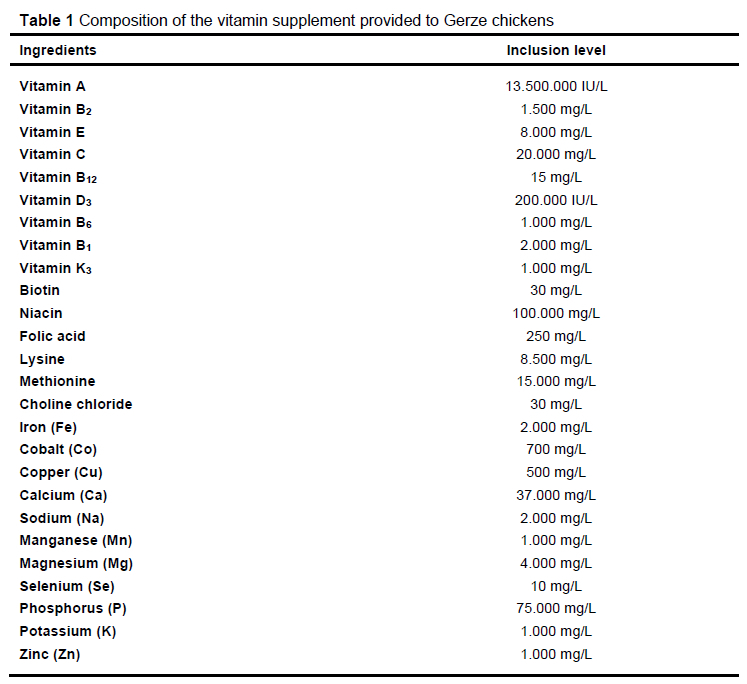
The vitamin supplement was added to the drinking water of two of the four groups from four weeks of age until one week before slaughter at 20 weeks of age. As per the product's instructions, 0.33 mL of the vitamin supplement was added per litre of water. The composition of the vitamin supplement is provided in Table 1.
Data on live weight, feed consumption, feed conversion ratios (FCRs), and mortality rates were collected and evaluated per replication. Live weights were determined by individually weighing all birds at two-week intervals. Carcass traits were evaluated by randomly selecting and slaughtering ten chickens (five males and five females) per replicate at 20 weeks of age. The birds were fasted for eight hours prior to slaughter. They were slaughtered in a semi-automated slaughterhouse, and subsequent processes included scalding (one minute at 56 °C), plucking, cold-water chilling, vent opening, evisceration, and air chilling. The hearts, livers, and cleaned gizzards were weighed, and their ratios to the cold carcass weights were recorded. Carcasses were portioned according to standard methods.
Meat pH was measured at three points on the left thigh and left breast after 12 hours at +4 °C using a PC 510 Cyberscan meter (Singapore). Meat colour (L*, a*, and b*) was evaluated at two points on the left thigh and left breast using a Konica Minolta CR-400 colorimeter. Mean values were calculated and recorded for both colour and pH.
To assess the impact of the vitamin supplement on the performance of male and female Gerze chickens, the data were analysed using SPSS version 20. Group means were compared using Duncan's multiple range test, a post hoc procedure commonly employed to identify significant differences among multiple groups. Feed conversion ratios were evaluated using the chi-square harmonic test, a non-parametric method suitable for analysing categorical data. A significance level of P <0.05 was adopted as the threshold for statistical significance.
Results and discussion
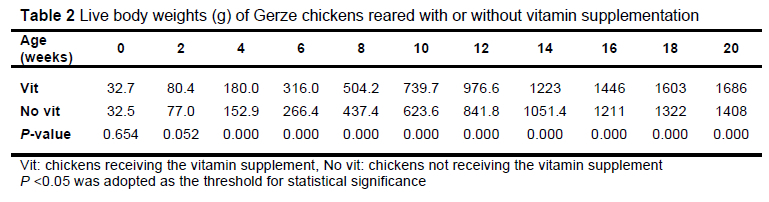
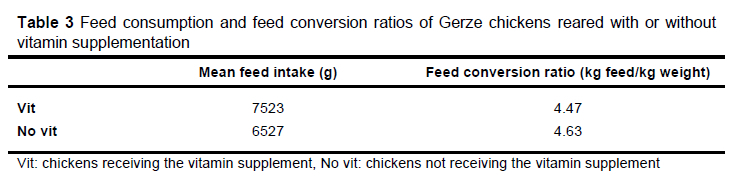
Significant differences in growth rates were observed between the chickens receiving the vitamin supplement from four weeks of age (Vit) and those not receiving the vitamin supplement (No vit), with the supplemented chickens attaining higher body weights (Table 2). Mean cumulative feed intakes and calculated FCRs by group are presented in Table 3, with the vitamin-supplemented group having a significantly better FCR value (Vit: 4.47, No vit: 4.63).
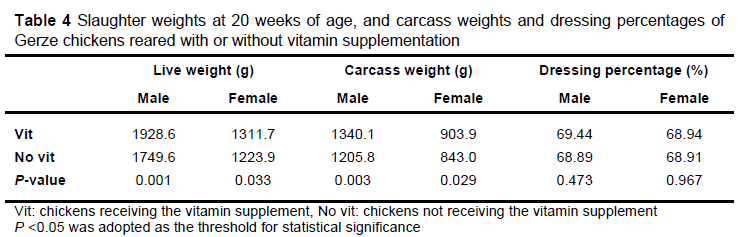
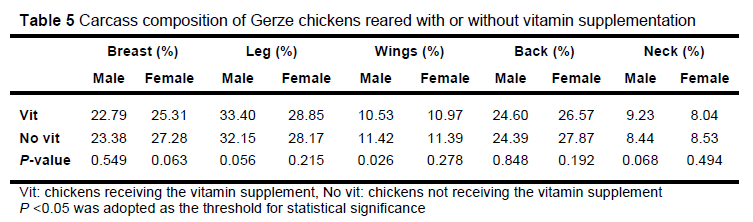
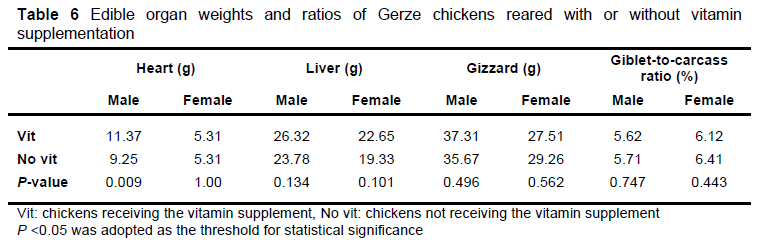
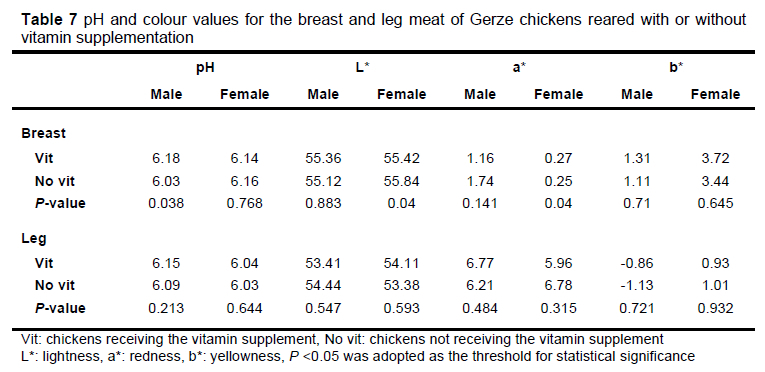
The birds were slaughtered at 20 weeks of age. Slaughter weights, carcass weights, and dressing percentages are shown in Table 4. Live and carcass weights were significantly higher in both the male and female birds receiving the vitamin supplement. However, differences in dressing percentages were not significant, with similar values observed across the groups. Carcass component percentages are presented in Table 5. No significant differences were found between the groups for any of the carcass components, and the legs constituted the largest portion of the carcass. Table 6 shows the weights of the hearts, livers, and gizzards, as well as the giblet-to-carcass ratios. Breast and leg meat pH and colour values are provided in Table 7.
In modern poultry production, the primary goal is to achieve the highest possible weight at the youngest age. Over time, research has led to the development of birds with substantially increased body weights, capable of reaching 2.0-2.5 kg by around 40 days of age. These are known as fast-growing chickens, and they currently dominate world broiler production. In contrast, when the time required to reach slaughter weight is longer, birds are classified as medium- or slow-growing. Local breeds typically take longer to reach slaughter weight, and, based on their slaughter age, local Gerze chickens can be considered slow-growing. Tang et al. (2009) reported that Chinese native chickens reach a live weight of approximately 1400 g in 112 days. Similarly, in this study, Gerze chickens exhibited a slower growth rate, attaining only 1200-1400 g at 16 weeks of age. Previous research has shown that adult Gerze chickens weigh around 1706 g (females) and 2317 g (males) at 52 weeks of age (Şekeroğlu & Özen, 1997).
In this study, the slaughter age was extended to 20 weeks to increase the carcass yield. Typically, local birds are not slaughtered before reaching sexual maturity (Rizzi, 2019), and at this stage, meat quality becomes more important than merely achieving higher body weights. Vitamin supplementation positively influenced body weight, resulting in significantly heavier chickens than in the control group (Vit: 1686 g vs. No vit: 1408 g at 20 weeks). Similar results have been reported in other studies. For instance, Phoprasit et al. (2014) demonstrated that broilers receiving a vitamin supplement reached 1729 g at 42 days, whereas the control group only reached 1601 g. Vitamins are essential organic compounds required in small quantities that support normal bodily functions and help mitigate the adverse effects of stress. Thus, the improved body weights observed in the vitamin-supplemented group may be attributed to enhanced metabolic activities.
The significant effects of vitamin supplementation on live weights were also evident in the slaughtered birds. In addition, males had higher live and carcass weights than females. Indigenous chicken breeds exhibit a wide range of live weights. For example, Padovana chickens in Italy reached 1600 g in 150 days (Cassandro et al., 2002), while Nigerian local breeds such as Fulani and Shika Brown reached approximately 1600 g in 140 days (Bamidele et al., 2020). Studies indicate that 1600 g is a critical threshold for indigenous slow-growing chickens (Cassandro et al., 2002; Yamak et al., 2014; Bamidele et al., 2020), and reaching this weight by 140-150 days old is key to obtaining a carcass over 1000 g.
Despite the observed differences in live weight, dressing percentages were similar between the groups. These findings align with those of Yamak et al. (2014), who reported that dressing percentages may decrease as growth rate increases. While genetic selection in broilers has improved both the body weight and dressing percentage, the dressing percentage values obtained in this study (60%-80%) remain within acceptable limits for poultry (Guenter et al., 1995).
Although body weight is a major parameter in chicken meat production, the proportions of specific carcass components also significantly influence profitability. Breast meat holds the highest economic value, and in selected hybrid broilers, the breast-to-carcass ratio can reach 27%-35% (Yamak et al., 2014; Chodova et al., 2021). In contrast, in native and slow-growing chickens, this ratio typically falls below 25% (Yamak et al., 2014; Rizzi, 2019). Breast yields vary among genetic groups, as breast meat development depends on muscle fibre number and size (Case et al., 2010). Although the vitamin supplement did not significantly alter the breast-to-carcass ratio in Gerze chickens, the observed ratios in both groups exceeded those commonly reported for slow-growing birds. Since dietary protein strongly affects breast meat yield, it is likely that the vitamin supplement alone did not influence this parameter.
Legs are also a preferred part of the chicken carcass, and in modern broilers, leg-to-carcass ratios are generally around 27%-30%. As the breast ratio increases, the leg ratio tends to decrease. Consequently, in non-selected local birds or slow-growing chickens raised in free-range systems, leg ratios may be higher. Sarica et al. (2014) reported that thigh and drumstick ratios increased with slower growth rates. In this study, vitamin supplementation did not affect the leg-to-carcass ratio, which is consistent with the findings of Phoprasit et al. (2014). Wings typically account for 10%-11 % of the carcass weight (Yamak et al., 2014), which aligns with the results of this study. The back and neck, being less preferred components, were also unaffected by vitamin supplementation.
The edible giblets (heart, liver, and gizzard) make up approximately 5% of the carcass. Giblet ratios were not significantly influenced by vitamin supplementation. Breed is the primary determinant of giblet weight (Musa et al., 2006), while growth rate can also affect giblet weight (Murawska et al., 2011). Sarica et al. (2014) found that edible giblet ratios varied from 4.40% in fast-growing broilers to 6.40% and 7.90% in slower-growing lines.
Meat pH is crucial for determining meat quality and shelf life. Optimal pH at 24 hours postmortem is 5.6-6.3 (Lesiow & Kijowski, 2003), with lower pH values associated with poorer meat quality (Chodova et al., 2021). In this study, both breast and leg meat from males and females fell within the normal pH range. Differences in pH between the vitamin-supplemented and control groups were not significant, except for in male breast meat, potentially reflecting pre-slaughter conditions.
The L* values for breast meat exceeded 53 in both the vitamin and control groups across the sexes, indicating lighter-than-usual meat, which may be associated with reduced meat quality. According to Zhang & Barbut (2005), breast meat with an L* value greater than 53 can be classified as PSE (pale, soft, and exudative), whereas values between 46 and 53 are considered normal. Under this classification, leg meat values for both treatments were within the normal range. The a* values of the breast meat were lower than those of the leg meat, and, notably, female breast meat had a colour closer to the green end of the spectrum. Such variation in meat colour can be caused by multiple factors, including bird age, sex, strain, diet, intramuscular fat content, moisture content, pre-slaughter conditions, and processing variables (Yang & Jiang, 2005).
Conclusions
Gerze chickens are one of two indigenous chicken breeds in Türkiye. They currently lack commercial value because of their relatively low egg production and live weight. One objective of this study was to evaluate the broiler performance of these chickens under intensive conditions, and to determine whether vitamin supplementation could improve their yield. While comparisons could be made between the groups reared with and without vitamin supplementation in terms of live weight, it was not possible to compare these results with previous research because of the absence of existing data on the fattening performance of Gerze chickens. This is, to our knowledge, the first study to evaluate the broiler performance of Gerze chickens under intensive conditions.
In conclusion, administering a vitamin supplement via drinking water influenced body weight, resulting in heavier chickens and improved FCRs. However, feed consumption also increased in the vitamin-supplemented group. Ultimately, the cost of feed and the market price of the carcass will determine the economic feasibility of using vitamin supplements for Gerze chicken production. Vitamins are organic compounds required in small amounts that are essential for normal bodily functions, growth, and reproduction. The success of poultry meat production is closely linked to improvements in growth and carcass yield, particularly by increasing the proportion of breast meat. Nevertheless, protein levels in the diet may have a more pronounced effect on increasing body mass than vitamins alone.
Authors' contributions
E. Cilavdaroglu designed and conducted the study, and U.S. Yamak prepared the manuscript.
Conflict of interest declaration
The authors declare that they have no conflicts of interest.
Acknowledgments
This study was supported by the General Directorate of Agricultural Research and Policy (project number: TAGEM20/ARGE10).
References
-
Aksoy, T., Narinç, D., & Aygün, A., 2022. In the light of studies in the world Denizli local chicken breed. Hayvansal üretim, 63, 75-83 (in Turkish). doi 10.29185/hayuretim.889534
» https://doi.org/10.29185/hayuretim.889534 -
Arslan, C., Cilavdaroğlu, E., & Yamak, U.S., 2023. Age-related changes in egg weight and shape index in Gerze chickens' eggs. BSJ Eng. Sci., 6(4), 317-320. doi 10.34248/bsengineering.1307350
» https://doi.org/10.34248/bsengineering.1307350 -
Bamidele, O., Sonaiya, E.B., Adebambo, O.A., & Dessie, T., 2020. On-station performance evaluation of improved tropically adapted chicken breeds for smallholder poultry production systems in Nigeria. Trop. Anim. Health Prod., 52, 1541-1548. doi 10.1007/S11250-019-02158-9
» https://doi.org/10.1007/S11250-019-02158-9 -
Case, L.A., Miller, S.P., & Wood, B.J., 2010. Factors affecting breast meat yield in turkeys. World's Poult. Sci. J., 66, 189-202. doi 10.1017/S0043933910000255
» https://doi.org/10.1017/S0043933910000255 - Cassandro, M., Baldan, G., Baruchello, M., Lunardi, E., & Marcomin, D., 2002. Carcass characteristics of Padovana chicken breed. In: Book of Abstracts of the 7th World Congress on Genetics Applied, August 2002, Montpellier, France. pp. 19-23.
-
Chodova, D., Tumova, E., Ketta, M., & Skrivanov, V., 2021. Breast meat quality in males and females of fast-, medium- and slow-growing chickens fed diets of 2 protein levels. Poult. Sci., 100, 100997. doi 10.1016/J.Psj.2021.01.020
» https://doi.org/10.1016/J.Psj.2021.01.020 - Cilavdaroğlu, E., Yamak, U.S., Uğur, Ş.E.N., & Önder, H., 2024. Effect of different color LED lighting in incubation on hatching performance. Sci. Papers Ser. D, Anim. Sci., 67(1), 208-212.
- Guenter, W., Campbell, L.D., & Johnson, D.E., 1995. Comparative feeding programmes for growing poultry. In: Poultry production. Ed: Hunton, P., Elsevier, London, 325-330.
- İlkilinç, E., Cilavdaroğlu, E., & Yamak, U.S., 2024. Effect of selection in live weight on reproductive traits of local Gerze chickens. Sci. Papers Ser. D, Anim. Sci., 67(1), 168-171.
- Kaya, M. & Yildiz, M.A., 2014. Chicken domestication and indigenous chicken breeds of Turkey. Tavukçuluk Araştırma Dergisi, 11(2), 21-28 (in Turkish).
- Lesiów, T. & Kijowski, J., 2003. Impact of PSE and DFD meat on poultry processing (a review). Pol. J. Food Nutr. Sci., 1253(2), 3-8.
-
Mercan, L. & Okumuş, A., 2015. Genetic diversity of village chickens in central black sea region and commercial chickens in turkey by using microsatellite markers. Turk. J. Vet. Anim. Sci., 39(2), 134-140. doi 10.3906/vet-1308-44
» https://doi.org/10.3906/vet-1308-44 -
Muminjanov, H. & Karagoz, A., 2019. Türkiye'nin biyoçeşitliliği: genetik kaynakların sürdürülebilir tarım ve gıda sistemlerine katkısı. Food and Agricultural Organization of the United Nations, Ankara. http://www.fao.org/3/ca1517tr/ca1517tr.pdf, accessed: 17/7/2024.
» http://www.fao.org/3/ca1517tr/ca1517tr.pdf -
Murawska, D., Kleczek, K., Wawro, K., & Michalik, D., 2011. Age-related changes in the percentage content of edible and non-edible components in broiler chickens. Asian-Australas. J. Anim. Sci., 24(4), 532-539. doi 10.5713/AJAS.2011.10112
» https://doi.org/10.5713/AJAS.2011.10112 -
Musa, H.H., Chen, J.H., Cheng, B.C., Li, D.M., & Mekki, D.M., 2006. Study on carcass characteristics of chicken breeds raised under the intensive condition. Int. J. Poult. Sci., 5(6), 530-533. doi 10.3923/IJPS.2006.530.533
» https://doi.org/10.3923/IJPS.2006.530.533 - Onbaşilar, E.E., Kahraman, M., & Güngör, Ö.F., 2019. Correlations among embryo weight, residual yolk sac weight and villus characteristics in Gerze and Lohman White genotypes at different embryonic ages. J. Adv. Agric. Technol., 6(1), 69-72.
- Özdoğan, N. & Gürcan, İ.S., 2006. Some characteristics of egg production of Denizli and Gerze local breeds. Lalahan Hayvancılık Araştırma Enstitüsü Dergisi, 46(2), 13-21 (in Turkish).
-
Phoprasit, P., Bunchasak, C., Rakangthong, C., & Poeikhampha, T., 2014. Effects of adding vitamins and organic acids into the drinking water on growth performance, carcass yield and meat quality of broilers raised under tropical condition. J. Appl. Sci., 14(24), 3493-3499. doi 10.3923/JAS.2014.3493.3499
» https://doi.org/10.3923/JAS.2014.3493.3499 -
Rizzi, C., 2019. Growth and slaughtering performance, carcass fleshiness, and meat quality according to the plumage colour in Padovana male chickens slaughtered at 18 weeks of age. Ital. J. Anim. Sci., 18(1), 450-459. doi 10.1080/1828051x.2018.1532823
» https://doi.org/10.1080/1828051x.2018.1532823 -
Sarica, M., Yamak, U.S., Turhan, M.A., Boz, F.T., Sarıcaoğlu, A., & Altop, A., 2014. Comparing slow-growing chickens produced by two- and three-way crossings with commercial genotypes. 2. Carcass quality and blood parameters. Europ. Poult. Sci., 78, 1-7. doi 10.1399/eps.2014.30
» https://doi.org/10.1399/eps.2014.30 - Şekeroğlu, A. & Özen, N., 1997. Gerze (Hacıkadı) ve Denizli tavuk İrklarının bazı verim özellikleri bakımından karşılaştırılması [Comparison of some performance characteristics of Gerze (Hacıkadı) and Denizli chicken breeds]. Akdeniz Üniversitesi Ziraat Fakültesi Dergisi, 10(1), 41-57 (in Turkish).
-
Tang, H., Gong, Y.Z., Wu, J., Jiang, Y., Wang, Y., & Li, K., 2009. Variation of meat quality traits among five genotypes of chicken. Poult. Sci., 88(10), 2212-2218. doi 10.3382/ps.2008-00036
» https://doi.org/10.3382/ps.2008-00036 -
Yamak, U.S., Sarica, M., & Boz, M.A., 2014. Comparing slow-growing chickens produced by two- and three-way crossings with commercial genotypes. 1. Growth and carcass traits. Europ. Poult. Sci., 78, 1-7. doi 10.1399/eps.2014.29
» https://doi.org/10.1399/eps.2014.29 -
Yang, N. & Jiang, R.S., 2005. Recent advances in breeding for quality chickens. World's Poult. Sci. J., 61(3), 373-381. doi 10.1079/WPS200463
» https://doi.org/10.1079/WPS200463 -
Zhang, L. & Barbut, S., 2005. Effects of regular and modified starches on cooked pale, soft, and exudative; normal; and dry, firm, and dark breast meat batters. Poult. Sci., 84(5), 789-796. doi 10.1093/Ps/84.5.789
» https://doi.org/10.1093/Ps/84.5.789
Accepted 30 December 2024
Published January 2025