Effect of selenium-vitamin E injections of ewes on reproduction and growth of their lambs
The experiment was conducted on 90 Karacabey Merino ewes divided into three groups. The first group of ewes was treated with 5 mL 0.1% sodium selenate, the second with 5 mL 0.1% sodium selenate and 250 mg vitamin E, while the third one was a control group. The effect of intra-muscular injection of selenium (Se) and Se plus vitamin E on oestrus, fertility, prolificacy, number of lambs reared the weight of lambs at birth and the live weight gain for 60 days was investigated. The injections of Se plus vitamin E significantly increased the incidence of oestrus, fertility and prolificacy in ewes, lamb body weight at day 60 and daily weight gain of ewes for 60 days postpartum compared with the control group.
Sheep; selenium; vitamin E; reproductive performance
Effect of selenium-vitamin E injections of ewes on reproduction and growth of their lambs
M. Koyuncu#; H. Yerlikaya
University of Uludag, Faculty of Agriculture, Department of Animal Science, 16059 Bursa, Turkey
ABSTRACTThe experiment was conducted on 90 Karacabey Merino ewes divided into three groups. The first group of ewes was treated with 5 mL 0.1% sodium selenate, the second with 5 mL 0.1% sodium selenate and 250 mg vitamin E, while the third one was a control group. The effect of intra-muscular injection of selenium (Se) and Se plus vitamin E on oestrus, fertility, prolificacy, number of lambs reared the weight of lambs at birth and the live weight gain for 60 days was investigated. The injections of Se plus vitamin E significantly increased the incidence of oestrus, fertility and prolificacy in ewes, lamb body weight at day 60 and daily weight gain of ewes for 60 days postpartum compared with the control group.
Keywords: Sheep, selenium; vitamin E, reproductive performance
It is widely documented that vitamins and minerals play an important role in the growth of animals and their reproductive performance. Selenium (Se) has a biological function related to vitamin E in that Se is an essential component of glutathione peroxidase, an enzyme involved in detoxification of hydrogen peroxide and lipid hydroperoxides. The vitamin E requirement may therefore be defined as the amount required preventing peroxidation in the particular subcellular membrane which is most susceptible to peroxidation. Moreover, Se is a component of selenoproteins and is involved in immune and neuropsychological function in the nutrition of animals (Meschy, 2000). Most nutritionists assume that reproductive performance will not be limited when animals are fed diets that meet the NRC levels. However, little is known about the effects of vitamin E supplementation on specific reproductive events in sheep. Because fertilization in sheep is an all-or-none phenomenon (i.e., either all ovulated eggs are fertilized or none are fertilized), the three major variables that contribute to litter size are ovulation rates, embryonic survival and foetal survival. Selenium deficiency plays a role in numerous economically important livestock diseases, problems that include impaired fertility, abortion, retained placenta and neonatal weakness (McDowell et al., 1996). Administration of Se improves daily weight gain of lambs (Gabryszuk & Klewiec, 2002) and reproductive performance in ewes.
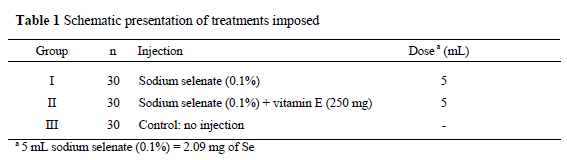
The present experiment has been conducted in the flock with a history of relatively low fertility (72 - 84%). The objective was to examine the effect of Se and Se plus vitamin E supplementation on the reproduction characteristics of ewes and the growth of their lambs. The experiment was conducted using 90 Karacabey Merino ewes, between two to three years of age. The ewes were divided into three groups, consisting of 30 ewes/group. The ewes in the first two experimental groups were given intramuscular injections of selenium and vitamin E (Injecom E-selenium-ROCHE and Yeldif -DIF, application practiced according to instruction sheet) at two stages before the mating and the lambing seasons, as indicated in Table 1.
The experiment started with the natural mating period in autumn. Ewes weighed ca. 52 to 60 kg and were 24-36 months old. The ewes from all groups were kept in the same shed and consisted as one flock while grazing. The nutrition was based on local feeds; meadow hay, fodder beet, feed supplement (oats, wheat bran, sunflower meal and limestone), pasture herbage and a trace-mineralized salt. Animals were routinely drenched against liver fluke and roundworms, and vaccinated against pasteurellosis and clostridia infections. Ewes were mated to 10 fertile Karacabey Merino rams during the breeding seasons of six weeks in September and October. Ewes lambed indoors and lamb weights were recorded at birth. Lambs were separated into sex groups at weaning, at an average age of two months.
Oestrus response, pregnancy, lambing, and fecundity rates were calculated as follows:
Oestrus response = number of ewes showing oestrus/total ewes treated in each group x 100;
Pregnancy rate = number of pregnant ewes/number of ewes showing oestrus and mated in each group x 100;
Lambing rate = number of ewes lambing/number of pregnant ewes in each group x 100;
Fecundity rate = number of lambs born/number of ewes lambing x 100.
Differences between groups in reproduction performance were analyzed using General Linear Models (GLM) procedure of SAS (1991). Reproductive performance percentages were examined using the Chi-square test.
The doses of selenium and vitamin E applied in this experiment did not result in miscarriages. Ewes from the vitamin E + Se injected group demonstrated oestrus symptoms 3 - 4 days earlier than the control groups.
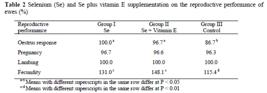
The incidence of oestrus response (100.0 and 96.7%, P < 0.05) in groups I and II, respectively, were significantly higher than in the control, group III (86.7%). This indicates that Se and Se plus vitamin E treatments had a significant beneficial influence on the oestrus response in ewes. The Se and Se plus vitamin E injections increased fecundity in groups I and II (131.0 and 148.1%, respectively) compared to the control group (P < 0.01).
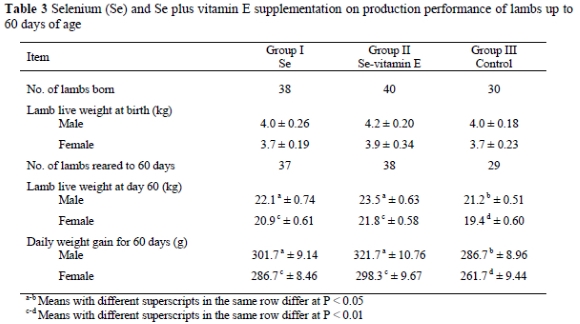
The data presented in Table 3 show that the body weight of lambs as well as the daily live weight gains of ewes 60 days postpartum were significantly higher (P < 0.05) in the two treatment groups than in the control group.
The administration of Se and Se plus vitamin E had significant positive effects on the incidence of oestrus, fertility, prolificacy in ewes, as well as on live weight gains of lambs up to 60 days of age. A positive effect of Se-vitamin E on fertility and prolificacy was observed in 3-year old ewes with two injections (2.1 mg of Se/injection) before mating and lambing (Anke, 1987). However, in this trial, injection of Se plus vitamin E did not increase the reproduction and production performance in younger ewes (Gabryszuk & Klewiec, 2002). Positive effects of Se or Se-vitamin E on fertility were observed by other authors (Scales, 1974; Mihajlovic et al., 1991; Koyuncu et al., 2006), but not confirmed (Segerson et al., 1986). A permeating dose of 5 mg selenium reduced the numbers of barren Merino ewes by 15% (Scales, 1974). The number of lambs born alive for control and Se-vitamin E treated ewes were 1.61 and 1.81, respectively, and lambs weaned per ewe lambing were 1.1 and 1.5, respectively (Segerson et al., 1986). In our study supplementation with Se-vitamin E had a positive effect on birth weight, daily weight gain and body weight at 60 days of age as compared to lambs from the group receiving Se only. Øvernes (1993) reported that adequate measures should be taken to ensure that animals receive on optimal supplementation of both Se and vitamin E. Selenium and Se plus vitamin E supplementation, when plasma Se concentration was within the reference value, appeared to contribute to a healthier udder status, but neither lamb weaning weights nor ewe productivity were enhanced by the treatment applied (Appeddu et al., 1994). Practically, Se supplementation enhances the level of Se and may indirectly improve animal performance (Sobiech & Kuleta, 2002), possibly by strengthening the immunity of the animals (Milad et al., 2001).
Data obtained in this study indicated that two injections of Se and Se plus vitamin E given before mating significantly increased the incidence of oestrus response, and fecundity rates in ewes, daily weight gain of ewes 0 to 60 days postpartum, and lamb body weight at 60 days of age. These findings should be useful in further exploring the frequency and amount of vitamin supplementation that may improve reproductive performance of ewes.
References
- Anke, M., 1987. Effect of selenium deficiency upon reproduction and milk production of goats. Proc. Macro and Trace Element Seminar, Leipzing-Jena, Germany, 1987. pp. 440-447.
- Appeddu, L.A., Ely, D.G., Aaron, D.K. & Deweese, W.P., 1994. Response of lactating ewes to injections of selenium and vitamin E. J. Anim. Sci. 72 (2), 11-15.
- Gabryszuk, M. & Klewiec, J., 2002. Effect of injecting 2- and 3-year-old ewes with selenium and selenium-vitamin E on reproduction and rearing of lambs. Small Rumin. Res. 43, 127-132.
- Koyuncu, M., Kara Uzun, S., Ozis, S. & Yerlikaya, H., 2006. Effects of selenium-vitamin E or progestagen-PMSG injections on reproductive performance of ewes. J. Appl. Anim. Res. 29, 137-140.
- McDowell, L.R., Williams, S.N. & Hidiroglu, N., 1996. Vitamin E supplementation for the ruminants. Anim. Feed. Sci. Technol. 60, 273-296.
- Meschy, F., 2000. Recent progress in the assessment of mineral requirements of goats. Livest. Prod. Sci., 64, 9-14.
- Mihajlovič, M., Lindeberg, P. & Rajkovič, M., 1991. Selenium content in feedstuffs and selenium status of sheep in some areas of Serbia. In: Trace Elements in Man and Animal, Vol. 7. Ed. Momcilowic, B., IMI, Zagrep. pp. 11-27.
- Milad, K., Racz, O. & Sıpulova, A., 2001. Effect of vitamin E and selenium on blood glutathione peroxidase activity and some immunological parameters in sheep. Vet. Med. Czech. 46, 1-5.
- Øvernes, G., 1993. Selenium supplementation in ruminants. Norw. J. Agric. Sci. 11, 199-203.
- SAS, 1991. Statistical Analysis Systems user's guide. Statistics Version 6.04, SAS Institute Inc., Cary N.C. USA.
- Scales, G.H., 1974. Reproductive performance of Merino ewes dosed with selenium prior mating. Proc. N. Z. Soc. Anim. Prod. 34, 103-113.
- Segerson, E.C., Gunsett, F.C. & Getz, W.R., 1986. Selenium-vitamin E supplementation and production efficiency in ewes marginally deficient in selenium. Livest. Prod. Sci. 14, 149-159.
- Sobiech, P. & Kuleta, Z., 2002. Usefulness of some biochemical indicators in detection of early stages of nutritional muscular dystrophy in lambs. Small Rumin. Res. 45, 209-215.