Predicting body weight in Ross 308 broiler chickens using a data mining algorithm approach
Abstract
Ross 308 broiler chickens are raised specifically for meat production, as they are fast growing and can be slaughtered at six weeks of age. This study aimed to use multivariate adaptive regression splines (MARS) and classification and regression tree (CART) data mining algorithms to predict the live body weights of Ross 308 male and female chickens from their morphological traits, and to compare the predictive performances of these two approaches. One hundred and twenty birds (60 males and 60 females) were used. The flock was reared under intensive conditions, and the entire flock was kept in the same house. Body weight and morphological traits such as wing length, beak length, shank length, body girth, body length, and shank circumference were measured for every Ross 308 chicken. Two data mining algorithms, MARS and CART, were used for body weight prediction, and goodness-of-fit criteria were used to select the best model. The CART data mining algorithm was found to be the best model, as it had greater predictive accuracy, and higher Pearson's correlation coefficient, coefficient of determination, and adjusted coefficient of determination test results, when predicting body weight in both male and female Ross 308 chickens. These results suggest that the CART data mining algorithm could be used to help farmers recognise the morphological traits that are most influential in determining body weight.
beak length; body girth; correlation; heat map; morphological traits
Introduction
The world population is predicted to rise to 9.5 billion in 2050 (Soltanali et al., 2016). As a result of this increase, in addition to an increasing demand for food, the exploitation of energy resources is growing (Soltanali et al., 2016). The livestock industry is one of the most important sources of protein and food for this growing population (Soltanali et al., 2016). In South Africa and globally, the poultry industry makes a considerable contribution to the food security status of consumers (Manyelo et al., 2022). Ross 308 broiler chickens are raised specifically for meat production, and are known for their fast growth and their potential to be sold or slaughtered by six weeks of age (Amao, 2022). This makes broiler chicken farming more profitable than other livestock businesses.
Morphological traits are good indicators of the growth potential and market value of broiler chickens (Isaac & Adeolu, 2023). Moreover, these traits can serve as a basis for the characterisation, grouping, selection, and improvement of poultry breeds (Isaac & Adeolu, 2023). Bila & Tyasi (2022) suggested that the morphological characterisation of animal breeds is an important stage in animal development programmes, as it allows animal keepers to identify and select exceptional lines for development. Furthermore, Yakubu (2011) reported that morphological variations within a breed are of immense biological interest, both as descriptive and analytical tools.
Body weight is one of the primary traits of economic importance in animal production (Yakubu & Ari, 2017), as weight directly translates into income, especially in markets where chicken prices are based on weight. Body weight records are also used when making breeding decisions, and are required for the calculation of medication dosages (Bila et al., 2023). Growth rate is consequently an important trait in animal production, based on economic factors, as it impacts the adaptability and economic suitability of livestock production (Önder et al., 2025; Ağyar et al., 2022). Characteristics that define the growth course of the individual, and the rate at which that individual reaches puberty, are thus key for determining the economic efficiency of livestock production (Wojnarowska et al., 2022).
Tırınk (2022) reported that the accurate determination of body weight offers a basis for animal science studies such as animal health management and herd management. However, determining body weight, especially without affecting animal welfare, poses a complex challenge. More research on predicting body weight accurately and reliably is thus needed. Prediction models in which morphological traits are used to predict body weight have recently been established (Isaac & Adeolu, 2023). Two data mining algorithms in particular have been used extensively in the animal sciences. These are multivariate adaptive regression splines (MARS) and classification and regression trees (CART). Tırınk et al. (2023) reported that MARS is a non-parametric regression method that employs smoothing splines methodology, and Faraz et al. (2023) noted that it provides both innovation and substantial ease in interpreting variables and their interactions. The MARS approach has previously been used in livestock sciences to predict the body weight of Kajli sheep (Faraz et al., 2023). Tırınk et al. (2023) reported that the CART algorithm analyses data for modelling and division purposes. A decision tree is developed using instructions that group data into unique categories. Classification and regression tree analysis has also been employed in animal sciences, to predict the weight of goats (Mathapo et al., 2022) and the egg weights of indigenous chickens (Liswaniso et al., 2021). However, to the author's knowledge, there is scanty information on the use of data mining algorithms for the prediction of the body weight of Ross 308 chickens.
Hence, the objective of this study was to use MARS and CART data mining algorithms to predict the live body weight of male and female Ross 308 chickens from morphological traits, and to compare the predictive performances of the two approaches.
Materials and methods
Study area
All procedures were performed following the standards and protocols set by the Potchefstroom College of Agriculture's Animal Research Ethics Committee, under project number AREC/02/2021. This study was conducted at the Broiler Production Division of the Animal Production Department of the Potchefstroom College of Agriculture, in the North West Province. The Potchefstroom College of Agriculture is located on the site of the Agricultural Centre of the North West Department of Agriculture and Rural Development, at 26° 42' 53" S, 27° 05' 49" E (Bila & Tyasi, 2022).
Experimental animals and management
Ross 308 broiler chickens were used for this study. The broiler house contained approximately 1000 chickens; 120 of these birds (60 males and 60 females) were selected for analysis. The flock was reared in an intensive system and the entire flock was kept in the same house. The chickens were subjected to phase-feeding practices, with feed being provided ad íibitum. Broiler starter feed was fed from day 1 to day 21, broiler grower feed was fed from day 21 to day 28, and broiler finisher feed was fed from day 28 until slaughter. The chickens had ad íibitum access to clean water. The temperature was recorded daily and regulated by controlling the ventilation of the house. From arrival until day 3, the chicks were given a stress-pack via their drinking water to enable them to acclimatise to the new environment and to combat stress. The chickens were inoculated against Newcastle and Gumboro diseases, with both vaccines being administered through their drinking water. The chickens were weighed weekly using a sensitive scale, and their weight gains were recorded.
Morphological traits measured
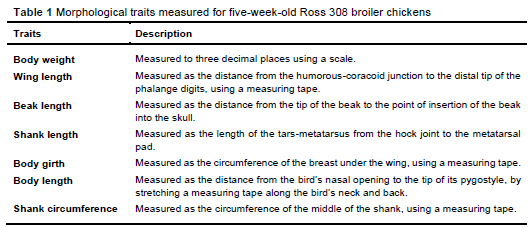
Morphological traits were measured on week five, at which time the 120 trial chickens were randomly sampled from the flock. The traits were measured in centimetres using a measuring tape, following the normal morphometric trait procedures reported by Bila & Tyasi (2022). The morphological traits measured are described in Table 1. All the morphological traits were measured by the same individual to avoid individual variations in measurements.
Statistical analysis
The Statistical Package for Social Sciences (2019), version 26.0, was used to analyse the data and provide the descriptive statistics for the body weight and morphological traits of the Ross 308 chickens. Decision tree algorithms were used to design the models to predict the body weight from the morphological traits of the chickens, as described by Eyduran et al. (2019). Goodness-of-fit criteria were used to assess the predictive performances of the CART and MARS models, as performed by Faraz et al. (2021). Correlation matrix heat maps were used to determine the correlations between the body weight and the morphological traits.
MARS algorithm
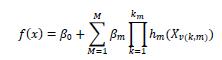
The MARS algorithm is a non-parametric machine learning method that is used for managing and recognising pattern problems in regression and classification, as well as handling non-linear data (Tırınk et al., 2023). Iqbal et al. (2023) suggested that the MARS model fits a series of linear regression functions to predict values of a continuous dependent variable. The MARS algorithm was used as described by Bila et al. (2023) and Rashijane et al. (2023), and was defined as:
Where:
f(x) is the estimated value of the dependent variable;
βο, and ßm are the intercepts; and
hm(Xv(k,m)) is the basis function, where v(k, m) is an index of the predictor for the mth component of the kth product, and Κ is the parameter regulating the order of interaction.
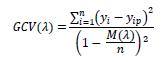
After building the most suitable MARS model, the basic functions that did not substantially contribute to the model's predictive performance were eliminated via a pruning process, which was based on the following generalised cross-validation error (GCV) calculation (Eyduran et al., 2019):
Where:
n is the number of training cases;
yi is the observed value of a response variable;
yip is the estimated value of a response variable; and
Μ(λ) is a penalty function for the complexity of the model, with λ terms.
CART algorithm
As a recursive data mining algorithm, CART was created by repeatedly splitting nodes into pairs of child nodes, starting from the root node containing the entire learning sample, as described by Breiman et al. (1984) and Kuhn & Johnson (2013).
Predictive performance of CART and MARS models
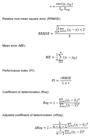
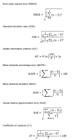
The predictive performances of the MARS and CART models were compared using goodness-of-fit test criteria (Bila et al., 2023). The following goodness-of-fit criteria were calculated:
Pearson's correlation coefficient (r):
Results
Descriptive statistics
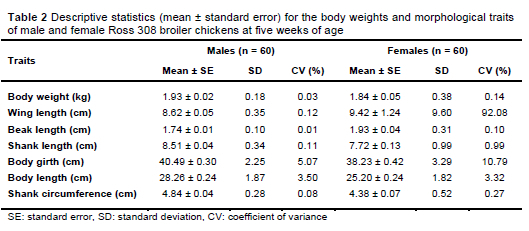
Descriptive statistics for all variables by sex (male and female) are expressed as the mean ± standard error and are reported in Table 2. The results showed that the average live weight of the Ross 308 chickens was 1.84 kg for females and 1.93 kg for males. The CV for the various traits ranged between 0.10% and 92.08% in females and between 0.03% and 5.07% in males, while the standard deviation ranged between 0.31 cm and 9.60 cm in females and between 0.10 cm and 2.25 cm in males.
Correlation matrix
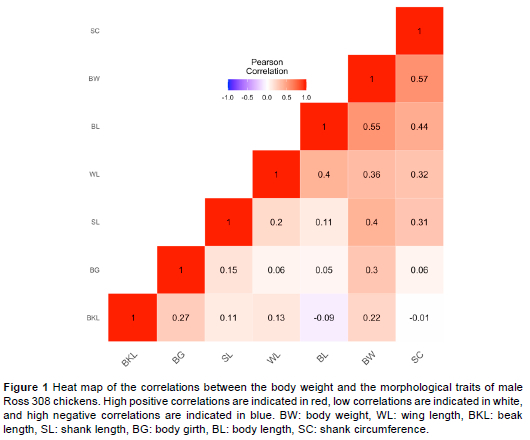
Figure 1 shows the correlations between the body weight and the morphological traits of male Ross 308 chickens. The body weight of male Ross 308 chickens was moderately positively correlated (P <0.05) with the body length (0.55), shank length (0.40), wing length (0.36), and body girth (0.30). In contrast, body length was negatively correlated (P <0.05) with beak length (-0.09).
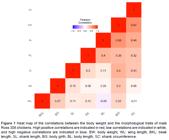
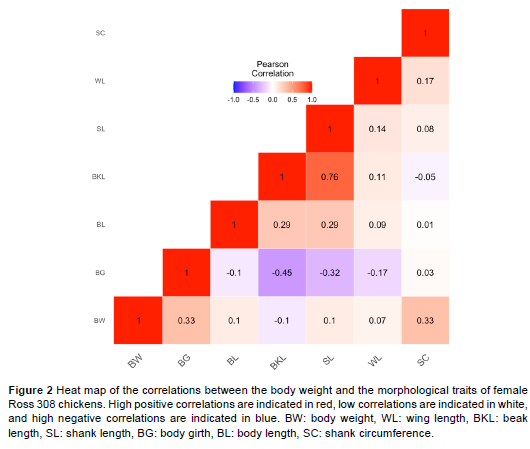
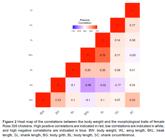
Figure 2 shows the correlations between the body weight and the morphological traits of female Ross 308 chickens. The body weight of female Ross 308 chickens was moderately positively correlated (P <0.05) with the shank circumference (0.33) and body girth (0.33). In contrast, body weight was negatively correlated (P <0.05) with beak length (-0.10). Moreover, beak length was highly positively correlated (P <0.01) with shank length (0.76).
The CART model
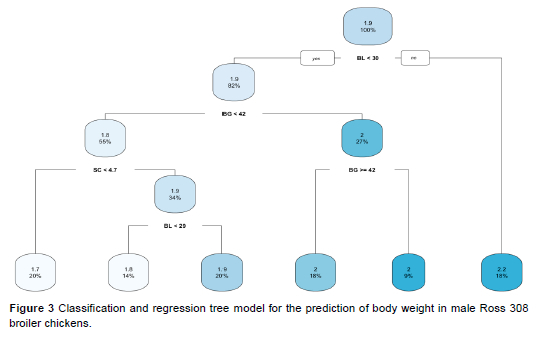
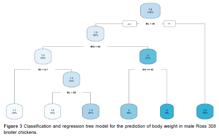
At the top of the regression tree diagram in Figure 3, the root node showed that the overall body weight of male Ross 308 chickens was 1.9 kg. The node was split into one group based on body length, with a cut-off point of 30 cm. This body length node was then split into two sub-groups based on the body girth, with a cut-off point of 42 cm. For the first sub-group, where the body girth was less than 42 cm, the average body weight was 1.8 kg, representing 55% of the flock. When the body girth was greater than 42 cm, the obtained body weight was 2 kg, representing 27% of the flock.
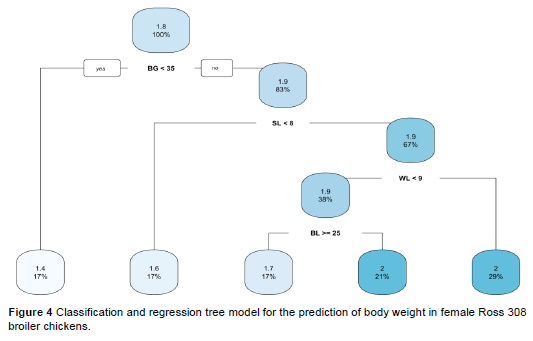
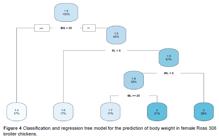
At the top of the regression tree diagram in Figure 4, the root node showed that the overall body weight of female Ross 308 chickens was 1.8 kg. The node was split into two sub-groups based on body girth, with a cut-off point of 35 cm. For the first sub-group, where the body girth was less than 42 cm, the average body weight was 1.4 kg, representing 17% of the flock. When the body girth was greater than 35 cm, the obtained body weight was 1.9 kg, representing 83% of the flock. This part of the tree was further split into two sub-groups based on shank length, with a cut-off point of 8 cm. When the shank length was less than 8 cm, the mean body weight was 1.6 kg, representing 17% of the flock. When the shank length was greater than 8 cm, the mean body weight was 1.9 kg, representing 67% of the flock.
The MARS model
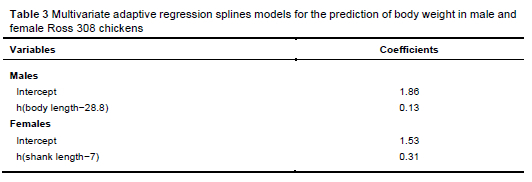
Table 3 shows the results of the MARS data mining algorithm for the prediction of body weight in male and female Ross 308 broiler chickens. The MARS model showed that body length was included in the developed model for male Ross 308 chickens, while shank length was included in the developed model for female Ross 308 chickens. In male Ross 308 chickens, the model's first term had an intercept with a coefficient of 1.86, while in the second term, body length had a cut-off point of 28.8 cm for a positive coefficient of 0.13. In female Ross 308 chickens, the model's first term had an intercept with a coefficient of 1.53, while in the second term, shank length had a cut-off point of 7 cm for a positive coefficient of 0.31.
Comparison of the MARS and CART data mining algorithms for male Ross 308 chickens
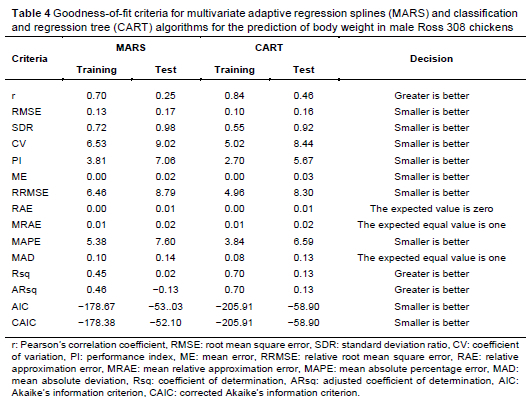
Goodness-of-fit criteria were used to assess the predictive performances of the two algorithms, and the test data set was used to confirm the comparison between the MARS and CART data mining algorithms. The goodness-of-fit criteria (Table 4) showed that the CART algorithm had better predictive performance than the MARS algorithm. The CART algorithm had higher r, Rsq, and ARsq values, and lower RMSE, SDR, CV, PI, RRMSE, MAPE, AIC, and corrected AIC values than the MARS algorithm.
Comparison of the MARS and CART data mining algorithms for female Ross 308 chickens
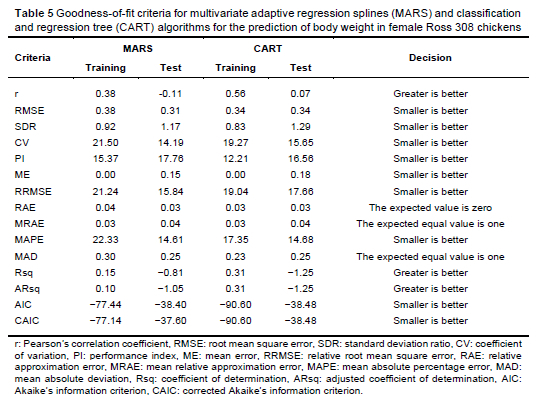
Goodness-of-fit criteria were used to assess the predictive performances of the two algorithms, and the test data set was used to confirm the comparison between the MARS and CART data mining algorithms. The goodness-of-fit criteria (Table 5) showed that the CART algorithm had better predictive performance than the MARS algorithm. The CART algorithm had higher r, Rsq, and ARsq test results and lower RMSE, SDR, CV, PI, RRMSE, MAPE, AIC, and CAIC values than the MARS algorithm.
Discussion
Morphological traits often influence animals' live body weights and are used as indirect selection criteria in breeding strategies (Celik & Yilmaz, 2018). These traits have also been employed in numerous studies to predict animal body weight (Faraz et al., 2021; Amao, 2022; Bila & Tyasi, 2022). This study examined the associations between the morphological traits and live body weights of male and female Ross 308 chickens. The correlations found showed that in male Ross 308 chickens, body weight was moderately correlated with body length, shank length, wing length, and body girth, while body length was negatively correlated with beak length. This suggests that there is a positive and directly proportional relationship between body weight and body length, indicating that as body length increases, body weight also increases. These findings are in line with the results of Isaac et al. (2024), who also studied broiler chickens. This correlation may be because the two traits are controlled by a single common gene (Hedayat-Evrigh et al., 2023), or because of a gene interaction that exists within the specific species and breed. Hedayat-Evrigh et al. (2023) reported that gene functioning and expression differed between different animals and breeds.
In female Ross 308 chickens, body weight was positively correlated with shank circumference and body girth, while beak length was highly positively correlated with shank length. These results concur with those of Amao (2018), who studied Nigerian indigenous chickens reared intensively in the Southern Guinea savanna. Moreover, these results also concur with the results of Amao (2022), who found that there was a highly significant positive correlation between the body weight and the body length, wing length, and shank length in Ross 308 broiler chickens. In contrast, Isaac et al. (2024) reported that other morphological traits, such as thigh circumference, wing span, and shank length, were highly correlated with body weight, and that these traits could be used in a selection index for the improvement of body weight in broiler chickens. Habashy et al. (2021) published similar findings to those found in this study, with body weight being highly correlated with body length and moderately correlated with shank length at twelve weeks of age. Differences between the results of this study and those of previous studies may be due to differences in production environments, feed consumption, and feeding programmes. Moreover, Bila et al. (2023) noted that while morphological correlations help to specify the degree of association between traits, they do not identify the causes of associations between traits.
Faraz et al. (2021) argued that data mining algorithms have the potential to overcome multicollinearity problems in predicting animal body weight. Therefore, in this study, the data mining algorithm approach was used to predict the live body weights of male and female Ross 308 broiler chickens based on their morphological traits. Multivariate adaptive regression splines and CART data mining algorithms were compared in terms of their ability to predict the live body weights of male and female Ross 308 chickens. The study's findings showed that body length was the best determinant factor for males, while shank length was the key determinant in the model for female Ross 308 chickens. These findings contradict those of Tyasi et al. (2020), who found that wing length was the best determinant factor of body weight in Hy-line Silver Brown chickens. This might be because of differences in the breeds studied, as well as differences in nutritional and environmental factors.
Furthermore, the results of this study showed that the CART algorithm had a higher predictive performance than the MARS algorithm for both sexes of Ross 308 chickens. These results concur with those of Tyasi et al. (2021), who found that the CART data mining algorithm exhibited much higher predictive accuracy than the chi-square automatic interaction detector (CHAID) and exhaustive CHAID algorithms, when the algorithms were used to predict live body weight in Hy-line Silver Brown commercial layer hens and indigenous Potchefstroom Koekoek chickens. However, the results of the current study contradict those of Hlokoe et al. (2022), who suggested that the MARS data mining algorithm performed better than the CART algorithm, when working with Nguni cows. In contrast, Karadas & Birinci (2019) used CART, CHAID, exhaustive CHAID, MARS, and multilayer perceptron algorithms to determine the factors affecting dairy cattle performance, and found that MARS outperformed the other algorithms tested. Despite the limited previous literature reporting on the use of MARS for predicting body weight from morphological traits in chickens, MARS has been successfully used to predict body weight from linear body measurements in other species. For instance, Faraz et al. (2023) reported on models that could predict the body weight of Kajli sheep. Interestingly, Oyebanjo et al. (2023) reported that the CART model revealed that heart girth was the best predictor of body weight in indigenous goat breeds.
Conclusion
This study found positive correlations between body weight and specific morphological traits in male and female Ross 308 chickens. Furthermore, the CART data mining algorithm demonstrated that body length in males and shank length in females significantly influenced the live body weight of Ross 308 chickens. It is essential that further research on the utilisation of data mining techniques for the prediction of body weight in the Ross 308 chicken breed is conducted using larger sample sizes, to enhance our understanding of this technology.
Conflict of interest
The author has no conflicts of interest to declare.
Acknowledgments
The author acknowledges the kind support of the Potchefstroom College of Agriculture, the farm manager, and the broiler production unit staff for their assistance in completing this study.
References
-
Ağyar, O., Tırınk, C., Önder, H., Şen, H., Piwczyński, D., & Yavuz, E., 2022. Use of multivariate adaptive regression splines algorithm to predict body weight from body measurements of Anatolian buffaloes in Türkiye. Animals, 12(21):2923. DOI: 10.3390/ani12212923
» https://doi.org/10.3390/ani12212923 -
Amao, S.R., 2022. Sexual dimorphism on body weight and some conformation traits of Ross 308 broiler chickens using Principal Component Analysis. ADAN Journal of Agriculture, 3:49-58. DOI: 10.36108/adanja/2202.30.0160
» https://doi.org/10.36108/adanja/2202.30.0160 - Amao, S.R., 2018. Application of principal component analysis on the body morphometric of Nigerian indigenous chickens reared intensively under southern guinea savanna condition of Nigeria. Journal of Environmental Issues and Agriculture in Deveíoping Countries, 10(1):1-12.
-
Bila, L. & Tyasi, T.L., 2022. Multivariate principal component analysis of morphological traits in Ross 308 broiler chicken breed. Asian Journal of Agriculture and Biology, 2022(3):202103132. DOI: 10.35495/ajab.2021.03.132
» https://doi.org/10.35495/ajab.2021.03.132 -
Bila, L., Malatji, P.D., & Tyasi, T., 2023. Predicting body weight of South African Sussex cattle at weaning using multivariate adaptive regression splines and classification and regression tree data mining algorithms. Journal of Applied Animal Research, 51:608-615. DOI: 10.1080/09712119.2023.2258976
» https://doi.org/10.1080/09712119.2023.2258976 -
Çelik, Ş. & Yilmaz, O., 2018. Prediction of body weight of Turkish tazi dogs using data mining techniques: Classification and regression tree (CART) and multivariate adaptive regression splines (MARS). Pakistan Journal of Zoology, 50(2):575-583. DOI: 10.17582/journal.pjz/2018.50.2.575.583
» https://doi.org/10.17582/journal.pjz/2018.50.2.575.583 - Eyduran, E., Akin, M., & Eyduran, S., 2019. Application of multivariate adaptive regression splines in agricultural sciences through r software. Nobel Academic Publishing, Ankara, Türkiye.
-
Faraz, A., Tırınk, C., Önder, H., Şen, U., Shaq, H.M., Tauqir, N.A., Waheed, A., & Nabeel, M.S., 2023. Usage of the XGBoost and MARS algorithms for predicting body weight in Kajli sheep breed. Tropical Animal Health and Production, 55:276. DOI: 10.1007/s11250-023-03700-6
» https://doi.org/10.1007/s11250-023-03700-6 -
Faraz, A., Tirink, C., Eyduran, E., Waheed, A., Tauqir, N.A., Nabeel, M.S., & Tariq, M.M., 2021. Prediction of live body weight based on body measurements in Thalli sheep under tropical conditions of Pakistan using CART and MARS. Tropical Animal Health and Production, 53(2):301. DOI: 10.1007/s11250-021-02748-6
» https://doi.org/10.1007/s11250-021-02748-6 -
Habashy, W., Enab, A., & El-Tahawy, W., 2021. Prediction of body weight and other linear body weight measurements of leghorn versus two Egyptian strains of chicken. Journal of Animal and Poultry Production, 12(8):287-291. DOI: 10.21608/jappmu.2021.88242.1017
» https://doi.org/10.21608/jappmu.2021.88242.1017 - Hedayat-Evrigh, N., Khalkhali-Evrigh, R., Ramezani, Y., Seyed Sharifi, R., & Shakouri, M., 2023. Integrating analysis of publicly available microarray data to study the immune response of cattle to infection with Mycobacterium bovis. Iranian Journal of Applied Animal Science, 13(1):11-19.
-
Hlokoe, V., Mokoena, K., & Tyasi, T.L., 2022. Using multivariate adaptive regression splines and classification and regression tree data mining algorithms to predict body weight of Nguni cows. Journal of Applied Animal Research, 50:534-539. DOI: 10.1080/09712119.2022.2110498
» https://doi.org/10.1080/09712119.2022.2110498 - Statistical Package for Social Sciences (SPSS), 2019. Statistical Packages for Social Sciences for Windows: Base System User's Guide, release 26.0 SPSS Inc., Chicago, USA.
-
Iqbal, F., Raziq, A., Zil-E-Huma., Tirink, C., Fatih, A., & Yaqoob, M., 2023. Using the artificial bee colony technique to optimize machine learning algorithms in estimating the mature weight of camels. Tropical Animal Health and Production, 55:86. DOI: 10.1007/s11250-023-03501-x
» https://doi.org/10.1007/s11250-023-03501-x -
Isaac, U. & Adeolu, A., 2023. Linear models for predicting body weight of crossbred chickens. International Journal of Research and Innovation in Applied Science, VIII(IV):62-70. DOI: 10.51584/IJRIAS.2023.8407
» https://doi.org/10.51584/IJRIAS.2023.8407 -
Isaac, U.S., Okafor, N.J., Nwachukwu, B.C., Albert, J.C., Aniemena, C.F., & Igbokwe, C.A., 2024. Stepwise canonical discriminant analysis for morphometric characterization of three strains of broiler chicken. Genetika, 56(1):43-54. DOI: 10.2298/GENSR2401043I
» https://doi.org/10.2298/GENSR2401043I -
Karadas, K. & Birinci, A., 2019. Determination of factors affecting dairy cattle: a case study of Ardahan province using data mining algorithms. Revista Brasileira de Zootecnia, 48:e20170263. DOI: 10.1590/rbz4820170263
» https://doi.org/10.1590/rbz4820170263 - Kuhn, M. & Johnson, K., 2013. Applied Predictive Modeling, Volume 26. Springer, New York, USA.
-
Liswaniso S., Qin, N., Tyasi, T.L., & Chimbaka, I.M., 2021. Use of data mining algorithms CHAID and CART in predicting egg weight from egg quality traits of indigenous free-range chickens in Zambia. Advances in Animal and Veterinary Sciences, 9(2):215-220. DOI: 10.17582/journal.aavs/2021/9.2.215.220
» https://doi.org/10.17582/journal.aavs/2021/9.2.215.220 -
Manyelo, T.G., Sebola, N.A., Ng'ambi, J.W., Weeks, W., & Mabelebele, M., 2022. The influence of different amaranth leaf meal inclusion levels on performance, blood profiles, and gut organ characteristics of Ross 308 broiler chickens. Frontiers in Veterinary Science, 9:869149. DOI: 10.3389/fvets.2022.869149
» https://doi.org/10.3389/fvets.2022.869149 -
Mathapo, M., Mugwabana, T., & Tyasi, T.L., 2022. Prediction of body weight from morphological traits of South African non-descript indigenous goats of lepelle-nkumbi local municipality using different data mining algorithm. Tropical Animal Health and Production, 54:1-9. DOI: 10.1007/s11250-022-03096-9
» https://doi.org/10.1007/s11250-022-03096-9 -
Önder, H., Tirink, C., Yakubets, T., Getya, A., Matvieiev, M., Kononenko, R., Şen, U., Özkan, Ç.Ö., Tolun, T., & Kaya, F., 2025. Predicting live weight for female rabbits of meat crosses from body measurements using LightGBM, XGBoost and support vector machine algorithms. Veterinary Medicine and Science, 11(1):e70149. DOI: 10.1002/vms3.70149
» https://doi.org/10.1002/vms3.70149 -
Oyebanjo, M., Coker, O., & Osaiyuwu, O., 2023. Predicting the body weight of indigenous goat breeds from morphological measurements using the classification and regression tree (CART) data mining algorithm. Biotechnology in Animal Husbandry, 39:33-49. DOI: 10.2298/BAH2301033O
» https://doi.org/10.2298/BAH2301033O - Rashijane, L., Mokoena, K., & Tyasi, T.L., 2023. Using multivariate adaptive regression splines to estimate the body weight of Savanna goats. Animals, 13:1-11.
- Soltanali H., Emadi B., Rohani A., Khojastehpour M., & Nikkhah A., 2016. Optimization of energy consumption in milk production units through integration of data envelopment analysis approach and sensitivity analysis. Iranian Journal of Applied Animal Science, 6(1):15-29.
-
Tirink, C., 2022. Comparison of Bayesian regularized neural network, random forest regression, support vector regression and multivariate adaptive regression splines algorithms to predict body weight from biometrical measurements in Thalli Sheep. Kafkas Üniversitesi Veteriner Fakültesi Dergisi, 28(3):411-419. DOI: 10.9775/kvfd.2022.27164
» https://doi.org/10.9775/kvfd.2022.27164 -
Tırınk, C., Onder, H., Francois, D., Marcon, D., Şen, U., Shaikenova, K., Omarova, K., & Tyasi, T.L., 2023. Comparison of the data mining and machine learning algorithms for predicting the final body weight for Romane sheep breed. PLoS One, 18(8):e0289348. DOI: 10.1371/journal.pone.0289348
» https://doi.org/10.1371/journal.pone.0289348 -
Tyasi, T.L., Eyduran, E., & Celik, S., 2021. Comparison of tree-based regression tree methods for predicting live body weight from morphological traits in Hy-line silver brown commercial layer and indigenous Potchefstroom Koekoek breeds raised in South Africa. Tropical Animal Health and Production, 53:7. DOI: 10.1007/s11250-020-02443-y
» https://doi.org/10.1007/s11250-020-02443-y -
Tyasi, T.L., Makgowo, K.M., Mokoena, K., Rashijane, L.T., Mathapo, M.C., Danguru, L.W., Molabe, K.M., Bopape, P.M., Mathye, N.D., & Maluleke, D., 2020. Multivariate adaptive regression splines data mining algorithm for prediction of body weight of Hy-line silver brown commercial layer chicken breed. Advances in Animal and Veterinary Sciences, 8(8):794-799. DOI: 10.17582/journal.aavs/2020/8.8.794.799
» https://doi.org/10.17582/journal.aavs/2020/8.8.794.799 -
Wojnarowska, A., Palka, S., Otwinowska-Mindur, A., & Ptak, E., 2022. Comparison of two nonlinear functions describing the growth of Popielno White and New Zealand White rabbits. Animal Science and Genetics, 18(4):1-13. DOI: 10.5604/01.3001.0016.1097
» https://doi.org/10.5604/01.3001.0016.1097 - Yakubu, A. & Ari, M., 2017. Principal component and discriminant analyses of body weight and conformation traits of Sasso, Kuroiler and indigenous Fulani chickens in Nigeria. Journal of Animal and Plant Sciences, 28:46-55.
- Yakubu, A., 2011. Discriminant analysis of sexual dimorphism in morphological traits of African Muscovy Ducks. Archivos de Zootecnia, 60(232):1115-1123.
Accepted 18 January 2025
Published 30 June 2025