Chia flour as a substitute for pork fat in Nile tilapia (Oreochromis niloticus) fishburgers
Abstract
The objective of this study was to evaluate the effect of the inclusion of chia flour (Salvia hispánica L.) as a substitute for pork fat in formulations of fishburgers made with Nile tilapia (Oreochromis niloticus). Five formulations, one control (without the inclusion of the flour) and four with increasing levels of substitution (12.50, 25.00, 37.50, and 50.00 %), were investigated. The inclusion of chia flour provided an improvement in the nutritional profile of fishburgers, with increases observed in the percentages of protein, fibre, and ash, in addition to a reduction in the lipid content and caloric value. In addition to modifying the texture profile, the substitution of dirty fat interfered with the colour of the studied samples, promoting a reduction in luminosity (L*) with increased flour inclusion. There was an improvement in the yield of formulations with higher percentages of chia flour. The lowest reduction in diameter and thickness of the burgers after cooking was observed with more flour. The partial substitution of swine fat with chia flour is a viable alternative to obtain healthier tilapia fishburgers with higher yield.
fat substitute; fish; fishburgers; Salvia hispanica L.
Introduction
Meat is one of the most important foods in the human diet due to its high-quality protein, minerals, and vitamins (Paschoal et al., 2019). According to data published by the Food and Agriculture Organization of the United Nations on the State of Fisheries and Aquaculture in the World (SOFIA), the world's fish production reached approximately 179 million tons in 2018, with revenues of ~US$ 401 billion. Of the total production, ~156 million tons were destined for human consumption, representing an annual per capita consumption of 20.5 kg/inhabitant (FAO, 2020). In 2019, Brazilian production reached 758,006 tons of cultivated fish, an increase of 4.9% over the previous year (Peixe, 2020). Predominantly cultivated species globally include carp (grass and silver), followed by Nile tilapia (Oreochromis niloticus), which represented 8.3% of the total fish produced by aquaculture in the year 2018 (FAO, 2020). In Brazil, tilapia is currently the most cultivated fish species, representing 57% of the total production of farmed fish, which keeps the country in the fourth position in the world ranking, behind the great countries already established in the field, such as China, Indonesia, and Egypt (Peixe, 2020). According to data published by Peixe (2020), the annual Brazilian per capita consumption is ~10.0 kg/inhabitant/year, whereas that recommended by FAO is 12.0 kg/inhabitant/year (FAO, 2020).
Nile tilapia is white, has a mild flavour, and low percentage of fat, in addition to the absence of Y-shaped spines. It is considered a versatile feedstock and has substantial potential for processing and industrialization. Therefore, Nile tilapia can be used for the development of new fish-based products, facilitating chain diversification for items that are easy to prepare, such as fishburgers, nuggets, dumplings, and sausages (Ogawa & Maia, 1999; Fogaça et al., 2015; Milanez et al., 2019).
Hamburgers are among the most consumed industrialized meat products in the world (Novello & Pollonio, 2012; De Oliveira et al., 2014) and formulations using tilapia meat as raw material for this product have been studied by several researchers (Bainy et al., 2015; Messias et al., 2016; Mitterer-Daltoé et al., 2017; Muzzolon et al., 2018; Mattje et al., 2019). However, most products have high percentages of saturated fat, which is intentionally added to improve sensory and technological attributes, such as flavour, aroma, and texture (De Oliveira et al., 2013; De Oliveira et al., 2014). The direct consequence of consuming large amounts of saturated fats is an increase in chronic diseases, such as hypertension, obesity, and dyslipidaemia (De Oliveira et al., 2013; Souza et al., 2014). Hence, developing hamburgers with a reduced saturated fat content, using ingredients, especially those of vegetable origin, can be an alternative to traditionally-used formulations, providing foods with better nutritional value (De Oliveira et al., 2014; Souza et al., 2014).
Due to its nutritional value and chemical composition, chia has been considered a new functional ingredient (Reyes-Caudillo et al., 2008) and its incorporation in food formulations can improve not only the nutritional value but also make the product healthier and more attractive (Souza et al., 2014; Mesías et al., 2016). Chia by-products have been tested as potential ingredients for fat replacement in several food formulations and the results indicate that these ingredients have great potential for use in various food matrices. For example, chia can be used in the development of meat-based products, without adversely affecting the final properties of the product and making them healthier (Souza et al., 2014; Herrero et al., 2017; Pintado et al., 2018; Rampe et al., 2022).
The present study therefore aimed to evaluate different levels of stabilized chia flour, in replacement of pork fat, on the technological, nutritional, and microbiological characteristics of tilapia fishburgers.
Materials and Methods
The experimental procedures for the fishburger formulations and the physico-chemical and microbiological analyses were carried out in the laboratories of the Federal Institute of Espírito Santo-Ifes, Campus of Alegre-ES, Brazil. Colour, water activity, and texture analyses were performed in the laboratories of the Federal University of Espírito Santo (CCA-UFES), in Alegre-ES.
The raw materials used to prepare the fishburgers were: Nile tilapia fillet, pork fat, stabilized chia flour, salt, antioxidant, preservative, garlic powder, and sugar. Tilapia fillets and chia flour were purchased from local businesses in the city of Alegre-ES. The other ingredients were supplied by the Agroindustry Section of the Federal Institute of Espírito Santo, Campus of Alegre-ES.
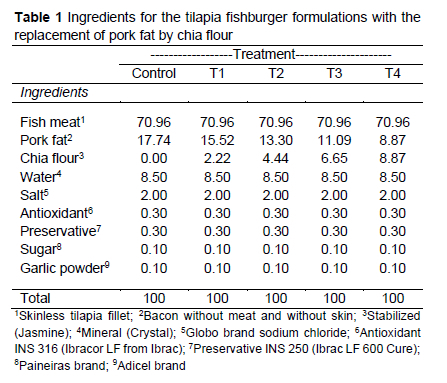
Five formulations of tilapia fishburgers were prepared, with a control formulation consisting exclusively of tilapia meat, pork fat, and additives and four formulations (T1-T4) with partial replacement of pork fat by chia flour (12.50, 25.00, 37.50, and 50.00%) (Table 1).
In order to make treatments T1, T2, T3 and T4, the chia flour was hydrated with water at room temperature (20-25 °C) and then the meat and other ingredients were added, one by one, in the proportions shown in Table 1. In all formulations, the ingredients were manually homogenized for ~10 min and then moulded into manual hamburger moulds of 12.5-cm diameter. The hamburgers were prepared as proposed by Novello & Pollonio (2012) with some modifications.
Samples of fishburgers were analysed in triplicate to determine moisture content, ash, protein, lipid, and dietary fibre according to the official methodology of AOAC (2019).
The moisture content was evaluated using the gravimetric method by drying in an oven at 105 °C until constant weight. The mineral matter was determined using the gravimetric method after the incineration of the organic matter in a muffle furnace at 550 °C. The protein analysis was performed using the conventional Kjeldahl method, and the fat content was measured using direct Soxhlet extraction. The dietary fibre content was established using the gravimetric method after acid digestion, and the non-nitrogen extract was determined by difference. The total energy value was estimated considering the Atwater conversion factors of 142 kcal/g of protein, 4 kcal/g of carbohydrate, and 9 kcal/g of lipid, according to Watt & Merril (1963).
Colour analysis was performed with the aid of a Model MiniScan EZ-HunterLab colourimeter, using D65 illuminant and an observation angle of 10° using the CIELab system. The results were expressed using angular coordinates: L* = luminosity (0 = black and 100 = white), a* (-80 to zero = green, from zero to +100 = red), and b* (-100 to zero = blue, from zero to +70 = yellow). From each treatment, four fishburgers were analysed, such that three samples were removed from each fishburger, and each sample was evaluated three times in the equipment, totalling 36 replicates.
The pH was measured in a potentiometer (Schott Handylab) using 5 g of each fishburger sample homogenized in 50 mL of distilled water for 5 min (Schott Handylab). Water activity (Aw) was determined by directly reading the samples at 25 °C using an Aw meter (Aqualab TE, Ecagon Devices, Pullman, WA).
The Instrumental Texture Profile (TPA) was performed with the Brookfield texturometer connected to a computer equipped with TexturePro CT V1.4 Build 17® software. Three samples measuring 30 × 30 × 10 mm were taken from four fishburgers, totalling 12 replicates. The test was performed using a cylindrical acrylic probe with a diameter of 38.1 mm, 50% sample compression, test speed of 1 mm/s, and 5 s between the two compressions. The parameters, hardness, cohesiveness, elasticity, gumminess, and chewiness were obtained (Szcesniak, 2002).
The fishburgers were grilled while still frozen on an electric grill at 200 °C. An average time of 8 min for cooking the fishburgers was standardized, with them being turned every 2 min to ensure the temperature in the centre of the product reached 75 °C (Arisseto & Pollonio, 2005). The yield of the fishburgers was calculated as the difference between the weight of the raw and grilled whole hamburger; the reduction in diameter and thickness of the raw and grilled fishburgers was also analysed (Bainy et al., 2015).
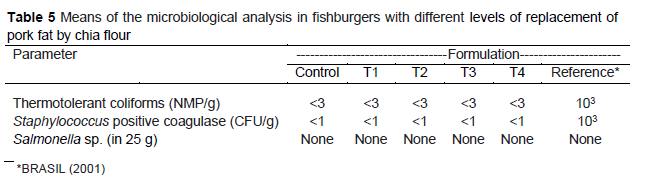
The microbiological analyses of the samples were carried out according to the official methods adopted by the Ministry of Agriculture and Supply and carried out as proposed by Silva et al. (2007). The results were compared with the standards stipulated by RDC n°12 (Brazil, 2001) for thermotolerant coliforms at 45 °C, Staphylococcus coagulase-positive, and Salmonella sp.
The experimental design was completely randomized (CRD) with five treatments and four repetitions (Control, T1, T2, T3 and T4). The results of the physico-chemical, instrumental, and cooking parameters of the fishburgers were subjected to analysis of variance (ANOVA) and the means were compared using the Scott-Knott test at 5% probability using statistical software (SAEG Version 9.1; SAEG, 2007). All analyses were performed in triplicate.
Results and Discussion
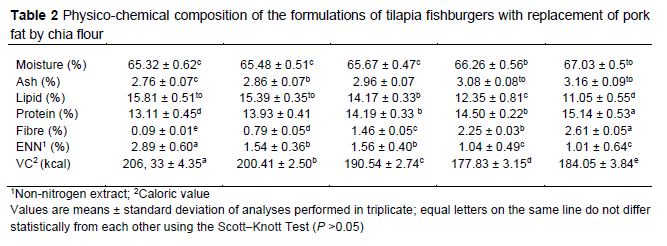
Table 2 shows the moisture, ash, lipid, protein, fibre, non-nitrogen extract, and the energy value of the five experimental formulations of fishburgers made with tilapia meat.
The studied samples had an average content of 65.95% moisture, 2.96% ash, 13.75% lipid, 14.17% protein, 1.44% dietary fibre, and 1.61% carbohydrate. The values were higher than those described by Bainy et al. (2015) for lipids (5.21%) and similar to the content of protein (13.98%) and minerals (2.17%) reported by the same authors in samples of raw tilapia hamburgers. There was an effect (P <0.05) in all tested parameters, proving that the replacement of pork fat by chia flour directly affected the nutritional and caloric value of the analysed formulations.
The incorporation of chia flour promoted an increase (P <0.05) in the contents of ash, protein, and dietary fibre. The increase in fibre reached 96% in T4, with a 13% increase in the protein value and >12% in the mineral composition over the control treatment. According to Capitani et al. (2013), chia flour is considered a food with excellent nutritional composition, since chia is a rich source of fibre (27.6 ± 0.1 g.100 g-1) and high biological value proteins (29.3 ± 0.4 g.100 g-1). The increase in the percentage of fibre is particularly interesting in hamburger formulations; despite being considered easy-to-prepare and widely-consumed, hamburgers generally have a low fibre content.
An improvement in nutritional value was also observed in a study conducted by Souza et al. (2014) in beef hamburgers with the inclusion of partially-defatted chia flour. In that study, the authors described an increase in the percentage of protein; ash; and omega-3 polyunsaturated fatty acids, especially alpha-linolenic acid. The authors concluded that the addition of chia by-products was an alternative to obtain nutritionally-balanced food. The increase in fibre content was also observed in a study by Rampe et al. (2022) in tilapia fishburgers with chia gel.
The results of the present research are also corroborated by Costantini et al. (2014), who investigated the enrichment of breads with the inclusion of chia flour; a consistent improvement in the nutritional content of the formulations (increase in protein, fibre, ash, and omega-3 fatty acids) was observed. Similarly, Sandri et al. (2017) reported increased contents of ash, lipid, protein, and dietary fibre in bread formulations enriched with 5% and 14% chia flour in comparison with gluten-free white bread.
Although chia flour is considered an excellent source of lipids, with more than 30% of its total composition as lipid (Muñoz et al., 2012), in the present study, the inclusion of this ingredient was responsible for promoting a reduction (P <0.05) in the lipid content in the fishburgers. Brazilian legislation determines that, to be considered "low fat" or "light", a product/food must present a 25% reduction in lipids compared to the traditional formulation (Brazil, 2012). Table 2 shows that the treatment with 50% replacement of pork fat by flour (T4) conforms to this specification.
Besides the lipid reduction, there was a ~10% decrease (P <0.05) in the caloric value of the formulations by incorporating 50% chia flour. Such results are satisfactory and demonstrate the ability of chia and its by-products to make food formulations healthier by promoting the reduction of both the lipid fraction and the caloric value, thus being attractive to consumers who seek low-calorie and low-fat food in meat products (Herrero et al., 2017). The results corroborate the findings of Souza et al. (2014) in hamburger formulations, who described a reduction in the caloric value of the formulations when partially replacing the mixture of beef and pork fat with partially-defatted chia flour.
The highest moisture values were observed in treatments T3 (37.5% replacement) and T4 (50% replacement), differing between themselves and among the other treatments (P <0.05). The present results corroborate the findings of Costantini et al. (2014), who observed an increase in moisture in bread formulations with added chia flour. The observed difference reflects the capacity of chia flour to retain moisture in the meat product, since chia has high-water retention capacity and is able to absorb more than 27 times its weight in water, resulting in the formation of a gel due to the presence of soluble fibre in its composition (Muñoz et al., 2012).
The inclusion of chia flour promoted a reduction (P <0.05) in the carbohydrate content of the tested samples. These findings concur with those of Fernandes & Salas-Mellado (2017) in bread formulations and Pereira et al. (2013) when making gluten-free potato breads enriched with chia flour. The chia flour, being rich in fibre, protein, minerals, and fat, can be used in food formulations to increase the nutritional value (Oliveira et al., 2015).
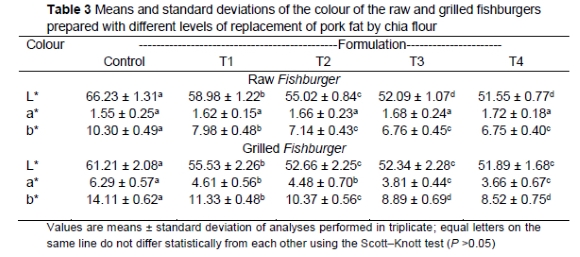
Values for the colour analysis of the five experimental samples of fishburgers are listed in Table 3. There were differences in light (L*) and yellow intensity (b*) in raw and cooked products, whereas the intensity of red (a*) was different only in grilled products (P <0.05).
The incorporation of chia flour was responsible for promoting a reduction (P <0.05) in the chromaticity of a* and b* coordinates of the samples submitted to thermal processing within the same colour spectrum, i.e., red (a* +) and yellow (b* +). The luminosity of the fishburgers decreased as the pork fat was replaced by the chia flour. This was an expected outcome, since chia flour is darker in colour than pork fat. Such results corroborate the findings of Fernandes & Salas-Mellado (2017) and Costantini et al. (2014) for the crumb and crust of breads made with chia flour instead of wheat and Rampe et al. (2022) for fishburgers made with chia gel. The luminosity observed in samples in the control group was 66.23 in the raw and 61.21 in the grilled samples. The results corroborate those described by Bainy et al. (2015), with values of 69.13 and 63.89 for raw and grilled tilapia burgers, respectively.
Thermal processing changed the colour of the tilapia fishburgers, making them slightly darker than the raw products. This is more evident when the comparison is made with the samples with lower percentages of chia flour inclusion (T1 and T2).
The difference observed for the L* parameter became less relevant in samples with 37.5% of pork fat replacement, given that, from this level onwards, the browning effect caused by the presence of flour is similar to that resulting from the production of melanoidins produced during Maillard reactions, which is responsible for the golden appearance observed on the surface of roasted meat products (Shibao & Bastos, 2011; Bainy et al., 2015).
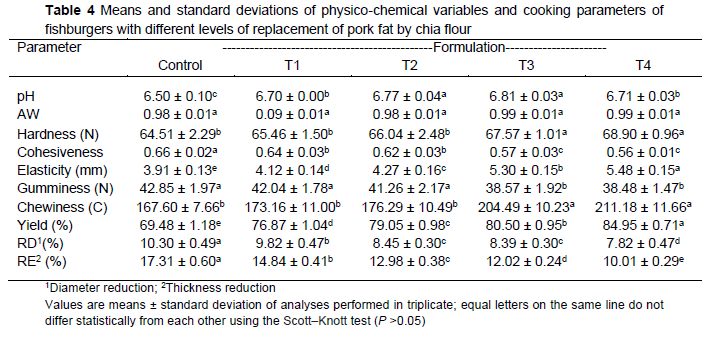
The water activity (Aw) was not influenced by the inclusion of chia flour (P >0.05). Note, however, that the values observed in all formulations were greater than 0.98, indicating high availability of free water. The high free water content can compromise the shelf life of formulations and influence not only safety, but also stability, since there is a greater propensity for microbial growth, as well as for the occurrence of deteriorative reactions, thus indicating greater susceptibility of the evaluated product (Welti & Vergara, 1997; Rita et al., 2012).
Samples of fishburgers had pH values close to neutrality of 6.50-6.8 that were influenced by the inclusion of chia flour (P <0.05). Combined with the high Aw observed in the present study, a pH close to neutral is considered conducive to the development of microorganisms. However, the pH value obtained in all formulations was in accordance with that recommended by Brazilian legislation, which requires a pH value <7.0 for fish meats considered suitable for consumption (Brazil, 2017). The results are similar to those described by Bainy et al. (2015), Muzzolon et al. (2018), and Zitroski et al. (2019) for Aw and pH of raw tilapia fishburgers.
The presence of chia flour in the formulations of fishburgers influenced the texture profile, promoting an increase in hardness, elasticity, and chewiness parameters and a reduction in the cohesiveness and gummyness of the evaluated samples ((P <0.05; Table 4). The results indicate that the presence of chia flour and the consequent increase in the fibrous fraction, in addition to reducing tenderness, made the samples of tilapia fishburgers more elastic and with a greater demand for energy needed for the chewing process.
The responses observed in the present study confirm the ability of chia flour to act as a modifier of the main attributes related to texture in food matrices, especially by acting as a thickening, gelling, and stabilizing agent (Capitani et al., 2012).
Trevisan et al. (2016), when evaluating oat fibre, described increased hardness and chewability with reduced cohesiveness but they did not observe changes in elasticity in cooked hamburger formulations. Similarly, López-Vargas et al. (2014), when analysing pork hamburger samples developed with passion fruit albedo fibre, reported an effect on all texture parameters evaluated and a tendency to lower elasticity and cohesiveness values upon the inclusion of flour.
Hardness represents one of the most important parameters of the texture of meat products, directly interfering with the quality of the products, and, therefore, influencing consumer preferences (Szczesniak, 2002).
There was a variation in cooking parameters by replacing pork fat with chia (P <0.05; Table 4). Yield is a valuable measure, especially for products subjected to thermal processing, as it reflects the observed weight after cooking. It is important that meat products maintain their original shape as much as possible, reducing losses with the cooking process, such as those arising from the exudation of liquids (Chaves et al., 2018). The fishburgers exhibited high yield percentages of 69-84%; the highest values of this variable were reached in the formulations with the highest percentages of chia flour (T3 and T4). The gain in yield was >18% in T4 when compared to control group (C); this is even more important when extrapolating to a greater volume of meat mass. For example, in a ton of fishburger, a gain of 180 kg can be achieved considering only the partial replacement of pork fat with chia flour.
Bainy et al. (2015) described a meat yield of grilled fish burgers of 85%. In a study evaluating the effects of the addition of yacon potato flour on the nutritional, technological, and sensory characteristics of tilapia fishburgers, Zitroski et al. (2019) reported yields of 69-74%. Chaves et al. (2018) described an increase in the yield of beef hamburger formulations when evaluating the use of a mix of flours (oats and flaxseed) to replace textured soy protein.
The fibre from chia seeds contains mucilage, which has properties similar to several hydrocolloids, with high absorption and water retention capacity. It is likely that the presence of mucilage and its high-water absorption capacity may have been effective in increasing yield, acting to reduce the free water content that tends to evaporate during the cooking process of fishburger samples (Muñoz et al., 2012).
The shrinkage was 25% smaller in the treatment with a higher percentage of chia inclusion compared to the control group. The reduction in thickness was 17.31% in control group and 10.01% in T4, i.e., an improvement of 42%. Therefore, the use of 50% chia flour to replace pork fat made fishburger samples more stable in the cooking process. The use of vegetable sources to replace pork fat positively affected both the yield and shrinkage reduction of hamburger samples made with beef and sheep in studies conducted by De Oliveira et al. (2014) and Seabra et al. (2002), respectively. Such results reaffirm the greater water retention capacity of the fibres composing the chia seed, ensuring the maintenance of the succulence of the final product and reducing losses during the cooking process (Muñoz et al., 2012; Capitani et al., 2013).
The microbiological results of the analysis of tilapia fishburgers are presented in Table 5 and demonstrate that the tested formulations do not present risks to the health of consumers, since the values are in accordance with the limit established by the current legislation (Brazil, 2001). The use of chia flour in partial replacement of pork fat did not negatively affect the microbiological quality of the developed products.
Conclusions
In the present study, chia flour proved to be a promising ingredient for partial replacement of pork fat, providing enrichment of the nutritional value of the samples, in addition to a substantial improvement in the cooking parameters. However, the changes observed in colour and texture profile reinforce the need for further studies to assess the sensory acceptance of fishburgers made with tilapia meat.
Conflicts of Interest
The authors declare that there is no conflict of interest.
Acknowledgements
To the Federal Institute of Science and Technology of Espírito Santo (Ifes - Campus de Alegre/ES). This study was financed in part by the Coordenação de Aperfeiçoamento de Pessoal de Nível Superior - Brasil (CAPES) Finance Code 001. To the State University of Norte Fluminense Darcy Ribeiro for the Ph.D. scholarship granted to the third author.
References
- AOAC. Official Methods of Analysis, 21st ed; Association of Official Analytical Chemists: Washington, DC, USA, 2011.
- Arisseto, A.P. & Pollonio, M.A.R., 2005. Avaliação da estabilidade oxidativa do hambúrguer tipo calabresa, formulado com reduzidos teores de nitrito e diferentes percentagens de gordura, durante armazenamento congelado. Higiene Alimentar 136, 72-80.
-
Bainy, E.M., Bertan, L.C., Corazza, M.L. & Lenzi, M.K., 2015. Effect of grilling and baking on physicochemical and textural properties of tilapia (Oreochromis niloticus) fish burger. J. Food Sci. Technol. 52, 5111 -5119. https://doi.org/10.1007/s13197-014-1604-3.
» https://doi.org/10.1007/s13197-014-1604-3 - BRAZIL, 2001. Agência Nacional de Vigilância Sanitária, RDC n° 12, de 02 de Janeiro de 2001. Regulamento técnico sobre padrões microbiológicos para alimentos. Diário Oficial da República Federativa do Brasil. Brasília, Agência Nacional de Vigilância Sanitária.
- BRAZIL, 2012. Agência Nacional de Vigilância Sanitária, RDC n° 54, de 12 de Novembro de 2012. Regulamento Técnico sobre Informação Nutricional Complementar. Diário Oficial da República Federativa do Brasil. Brasília, Agência Nacional de Vigilância Sanitária.
- BRAZIL, 2017. Regulamento da Inspeção Industrial e Sanitária de Produtos de Origem Animal (RIISPOA). Ministério da Agricultura, Pecuária e Abastecimento.
-
Capitani, M.I., Ixtaina, V.Y., Nolasco, S.M. & Tomás, M.C., 2013. Microstructure, chemical composition and mucilage exudation of chia (Salvia hispanica L.) nutlets from Argentina. J. Sci. Food Agric. 93, 3856-3862. https://doi.org/10.1002/jsfa.6327.
» https://doi.org/10.1002/jsfa.6327 -
Capitani, M.I., Spotorno, V., Nolasco, S.M. & Tomás, M.C., 2012. Physicochemical and functional characterization of by-products from chia (Salvia hispanica L.) seeds from Argentina. Food Sci. Technol. 45, 94-102. https://doi.org/10.1016/j.lwt.2011.07.012.
» https://doi.org/10.1016/j.lwt.2011.07.012 -
Chaves, M.A., Silva, J.M.A., Geniake, A.C.V., Dourado, E.C., Santos, M.P., Oliveira Santos, M.P. & Baldissera, E.M., 2018. Bovine meat hamburger with chia mixed flour, oats and linseed. Rev. Prod. Desenvolv. 4, 21 - 30. https://doi.org/10.32358/rpd.2018.v4.306.
» https://doi.org/10.32358/rpd.2018.v4.306 -
Costantini, L., Luksic, L., Molinaria, R., Kreft, I., Bonafaccia, G., Manzi, L. & Merendino, N., 2014. Development of gluten-free bread using tartary buckwheat and chia flour rich in flavonoids and omega-3 fatty acids as ingredients. Food Chem. 165, 232-240. https://doi.org/10.1016/j.foodchem.2014.05.095.
» https://doi.org/10.1016/j.foodchem.2014.05.095 -
De Oliveira, D.F., Coelho, A.R., Burgardt, V.C.F., Hashimoto, E.H., Lunkes, A.M., Marchi, J.F. & Tonial, I.B., 2013. Alternatives for a healthier meat product: A review. Braz. J. Food Technol. 16, 163-174. https://doi.org/10.1590/S1981-67232013005000021.
» https://doi.org/10.1590/S1981-67232013005000021 -
De Oliveira, D.F., Mileski, J.P.F., Carli, C.G., Marchi, J.F., Silva, D.C., Coelho, A.R. & Tonial, I.B., 2014. Golden flaxseed flour as a substitute for animal fat in reduced-sodium beef hamburgers. Braz. J. Food Technol. 17, 273-282. https://doi.org/10.1590/1981-6723.0714.
» https://doi.org/10.1590/1981-6723.0714 -
FAO, 2020. The State of World Fisheries and Aquaculture 2020. Sustainability in action. Disponível em: <http://www.fao.org/3/ca9229en/CA9229EN.pdf>. Acesso em: 02 de Março de 2023.
» http://www.fao.org/3/ca9229en/CA9229EN.pdf -
Fernandes, S.S. & Salas-Mellado, M.M., 2017. Addition of chia seed mucilage for reduction of fat content in bread and cakes. Food Chem. 227, 237-244. https://doi.org/10.1016/j.foodchem.2017.01.075.
» https://doi.org/10.1016/j.foodchem.2017.01.075 -
Fogaça, F.H.S., Otani, F.S., Portella, C.G., Santos-Filho, L.G.A. & Sant'Ana, L.S., 2015. Characterization of surimi from mechanically deboned tilapia meat and fishburger preparation. Semin.: Ciênc. Agrar. 36, 765-776. http://dx.doi.org/10.5433/1679-0359.2015v36n2p765.
» http://dx.doi.org/10.5433/1679-0359.2015v36n2p765 -
Herrero, A.M., Ruiz-Capillas, C., Pintado, T., Carmona, P. & Jimenez-Colmenero, F., 2017. Infrared spectroscopy used to determine effects of chia and olive oil incorporation strategies on lipid structure of reduced-fat frankfurters. Food Chem. 221, 1333-1339. https://doi.org/10.1016/j.foodchem.2016.11.022.
» https://doi.org/10.1016/j.foodchem.2016.11.022 -
López-Vargas, J., Fernández-López, J., Pérez-Álvarez, J.Á. & Viuda-Martos, M., 2014. Quality characteristics of pork burger added with albedo-fibre powder obtained from yellow passion fruit (Passiflora edulis var. Flavicarpa) co-products. Meat Sci. 97, 270-276. https://doi.org/10.1016/j.meatsci.2014.02.010.
» https://doi.org/10.1016/j.meatsci.2014.02.010 -
Mattje, L.G.B., Tormen, L., Bombardelli, M.C.M., Corazza, M.L. & Bainy, E.M., 2019. Ginger essential oil and supercritical extract as natural antioxidants in tilapia fish burger. J. Food Process. Preserv. 43, e13942. https://doi.org/10.1111/jfpp.13942.
» https://doi.org/10.1111/jfpp.13942 -
Mesías, M., Holgado, F., Márquez-Ruiz, G. & Morales, F.J., 2016. Risk/benefit considerations of a new formulation of wheat-based biscuit supplemented with different amounts of chia flour. LWT-Food Sci. Technol. 73, 528-535. http://dx.doi.org/10.1016/j.lwt.2016.06.056.
» http://dx.doi.org/10.1016/j.lwt.2016.06.056 -
Messias, C.R., Konopka, D.N., Biassi, D.C., Vianna, R.B., Quast, E., Bainy, E.M. & Poliseli-Scopel, F.H., 2016. Sensory training and characterization of fish burger formulations made with filleting byproducts of tilapia (Oreochromis niloticus). Braz. J. Food Res. 7, 125-142. https://doi.org/10.3895/rebrapa.v7n2.3652.
» https://doi.org/10.3895/rebrapa.v7n2.3652 - Milanez, A.Y., Guimarães, D.D., Maia, G.B.S., Muñoz, A.E.P. & Filho, M.X.P., 2019. Potential and barriers to exporting tilapias in Brazil. Embrapa Pesca Aquicult. 25, 155-470.
-
Mitterer-Daltoé, M.L., Nogueira, B.A., Rodrigues, D.P. & Breda, L.S., 2017. Sensory perception in the replacement of NaCl by MSG in fish burgers. Acta Sci. Technol. 39, 565-572. https://doi.org/10.4025/actascitechnol.v39i5.28660.
» https://doi.org/10.4025/actascitechnol.v39i5.28660 -
Muñoz, L.A., Cobos, A., Diaz, O. & Aguilera, J.M., 2012. Chia seeds: Microstructure, mucilage extraction, and hydration. J. Food Eng. 108, 216-224. https://doi.org/10.1016/jJfoodeng.2011.06.037.
» https://doi.org/10.1016/jJfoodeng.2011.06.037 -
Muzzolon, E., Biassi, D.C., Konopka, D.N., Oliveira, J., Poliseli-Scopel, F.H. & Bainy, E.M., 2018. Processamento de fishburguer utilizando subprodutos da filetagem de tilápia: Caracterização físico-química, análise do congelamento e avaliação da vida de prateleira. Braz. J. Food Res. 9, 154-173. https://doi.org/10.3895/rebrapa.v9n1.5251.
» https://doi.org/10.3895/rebrapa.v9n1.5251 -
Novello, D. & Pollonio, M.A.R., 2012. Adição de linhaça dourada (Linum usitatissimum L.) e derivados em hambúrgueres bovinos: aceitação sensorial e análise de sobrevivência. Bol. Cent. Pesqui. Process. Aliment. 30, 273-286. http://dx.doi.org/10.5380/cep.v30i2.30505.
» http://dx.doi.org/10.5380/cep.v30i2.30505 - Ogawa, M. & Maia, E.L., 1999. Manual de pesca: Ciência e tecnologia do pescado. São Paulo: Varela. 430 p.
-
Oliveira, M.R., Novack, M.E., Santos, C.P., Kubota, E. & Rosa, C.S., 2015. Avaliação da substituição da farinha de trigo por farinha de chia (Salvia hispanica L.) em massas alimentícias. Semin.: Ciênc. Agrar. 36, 2545-2554. 10.5433/1679-0359.2015v36n4p2545.
» https://doi.org/10.5433/1679-0359.2015v36n4p2545 -
Paschoal, E.C., Beltrami, J.M., Santos, I.C., Germano, R.M., Soares, A.A., Dias, J.C.P., Almada, A.F.B., De Sá, T.C., Gonçalves, D.D. & Otutumi, L.K., 2019. Estabilidade oxidativa da carne e derivados cárneos com o uso de antioxidantes naturais ou sintéticos em artigos publicados na base de dados da Scielo: Revisão de literatura. Med. Vet. (UFRPE) 13, 136-142. https://doi.org/10.26605/medvet-v13n1-2621.
» https://doi.org/10.26605/medvet-v13n1-2621 -
Peixe B.R., 2020 - Associação Brasileira da Piscicultura - Anuário Peixe BR da Piscicultura 2020. Disponível em: <https://www.peixebr.com.br/anuario-2020/>. Acesso em: 02 de Março de 2023.
» https://www.peixebr.com.br/anuario-2020/ -
Pereira, B.S., Pereira, B.S., Cardoso, E.S., Mendonça, J.O.B., Souza, L.B., Santos, M.P., Zago, L. & Freitas, S.M.L., 2013. Análise físico-química e sensorial do pão de batata isento de glúten enriquecido com farinha de chia. DEMETRA: Aliment., Nutr. Saúde 8, 125-136. https://doi.org/10.12957/demetra.2013.5646.
» https://doi.org/10.12957/demetra.2013.5646 -
Pintado, T., Herrero, A.M., Jiménez-Colmenero, F., Pasqualin Cavalheiro, C. & Ruiz-Capillas, C., 2018. Chia and oat emulsion gels as new animal fat replacers and healthy bioactive sources in fresh sausage formulation. Meat Sci. 135, 6-13. https://doi.org/10.1016/j.meatsci.2017.08.004.
» https://doi.org/10.1016/j.meatsci.2017.08.004 -
Rampe, M.C.C., Henry, F.C., Oliveira, R.F., Santos Junior, A.C., Maradini Filho, A.M. & Darlengo, M.C.J.D., 2022. Evaluation of chia gel incorporation as a fat substitute in Nile tilapia fishburger. S. Afr. J. Anim. Sci. 52, 621-629. http://dx.doi.org/10.4314/sajas.v52i5.06.
» http://dx.doi.org/10.4314/sajas.v52i5.06 -
Reyes-Caudillo, E., Tecante, E. & Valdivia-López, M.A., 2008. Dietary fibre content and antioxidant activity of phenolic compounds present in Mexican chia (Salvia hispánica L.) seeds. Food Chem. 107, 656-663. https://doi.org/10.1016/j.foodchem.2007.08.062.
» https://doi.org/10.1016/j.foodchem.2007.08.062 - Rita, G.M., Sofía, A.M., Betania, L.M., Carolina, F. & Elena, C.M., 2012. Rol de los hidrocoloides de semillas de chía y lino en la optimización de panificados libres de gluten. Diaeta. 30, 31 -38.
-
Sandri, L.T.B., Santos, F.G., Fratelli, C. & Capriles, V.D., 2017. Development of gluten-free bread formulations containing whole chia flour with acceptable sensory properties. Food Sci. Nutr. 5, 1021 -1028. https://doi.org/10.1002/fsn3.495.
» https://doi.org/10.1002/fsn3.495 - Seabra, L.M.J., Zapata, J.F.F., Nogueira, C.M., Dantas, M.A. & Almeida, R.B., 2002. Cassava starch and oatmeal as fat replacers of lamb burgers. Food Sci. Technol. 22, 245-248.
- Shibao, J. & Bastos, D.H.M., 2011. Maillard reaction products in foods: Implications for human health. Rev. Nutr. 24, 895-904.
- Silva, N., Junqueira, V.C.A., Silveira, N.F.A., Taniwaki, M.H., Santos, R.F.S. & Gomes, R.A.R., 2007. Manual de métodos de análise microbiológica de alimentos, 3rd ed. Livraria Varela: São Paulo, Brazil.
-
Souza, A.H., Gohara, A.K., Rotta, E.M., Chaves, M.A., Silva, C.M., Dias, L.F., Gomes, S.T.M., Souza, N.E. & Matsushita, M., 2014. Effect of the addition of chia by-products on the composition of fatty acids in hamburgers through chemometric methods. J. Sci. Food Agric. 95, 928-935. https://doi.org/10.1002/jsfa.6764.
» https://doi.org/10.1002/jsfa.6764 -
Szczesniak, A.S., 2002. Texture is a sensory property. Food Qual. Prefer. 13, 215-225. http://dx.doi.org/10.1016/S0950-3293(01)00039-8.
» http://dx.doi.org/10.1016/S0950-3293(01)00039-8 -
Trevisan, Y.C., Bis, C.V., Henck, J.M. & Barretto, A.C.B., 2016. Effect of the addition of oat fibre on the physicochemical properties of cooked frozen hamburger with reduced fat and salt. Braz. J. Food Technol. 19:e2015079. https://doi.org/10.1590/1981-6723.7915.
» https://doi.org/10.1590/1981-6723.7915 - Watt, B. & Merrill, A.L., 1963. Composition of Foods: Raw, Processed, Prepared; Agriculture Handbook, 8; Consumer and Food Economics Research Division/Agricultural Research Service: Washington, DC, USA, p.198.
- Welti, J. & Vergara, F., 1997. Atividade de água / Conceito y aplicación em alimentos com alto contenido de humedad. In: AGUILERA, J.M. Temas em Tecnologia de Alimentos. Santiago de Chile: Universidad de Santiago de Chile, p.11-26.
-
Zitroski, N., Vendruscolo, T.A.D., Kuasnei, M., Pinto, V.Z., Bainy, E.M., 2019. Características nutricionais, tecnológicas e sensoriais de fishburger de tilápia com adição de farinha de yacon (Smallanthus sonchifolius). Ver. Bras. Tecnol. Agroind. 13, 2840-2862. http://dx.doi.org/10.3895/rbta.v13n1.7267.
» http://dx.doi.org/10.3895/rbta.v13n1.7267
Accepted 7 August 2024
Published 30 September 2024