Artificial neural networks for predicting first-lactation 305-day milk yield in crossbred cattle
Abstract
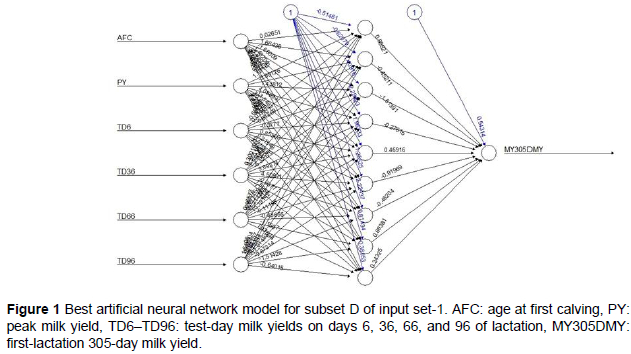
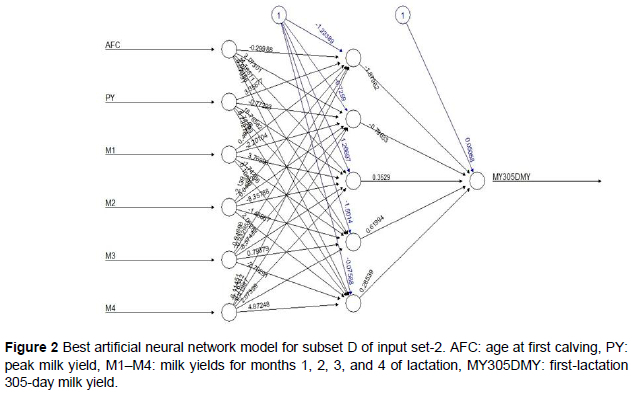
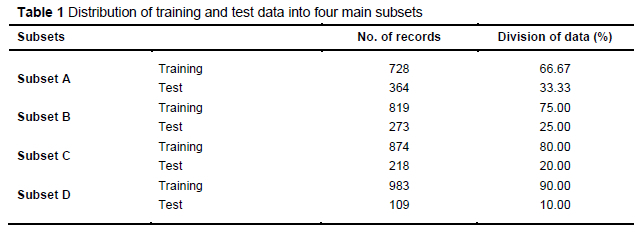
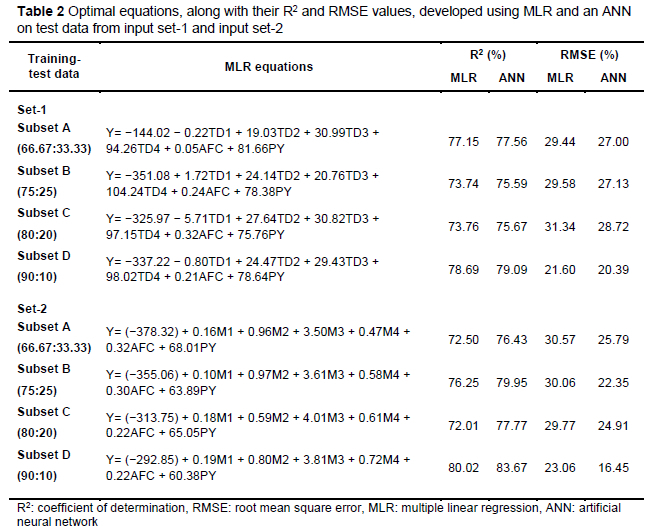
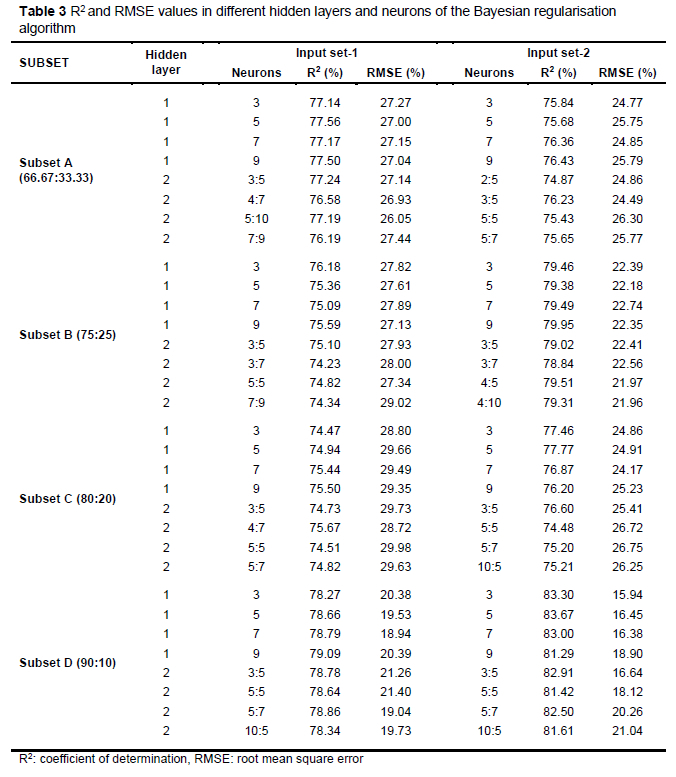
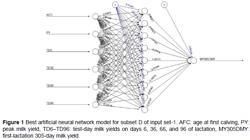
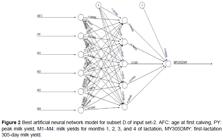
This study was conducted using the first-lactation records of 1092 Vrindavani crossbred cattle to compare the relative efficiency of an artificial neural network (ANN) versus multiple linear regression for predicting the first-lactation 305-day milk yield (FL305DMY). The two input sets used for predicting FL305DMY in the study were input set-1 : first four monthly test-day milk yields, age at first calving, and peak milk yield; and input set-2: first four monthly milk yields, age at first calving, and peak milk yield. The ANN was trained using a backpropagation algorithm based on Bayesian regularisation, and the algorithm was tested using four sets of training and test data at ratios of 66.67:33.33, 75:25, 80:20, and 90:10. The results revealed that the coefficient of determination showed no regular trend with decreasing the test dataset. Nevertheless, the observed values were highest for the 90:10 ratio of training-test data for both input sets, with the lowest root mean square error. The ANN model outperformed the multiple linear regression model when predicting FL305DMY, with an accuracy of 79.09% for input set-1 and 83.67% for input set-2, with the lowest root mean square error values for both input sets. Therefore, the ANN model can be used as an alternative technique to predict FL305DMY in Vrindavani cows.
Bayesian regularisation; milk; multiple linear regression; Vrindavani cattle
 Thumbnail
 Thumbnail