Artificial neural networks for predicting first-lactation 305-day milk yield in crossbred cattle
Abstract
This study was conducted using the first-lactation records of 1092 Vrindavani crossbred cattle to compare the relative efficiency of an artificial neural network (ANN) versus multiple linear regression for predicting the first-lactation 305-day milk yield (FL305DMY). The two input sets used for predicting FL305DMY in the study were input set-1 : first four monthly test-day milk yields, age at first calving, and peak milk yield; and input set-2: first four monthly milk yields, age at first calving, and peak milk yield. The ANN was trained using a backpropagation algorithm based on Bayesian regularisation, and the algorithm was tested using four sets of training and test data at ratios of 66.67:33.33, 75:25, 80:20, and 90:10. The results revealed that the coefficient of determination showed no regular trend with decreasing the test dataset. Nevertheless, the observed values were highest for the 90:10 ratio of training-test data for both input sets, with the lowest root mean square error. The ANN model outperformed the multiple linear regression model when predicting FL305DMY, with an accuracy of 79.09% for input set-1 and 83.67% for input set-2, with the lowest root mean square error values for both input sets. Therefore, the ANN model can be used as an alternative technique to predict FL305DMY in Vrindavani cows.
Bayesian regularisation; milk; multiple linear regression; Vrindavani cattle
Introduction
Early milk yield prediction is crucial for dairy cattle herd strength and breeding policy, as low-producing cows can be identified early for judicious culling and economic benefits (Kominakis et al., 2002; Abd El-Hack et al. 2018; Abdelnour et al., 2019; Raza et al., 2020a,b; Youssef et al., 2023).
Conventional linear models based on single linear regression or multiple linear regression (MLR), stepwise multiple regression, projection pursuit regression, logistic regression, or partial least-squares regression, have been used globally as prediction tools for predicting production parameters, but they carry some inherent drawbacks. For example, several variables involved in modelling various biological processes are not quantitative. It is therefore difficult to incorporate such models into conventional empirical or statistical models, and their practical application and prediction power are thus limited.
Artificial neural networks (ANNs) are mathematical models of computational techniques inspired by biological neural networks, and are a component of machine learning (Gabriel, 2016). Artificial neural networks are sometimes called the sixth generation of computing, because they simulate neural networks, connectionist models, and parallel distributed processing. They are also adaptive and change their modelling based on internal or external information that flows through networks. Artificial neural networks have been used in fields like bioinformatics, economic prediction, medical diagnosis, and engineering, but less work has been done on their potential use in animal sciences. A backpropagation-based neural network model was reported to be useful for predicting improved dairy yield (Salehi et al., 1998; Grzesiak et al., 2003), and ANNs were successfully used in a study on dairy milk prediction and cow culling decisions (Lacroix et al., 1997). Artificial neural networks can also be used to decrease the interval between collecting records and computing animal breeding values (Nosrati et al., 2021). In addition, real-world data and ANN-predicted data from the first lactation can be used to compute estimated breeding values (Nosrati et al., 2021).
This study aimed to predict the first-lactation milk yield early in lactation using test-day milk yields, monthly milk yields, age at first calving (AFC), and peak milk yield (PY) in crossbred cattle, using an ANN.
Materials and methods
For this study, records on the first-lactation traits of 1092 Vrindavani cows were collected. Vrindavani cows are a type of crossbred cattle that were developed by crossing exotic Holstein-Friesian, Brown Swiss, and Jersey cattle with indigenous Hariana cattle.
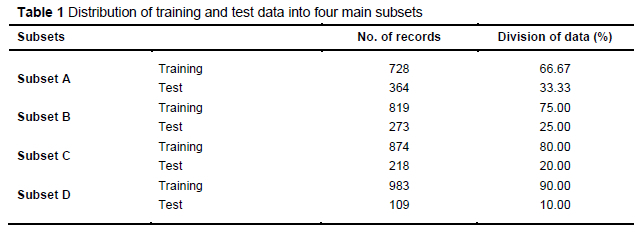
A total of four test-day milk yields were collected at intervals of 30 days, on the 6th, 36th, 66th, and 96th days of lactation (TD6, TD36, TD66, and TD96, respectively). Each individual cow's first four monthly milk yields, for the 1st, 2nd, 3rd, and 4th months of lactation (M1, M2, M3, and M4), were also collected. In addition, PY and AFC data were collected as input variables for predicting milk yield during the first 305 days of the first lactation (FL305DMY). Thus, in this study, 4368 test-day and 4368 monthly milk yields from the first-lactation records of 1092 animals were used for prediction. These datasets were partitioned randomly into four training and test sets: subsets A, B, C, and D (Table 1). The training sets were used to estimate the regression parameters, and the test sets were used to validate the estimated regression parameters in terms of the prediction accuracy of the training sets.
The values of the input and target patterns were scaled to [-1, 1] prior to training. The input variables were divided into two input sets: input set-1 and input set-2. In input set-1, the first four test-day milk yields (TD6, TD36, TD66, and TD96), along with the AFC and PY, were used, and in input set-2, the first four monthly milk yields (M1, M2, M3, and M4), along with the AFC and PY, were used.
The ANN, a multilayer feed-forward neural network with a backpropagation error learning mechanism, was developed using the Neural Network Toolbox (NNT) of MATLAB 7.8.0 (Matlab Users' Guide, R2009a) to predict FL305DMY. The network was trained and simulated using a Bayesian regularisation (BR) backpropagation algorithm for up to 4000 epochs (where an epoch is a single pass through the sequence of all input vectors), or until the algorithm truly converged. The input and target data were processed to ensure that their mean was 0 and the standard deviation was 1, using the NNT feature as per the algorithm's requirements. Network parameters, such as learning rate (0.01), momentum (0.05), and error goal (0), were used as the default settings of the proposed algorithm. All parameters were kept at their default values, as enforced by the NNT in MATLAB (Ghedira et al., 2004). The artificial neural network plots were developed for both input sets using R-Studio 1.2.1335.0.
The Levenberg-Marquardt algorithm with BR (Foresee et al., 1997) minimises the linear combination of weights and squared errors, resulting in good network generalisation qualities at the end of training. The BR algorithm does not require regularisation for the weight-decay method because it possesses an inbuilt regularisation feature. Backpropagation was used to estimate the Jacobian performance of the bias variables and weight (Foresee & Hagan, 1997). Each variable was adjusted using the Levenberg-Marquardt algorithm. Without computing the Hessian matrix, the Levenberg-Marquardt training algorithm was designed to achieve second-order training speed (Hagan et al., 1994).
The models' performance and accuracy were tested based on each training function evaluated using the coefficient of determination (R2-value) and root mean square error (RMSE) values for the test data. The network was tested with one hidden layer containing 3, 5, 7, and 9 neurons and two hidden layers containing 2:5, 2:10, 3:5, 3:6, 3:7, 4:7, 4:10, 5:5, 5:7, and 10:5 neurons. The initial bias matrix and weights were randomly initialised between -1 and 1. The tangent sigmoid, which is based on a nonlinear transformation function, was used to determine the output from the summation of weighted neuron inputs in each hidden layer. The original linear transformation function was used in the output layer of the network response. The designed network was trained in supervisory mode using the BR variant of the backpropagation of the error learning algorithm.
Results and discussion
The average test-day milk yields for TD6, TD36, TD66, and TD96 were 7.72 ± 0.10 kg, 10.88 ± 0.11 kg, 10.64 ± 0.10 kg, and 9.96 ± 0.10 kg, respectively, whereas the average monthly milk yields for M1, M2, M3, and M4 were 127.0 ± 3.00 kg, 322.04 ± 3.13 kg, 326.56 ± 3.12 kg, and 308.38 ± 3.94 kg, respectively. The PY and first-lactation 305-day milk yield were 14.44 ± 0.10 kg and 2555.40 ± 26.63 kg, respectively, while the AFC was 975.44 ± 4.59 days.
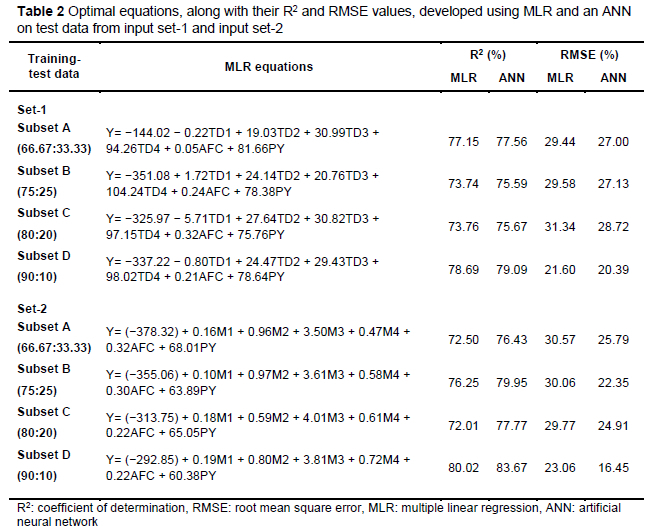
The FL305DMY model was predicted from input set-1 and input set-2 by MLR using different training-test sets (Table 2). Input set-1 showed that subset D had the highest R2 (78.69%) and lowest RMSE (21.60%), while the lowest R2 (73.74%) was obtained from subset B, with an RMSE of 29.58%, and subsets A and C had intermediate values. For input set-2, subset D exhibited the highest R2 (80.02%) and the lowest RMSE (23.06%). The lowest R2 (72.01%) was obtained from subset C, with an RMSE of 29.77%, and subsets A and B had intermediate values. The R2 and RMSE values for the MLR did not show a trend for input set-1 (Table 2).
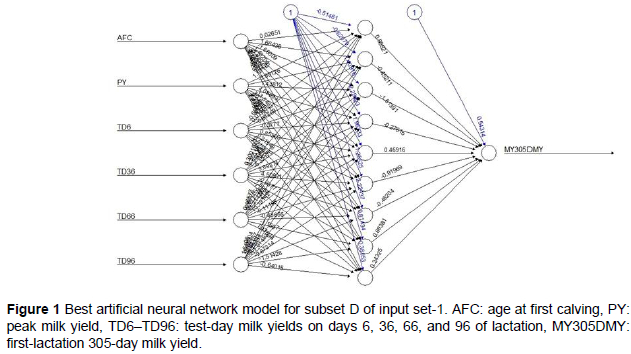
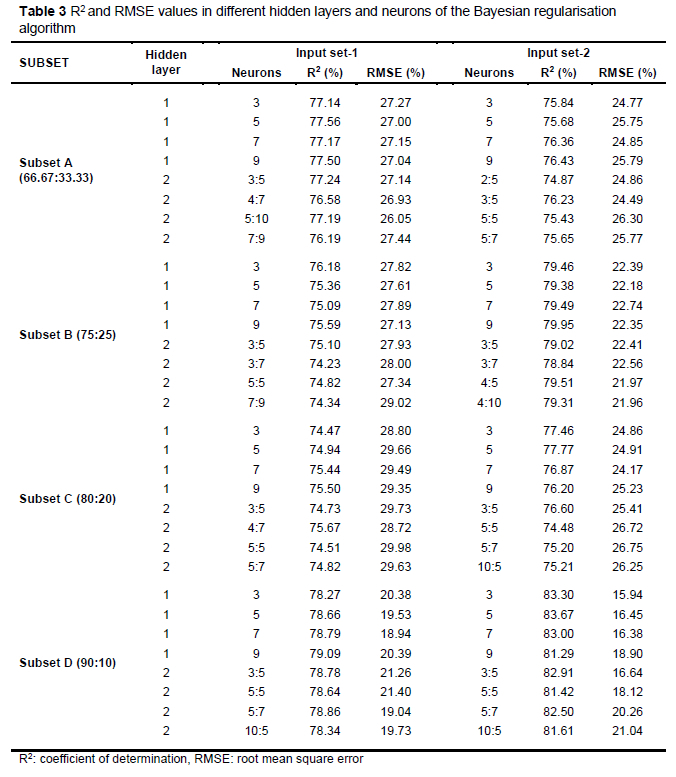
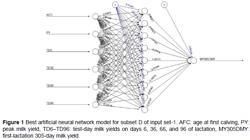
The FL305DMY prediction was performed by the ANN on different training-test sets. Various combinations of hidden layers with several neurons in a particular hidden layer were used to improve the R2 and RMSE values for both input sets. For input set-1, the highest R2 achievable for subset A was 77.56%, and its RMSE was 27.00%, with one hidden layer having five neurons (Table 3). For subset B, the highest R2 achievable was 76.18%, and its RMSE was 27.82%, with one hidden layer containing three neurons. Subsets C and D showed the highest achievable R2 values (75.67% and 79.09%, respectively) and RMSE values (28.72% and 20.39%, respectively), with two hidden layers having 4:7 neurons and one hidden layer having 9 neurons, respectively. Of the four subsets, subset D showed the highest R2 and lowest RMSE, and the best ANN model was thus developed for subset D (Figure 1).
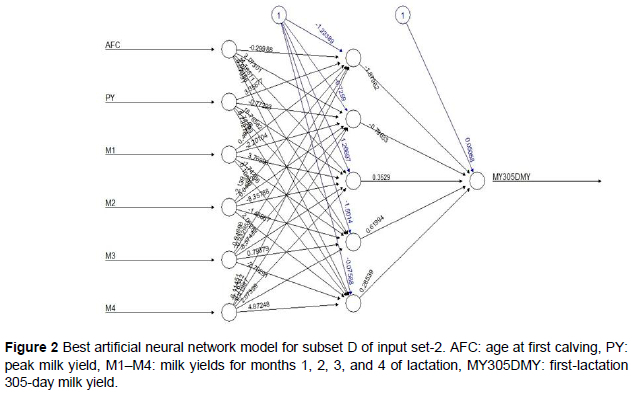
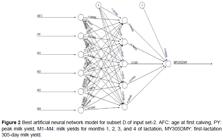
For input set-2, subset A showed the highest achievable R2 of 76.43%, with an RMSE of 25.79%, with one hidden layer with nine neurons, and subset B showed the highest achievable R2 of 79.95%, with an RMSE of 22.35%, with one hidden layer with nine neurons (Table 3). The highest achievable R2 (77.77%) and RMSE (24.91%) values were obtained for subset C, with one hidden layer having five neurons. For subset D, the highest achievable R2 (83.67%) and RMSE (16.45%) values were obtained with a hidden layer with five neurons. Of the four subsets, the highest R2 and lowest RMSE values were obtained for subset D, and the best ANN model was thus developed for subset D (Figure 2). The R2 and RMSE values showed no regular trend in decreasing the percentage of the test datasets for both input sets.
The ANN model achieved higher R2 values and lower RMSE values than the MLR model for all subsets in both input sets for predicting FL305DMY in Vrindavani cows. For input set-1, the best ANN algorithm achieved an optimum level of accuracy of 79.09% and an RMSE of 20.39%, whereas the MLR model achieved 78.69% accuracy and an RMSE value of 21.60%. For input set-2, the best ANN algorithm achieved an optimum model accuracy of 83.67% and RMSE of 16.45%, whereas the MLR model achieved an optimum accuracy of 80.02% and RMSE of 23.06%. The R2 and RMSE values and the optimum equations for the ANN and MLR on the test dataset for the different subsets are listed in Table 2.
Early prediction of the FL305DMY using the test-day milk yield and the first few monthly milk yields would be useful under field conditions in which infrastructure and recording facilities are limited. When predicting the FL305DMY using the ANN based on input set-1, the highest R2 and lowest RMSE values were observed in subset D. Similar findings were observed by Grzesiak et al. (2006), who used test-day milk yield to predict standardised and full-lactation milk yield, and obtained an R2 of 77% and an RMSE of 14.74%.
However, Lacroix et al. (1995) reported better predictive properties for ANNs, mainly because they used larger and more comprehensive datasets and more independent variables, including the stage of lactation, for ANN design. Dongre et al. (2012) reported an ANN that explained a higher R2 (86.08%) for predicting FL305DMY, using fortnightly test-day records of Sahiwal cows. Gorgulu (2012) also obtained higher R2 values (90%), using a few test-day records and some environmental factors, such as age, number of lactations, and season of calving, for predicting 305-day milk yield in Brown Swiss cattle using an ANN.
Bhosale & Singh (2015) used an ANN to predict milk yield in Frieswal cows using the first five test-day milk yields at monthly intervals, and obtained an accuracy of 85.07%. For input set-2, the ANN value for subset D obtained the highest R2 value (83.67%). However, Mundhe et al. (2014) reported that an ANN explained a higher R2 (89.29%) for predicting FL305DMY using monthly part lactation milk yield records for Sahiwal cattle.
The higher accuracy obtained in these previous studies may have been because of their use of more input variables. Nonetheless, the results of our study indicate that FL305DMY can be predicted in Vrindavani cows early in the first lactation using the first four test-day milk yields and the first four monthly milk yields, along with the AFC and PY, using an ANN. The highest R2 and lowest RMSE values were observed in subset D, and the lowest R2 was observed in subset C. The MLR models for both input sets showed that subset D explained the highest R2 and lowest RMSE values. Similar findings were reported by Saini et al. (2005), who observed that a prediction equation with three variables (1st, 2nd, and 7th monthly test-day milk yields) was adequately accurate (78.48%) when estimating the 300-day milk yield from test-day yields in Rathi cows. Njubi et al. (2010) similarly reported that a prediction equation using four test-day milk yields resulted in adequate accuracy (79.0%) when predicting the FL305DMY from test-day milk yields in Kenyan Holstein-Friesian cows. Chandrakar (2018) predicted FL305DMY using monthly milk yields in Vrindavani cows and observed that the highest R2 value was obtained for the fifth month (79.42%), and suggested that 5th month milk yield could be used as the most effective predictor for FL305DMY early in lactation.
In this study, the R2 value was higher for the ANN than the MLR, and the RMSE values were lower for the ANN than the MLR. Sanzogni & Kerr (2001) compared the quantitative properties of MLR and an ANN, and reported that MLR was superior to the ANN and that the RMSE values for the ANN and MLR were similar. Sharma et al. (2006) predicted FL305DMY in Karan Fries cows comparing the RBFNN and MLR models. The RBFNN model had a slightly lower RMSE (9.44%) than MLR (9.46%). In another study, Sharma et al. (2007) predicted the first-lactation milk yield in Karan Fries cattle and reported that the ANN model had a slightly higher accuracy (92.03%) than the MLR model (91.38%). Gandhi et al. (2012) predicted FL305DMY using monthly test-day milk records in Sahiwal cows and found no significant differences between the ANN and MLR values, although the ANN achieved a slightly lower accuracy (93.18%) than MLR, which achieved an accuracy of 93.77%. Bhosale & Singh (2015) reported that an ANN model had a slightly higher accuracy (85.07%) than an MLR model (84.60%) in predicting FL305DMY using test-day milk records. Mundhe et al. (2014) reported a higher R2 (89.29%) for an ANN when predicting FL305DMY using monthly part lactation milk yield records in Sahiwal cattle.
Gandhi et al. (2009) developed equations to predict lifetime milk production in Sahiwal cattle and found that ANN estimates were higher than MLR estimates. Similarly, the RMSE of the prediction was lower for the MLR than for the ANN. The prediction accuracy of lifetime milk production in Sahiwal cattle using MLR was lower than the accuracy of the ANN model, and the RMSE values were lower for the ANN than the MLR (Gandhi et al., 2010).
While the results are promising, this study has certain limitations that warrant attention. Firstly, the dataset was restricted to Vrindavani crossbred cattle, which may limit the generalisability of the models to other breeds or populations. Future studies should incorporate data from diverse breeds and environmental conditions to enhance the robustness of the models. Additionally, the study focused solely on a few easily measurable traits, excluding other potential predictors such as health status, feed intake, and environmental factors. Incorporating these variables into future research could further improve prediction accuracy. The ANN model's reliance on extensive computational resources and its black-box nature also highlight the need for explainable artificial intelligence techniques to improve transparency and trust in its predictions. Finally, external validation using independent datasets is essential to confirm the applicability of the models in different contexts. Advanced machine-learning techniques, such as ensemble models and recurrent neural networks, can also be explored to further enhance predictive performance.
Conclusion
In the present study, the R2 was slightly higher for the ANN than MLR for the prediction of FL305DMY using the first four monthly test-day milk yields, AFC, and PY. The R2 was also higher for the ANN than MLR during the prediction of FL305DMY using the first four monthly milk yields, AFC, and PY. Hence, the ANN model can be effectively used as an alternative tool for predicting FL305DMY, using both test-day and monthly milk yields, along with the AFC and PY, in Vrindavani cattle. This study demonstrated the superiority of ANNs over MLR for predicting FL305DMY in crossbred cattle, emphasising the potential of machine-learning approaches in dairy science. Although ANN models offer significant advantages in capturing complex biological relationships, their adoption in practical settings requires addressing the challenges related to computational demand and interpretability. Future research should focus on expanding datasets, integrating additional predictors, and validating models across diverse populations and environments.
Authors' contributions
SMU (ORCID: 0000-0001-8506-2929) conceptualisation, data collection, methodology, analysis, writing, and original draft preparation; TD (ORCID: 0000-0002-6029-0236) data collection, methodology, and review; QSS (ORCID: 0000-0003-4558-2860) laboratory analysis, writing, and review; NPS (ORCID: 0000-0002-8043-6298) laboratory analysis, writing, and review; RT (ORCID: 0000-0003-4426-7359) and JC (ORCID: 0009-0009-9596-1667) laboratory analysis, writing, and editing; MMAG (ORCID: 0000-0002-1788-5082) data analysis, writing, and review; IMY (ORCID: 0000-0003-3280-4495) analysis, writing, review, and editing; AS (ORCID: 0000-0002-1598-1820) analysis, writing, review, and editing; AK (ORCID: 0000-0002-6495-7253) laboratory analysis, writing, and review; AAS (ORCID: 0000-0003-3247-5898) data collection, analysis, writing, review, and editing.
Conflict of interest declaration
The authors declare that they have no conflicts of interest related to the content of this paper.
Acknowledgment
The authors extend their appreciation to the Researchers Supporting Project, number RSPD2025R971, King Saud University, Riyadh, Saudi Arabia, for funding this research. The authors are also highly thankful to the Director, ICAR-IVRI, Izatnagar, Bareilly, for providing the basic and necessary facilities. We would also like to sincerely thank the Livestock Production Management Section of ICAR-IVRI for providing the data used in this study. The research work was supported by grants received from CAAST-ACLH (NAHEP/CAAST/2018-19) from the ICAR World Bank-funded National Agricultural Higher Education Project (NAHEP).
References
-
Abd El-Hack, M.E., Abdelnour, S.A., Swelum, A.A., & Arif, M., 2018. The application of gene marker-assisted selection and proteomics for the best meat quality criteria and body measurements in Qinchuan cattle breed. Mol. Biol. Rep., 45, 1445-1456. doi 10.1007/s11033-018-4211-y
» https://doi.org/10.1007/s11033-018-4211-y -
Abdelnour, S.A., Abd El-Hack, M.E., Khafaga, A.F., Arif, M., Taha, A.E., & Noreldin, A.E., 2019. Stress biomarkers and proteomics alteration to thermal stress in ruminants: A review. J. Therm. Biol., 79, 120-134. doi 10.1016/j.jtherbio.2018.12.013
» https://doi.org/10.1016/j.jtherbio.2018.12.013 -
Bhosale, M.D. & Singh, T.P., 2015. Comparative study of feed-forward neuro-computing with multiple linear regression model for milk yield prediction in dairy cattle. Curr. Sci., 108(12), 2257-2260. doi 10.18520/cs/v113/i05/951-955
» https://doi.org/10.18520/cs/v113/i05/951-955 - Chandrakar, J., 2018. Prediction of 305 days milk yield using test day milk records in crossbred cattle. MSc thesis, Deemed University, Indian Veterinary Research Institute, Bareilly, India.
-
Dongre, V.B., Gandhi, R.S., Singh, A., & Ruhil, A.P., 2012. Comparative efficiency of artificial neural networks and multiple linear regression analysis for prediction of first lactation 305-day milk yield in Sahiwal cattle. Livest. Sci., 147(1-3), 192-197. doi 10.1016/j.livsci.2012.04.002
» https://doi.org/10.1016/j.livsci.2012.04.002 - Foresee, F.D. & Hagan, M.T., 1997. Gauss-Newton approximation to Bayesian regularization. In: Proceedings of the IEEE International Joint Conference on Neural Networks, vol. 3, 1930-1935. doi 10.1109/ijcnn.1999.831145
- Gabriel, J., 2016. Artificial Intelligence: Artificial Intelligence for Humans (1st ed). CreateSpace Independent Publishing Platform, USA. doi 10.1093/wentk/9780190602383.003.0001
-
Gandhi, R.S., Monalisa, D., Dongre, V.B., Ruhil, A.P., Singh, A., & Sachdeva, G.K., 2012. Prediction of first lactation 305-day milk yield based on monthly test day records using artificial neural networks in Sahiwal cattle. Indian J. Dairy Sci., 65(3), 229-233. doi 10.18805/ijar.b-3963
» https://doi.org/10.18805/ijar.b-3963 -
Gandhi, R.S., Raja, T., Ruhil, A.P., & Kumar, A., 2009. Prediction of lifetime milk production using artificial neural network in Sahiwal cattle. Indian J. Anim. Sci., 79, 1038-1040. doi 10.56093/ijans.v85i5.48567
» https://doi.org/10.56093/ijans.v85i5.48567 -
Gandhi, R.S., Raja, T., Ruhil, A.P., & Kumar, A., 2010. Artificial neural network versus multiple regression analysis for prediction of lifetime milk production in Sahiwal Cattle. J. Appl. Anim. Res., 38, 233-237. doi 10.1080/09712119.2010.10539517
» https://doi.org/10.1080/09712119.2010.10539517 - Ghedira, H. & Bernier, M., 2004. The effect of some internal neural network parameters on SAR texture classification performance. In: Proceedings of the IEEE International Geosciences and Remote Sensing Symposium, 6, Anchorage, Alaska, USA. pp: 3845-3848. doi 10.1109/igarss.2004.1369962
-
Gorgulu, O., 2012. Prediction of 305-day milk yield in Brown Swiss cattle using artificial neural networks. S. Afr. J. Anim. Sci., 42(3), 208-287. doi 10.4314/sajas.v39i1.43540
» https://doi.org/10.4314/sajas.v39i1.43540 -
Grzesiak, W., Blaszczyk, P., & Lacroix, R., 2006. Methods of predicting milk yield in dairy cows-Predictive capabilities of Wood's lactation curve and artificial neural networks (ANNs). Comp. Electron. Agric., 54(2), 69-83. doi 10.1016/j.compag.2006.08.004
» https://doi.org/10.1016/j.compag.2006.08.004 -
Grzesiak, W., Lacroix, R., Wójcik, J., & Blaszczyk, P., 2003. A comparison of neural network and multiple regression predictions for 305-day lactation yield using partial lactation records. Canadian J. Anim. Sci., 83(2), 307-310. doi 10.4141/a02-002
» https://doi.org/10.4141/a02-002 -
Hagan, M.T. & Menhaj, M.B., 1994. Training feedforward networks with the Marquardt algorithm. IEEE Trans. Neur. Net., 5(6), 989-993. doi 10.1109/72.329697
» https://doi.org/10.1109/72.329697 -
Kominakis, A.P., Abas, Z., Maltaris, I., & Rogdakis, E., 2002. A preliminary study of the application of artificial neural networks to prediction of milk yield in dairy sheep. Comp. Electron. Agric., 35(1), 35-48. doi 10.1016/s0168-1699(02)00051-0
» https://doi.org/10.1016/s0168-1699(02)00051-0 -
Lacroix, R., Salehi, F., Yang, X.Z., & Wade, K.M., 1997. Effects of data pre-processing on the performance of artificial neural network for dairy yield prediction and cow culling classification. Trans. American Soc. Agric. Engin., 40, 839-846. doi 10.13031/2013.21294
» https://doi.org/10.13031/2013.21294 -
Lacroix, R., Wade, K.M., Kok, R., & Hayes, J.F., 1995. Prediction of cow performance with a connectionist model. Trans. American Soc. Agric. Engin., 38, 1573-1579. doi 10.13031/2013.27984
» https://doi.org/10.13031/2013.27984 -
Mundhe, U.T., Gandhi, R.S., Das, D.N., Dongre, V.B., & Gupta, A., 2015. Genetic and non-genetic factors affecting monthly part lactation milk yields in Sahiwal cattle. Indian J. Anim. Sci., 85(5), 517-518. doi 10.56093/ijans.v85i5.48586
» https://doi.org/10.56093/ijans.v85i5.48586 -
Njubi, D.M., Wakhungu, J.W., & Badamana, M.S., 2010. Use of test-day records to predict first lactation 305-day milk yield using artificial neural network in Kenyan Holstein-Friesian dairy cows. Trop. Anim. Health Prod., 42, 639-644. doi 10.1007/s11250-009-9468-7
» https://doi.org/10.1007/s11250-009-9468-7 -
Nosrati M., Hafezian S.H., & Gholizadeh M., 2021. Estimating heritabilities and breeding values for real and predicted milk production in Holstein dairy cows with artificial neural network and multiple linear regression models. Iranian J. Appl. Anim. Sci., 11(1), 67-78. doi 10.31274/rtd-180816-3754
» https://doi.org/10.31274/rtd-180816-3754 -
Raza, S.H.A., Kaster, N., Khan, R., Abdelnour, S.A., El-Hack, M.E.A., Khafaga, A.F., Taha, A., Ohran, H., Swelum, A.A., Schreurs, N.M., & Zan, L., 2020b. The role of microRNAs in muscle tissue development in beef cattle. Genes, 11(3), 295. doi 10.3390/genes11030295
» https://doi.org/10.3390/genes11030295 -
Raza, S.H.A., Khan, S., Amjadi, M., Abdelnour, S.A., Ohran, H., Alanazi, K.M., Abd El-Hack, M.E., Taha, A.E., Khan, R., Gong, C., Schreurs, N.M., Zhao, C., Wei, D., & Zan, L., 2020a. Genome-wide association studies reveal novel loci associated with carcass and body measures in beef cattle. Arch. Biochem. Biophys., 694, 108543. doi 10.1016/j.abb.2020.108543
» https://doi.org/10.1016/j.abb.2020.108543 -
Saini, T., Gahlot, G.C., & Kachwaha, R.N., 2005. Prediction of 300 days lactation yield on the basis of test day milk yield in Rathi Cows. Indian J. Anim. Sci., 75(9), 1087-1089. doi 10.18805/ijar.b-3963
» https://doi.org/10.18805/ijar.b-3963 -
Salehi, F., Lacroix, R., & Wade, K.M., 1998. Effects of learning parameters and data presentation on the performance of back-propagation networks for milk yield prediction. Trans. American Soc. Agric. Engin., 41, 253-259. doi 10.13031/2013.17144
» https://doi.org/10.13031/2013.17144 -
Sanzogni, L. & Kerr, D., 2001. Milk production estimates using feed forward artificial neural networks. Comp. Electron Agric., 32(1), 21-30. doi 10.1016/s0168-1699(01)00151-x
» https://doi.org/10.1016/s0168-1699(01)00151-x -
Sharma, A.K., Sharma, R.K., & Kasana, H.S., 2006. Empirical comparisons of feed forward connectionist and conventional regression models for prediction of first lactation 305-day milk yield in Karan Fries dairy cows. Neur. Comp. Appl., 15, 359-365. doi 10.1007/s00521-006-0037-y
» https://doi.org/10.1007/s00521-006-0037-y -
Sharma, A.K., Sharma, R.K., & Kasana, H.S., 2007. Prediction of first lactation 305-day milk yield in Karan Fries dairy cattle using ANN modelling. Appl. Soft Comp., 7, 1112-1120. doi 10.1016/j.asoc.2006.07.002
» https://doi.org/10.1016/j.asoc.2006.07.002 -
Singh, R.R., Dutt, T., Kumar, A., Tomar, A.K.S., & Singh, M., 2011. On-farm characterization of Vrindavani cattle in India. Indian J. Anim. Sci., 81(3), 267-271. doi 10.56093/ijans.v83i12.35805
» https://doi.org/10.56093/ijans.v83i12.35805 -
Youssef, N.H., El Gammal, M.H., Altaie, H.A., Qadhi, A., Tufarelli, V., Losacco, C., Abd El-Hack, M. E., & Abdelsalam, N. R., 2023. Mycotoxins in milk: Occurrence and evaluation of certain detoxification attempts. Food Sci. Nut., 11(6), 2751-2766. doi 10.1002/fsn3.3254
» https://doi.org/10.1002/fsn3.3254
Accepted 20 December 2024
Published January 2025