Effects of feeding B. subtilis and B. licheniformis on the growth and carcass characteristics of feedlot lambs
Abstract
This study investigated the effects of dietary Bacillus subtilis and Bacillus licheniformis supplements on the growth performance, carcass characteristics, dressing percentage, morbidity, and mortality of weaner lambs under commercial South African feedlot conditions. The blinded field trial included 649 Merino lambs, with an average age of four months and an average weight of 30 kg at the start of the trial. These lambs were randomly allocated to either a probiotic-supplemented diet or a control diet. Lambs were weighed, ear-tagged, and stratified by initial body weight before allocation to treatment groups. Lambs were initially allocated at 65 lambs per pen across 10 pens (five pens per treatment group, 325 lambs per treatment); however, one lamb died during transport prior to pen allocation, leaving a total of 649 lambs enrolled in the study. Probiotic supplementation did not significantly affect overall average daily gain, but differences were observed in interval growth rates between days 15 and 28. Lambs receiving probiotics had numerically higher feed intakes, but a descriptively higher feed conversion ratio compared to the controls. The probiotic treatment group also had a lower dressing percentage and higher incidences of low-grade rumen parakeratosis. No significant differences were observed between the groups for overall morbidity and mortality during the feeding period. These findings suggest that probiotic supplementation can improve growth during the first 28 days of the feeding period; however, the negative effects on rumen and lung health (bronchopneumonia and rumen parakeratosis) that developed in the probiotic-supplemented lambs during the feeding period should be noted.
average daily gain; organ pathology; probiotics; sheep; South African Mutton Merino
Introduction
The use of antimicrobials in food animal production is believed to exceed use in humans worldwide (Van et al., 2020). Nearly all classes of antimicrobials employed in human medicine are also utilised in food-producing animals, including third- and fourth-generation cephalosporins, fluoroquinolones, glycopeptides, and streptogramins (Aarestrup et al., 2008). Antimicrobials are widely used to prevent or treat disease in food-producing animals and, along with the intensification of animal production systems, the use of antimicrobials for therapeutic, prophylactic, and growth-promoting purposes has increased substantially (Poole & Sheffield, 2013).
Consumer awareness related to antibiotic use in livestock production has led to the adoption of alternative in-feed strategies, particularly probiotics or direct-fed microbials, to reduce the dependence of livestock systems on antibiotics (El Jeni et al., 2024; Guimaraes et al., 2024). Probiotics are non-pathogenic live microorganisms that can be administered orally to provide beneficial effects in the host's digestive tract (Guillot, 1998). They play multiple advantageous roles, including improving gut epithelial cell integrity (Rhayat et al., 2019), enhancing immune responses against potential pathogens, increasing beneficial gut microorganisms, and inhibiting the adhesion of pathogens and toxins to the intestinal epithelium (Shin et al., 2019; Wang et al., 2019).
The use of probiotics in monogastric animal diets has been studied extensively, with one of the most well-documented benefits of probiotics being the protection against intestinal diseases (Ahasan et al., 2015). In nursery pigs, probiotics reduce post-weaning diarrhoea, mortality, and the shedding of haemolytic Escherichia coli (Hansen et al., 2022). Several probiotics are also used in broiler diets as additives or antibiotic alternatives that improve both health and productive performance (Tomczyk et al., 2024). In recent years, the application of probiotics in ruminant production has gained popularity, particularly in dairy animals, owing to perceived health benefits (Markowiak & Slizewska, 2018; Cull et al., 2022a; Cull et al., 2022b). The use of probiotics in stocker cattle has also been explored, with studies showing a reduced risk of bovine respiratory disease through the modulation of gut-lung immune interactions, along with improved growth performance and overall immune responsiveness (Galyean et al., 2022).
Probiotic bacteria are primarily derived from the intestinal tract and commonly belong to the genera Bifidobacterium, Lactobacillus, and Enterococcus (Nithya & Halami, 2013; Dubreuil, 2017). The use of Bacillus spp. as probiotics has gained popularity because their spore-forming ability allows them to withstand extreme environmental conditions, including temperature fluctuations, variable oxygen levels, broad pH ranges, and nutrient depletion in the environment (Hong et al., 2005; Nithya & Halami, 2013; Bernadeau et al., 2017; Pahumunto et al., 2021; Luise et al., 2022). Spore survivability is advantageous in feed manufacturing, as spores are not lost during high-temperature processes like pelleting (Capelloza et al., 2023).
In addition to their robustness, Bacillus spp. have the ability to grow in both the rumen and the small intestine, which may positively impact the health and function of the entire ruminant gastrointestinal tract (Green et al., 1999; Fuerniss et al., 2022). Bacillus spp. produce a diverse array of enzymes, including xylanase, cellulase, and amylase, which enhance feed digestibility and nutrient availability, and improve overall animal performance (Elshagabee et al., 2017; Su et al., 2020). Furthermore, these strains are known to inhibit the growth of pathogenic bacteria (Copani et al., 2020), promote the production of anti-inflammatory compounds (Rhayat et al., 2019), and stimulate the formation of biofilms and mucin layers (Santano et al., 2020). These functions strengthen the gastrointestinal barrier, preventing harmful bacteria from entering systemic circulation and affecting other organs (Izuddin et al., 2019).
While evidence supporting probiotic use in ruminant nutrition is growing, data on their effects when utilised in feedlot lamb production remain limited. The aim of this study was to evaluate the impact of dietary supplementation with Bacillus subtilis and Bacillus licheniformis on the growth performance, carcass characteristics, dressing percentage, morbidity, and mortality of weaner lambs under commercial South African feedlot conditions. It was hypothesised that probiotic inclusion would result in increased growth performance, carcass weight, and dressing percentage, and decreased morbidity and mortality among South African feedlot lambs.
Materials and methods
A total of 650 male South African Mutton Merino weaner lambs were sourced from an extensive rearing farm in Smithfield, in the Free State Province of South Africa (30.2118° S, 26.5305° E). On-site records over the past two years indicated an annual rainfall of 500-600 mm, with summer temperatures ranging from approximately 21 °C to 32 °C and ample grazing, providing ideal conditions for extensive lamb production. Lambs were transported overnight for approximately 12 hours in a registered livestock vehicle to a typical South African commercial sheep feedlot near Deneysville, Free State Province (26.8844° S, 28.0949° E). In February 2025, average daytime temperatures at this feedlot ranged from 27 °C to 28 °C, with rainfall occurring mainly as afternoon thundershowers. At the feedlot, the lambs were housed in pens and fed a formulated grain-based diet throughout the feeding period.
Ethical approval (REC (019-24)) was granted for the trial by the Research and Animal Ethics Committee of the Faculty of Veterinary Science, University of Pretoria. All animal handling, management procedures, and general animal husbandry were performed in strict accordance with the research protocol. General animal health was supervised by an external feedlot veterinarian, with daily animal monitoring conducted by the feedlot health team to identify signs of illness and distress.
The study was designed as a blinded, randomised field trial. The feedlot phase lasted 54 days, comprising a five-day adaptation period followed by a 49-day trial period. During the final 21 days of the trial, lambs continued to receive the same diet as earlier in the trial, with the addition of zilpaterol hydrochloride at 70 g per tonne. This was followed by a three-day compulsory withdrawal period, during which the lambs were fed the same feed as they had received prior to the addition of the zilpaterol hydrochloride.
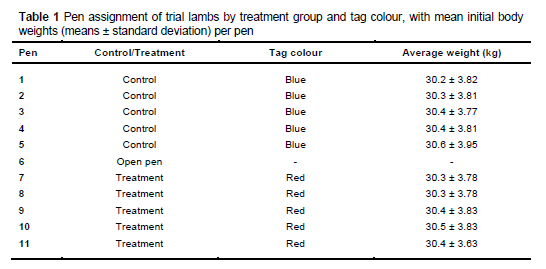
The five-day adaptation period allowed the lambs to achieve adequate rumen fill, rehydrate, and recover before the trial. During this period, lambs had ad libitum access to lucerne hay and were offered a limited amount of pelleted feed (300 g per lamb of the control diet) to gradually introduce them to the feedlot diet, with the aim of minimising digestive disturbances. Lambs were weighed, ear-tagged, and randomly allocated to control or treatment groups, stratified by initial body weight. The plan was to randomly allocate 65 lambs to each of 10 pens, with five pens per treatment group (Table 1), resulting in 650 lambs in total. However, one lamb died during transportation prior to pen allocation, leaving one pen with 64 lambs and a total of 649 lambs enrolled in the trial. Control and treatment pens could not be adjacent because of the risk of cross-contamination, so the 10 pens were split into two adjacent blocks. A random number was generated to assign one block to the control group and the other to the treatment group. Lambs were then sorted by arrival weight in ascending order and assigned to pens based on a predetermined, randomly assigned pen order to prevent confounding by initial lamb weight.
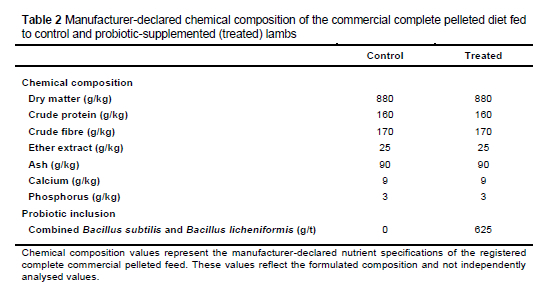
The experimental diet consisted of a commercially registered complete pelleted feed (reg no. V30575), manufactured by a commercial animal feed company prior to the start of the trial. The feed was supplied in pelleted form and produced through the mixing and pelleting of all ingredients to ensure homogeneity and uniform nutrient distribution. The pelleted diet consisted of yellow maize, sunflower oilcake, wheat bran, soya hulls, lucerne hay, molasses, soya oilcake, corn germ meal, and a commercial vitamin-mineral premix. The chemical composition of the experimental diet was provided by the manufacturer and represents the formulated nutrient specifications of the registered product (Table 2). The nutritional composition of the diet was not independently analysed in the study. All animals were fed the same basal diet, differing only by the inclusion of the probiotic in the treatment diet; however, owing to the proprietary nature of the feed, minor confounding effects cannot be completely ruled out, although they are not anticipated.
Feed preparation and bagging were performed at a mill located near the feedlot, in Klerksdorp, North West Province, to minimise transport costs. The control diet was processed into 4 mm pellets and bagged before the treatment diet to prevent cross-contamination with Bacillus spp. spores. The treatment diet, which was also produced as 4 mm pellets, contained 625 g per tonne of B. subtilis and B. licheniformis, providing a total of 3.2 × 10⁹ colony-forming units (CFU)/gram. Each species contributed equally, with 1.6 × 10⁹ CFU/gram of B. subtilis and 1.6 × 10⁹ CFU/gram of B. licheniformis, in accordance with the manufacturer's recommendations. Lambs were fed twice daily at 08:00 and 17:00, with feed bunks turned at each feeding. Water was provided ad libitum via automated troughs.
On day two of the adaptation period, all trial lambs were vaccinated with an inactivated respiratory vaccine containing Mannheimia haemolytica serotype A1, Pasteurella multocida serotype A, Bibersteinia trehalosi, and parainfluenza virus 3 (Design Biologix); a multivalent clostridial vaccine containing Clostridiumperfringenstypes A, B, C, and D, Clostridium oedematiens, Clostridiumsepticum, Clostridium tetani, and Clostridium chauvoei (Ceva Animal Health); and an autogenous Salmonella Typhimurium vaccine (Design Biologix). At the time of inoculation, the lambs were dosed with an anthelmintic (Kyron Agri), received metaphylactic treatment with Duplocillin® (Merck Animal Health), were administered oral electrolytes (Afrivet), and were implanted with Revalor H® (trenbolone acetate and oestradiol 17β; 20 mg; Merck Animal Health). The processing of all trial animals was performed by the designated processing team and took approximately four hours.
The lambs were weighed before feeding on days 0 (D0), 14 (D14), 28 (D28), and 49 (D49) of the trial using a calibrated scale (Tru-test XR5000 weigh indicator). To minimise variation in weight caused by rumen fill, lambs were weighed in the morning before feed was offered. To minimise cross-contamination with the probiotic, lambs in the control pens were weighed before those in the treatment pens. To maintain consistency throughout the trial, pens were weighed sequentially, starting with pen 1 (control) and proceeding to pen 11 (treatment). Before weighing on D0, lambs were assigned to groups and held in small pens with unrestricted access to lucerne hay bales near the weighing area. Lucerne supplementation was provided to reduce the risk of digestive disturbances should lambs overeat upon introduction to the feedlot diet.
To maintain the single-blinded design, groups were referred to as either the blue or red group rather than the control or treatment group (Table 1). This ensured that feedlot management staff remained unaware of which group received probiotic supplementation, thus minimising observer bias. Morbidity and mortality, along with their causes (where known), were recorded daily both manually and electronically. Morbidity was documented using treatment sheets for each group, recording animals that received veterinary care, as well as the medications administered and their dosages. All mortalities that occurred prior to the scheduled slaughter date underwent a complete post-mortem examination by the feedlot veterinarian overseeing the project.
Feed intake data, expressed on an as-is basis, were provided by the feedlot at the conclusion of the trial. Total intake per group was calculated by subtracting the total remaining feed weight at the end of the trial from the total feed delivered at the beginning of the trial. The average feed intake (AFI) per pen was calculated by dividing the total feed intake for the pen by the number of lambs housed in that pen.
Lambs were moved on the hoof to a commercial lamb abattoir, located on the same premises as the feedlot, for humane slaughter. Lambs were stunned using head-only electrical stunning, during which an electrical current was passed through the head for approximately 60 seconds to induce unconsciousness. While unconscious, the lambs were humanely killed by severing both the jugular veins and carotid arteries. The lambs were bled for a minimum of six minutes to ensure death by cerebral anoxia prior to dressing. Lung and rumen lesions were evaluated macroscopically and scored by a single experienced specialist veterinary pathologist to ensure consistency across animals. Lung lesions were scored on a semi-quantitative scale that integrated both the extent and chronicity of bronchopneumonia-specific consolidation (Thompson et al., 2006).
Normal lungs were scored as having no detectable lesions. Low-grade acute bronchopneumonia was characterised by focal or limited consolidation involving less than 50% of a single cranial lobe, with hyperaemia, oedema, and/or fibrinous exudation consistent with active inflammation. Low-grade chronic bronchopneumonia was characterised by focal or limited consolidation involving less than 50% of a single cranial lobe, with pale, firm parenchyma and some fibrous adhesions between adjacent lobes and/or to the pleura, consistent with resolving or chronic inflammation. High-grade acute bronchopneumonia was characterised by extensive consolidation affecting more than 50% of a single cranial lobe (usually extending to an adjacent lobe), typically hyperaemic, heavy, and firm, with or without fibrin exudation. High-grade chronic bronchopneumonia was characterised by extensive consolidation involving more than 50% of a single cranial lung lobe, with the lesion progressing caudally, with pale, firm, fibrotic tissue and prominent interlobular and/or pleural adhesions.
Rumen lesions were scored macroscopically using a three-point system (normal rumen, low-grade parakeratosis, and high-grade parakeratosis), based on the pathologist's practical experience and diagnostic expertise. No other lesions (e.g. ulcers, rumenitis) were observed, so the scoring system applied exclusively to ruminal parakeratosis. Normal rumen mucosa was scored as having no detectable injury. Notably, the extent of rumen papillary involvement was mostly diffuse, so scoring did not depend on the proportion of the rumen luminal surface that was involved. Each rumen was emptied of ingesta, rinsed, and examined visually. Low-grade ruminal parakeratosis was characterised by mild to moderate papillary thickening, palpable slight papillary hardening with clumping of papillae, and only occasional entrapment of feed among the papillae. High-grade ruminal parakeratosis was characterised by marked papillary thickening, extensive papillary fusion, and severe hardening of the papillae, with extensive entrapment of feed (especially maize kernels) among the clumped papillae.
Rumen and lung scores were recorded manually and electronically, with the pathologist blinded to which group received the probiotic-supplemented diet. Cold carcass weights were calculated by the abattoir after the lambs were stunned, exsanguinated, skinned, and eviscerated. A 3% shrink was applied to account for moisture loss during chilling (Muela et al., 2010). Carcass yield, also referred to as dressing percentage, was calculated as the cold carcass weight expressed as a percentage of the live body weight at slaughter and was provided by the abattoir (Campos et al., 2019).
The data were recorded in a spreadsheet program (Excel 2007; Microsoft Corp., Redmond, Washington, USA). Quantitative data were assessed for normality by calculating descriptive statistics, plotting histograms, and performing the Anderson-Darling normality test using MINITAB Statistical Software, Release 13.32 (Minitab Inc, State College, Pennsylvania, USA). Quantitative data were further described using the mean and standard deviation, while categorical data were described using proportions and 95% confidence intervals. The correlations between quantitative variables were estimated using Spearman's rho. Mixed-effects regression, incorporating the treatment group as a fixed effect and pen as a random effect, was used to compare production and selected health parameters between the treatment groups. A logistic link function was used to compare the categorical data. Regression modelling was performed using available software (IBM SPSS Statistics Version 30, International Business Machines Corp., Armonk, NY, USA), with significance set as P <0.05.
Results and discussion
The objective of the current study was to evaluate the effects of supplementing a total mixed ration with a probiotic blend containing B. licheniformis and B. subtilis on the feedlot performance, carcass characteristics, dressing percentage, morbidity, and mortality of South African Mutton Merino lambs.
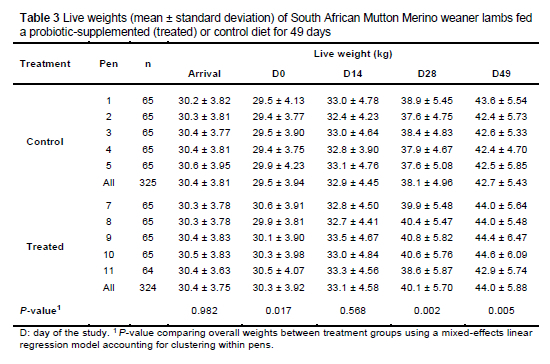
Both the control and treatment groups had average starting live weights of 30.4 kg. By the end of the trial, the treatment group weighed 44.0 kg on average, compared to 42.7 kg for the control group, indicating greater weight gain by the treatment group lambs (P = 0.005, Table 3). Differences were also observed in the loss of weight between arrival and post-adaptation (D0). The control group experienced an average weight loss of 900 g, whereas the treatment group showed a smaller than average weight loss of 100 g. All lambs had unrestricted access to lucerne during weighing. However, the treatment group lambs (pens 6-11) were weighed later in the day, allowing longer access to lucerne. This may have increased rumen fill at the time of weighing, which could explain the smaller apparent weight loss or reduced shrinkage between arrival and D0 in the treatment group.
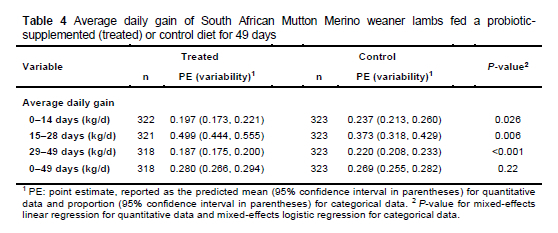
The control group lambs recorded an overall weight gain of 12.3 kg, whereas the treatment group lambs gained 13.6 kg, on average (Table 3); however, probiotic supplementation had no significant effect on the overall average daily gain (ADG) over the 49-day trial period (P = 0.220, Table 4). Similar findings were reported by Cordeiro et al. (2024), who found that ADG was not affected in finishing bulls supplemented with B. subtilis and B. licheniformis at 3.2 × 10⁹ CFU/gram, and in feedlot lambs fed maize silage inoculated with B. subtilis and Lactobacillus plantarum at a rate of 1 × 10⁵ CFU/gram (Rabelo et al., 2018).
More pronounced trends were observed when analysing the interval-based ADG (Table 4). From D0 to D14, the control group achieved an ADG of 0.24 kg/day, whereas the treatment group recorded an ADG of 0.2 kg/day (P = 0.026). In the D15-28 interval, the treatment group demonstrated a significantly higher ADG (P = 0.006, Table 4), concurring with a similar study in which three-month-old weaner lambs supplemented with B. subtilis had significantly improved growth performance and heavier final weights (Gao et al., 2023).
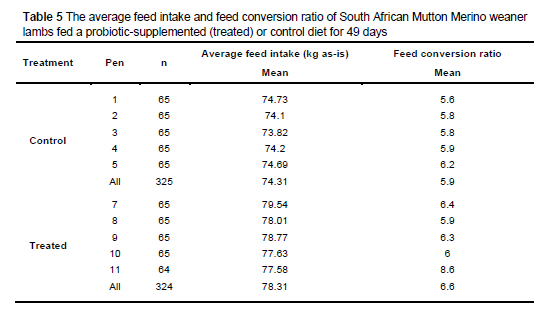
Some studies suggest that improvements in growth performance with probiotic supplementation may be partly related to feed intake (Antunovic et al., 2005). In the present study, the probiotic-supplemented lambs appeared to consume more feed, although this was not statistically analysed and should thus be interpreted with caution. The heavier final weights at the end of the feeding period may have therefore been due to other factors, rather than feed intake alone.
The AFI per lamb was recorded at the end of the trial (Table 5). Observationally, lambs in the treatment group appeared to consume more feed than those in the control group. These observations are consistent with those of Saleem et al. (2016), who reported higher dry matter intakes in lambs supplemented with probiotics during the post-weaning period. In another study, Gao et al. (2023) observed numerically higher feed intakes in lambs supplemented with a B. subtilis-based probiotic, with similar trends also being reported by Kochewad et al. (2009).
The feed conversion ratio, calculated using D0 weights, was 5.9 in the control group and 6.6 in the treatment group (Table 5). This indicates that the control group converted feed into live weight gain more efficiently than the treatment group, requiring less feed per kilogram of weight gain. A limitation of the AFI measurement is that it was recorded at a single time point at the end of the feeding period, and therefore did not capture daily fluctuations in feed intake between the groups.
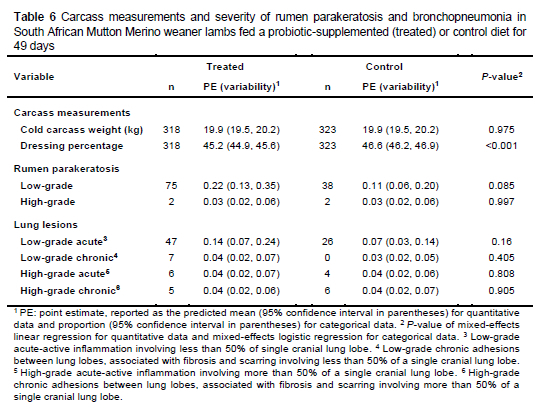
The cold carcass mass and dressing percentage values are presented in Table 6. The average cold carcass mass for both groups was 19.9 kg (P = 0.975), with a dressing percentage of 46.6% for the control group and 45.2% for the treatment group (P <0.001). The significant difference in dressing percentage, favouring the control group, was unexpected. In a study by Dias et al. (2022) on feedlot steers, probiotic supplementation did not significantly influence the carcass weight. In contrast, probiotic supplementation appeared to reduce the dressing percentage of the treatment group in this study. The dressing percentage (carcass yield) is calculated by dividing the carcass weight by the final live weight, and can be influenced by factors such as the diet (Lovett et al., 2003; Walsh et al., 2008; Minchin et al., 2009; Pesonen et al., 2012), animal age (Ríos-Utrera et al., 2005; Petrovic et al., 2017), and degree of rumen fill prior to slaughter (Bowling et al., 1978; Jones et al., 1985). In this study, animal age and diet were consistent between the groups, with the exception of the inclusion of the probiotic in the treatment diet. The observed AFI in the treatment group suggests that these lambs had fuller rumens, which may have contributed to the lower dressing percentage. A fuller gastrointestinal tract increases the weight subtracted from the final live weight post-evisceration, leading to a greater difference between the live weight and carcass weight. Increased feed intake may have contributed to both the heavier final weights and the greater gastrointestinal tract fill (Clauss et al., 2016).
Macroscopically, low-grade rumen parakeratosis was more common in the treatment group, with 75 animals (24%) affected, compared to 38 animals (12%) in the control group (P = 0.085, Table 6). Macroscopic lung lesions consistent with bronchopneumonia were also more prevalent in the treatment group, affecting 20% of animals compared to 11% in the control group (Table 6).
Bacillus licheniformis and B. subtilis produce a wide range of digestive enzymes in the rumen and lower digestive tract (Elshaghabee et al., 2017; Luise et al., 2022; Cappellozza et al., 2023; Gresse et al., 2025), enhancing the digestibility of starch and other dietary components (Cordeiro et al., 2024). In particular, the starch-hydrolysing capacity of B. licheniformis increases starch availability (Deng et al., 2018; Lopez et al., 2024; Silva et al., 2024). Readily fermentable carbohydrates such as maize are key components of diets in intensive production systems, with starch being the primary constituent of these grains (Kotarski et al., 1992). Rations rich in readily fermentable carbohydrates undergo rapid microbial fermentation in the rumen, resulting in the accelerated production of volatile fatty acids (Nagaraja & Titgemeyer, 2007). Ruminal acidosis develops when ruminants overconsume these carbohydrates, leading to an excessive accumulation of acids in the rumen and a concurrent reduction in ruminal pH (Plaizier et al., 2012). In the present study, the combination of a high-starch diet and enhanced starch hydrolysis from probiotic activity may have predisposed the treatment group to subclinical ruminal acidosis. One common outcome of this condition is rumen parakeratosis, which is macroscopically visible on the luminal/mucosal surface (Nocek, 1997; Steele et al., 2009). Since the rumen mucosa plays a pivotal role in the absorption and metabolism of volatile fatty acids (Baldwin, 1999), the excessive papillae clumping and keratinisation associated with parakeratosis (Bull et al., 1965; Hinders & Owen, 1965) can impair energy balance and growth, likely contributing to the lower ADG observed in the treatment group during days 29 to 49 of the trial (Table 4).
The higher incidence of bronchopneumonia observed at the abattoir in the treatment group may also be linked to the greater extent of rumen mucosal damage. During subclinical ruminal acidosis, the rumen flora shifts towards lactic acid-producing Gram-positive bacteria (Hernandez et al., 2014), while Gram-negative populations are suppressed. Low rumen pH can cause partial lysis of Gram-negative bacteria, releasing endotoxins (lipopolysaccharides) into the rumen fluid, which may cross the rumen wall and enter systemic circulation (Kleen et al., 2003; Khafipour et al., 2009). Systemic lipopolysaccharides can trigger pro-inflammatory responses (Rojas et al., 2005) and impair alveolar macrophage and neutrophil function, thereby weakening the host's innate immune defences (Harvill et al., 1999; Do Vale et al., 2016). This immunomodulation, combined with low-grade systemic inflammation, may facilitate secondary bacterial colonisation of the lungs, potentially contributing to the higher incidence of bronchopneumonia in the treatment group.
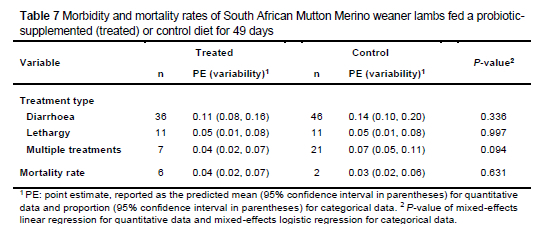
During the trial, 36 animals in the treatment group were treated with a broad-spectrum antibiotic based on their diagnosed condition of diarrhoea, compared with 46 animals in the control group (P = 0.336, Table 7). Of these, seven animals in the treatment group and 21 in the control group required repeated treatments for the same condition (P = 0.094).
The mortality rate was numerically higher in the treatment group (six animals) than in the control group (two animals), although this difference was not statistically significant (P = 0.631). Post-mortem examinations indicated that bronchopneumonia was the primary cause of death in lambs that had not received any prior treatment. The primary cause of morbidity was diarrhoea (Table 7). Probiotic supplementation appeared to be beneficial, as the treatment group showed a lower incidence of diarrhoea and required fewer repeated treatments; however, this difference was not statistically significant. Probiotics are known to enhance host immunity by modulating immune function and inhibiting the growth of pathogenic bacteria (Copain et al., 2020). In vitro studies have shown that B. licheniformis and B. subtilis inhibit S. typhimurium (Gresse et al., 2025). They also promote beneficial microbes and prevent pathogen adhesion to intestinal epithelial cells through competitive exclusion (Shin et al., 2019; Wang et al., 2019). These results thus support the established role of probiotics in maintaining gastrointestinal health and immunity (Ashraf & Shah, 2014; Peng et al., 2022).
Conclusion
Supplementation with B. subtilis and B. licheniformis improved the ADG of the feedlot lambs during the first 28 days of the trial. However, prolonged probiotic inclusion was associated with reduced growth rates later in the feeding period. The ability of B. licheniformis to hydrolyse starch, combined with an increased AFI, may have contributed to the development of subclinical ruminal acidosis, with a higher incidence of low-grade ruminal parakeratosis in probiotic-supplemented lambs. However, although the difference was not statistically significant, supplementation with B. subtilis and B. licheniformis appeared to improve intestinal health, as indicated by the reduced incidence of diarrhoea and fewer repeated treatments in the treatment group lambs. These results suggest that in-feed probiotic supplementation in feedlot lambs may be beneficial during specific phases of the feeding period to improve ADG and reduce morbidity. However, further research is required to identify the optimal timing of supplementation to maximise growth while minimising the risk of rumen and lung pathology.
Authors contributions
J.D.M. was involved in data collection and writing of the manuscript. G.F. designed the study, analysed the data, and critically revised the manuscript. S.J.C. was involved in the initial study planning and critically revised the manuscript. L.O. and E.C.W. assisted with manuscript revision. All authors read and approved the final version of the manuscript.
Conflict of interest declaration
The authors declare no financial, personal or other relationships with individuals or organisations that could inappropriately influence this work. No financial support was received for the trial.
Acknowledgements
The authors wish to thank Jakkalspruit feedlot (Deneysville) for their support during the trial, Lee Meat for their assistance with the slaughter, Dr Kelly Barnard for veterinary assistance throughout the study, Professor Leon Prozesky for performing the rumen and lung scoring, and De Heus Animal Nutrition for feed formulation and preparation.
References
-
Aarestrup, F.M., Wegener, H.C., & Collignon, P., 2008. Resistance in bacteria in the food chain: epidemiology and control strategies. Expert Review of Anti-infective Therapy, 6:733-750. DOI: https://doi.org/10.1586/14787210.6.5.733
» https://doi.org/10.1586/14787210.6.5.733 -
Ahasan, A.S.M.L., Agazzi, A., Invernizzi, G., Bontempo, V., & Savoini, G., 2015. The beneficial role of probiotics in monogastric animal nutrition and health. Journal of Dairy Veterinary and Animal Research, 2:116-132. DOI: https://doi.org/10.15406/jdvar.2015.02.00041
» https://doi.org/10.15406/jdvar.2015.02.00041 -
Antunović, Z., Šperanda, M., Liker, B., Šerić, V., Senčić, Đ., Domaćinović, M., & Sperandat, T., 2005. Influence of feeding the probiotic Pioneer PDFM® to growing lambs on performances and blood composition. Acta Veterinaria, 55:287-300. DOI: https://doi.org/10.2298/AVB0504287A
» https://doi.org/10.2298/AVB0504287A -
Ashraf, R. & Shah, N.P., 2014. Immune system stimulation by probiotic microorganisms. Critical Reviews in Food Science and Nutrition, 54:938-956. DOI: https://doi.org/10.1080/10408398.2011.619671
» https://doi.org/10.1080/10408398.2011.619671 -
Baldwin, R.L., 1999. The proliferative actions of insulin, insulin-like growth factor I, epidermal growth factor, butyrate and propionate on ruminal epithelial cells in vitro. Small Ruminant Research, 32:261-268. DOI: https://doi.org/10.1016/S0921-4488(98)00188-6
» https://doi.org/10.1016/S0921-4488(98)00188-6 -
Bernardeau, M., Lehtinen, M.J., Forssten, S.D., & Nurminen, P., 2017. Importance of the gastrointestinal life cycle of Bacillus for probiotic functionality. Journal of Food Science and Technology, 54:2570-2584. DOI: https://doi.org/10.1007/s13197-017-2688-3
» https://doi.org/10.1007/s13197-017-2688-3 -
Bowling, R.A., Riggs, J.K., Smith, G.C., Carpenter, Z.L., Reddish, R.L., & Butler, O.D., 1978. Production, carcass and palatability characteristics of steers produced by different management systems. Journal of Animal Science, 46:333-340. DOI: https://doi.org/10.2527/jas1978.462333x
» https://doi.org/10.2527/jas1978.462333x -
Bull, L.S., Bush, L.J., Friend, J.D., Harris, J.R., & Jones, E.W., 1965. Incidence of ruminal parakeratosis in calves fed different rations and its relation to volatile fatty acid absorption. Journal of Dairy Science, 48:1459-1466. DOI: https://doi.org/10.3168/jds.S0022-0302(65)88499-5
» https://doi.org/10.3168/jds.S0022-0302(65)88499-5 -
Campos, F.S., Carvalho, G.G.P., Santos, E.M., Araújo, G.G.L., Gois, G.C., Rebouças, R.A., Magalhães, A.L.R., Oliveira, J.S., Voltolini, T.V., Carvalho, B.M.A., & Perazzo, A.F., 2019. Characteristics of carcass and non-carcass components of lambs fed diets containing silages of forages adapted to the semi-arid environment. South African Journal of Animal Science, 49:119-130. DOI: https://doi.org/10.4314/sajas.v49i1.14
» https://doi.org/10.4314/sajas.v49i1.14 -
Capelloza., B.I., Segura, A., Milora, N., Galschioet, C., Schjelde, M., & Copani, G., 2023. Stability of Bacillus and Enterococcus faecium 669 probiotic strains when added to different feed matrices used in dairy production. Animals, 13:2350. DOI: https://doi.org/10.3390/ani13142350
» https://doi.org/10.3390/ani13142350 -
Clauss, M., Stewart, M., Price, E., Peilon, A., Savage, T., Van Ekris, I., & Munn, A., 2016. The effect of feed intake on digesta passage, digestive organ fill and mass, and digesta dry matter content in sheep (Ovis aries): Flexibility in digestion but not in water reabsorption. Small Ruminant Research, 138:12-19. DOI: https://doi.org/10.1016/j.smallrumres.2016.03.029
» https://doi.org/10.1016/j.smallrumres.2016.03.029 - Copani, G.C., Queiroz, O.C.M., & Boll, E.J., 2020. Lactobacillus animalis LA51 and Bacillus sp. probiotics confer protection from the damaging effects of pathogenic Clostridium perfringens and Escherichia coli on the intestinal barrier. Journal of Dairy Science, 103:103.
-
Cordeiro, M.W.S., Cappellozza, B.I., de Melo, N.N., & Bernardes, T.F., 2024. Effects of a Bacillus based direct-fed microbial on performance, blood parameters, fecal characteristics, rumen morphometrics, and intestinal gene expression in finishing beef bulls. Journal of Animal Science, 102:skae259. DOI: https://doi.org/10.1093/jas/skae259
» https://doi.org/10.1093/jas/skae259 -
Cull, C., Singu, V.K., Cull, B.J., Lechtenberg, K.F., Amachawadi, R.G., Schutz, J.S., & Bryan, K.A., 2022a. Efficacy of Lactobacillus animalis and Propionibacterium freudenreichii-based feed additives in reducing Salmonella-associated health and performance effects in commercial beef calves. Antibiotics, 11:1328. DOI: https://doi.org/10.3390/antibiotics11101328
» https://doi.org/10.3390/antibiotics11101328 -
Cull, C., Singu, V.K., Cull, B.J., Lechtenberg, K.F., Amachawadi, R.G., Schutz, J.S., & Bryan, K.A., 2022b. Efficacy of two probiotic products fed daily to reduce Clostridium perfringens-based adverse health and performance effects in dairy calves. Antibiotics, 11:1513. DOI: https://doi.org/10.3390/antibiotics11111513
» https://doi.org/10.3390/antibiotics11111513 -
Deng, K.D., Xiao, Y., Ma, T., Tu, Y., Diao, Q.Y., Chen, Y.H., & Jiang, J.J., 2018. Ruminal fermentation, nutrient metabolism, and methane emissions of sheep in response to dietary supplementation with Bacillus licheniformis. Animal Feed Science and Technology, 241:38-44. DOI: https://doi.org/10.1016/j.anifeedsci.2018.04.014
» https://doi.org/10.1016/j.anifeedsci.2018.04.014 -
Dias, B.G.C., Santos, F.A.P., Meschiatti, M., Brixner, B.M., Almeida, A.A., & Queiroz, O., 2022. Effects of feeding different probiotic types on metabolic, performance, and carcass responses of Bos indicus feedlot cattle offered a high concentrate diet. Journal of Animal Science, 100:skac289. DOI: https://doi.org/10.1093/jas/skac289
» https://doi.org/10.1093/jas/skac289 -
Do Vale, A., Cabanes, D., & Sousa, S., 2016. Bacterial toxins as pathogen weapons against phagocytes. Frontiers in Microbiology, 7:42. DOI: https://doi.org/10.3389/fmicb.2016.00042
» https://doi.org/10.3389/fmicb.2016.00042 -
Dubreuil, J.D., 2017. Enterotoxigenic Escherichia coli and probiotics in swine: What the bleep do we know? Biosciences of Microbiota Food and Health, 36:75-90. DOI: https://doi.org/10.12938/bmfh.16-030
» https://doi.org/10.12938/bmfh.16-030 -
El Jeni, R., Villot, C., Koyun, O.Y., Osario-Doblado, A., Baloyi, J.J., Lourenco, J.M., Steele, M., & Callaway, T.R., 2024. Invited review: "Probiotic" approaches to improving dairy production: reassessing "magic foo-foo dust". Journal of Dairy Science, 107:1832-1856. DOI: https://doi.org/10.3168/jds.2023-23831
» https://doi.org/10.3168/jds.2023-23831 -
Elshaghabee, F.M.F., Rokana, N., Gulhane, R.D., Sharma, C., & Panwar, H., 2017. Bacillus as potential probiotics: status, concerns and future perspectives. Frontiers in Microbiology, 8:1490. DOI: https://doi.org/10.3389/fmicb.2017.01490
» https://doi.org/10.3389/fmicb.2017.0149 -
Fuerniss, L.K., Kreikemeier, K.K., Reed, L.D., Cravey, M.D., & Johnson, B.J., 2022. Cecal microbiota of feedlot cattle fed a four-species Bacillus supplement. Journal of Animal Science, 100:skac258. DOI: https://doi.org/10.1093/jas/skac258
» https://doi.org/10.1093/jas/skac258 -
Galyean, M.L., Duff, G.C., & Rivera, J.D., 2022. Galyean appreciation club review: revisiting nutrition and health of newly received cattle - what have we learned in the past 15 years? Journal of Animal Science, 100:skac067. DOI: https://doi.org/10.1093/jas/skac067
» https://doi.org/10.1093/jas/skac067 -
Gao, Y., Wei, W., Tian, D., Li, J., Wang, Y., & Qi, J., 2023. Corn straw total mix dietary supplementation of Bacillus subtilis-enhanced growth performance of lambs by favourably modulating rumen bacterial microbiome. Fermentation, 9:32. DOI: https://doi.org/10.3390/fermentation9010032
» https://doi.org/10.3390/fermentation9010032 -
Green, D.H., Wakeley, P.R., Page, A., Barnes, A., Baccigalupi, L., Ricca, E., & Cutting, S.M., 1999. Characterization of two Bacillus probiotics. Applied and Environmental Microbiology, 65:4288-4291. DOI: https://doi.org/10.1128/AEM.65.9.4288-4291.1999
» https://doi.org/10.1128/AEM.65.9.4288-4291.1999 -
Gresse, R., Cappellozza, B.I., Macheboeuf, D., Torrent, A., Danon, J., Capern, L., Sandvang, D., Niderkorn, V., Copani, G., & Forano, E., 2025. In vitro investigation of the effects of Bacillus subtilis-810B and Bacillus licheniformis-809A on the rumen fermentation and microbiota. Animals, 15:476. DOI: https://doi.org/10.3390/ani15040476
» https://doi.org/10.3390/ani15040476 - Guillot, J.F., 1998. Les probiotiques en alimentation animale. Cahiers Agricultures. 7:49-54.
-
Guimaraes, O., Preedy, G., Trent Fox, J., Cappellozza, B.I., Davis, T.C., Schutz, J.S., & Theurer, M.E., 2024. A novel direct-fed microbial impacts growth performance and supports overall health of feedlot cattle. Ruminants, 4:267-279. DOI: https://doi.org/10.3390/ruminants4020019
» https://doi.org/10.3390/ruminants4020019 -
Hansen, L.H.B., Lauridsen, C., Nielsen, B., Jorgensen, L., & Canibe, N., 2022. Impact of early inoculation of probiotics to suckling piglets on post weaning diarrhoea - A challenge study with enterotoxigenic E. coli F18. Animal, 16:100667. DOI: https://doi.org/10.1016j.animal.2022.100667
» https://doi.org/10.1016j.animal.2022.100667 -
Harvill, E.T., Cotter, P.A., Yuk, M.H., & Miller, J.F., 1999. Probing the function of Bordetella bronchiseptica adenylate cyclase toxin by manipulating host immunity. Infection and Immunity, 67:1493-1500. DOI: https://doi.org/10.1128/IAI.67.3.1493-1500.1999
» https://doi.org/10.1128/IAI.67.3.1493-1500.1999 -
Hernandez, J., Benedito, J.L., Abuelo, A., & Castillo, C., 2014. Ruminal acidosis in feedlot: From aetiology to prevention. The Scientific World Journal, 2014:702572. DOI: https://doi.org/10.1155/2014/702572
» https://doi.org/10.1155/2014/702572 -
Hinders, R.G. & Owen, F.G., 1965. Relation of ruminal parakeratosis development to volatile fatty acid absorption. Journal of Dairy Science, 48:1069-1073. DOI: https://doi.org/10.3168/jds.S0022-0302(65)88393-X
» https://doi.org/10.3168/jds.S0022-0302(65)88393-X -
Hong, H.A., Le, H.D., & Cutting, S.M., 2005. The use of bacterial spore formers as probiotics. FEMS Microbiology Reviews, 29:813-835. DOI: https://doi.org/10.1016/j.femsre.2004.12.001
» https://doi.org/10.1016/j.femsre.2004.12.001 -
Izuddin, W.I., Loh, T.C., Foo, H.L., Samsudin, A.A., & Humam, A.M., 2019. Postbiotic L. plantarum RG14 improves rumen epithelium growth, immune status and upregulates the intestinal barrier function in post-weaning lambs. Scientific Reports, 9:9938. DOI: https://doi.org/10/.1038/s41598-019-46076-0
» https://doi.org/10/.1038/s41598-019-46076-0 -
Jones, S.D.M., Rompala, R.E., & Jeremiah, L.E., 1985. Growth and composition of the empty body in steers of different maturity types fed concentrate or forage diets. Journal of Animal Science, 60:427-433. DOI: https://doi.org/10.2527/jas1985.602427x
» https://doi.org/10.2527/jas1985.602427x -
Khafipour, E., Krause, D.O., & Plaizier, J.C., 2009. A grain-based subacute ruminal acidosis challenge causes translocation of lipopolysaccharide and triggers inflammation. Journal of Dairy Science, 92:1060-1070. DOI: https://doi.org/10.3168/jds.2008-1389
» https://doi.org/10.3168/jds.2008-1389 -
Kleen, J.L., Hooijer, G.A., Rehage, J., & Noordhuizen, J.P.T.M., 2003. Subacute ruminal acidosis (SARA): a review. Journal of Veterinary Medicine. A, Physiology, Pathology, Clinical Medicine, 50:406-414. DOI: https://doi.org/10.1046/j.1439-0442.2003.00569.x
» https://doi.org/10.1046/j.1439-0442.2003.00569.x - Kochewad, S.A., Chahande, J.M., Kanduri, A.B., Deshmukh, D.S., Ali, S.A., & Patil, V.M., 2009. Effect of probiotic supplementation on growth parameters of Osmanabadi kids. Veterinary World, 2:29.
-
Kotarski, S.F., Waniska, R.D., & Thurn, K.K., 1992. Starch hydrolysis by the rumen microflora. The Journal of Nutrition, 122:178-190. DOI: https://doi.org/10.1093/jn/122.1.178
» https://doi.org/10.1093/jn/122.1.178 -
Lopez, A.M., Sarturi, J.O., Johnson, B.J., Woerner, D.R., Henry, D.D., Ciriaco, F.M., Silva, K.G.S., & Rush, C.J., 2024. Effects of bacterial direct-fed microbial combinations on beef cattle growth performance, feeding behaviour, nutrient digestibility, ruminal morphology and carcass characteristics. Journal of Animal Science, 102:skae004. DOI: https://doi.org/10.1093/jas/skae004
» https://doi.org/10.1093/jas/skae004 -
Lovett, D., Lovell, S., Callan, J., Finlay, M., Connoly, J., & O'Mara, F.P., 2003. Effect of forage/concentrate ratio and dietary coconut oil level on methane output and performance of finishing beef heifers. Livestock Production Science, 84:135-146. DOI: https://doi.org/10.1016/j.liveprodsci.2003.09.010
» https://doi.org/10.1016/j.liveprodsci.2003.09.010 -
Luise, D., Bosi, P., Raff, L., Amatucci, L., Virdis, S., & Trevisi, P., 2022. Bacillus spp. probiotic strains as a potential tool for limiting the use of antibiotics and improving the growth and health of pigs and chickens. Frontiers in Microbiology, 13:801827. DOI: https://doi.org/10.3389/fmicb.2022.801827
» https://doi.org/10.3389/fmicb.2022.801827 -
Markowiak, P. & Slizewska, K., 2018. The role of probiotics, prebiotics and synbiotics in animal nutrition. Gut Pathogens, 10:21. DOI: https://doi.org/10.1186/s13099-018-0250-0
» https://doi.org/10.1186/s13099-018-0250-0 -
Minchin, W., Buckley, F., Kenny, D.A., Monahan, F.J., Shalloo, L., & O' Donovan, M., 2009. Effect of grass silage and concentrate based finishing strategies on cull dairy cow performance, carcass and meat quality characteristics. Meat Science, 81:93-101. DOI: https://doi.org/10.1016/j.meatsci.2008.07.001
» https://doi.org/10.1016/j.meatsci.2008.07.001 -
Muela, E., Sanudo, C., Campo, M.M., Medel, I., & Beltran, A., 2010. Effects of cooling temperature and hot carcass weight on the quality of lamb. Meat Science, 84:101-107. DOI: https://doi.org/10.1016/j.meatsci.2009.08.020
» https://doi.org/10.1016/j.meatsci.2009.08.020 -
Nagaraja, T.G. & Titgemeyer, E.C., 2007. Ruminal acidosis in beef cattle. The current microbiological and nutritional outlook. Journal of Dairy Science, 90:17-38. DOI: https://doi.org/10.3168/jds.2006-478
» https://doi.org/10.3168/jds.2006-478 -
Nithya, V. & Halami, P.M., 2013. Evaluation of the probiotic characteristics of Bacillus species isolated from different food sources. Annals of Microbiology, 63:129-137. DOI: https://doi.org/10.1007/s13213-012-0453-4
» https://doi.org/10.1007/s13213-012-0453-4 -
Nocek, J.E., 1997. Bovine acidosis: implications on laminitis. Journal of Dairy Science, 80:1005-1028. DOI: https://doi.org/10.3168/jds.S0022-0302(97)76026-0
» https://doi.org/10.3168/jds.S0022-0302(97)76026-0 -
Pahumunto, N., Dahlen, G., & Teanpaisan, R., 2021. Evaluation of potential probiotic properties of Lactobacillus and Bacillus strains derived from various sources for their potential use in swine feeding. Probiotics and Antimicrobial Proteins, 15:479-490. DOI: https://doi.org/10.1007/s12602-021-09861-w.
» https://doi.org/10.1007/s12602-021-09861-w -
Peng X., Ed-Dra, A., Song, Y., Elbediwi, M., Nambiar, R.B., Zhou, X., & Yue, M., 2022. Lacticaseibacillus rhamnosus alleviates intestinal inflammation and promotes microbiota-mediated protection against Salmonella fatal infections. Frontiers in Immunology, 13:973224. DOI: https://doi.org/10.3389/fimmu.2022.973224
» https://doi.org/10.3389/fimmu.2022.973224 -
Pesonen, M., Honkavaara, M., & Huuskonen, A.K., 2012. Effect of breed on production, carcass traits and meat quality in Aberdeen angus, limousine and Aberdeen angus χ limousine bulls offered a grass silage-grain-based diet. Agricultural and Food Science, 21:361-369. DOI: https://doi.org/10.23986/afsci.6520SU
» https://doi.org/10.23986/afsci.6520SU -
Petrovic, M.Z., Dokovic, R., Cincovic, M., Ilic, Z., Petrovic, M.D., Cobanovic, N., & Karabasil, N., 2012. Effect of age of young Simmental bulls on dressing percentage. Acta Agriculturae Serbica. 22:11 -21. DOI: https://doi.org/10.5937/AASer1743011P
» https://doi.org/10.5937/AASer1743011P -
Plaizier, J.C., Khafipour, E., Li, S., Gozho, G.N., & Krause, D.O., 2012. Subacute ruminal acidosis (SARA), endotoxins, and health consequences. Animal Feed Science and Technology, 172:9-21. DOI: https://doi.org/10.1016/j.anifeedsci.2011.12.004
» https://doi.org/10.1016/j.anifeedsci.2011.12.004 - Poole, T. & Sheffield, C., 2013. Use and misuse of antimicrobial drugs in poultry and livestock: mechanisms of antimicrobial resistance. Pakistan Veterinary Journal, 33:266-271.
-
Rabelo, C.H.S., Lara, E.C., Basso, F.C., Härter, C.J., & Reis, R.A., 2018. Growth performance of finishing feedlot lambs fed maize silage inoculated with Bacillus subtilis and lactic acid bacteria. The Journal of Agricultural Science, 156:839-847. DOI: https://doi.org/10.1017/S0021859618000679
» https://doi.org/10.1017/S0021859618000679 -
Rhayat, L., Maresca, M., Nicoletti, C., Perrier, J., Brinch, K.S., Christian, S., & Devillard, E., 2019. Effect of Bacillus subtilis strains on intestinal barrier function and inflammatory response. Frontiers in Immunology, 10:564. DOI: https://doi.org/10.3389/fimmu.2019.00564
» https://doi.org/10.3389/fimmu.2019.00564 -
Ríos-Utrera, A., Cundiff, L.V., Gregory, K.E., Koch, R.M., Dikeman, M.E., Koohmaraie, M., & Van Vleck, L.D., 2005. Genetic analysis of carcass traits of steers adjusted to age, weight, or fat thickness slaughter end points. Journal of Animal Science, 83:764-776. DOI: https://doi.org/10.2527/2005.834764x
» https://doi.org/10.2527/2005.834764x -
Rojas, M., Woods, C.R., Mora, A.L., Xu, J., & Brigham, K.L., 2005. Endotoxin-induced lung injury in mice: Structural, functional, and biochemical responses. American Journal of Physiology, 288:333-341. DOI: https://doi.org/10.1152/ajplung.00334.2004
» https://doi.org/10.1152/ajplung.00334.2004 -
Saleem, A.M., Zanouny, A.I., & Singer, A.M., 2016. Growth performance, nutrients digestibility, and blood metabolites of lambs fed diets supplemented with probiotics during pre- and post-weaning period. Asian-Australasian Journal of Animal Sciences, 30:523-530. DOI: https://doi.org/10.5713/ajas.16.0691
» https://doi.org/10.5713/ajas.16.0691 -
Santano, N.B., Boll, E.J., Capern, L.C., Cieplak, T.M., Keleszade, E., Letek, M., & Costabile, A., 2020. Comparative evaluation of the antimicrobial and mucus induction properties of selected Bacillus strains against enterotoxigenic Escherichia coli. Antibiotics, 9:849. DOI: https://doi.org/10.3390/antibiotics9120849
» https://doi.org/10.3390/antibiotics9120849 -
Shin, D., Chang, S.Y., Bogere, P., Won, K., Choi, J.Y., Choi, Y,J., Lee, H.K., Hur, J., Park, B.Y., & Kim, Y., 2019. Beneficial roles of probiotics on the modulation of gut microbiota and immune response in pigs. PloS One, 14:e0220843. DOI: https://doi.org/10.1371/journal.pone.0220843
» https://doi.org/10.1371/journal.pone.0220843 -
Silva, K.G.S., Sarturi, J.O., Johnson, B.J., Woerner, D.R., Lopez, A.M., Rodrigues, B.M., Nardi, K.T., & Rush, C.J., 2024. Effects of bacterial direct-fed microbial mixtures offered to beef cattle consuming finishing diets on intake, nutrient digestibility, feeding behaviour, and ruminal kinetics/fermentation profile. Journal of Animal Science, 102:skae003. DOI: https://doi.org/10.1093/jas/skae003
» https://doi.org/10.1093/jas/skae003 -
Steele, M.A., Alzahal, O., Hook, S.E., Croom, J., & McBride, B.W., 2009. Ruminal acidosis and the rapid onset of ruminal parakeratosis in a mature dairy cow: a case report. Acta Veterinaria Scandinavica, 51:39. DOI: https://doi.org/10.1186/1751-0147-51-39
» https://doi.org/10.1186/1751-0147-51-39 -
Su, Y., Liu, C., Fang, H., & Zhang, D., 2020. Bacillus subtilis: A universal cell factory for industry, agriculture, biomaterials and medicine. Microbial Cell Factories, 19:173. DOI: https://doi.org/10.1186/s12934-020-01436-8
» https://doi.org/10.1186/s12934-020-01436-8 -
Thompson, P.N., Stone, A., & Schultheiss, W.A., 2006. Use of treatment records and lung lesion scoring to estimate the effect of respiratory disease on growth during the early and late finishing periods in South African feedlot cattle. Journal of Animal Science, 84:488-498. DOI: https://doi.org/10.2527/2006.842488x
» https://doi.org/10.2527/2006.842488x -
Tomczyk, G., Niczyporuk, J.S., Kozdrun, W., Sawicka-Durkalec, A., Bocian, L., Barabasz, M., & Michalski, M., 2024. Probiotic supplementation as an alternative to antibiotics in broiler chickens. Journal of Veterinary Research, 68:147-154. DOI: https://doi.org/10.2478/jvetres-2024-0009
» https://doi.org/10.2478/jvetres-2024-0009 -
Van, T.T.H., Yidana, Z., Smooker, P.M., & Coloe, P.J., 2020. Antibiotic use in food animals worldwide, with a focus on Africa: Pluses and minuses. Journal of Global Antimicrobial Resistance, 20:170-177. DOI: https://doi.org/10.1016/j.jgar.2019.07.031
» https://doi.org/10.1016/j.jgar.2019.07.031 -
Walsh, K., O'Kiely, P., Moloney, A.P., & Boland, T.M., 2008. Intake, performance and carcass characteristics of beef cattle offered diets based on whole-crop wheat or forage maize relative to grass silage or ad libitum concentrates. Livestock Science, 116:223-236. DOI: https://doi.org/10.1016/j.livsci.2007.10.010
» https://doi.org/10.1016/j.livsci.2007.10.010 -
Wang, K., Cao, G., Zhang, H., Li, Q., & Yang, C., 2019. Effects of Clostridium butyricum and Enterococcus faecalis on growth performance, immune function, intestinal morphology, volatile fatty acids, and intestinal flora in a piglet model. Food and Function. 10:7844-7854. DOI: https://doi.org/10.1039/c9fo01650c
» https://doi.org/10.1039/c9fo01650c
Accepted 23 March 2026
Published 03 April 2026