Chlorocholine chloride residue distribution in eggs, breast and femur meat of laying hens determined by labelled-15N estimates
Abstract
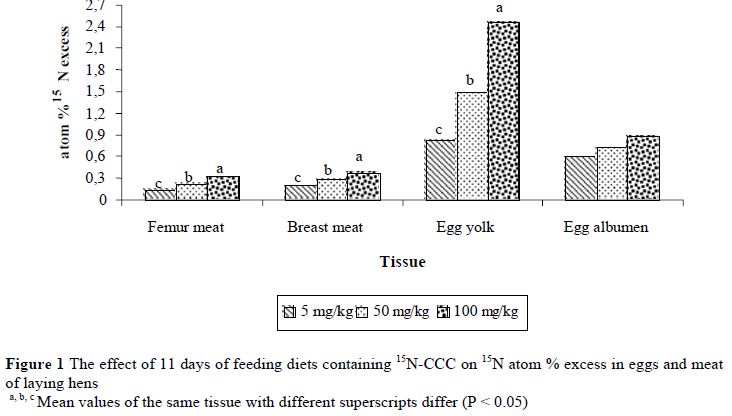
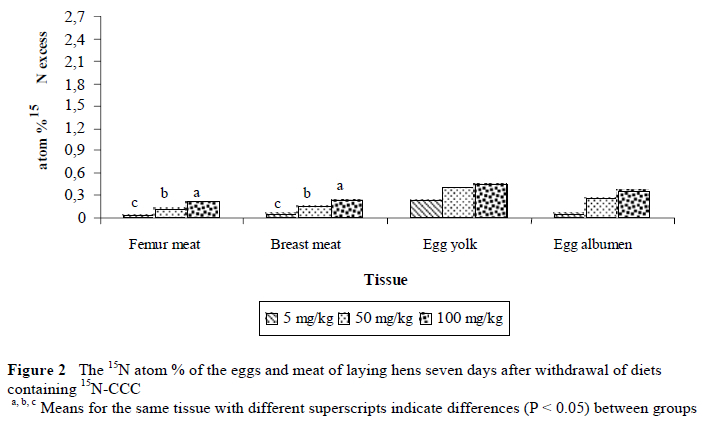
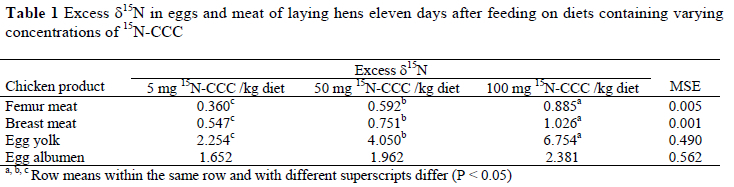
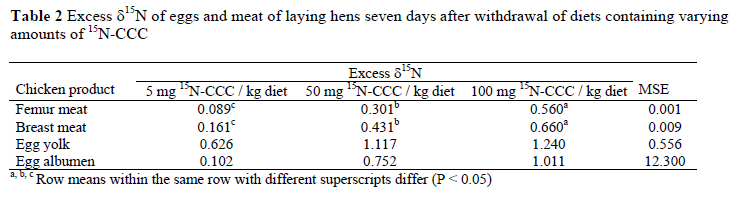
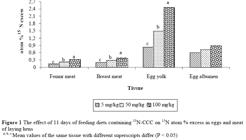
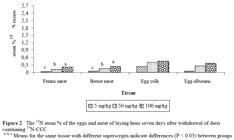
The distribution of chlorocholine chloride (CCC) residue or its metabolites in the meat and eggs of laying hens was studied using the 15N delta value (515N) and 15N atom % derived from 15N-CCC containing diets. In a completely randomised design, 20 laying hens were divided into four groups allocated four different diets namely; 0 mg 15N-CCC /kg feed a control diet (group A); 5 mg 15N-CCC /kg feed (group B), 50 mg 15N-CCC /kg (group C) and 100 mg 15N-CCC /kg (group D) for 11 days. During the seven days that followed, 15N-CCC diets were withdrawn and all hens were restored to feeding on the control diet. The 515N excess and 15N atom % excess in meat and eggs of hens fed diets containing 15N-CCC, were higher than in the control diet after 11 days of treatment and seven days after withdrawal of 15N-CCC, except for the egg yolk values of hens fed 5 mg 15N-CCC /kg feed. The 515N excess and 15N atom % excess of meat, egg yolk and egg albumen were dependent on dietary 15N-CCC concentrations and differed significantly between tissues for each of the three 15N-CCC concentrations examined. Femur meat 515N excess and 15N atom % excess were similar to that of breast meat but differed significantly from that of other tissues. The results show that tissue type is a factor in CCC residue/metabolite accumulation in chicken products suggesting differences in exposure or risk of CCC on consumers.
Chlorocholine chloride residues; poultry products; labeled-15N
 Thumbnail
 Thumbnail