Growth performance, faecal scores, and metabolic profiles of neonatal Holstein calves with extended transition milk feeding
Abstract
The performance and health status of dairy calves may benefit from further transition milk feeding during the early postnatal period. However, transition milk obtained from cows during the first three to seven postpartum milkings is usually commingled with bulk tank milk by farmers. Therefore, this study aimed to evaluate the growth performance and health status of Holstein calves provided with extended transition milk feeding for the first three weeks of life. Twenty newborn singleton Holstein calves without any health problems or dystocia were blocked by birthweight, sex, and parity and assigned to two groups: control (fed normal milk after day 5, n = 10) and transition (fed transition milk up to day 21, n = 10). The calves were housed in individual hutches and weighed to determine their growth rate, and blood samples were collected on days 1, 7, 14, and 21. Residual calf starter pellets were weighed daily to calculate the feed conversion efficiency. The calves were monitored and their faecal scores were recorded daily. Feeding transition milk until 21 days of age improved the calves' daily growth and calf starter pellet feed conversion efficiency. The calves' faecal scores and blood parameters were not affected by transition milk feeding. No treatment χ week interactions were observed in the calves' growth performance, faecal scores, and blood parameters, except for the serum concentrations of aspartate aminotransferase and beta-hydroxybutyrate. In conclusion, feeding Holstein calves transition milk for the first three weeks of life is recommended to improve growth performance.
blood parameters; dairy calf; diarrhoea; growth performance; transition milk
Introduction
Transition milk, which is collected between the second and seventh milkings postpartum, during the transition from colostrum to normal milk, contains maternal leukocytes, growth hormones, cytokines, antimicrobial factors, and nutrients (Foley & Otterby, 1978; Andrew, 2001 ; Yang et al., 2015; Godden et al., 2019). It has been found to contain 15 immune system proteins, the concentrations of which gradually decrease during subsequent milkings (Fahey et al., 2020). However, lactoperoxidase, which has been identified as a bactericide and bacteriostatic protein, is actually more abundant in transition milk than in colostrum (Korhonen, 1977; Fahey et al., 2020). The higher concentrations of n-3 and n-6 polyunsaturated fatty acids, as well as palmitic and myristic acids, found in transition milk compared with normal milk, highlight the importance of these fatty acids for neonatal calves (Wilms et al., 2022). Moreover, many of the bioactive molecules present in colostrum are still present at considerable concentrations in transition milk, demonstrating the potential application of transition milk in dairy calf nutrition (Tortades et al., 2023).
Infectious pathogens that cause diarrhoea colonise the small intestine and produce toxins that cause hypersecretion in the intestinal mucosa (Acres, 1985). Dairy calves in the first three weeks of life are more vulnerable to diarrhoea and mortality because of their low antibody-producing activity (Nagahata et al., 1991; Wells et al., 1996; Gulliksen et al., 2009). Feeding calves transition milk was found to have no effect on their serum immunoglobulin concentrations because of gut closure within the first 24 hours postpartum (Conneely et al., 2014). However, while immunoglobulins cannot be absorbed from the calf intestinal lumen after 24 hours of age, the antibodies and antimicrobial factors in transition milk may still protect the calf gut lumen from pathogens in the first weeks of life. The improved crypt depth and villus length caused by transition milk feeding promotes intestinal development and immune defence mechanisms against diarrhoea (Yang et al., 2015; Van Soest et al., 2020; Van Soest et al., 2022a). In addition, calves fed transition milk have been reported to have more beneficial bacteria in their intestinal lumens because of the high oligosaccharide content of transition milk (Fischer-Tlustos et al., 2020).
Several reports have stated that colostrum supplementation in the first two weeks of calves' lives improved their performance and had a protective effect against diarrhoea (Berge et al., 2009; McCarthy et al., 2024). Conneely et al. (2014) similarly observed that calves fed transition milk within two days of birth had better eye, ear, and nasal scores, and Korhonen (1977) stated that antimicrobial factors in transition milk provide protection against infection and support the immune systems of calves during the first week of their lives. Zwierzchowski et al. (2020) indicated that feeding calves transition milk supplemented with colostrum for up to six days postpartum had some beneficial effects on health parameters and humoral immunity indicators. They also reported some positive effects on the growth performance of calves fed transition milk during the first week of life.
Higher growth rates and an improved health status during the pre-weaning period positively influences the future milk yield and reproductive performance of dairy cows (Heinrichs & Heinrichs, 2011 ; Soberon et al., 2012). Researchers have suggested that feeding calves transition milk for two to six days postpartum improves performance and boosts the immune system by stimulating earlier intestinal growth (Conneely et al., 2014; Van Soest et al., 2020; Zwierzchowski et al., 2020; Van Soest et al., 2022b). However, transition milk is mostly overlooked by producers and is commingled with bulk tank milk. While Kargar et al. (2021) reported that partial replacement of waste milk with transition milk had beneficial effects on the performance and health status of dairy calves, limited information is available regarding the potential benefits of feeding transition milk to calves during the later weeks postpartum. In addition, a short transition milk supply period may not show potential advantages in terms of performance and health parameters (Da Silva et al., 2023). Considering the literature mentioned above, we hypothesised that the extended feeding of pure transition milk would result in the increased performance and improved health status of dairy calves in the first weeks of life. Therefore, the purpose of this study was to investigate the growth performance and health status of Holstein calves fed transition milk for the first three weeks postpartum.
Materials and methods
Animals, housing, feeding, and treatments
All procedures were approved by the Ethics Committee of the Selcuk University Faculty of Veterinary Experimental Animals Production and Research Center (permit number: 2021/48, date of approval: 23/03/2021). The study was conducted from April to August on the Dr. Hümeyra Özgen Research and Application Farm of Selcuk University.
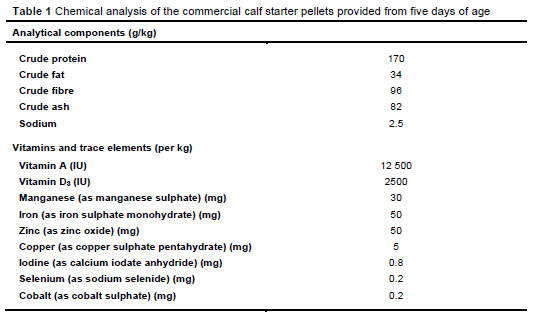
Holstein cows and heifers were monitored from 21 days prepartum and then transferred to individual calving pens at five days prepartum. Calving was managed by experienced farm personnel under the supervision of a farm veterinarian. Twenty healthy singleton calves that did not need any assistance for dystocia were weighed and separated from their dams in the first 24 hours postpartum and then transferred to individual calf hutches. The mean (± standard deviation) birthweight was recorded as 37.2 ± 3.87 kg. Straw was provided as bedding in the calf hutches and the calves had ad libitum access to fresh commercial starter pellets and water from buckets from five days of age (Table 1).
The 20 selected bottle-fed calves (6 male and 14 female) were included in the study for the first 21 days postpartum. The calves were offered 3 L of fresh colostrum from their dams by bottle in the first two hours postpartum, followed by a further 2.5 L in the first 24 hours. During the following four days, all the calves were fed 2 L of transition milk twice daily. At five days of age, the calves were randomly assigned to two treatment groups - the control group (n = 10) and the transition milk group (n = 10) -considering the homogeneity of their birthweight and sex, and the parity of their dams. The control group received 2.5 L of normal milk twice daily, while the transition milk group received 2.5 L of transition milk twice daily until the end of the study. Pooled transition milk was obtained from cows between their second and seventh milkings postpartum. This transition milk was stored in plastic bottles in a freezer at -20 °C and was thawed at 38-39 °C prior to feeding. During the 21 consecutive days of the trial, samples of the pooled transition milk were collected and transferred to a commercial milk testing laboratory to determine their nutritional composition.
Data collection and chemical analysis
Each calf was weighed at birth and at 7, 14, and 21 days of age to calculate the daily growth rate. Daily total calf starter pellet consumption was recorded twice weekly from 5-21 days of age, and the average daily intake was determined and used to calculate the calves' feed efficiency (gain/pellet intake).
Faecal evaluations were performed by a study researcher who did not know to which treatment group each calf was assigned. Daily faecal scores and health examinations were recorded after the morning feeding. Faecal status was recorded using a 5-point scale, with 1 indicating normal faeces and 5 indicating watery faeces with colour variation. This faecal scoring was based on a minor modification of the method developed by Kertz & Chester-Jones (2004). Any faecal score above 3 was recorded as a scour day. Daily results were averaged into weekly means to fit the data for statistical analysis. The calves did not show any respiratory problems, and no calves died during the study.
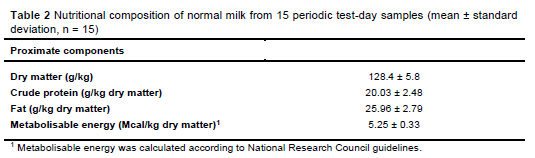
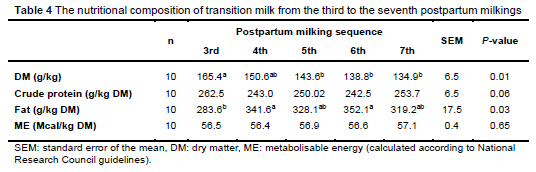
Transition milk samples from the third to the seventh milkings postpartum were collected from the ten cows whose calves were in the transition milk treatment group and were sent for milk composition analysis. Milk nutritional parameters, including the dry matter, protein, and fat concentrations, as well as the metabolisable energy content, were determined by infrared analysis with a FTIR interferometer using a Milkana® Express Plus Analyzer. The composition of normal milk from 15 periodic test-day samples is shown in Table 2.
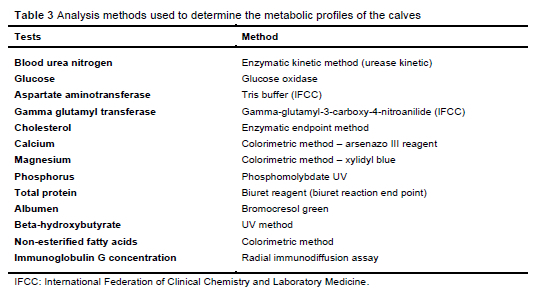
Blood samples from the calves were collected in Vacutainer tubes via jugular venipuncture at 24 hours postpartum and then weekly for three weeks. The blood samples were centrifuged at 3000 g for 10 minutes at 4 °C and then stored at -20 °C in 2 mL cryotubes until chemical analysis. The serum immunoglobulin G concentration was analysed using a commercial radial immunodiffusion assay. The other biochemical parameters were analysed using a Randox Imola chemistry analyser (Randox Laboratories Ltd.) in a commercial laboratory (MG Institute, Konya, Türkiye). The methods used to analyse the metabolic profiles are shown in Table 3.
Statistical analyses
The data were recorded in Excel and analysed using a mixed model with repeated measures in the Statistical Package for the Social Sciences (SPSS version 29.0). One of the control calves had severe septicaemia during the second week of life and was removed from the study for the analysis of growth performance parameters. Birthweight, which was assumed to be significantly correlated with growth performance, was included as a covariate in the model when analysing the growth performance variables. Treatment (control or transition milk), week of measurement, and the treatment χ week interaction were included as fixed effects, and each individual calf, the parity of the dam (primiparous or multiparous), and the calf sex (male or female) were included as random effects. Week of measurement was considered a repeated effect in the model. To compare the main effects, the 95% confidence interval was adjusted using the Bonferroni correction test. The covariance structure was selected as auto regressive first-order based on the smallest two restricted log likelihood of information criteria.
Results and discussion
Concentrations of bovine colostrum in the first secretion (colostrum) turn into transition milk over the next few milkings, and then finally reach normal milk composition, as regularly measured in bulk tank milk (Godden et al., 2019). The composition of the transition milk collected from the third to seventh milkings is shown in Table 4. The dry matter content of the transition milk decreased steadily over time (P = 0.01). However, the protein and metabolisable energy contents of the transition milk did not significantly change during the postpartum period monitored. There was a tendency for the fat content to increase after the third milking. Previous studies reporting the nutritional composition of transition milk have lacked statistical analysis, making it difficult to compare their results with the results of this study (Foley & Otterby, 1978; Hammon et al., 2000; Van Soest et al., 2020; Kargar et al., 2021).
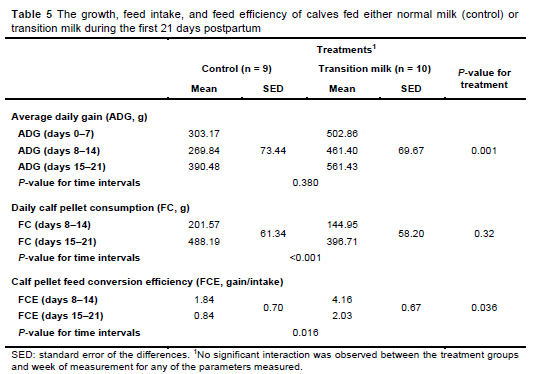
The consensus from previous research is that feeding newborn calves transition milk within the first six days postpartum improves their performance status (Franklin et al., 2003; Conneely et al., 2014; Zwierzchowski et al., 2020; Van Soest et al., 2022a). However, whether this beneficial effect would be observed in calves fed transition milk for an extended period postpartum was uncertain. The results showed that feeding transition milk to calves up to 21 days of age increased their daily body weight gain, as shown in Table 5. Calves in the transition milk group gained approximately 200 g/day more body weight than those in the control group, throughout the study period (P = 0.001). These results are mostly in accordance with those of previous studies. Several authors have reported greater average daily gains in calves fed extended colostrum supplements for the first 14 days of life (Berge et al., 2009; McCarthy et al., 2024), and Yang et al. (2015) reported a 2.1 kg higher body weight gain when they fed calves transition milk rather than normal milk for the first eight days postpartum. Kargar et al. (2021) found a higher average daily gain when calves were fed transition milk instead of normal milk up to 21 days of age, and Van Soest et al. (2022a) reported an increase in the abomasum contents of calves fed transition milk. Therefore, the positive effect of transition milk feeding on performance might have been due to differences in gastrointestinal tract contents. The larger proportion of polyunsaturated fats in transition milk than in normal milk may play an essential role in the growth of calves (Wilms et al., 2022). Kargar et al. (2021) reported an increase in performance during the pre-weaning period in calves fed a mixture of waste milk and transition milk, and we therefore expected that the calves fed whole transition milk in this study would also grow faster throughout the entire pre-weaning period, which would be beneficial for the future profitability of the dairy farm (Soberon et al., 2012).
Calf growth was indirectly affected by the calf starter pellet feed conversion efficiency. Calves with better feed efficiency have improved average growth rates and can be weaned earlier. This increases the profitability of farmers by decreasing their costs during the pre-weaning period. Greater concentrate intake was reported during the first 28 days of life when calf milk replacer was supplemented with colostrum (Berge et al., 2009). This improved performance may have been due to the extra nutrients provided by the transition milk in the early postnatal period (Godden et al., 2019). Despite the insignificant differences in pellet consumption between the treatment groups, the transition milk calves had a better feed conversion efficiency than the control calves, because of their higher growth rates (Table 5). These results support our hypothesis that extended transition milk feeding improves calf performance during the neonatal period.
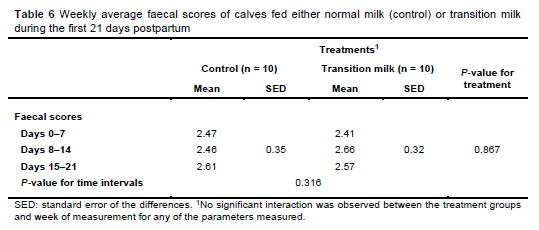
As can be seen in Table 6, the faecal scores of the calves were not significantly affected by either of the main effects (dietary treatment or week of measurement), or their interaction. Several studies, such as Conneely et al. (2014), have reported that the further feeding of transition milk after the initial consumption of colostrum had no significant effect on faecal scores. However, Kargar et al. (2021) reported that replacing normal milk with 2 L of transition milk resulted in fewer days of diarrhoea in the first three weeks of life. Berge et al. (2009) and McCarthy et al. (2024) similarly observed fewer incidences of diarrhoea in the first 14 days postpartum in colostrum-supplemented calves. Nonetheless, Van Soest et al. (2020) did not observe any significant effect of feeding transition milk for the first four days postpartum on faecal scores in calves. When evaluating faecal scores, farm management should be considered. The calves in this study were carefully monitored by the farm veterinarian and experienced study personnel throughout the study to ensure that they had adequate health status. If there had been management problems, a significant difference between the treatment groups may have resulted.
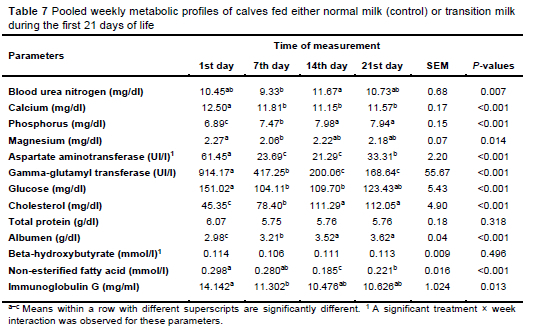
Adequate colostrum intake is essential for newborn calves to protect against passive immune deficiency and, therefore, the potential risks of diarrhoea in the first 24 hours of life (Berge et al., 2009). Furthermore, transition milk has been found to promote the early development of the intestinal tract and enhance the local immune system in the gut (Berge et al., 2009; Yang et al., 2015; Godden et al., 2019; Van Soest et al., 2020; Van Soest et al., 2022a). In this study, the calves met the criteria for adequate passive immunity transfer, with immunoglobulin G concentrations of >10 mg/mL on the first day (Table 7). This adequate immunoglobulin G concentration may have been as a result of the large volumes of colostrum consumed by all the calves during the first two hours postpartum.
The combined weekly metabolic profiles of the calves in both treatment groups are shown in Table 7. There were no significant effects of feeding transition milk on the metabolic profiles. However, differences between the blood samples collected at different times postpartum were observed (P <0.05), with the exception of the total protein and beta-hydroxybutyrate concentrations. Previous studies investigating the effects of further transition milk feeding on metabolic profiles are lacking, which makes it difficult to discuss the results of this study in detail. Serum non-esterified fatty acid concentrations gradually decreased until two weeks of age and then slightly increased in the third week postpartum (P <0.001), which concurs with the results of Quigley et al. (1991) and partly with the results of Da Silva et al. (2023) and Van Soest et al. (2022b). These temporal changes may have been due to the increase in the amount of calf starter pellets consumed and the change in the feed conversion rate (Stanley et al., 2002). The decrease in the glucose concentration with age was somewhat similar to the findings of previous studies (Quigley et al., 1991; Stanley et al., 2002; Da Silva et al., 2023). Van Soest et al. (2022a) reported that the serum glucose concentration before feeding was not affected by transition milk treatment in the first five days of life, but that it tended to increase the serum non-esterified fatty acid concentration by 16%, which is somewhat similar to our results.
Although the blood beta-hydroxybutyrate concentration did not differ between the sampling weeks, a treatment × week interaction was found (P <0.001). Quigley et al. (1991) reported that the magnitude of significant differences in beta-hydroxybutyrate concentrations varied with week of age, and that the beta-hydroxybutyrate concentration was closely related to the grain intake. The non-significant differences between the sampling weeks might be related to the fact that the blood samples were collected from the calves during the early postnatal period, during which time the calves may not have consumed enough starter feed to cause significant differences over time.
Serum calcium, aspartate aminotransferase, and gamma-glutamyl transferase levels were significantly higher on the first day of measurement and then decreased after seven days of age (P <0.001). Garel & Barlet (1976) similarly reported a decline in the serum calcium concentration in newborn calves after 2.5 days of age, and Zanker et al. (2001) reported that both serum aspartate aminotransferase and gamma-glutamyl transferase levels in newborn calves increased for the first few days of age and then decreased on the seventh day postpartum. The increase in the serum phosphorus concentration after the first day of life was in partial agreement with the findings of Garel & Barlet (1976).
Yang et al. (2015) investigated the effects of transition milk feeding versus bulk tank milk feeding on the first day of life, in the absence of colostrum provision, and found no significant effect on serum albumen concentrations, which is consistent with our results. In addition, when calves were offered transition milk supplemented with colostrum for up to six days postpartum, serum cholesterol, immunoglobulin, and total protein concentrations were reported to be significantly higher than those of calves fed normal milk for the first weeks of life, resulting in an increase in immunological protection up to 60 days of age (Zwierzchowski et al., 2020). However, the same authors found that the transition milk treatment did not influence serum aspartate aminotransferase and glucose concentrations. Conneely et al. (2014) reported that the further feeding of transition milk after initial colostrum intake did not affect serum immunoglobulin G concentrations, because of the closure of immunoglobulin G absorption via the gut epithelium, which is consistent with our findings. Da Silva et al. (2023) investigated the differences in some blood parameters in samples collected from the 24th to the 72nd hours of life from calves that received either normal or transition milk. They reported that transition milk treatment did not significantly influence the measured blood parameters; however, the albumen and total protein concentrations increased and the non-esterified fatty acid concentration decreased over time during the first three days postpartum.
Conclusion
Our results demonstrate that extended transition milk feeding up to three weeks of age improves the growth performance of Holstein calves. Faecal scores and overall metabolic profiles were not affected by feeding with transition milk, and no treatment χ week interaction was observed for any of the variables, except for a few metabolic parameters. These findings on growth performance support our hypothesis of the possible benefits of extended transition milk feeding of newborn dairy calves in the early critical weeks of life, providing a basis for further studies. It is unclear whether these benefits would continue later in life; however, the extended feeding of calves with transition milk, rather than commingling this milk with bulk tank milk, may improve the profitability of dairy farmers. Further comprehensive studies are recommended to investigate the potential benefits of feeding transition milk to neonatal dairy calves for different periods postpartum, as well as to determine the effects of this in the pre- and post-weaning periods.
Authors' contributions
M.Ç. designed the experiment. M.Ç., S.G., and Z.K.K. collected the data. M.Ç. performed the statistical analysis. M.Ç., M.S.A., and Ş.İ. wrote the paper. All authors reviewed and approved the final manuscript.
Conflict of interest declaration
The authors declare no conflicts of interest.
Acknowledgements
A summary of this study was presented as an oral presentation (abstract) at the 6th International Conference on Innovative Studies of Contemporary Sciences on August 1-2, 2022. The authors are grateful for the technical assistance of the staff at the Dr. Hümeyra Özgen Research and Application Farm of Selcuk University. The study was funded by Selcuk University Scientific Research Foundation, Konya (project number 22401019).
References
-
Acres, S.D., 1985. Enterotoxigenic Escherichia coli infections in newborn calves: a review. Journal of Dairy Science, 68:229-256. DOI: https://doi.org/10.3168/jds.S0022-0302(85)80814-6
» https://doi.org/10.3168/jds.S0022-0302(85)80814-6 -
Andrew, S.M., 2001. Effect of composition of colostrum and transition milk from Holstein heifers on specificity rates of antibiotic residue tests. Journal of Dairy Science, 84:100-106. DOI: https://doi.org/10.3168/jds.S0022-0302(01)74457-8
» https://doi.org/10.3168/jds.S0022-0302(01)74457-8 -
Berge, A.C., Besser, T.E., Moore, D.A., & Sischo, W.M., 2009. Evaluation of the effects of oral colostrum supplementation during the first fourteen days on the health and performance of preweaned calves. Journal of Dairy Science, 92:286-295. DOI: https://doi.org/10.3168/jds.2008-1433
» https://doi.org/10.3168/jds.2008-1433 -
Conneely, M., Berry, D., Murphy, J.P., Lorenz, I., Doherty, M.L., & Kennedy, E., 2014. Effect of feeding colostrum at different volumes and subsequent number of transition milk feeds on the serum immunoglobulin G concentration and health status of dairy calves. Journal of Dairy Science, 97:6991-7000. DOI: https://doi.org/10.3168/jds.2013-7494
» https://doi.org/10.3168/jds.2013-7494 -
da Silva, A.P., Cezar, A.M., Toledo, A.F., Donde, S.C., Coelho, M.G., Tomaluski, C.R., Virginio Junior, G.F., & Bittar, C.M.M., 2023. Effect of maternal or formulated transition milk on the health and performance of dairy calves. Animals (Basel), 13(10):1674. DOI: https://doi.org/10.3390/ani13101674
» https://doi.org/10.3390/ani13101674 -
Fahey, M.J., Fischer, A.J., Steele, M.A., & Greenwood, S.L., 2020. Characterization of the colostrum and transition milk proteomes from primiparous and multiparous Holstein dairy cows. Journal of Dairy Science, 103:1993-2005. DOI: https://doi.org/10.3168/jds.2019-17094
» https://doi.org/10.3168/jds.2019-17094 -
Fischer-Tlustos, A.J., Hertogs, K., van Niekerk, J.K., Nagorske, M., Haines, D.M., & Steele, M.A., 2020. Oligosaccharide concentrations in colostrum, transition milk, and mature milk of primi- and multiparous Holstein cows during the first week of lactation. Journal of Dairy Science, 103:3683-3695. DOI: https://doi.org/10.3168/jds.2019-17357
» https://doi.org/10.3168/jds.2019-17357 -
Foley, J. & Otterby, D., 1978. Availability, storage, treatment, composition, and feeding value of surplus colostrum: a review. Journal of Dairy Science, 61:1033-1060. DOI: https://doi.org/10.3168/jds.S0022-0302(78)83686-8
» https://doi.org/10.3168/jds.S0022-0302(78)83686-8 -
Franklin, S., Amaral-Phillips, D., Jackson, J., & Campbell, A., 2003. Health and performance of Holstein calves that suckled or were hand-fed colostrum and were fed one of three physical forms of starter. Journal of Dairy Science, 86:2145-2153. DOI: https://doi.org/10.3168/jds.S0022-0302(03)73804-1
» https://doi.org/10.3168/jds.S0022-0302(03)73804-1 -
Garel, J.-M. & Barlet, J.-P., 1976. Calcium metabolism in newborn animals: the interrelationship of calcium, magnesium, and inorganic phosphorus in newborn rats, foals, lambs, and calves. Pediatric Research, 10:749-754. DOI: https://doi.org/10.1203/00006450-197608000-00011
» https://doi.org/10.1203/00006450-197608000-00011 -
Godden, S.M., Lombard, J.E., & Woolums, A.R., 2019. Colostrum management for dairy calves. Veterinary Clinics of North America: Food Animal Practice, 35:535-556. DOI: https://doi.org/10.1016/j.cvfa.2019.07.005
» https://doi.org/10.1016/j.cvfa.2019.07.005 -
Gulliksen, S., Jor, E., Lie, K., Loken, T., Akerstedt, J., & Osteras, O., 2009. Respiratory infections in Norwegian dairy calves. Journal of Dairy Science, 92:5139-5146. DOI: https://doi.org/10.3168/jds.2009-2224
» https://doi.org/10.3168/jds.2009-2224 -
Hammon, H.M., Zanker, I.A., & Blum, J.W., 2000. Delayed colostrum feeding affects IGF-I and insulin plasma concentrations in neonatal calves. Journal of Dairy Science, 83:85-92. DOI: https://doi.org/10.3168/jds.S0022-0302(00)74859-4
» https://doi.org/10.3168/jds.S0022-0302(00)74859-4 -
Heinrichs, A. & Heinrichs, B., 2011. A prospective study of calf factors affecting first-lactation and lifetime milk production and age of cows when removed from the herd. Journal of Dairy Science, 94:336-341. DOI: https://doi.org/10.3168/jds.2010-3170
» https://doi.org/10.3168/jds.2010-3170 -
Kargar, S., Bahadori-Moghaddam, M., Ghoreishi, S., Akhlaghi, A., Kanani, M., Pazoki, A., & Ghaffari, M., 2021. Extended transition milk feeding for 3 weeks improves growth performance and reduces the susceptibility to diarrhea in newborn female Holstein calves. Animal, 15:100151. DOI: https://doi.org/10.1016/j.animal.2020.100151
» https://doi.org/10.1016/j.animal.2020.100151 -
Kertz, A.F. & Chester-Jones, H., 2004. Invited review: guidelines for measuring and reporting calf and heifer experimental data. Journal of Dairy Science, 87:3577-3580. DOI: https://doi.org/10.3168/jds.S0022-0302(04)73495-5
» https://doi.org/10.3168/jds.S0022-0302(04)73495-5 -
Korhonen, H., 1977. Antimicrobial factors in bovine colostrum. Agricultural and Food Science, 49:434-447. DOI: https://doi.org/10.23986/afsci.71956
» https://doi.org/10.23986/afsci.71956 -
McCarthy, H., Cantor, M., Lopez, A., Pineda, A., Nagorske, M., Renaud, D., & Steele, M., 2024. Effects of supplementing colostrum beyond the first day of life on growth and health parameters of preweaning Holstein heifers. Journal of Dairy Science, 107:3280-3291. DOI: https://doi.org/10.3168/jds.2023-23649
» https://doi.org/10.3168/jds.2023-23649 -
Nagahata, H., Kojima, N., Higashitani, I., Ogawa, H., & Noda, H., 1991. Postnatal changes in lymphocyte function of dairy calves. Journal of Veterinary Medicine, Series B, 38:49-54. DOI: https://doi.org/10.1111/j.1439-0450.1991.tb00845.x
» https://doi.org/10.1111/j.1439-0450.1991.tb00845.x -
Quigley, J., Caldwell, L., Sinks, G., & Heitmann, R., 1991. Changes in blood glucose, nonesterified fatty acids, and ketones in response to weaning and feed intake in young calves. Journal of Dairy Science, 74:250-257. DOI: https://doi.org/10.3168/jds.S0022-0302(91)78167-8
» https://doi.org/10.3168/jds.S0022-0302(91)78167-8 -
Soberon, F., Raffrenato, E., Everett, R.W., & Van Amburgh, M.E., 2012. Preweaning milk replacer intake and effects on long-term productivity of dairy calves. Journal of Dairy Science, 95:783-793. DOI: https://doi.org/10.3168/jds.2011-4391
» https://doi.org/10.3168/jds.2011-4391 -
Stanley, C.C., Williams, C.C., Jenny, B.F., Fernandez, J.M., Bateman, H.G., Nipper, W.A., Lovejoy, J.C., Gantt, D.T., & Goodier, G.E., 2002. Effects of feeding milk replacer once versus twice daily on glucose metabolism in Holstein and Jersey Calves. Journal of Dairy Science, 85:2335-2343. DOI: https://doi.org/10.3168/jds.S0022-0302(02)74313-0
» https://doi.org/10.3168/jds.S0022-0302(02)74313-0 -
Tortades, M., Garcia-Fruitos, E., Aris, A., & Terre, M., 2023. Short communication: The biological value of transition milk: analyses of immunoglobulin G, IGF-I and lactoferrin in primiparous and multiparous dairy cows. Animal, 17:100861. DOI: https://doi.org/10.1016/j.animal.2023.100861
» https://doi.org/10.1016/j.animal.2023.100861 -
Van Soest, B., Cullens, F., VandeHaar, M.J., & Nielsen, M.W., 2020. Short communication: Effects of transition milk and milk replacer supplemented with colostrum replacer on growth and health of dairy calves. Journal of Dairy Science, 103:12104-12108. DOI: https://doi.org/10.3168/jds.2020-18361
» https://doi.org/10.3168/jds.2020-18361 -
Van Soest, B., Nielsen, M.W., Moeser, A., Abuelo, A., & VandeHaar, M., 2022a. Transition milk stimulates intestinal development of neonatal Holstein calves. Journal of Dairy Science, 105:7011-7022. DOI: https://doi.org/10.3168/jds.2021-21723
» https://doi.org/10.3168/jds.2021-21723 -
Van Soest, B., Nielsen, M.W., Moeser, A., Abuelo, A., & VandeHaar, M., 2022b. Transition milk stimulates intestinal development of neonatal Holstein calves. Journal of Dairy Science, 105:7011-7022. DOI: https://doi.org/10.3168/jds.2021-21723
» https://doi.org/10.3168/jds.2021-21723 -
Wells, S., Dargatz, D., & Ott, S., 1996. Factors associated with mortality to 21 days of life in dairy heifers in the United States. Preventive Veterinary Medicine, 29:9-19. DOI: https://doi.org/10.1016/S0167-5877(96)01061-6
» https://doi.org/10.1016/S0167-5877(96)01061-6 -
Wilms, J.N., Hare, K.S., Fischer-Tlustos, A.J., Vahmani, P., Dugan, M.E.R., Leal, L.N., & Steele, M.A., 2022. Fatty acid profile characterization in colostrum, transition milk, and mature milk of primi- and multiparous cows during the first week of lactation. Journal of Dairy Science, 105:4692-4710. DOI: https://doi.org/10.3168/jds.2022-20880a
» https://doi.org/10.3168/jds.2022-20880a -
Yang, M., Zou, Y., Wu, Z.H., Li, S.L., & Cao, Z.J., 2015. Colostrum quality affects immune system establishment and intestinal development of neonatal calves. Journal of Dairy Science, 98:7153-7163. DOI: https://doi.org/10.3168/jds.2014-9238
» https://doi.org/10.3168/jds.2014-9238 -
Zanker, I., Hammon, H., & Blum, J., 2001. Activities of y-glutamyltransferase, alkaline phosphatase and aspartate-aminotransferase in colostrum, milk and blood plasma of calves fed first colostrum at 0-2, 6-7, 12-13 and 24-25 h after birth. Journal of Veterinary Medicine Series A, 48:179-185. DOI: https://doi.org/10.1046/j.1439-0442.2001.00338.x
» https://doi.org/10.1046/j.1439-0442.2001.00338.x -
Zwierzchowski, G., Micinski, J., Wojcik, R., & Nowakowski, J., 2020. Colostrum-supplemented transition milk positively affects serum biochemical parameters, humoral immunity indicators and the growth performance of calves. Livestock Science, 234:103976. DOI: https://doi.org/10.1016/j.livsci.2020.103976
» https://doi.org/10.1016/j.livsci.2020.103976
Accepted 19 September 2025
Published 07 October 2025