Effect of finishing system on carcass characteristics and composition of Mubende goats and their Boer goat crossbreds
Abstract
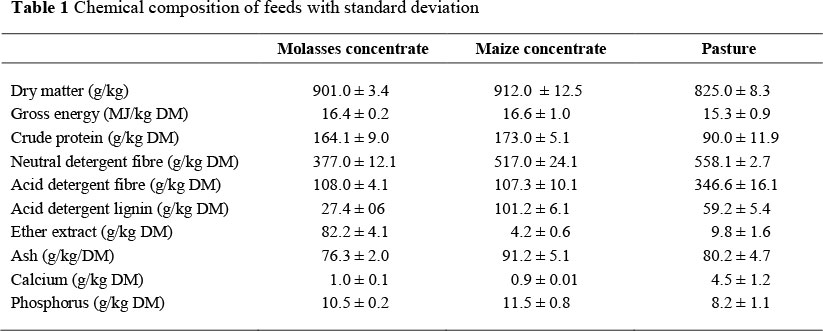
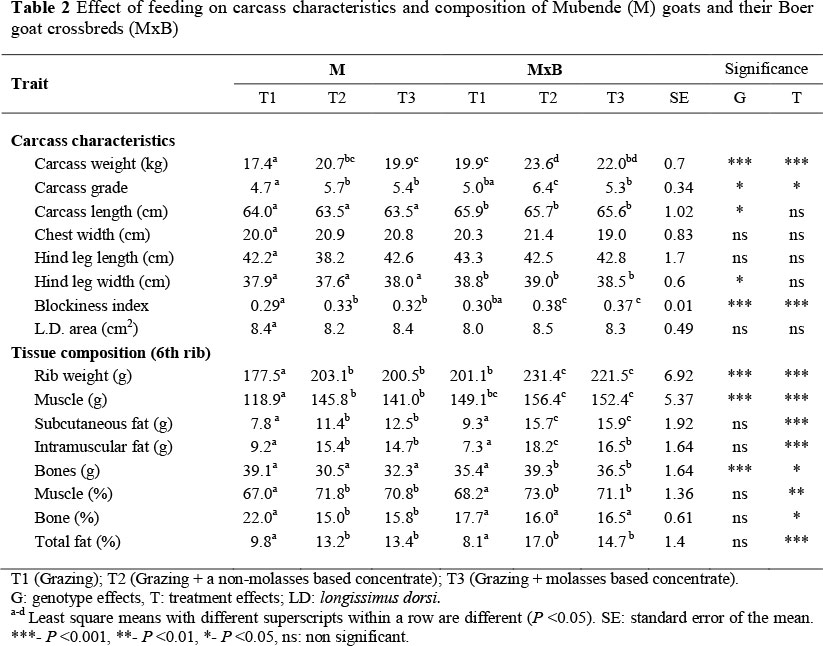
A study was conducted to evaluate the influence of feeding systems on carcass characteristics and composition of Mubende goats and their Boer goat crossbreds. A 2 x 3 factorial arrangement was used to randomly allocate 60 castrates, 30 purebred Mubende and 30 Mubende x Boer, aged 9 - 12 months, to three feeding systems: sole grazing (T1), grazing + non-molasses based concentrate (T2) and grazing + a molasses based concentrate (T3). Carcass measurements included carcass weights, carcass length, internal chest width, hind-limb length and maximum hind limb width. Tissue composition was estimated using the 6th rib. Crossbreds had heavier and longer carcasses (23.1 kg) and (65.7 cm) than the Mubende (19.0 kg and 63.2 cm), respectively. Crossbreds also had bigger hind quarters (39.0 cm) and higher blockiness (0.38) indices than Mubende goats, 37.1 cm and 0.29, respectively. Dissectible lean and fat percentages varied in an ascending order of 66%, 72%, 72.6% and 8%, 14% and 16.5% for T1, T2 and T3, respectively. A reverse trend was observed for bone percentages with carcasses from T1 having higher bone percentage (18.1%) than T2 (16.5%) and T3 (16.1%) irrespective of genotype. The study showed that supplementation of grazing goats has a great potential for goat meat production in Uganda.
Carcass characteristics; composition; indigenous goats; supplementation