The effect of gonadotropin-releasing hormone after a short-term synchronisation protocol on fertility in Assaf sheep during the breeding season
Abstract
This study aimed to evaluate the effect of gonadotropin-releasing hormone (GnRH) administration 48 hours after progesterone-impregnated sponge removal on fertility and prolificacy in lactating Assaf ewes. In this study, 71 ewes were synchronised using intravaginal sponges containing 60 mg medroxyprogesterone acetate for six days. On the day of sponge removal, all ewes received 500 lU of equine chorionic gonadotropin and 75 μg of d-cloprostenol. In the control group (n = 35), ewes were injected with 1 mL of physiological saline solution; in the GnRH group (n = 36), ewes were injected with 0.1 mg of GnRH analogue 48 hours after sponge removal. There were no significant differences between the groups in the progesterone concentration, oestrus response, oestrus duration, onset of oestrus, abortion rate, lambing rate, multiple birth rate, and fertility results. However, the pregnancy rate differed between the groups, being significantly lower in the GnRH-injected ewes (69.44%) than in the control ewes (91.42%). The lambing rates were 90.62% and 96.0% in the control and GnRH ewes, respectively. The results of this study suggest that GnRH administration 48 hours after progesterone-containing sponge removal enhances prolificacy in lactating Assaf ewes during the breeding season, and it was concluded that prolificacy rates could be improved with post-synchronisation GnRH administration. However, pregnancy rates would need to be increased using different supportive treatments.
Assaf ewe; breeding season; GnRH; post-synchronisation; prolificacy
Introduction
Fertility success is a major factor for herd sustainability in livestock enterprises. Enhancing the reproductive performance of sheep reduces the lambing interval, culling and replacement rates, and costs, while increasing the number of lambs per year and profitability (Notter, 2000; Baki Acar et al., 2013; Liu, 2022). Sheep reproduction presents a seasonal pattern, with photoperiod controlling reproductive activity by increasing melatonin secretion from the pineal gland during the short-day season. Reproductive management practices have long utilised this seasonality during both breeding and non-breeding seasons in sheep farming (Ramírez-Ramírez et al., 2021; Simões et al., 2021). However, oestrus or ovulation synchronisation protocols can also be used to enhance reproductive efficiency, synchronise lambing, ensure adequate milk and meat production for the market, simplify management - particularly for preventive treatment applications - and increase lamb sales. During the breeding season, prostaglandin F2a (PGF2a), progestogens, equine chorionic gonadotropin (eCG), and gonadotropin-releasing hormone (GnRH) are used for exogenous hormone administration. Melatonin may also be added to synchronisation protocols during out-of-season periods (Yang et al., 2020). Shortand long-term progesterone-containing intravaginal sponges or devices, in combination with eCG and PGF2a, are the most commonly used protocols for oestrus synchronisation in ewes. Nevertheless, there remains ambiguity regarding the supportive effect of administering GnRH before or after the removal of progesterone devices on pregnancy rates and fertility in small ruminants. It has been reported that GnRH administration stimulates ovulation, increases embryonic viability, and improves conception rates (Titi et al., 2010). However, several studies have reported that the use of GnRH in combination with synchronisation protocols does not improve fertility or pregnancy rates (Baki Acar et al., 2013; Maggi et al., 2024; Zhang et al., 2024).
The effective measurement data for small ruminant reproduction are fertility, fecundity, and prolificacy values. The ovulation rate, number of lambs per year, and litter size provide fertility values, and farmers aspire to achieve higher fertility, fecundity, and prolificacy in sheep breeding (Abdoli et al., 2016). Prolificacy, which is the average number of lambs born per lambing, is mainly controlled by prolificacy genes such as the bone morphogenetic protein 15 (BMP15), fecundity gene (FecX°), beta-1,4-N-acetyl-galactosaminyl transferase 2 (B4GALNT2), growth differentiation factor 9 (GDF9), and bone morphogenetic protein receptor 1B (BMPR1B). Mutations in these major genes can regulate ovulation rates and litter size in sheep and goats (Notter, 2000; Sadeghi et al., 2022; Cui et al., 2022), and several sheep breeds, including Romanov (mean litter size of 3.4), Chios/Sakiz (mean litter size of 2.5), Lleyn (mean litter size of 3.4), Hu (mean litter size of 3.0), and Han (mean litter size of 2.9), among others, are classified as highly prolific breeds. Studies have also reported that ewe age (with a maximum at three to six years), seasonal differences (higher in winter and spring lambings), and management within a flock can affect prolificacy (Notter, 2000; Drobik & Martyniuk, 2014). Different fertility and prolificacy-improving methods, such as cross-breeding, within-breed selections, and gene editing, are applied to local low-prolific breeds on sheep farms worldwide (Davis et al., 2006; Cyhan et al., 2009; Gootwine, 2020). Exogenous gonadotropic hormone administration to increase litter size has also been investigated, and it has been suggested that these hormonal supports might improve prolificacy at variable rates in different sheep breeds (Kutlu & Dinç, 2021).
There is much existing data about methods to enhance reproductive efficiency and litter size in small ruminants; however, these data demonstrate that reproductive parameters are affected by various factors, such as breed, region, and management (Gootwine, 2020; Kutlu & Dinç, 2021; Cui et al., 2022). Consequently, continued investigation into the fertility and reproductive improvement of sheep is required. The present study investigated the effect of GnRH administration 48 hours after sponge removal on the prolificacy traits of Assaf ewes during the breeding season.
Materials and methods
This study was conducted in accordance with the Guidelines for the Care and Use of Animals and approved by the Ayhan §ahenk Agricultural Application and Research Center Animal Experiments Local Committee of Nigde Ömer Halisdemir University (approval number: 2023-11).
Animal material
This experiment was performed on a commercial farm using 71 healthy, late-lactation Assaf ewes (aged between two and five years) housed in free-stall barns. The farm is in Nigde province, located at 37°58'0" N, 34°40'45" E, and is 1243 m above sea level. The ewes were milked twice a day at 07:00 and 19:00 using a 2 χ 12 fishbone milking machine system. They were fed a hay, corn silage, ryegrass silage, corn, and concentrate mixture (lactation period: 1280 g/day, 18% crude protein, 2800 kcal/kg metabolisable energy, and 4.40% fat; dry period: 700 g/day, 14% crude protein, 2750 kcal/kg metabolisable energy, and 3.80% fat), and had ad libitum access to water and mineral blocks. The ewes' mean body condition score on a 1 to 5 scale (1: emaciated and 5: obese) was 3.29 ± 0.07 in the control group and 3.35 ± 0.07 in the GnRH group. The parity distribution of the ewes between the groups was similar (control group: n = 10 first parity, n = 3 second parity, n = 11 third parity, and n = 11 fourth parity; GnRH group: n = 10 first parity, n = 5 second parity, n = 10 third parity, and n = 11 fourth parity). Routine reproductive examinations were performed and only healthy ewes were selected for the study. Adult, intact, and fertile (according to farm records) rams (n = 17) were housed separately from the ewes.
Experimental design and hormonal treatments
The ewes were synchronised using a short-term progesterone protocol. Each ewe received an intravaginal sponge containing 60 mg medroxyprogesterone acetate (Esponjavet®, HIPRA, Spain) for six days. Upon sponge removal, all ewes received 500 lU of eCG (Oviser®, HIPRA, Spain) and 75 μg of d-cloprostenol (Gestavet Prost®, HIPRA, Spain) intramuscularly. The ewes were then randomly divided into two groups: in the control group (n = 35), the ewes were intramuscularly injected with 1 mL of physiological saline solution, while in the GnRH group (n = 36), the ewes were injected with 0.1 mg of GnRH analogue (Gestavet GnRH®, HIPRA, Spain) 48 hours after sponge removal.
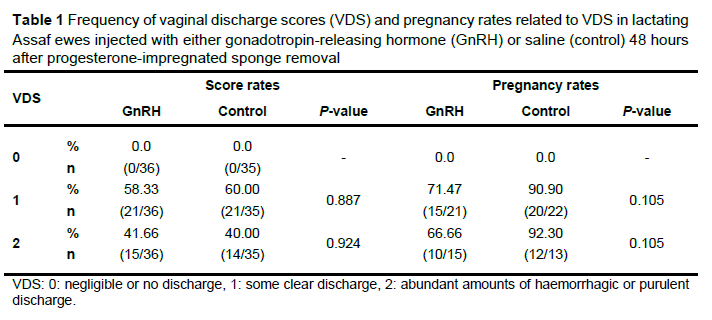
Vaginal discharge scores were recorded for all ewes and compared to pregnancy rates. Vaginal discharge was evaluated for characteristics (odour, amount, texture, and colour) and scored (0: negligible or no discharge, 1: some clear discharge, and 2: abundant haemorrhagic or purulent discharge). Oestrous signs and mating behaviours were video recorded and evaluated for three days. Ewes were mated with proven Assaf rams until oestrus ended. Pregnancy diagnosis was performed using transrectal real-time B-mode ultrasonography (WED-3000V, HASVET, Türkiye) 23-26 and 35-38 days after mating. Oestrus response, pregnancy rate, embryonic death rate, abortion rate, lambing rate, twinning rate, fecundity, prolificacy, and fertility rate were also noted:
• Oestrus response: Number of ewes in oestrus/Total number of ewes χ 100
• Pregnancy rate: Number of pregnant ewes/Number of ewes mated χ 100
• Lambing rate: Number of ewes lambed/Number of ewes pregnant χ 100
• Twinning rate: Number of ewes producing twin lambs/Number of ewes lambed χ 100
• Fecundity: Number of lambs born per ewe mated
• Prolificacy: Number of lambs born per ewe lambed
• Fertility: Number of ewes lambed
Blood sample collection and progesterone analysis
Blood samples from all the Assaf ewes were collected by jugular venipuncture using non-heparinised vacuum tubes (Ayset Vacutainer®, Adana, Türkiye) on the day of sponge removal. The samples were centrifuged at 3000 g for 15 minutes (NF800, Nüve®, Türkiye), and the separated serum samples were stored at -20 °C until analyses were performed. Serum progesterone concentrations were determined using the chemiluminescent (CLIA) method (Snibe-Maglumi 4000 Plus, Shenzhen, China), with a sensitivity of <0.1 ng/ml, a specificity of 90%, and intra-assay and inter-assay coefficients of variation of 3.4%-5.5% and 1.6%-2.2%, respectively, for samples containing between 0.1 and 80 ng/ml progesterone.
Statistical analysis
Statistical analyses were performed using the Statistical Package for the Social Sciences (SPSS) software, version 25.0. The onset of oestrus, oestrus duration, pregnancy duration, body condition score, days in milk, number of lactations, milk yield, and vaginal discharge scores were analysed using independent sample t-tests. Blood progesterone levels, pregnancy rates, oestrus responses, lambing rates, twinning/triplet rates, fertility, and vaginal discharge scores were compared using the Mann-Whitney U test. The fecundity, prolificacy, abortion rate, and lamb sex distribution were analysed using chi-square tests, and the distribution of the onset of oestrus was analysed using a repeated measures test. The differences were considered significant when P <0.05.
Results
The vaginal discharge scores and pregnancy rates related to vaginal discharge were compared between the control and GnRH groups (Table 1). Varying degrees of vaginal discharge were observed in all ewes. Clear and negligible amounts of discharge, and moderate haemorrhagic staining on the intravaginal sponges were observed in ewes scored 1, and abundant amounts of purulent, malodorous discharge, and dense haemorrhagic staining on the intravaginal sponges were observed in ewes scored 2 following sponge removal. However, there were no significant differences in either the vaginal discharge scores or the pregnancy rates related to the vaginal discharge scores between the treatment groups.
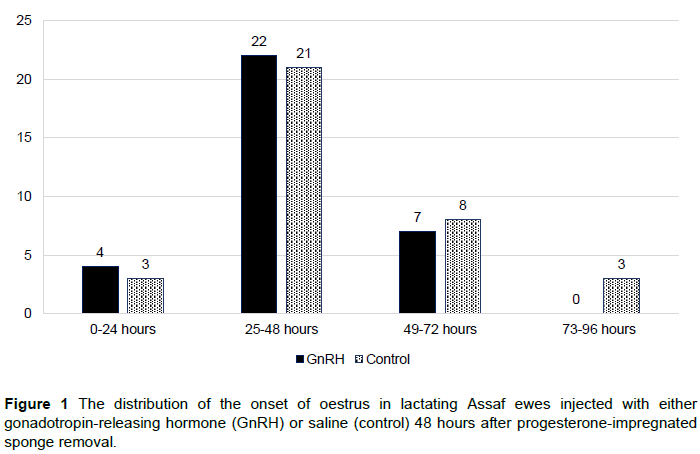
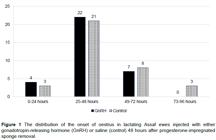
The oestrus onset distribution is presented in Figure 1. The onset of oestrus typically occurred between 24 and 48 hours after sponge withdrawal.
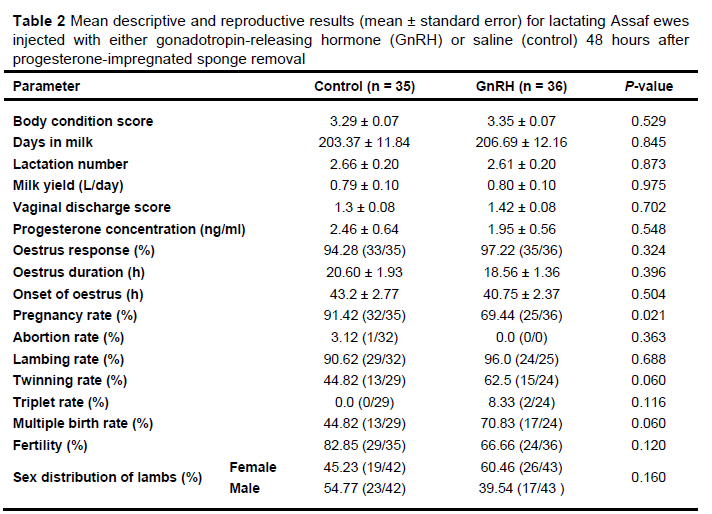
Mean body condition score, days in milk, lactation number, milk yield, vaginal discharge score, progesterone concentration, oestrus response, pregnancy rate, abortion rate, lambing rate, twinning/triplet rate, fertility, and lamb sex distribution data for each treatment group are presented in Table 2. There were no significant differences between the groups in the descriptive and reproductive results, with the exception of the pregnancy rate (P <0.05), which differed between the control and GnRH groups. The pregnancy rate was significantly lower in the ewes injected with GnRH 48 hours after sponge removal (69.44%) than in the control ewes (91.42%). However, the lambing rates were 90.62% (29/32) and 96.0% (24/25) in the control and GnRH groups, respectively (P >0.05).
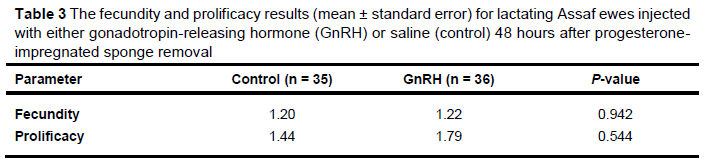
The number of lambs, fecundity, and prolificacy values did not differ significantly between the groups (Table 3). However, the prolificacy was numerically higher in the GnRH group (1.79) than in the control group (1.44). Moreover, the number of lambs born in the control group was 42, compared with 43 in the GnRH group. The prolificacy in relation to the ewe parity was also evaluated. In first parity ewes in the control group, singleton pregnancies were detected in eight ewes and twins were detected in two ewes, while in first parity ewes in the GnRH group, three ewes had singletons and two ewes had twins. In second parity ewes, there were two sets of twins and one singleton in the control group, and one set of twins and four singletons in the GnRH group. In third parity ewes, six ewes lambed singletons and three ewes lambed twins in the control group, while three ewes lambed singletons, five ewes lambed twins, and one ewe lambed triplets in the GnRH group. In fourth parity ewes, there were five singletons and five sets of twins in the control group, and four singletons and five sets of twins in the GnRH group.
Discussion
The present study investigated the effect of GnRH treatment 48 hours after sponge removal on prolificacy in lactating Assaf ewes during the breeding season. The pregnancy rate was significantly lower in the GnRH group than the control group. Nonetheless, 43 lambs were produced by the GnRH treated ewes and 42 were produced by the control group ewes. The prolificacy was also numerically higher in the GnRH group (1.79) than in the control group (1.44).
Selecting an optimal oestrus synchronisation protocol is critical for enhancing oestrus response, pregnancy rate, and overall fertility in small ruminants. Progesterone-based synchronisation protocols are the most effective methods of reproductive control in sheep. Long-duration progesterone therapies (12-14 days) successfully induce oestrous responses; however, conception rates tend to be suboptimal (Abecia et al., 2021; Farooqi et al., 2021). Progesterone exposure of more than nine days reduces oocyte quality, sperm survival in the female genital tract, and embryonic development; moreover, intravaginal sponges increase vaginitis and genital tissue contamination by blocking vaginal secretion drainage. Consequently, short-duration progesterone-based protocols (5-9 days) have been successfully modified to cause the ovulation of newly recruited growing follicles, with a less suppressive effect on local immunity and sperm fertility (Vinoles et al., 2001; Hameed et al., 2021). In the present study, the ewes were synchronised using a short-term progesterone sponge application (6 days), based on previous study results. The oestrus response (94.28%) of all ewes and pregnancy rates (91.42%) of the non-GnRH treated ewes were found to be satisfactory. Various oestrous responses and pregnancy rate results in ewes have been reported in previous studies using short-term progesterone-based synchronisation protocols (Arikan et al., 2021). The variation in these reports might be linked to the ewe breed, management factors (extensive, semi-intensive, or intensive systems), the method of application (sponge or implant), the progesterone analogue used (medroxyprogesterone acetate or fluorogestone acetate), additional hormones used (PGF2a and eCG), and environmental factors.
Several hormones and treatment periods have been studied in the context of progesterone-based synchronisation protocols, including comparisons of eCG and GnRH, the timing of eCG and PGF2α injections before or after sponge removal, and GnRH administration at the beginning of the protocol or at various time points after sponge removal or mating (Titi et al., 2010; Kutlu & Dinç 2021; Maggi et al., 2024; Zhang et al., 2024). Administration of GnRH at the beginning of the synchronisation protocol could not improve pregnancy rates reasonably in small ruminants, contrary to expectations (Baki Acar et al., 2013; Hameed et al., 2021). Similarly, GnRH injection at the time of progesterone device removal or 36 and 48 hours after removal did not increase pregnancy rates in sheep, with the pregnancy rates being lower than the control group in various studies (Kutlu & Dinç 2021; Maggi et al., 2024; Zhang et al., 2024; Dogan et al., 2024). Our results are comparable with those of these previous studies, with the pregnancy rate of the GnRH group being significantly lower than that of the control group. Zhang et al. (2024) commented on the negative effects of GnRH administration on pregnancy through its impact on metabolic pathways. They reported that a single injection of the GnRH agonist triptorelin 48 hours after sponge removal decreased hydroxyproline levels, but increased corticosterone and prostaglandin D2 levels. However, the prolificacy of the ewes in our study was markedly higher in the GnRH group than in the control group, although this difference was not statistically significant. This higher prolificacy concurred with the results of Kutlu & Dinç (2021), who also used Awassi ewes and reported that while the pregnancy rate was lower than that of the control group, the litter size increased with single-dose GnRH injection (Kutlu & Dinç, 2021). The positive effect of GnRH administration 48 hours after sponge removal on prolificacy should thus be investigated on a broader scale. New perspectives on improving both pregnancy rates and prolificacy warrant further evaluation.
Assaf sheep were developed by cross-breeding German East Friesian sheep and Israeli Awassi sheep, producing a dual-purpose breed used for both meat and milk production. They also exhibit high fertility and multiparity. For decades, Assaf sheep have been an increasingly preferred breed in the Middle East, in countries such as Israel, Jordan, and Palestine, as well as in European countries such as Spain, Bulgaria, and Moldova (Gootwine, 2011; Lutskanov et al., 2023; Hidalgo González et al., 2024; Aljamaeen et al., 2025). The Assaf breed typically has an average prolificacy (1.6 lambs per lambing) (Madrigali et al., 2021), and in the present study, the prolificacy rates of the ewes in the control and GnRH groups were 1.44 and 1.79, respectively. The prolificacy rate was thus increased by the GnRH treatment of lactating Assaf ewes during the breeding season in our study. Notter (2000) reported that the prolificacy rate can be affected by the age of the ewe (reaching a maximum between three and six years of age), the season (higher in winter and spring lambing), and breed differences. Ewes in this study ranged from two to five years of age, and the prolificacy in the control group was similar to the results of previous studies on Assaf ewes. The litter size in relation to parity was also in accordance with previous reports, showing an increase in the proportion of multiple lambing events with increasing parity in the GnRH group (Abegaz et al., 2002; Kutlu & Dinç, 2021). However, a supportive effect of GnRH treatment 48 hours after sponge removal was also observed.
High prolificacy is a desirable fertility parameter for sustainable livestock production. However, increased litter size can have negative effects on ewe and foetal health. Multi-foetal pregnancies may cause foetal hypoxia, oxidative stress, reduced growth rates due to limited uterine capacity, and increased perinatal and postnatal mortality in lambs (Kenyon et al., 2019). Maternal health is also at risk in multi-foetal pregnancies, especially in extensive systems with limited control of environmental factors and insufficient nutritional and metabolic resources. The maternal mortality rate is higher in prolific sheep owing to pregnancy toxaemia in conditions of undernutrition (Gootwine, 2020).
In the present study, the multiple birth rate was 44.8% in the control group and 70.8% in the GnRH group. Lamb mortality due to dystocia was seen in one ewe in the control group and two ewes in the GnRH group; additionally, two ewes in the control group and one ewe in the GnRH group died during pregnancy. Thus, multi-foetal pregnancies were not associated with increased foetal/lamb or maternal mortality in the lactating Assaf ewes in the present study. However, the ewes were raised under an intensive management system with sufficient nutrient availability and veterinary care; therefore, multi-foetal pregnancies did not negatively affect either group.
Conclusions
An increased pregnancy rate and litter size are the most desirable reproductive parameters for sustainability in sheep breeding. The results of our study suggest that administering GnRH 48 hours after the removal of progesterone-containing sponges enhances prolificacy in lactating Assaf ewes during the breeding season. We conclude that post-mating GnRH injection may be considered to improve litter size in sheep, despite its negative impact on pregnancy rates when administered after sponge removal. Therefore, alternative pathways and promoter factors for enhancing pregnancy rates should be explored in addition to GnRH administration.
Authors' contributions
U.K.: Writing - review and editing, visualisation, investigation, formal analysis, data curation, and conceptualisation. D.B.A.: Writing - review and editing, methodology, validation, and supervision. The final version of this manuscript was read, reviewed, and approved by both the authors.
Conflict of interest declaration
The authors declare that they have no conflicts of interest.
Acknowledgements
The authors thank Dr Hatice Hizli for the critical reading of the statistical analyses of this paper. This research did not receive any specific grant from funding agencies in the public, commercial, or not-for-profit sectors.
References
-
Abdoli, R., Zamani, P., Mirhoseini, S.Z., Ghavi Hossein-Zadeh, N., & Nadri, S., 2016. A review on prolificacy genes in sheep. Reproduction in Domestic Animals, 51(5):631-637. DOI: https://doi.org/10.1111/rda.12733
» https://doi.org/10.1111/rda.12733 -
Abecia, J.A., Forcada, F., & Gonzalez-Bulnes, A., 2012. Hormonal control of reproduction in small ruminants. Animal Reproduction Science, 130:173-179. DOI: https://doi.org/10.1016/j.anireprosci.2012.01.011
» https://doi.org/10.1016/j.anireprosci.2012.01.011 -
Abegaz, S., Duguma, G., Negussie, E., Gelmesa, U., Terefe, F., & Rege, J.E.O., 2002. Factors affecting reproductive performance and estimates of genetic parameters of litter size in Horro sheep. The Journal of Agricultural Science, 139(1):79-85. DOI: https://doi.org/10.1017/S0021859602002265
» https://doi.org/10.1017/S0021859602002265 -
Aljamaeen, A.K., Tabbaa, M.J., Al-Atiyat, R.M., & Titi, H.H., 2025. Phenotypic characteristics and factors associated with Assaf lamb body weight and morphology. Qeios, 7(1):1-12. DOI: https://doi.org/10.32388/QZ3J92.2
» https://doi.org/10.32388/QZ3J92.2 -
Arikan, M.S., Mat, B., Alkan, H., Çevrimli, M.B., Akin, A.C., Çahin, T.S., & Tekindal, M.A., 2021. A meta-analysis of the effects of synchronization protocols applied to sheep in Turkey on pregnancy rates during breeding and non-breeding seasons. Veterinary Medicine and Science, 7(6):2280-2289. DOI: https://doi.org/10.1002/vms3.610
» https://doi.org/10.1002/vms3.610 -
Baki Acar, D., Birdane, M.K., Ozenc, E., Yeni, D., & Dogan, I., 2013. Effectiveness of different progesterone analogues and GnRH on reproductive parameters in nulliparous Saanen goats at the end of the transition period. Kafkas Universitesi Veteriner Fakültesi Dergisi, 19(7):A181-A186. DOI: https://doi.org/10.9775/kvfd.2013.8747
» https://doi.org/10.9775/kvfd.2013.8747 -
Ceyhan, A., Sezenler, T., & Erdogan, i., 2009. The estimation of variance components for prolificacy and growth traits of Sakiz sheep. Livestock Science, 122(1):68-72. DOI: https://doi.org/10.1016/j.livsci.2008.07.030
» https://doi.org/10.1016/j.livsci.2008.07.030 -
Cui, Y., Zhang, L., Li, J., Chen, Q., Ren, L., & Jia, J., 2022. Differential expression of proteins in Tibetan sheep ovary and relation to litter size traits at different follicular development stages. Kafkas Universitesi Veteriner Fakültesi Dergisi, 28(3):327-335. DOI: https://doi.org/10.9775/kvfd.2022.27004
» https://doi.org/10.9775/kvfd.2022.27004 -
Davis, G.H., Balakrishnan, L., Ross, I.K., Wilson, T., Galloway, S.M., Lumsden, B.M., Hanrahan, J.P., Mullen, M., Mao, X.Z., Wang, G.L., Zhao, Z.S., Zeng, Y.Q., Robinson. J.J., Mavrogenis, A.P., Papachristoforou, C., Peter, C., Baumung, R., Cardyn, P., Boujenane, I., Cockett, N.E., & Notter, D.R., 2006. Investigation of the Booroola (FecB) and Inverdale (FecXI) mutations in 21 prolific breeds and strains of sheep sampled in 13 countries. Animal Reproduction Science, 92(1-2):87-96. DOI: https://doi.org/10.1016/j.anireprosci.2005.06.001
» https://doi.org/10.1016/j.anireprosci.2005.06.001 -
Dogan, I., Toker, M., Aktar, A., & Yilmaz, M., 2024. Effect of GnRH and hCG treatment following a short-term estrus synchronization protocol on ovulation and the fertility in Merino ewes, during the breeding season. Journal of the Hellenic Veterinary Medical Society, 74(4):6517-6524. DOI: https://doi.org/10.12681/jhvms.31541
» https://doi.org/10.12681/jhvms.31541 - Drobik, W. & Martyniuk, E., 2014. Factors affecting prolificacy and lambs rearing results in Olkuska sheep population. Annals of Warsaw University of Life Sciences-SGGW. Animal Science, 53:85-94.
-
Farooqi, Z.R., Ahmad, E., Akhtar, M.S., Ahmad, T., Khan, M.I.R., Naseer, Z., Sattar, A., & Serin, i., 2021. Efficacy of progesterone or GnRH based estrous synchronization protocols in Beetal goats during low breeding season. The Journal of Animal and Plant Sciences, 31(6):1867-1872. DOI: https://doi.org/10.36899/JAPS.2021.6.0392
» https://doi.org/10.36899/JAPS.2021.6.0392 -
Gootwine, E., 2011. Mini review: breeding Awassi and Assaf sheep for diverse management conditions. Tropical Animal Health and Production, 43:1289-1296. DOI: https://doi.org/10.1007/s11250-011-9852-y
» https://doi.org/10.1007/s11250-011-9852-y -
Gootwine, E., 2020. Invited review: Opportunities for genetic improvement toward higher prolificacy in sheep. Small Ruminant Research, 186:106090. DOI: https://doi.org/10.1016/j.smallrumres.2020.106090
» https://doi.org/10.1016/j.smallrumres.2020.106090 -
Hameed, N., Khan, M.I.uR., Zubair, M., & Andrabi, S.M.H., 2021. Approaches of estrous synchronization in sheep: developments during the last two decades: a review. Tropical Animal Health and Production, 53:485. DOI: https://doi.org/10.1007/s11250-021-02932-8
» https://doi.org/10.1007/s11250-021-02932-8 -
Hidalgo González, C., Rodríguez Fernández, M., Plaza, J., Nieto, J., Pérez-Garcia, M.E., & Palacios, C., 2024. Optimizing lambing efficiency: Alternative management strategies for Assaf ewe flocks. SSRN [Preprint]. DOI: http://dx.doi.org/10.2139/ssrn.5026672
» http://dx.doi.org/10.2139/ssrn.5026672 -
Kenyon, P.R., Roca Fraga, F.J., Blumer, S., & Thompson, A.N., 2019. Triplet lambs and their dams-a review of current knowledge and management systems. New Zealand Journal of Agricultural Research, 62:399-437. DOI: https://doi.org/10.1080/00288233.2019.1616568
» https://doi.org/10.1080/00288233.2019.1616568 -
Kutlu, M. & Dinç, D.A., 2021. The effect of double-dose GnRH injections on reproductive performance parameters following short-term progestagen administration in lactated Awassi ewes during the non-breeding season. Tropical Animal Health and Production, 53(2):277. DOI: https://doi.org/10.1007/s11250-021-02735-x
» https://doi.org/10.1007/s11250-021-02735-x -
Liu, Z., Zhang, W., Zhu, C., Chen, X., Zhao, Y., Wang, Y., & Zeng, W., 2022. Effect of different litter size on the rate of postpartum uterine involution in Hu sheep. Kafkas Universitesi Veteriner Fakültesi Dergisi, 28(2):275-280. DOI: https://doi.org/10.9775/kvfd.2021.26965
» https://doi.org/10.9775/kvfd.2021.26965 -
Lutskanov, P.I., Mashner, O.A., Evtodienko, S., Borzin, G.I., & Evgeniya, A., 2023. Characteristics of lambs and milk productivity of Tsigay breed ewes and F1 and F2 crosses with Assaf dairy sheep. Bulgarian Journal of Animal Husbandry/Zivotnov Dni Nauki, 60(4):8. DOI: https://doi.org/10.61308/ltht5554
» https://doi.org/10.61308/ltht5554 -
Madrigali, A., Rota, A., Panzani, D., Castellani, S., Shawahina, M., Hassan, A., Di Iacovo, F., Rossignoli, F., & Camillo, F., 2021. Artificial insemination in sheep with fresh diluted semen: comparison between two different semen extenders and management protocols. Tropical Animal Science Journal, 44(3):255-260. DOI: https://doi.org/10.5398/tasj.2021.44.3.255
» https://doi.org/10.5398/tasj.2021.44.3.255 -
Maggi, G., Pires, O.S., Junior, S.F.V., Oliveira, F.C., Moraes, F.P., Ferreira, R., Vieira, A.D., Rovani, M.T., Gonçalvez, P.B.D., Mondadory, R.G., & Gasperin, B.G., 2024. Is it possible to replace eCG by GnRH in the hormonal protocol for timed artificial insemination in ewes during the breeding season? Domestic Animal Endocrinology, 89:106878. DOI: https://doi.org/10.1016/j.domaniend.2024.106878
» https://doi.org/10.1016/j.domaniend.2024.106878 -
Notter, D.R., 2000. Effects of ewe age and season of lambing on prolificacy in US Targhee, Suffolk, and Polypay sheep. Small Ruminant Research, 38(1):1-7. DOI: https://doi.org/10.1016/S0921-4488(00)00144-9
» https://doi.org/10.1016/S0921-4488(00)00144-9 -
Ramírez-Ramírez, A.I., Delgado-Tiburcio, G.I., Cruz-Espinoza, F., Herrera-Corredor, A.C., & Gallegos-Sánchez, J., 2021. Photoperiod and its relationship to sheep reproduction. Agro Productividad, Early Access VI. DOI: https://doi.org/10.32854/agrop.v14i10.1620
» https://doi.org/10.32854/agrop.v14i10.1620 -
Sadeghi, M., Bahrami, A., Hasankhani, A., Kioumarsi, H., Nouralizadeh, R., Abdulkareem, S.A., Ghafouri, F., & Barkema, H.W., 2022. lncRNA-miRNA-mRNA ceRNA network involved in sheep prolificacy: An integrated approach. Genes, 13:1295. DOI: https://doi.org/10.3390/genes13081295
» https://doi.org/10.3390/genes13081295 -
Simões, J., Abecia, J.A., Cannas, A., Delgadillo, J.A., Lacasta, D., Voigt, K., & Chemineau, P., 2021. Managing sheep and goats for sustainable high yield production. Animal, 15:100293. DOI: https://doi.org/10.1016/j.animal.2021.100293
» https://doi.org/10.1016/j.animal.2021.100293 -
Titi, H.H., Kridli, R.T., & Alnimer, M.A., 2010. Estrus synchronization in sheep and goats using combinations of GnRH, progestagen and prostaglandin F2a. Reproduction in Domestic Animals, 45(4):594-599. DOI: https://doi.org/10.1111/j.1439-0531.2008.01309.x
» https://doi.org/10.1111/j.1439-0531.2008.01309.x -
Vinoles, C., Forsberg, M., Banchero, G., & Rubianes, E., 2001. Effect of long-term and short-term progestagen treatment on follicular development and pregnancy rate in cyclic ewes. Theriogenology, 55:993-1004. DOI: https://doi.org/10.1016/S0093-691X(01)00460-5
» https://doi.org/10.1016/S0093-691X(01)00460-5 -
Yang, L., Yao, X., Chen, X., Zang, S., Sun, H., Liu, Y., & Dun, W., 2020. Expression of follicle-stimulating hormone, luteotropic hormone, estrogen and progesterone receptors in ovary, oviduct and endometrium after estrus induction in ewe. Kafkas Universitesi Veteriner Fakültesi Dergisi, 26(1):65-70. DOI: https://doi.org/10.9775/kvfd.2019.22274
» https://doi.org/10.9775/kvfd.2019.22274 -
Zhang, J., Sun, S., Bai, X., Yang, N., Liu, Y., Wu, X., & Li, X., 2024. Metabolomics analysis of the effect of GnRH on the pregnancy rate of ewes with estrus synchronization scheme based on progesterone. Frontiers in Veterinary Science, 11:1442931. DOI: https://doi.org/10.3389/fvets.2024.1442931
» https://doi.org/10.3389/fvets.2024.1442931
Accepted 06 December 2025
Published 14 January 2026