The effect of various additives to vetch forage silage on in vitro digestibility values and feed quality
Abstract
The aim of this study was to determine the effect of adding pomace (peach, apricot) and molasses in different proportions to vetch feed on the digestibility values and relative feed quality of the silage. The forage was wilted before being chopped into pieces approximately 2-3 cm in length. Fruit and molasses were added to the silage. Treatment groups included: 0 + vetch (control), 2% peach + vetch, and 4% peach + vetch, 2% apricot + vetch, 4% apricot + vetch, and 2% molasses + vetch, and 4% molasses + vetch. A total of 42 samples of silage (7 × 6 in parallel) were prepared. The silages were kept in vacuum bags for 60 days (at 25 °C). The data were subjected to variance analysis. When reducing the additives, the content of ether extract, crude protein, neutral detergent fibre, and acid detergent lignin decreased, but Fleig score increased. The highest values of in vitro gas production, CH4, organic matter digestibility, metabolizable energy, and net energy for lactation in the silage were obtained with a 2% apricot additive. The addition of 4% molasses to the feed increased the relative feed and relative forage quality values. The addition of fruit and molasses to vetch silage can improve feed quality.
apricot; in vitro digestibility; molasses; peach; vetch
Introduction
The quality of roughage sources is important in obtaining high-quality animal products. Due to insufficient production of high-quality roughage for ruminant feeding and the high costs associated with feed, there has been a quest to find alternative roughage sources. The increase in the human population has led to a rise in food demand; however, substantial food waste is observed. Fruits and vegetables, which perish quickly, contribute substantially to this waste, along with market and fruit juice factory residues, forming a portion of the sources of greenhouse gases in our environment. The importance of utilizing fruit waste in animal feeding has emerged both to mitigate the harmful effects on the environment caused by wastage and to provide an alternative source of high-quality roughage for obtaining animal protein, which is important in human nutrition (Das et al., 2018; Sahoo et al., 2021). Currently, studies on the utilization of fruit and vegetable waste in animal feeding have gained attention (Sahoo et al., 2021; Tedesco et al., 2021; Besharati et al., 2022; Giller et al., 2022). Since fruit and vegetable waste cannot be stored for long periods, extending their use in animal feeding over time is not feasible. Therefore, the method of ensiling, which enables the prolonged utilization of waste, has been adopted (Tai et al., 2020; Lalramhlimi et al., 2022). Forage crops intended for ensilage should ideally have a high soluble carbohydrate content to facilitate easy fermentation. However, some forage crops, particularly leguminous ones such as vetch, have a low soluble carbohydrate content, making ensilage challenging. Fruit waste can be utilized to overcome this challenge, enabling both ensilage of such forage crops and their utilization in animal feeding throughout the year (Gharehbagh et al., 2020; Ülker et al., 2020).This study was conducted to determine the effects of adding peach and apricot pomaces at different ratios, along with molasses, to vetch fodder silage.
Material and Methods
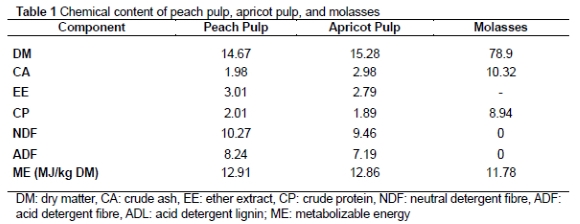
The forage material for this study consisted of vetch plants harvested during the flowering period in a field located within the boundaries of Erzincan province, Turkey in the 2022 season. The peach and apricot pulp used in the silage production were obtained from Erzincan Tunay Food Industry Trade Inc., while the molasses was sourced from Erzincan Sugar Factory, Turkey. The chemical content of peach pulp, apricot pulp, and molasses additives is provided in Table 1.
The fodder plant was cut into pieces 2-3 cm in length after being slightly wilted. Treatment groups included: 0 + vetch (control), 2% peach + vetch, 4% peach + vetch, 2% apricot + vetch, 4% apricot + vetch, and 2% molasses + vetch, 4% molasses + vetch. A total of 42 samples of silage (7 χ 6 in parallel) were prepared. Prepared silage samples were vacuum-sealed in vacuum bags (25 cm × 35 cm) and stored for 60 d at 25 °C. After opening the silage, the pH value was measured using a digital pH meter (Anonymous, 1987). The Fleig Score of the silage was calculated (Ramzan et al., 2022):

Rumen contents were obtained from three female Holstein cattle (450-500 kg) slaughtered at the Erzurum Meat and Fish Processing Plant, Turkey. Approximately 5 min after opening the rumen of each animal post-slaughter, rumen fluid was collected and transported to the feed analysis laboratory (in a CO2 atmosphere at 39 °C) (Kilic and Abdiwali, 2016).
The analysis of CP, DM, and CA of the silage was conducted according to the methods of Kılıç and Abdiwali (2016); EE analysis was performed using the AOCS 2005 method. Subsequently, ADF and NDF analyses were carried out using the ANKOM2000 Fiber Analyzer, and ADL analysis was determined following the method reported by Van Soest et al. (1991).
The relative feed value (RFV) was calculated using the formula developed by Van Dyke and Anderson (2000):

where DMD is dry matter digestibility and DMI is dry matter intake.
Samples were processed using the Ankom Daisy incubator as reported by Van Soest et al. (1991) and Adesogan (2005) for true dry matter digestibility (TDMD), true organic matter digestibility (TOMD), dry matter intake (DMI), true NDF digestibility (TNDFD), and total digestible nutrients (TDN) values. Relative forage quality (RFQ) was determined using the following equations (Van Soest et al., 1991; Adesogan, 2005):

where ME, metabolizable energy; GP, net gas production of 200 mg dry feed sample after 24 h; NEl, net energy lactation.
Total gas and methane production of the samples were determined as reported by Menke et al. (1979) and Goel et al. (2008). After gas measurements, the remaining samples were boiled using the method reported by Van Soest et al. (1991). From the digestibility parameters, the amount of true dry matter (GKMS) and true digestibility (GSD), partitioning factor (PF), microbial yield (MY), microbial protein (MP), and microbial protein synthesis efficiency values were determined as reported by Blümmel et al. (1997).
The obtained data were subjected to analysis of variance using the SPSS 24 (IBM, 2016) software package and group comparisons were conducted using Duncan's multiple range test.
Results and Discussion
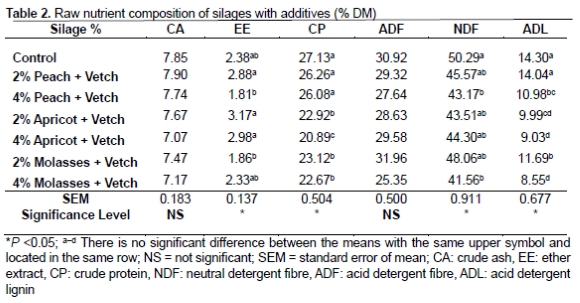
The effects of supplementing vetch forage silage with fruit pulp and molasses on nutrient composition, excluding DM and ADF, were statistically significant (P <0.05) (Table 2). Addition of 2% peach and apricot, and 4% apricot (2.88, 3.17, and 2.98) increased the EE content, whereas 4% peach and 2% molasses (1.81 and 1.86) decreased the EE content. Ülger et al. (2020) determined that lemon waste increased corn silage DM content, whereas mandarin waste decreased it. Fruits such as peach and apricot are naturally low in fat content. However, these fruits are rich in fibre and other nutrients. When added, they can increase the crude fat content. The reason for this could be particularly due to the effect of fibre content.
Molasses is typically a material with low fat content. The addition of molasses to the silage mixture may lead to a decrease in crude fat content. The addition of peach did not affect the CP content compared to the control, whereas the addition of apricot and molasses reduced the CP content. The greatest reduction was observed with 4% apricot addition (20.89%). In various studies, it has been reported that the addition of certain fruit residues and molasses does not affect the CP content of silage; in some cases it decreased and in others, it increased (Saruhan & ibrahimoglu, 2019; Ülger et al., 2020; Gül, 2023). The variations in CP content due to the addition of fruit residues may stem from differences in the feed material used for silage. The addition of apricot and molasses could alter the fermentation process of silage, potentially leading to the breakdown and loss of proteins.
Except for the addition of 2% peach, the addition of 4% peach, apricot, and molasses reduced the NDF and ADL content of vetch silage. The lowest NDF content was observed with 4% peach (43.17%), whereas the lowest ADL content was detected with 4% molasses addition. Similarly, in some studies, the NDF and ADL content of silage has been reported to decrease (Ülger et al., 2020; Gül, 2023). The fermentation process of the added substances may affect the NDF and ADL content of the silage. The breakdown and decrease in fibre content may result from the fermentation of these additives.
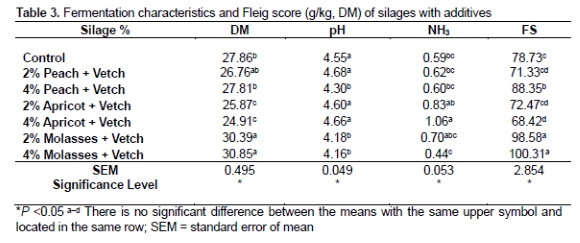
The addition of different proportions of fruit pulps and molasses to vetch forage silage was statistically significant in terms of Fleig score and fermentation characteristics (Table 3) (P < 0.05). Whereas peach supplementation did not affect the silage DM content, apricot supplementation decreased DM, and molasses supplementation increased DM content. The addition of peach and molasses at 4% decreased the pH value of the silage. However, 4% apricot supplementation increased the NH3 content of the silage. Compared to the control group, the addition of 4% apricot decreased the FS value of the silage, whereas the addition of 4% peach and molasses increased it. The lowest pH (4.16) and NH3 (0.44) values, along with the highest DM content (30.85) and FP value (100.31), were achieved with the addition of 4% molasses.
Molasses sugars can promote the proliferation of desirable microorganisms such as lactic acid bacteria. These bacteria produce lactic acid during silage fermentation, contributing to a decrease in pH and aiding in silage preservation. The increase in dry matter content, decrease in pH value, and attainment of the highest Fleig score due to molasses supplementation indicate that this additive positively influences the fermentation process and enhances silage quality. Additionally, fruit pomaces also influenced the nutrient content of silage and increased the FP value when added in specific proportions. Similar results have been obtained in some studies involving molasses and various fruit pomaces (İbrahimoğlu & Saruhan, 2019; Ülger et al., 2020; Tai et al., 2021; Gül, 2023). These findings indicate that the use of additives such as fruit pomaces and molasses in silage production can enhance its quality and nutritional value.
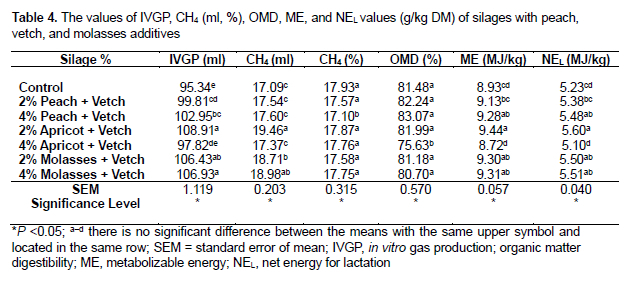
IVGP, CH4 production (ml and %), OMD, ME, and NEl values of vetch silage were different between treatments (P <0.05; Table 4). The addition of 2% apricot supplementation increased gas production of silage the most compared to the control group (108.91 ml). Whereas additives did not markedly decrease CH4 (ml) production compared to the control group, the highest increase was observed with 2% apricot supplementation (19.46 ml). Although the additives generally did not affect CH4 (%) production, 4% peach supplementation decreased this by 17.60% and 4% apricot supplementation by 75.63%. The addition of 2% apricot supplementation increased the ME and NEl values of the silage the most compared to the control group (9.44 and 5.60 MJ/kg, respectively). The reason for these effects may be attributed to the influence of additives on silage microbial activity and digestibility, thereby altering gas production, methane production, and energy values. These effects can be linked to the nutrients contained in the additives and their impact on microbial activity. For example, the supplementation of apricot may enhance the digestibility of silage and stimulate microbial activity, thus increasing gas production and energy values. Similar results have been obtained in studies concerning molasses and various fruit pomaces (İbrahimoğlu & Saruhan, 2019; Ülger et al., 2020; Sahoo et al., 2021).
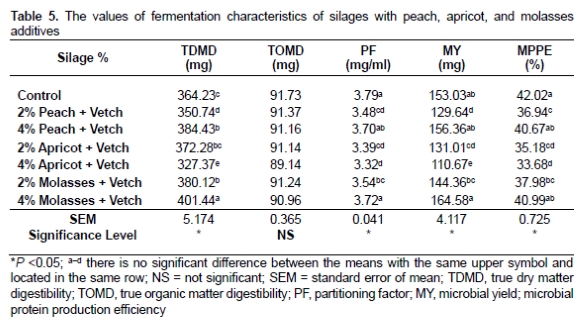
The effects of supplementation with pulp and molasses additives on vetch forage silage, except for TOMD, were found to be statistically significant in terms of TDMD, PF, MY, and MPPE values (Table 5) (P <0.05). Whereas 4% apricot supplementation decreased TDMD the most (327.37 mg), 4% molasses supplementation increased it the most (401.44 mg). This indicates a potential negative effect of 4% apricot on digestion, whereas 4% molasses was determined to improve digestion. The addition of 4% apricot supplementation decreased the PF value the most (3.32 mg/ml), indicating that digestion is more challenging or that the animal's digestive system struggles to adapt to this substance. The 4% apricot supplementation also resulted in the greatest decrease in MY value (110.67 mg), indicating a decrease in microbial activity or a reduction in the amount of protein obtained from digested feed. The addition of 4% molasses supplementation increased the MY the most (164.58 mg). This indicates an increase in microbial activity or a higher synthesis of protein from digested feed. MPPE was highest in the control group (42.02%) and 4% apricot supplementation decreased it the most (33.68%). This indicates a negative response of the digestive system microorganisms with apricot supplementation. Studies have reported molasses supplementation to increase or decrease silage digestibility, PF, MP, and MPSE values (Apo-Donia et al., 2022; Gürsoy, 2023).
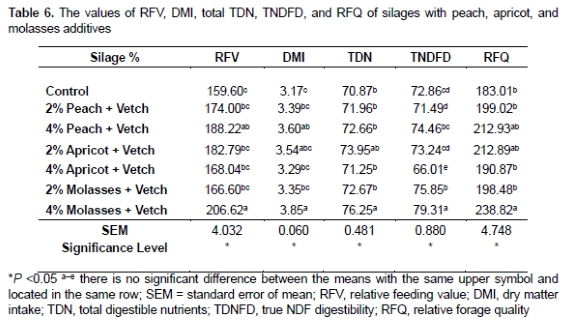
The supplementation of vetch forage silage with different contents of fruit pomaces and molasses showed statistically significant effects on RFV, DMI, TDN, TNDFD, and RFQ values (P < 0.05; Table 6). The supplementation of vetch forage silage with different contents of fruit pomaces and molasses increased the RFV and DMI of the silage, particularly with 4% peach and 4% molasses supplementation. The highest increase in RFV and DMI was observed with 4% molasses supplementation (206.62% and 3.60%, respectively). The highest TDN content of the silage was observed with 4% molasses supplementation (76.25%). The lowest TNDFD was determined with 4% apricot supplementation (66.01%), whereas the highest was observed with 4% molasses supplementation. Of the additives, the highest RFQ value of the silage was obtained with 4% molasses supplementation (reaching 238.82).
Molasses is a common additive used to sweeten feeds and enhance digestibility. Therefore, it is expected that the addition of molasses will increase the relative feed value and dry matter intake of feed. Additionally, molasses has a known enhancing effect on digestible nutrients. Besides improving feed quality, molasses supplementation improves the nutritional values of feed. Similar to the current study, the addition of molasses increased NYD and NYK values of silage (Hundal et al., 2021; Abo-Donia et al., 2022; Canbolat, 2022; Ramzan et al., 2022).
Conclusion
This study suggests that fruit and vegetable waste can be utilized to obtain high-quality forage. With the increasing population and the expected food scarcity in recent times, preventing waste will not only mitigate risks of food insecurity but also contribute substantially to obtaining high-quality animal products by utilizing waste. Utilizing waste plays an important role in addressing these challenges and providing high-quality animal products.
Authors' Contributions
The authors declare that they have contributed equally to the study.
Conflict of Interest Declaration
The authors declare that they have no conflict of interest.
Acknowledgements
This study was supported by the Scientific Research Projects commission of Agrı İbrahim Çeçen University (Project No: ECOHÜYO. 22.002).
References
- Adesogan, A. T., 2005. Effect of bag type on the apparent digestibility of feeds in ANKOM DaisyII incubators. Anim Feed Sci Technol. 119, 333-344.
- Abo-Donia, F. M., Ahmed El-Shora, M., Abd-Elaziz Riad, W., Basuony Elgamal, N. & Abdel-Menaem El-Hamady, W., 2022. Improve the nutritional value and utilisation of rice straw via an ensiling process with different sources of energy and nitrogen enrichment. J Applied Anim Res. 19, 333-341.
- AOCS, 2005. Official Procedures, Approved Procedure Am 5-04, Rapid determination of oil/fat utilizing high temperature solvent extraction. J Am Oil Chem Soc, Urbana, IL, USA.
- Canbolat, O., 2022. Effect of supplementation of urea on the nutritive value and fermentation characteristics of apple pulp silages. J Agri Sci. 1, 430-437.
- Das, N.G., Huque, K.S., Amanullah, S.M., Dharmapuri, S. & Makkar, H.P.S., 2018. Study of chemical composition and nutritional values of vegetable wastes in Bangladesh. Vet. Anim. Sci. 5, 31-37.
- Giller, K., Bossut, L., Eggerschwiler, L., & Terranova, M., 2022. In vitro ruminal fermentation, methane production, and nutrient degradability as affected by fruit and vegetable pomaces in differing concentrations. J. Anim. Physiol. Anim. Nutr. 106, 957-967.
- Gharehbagh, A. G., Pirmohammadi, R., Alijoo, Y. A. & Behroozyar, H. K., 2020. Investigating the effect of apple pomace silage as fodder source on performance and residues of its toxins in milk and some rumen fermentation in Mahabadi lactation goats in early lactation period. Ukr J Ecol. 10, 241-245.
- Gül, S., 2023. The impact of wheat bran and molasses addition to caramba mix silage on feed value and in vitro organic matter digestibility. J. King Saud Univ. Sci. 35, 102400.
- Gürsoy, E., Sezmiş, G., & Kaya, A., 2023. Effect of urea and molasses supplementation on in vitro digestibility, feed quality of mixed forage silages. Czech J. Anim. Sci. 68(6).
- Hundal, J. S., Sharma, A., Pal, R. & Grewal, R. S., 2021. Harnessing the in vitro nutritional potential of different varieties of sugarcane tops silages enriched with molasses and bacterial inoculants as an unconventional feed resource. Sugar Tech. 24, 923-932
-
Kilic, Ü. & Abdiwali, M. A., 2016. Determination of in vitro true digestibilities and relative feed values of wine industry grape residues as alternative feed source. Kafkas Univ Vet Fac J. 22, 895-901. doi: 10.9775/kvfd.2016.15617
» https://doi.org/10.9775/kvfd.2016.15617 - Lalramhlimi, B., Mukherjee, D., Chakraborty, I., Ghosh, N., Chattopadhyay, A., & Dey, R. C., 2022. Fruit and vegetable wastes as livestock feeds. In: Fruits and Vegetable Wastes: Valorization to Bioproducts and Platform Chemicals. Singapore: Springer Nature Singapore. pp. 139-168.
- Menke, K.H., Raab, L., Salewski, A., Steingass, H., Fritz, D. & Schneider W., 1979. The estimation of the digestibility and metabolisable energy content of ruminant feeding stuffs from the gas production when they are incubated with rumen liquor. J Agri Sci. 8, 217-222.
- Ramzan, H. N., Tanveer, A., Maqbool, R., Akram, H. M. & Mirza, M. A., 2022. Use of sugarcane molasses as an additive can improve the silage quality of sorghum-Sudan grass hybrid. Pak J Agri Sci. 18, 75-81.
- Sahoo, A., Sarkar, S., Lal, B., Kumawat, P., Sharma, S., & De, K., 2021. Utilization of fruit and vegetable waste as an alternative feed resource for sustainable and eco-friendly sheep farming. Waste Manag. 128, 232-242.
- Saruhan, V., & İbrahimoğlu, M. S., 2019. Farklı oranlarda mürüdümük (Lathyrus sativus L.) bitkisinin bazı meyve posaları ile silolanma özelliklerinin belirlenmesi. Avrupa Bilim ve Teknoloji Dergisi, 17, 66-70.
- Tai, V. A., Tuan, B. Q., Van, T. T. T., & Trach, N. X., 2020. Use of cashew apple fruit silage in the cattle fattening diet. Livestock Res Rural Dev. 32, 5.
- Tedesco, D. E. A., Scarioni, S., Tava, A., Panseri, S., & Zuorro, A., 2021. Fruit and vegetable wholesale market waste: Safety and nutritional characterisation for their potential re-use in livestock nutrition. Sustainability, 13, 9478.
- Ülger, İ., Beyzi, S. B., Kaliber, M., & Konca, Y., 2020. Chemical, nutritive, fermentation profile, and gas production of citrus pulp silages, alone or combined with maize silage. S. Afr. J. Anim. Sci. 50, 161-169.
- Van Soest, P. J., Robertson, J. B. & Lewis, B.A., 1991. Methods for dietary fiber, neutral detergent fiber, and nonstarch polysaccharides in relation to animal nutrition. J Dairy Sci. 6, 3583-3597.
- Van Dyke, N.J. & Anderson, P. M., 2000. Interpreting a Forage Analysis. Alabama Cooperative Extension. Circular ANR-890.
- Ward, R. & Ondarza, M. B., 2008. Relative feed value (RFV) vs. relative forage quality (RFQ). Cumberland Valley Analytical Services, INC. Hagestown, MD, Paradox Nutrition, LLC, West Chazy, NY.
Accepted 22 June 2024
Published 26 June 2024