The Impact of Mentorship on Farm Performance of Proactive Land Acquisition Strategy Beneficiaries in South Africa
Abstract
Evaluations of the impact of mentorship are limited. The few existing studies have a local municipalities or provincial levelfocus that paints an inconclusive picture at the national level. This paper aimed to assess the impact of mentorship on PLAS farm performance. A survey dataset of 1989 PLAS farms acquired between 2006 and 2018 was used. A multidisciplinary team of researchers from various agricultural fields did the assessment. Descriptive statistics was used to analyse the data for this specific research paper. Our results show that only 22% (423) of beneficiaries appointed mentors to support them. Having a mentor does not appear to have significantly increased PLAS farm productivity. Only 20% of farmers with mentors produced at medium-scale and commercial levels compared to 14% without mentors. The evaluation isolated significant shortcomings in the mentorship arrangements on PLAS farms. Mentorship as a form of extension is only one factor in the farm/farmer development equation. Numerous other factors are also vital in enhancing farm performance. Therefore, we conclude that mentorship had little impact on farm performance in the PLAS portfolio.
Extension Approach; Agrarian Reform; Emerging Farmer
1. INTRODUCTION
Implementing land reform policy is a constitutionally endorsed mandate. Since 1997, the South African democratic government has been implementing a three-tier land reform program comprised of land restitution, land tenure reform and land redistribution (Department of Land Affairs, 1997). The latter, which is the focus of this study, seeks to strike a balance in racial land ownership. Since its adoption, several sub-programs, such as the Settlement Land Acquisition Strategy (SLAG) and Land Redistribution for Agricultural Development (LRAD), have been proposed and implemented. A successor of these programs was the Proactive Land Acquisition Strategy (PLAS), adopted in 2006, meant to accelerate the pace of land redistribution.
However, the change in the programmed approach did not change much in land reform farm performance in terms of operation and production. Numerous studies have shown that farms redistributed under land reform policy experience a drop in production and productivity, and in a large proportion of cases, no production at all is evident (Kirsten et al., 2016; Gandidzanwa et al., 2021; Mtero et al., 2023).
Several reasons are cited for the poor production and productivity on redistributed farms. Firstly, Groenewald (2004), in his analyses of "conditions for successful land reform", has listed and discussed funding for land reform beneficiaries. Further, Binswanger-Mkhize et al. (2009:10) also emphasised the need and importance of post-settlement support as follows "The history of many land redistribution programs demonstrates that when poor people are given good farmland and adequate post-settlement support, they can lift themselves out of poverty permanently". It appears that the limitations in terms of post-settlement support in South African land reform funding mechanism are why only a few successful cases exist. This is partly due to insufficient coordination in rendering support and allocating scarce funding resources to many beneficiaries (Lahiff, 2016).
Secondly, several researchers have acknowledged the failure of land reform projects because of poor beneficiary selection (LRAAP, 2019; Zantsi & Greyling, 2021). The limited success of the programme is at least partly the result of a lack of clarity and transparency in the criteria used for selecting beneficiaries, as evident in the literature (Sebola, 2018).
Thirdly, some researchers cite the State's reluctance to give land reform beneficiaries full rights of ownership of the redistributed land as a significant constraint (LRAAP, 2019). This reluctance contrasts with the evidence that secure tenure rights incentivise investments to increase land productivity (Deininger & Ali, 2008). In addition, tenure security and land rights enable beneficiaries to secure investment and production loans from commercial banks and other lenders (BFAP, 2013).
Fourthly, another limiting factor is an insufficient budget. Not only is inadequate money allocated to the land reform programme, but the expenditure on the programme is often wasteful and inefficient. This limits progress in land redistribution (Vink & Kirsten, 2019). Aliber (2019) has shown how the land reform budget has declined over time, even though land reform is cited as a key priority of the State. Hence, researchers also indicate that insufficient land reform budgets are responsible for slow and inefficient land redistribution, as limited financial resources are often misused and mismanaged.
Poor productivity on land reform farms has compelled the government to encourage mentorship by experienced and well-established commercial farmers so that land reform beneficiaries can improve their performance. However, evaluations of the impact of mentorship are limited. The few documented studies have a local municipality or provincial focus, which provides an inconclusive national-level picture (Maka & Aliber, 2019). Other studies have focused on understanding the determinants of commercial farmers' willingness to mentor land reform beneficiaries (Zantsi & Cloete, 2023).
To address this caveat, our analysis of PLAS beneficiary mentorship provides a clear picture at a national level using a representative sample that spans the nine provinces. Thus, our survey dataset has 1989 PLAS farms acquired between 2006 and 2018. This is as good as a census for this period. To address our study objective, which is to what extent mentorship influences farm performance, we used a farm assessment tool developed by a multidisciplinary team of researchers from various agricultural fields, such as agronomy, livestock and pasture science, and agricultural economics and natural resource expertise.
2. DATA AND METHOD
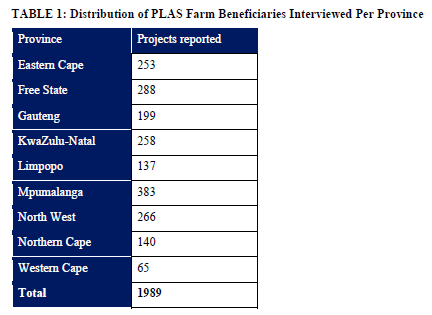
This study on Proactive Land Acquisition Strategy (PLAS) beneficiaries was a nationwide study, and interviews were conducted with 1989 beneficiaries, as shown in the distribution outlined in Table 1. The list of all beneficiaries was obtained from the Department of Agriculture, Land Reform and Rural Development. The 1989 sample represents 89% of the total PLAS farms purchased nationally between 2006 and 2018. A face-to-face questionnaire by trained enumerators captured data from PLAS beneficiaries.
The survey focused on seven aspects:
(1) Assets available for agricultural endeavour.
(2) Inputs and labour used in farm enterprises.
(3) Technology and support utilisation by the beneficiary (farmer).
(4) Production/productivity achieved.
(5) Income generated by the enterprise.
(6) Food security status of the beneficiary (farmer).
(7) Social capital status of the beneficiary (farmer).
At a project level, a toolkit based on the collective rural development experience of more than two decades was used to analyse the data. This included a multidisciplinary evaluation panel consisting of experts in soil science, natural resources, geographical information systems, land use planning and agricultural economists, and commodity experts in livestock, grain crops, vegetables and horticulture. Other components of the toolkit involved the use of Geospatial maps.
The multidisciplinary team met in workshops hosted by the Agricultural Research Council, where focus group discussions (a recognised, qualitative scientific analysis process) were held to unpack the data and evaluate farms. Apart from the ARC experts, the focus groups also included input from private companies, agricultural cooperatives, commodity organisations, and academic and government institutions. Focus group discussions are a form of qualitative research which is ideal for getting in-depth opinions from different people in different fields of agriculture on how beneficiary selection and support should be dealt with in the context of PLAS. The multidisciplinary groups comprised 5-8 people and a moderator to guide the discussions.
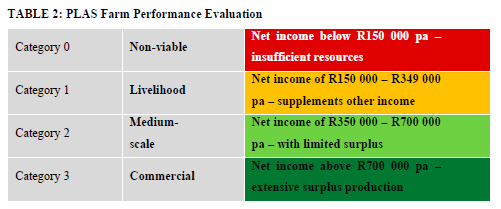
For this specific research paper, we have used descriptive statistics executed in Excel to analyse the data and guide recommendations from the multidisciplinary team's results. Based on the expert evaluation, farm performance was categorised into four levels, as shown in Table 2.
3. RESULTS AND DISCUSSION
3.1. Farmer/Beneficiary Demographic Information
The average age of PLAS beneficiaries was approximately 53 years old, and they were predominantly men (78%). The majority of beneficiaries (41.31%) have secondary school levels of education, while 35.29% have tertiary education. One in five beneficiaries (41.31%) completed secondary education, while 35.29% have tertiary education. Only 5.5% of beneficiaries have no formal education. Our results suggest that mentorship identification combines top-down and bottom-up approaches.
3.2. Farm Performance
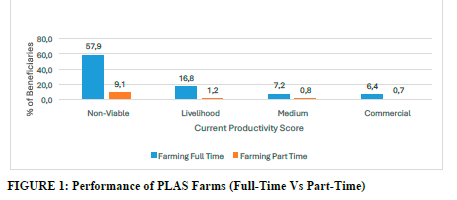
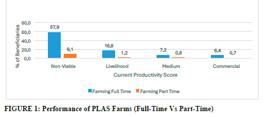
Figure 1 highlights the distribution of PLAS beneficiaries according to their farming status (full/part-time) and production level in the previous year. Most (88.2%) beneficiaries indicated that they farm full-time, with only 11.8% of beneficiaries farming part-time. Of those who achieved commercial productivity levels, the majority (90%) were full-time farmers. It would appear that farming status does not have any significant impact on productivity. It is, however, essential to remember that the PLAS programme is designed to support the development of emerging farmers in the South African agricultural sector.
3.3. Mentorship and Strategic Partner
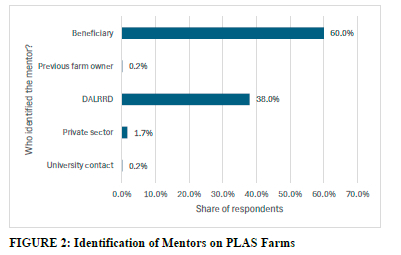
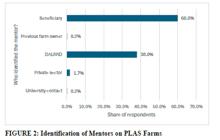
Most PLAS beneficiaries (59%) identified mentors independently instead of being allocated mentors by DALRRD. In contrast, 38% had mentors identified by DALRRD. Private contacts identified the remaining mentors. Only 22% (423) of beneficiaries had mentors appointed for support. No official documentation explains the selection and appointment of mentors for the PLAS beneficiaries.
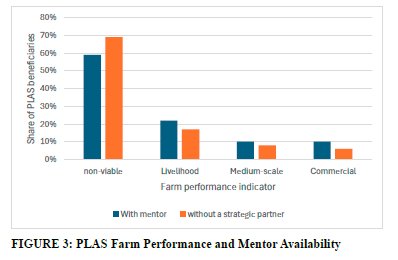
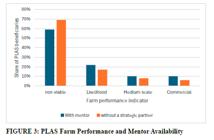
Having a mentor did not appear to have significantly increased PLAS productivity. As shown in Figure 3, only 20% of farmers with mentors produced at medium-scale and commercial levels compared to 14% of farmers without mentors. The evaluation isolated significant shortcomings in mentorships. Most beneficiaries with mentors could still not clearly articulate production and income information. The analysis also revealed that 54% of those with access to a mentor were RECAP (farms that received recapitalisation funds) beneficiaries, while 46% were non-RECAP farms. This could be due to the cost associated with mentorship fees. As a result, mentorship seemed to be aligned with the disbursement and availability of RECAP funds. A clear observation is that beyond the RECAP funds, the mentorship programme ceased. Under ideal circumstances, and in particular, where funded by the State, mentorship should be subject to a contractual agreement that defines engagement frequency, disclosure of financial statements, formal procedures for conflict resolution and other aspects (Gray et al., 2005). Hence, the mentorship concept requires review, and its design and monitoring must be reconsidered.
3.4. Strategic Partnership
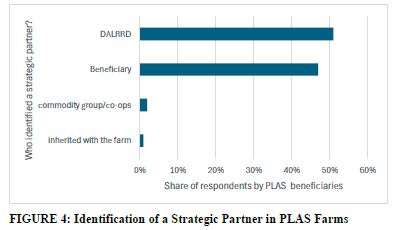
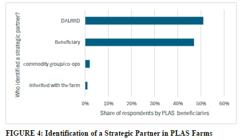
Amanor-Boadu and Martin (1992) defined a strategic alliance as a business arrangement in which two or more independent entities with their strategic intent recognise a need to collaborate, use mutually controlling decision-making processes and governance and share associated risks and benefits,-only 10% (203) of beneficiaries entered strategic partnerships. Furthermore, 47% of farmers identified their strategic partners, while the State identified 51% of these partners and only 2% were identified by private players such as commodity groups and cooperatives (Figure 4). Further analysis revealed that 58% of those with access to strategic partnerships were RECAP beneficiaries, while 42% were non-RECAP beneficiaries.
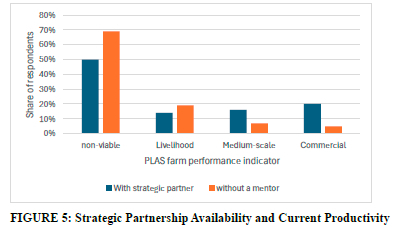
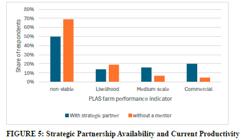
An analysis of the relationship between the presence of a strategic partner and current productivity revealed that strategic partnership had a limited impact on the productivity of PLAS farms (Figure 5). Out of the 203 PLAS projects engaged in strategic partnerships, 36% produced at medium and commercial levels while 12% of farmers without a strategic partnership produced at medium and commercial levels.
Having a mentor does not appear to significantly increase PLAS farm productivity. Only 20% of farmers with mentors produced at medium-scale and commercial levels compared to 14% without mentors. The evaluation isolated significant shortcomings in mentorships. Many beneficiaries with mentors could not articulate production and income information. The analysis also revealed that 54% of those with access to mentors were Recapitalisation and Development Program (RECAP) beneficiaries, while 46% were non-RECAP farms. This could be due to the cost associated with mentorship fees. As a result, mentorship seemed to be aligned with the disbursement and availability of RECAP funds. A clear observation is that beyond the RECAP funds, the mentorship programme ceased.
4. CONCLUSION AND EXTENSION IMPLICATIONS
Land reform, especially the land redistribution component, has received a lot of criticism for poor progress both on the pace of land transfer and in terms of poor productivity of the transferred land. To address this challenge, associated with a lack of farming skills and/or a lack of beneficiaries' resources, the government facilitates mentorship programme, where established commercial farmers mentor land reform farmers. However, the effectiveness of this programme is not clear, and this paper endeavoured to assess the extent to which mentorship contributes to farm productivity.
From the literature review, mentorship as a form of extension is only one factor in the farm/farmer development equation. Farm performance will remain limited if other vital factors, such as access to resources, funds and capacity-building opportunities, are not addressed. Our results from 1989 PLAS farm beneficiaries suggest little difference between the performance of beneficiaries with and those without mentors. The farm's performance was based on an assessment completed by a multidisciplinary team of scientists from across the agricultural spectrum that assessed how the farm performed concerning its actual potential natural and physical resources and assets.
Therefore, we conclude that mentorship had little impact on farm performance. This suggests that for land reform farms to perform as envisaged in the Land Reform Policy and the National Development Plan's Chapter Six, to alleviate poverty, provide employment and create vibrant rural communities, the whole equation of necessary support and mentorship must be in place. This underscores the interconnectedness of advisory services and the support emerging farmers require to succeed. Therefore, extension agents should have a blend of technical and financial management skills to complement government post-settlement support.
REFERENCES
- ALIBER, M., 2019. How we can promote a range of livelihood opportunities through land redistribution. Working Paper No. 58. Programme for Land and Agrarian Studies, University of the Western Cape, Cape Town.
- AMANOR-BOADU, V. & MARTIN, L., 1992. Enhancing the competitiveness of Canadian agri-food industries through vertical strategic alliances. George Morris Center Paper.
- BINSWANGER-MKHIZE, H.P., 2014. From failure to success in South African land reform. Afr. J. Agric. Resour. Econom., 9(4): 253-269.
- BUREAU FOR FOOD AND AGRICULTURAL POLICY (BFAP)., 2013. Land reform in the Free State, the land audit, and the way forward to 2030. Pretoria: A report to Free State Agriculture.
- DEININGER, K. & ALI, D.A., 2008. Do overlapping land rights reduce agricultural investment? Evidence from Uganda. Am. J. Agric. Econ., 90(4): 869-882.
- DEPARTMENT OF LAND AFFAIRS (DLA)., 1997. White Paper on South African Land Policy. Pretoria.
- GANDIDZANWA, C., VERSCHOOR, A.J. & SACOLO, T., 2021. Evaluating Factors Affecting Performance of Land Reform Beneficiaries in South Africa. Sustainability., 13(16): 9325.
- GRAY, B.C., LYNE, M.C. & FERRER, S.R.D., 2005. Criteria to monitor the poverty alleviation, empowerment and institutional performance of equity-share schemes in South African Agriculture. Agrekon., 44(4): 465-495.
- GROENEWALD, J.A., 2004. Conditions for successful land reform in Africa. S. Afr. J. Econ. Manag. Sci., 7(4): 673-682.
- KIRSTEN, J., MACHETHE, C., NDLOVU, T. & LUBAMBO, P., 2016. Performance of land reform projects in the Northwest province of South Africa: Changes over time and possible causes. Dev. South. Afr., 33(4): 442-458.
- LAHIFF, E., 2016. Stalled Land Reform in South Africa. Current History., 115(781): 181-87.
- LAND REFORM AND AGRICULTURE ADVISORY PANEL (LRAAP)., 2019. Final Report of the Presidential Advisory Panel on Land Reform and Agriculture. Pretoria: The Presidency.
- MAKA, L. & ALIBER, M., 2019. The role of mentors in land reform projects supported through the recapitalisation and development programme: Findings from Buffalo City Metropolitan Municipality, South Africa. S Afr. Jnl. Agric. Ext., 47(2): 37-45.
- MTERO, F., GUMEDE, N. & RAMANTSIMA, K., 2023. Elite Capture in South Africa's Land Redistribution: The Convergence of Policy Bias, Corrupt Practices and Class Dynamics. J. South. Afr. Stud., 49(1): 5-24.
-
SEBOLA, M.P., 2018. Financing emerging black farmers for agricultural development in South Africa: A wasteful and unworkable model for creating black farmers. J. Transdiscipl. Res. S. Afr., 14(1). doi. org/10.4102/td.v14i1.555.
» https://doi.org/10.4102/td.v14i1.555 - VINK, N. & KIRSTEN, J., 2019. Principles and practice for successful farm land redistribution in South Africa. Working paper 57. Programme for Land and Agrarian Studies, University of the Western Cape, South Africa.
- ZANTSI, S. & GREYLING, J.C., 2021.Land Redistribution in South Africa's Land Reform Policy: A Better Way to Select Beneficiaries. Agrekon., 60(2): 108-127.
- ZANTSI, S. & CLOETE, K., 2023. Determinants of commercial farmers' willingness to mentor emerging farmers in South African land reform. Dev Pract., 33(7): 825-840.