Closing the Gender Gap in Marula (Sclerocarya Birrea) Food Value Chains: A Gendered Analysis of Women's Participation in Enhancing Household Food and Income in Southeastern Lowveld, Zimbabwe
Abstract
Women's participation in utilising Non-Timber Forest Products for household income and food availability has gained global attention. However, there is a lack of gender-disaggregated empirical evidence on Marula collection, processing and marketing, their contribution to household food and income. The study was conducted among communities adjacent to Gonarezhou National Park, Chiredzi District. A survey of 280 respondents, four focus group discussions, and six key informant interviews were conducted. Qualitative data were analysed using content analysis, while probit and OLS regression models were used to analyse quantitative data. Market access, farm size and household size were significant determinants for women, whilst age, household size, and source of income influenced men's participation. Other economic activities, transport costs and seasonality of Marula influenced both women's and men's participation. Women dominated the Marula processing and marketing. Marula marketing is profitable; hence, interventions targeting reducing the gap should consider utilising Marula food value chain development.
Marula; Food Availability; Household Income; Gender Gap; Women; Men
1. INTRODUCTION
Close to 1.4 billion poor rural people worldwide rely on non-timber forest products (NTFPs) for food, energy, nutrition, health, household, and cultural benefits (Ingram et al., 2016; Jalonen et al., 2023; Luswaga, 2023). Ingram et al. (2016) postulate that the annual household income of people living within and near forests in the developing world ranges from 20 to 25%. Benefits from NTFPs include products and services, except timber (Kassa & Yigezu 2015; Stoian 2003; Bista & Webb. In Southern Africa, Sclerocarya birrea (Marula) is relatively underutilised despite its high abundance and commercial potential, owing to its ease of propagation and multi-purpose uses, making it a critical NTFP agro-forestry resource, particularly in marginal communities. Marula and other local tree species, such as baobab (Adansonia digitata) and Uapaca kikiana, serve a dual purpose: supporting local livelihoods and conserving biodiversity, thereby ensuring socioeconomic and environmental sustainability. Marula is a commercially, medicinally, and culturally significant plant species in most African developing countries, including Zimbabwe, Botswana and South Africa. NTFPs provide an alternative livelihood option for marginalised rural groups such as women, especially in the face of climate change, where rainfed agricultural production is increasingly becoming unreliable (Nemarundwe et al., 2008). However, women lack access to and ownership rights over economic resources such as land, access to credit, and vital information needed to engage in highly productive formal sectors of the economy. Hence, NTFPs provide an alternative source of livelihood.
Marula is among the many NTFPs getting increased attention from the Non-Governmental Organisations (NGOs) in Southern Africa. Hilfswerk Austria International (HWA), Bio-Innovation Zimbabwe (BIZ) and KAITE are some organisations working with close to 3200 wild Marula fruit collectors, 80% of whom are women in rural areas such as Chivi South in Masvingo Province of Zimbabwe. These women have been engaged in supplying a wide variety of raw Marula fruit and processed products to local NGOs. However, limited support for rural women has led to missed opportunities to improve their livelihoods. Women have also been confined to the arduous value chain nodes of Marula collection and processing while being excluded from marketing and income-sharing decisions. There is limited empirical evidence on Marula use at the household level, particularly regarding consumption and income generation.
In South Africa, Marula processing is primarily conducted at the commercial level to produce products such as wine and oils, which do not contribute directly to household-level food consumption and income (Hlangwani et al., 2023; Fujiyoka, 2021). In Namibia and South Africa, the exploitation of Marula has shown enormous potential among marginalised groups such as women. Similarly, efforts to improve Marula's contribution to income and food in Zimbabwe would hypothetically improve household food and income availability. According to Fujiyoka (2021), Marula fruits have the highest economic return and should be targeted for commercialisation activities in Zimbabwe, South Africa, Botswana and Namibia. However, despite the enormous potential benefits, in Zimbabwe, Marula is not utilised significantly, and the lack of capital, processing equipment, and markets is a significant challenge, as cited by Nemarundwe et al. (2008).
Women's contribution to NTFPs is critical to household income. As such, the global community is encouraged to renew its attention to women's economic empowerment and intensify investments in women, as this would benefit women, men, children, and society (Shackleton et al., 2011). In most developing countries, the utilisation of Marula tree products has marked implications on gender roles in conservation, collection, transportation, processing, and marketing. These differentiated gender roles have resulted in intra-household gender inequalities, culminating in skewed income sharing and burdening in terms of responsibilities against women at the household level. A gendered analysis of the Marula value chain in Zimbabwe is critical to identifying the weakest links and ensuring the inclusive upgrading of Marula food value chains. Currently, there is limited gender-disaggregated empirical evidence on the participation of women and men, and on the extent to which Marula (S. birrea) collection, processing, and marketing contribute to household income and food availability.
This study, therefore, was conducted to address the following key question: What were the determinants influencing women's and men's decisions to participate in marula value chains? To what extent did women's and men's participation in marula value chains contribute to household income and food availability?
1.1. Conceptual Framework
Most gender analysis studies within agriculture and non-timber forest products are based on the conceptual approaches of household and intrahousehold production models (Masamha et al., 2018; Duflo & Udry, 2004); women empowerment (Alkire et al., 2013; Malapit et al., 2020; Quisumbing et al., 2021), livelihood and asset approach (Quisumbing et al., 2015).
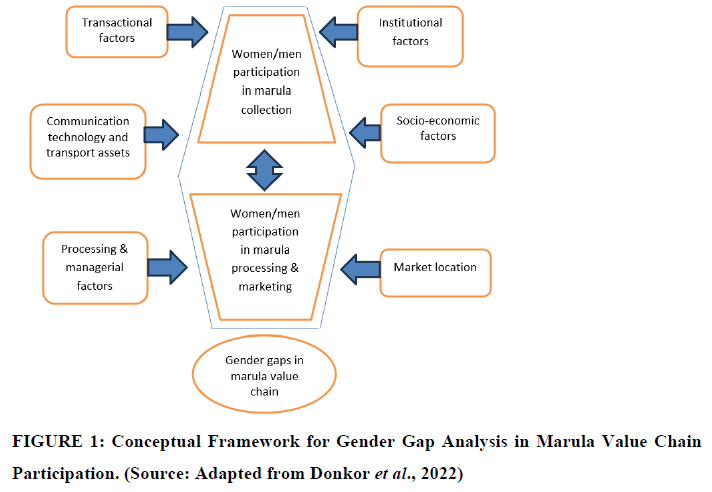
These approaches argue that most economies are gendered and refute gender neutrality, resulting in gender gaps in the collection, processing, and marketing of non-timber forest products. Therefore, this study is underpinned by the 'gendered economy's foundation framework (See Figure 1) in which gender gaps and participation are the central concepts. These aspects are described from the "who" perspective, which examines women's participation relative to men, and the "how" perspective, which examines the form, extent, and effects of participation. The importance of involvement examines the proportion of men and women participating in Marula fruit collection, processing, and marketing, whilst the impact of participation includes the benefits obtained from participation in the Marula food value chain. However, to improve women's and men's participation across the different nodes, interventions in policy, technology, and institutional development are required, as these factors are evident in their influence on gender gaps, as depicted in the conceptual framework (See Figure 1) underpinning this study. Gender-sensitive policy interventions, such as access to product markets, credit lines, and market information, are vital for men and women in the Marula value chain to derive greater benefits from participation, as the framework indicates.
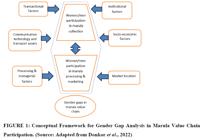
The conceptual framework shows that women's and men's participation in Marula collection, marketing, and processing is influenced by several factors, such as market location, technology, socioeconomic factors, and institutional and transactional factors, resulting in widening gender gaps. These gender gaps manifest in various forms, especially women's failure to control income and productive assets. Women are also relegated to arduous Marula value chain nodes of collection and processing because they have no power to control the marketing activities and income.
2. MATERIAL AND METHODS
2.1. Study Site Description
The study was undertaken in 4 wards of the communal areas of Chiredzi District, which are adjacent to Gonarezhou National Park and lie in the Southeastern Lowveld of Zimbabwe. The area receives erratic rains with an annual average rainfall of less than 450 mm (Dowo et al., 2017; Jiri et al., 2017). Mopane (Colophospermum mopane) and Marula (Sclerocarya birrea) are the dominant vegetation. Chiredzi district was purposively sampled because of the abundance, endowment, use, and marketing of Marula by local communities. Agriculture remains one of the main livelihood activities; however, crop failure and human-wildlife conflict characterise these communities. As a result, NTFPs have emerged as a key livelihood option, with Marula being the most common species in the area.
2.2. Sampling and Data Collection
A multistage sampling technique was used, with the household being the sampling unit. The Matibi 2 communal lands in the Chiredzi district were purposively selected as the study area due to the abundance of marula trees. Four wards were also purposively selected, given the presence of forest-dependent communities and the high Marula endowment. The household list of NTFP actors was provided by the Agriculture Training and Extension officers at the ward level. A cross-sectional research design and a mixed-methods approach were employed to collect data. Quantitative data were collected from 280 households using structured questionnaires. Qualitative data were collected through 4 Focus Group Discussions (FGDs) and 6 Key informant interviews (composed of 4 Agriculture extension officers and 2 community leaders) to complement household survey data. The FGDs consisted of household heads, mainly women, men, and youth, with an average of 8-12 participants per group. A reliability test of the questionnaire gave a Cronbach's alpha of α=0.79. Validity was enhanced through methodological triangulation. A pilot test of the instrument was undertaken on 10 respondents.
2.3. Empirical Analysis
The Statistical Package for the Social Sciences (SPSS) version 29 was used for descriptive and confirmatory analyses. The probit model and the Ordinary Least Squares (OLS) regression were used to analyse variables that determine the levels of participation of women and men at each Marula value chain node. Microsoft Excel was then used to analyse gross margin and profitability indices. To determine factors influencing the decision to participate in the Marula market, the following model was adopted:
2.4. Selection model
Whether or not a household participated in Marula marketing is modelled as:

Where Y* = 1 if a household participated in Marula products marketing, and equals zero if otherwise; Z is a vector of independent variables; α is a vector of parameters and measures the effect of independent variables on market participation decisions by households, while ε1 represents the error term, which is usually normally distributed with zero mean and standard deviation (e~N (0,1).
Hence, the selection model used for households' decisions to participate in the Marula market or not is as follows:

Pr(Y1) is the probability that a household decides to market Marula products or not. X1-X8 represent the explanatory variables, and e is the error term, which is usually distributed. The level of market participation was assessed using the Ordinary Least Squares (OLS) method. The Gross Margin (GM) analysis was used to assess the costs and returns of participation in the Marula value chain at the household level. Furthermore, the Gross Margin Ratio (GMR) and benefit-cost ratio approaches were implemented to determine the profitability and contribution of Marula processing and marketing.
3. RESULTS
3.1. Socioeconomic Analysis of NTFP Chain Participants
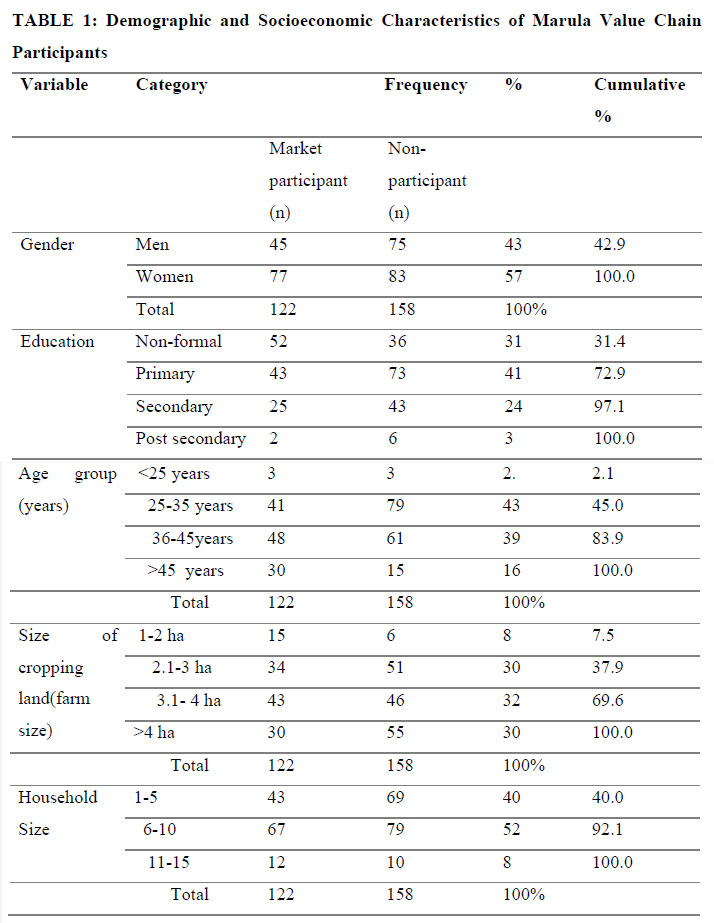
Table 1 indicates that of the 280 respondents, 44% participated in marketing Marula products, while 56.4% participated in other value chain activities. From all the Marula marketing participants, 63% were women and 37% were men. This signified the importance of NTFP contributions to rural communities, particularly in Marula food value chains. About 73% of the Marula chain participants had primary education or no formal education, indicating that NTFP utilisation provides a significant economic avenue for the less-educated to meet food, nutrition, and income needs.
The age groups 25-35 years and 36-45 years, which constitute the dominant active labour force, recorded the highest combined percentage (82%) of individuals involved in Marula chain activities. Nearly 52% of market participants engaged in Marula value chain activities had household sizes of 6-10 members. Close to 70% of households owned arable land (farm size) ranging from 1 to 4 hectares, while households with arable land above 4 hectares accounted for 30%. This showed that few households with arable land above 4 hectares were involved in Marula food value chain activities; instead, they primarily rely on agriculture as a livelihood source.
3.2. Determinants of the Decision of Households to Participate in Marula Product Marketing
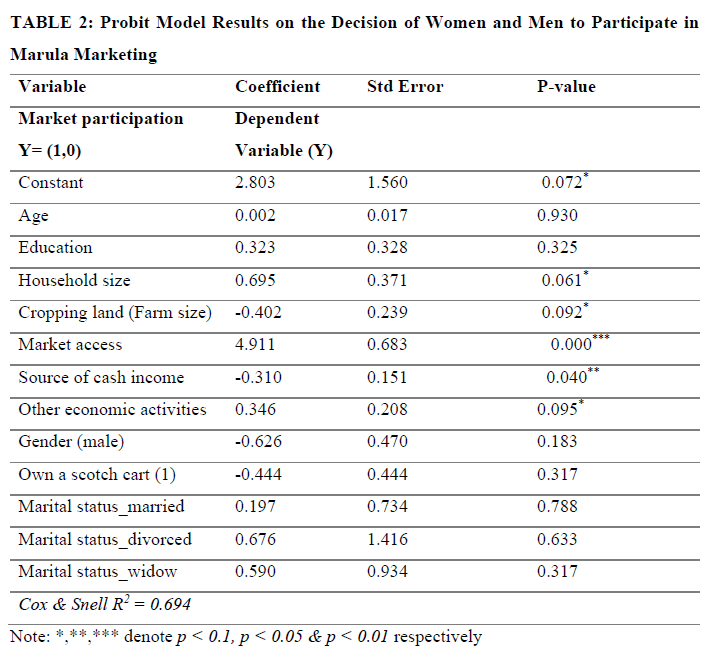
Probit model results presented in Table 2 indicate that men negatively influenced the decision to participate in Marula product marketing, whilst their female counterparts were 0.62 times more likely to decide to join Marula marketing. There is positive, significant (p=0.061) evidence at the 10% level that household size influenced participation in the marketing of Marula food products (Table 2). Similarly, the variable farm size was significant (p=0.092) at the 10% significance level in influencing the household's decision to participate in the marketing of Marula food products. As expected, an increase in arable land ownership by one hectare was associated with a 0.4-fold increase in the likelihood that the household would decide against participating in the marketing of Marula food products (Table 2). Market access was positive and highly significant (p<0.01) at the 5% and 10% levels in influencing market participation in Marula products. A 1-unit increase in access to Marula food markets increased the odds of households' decision to market Marula food products by 4.91 times. The results indicate that the rise in alternative, more stable sources, such as formal employment, made an individual 0.31 times less likely to participate in Marula product marketing. A household engaged in an extra economic activity is 0.346 times more likely to engage in marketing Marula food products. Marital status and ownership of assets such as a Scotch cart did not significantly influence market participation at 10%, 5% and 1% significance levels. Overall, the probit model was a good fit since the Cox and Snell R2 was 0.69.
3.3. Determinants of Women's and Men's Participation in Marula Fruit Collection
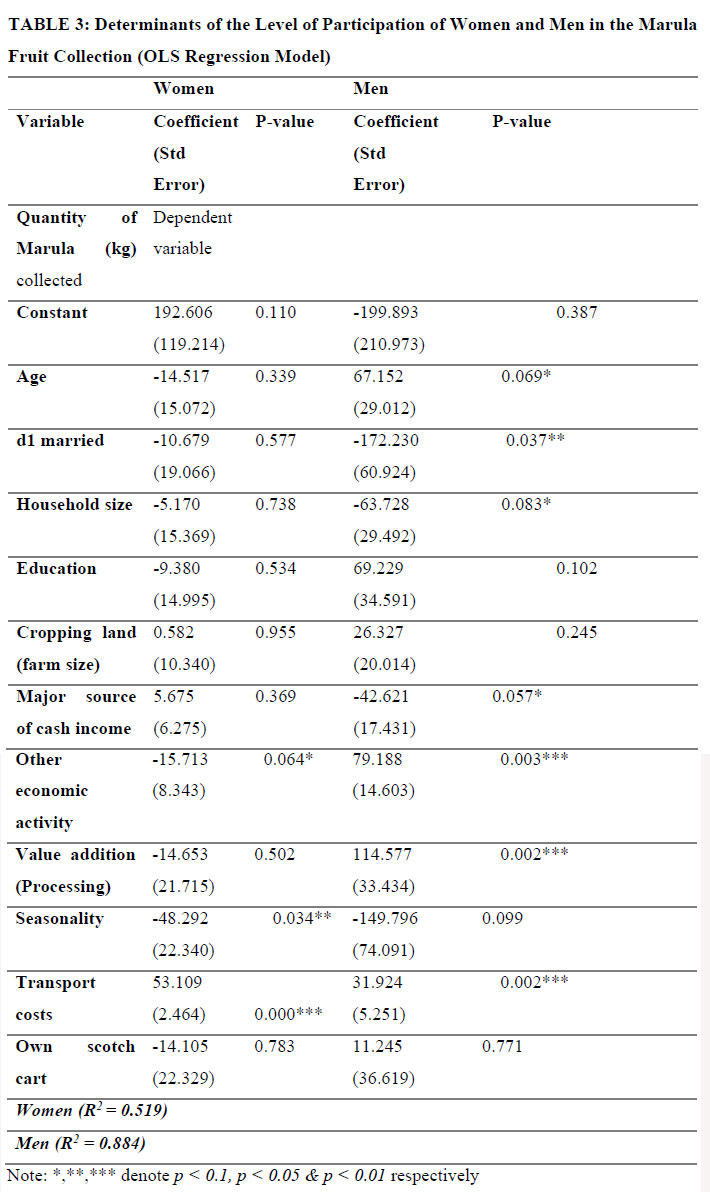
Ordinary Least Squares regression models were used to analyse men's and women's participation in Marula fruit collection, and the results are presented in Table 3. The results show that, for men, at the 10% level, age had a significant positive effect on participation in Marula fruit collection (p=0.069), whereas, for women, age was insignificant and negatively influenced participation in Marula fruit collection. Thus, an increase in a man's age by one year would result in an increase in Marula fruit collected by 67.15kg, whilst for women, an increase in age by one year results in a concomitant decrease in Marula fruit collected by 14.52kg. This outcome is, on the other hand, amplified by an excerpt from the Ward 9 councillor, who revealed the following:
" … . .. as local men grow older, they tend to enjoy Marula beer to such an extent that they opt to travel to distant forests to collect Marula fruit while women embark on other household chores."
Household size negatively influenced participation in Marula fruit collection among both men and women, as indicated by the negative coefficients (Table 2). In addition, according to the FDG conducted in ward 10, the peak Marula harvesting and collection period, which falls in March, coincides with the peak of rain-fed agricultural activities, implying competing interests in terms of labour force and time. This situation, therefore, negatively affects Marula fruit collection activities, especially for women who have additional household chores and responsibilities.
At the 10% level, dryland cropping significantly (p=0.057) and negatively influenced men's participation in Marula fruit collection, while women's participation was positively affected (See Table 3). This shows that men would prioritise dryland farming over Marula fruit collection, unlike their female counterparts. Because women rarely own arable land, which they access through men, they still consider Marula collection an important alternative food and income source; hence, a positive coefficient (0.582) was recorded (Table 3). Other economic activities, such as formal employment, significantly affected men's participation in Marula fruit collection (p<0.01) at the 5% level. The results show that a 1-unit increase in other income-generating activities decreased Marula fruit collection by 15.7kg for women, while it increased by 79.18kg for men.
Marula processing significantly (p<0.01) and positively influenced the level of fruit collection by men, whereas for women, Marula fruit value-addition (processing) prospects resulted in a decline in fruit collection. Consistent with this assertion, an Agriculture Extension Officer (key informant) gave the following insights:
" … . the study area is a patriarchal society where men have total control of productive resources and household income; hence, they normally participate where there is financial benefit … ."
Transport costs had a positive and significant (p<0.01) influence at the 5% level on the participation of both women and men in Marula fruit collection. Transport costs related to ferrying the Marula do not preclude women and men from collecting Marula fruit, as fruit collection increased by 53.2kg and 31.92kg for women and men, respectively, with a unit increase in costs. The seasonality of Marula fruit collection was negative but insignificant (p=0.099) for men, but significant for women (p=0.034). A unit decrease in the length of the harvesting season resulted in a concomitant reduction in Marula fruit collection by 48.29kg and 149.79kg for women and men, respectively.
3.4. Factors Influencing Women's Participation in Marula Kernel Extraction
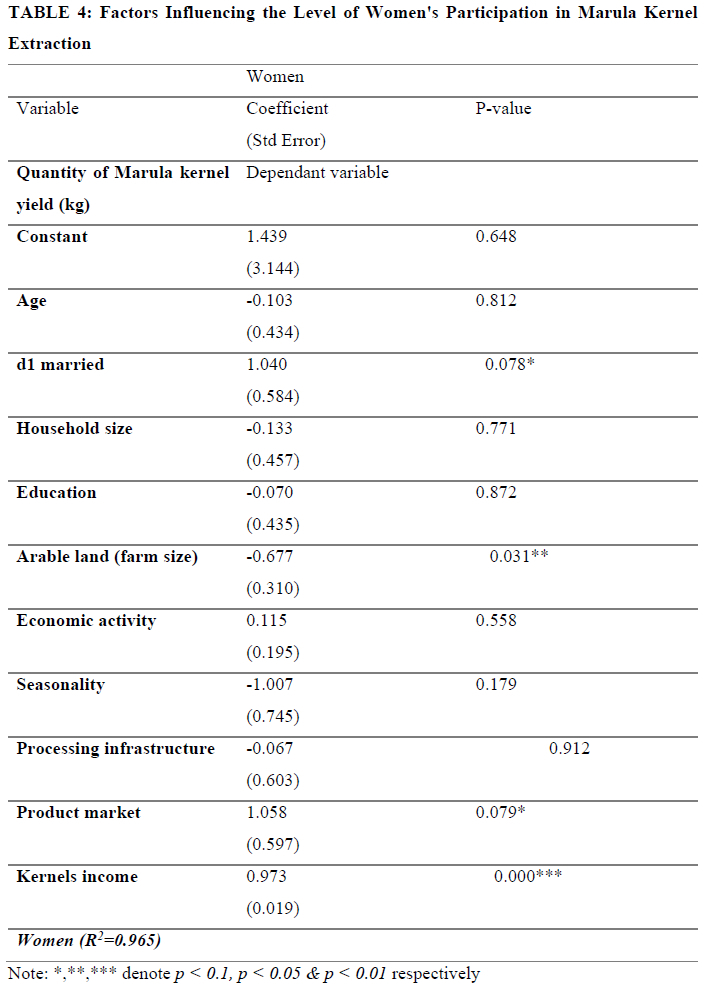
The Ordinary Least Squares (OLS) model (Table 4) revealed that, at the 5% significance level, farm size had a significant negative effect on women's participation in Marula kernel extraction (p=0.031). An increase of 1 hectare of arable land resulted in a 0.67kg decrease in Marula kernels extracted by women. Access to markets had a significant positive effect on women's participation in Marula kernel extraction (p < 0.1). A unit increase in market access resulted in a 1.058kg increase in Marula kernels extracted by women. Income from the sale of kernels was found to have a positive and significant influence on women's participation in Marula kernel extraction (p<0.01) at the 5% and 10% significance levels. A unit increase in the income generated from the sale of kernels resulted in a 0.973kg increase in kernel output produced by women. Being a married woman significantly influenced participation in Marula kernel extraction (p=0.078), suggesting the need for additional household income.
NB: There were no valid cases to compute statistics on men's participation in Marula kernel extraction, as only 3 men were practising it.
3.5. Determinants of the Level of Women's and Men's Participation in Marula Kernel Marketing
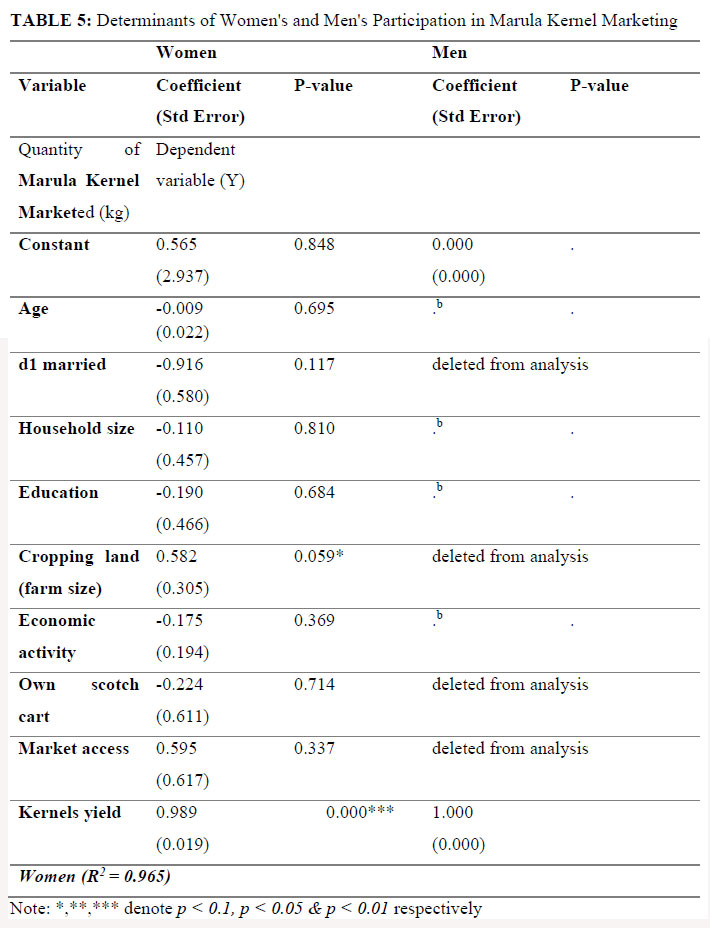
In Table 5, only three men were involved in kernel extraction among the 122 market participants, and the data entered were insufficient to draw inferences for men. Hence, only the kernel yield model was computed for women. The yield of kernels per season was positively and significantly (p<0.01), affecting the marketing of Marula kernels for both women and men. A unit increase in the quantity of kernels extracted resulted in a 0.98kg increase in Marula kernels sold by women. According to a middle-aged woman resident of Ward 10:
" …… .. Marula kernels are a delicacy which is enjoyed by almost every family, such that there ought to be a surplus or financial need for one to sell"
Cropland size was significant (p=0.059) at the 10% level and positively influenced women's participation in Marula kernel marketing. An increase of 1 hectare of agricultural land resulted in a 0.58kg increase in women's Marula kernel marketing.
As for the variable age, an increase of 1 year in a woman's age resulted in a reduction in kernel marketing by 0.009kg. The negative relationship between women's age and Marula kernel marketing could be due to reduced long-distance market walks. As market access improved by a unit, Marula kernel marketing by women also increased by a corresponding 0.595kg (Table 5).
NB: There were no valid cases to compute statistics for men's participation in Marula kernel marketing.
3.6. Gross Margin Analysis Marula Products Marketing
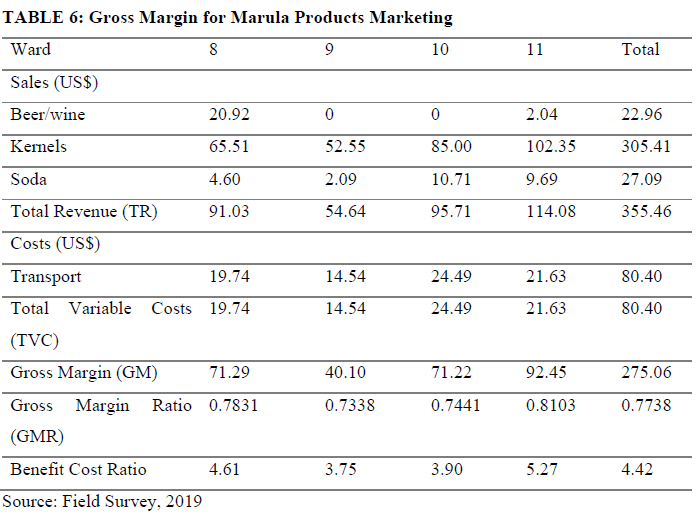
The highest income (US$305.46) came from Marula kernel marketing, accounting for 85.9% of total revenue across the four wards. In Table 6, Ward 11 had the highest GM of US$92.45 because of the availability of the Marula product market. The only cost to which the respondents could assign a value was the transport cost of ferrying fruit from collection points to their homesteads. The positive GM value (US$275.06) for the four wards revealed that Marula processing and marketing are profitable. GMR analysis shows that Marula value addition and marketing were profitable, and Ward 11 had the highest GMR of 0.81. The Benefit Cost Ratio was more significant than one across the four wards, with Ward 11 having the highest BCR of 5.27. This indicated that Marula's value addition and marketing is a viable enterprise.
4. DISCUSSION
4.1. Socioeconomic Characteristics of NTFP Participants
The finding that more women were participating in Marula food products marketing signified the vital contribution of women in NTFP utilisation in rural communities, as similarly reported by Dishan et al. (2010), that 83% of the participants involved in NTFPs were young women aged 18 - 45 years in the areas adjacent to Gashaka Gumti National Park of Nigeria. This is contrary to the hypothesis that women are generally precluded from participating in the marketing nodes of NTFPs. In addition, Jalonen et al. (2023) argue that women, ethnic minorities, and the landless are forest-dependent groups in India; hence, the need to improve their agency in NTFP utilisation, as similarly reported in this study. Most of the participants from this study had primary education and informal education. Likewise, John et al. (2013) postulate that less formally educated people in rural communities derive livelihoods from NTFP utilisation for food and income. This is mainly because those individuals with formal post-secondary education seek employment elsewhere. A high percentage of participants in the 25 to 45-year age group were reported to be actively engaged in Marula food value chain activities. This is because the majority of those who engage in NTFPs fall within the physically fit and economically active age range of 20 - 50 years, as similarly reported by John et al. (2013), where youthful participants dominated the utilisation of NTFPs. The empirical evidence from this study also reports that households with more members were very active participants in Marula fruit collection, which corroborates findings by Kassa and Yigezu (2015), where households had an average household size of 2 to 9 members with more members participating in NTFPs value chain activities of forest coffee, honey, spices and medicinal plants in Southwest Ethiopia.
4.2. Determinants of Women's and Men's Participation in Marula Fruit Collection
The decrease in Marula fruit collection by women with age can be attributed to the life-cycle hypothesis, which posits diminishing marginal effects on collection. In essence, the life-cycle hypothesis is an economic theory that describes people's spending and saving habits over their lifetimes. In this context, it explains the behaviour of women participating in Marula food value chains, where their current spending is influenced by future activities such as farming and off-farm employment. Insights from an FGD in Ward 9 revealed that local women engaged in multiple household tasks as they grew older and the household size increased, thereby reducing their overall participation in Marula fruit collection. Akidi et al. (2018) also reported relatively similar findings in a smallholder poultry study involving Indigenous chicken rearing in the Gulu district of Uganda, where an increase in age by one year resulted in a 3.9% decrease in market participation. The relatively older participants would find it hard to travel long distances, thereby discouraging them from continuing to rear and sell indigenous chickens. Shackleton et al. (2011) echoed similar reports on the collection of Gum olibanum in Ethiopia, where men embarked on collection trips for several weeks, thereby restricting women to less distant places. In a patriarchal society, being a married man automatically entails assuming household head responsibilities, which require engaging in additional economic activities, such as formal employment, to supplement household income, thereby reducing the time allocated to Marula collection. As household size increases, there is a need for more stable income streams, such as those from formal employment or agriculture, to support the growing family, compared to the Marula collection, which tends to be seasonal and very labour-intensive.
Similar findings by Sadashivappa et al. (2006) argue that large-scale farmers and households that provided a regular supply of hired labour to farms in the South Indian locality were rarely involved in NTFP collection. Sadashivappa et al. (2006) asserted that the development of agriculture in the South Indian region had a significant indirect bearing on the level of NTFP extraction.
In South India, large households provide labour to nearby farms, so they rarely get involved in NTFP collection. In addition, according to an FDG conducted in ward 10, the peak Marula harvesting period, which falls in March, coincides with the peak of rain-fed agricultural activities, thereby negatively affecting Marula fruit collection. Households in Chiredzi District rely mostly on smallholder agriculture; hence, men tend to allocate more time and resources to agricultural activities than to marula value chain activities.
As the primary sources of cash income become more stable, such as irrigation farming or formal employment, men's participation in Marula fruit collection tends to decline. In contrast, the need to supplement cash income and nutrition becomes vital for women, hence their increased participation in Marula fruit collection. Kassa and Yigezu (2015), in a similar study, outlined that women contribute significantly to the household's purchasing power through the collection of NTFPs. (2006) reported that the participation behaviour of indigenous people in NTFPs in South India showed that income from other sources negatively affected NTFP extraction and marketing. This further corresponds with the findings of the study on women's empowerment through NTFPs in Ethiopia (Kassa & Yigezu, 2015).
According to an Agriculture Extension Officer (key informant):
" … . the study area is a patriarchal society where men have total control of productive resources and household income, hence they normally participate where there is financial benefit … ."
The study by Carr and Hartl (2008) reported that women do not benefit from NTFPs equally with men along the gender axis, which is well aligned with the results of this study. Transport costs for Marula did not affect participation for both women and men. Consistent with these results, Shackleton and Shackleton (2012) reported that harvesting Marula fruit goes beyond income generation and involves brewing Marula beer for cultural and traditional festivals, where the purpose outweighs economic returns, given the community importance placed on these events.
The seasonality of the Marula was negatively related to the Marula collection. Similar results were reported by Amusa et al. (2017), who argued that the seasonality of NTFPs negatively influenced the collection of bush mango, African walnut, and bush pepper. Ngorima (2006) echoed similar findings on the 'inferiority' of NTFP collection as an occupation due to seasonal availability. This study reports that a staggering 72% of participants, across both informal and formal education, were major participants in Marula utilisation. This finding was echoed by Opaluwa et al. (2011), who reported that 82% of participants were illiterate and had only attained primary education, in a study focusing on the utilisation of NTFPs in Kogi State, North Central Nigeria. This could be attributed to the fact that NTFPs serve as a fallback and alternative livelihood option for rural women with less formal education. In addition, education had both negative and positive effects on women and men, respectively, in the Marula collection, indicating that as women attain more education, they abandon Marula as a livelihood activity and seek formal employment and other lucrative business opportunities, whereas their male counterparts do not. Farm size had positive coefficients for both women and men, showing that as agricultural land increases, so does Marula fruit collection. However, this is contrary to findings from several studies, and, to support these findings, Kar and Jacobson (2012) argue that there is insufficient evidence to conclude that an increase in cropland leads to less dependence on NTFPs.
4.3. Factors Influencing the Decision to Participate in Marula Fruit Marketing
Women emerged as significant participants in marketing because the majority of rural women regard NTFPs as a substantial source of livelihood, as Ekwugha and Onyema (2014) argued that NTFPs could contribute to poverty alleviation among rural women involved in petroleum, rubber, plantain, and banana value chains, among other natural resources in Imo State, Nigeria. As household size increases, the likelihood of participating in Marula marketing increases, as supported by Dash et al. (2016), who found that larger households have more workers and more people to feed and engage in NTFP activities. The increase in farm size negatively affected the decision to participate in marketing Marula products. This is because local rural people mainly rely on agriculture; hence, the more land available for agriculture, the more labour is allocated to agriculture, thereby reducing NTFP activities. Dash et al. (2016) found similar results, arguing that households with more cropland were more likely to engage in agricultural activities, thereby earning more income than from NTFP activities, such as the Marula food value chains. The results indicate that the increase in more stable sources of income, such as formal employment, resulted in an individual being less likely to participate in Marula products, as reported by Dash et al. (2016), that participation in NTFPs is negatively affected by other stable and sustainable sources of income, which increases the wealth of households. Households exposed to more market opportunities for their Marula products are more likely to participate in the marketing. In a related study, Akidi et al. (2018) argue that farmers exposed to village-level markets were much more likely to produce and trade their produce. The increase in market participation as other economic activities increase is consistent with studies by researchers such as Dash et al. (2016), who found that as wealth increases, exploitation of NTFPs also increases due to higher income from NTFPs. Similarly, Shackleton and Shackleton (2012) reported the same findings in the Bushbuckridge District of South Africa.
4.4. Determinants of Women's Participation in Marula Kernel Extraction and Marketing
Kernel extraction is regarded as a feminine role according to information obtained from the Ward 9 FGD; hence, significantly fewer men participated in this activity. This is also revealed by Shackleton and Shackleton (2012), who reported that kernel extraction was the duty of female household members and was rarely performed by their male counterparts. Empirical findings show that women from better-off households with relatively more extensive cropping land are less likely to depend on NTFPs (Mohammed, 2011).
Access to the market increased the propensity to process Marula kernels, as similarly reported by Sadashivappa et al. (2006), who postulate that the use of NTFP is shaped by access to local markets. This is consistent with the report by John et al. (2013), which states that NTFP activities are intended to increase the incomes of rural people, thereby alleviating poverty. Married women dominated over single women in NTFP activities, which is consistent with reports by John et al. (2013) who argue that marital status was a significant determinant of the profitability of NTPFs. Education level and seasonality of the Marula fruit negatively influenced the quantities of Marula kernels extracted by women. This was consistent with the findings of Amusa et al. (2017), in which the seasonality of NTFPs was a constraint on their production and trade.
Shackleton and Shackleton (2012) reported that Marula kernels were mainly for home consumption and were often consumed immediately after the extraction; hence, the increase in kernel yield improved kernel marketing. The positive relationship between land size and kernel marketing may be due to the fact that ownership of agricultural land does not necessarily translate into improved farming or household food availability, hence the need to supplement income and food from NTFPs such as Marula. Similarly, Kar and Jacobson (2012) argued that ownership of more cropland does not necessarily mean less dependence on NTFPs.
The life cycle hypothesis could explain the negative relationship between age and Marula kernel marketing, as people age, they experience diminishing marginal returns (Akidi et al., 2018). The same finding is also reported by Akidi et al. (2018), who find that households closer to local markets are more likely to market their products. Marital status negatively influenced Marula kernel marketing. Insights from Ward 9 and Ward 10 FGDs revealed that women undertake almost all household chores, including cattle herding and agricultural work, such as bird scaring in sorghum and millet fields; hence, they have little time for kernel marketing.
4.5. The Economic Viability of Marula Products Marketing
Marula kernel marketing yielded more household income. Similar findings by Shackleton and Shackleton (2012) indicate that households in the Bushbuckridge District of South Africa who sold Marula kernels earned substantial income. Elderly people performed most of the kernel extraction, similar to Shackleton and Shackleton's (2012) reports, which found that 78% of the extraction was done by the elderly, including the mother and grandmother. The only cost burden was transport, as Ariyo et al. (2018) concluded that transport costs constitute the main variable cost in NTFPs. The positive gross margin recorded in this study is consistent with findings from Ogun State, Nigeria, which revealed that the NFTP enterprise is highly profitable (Idowu, 2018). Similarly, Terver et al. (2014) concluded that NTFPs were a viable enterprise in Yobe State, Nigeria. Economic analysis also indicates that Marula value addition and marketing are viable enterprises, as reported by Ariyo et al. (2018), who found that the collection and marketing of Marula is a profitable and lucrative business, with a value of N3,405.11 per respondent in Nigeria.
5. CONCLUSION AND RECOMMENDATIONS
Marula value chain interventions that target women's participation in collection, processing, and marketing activities have the potential to close the gender gap. The results depict the Marula food chain as a profitable enterprise that contributes to household income, food security, and cultural festivals. Empirical evidence refutes the hypothesis that women are excluded from Marula marketing and other value chain nodes. Women's participation was predominant across all identified Marula value chain nodes, with men's contribution only clearly evident in the transportation of Marula raw fruit. Therefore, this enterprise can be developed and expanded as a women's empowerment initiative to improve household income and food availability, thereby closing the gender gap. There is a need to improve Marula market access to optimise income generation, particularly for Marula kernels, which showed higher gross margins. Other economic factors, such as transport costs, seasonality, output quantity, size of owned cropland, income from the sale of produce, and access to product markets, influenced the levels of women's and men's participation in processing Marula products. Capacity building for women in education and training will broaden alternative livelihood options for women, since most of those actively participating in Marula food value chains have no education beyond the primary level. Insights from the key informant interviews and FGDs highlighted problems with Marula's shelf life; hence, we recommend investment in research and development to improve Marula's shelf life, market access, and skills development in processing and marketing, targeting women and youths.
Authors have no conflicts of interest to declare.
REFERENCES
- AKIDI, I.L., WAMALA, S.K. & MUGONOLA, B., 2018. Determinants of smallholder indigenous chicken farmers ' market participation decisions and value of sales in Gulu district. J. Dev. Agric. Econ., 10(8): 271-278.
- ALKIRE, S., MEINZEN-DICK, R., PETERMAN, A., QUISUMBING, A., SEYMOUR, G. & VAZ, A., 2013. The women's empowerment in agriculture index. World Dev., 52: 71-91.
- AMUSA, T., JIMOH, S.O. & AZEEZ, I., 2017. Socio-economic factors influencing marketing of non-timber forest products in tropical lowland rainforests of south-western Nigeria. South. For., 79(2): 161-168.
- ARIYO, O.C., OLUWALANA, S.A. & ARIYO, M.O., 2018. Profitability analysis of non-timber forest products collected from block A and golf course forests of International Institute of Tropical Agriculture ( IITA ), Ibadan, Oyo State, Nigeria. Adv. Res., 14(2): 1-12.
- BISTA, S. & WEBB, E.L., 2006. Collection and marketing of non-timber forest products in the far western hills of Nepal. Environ. Conserv., 33(3): 244-255.
- CARR, M. & HARTL, M., 2008. Gender and non-timber forest products: Promoting food security and economic empowerment. IFAD.
- DASH, M., BEHERA, B. & BAHADUR, D., 2016. Forest policy and economics determinants of household collection of non-timber forest products ( NTFPs ) and alternative livelihood activities in Similipal Tiger. For. Policy Econ., 73: 215-228.
- DISHAN, E.E., AGISHI, R. & AKOSIM, C., 2010. Women's involvement in non-timber forest products utilisation in support zones of Gashaka Gumti National Park. J. Res. For. Wildl. Environ., 2(1): 73-84.
- DONKOR, K.O., GOTTUMUKKALA, L.D., LIN, R. & MURPHY, J.D., 2022. A perspective on the combination of alkali pre-treatment with bioaugmentation to improve biogas production from lignocellulose biomass. Bioresour. Technol., 351: 126950.
- DOWO, G.M., KATIVU, S. & GARINE-WICHATITSKY, M.D.E., 2017. Local perceptions of tree diversity , resource utilisation and ecosystem services provision at the periphery of Gonarezhou National Park, Zimbabwe. For. Trees Livelihoods., 27(1): 1-21.
- DUFLO, E. & UDRY, C., 2004. Intra household resource allocation in Cote d'Ivoire: Social norms, separate accounts and consumption choices. Working Paper No. 10498, May 2004/Discussion Paper No. 875. Cambridge, MA and New Haven, CT: National Bureau of Economic Research and Yale University. Economic Growth Center, Yale University.
- EKWUGHA, E.U. & ONYEMA, M.C., 2014. Prospects of non-timber forest products (NTFPs) on poverty alleviation among rural women in Imo State, Nigeria. Paper presented at the International Conference on Advances in Agricultural, Biological & Environmental Sciences (AABES-2014), 15-16 Oct, Dubai (UAE), pp. 76-79.
- FUJIOKA, Y., 2021. Rethinking the potential for the commodification of Africa's natural resources: A case study of marula use in Phalaborwa, South Africa. In T. Meguro, C. Ito & K. Kirigia (eds.), 'African potentials' for wildlife conservation and natural resource management: Against the Image of 'deficiency ' and tyranny. Langaa RPCIG, p. 219.
- HLANGWANI, E., HAL, P.H.V., MOGANEDI, K.L. & DLAMINI, B.C., 2023. The future of African wild fruits: A drive towards responsible production and consumption of the marula fruit. Front. Sustain. Food Syst., 7: 1294437.
- IDOWU, D.S., 2018. Gross margin analysis of trade in non-timber forest products (NTFPs) in Ogun State, Nigeria. Adv. For. Sci., 5(2): 289-292.
- INGRAM, V., HAVERHALS, M., PETERSEN, S., ELIAS, M., BASNETT, S. & PHOSISO, S., 2016. Gender and forest, tree and agroforestry value chains: Evidence from literature In C.J.P. J. Colfer, B.S. Basnett & M. Elias (eds.), Gender and forests: Climate change, tenure, value chains and emerging issues. New York, USA: Routledge, pp. 221-242.
- JALONEN, R., ZIEGERT, R.F. & LAMERS, H.A.H., 2023. From within and without: Gender, agency and sustainable management of non-timber forest products in two Indian States. Small-scale For., 22: 323-349.
- JAMA, B.A., MOHAMED, A.M., MULATYA, J. & NJUI, A.N., 2008. Comparing the ''Big Five'': A framework for he sustainable management of indigenous fruit trees in the drylands of East and Central Africa. Ecol. Indic., 8: 170-179.
-
JIRI, O., MTALI-CHAFADZA, L. & MAFONGOYA, P.L., 2017. Influence of smallholder farmers ' perceptions on adaptation strategies to climate change and policy implications in Zimbabwe. Available from https://agris.fao.org/search/en/providers/122535/records/65e0186e63b8185d9cb1578e
» https://agris.fao.org/search/en/providers/122535/records/65e0186e63b8185d9cb1578e - JOHN, J.I., NNAMDI, M.S. & ADURALERE, I.I., 2013. Economics of non-timber forest products (NTFPs) in Oyo State. IOSR J. Humanit. Soc. Sci., 18(4): 1-18.
- KAR, S.P. & JACOBSON, M.G., 2012. Forest Policy and Economics NTFP income contribution to household economy and related socio-economic factors: Lessons from Bangladesh. For. Policy Econ., 14(1): 136-142.
- KASSA, G. & YIGEZU, E., 2015. Women economic empowerment through non-timber forest products in Gimbo District, South West Ethiopia. Am. J. Agric. Res. For., 3(3): 99-104.
- LUSWAGA, H., 2023. Non-timber forest products benefit community groups and conservation motivation in mountains of Tanzania. Environ. Sustain. Indic., 18: 100238.
- MALAPIT, H.J., MEINZEN-DICK, R.S., QUISUMBING, A.R. & ZSELECZKY, L., 2020. Women: Transforming food systems for empowerment and equity. In IFPRI 2020 Global Food Policy Report. Washington, DC: International Food Policy Research Institute (IFPRI), pp. 36-45.
- MASAMHA, B., UZOKWE, V.N.E. & THEBE, V., 2017. Women's empowerment in traditional food value chains at the micro-level: Evidence from cassava smallholder farming in Tanzania. Agroecol. Sustain. Food Syst., 42(1): 28-47.
-
MOHAMMED, A., TILAHUN, M., MUYS, B., MATHIJS, E. & GIDEY, A., 2011. The effect of income from non-timber forest products on rural poverty and income inequality: A case study from the dry woodland area of Tigray. Available from https://www.researchgate.net/publication/316691768_The_effect_of_income_from_non_timber_forest_products_on_rural_poverty_and_income_inequality_a_case_study_from_the_dry_woodland_area_of_Tigray
» https://www.researchgate.net/publication/316691768_The_effect_of_income_from_non_timber_forest_products_on_rural_poverty_and_income_inequality_a_case_study_from_the_dry_woodland_area_of_Tigray - NEMARUNDWE, N., NGORIMA, G. & WELFORD, L., 2008. Cash from the commons: Improving natural products value chains for poverty alleviation. Paper submitted to the 12th Biennial Conference of the International Association for the Study of Commons (IASC), 14-18 July, Cheltenham, England, pp. 1-22.
- NGORIMA, G.T., 2006. Towards sustainable use of Marula (Sclerocarya birrea) in the Savannah woodlands of Zvishavane District, Zimbabwe. Doctoral dissertation, University of the Witwatersrand.
- OPALUWA, P., ONUCHE, U. & SALE, S., 2011. Factors affecting the collection and utilisation of non-timber forest products in rural communities of North Central, Nigeria. J. Agric. Food. Tech., 1(5): 47-49.
- QUISUMBING, A., HECKERT, J., FAAS, S., RAMANI, G., RAGHUNATHAN, K., MALAPIT, H. AND PRO-WEAI FOR MARKET INCLUSION STUDY TEAM., 2021. Women's empowerment and gender equality in agricultural value chains: Evidence from four countries in Asia and Africa. Food Sec., 13: 1101-1124.
- QUISUMBING, A.R., RUBIN, D., MANFRE, C., WAITHANJI, E., VAN DEN BOLD, M., OLNEY, D., JOHNSON, N. & MEINZEN-DICK, R., 2015. Gender, assets, and market-oriented agriculture: Learning from high-value crop and livestock projects in Africa and Asia. Agric. Hum. Values., 32: 705-725.
-
SADASHIVAPPA, P., SURYAPRAKASH, S. & KRISHNA, V.V., 2006. Participation behaviour of indigenous people in non-timber forest products extraction and marketing in the dry deciduous forests of South India. Paper presented at the Conference on International Agricultural Research for Development, 11-13 October, Tropentag, University of Bonn. Available from https://www.researchgate.net/publication/216843395_Participation_Behavior_of_Indigenous_People_in_Non-Timber_Forest_Products_Extraction_and_Marketing_in_the_Dry_Deciduous_Forests_of_South_India
» https://www.researchgate.net/publication/216843395_Participation_Behavior_of_Indigenous_People_in_Non-Timber_Forest_Products_Extraction_and_Marketing_in_the_Dry_Deciduous_Forests_of_South_India - SHACKLETON, S. & SHACKLETON, C., 2012. The contribution of marula Sclerocarya birrea) fruit and fruit products to rural livelihoods in the Bushbuckridge district, South Africa: Balancing domestic needs and commercialisation. For. Trees Livelihoods., 15(1): 3-24.
- SHACKLETON, S., PAUMGARTEN, F., KASSA, H., HUSSELMAN, M. & ZIDA.M., 2011. Opportunities for enhancing poor women ' s socio- economic empowerment in the value chains of three African non-timber forest products ( NTFPs ). Int. For. Rev., 13(2): 136-151.
- STOIAN, D., 2003. Making the best of two worlds : rural and peri-urban livelihood options sustained by non-timber forest products from the Bolivian Amazon. World Dev., 33(9): 1473-1490.
- TERVER, T.N., TYONZUGHUL, O.J. & AONDOASEER, B.J., 2014. Prioritization and cost and returns analyses of selected non-timber forest products in Yobe State, Nigeria. J. Dev. Agric. Econ., 6(12): 481-489.