Determinants of Farm Income During Lockdown Restrictions Amongst Small-Scale Farmers in the Gauteng Province, South Africa
Abstract
The paper aims to determine which factors influenced the level of farm income for small-scale farmers in Gauteng Province during the lockdown period. Simple random sampling was used to collect data from 132 small-scale farmers using an online survey between January and February 2023. The Ordinary Least Square model (OLS) was used to analyse the data. The results showed that the farmer's age, level of education, non-farm income, number of farm workers employed, farming experience and lockdown influenced the level of farm income. In contrast, lack of funding negatively influenced the level offarm income. By improving the level of education and providing specialised training on modern farming techniques and farm management, farmers can enhance their productivity and efficiency. In addition, to enhance the overall farm income, it is recommended that non-farm income opportunities be promoted and supported as they have been shown to positively influence the level of farm income. Governments and financial institutions should also work together to create and expand funding opportunities for small-scale farmers, such as low-interest loans, grants, and subsidies.
Farm Management; OLS Model; COVID-19
1. INTRODUCTION
The COVID-19 epidemic has devastated nearly every industry and community since it began in 2020, including agriculture and farm households. The epidemic further impacted agricultural supply networks, which led to a decline in farm productivity, a rise in farm production costs, and volatility in output prices, all of which affected farm income (Thanh et al., 2022). Disturbances in the farm product marketing system hampered overall farm management, particularly for farms run by farmers with low levels of empowerment. This disturbance resulted in lower farm income and productivity during the lockdown due to the COVID-19 outbreak (Damanik et al., 2021). Crop losses, storage issues, and disruptions in transportation networks due to the COVID-19 effects decreased the production of agricultural products. This hampered farmers' access to crucial production inputs, thus further impairing their productivity, which resulted in a loss of farm income (Hossain, 2020).
Due to the pandemic's disruption of the commodities supply chain, farmers could not sell their produce, which decreased their income (Irawan et al., 2022). Farmers can be considered efficient if they use their resources to create more outputs than inputs and can be effective if they allocate their resources efficiently. In the end, the worth of farming operations will be determined by taking the value of the produce and subtracting all the incurred costs, known as farming income (Jumiyati & Irmawati, 2021). Various factors, including input and output prices and the unique characteristics of the farm and household, determine household income. The income stems from agricultural and non-agricultural sources (Sharma et al., 2020). Adem et al. (2018) highlight how farming is a seasonal activity in underdeveloped countries, requiring households to rely on various sources of income at different seasons of the year. Most impoverished households worldwide depend on agriculture as their primary source of income (Ceballos et al., 2020). It is critical to comprehend how measures to halt the disease's spread impact smallholder farmers' lives (Ceballos et al., 2020).
During the lockdown, the farmers moved to local retail markets, thus increasing local supply relative to demand while reducing the prices of their produce. This was caused by traders who connected the farmers' products with wholesale markets because they could not travel or because of the need to offer lower prices even though their operating costs increased (Varshney et al., 2020). Ceballos et al. (2021) showed that lower farm income was linked to higher borrowing and lower food security. This emphasises the dire repercussions of a lockout, the ensuing market closures for farmers, and the critical role that price risk plays in maintaining farming profits. Damanik et al. (2021) and Khan (2022) claimed that, before the lockdown restrictions, most farmers had to deal with several obstacles, such as a lack of funding, a lack of knowledge and expertise, a lack of ability to innovate, and problems selling their agricultural products, all of which reduced their farm income. Additionally, the source of these issues was the comparatively low level of farmer empowerment, which prevented farmers from overcoming the difficulties caused by the lockdown. Due to these difficulties, farm management could not fully optimise its influence on farm income and production (Tripathi et al., 2021).
Given the lack of research on farm income since the lockdown restrictions were announced, this study was carried out to fill the knowledge void and provide guidance on how farmers might handle issues linked to income during outbreaks of this kind. The study aims to identify factors affecting the level of farm income by small-scale farmers in Gauteng Province, especially during lockdown restrictions.
2. METHODOLOGY
2.1. Study Area
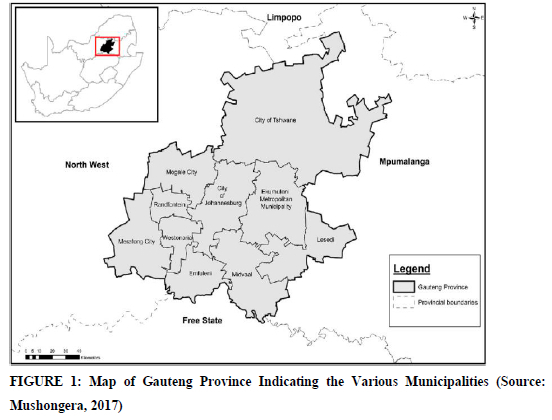
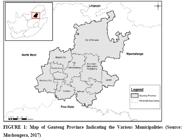
The study was conducted in the five municipalities of the Gauteng Province (see Figure 1): Sedibeng, Ekurhuleni, Johannesburg, West Rand, and Tshwane. The study focuses on Gauteng because the province is an economic hub of the country with an ever-increasing population. Gauteng is estimated to have a population of over 15 million and is projected to grow to 18 million by 2030 and increase between 22 and 25 million by 2050 (Mutevedzi et al., 2022).
2.2.
Sampling MethodThe study adopted simple random sampling to collect data from 132 small-scale farmers. Small-scale farmers were sampled from the list of farmers in the Gauteng Department of Agriculture, Rural Development and Environment (GDARDE) database. The list included 1025 farmers, of which only 132 (13%) completed the questionnaire.
2.3.
Data CollectionOnline surveys were utilised to gather primary data using a questionnaire from January to February 2023. The Tshwane University of Technology had access to the list of Gauteng farmers database that was prepared between 2020 and 2023. Then, GDARDE was permitted to approach these farmers to participate in the study. Information about the socioeconomic status, farm characteristics, and institutional factors was gathered using the questionnaire.
2.4. Analytical Technique
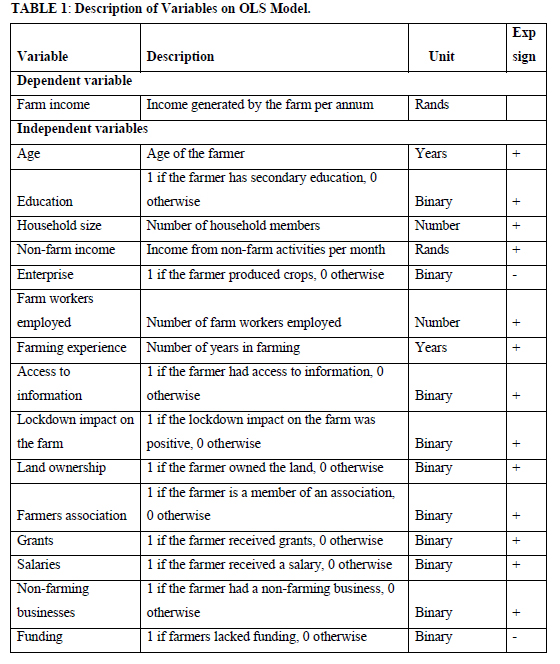
The study adopted Ordinary Least Squares (OLS) to identify factors determining the level of farm income amongst small-scale farmers in Gauteng Province. Farm income was used as the dependent variable in the OLS model. The OLS is a linear regression methodology utilised to ascertain the unknown parameters within a model. This technique minimises the sum of squared residuals, which denotes the discrepancies between the dependent variable's observed values and the model's anticipated values. The residual can be precisely described as the variation between the real and projected values. An alternative term for residual is "error term" (Sharma et al., 2013).

Where:
Y is the dependent variable
B0 is the constant term
B1, B2... B15 are the coefficients of the independent variables X1, X2... X15
ei is the error term. Table 1 describes the variables used in OLS.
3. RESULTS AND DISCUSSIONS
3.1. Characteristics of Farmers in Gauteng Province
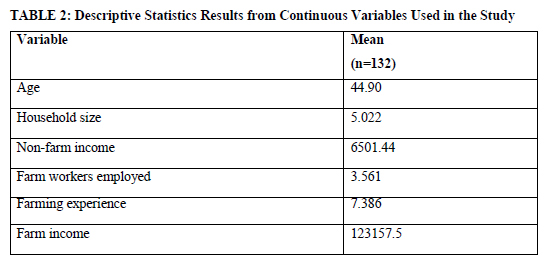
Table 2 shows the results of the descriptive statistics applied to the continuous variables. The results indicate that a small-scale farmer in Gauteng Province is 45 years old, with a household average of five members, generating an average of R6501 non-farm income per month. Small-scale farmers employ four workers with an average of seven years of farming experience, making an average of R123 157 in farm income per annum.
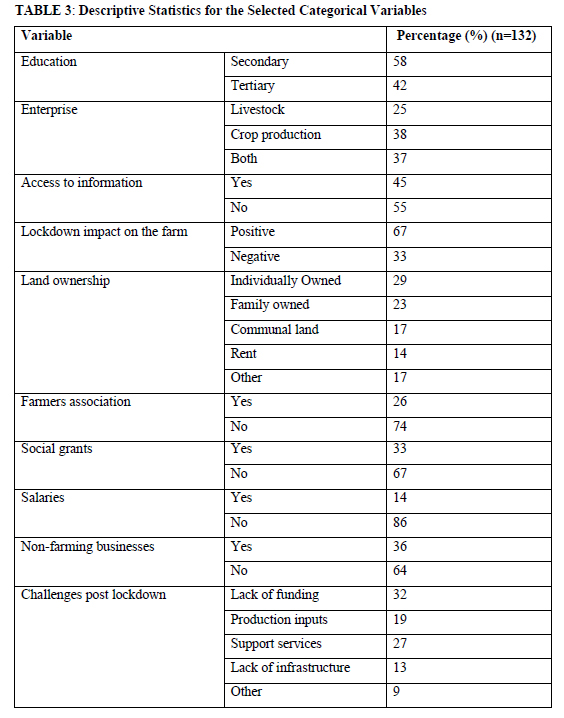
Table 3 presents descriptive results for categorical variables. The results show that most farmers had secondary education (58%). Furthermore, approximately 38% of small-scale farmers produce crops, and 55% have no information access. About 67% of small-scale farmers indicated that the lockdown's impact on the farming business was positive. Approximately 29% of small-scale farmers individually owned their land, while 74% were not members of any farmer's association. About 67% did not receive social grants, and 86% did not receive salaries. The results also show that 32% of small-scale farmers had no access to funding during the lockdown restrictions.
3.2. Factors Influencing the Level of Farm Income of Small-Scale Farmers in Gauteng Province
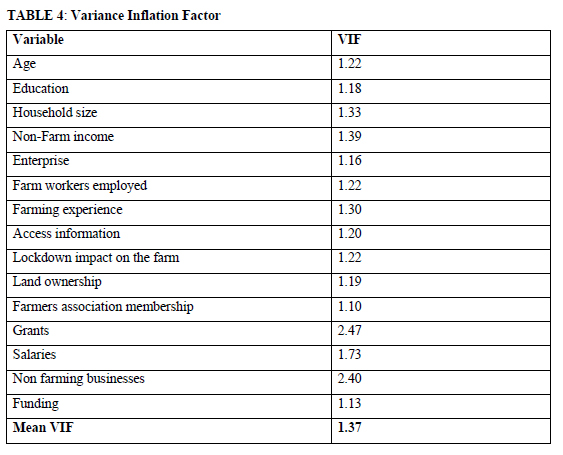
Table 4 shows the variance inflation factor (VIF), which is meant to estimate the correlation among the independent variables. The VIF mean was 1.37, which is lower and suggests no correlation between the variables. This aligns with the assertion by Thompson et al. (2017) that there is little evidence for multicollinearity if all the VIFs range from 1.7 to 2.5.
3.2.1. Discussion of Significant Variables
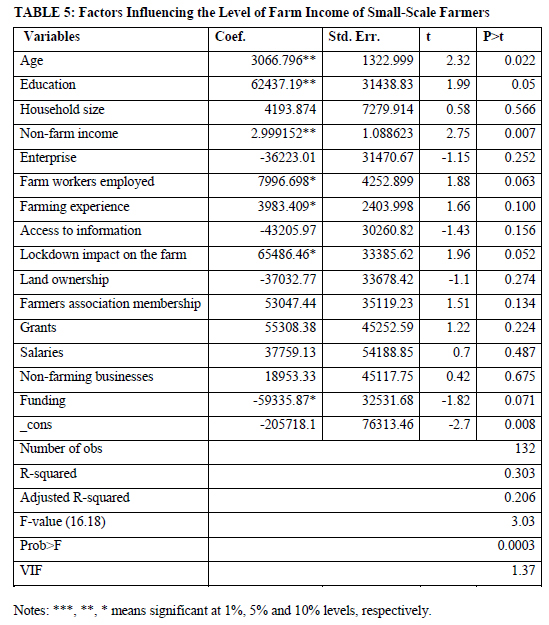
Table 5 presents the factors that influence the level of farm income of small-scale farmers. The adjusted R2 of 21% and the highly significant F-value at the 1% level indicate that the data and the regression model fit each other well. The results showed that age, level of education, non-farm income, farm workers employed, farming experience, lockdown impact, and lack of funding were the factors that impact the level of farm revenue of small-scale farmers.
Demographic variables (age and education level) influence farm income. The variable "age" was statistically significant at 5% and indicated a positive relationship with farm income. This implies that, for every additional year added to the farmer's life, the level of farm income is more likely to increase. This is supported by the findings of Paudel et al. (2022) that a household headed by an older person is likely to earn more money from farming. In addition, the variable "education" was statistically significant at 5%, indicating a positive influence on farm income. This implies that the probability of increasing farm income will rise as farmers become more educated. The conclusions drawn by Sharma et al. (2020) suggest that the more highly educated households can earn more money outside of the farm, which will supplement their income. Sharma et al. (2020) add that the percentage of production income initially rises with higher household income due to higher household education.
Economic variables such as non-farm income and lockdown impact on farming business influenced the level of farm income among small-scale farmers. The "non-farm income" variable is positive and statistically significant at 1%. This implies that the participation of farmers in non-farm businesses can increase farm income. Sharma et al. (2020) affirm that household agricultural income increasingly stems from off-farm activities. Furthermore, the variable "lockdown impact on the farm" was positive and statistically significant at 5%. Farmers who benefited from lockdown restrictions most likely produced goods for specific markets that saw increased demand during this period.
Contrary to expectations of widespread disruption, some lockdown measures created profit opportunities. Local farmers, who did not need permits to relocate, often received direct purchases from customers while bypassing stores and markets. Additionally, with the restricted movement at the time, farmers spent more time on their farms, which enhanced productivity. Hammond et al. (2022) support this, noting that increased farming activity was a key factor that COVID-19 positively impacted.
Farm characteristics also influence the level of farm income. The variable "farm workers employed" is statistically significant at 5% and reflects a positive relationship with the level of farm income during the lockdown. This implies that farmers who had workers during the pandemic may have witnessed increased farm income. This suggests that those who were able to continue producing while others were unable to did so with a competitive advantage, thus controlling the market owing to their steady supply of produce. While the lockdown may have impacted output, this may not have been the case for those who relied on temporary labourers who may have given their health top priority. The "farming experience" variable was positive and statistically significant at 10%. An additional year of farming experience may have positively influenced the farmer's farm income. The more the farmers continue to farm, the more they may develop. Hence, they may improve their production, leading to maximised farm income and allowing them to develop risk management strategies. This notion is supported by Nazir et al. (2018), who believe that the expected probability of the level of farm income will improve with each unit increase in farming expertise.
In addition, the level of farm income is also influenced by institutional factors. The variable "funding" was negative and statistically significant at 10%. This implies that when farmers do not have adequate financial resources or access to funding, their ability to generate income is adversely affected. The results are supported by Mtombeni et al. (2019), who observed that most financial institution funding is directed to commercial farmers. Therefore, the funding initiatives that were examined do not reach small-scale farmers.
4. CONCLUSION AND RECOMMENDATION
The study determined which factors influenced the level of farm income during the lockdown restrictions. The results indicated that demographic variables such as the age of the farmer, level of education, economic factors (on-farm income and lockdown impact on the farm), farm characteristics (farm workers employed and farming experience), and institutional factors (lack of funding) influence the level of farm income amongst the small-scale farmers in Gauteng Province. The age of farmers was critical in deciding to participate in farm activities to improve farm income, where both young and older farmers were open to participation. Farmers who had obtained formal education were also more likely to participate in farming activities to improve farm income. Education and formal training will afford farmers more opportunities. Non-farm income played a crucial role in the generation of farm income. When production was interrupted, non-farm activities assisted the farmers in generating income for their livelihood and well-being. The income generated was further used to fund some farm activities to improve the farm's income level. Farm workers played a key role in ensuring that farm income improved. Even though lockdown restrictions were expected to impact the farmers negatively, most participant farmers recorded that it was not too detrimental as new opportunities arose, resulting in a positive increase in farm income.
The study recommends that farmers enhance their productivity and efficiency by improving education and providing specialised training on modern farming techniques and farm management. In addition, to enhance the overall farm income, it is recommended that non-farm income opportunities be promoted and receive support, as it is evident that these positively influence the level of farm income. Governments and financial institutions should also work together to create and expand funding opportunities for small-scale farmers, for example, by offering low-interest loans, grants, and subsidies.
The authors declare no conflicts of interest.
5. ACKNOWLEDGEMENT
The authors express appreciation to the small-scale farmers in the Gauteng Province who participated in the study. Appreciation also goes to the Gauteng Department of Agriculture, Rural Development and Environment (GDARDE) for permitting us to collect data from the farmers in the province.
REFERENCES
- ADEM, M., TADELE, E., MOSSIE, H. & AYENALEM, M., 2018. Income diversification and food security situation in Ethiopia: A review study. Cogent Food Agrie., 4(1): 1-17.
- CEBALLOS, F., KANNAN, S. & KRAMER, B., 2020. Impacts of a national lockdown on smallholder farmers' income and food security: Empirical evidence from two states in India. World Dev., 136: 1-5.
- CEBALLOS, F., KANNAN, S. & KRAMER, B., 2021. Crop prices, farm incomes, and food security during the COVID-19 pandemic in India: Phone-based producer survey evidence from Haryana State. Agrie. Eeon., 52(3): 525-542.
- DAMANIK, I.P.N., TAHITU, M.E., TURUKAY, M. & ADAM, F.P., 2021. Farmers empowerment level analysis in farming during the Covid-19 pandemic and its impact on farm income. Environ. Earth Sei., 883(1): 1-7.
- HAMMOND, J., SIEGAL, K., MILNER, D., ELIMU, E., VAIL, T., CATHALA, P., GATERA, A., KARIM, A., LEE, J.E., DOUXCHAMPS, S. & TU, M.T., 2022. Perceived effects of COVID-19 restrictions on smallholder farmers: Evidence from seven lower-and middle-income countries. Agrie. Syst., 198: 1-11.
- HOSSAIN, S.T., 2020. Impacts of COVID-19 on the agri-food sector: Food security policies of Asian productivity organization members, J. Agrie. Sei., 15(2): 116-132.
- IRAWAN, A., SAEFUDIN, S., SURYANTY, M. & YULIARSO, M.Z., 2022. Impact of COVID-19 pandemic on the economy of oil palm smallholder's household income. JADEE., 12(3): 425-441.
- JUMIYATI, S. & IRMAWATI, I., 2021. Increasing income and farming management: Empowering survivor farmers in reducing the impact of Covid-19. WJARR., 11(1): 221-228.
- KHAN, M.A., 2022. Smallholder farmers' awareness of COVID-19, challenges, and attitude towards government's lockdown strategies in Pakistan. The JRCD., 17(1): 49-68.
- MTOMBENI, S., BOVE, D. & THIBANE, T., 2019. An analysis of finance as a barrier to entry and expansion for emerging farmers. Working Paper CC2019/01. Competition Commission, South Africa.
- MUSHONGERA, D., 2017. Beyond GDP in assessing development in South Africa: The Gauteng City-Region socioeconomic barometer. Dev. South. Afr., 34(3): 330-346.
- MUTEVEDZI, P.C., KAWONGA, M., KWATRA, G., MOULTRIE, A., BAILLIE, V., MABENA, N., MATHIBE, M.N., RAFUMA, M.M., MAPOSA, I., ABBOTT, G. & HUGO, J., 2022. Estimated SARS-CoV-2 infection rate and fatality risk in Gauteng Province, South Africa: A population-based seroepidemiological survey. Int. J. Epidemiol, 51(2): 404-417.
- NAZIR, A., LI, G., INAYAT, S., IQBAL, M.A., HUMAYOON, A. & AKHTAR, S., 2018. Determinants for income diversification by farm households in Pakistan. JAPS., 28(4): 1163-1173.
- PAUDEL, S., FILIPSKI, M.J. & MINTEN, B., 2022. Income diversification and the rural non-farm economy. Intl. Food Policy Res. Inst., 27: 1-27.
- SHARMA, G.P., PANDIT, R., WHITE, B. & POLYAKOV, M., 2020. The income diversification strategies of smallholders in the hills of Nepal. Dev. Policy Rev., 38(6): 804-825.
- SHARMA, V., RUDNICK, D.R. & IRMAK, S., 2013. Development and evaluation of ordinary least squares regression models for predicting irrigated and rainfed maize and soybean yields. J. ASABE, Trans., 56(4): 1361-1378.
- THANH, P.T., THE DUY, D. & BAO DUONG, P., 2022. Disruptions to agricultural activities, income loss and food insecurity during the COVID-19 pandemic: Evidence from farm households in a developing country. JADEE., 12(3): 531-547.
- THOMPSON, C.G., KIM, R.S., ALOE, A.M., & BECKER, B.J., 2017. Extracting the variance inflation factor and other multicollinearity diagnostics from typical regression results. BASP., 39(2): 81-90.
- TRIPATHI, H.G., SMITH, H.E., SAIT, S.M., SALLU, S.M., WHITFIELD, S., JANKIELSOHN, A., KUNIN, W.E., MAZIBUKO, N. & NYHODO, B., 2021. Impacts of COVID-19 on diverse farm systems in Tanzania and South Africa. Sustainability., 13(17): 1-16.
- VARSHNEY, D., ROY, D. & MEENAKSHI, J.V., 2020. Impact of COVID-19 on agricultural markets: Assessing the roles of commodity characteristics, disease caseload and market reforms. IndianEcon. Rev., 55(1): 83-103.
- WEGERIF, M., 2022. The impact of COVID-19 on black farmers in South Africa. Agrekon., 61(1): 52-66.