Effects of Communication Media on Adoption of Improved Sorghum Farming Practices in Dodoma Region, Tanzania
Abstract
Adopting improved sorghum farming practices is significant for enhancing food security and improving the livelihoods of smallholder farmers, particularly in drought-prone regions like Dodoma, Tanzania. However, the effects of different communication media on promoting these practices' adoption are poorly understood. This study examined the impact of various communication media on smallholder farmers' adoption of improved sorghum farming practices. Results indicate that interpersonal contact emerged as the most widely used communication medium, with an average score of 2. 78, while newspapers, songs, and drama were the least utilised media, with average scores of 1.01, 1.02, and 1.03, respectively. ANOVA analysis demonstrated a significant difference in the use of communication media for accessing agricultural information, supported by an F-statistic of253.11 and a correspondingp-value of <0.001, providing strong evidence for the observed variations in communication media usage. Binary logistic regression results revealed that interpersonal interactions were the primary source of agricultural information, strongly correlated with higher adoption. Direct interpersonal communication facilitated information exchange, encompassing verbal and non-verbal cues as suggested by Media Richness Theory. Mobile phones and television had a significant positive effect on adopting all six improved sorghum farming practices. These findings emphasise the key role of communication media in adoption and recommend a flexible approach incorporating interpersonal communication, mobile phone technology, and television tailored to local contexts to enhance the adoption of improved sorghum farming practices among smallholder farmers.
Communication Media; Adoption; Sorghum; Farming Practices
1. INTRODUCTION
Communication media play a significant role in transmitting information, serving as pathways through which messages are communicated and understood. They are important communication tools for disseminating knowledge, sharing ideas, and fostering understanding among individuals and groups (Lee et al., 2021; Oltarzhevskyi, 2019). However, it is important to acknowledge that the effectiveness of communication media is not always and universally the same. The effectiveness of communication media may vary due to their ability to carry and convey information and differences in audience, context, and situations. Soedarsono et al. (2020) and Hyland-Wood et al. (2021) posit that different situations and audiences necessitate using specific media to ensure effective communication. Therefore, appropriately selecting and using communication media can improve information conveyance and efficiently support knowledge exchange.
In the realm of disseminating agricultural information, the selection and use of appropriate communication media is of paramount importance. Farmers depend on the media to acquire information to enhance their farming methods, mitigate risks, and boost productivity and livelihoods (Mansoor, 2021; Sonmez Cakir & Adiguzel, 2020). Communication media grant farmers access to knowledge, information, and updates on available novel farming practices and technologies (Omulo & Kumeh, 2020; Subejo et al., 2019). They bridge the information gap, offer new perspectives to farmers, and contribute to improving agriculture in terms of livelihoods and sustainability. Mwinami et al. (2023) suggest that appropriate communication media are required to enhance information exchange. Similarly, Mtega (2021) argues that selecting the appropriate communication channels is essential for effective communication. The criteria for selecting and using appropriate communication media differ among individuals. This is associated with differences in preferences, accessibility, context and technology proficiency. Thus, recognising the effectiveness of communication media and understanding the diverse needs of smallholder farmers is vital in promoting the adoption.
Globally, several studies have been conducted to explore the impact of communication media on adopting agricultural practices and technologies. Akhter et al. (2021) and Tucker et al. (2022) highlighted how interpersonal media significantly impacted farmers' decisions to adopt new farming methods in Asia and North America. According to Erjavec et al. (2021), digital platforms, mobile phones, and televisions were beneficial in sharing knowledge and promoting the adoption of improved agricultural techniques in Europe. Short films significantly encouraged the adoption of improved farming methods among Ugandan farmers, as shown by Van Campenhout et al. (2020). According to Tambo et al. (2019), radio and drama benefited Rwandans adopting ecologically friendly management practices.
In Tanzania, agricultural research institutes and stakeholders have made concerted efforts to disseminate agricultural information to smallholder farmers through various media. The most commonly used communication media by farmers in Tanzania include print media (such as newspapers and posters), electronic media (including radio, television, and mobile phones), and interpersonal interactions (such as face-to-face communication) (Benard et al., 2020; Mtega, 2021; Ndimbwa et al., 2021; Peter et al., 2021; Silvestri et al., 2021; Benard et al., 2020). The TARI communication strategy also acknowledges the significance of using various communication media to share agricultural information. It emphasises combining traditional methods such as farm visits and Farmer Field Schools with modern or hybrid media such as web platforms, robotics, radios, and TV programs. The strategy emphasises integrating digital tools as a key opportunity for transferring technology from the source to end users (TARI, 2019).
However, despite these efforts, there is a noticeably low adoption rate of various improved sorghum farming practices among farmers in Dodoma, Tanzania. This is also noted by Tanzania Agricultural Policy (2013), which states that a significant majority of smallholder farmers have not yet adopted the recommended agricultural technologies and practices, such as the use of improved seeds, fertilisers, suitable farm tools, rainwater harvesting, and post-harvest technologies (URT, 2013 ). This lack of adoption poses a threat to food security and rural livelihoods. The existing research on the effects of communication media on promoting the adoption of improved sorghum farming practices in Dodoma, Tanzania, is limited. While studies by Tegene et al. (2023), Atser et al. (2022), Ndimbwa et al. (2019), and Moyo and Salawu (2018) have explored the use of different communication media in agricultural contexts, there is a lack of specific research focusing on the effectiveness of communication media in promoting the adoption of improved sorghum farming practices in Dodoma. This knowledge gap hampers the development of effective strategies to address barriers to adoption, undermining the region's optimal sorghum production. Therefore, based on the literature reviewed, it was hypothesised that;
i. Ho: There are no variations in the use of communication media in accessing agricultural information pertaining to sorghum farming.
ii. Ho: There is no significant relationship between using different communication media and adopting improved sorghum farming practices.
2. THEORETICAL REVIEW
2.1. Media Richness Theory
In this study, both Rogers' Diffusion of Innovation theory (1995) and the Media Richness Theory (MRT) developed by Daft and Lengel (1983) were utilised to examine the adoption of improved sorghum farming practices. The diffusion or spread of an innovation relies on communication channels, which refer to the means through which a message is transmitted from the source to the receiver. While the Diffusion of Innovation theory provides valuable insights into the communication and adoption of innovations through various media, it does not directly consider the effectiveness of the communication media used to promote innovation adoption. The study incorporated the Media Richness Theory into its analysis to address this gap. The Media Richness Theory suggests that different communication media vary in their effectiveness in conveying information. This theory identifies four important dimensions that determine the richness of a medium: its ability to represent multiple cues (both verbal and nonverbal), provide immediate feedback, accommodate natural language use, and convey personalised emotions and feelings. This study used the Media Richness Theory to assess the effects of various communication media, such as radio, television, mobile phones, newspapers, posters, drama, songs, and interpersonal contacts, on adopting improved sorghum farming practices. By applying this theory, the study aimed to understand how the richness of a communication medium aligned with the information being conveyed and the preferences of the intended audience.
3. METHODOLOGY
3.1. Study Area
The study took place in Dodoma, Tanzania, purposefully chosen for its agro-ecological conditions highly recommended for sorghum cultivation, which is recognised as a staple food crop in the region (JMK, 2017). The selection of the region was also driven by the potential of sorghum farming to improve food security in the area (Mwamahonje et al., 2021). Food security is a major concern in the region, and sorghum, a staple food crop, holds significant importance.
3.2. Research Design, Sampling Procedure and Sample Size
A cross-sectional analytical research design was used as it allowed the collection of data from a wide range of individuals at a single point in time, and the data were used to test hypotheses. A multi-stage sampling approach was employed to obtain study participants. At first, three districts were randomly selected out of seven in the region, ensuring an equal representation probability for each district. These were Kongwa, Kondoa and Bahi. In the second sampling stage, a list of all wards in the selected districts was compiled to create a sampling frame, with three wards randomly chosen from each district. In the third stage, three villages were randomly designated from each of the previously selected wards. During the fourth stage, households were randomly picked from the lists of households within the chosen villages. Data were then collected from the heads of these selected households. The purposively chosen key informants included nine ward extension officers and six TARI agricultural experts.
The sample size was calculated using the Cochran (1963) formula appropriate for large or infinite populations (see equation (1), with parameters Z=1.96, q=0.5, p=0.5, and e=0.05). The calculation indicated a minimum requirement of 384 respondents. However, a sample size of 399 respondents was obtained. This decision to exceed the minimum requirement was driven by statistical considerations, accounting for potential non-responses, missing data, or outliers that could impact the reliability of the findings.

3.3. Data Collection
Primary data were this paper's key source of information, and they were collected through interviews with sorghum farmers using a structured questionnaire. Qualitative data were collected using an interview guide from nine extension officers and six TARI agricultural experts. Secondary data were also considered, which were collected from different reports and published and unpublished documents from the Ministry of Agriculture, the National Bureau of Statistics, TARI, and other websites. The information collected included sorghum cultivation.
3.4. Data Analysis
Qualitative and quantitative methods were employed for analysis. Thematic analysis was used to analyse qualitative data obtained from open-ended questionnaire questions and key informant interviews. Quantitative data were analysed using descriptive statistics (frequencies, mean, standard deviation and ranks) and inferential analysis (ANOVA and binary logistic regression). A two-way analysis of variance was employed to investigate the significant variations in the utilisation of communication media for accessing agricultural information. The outcome of interest was the usage of communication media gauged on an index ranging from 0 to 4. The independent variable encompassed various communication channels: posters, newspapers, television, radio, mobile phones, interpersonal contact, agricultural exhibitions, local meetings, drama, and songs. The model formulation is outlined in the equation (3).

where:
Y ij is the dependent variable (usage of the media), μ is an overall mean, τi is a media effect, ß j is the jth individual farmer effect in usage and εij is the random error term which is normally identically distributed (0, σ2).
Binary logistic regression models were used to assess the effects of communication media on adopting improved sorghum farming practices. For each component of an improved farming practice, separate models were fitted, and the results were presented in a table using adjusted odds ratios and the corresponding p-values. The general form of the model is as given in the equation (4).

Where the X's denotes the use of communication channels to access agricultural information. Xt = newspapers, X2 = posters, X3 = television, XA = radio, X5 = mobile phone, X6 = interpersonal contact, X7= agricultural exhibitions, X8= local meeting, X9 = drama, and X10= songs. The parameter a is the overall "log (odd)" of adopting an improved sorghum farming practice for a farmer, regardless of the communication media used in accessing agricultural information.
4. RESULTS AND DISCUSSIONS
4.1. Adoption of Improved Sorghum Farming Practices
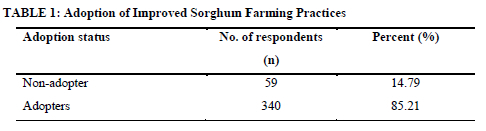
The results from Table 1 indicate that among the 399 sorghum farmers surveyed, 59 individuals, accounting for 14.79% of the total, did not adopt any of the six recommended practices. On the other hand, 340 farmers, constituting 85.21% of the sample, adopted at least one of the recommended practices. These findings are consistent with the prevailing pattern of limited adoption of recommended farming practices among smallholder farmers in developing nations. Various factors influence the adoption of improved sorghum farming practices. These include the availability and accessibility of information, affordability of implementation, compatibility with existing farming systems, perceived risk, and the level of support provided by agricultural extension services. These results align with the findings of Kaliba et al. (2018), who also associated low adoption rates with factors such as lack of awareness, inadequate resources (such as land and capital), and the absence of subsidies. Similarly, Kimbi et al. (2020) argue that the adoption of improved sorghum technologies among smallholder farmers in Tanzania remains low, often due to difficulties in accessing high-quality inputs for various reasons.
4.2. Use of Communication Media in Accessing Agricultural Information on Improved Sorghum Farming Practices
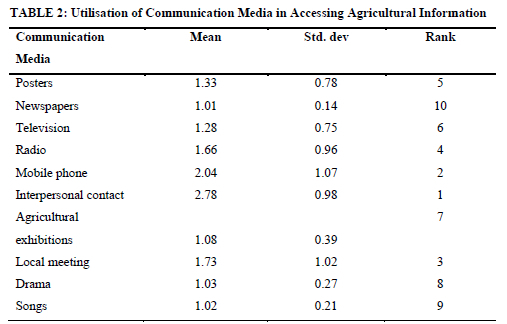
The data presented in Table 2 offers an overview of communication media usage by sorghum farmers to access agricultural information. Various media, including posters, newspapers, television, radio, mobile phones, interpersonal contact, agricultural exhibitions, local meetings, drama, and songs were examined. The "mean" column in the table showcases the average usage levels, rated on a scale of 0 to 4. The "Std. dev" column highlights the variability (standard deviation) observed in farmers' ratings concerning the usage extent of specific communication media. Moreover, the "rank" column demonstrates the descending order of media usage. These findings distinctly portray the diverse communication channel preferences for accessing agricultural research information. The results indicate that interpersonal contact ranks as the most utilised medium, recording an average of 2.78.
In contrast, newspapers, songs, and drama are the least utilised media, averaging 1.01, 1.02, and 1.03, respectively. The lower usage of traditional media such as songs and drama might be attributed to the increasing prominence of contemporary media such as mobile phones, television, and radio. This suggests that traditional media typically rely more on verbal communication than other mediums, while modern communication predominantly focuses on employing technology for effective communication. The findings are also supported by key informants who argued that:
the choice and use of communication media in rural setting is determined by various factors such as education, affordability and accessibility. Education limits smallholder farmers to make use of digital platforms and print media such as the internet and farm magazines... other media platforms are both costly and inaccessible ...as result, face to face is mostly used in rural settings..." (Interview, Kondoa, 28 June 2022).
The key informant interview underscores the intricate factors affecting the use of communication media in rural settings, suggesting that education is vital in shaping media choices. The limited educational opportunities for smallholder farmers can impede their effective use of digital platforms and print media, like the internet and farm magazines, due to challenges in affordability and accessibility. It emphasises affordability and accessibility as key factors influencing the selection of communication media, noting that, aside from face-to-face interactions, other media platforms are often seen as expensive and hard to access in rural areas.
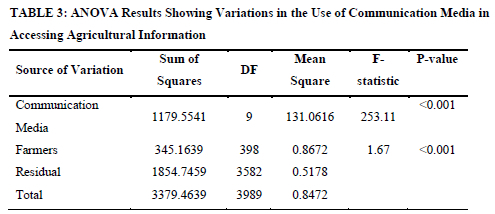
A two-way Analysis of Variance (ANOVA) was also performed to evaluate the statistical significance of the differences in communication media usage for accessing agricultural information. The results of the ANOVA analysis are outlined in Table 3. A disparity in the utilisation of communication media for accessing agricultural information was identified. This significant difference is substantiated by an F-statistic of 253.11 with an associated p-value of <0.001, providing compelling evidence for the observed variations in communication media usage.
4.3. Effects of Communication Media on the Adoption of Improved Sorghum Farming Practices
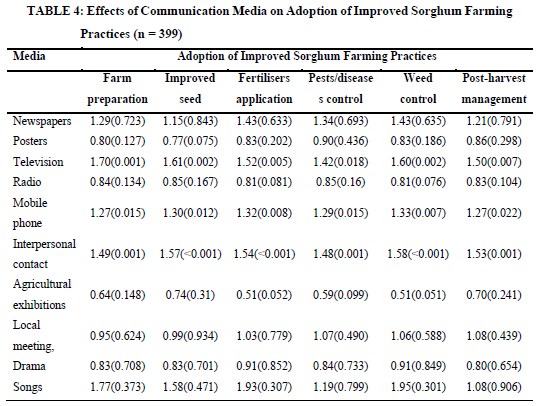
The study sought to investigate how the use of various communication media influences the adoption of improved sorghum farming practices among smallholder farmers in the Dodoma region. Binary logistic regression models were utilised to assess the effects of communication media on adopting improved sorghum farming practices, as summarised in Table 4. The adjusted odds ratios for each communication medium's impact on specific farming practices and their respective p-values in parentheses are presented. Interpersonal contact had a significantly positive influence on the adoption of all analysed farming practices: farm preparation (OR = 1.49, p < 0.001), improved seed varieties (OR = 1.57, p < 0.001), fertiliser/manure application (OR = 1.54, p < 0.001), weed control (OR = 1.48, p < 0.001), pest and disease control (OR = 1.58, p < 0.001), and post-harvest loss management (OR = 1.53, p < 0.001). These results indicate that interpersonal interactions were the primary source of agricultural information and strongly correlated with a higher extent of adoption. Immediate feedback through interpersonal networks proved highly effective for driving changes. Direct interpersonal communication facilitated the exchange of information, encompassing both verbal and non-verbal cues, aligning with findings from Skaalsveen et al. (2020) and Unay-Gailhard and Simões (2022). The findings are also in line with MRT. These theories help explain why certain media, such as interpersonal, may be more effective in specific contexts or audiences, based on their ability to convey information effectively and satisfy individuals' needs and motivations.
Regarding mobile phones, the results revealed a significant positive effect with odds ratios of 1.27 (p = 0.015) for farm preparation, 1.30 (p = 0.012) for improved seed varieties, 1.32 (p = 0.008) for fertilisers/manure application, 1.29 (p = 0.015) for weed control, 1.33 (p = 0.007) for pest and disease control, and 1.27 (p = 0.022) for post-harvest management. Contrary to the hypothesis, electronic media, specifically mobile phones and TV, demonstrated a significant positive relationship with adopting improved sorghum farming practices. Farmers accessing information through these media were more inclined to adopt these practices. This positive influence can be attributed to the widespread accessibility and effective audiovisual communication capabilities of mobile phones and television. As a widely used communication tool, mobile phones reach diverse and dispersed farming communities, while television, with its audiovisual features, effectively conveys information and elicits emotional responses. These findings are in line with research by Cole and Fernando (2021), illustrating the impact of mobile phone voice-based consulting services on encouraging recommended farming practices among smallholder cotton farmers in rural India. Similarly, Sousa (2019) sees mobile phone videos' substantial role in facilitating information exchange among farmers and promoting the adoption of agronomic technologies in South Africa. Key informants support this:
"... the use of mobile phones has significantly enhanced communication with farmers, reducing the need for in-person meetings. Mobile phones are versatile, allowing the use of both audiovisual and text-based content, making them an efficient communication channel suitable for both literate and illiterate farmers...., on the other hand, the use of the radio primarily relies on verbal communication and lacks the capability for simultaneous feedback. This limitation hinders its effectiveness in conveying agricultural information...... " (Interview, Kongwa, 23 June 2022).
Another key interviewee at TARI Hombolo Centre commented that:
the use of mobile phones has revolutionised the communication between farmers and agricultural experts in sharing agricultural information and knowledge. Mobile phones are increasingly being used by both rural farmers and extension personnel. This has reduced the need for physical visits or even face-to-face interactions. "
The effects of television on adoption of all six improved sorghum farming practices was positively significant with odds ratios of 1.70 (p=0.001) for farm preparation, 1.61 (p=0.002) for use of improved seed varieties, 1.52 (p=0.005) for application of fertilisers/manure, 1.42 (p=0.018) for control of weeds, 1.60 (p=0.002) for control of pests and diseases, and 1.50 (p=0.007) for post-harvest management. The results are consistent with those of Tambo et al. (2019), who discovered that among the three ICT channels, television had a larger influence on people's decision to employ pest control because it allowed people to combine verbal and visual communication aspects. Similar findings are also noted by Waaswa et al. (2021) in Kenya. In view of this observation, using modern ICT media, such as television, according to Norton and Alwang (2020), could assist extensionists and farmers in disseminating various innovative agricultural technologies. The key informants also support this during data collection.
".... Television is very effective in disseminating agricultural research information and promoting adoption to smallholder farmers who are largely semi-illiterate. Unlike other media, it has the ability to display visual images which enhances comprehension and memory retention, capturing farmers' emotional connections and promoting a deeper understanding of the communicated concepts.... This is based on the assumption that seeing is believing" (Interview, Bahi, 25 June 2022).
Print media was predicted to not significantly impact adoption, and the findings support this hypothesis. Newspapers and posters were rarely used and had minimal influence as they lacked interactivity and feedback mechanisms. They primarily convey information through static text and basic images, limiting cues and language diversity. This contrasts with Kigatiira et al. 's (2018) findings, which highlighted the role of print media among Irish potato farmers in Kenya, particularly due to a high literacy level. Similarly, traditional media was expected to have no significant effect on adoption, and the results align with this hypothesis. Songs and drama, among other traditional media, were infrequently used and had little impact. This differs from Ekerete and Ufot's (2017) findings, which emphasised the effectiveness of traditional folk media in conveying agricultural information to rural farmers.
The results show how different media align with or deviate from the hypotheses. It is clear that only interactive media, like interpersonal communication, phone usage, and television, effectively enhance understanding and implementation of modern methods, which aligns with the Media Richness Theory (MRT). This stresses the fundamental role of these multimedia platforms in promoting broader adoption, addressing the central research question.
5. CONCLUSION AND RECOMMENDATIONS
The key findings emphasise variations in the effectiveness of communication media in encouraging the adoption of improved sorghum farming practices. Face-to-face interactions within interpersonal networks, mobile phones, and television are significant drivers of adoption, aligning with the principles of the Media Richness Theory. This theory suggests that communication channels differ in their effectiveness in conveying information, with face-to-face communication considered the richest, followed by written documents, telephone conversations, and so on. The results suggest that adopting improved farming practices could be enhanced through the appropriate choice and use of communication media. In contrast, traditional media, such as songs and print media, have limited impact due to their one-way nature and restricted circulation.
5.1. Recommendations
To effectively promote better sorghum farming practices among smallholder farmers, agricultural research institutes and stakeholders should adopt a holistic media strategy. This involves promoting interpersonal communication through local workshops, farmer field schools, and community-based extension services for face-to-face interactions and feedback. Additionally, utilising mobile phones and television for tailored audiovisual content, such as videos and infographics, can offer user-friendly agricultural information, enhancing farmers' knowledge. Embracing technological innovations like mobile apps and farmer-centric TV ensures convenient access to personalised agricultural guidance. The value of traditional and modern methods, involving farmers in material design, ensures ownership and effective information dissemination. Implementing these strategies comprehensively can effectively bring about behavioural change and encourage the adoption of improved sorghum farming practices.
REFERENCES
- AKHTER, P., HUSSAIN, T. & AHSAN, H.B., 2021. Mass media as a source of agricultural information: An overview of literature. Global Reg. Rev., VI(II): 58-63.
- ATSER, G., DIXON, A., EKELEME, F., HAUSER, S., FADAIRO, O., ADEKOYA, A., AYANWALE, A., AGADA, M., OLADOKUN, I., AKPU, P., SANNI, L., PYPERS, P., AMPADU-BOAKYE, T., LAUWE, B. & VAN, B., 2022. The effect of communication media on the uptake of agricultural innovations in selected states of Nigeria. J. Agric. Educ. Ext, 29(5): 583-604.
- BENARD, R., DULLE, F. & LAMTANE, H., 2020. Challenges associated with the use of information and communication technologies in information sharing by fish farmers in the Southern highlands of Tanzania. J. Inf. Commun. Ethics Soc., 18(1): 44-61.
- COLE, S.A. & FERNANDO, A.N., 2021. 'Mobile'izing agricultural advice technology adoption diffusion and sustainability. Econ. J., 131(633): 192-219.
- EKERETE, B. & UFOT, I., 2017. Perceived effectiveness of traditional media of information dissemination by farmers in Ikot Abasi Local Government Area of Akwa Ibom State, Nigeria. Int. J. Commun., 7(3): 184-191.
- ERJAVEC, K., JANZEKOVIC, M., KOVAC, M., SIMCIC, M., MERGEDUS, A., TERCIC, D. & KLOPCiC, M., 2021. Changes in use of communication channels by livestock farmers during the COVID-19 pandemic. Sustain., 13(18): 10064.
-
HYLAND-WOOD, B., GARDNER, J., LEASK, J. & ECKER, U.K., 2021. Toward effective government communication strategies in the era of COVID-19. Humanit. Soc. Sci. Commun., 8(1): https://doi.org/10.1057/s41599-020-00701-w.
» https://doi.org/10.1057/s41599-020-00701-w - KIGATIIRA, K.K., MBERIA, H.K. & WANGULA, K., 2018. The effect of communication channels used between extension officers and farmers on the adoption of Irish Potato farming. Int. J. Acad. Res. Bus. Soc. Sci., 8(4): 377-391.
- LEE, Y., TAO, W., LI, J.-Y. Q. & SUN, R., 2021. Enhancing employees' knowledge sharing through diversity-oriented leadership and strategic internal communication during the COVID-19 outbreak. JKnowlManag., 25(6): 1526-1549.
- MANSOOR, M., 2021. Citizens' trust in government as a function of good governance and government agency's provision of quality information on social media during COVID-19. Gov. Inf. Q., 38(4): 101597.
- MOYO, R. & SALAWU, A., 2018. A survey of communication effectiveness by agricultural extension in the Gweru district of Zimbabwe. J. Rural Stud., 60: 32-42.
- MTEGA, W.P., 2021. Communication channels for exchanging agricultural information among Tanzanian farmers: A meta-analysis. IFLA Journal., 47(4): 570-579.
- MWAMAHONJE, A., ELEBLU, J.S.Y., OFORI, K., FEYISSA, T., DESHPANDE, S. & TONGOONA, P., 2021. Evaluation of traits' performance contributing to drought tolerance in sorghum. Agronomy., 11(9): 1698.
- MWINAMI, N., DULLE, F.W. & MTEGA, W.P., 2023. The communication channels and their potential applicability in enhancing agricultural research data sharing among agricultural researchers in Tanzania. LIBER Quarterly., 33(1): 1-28.
- NDIMBWA, T., MWANTIMWA, K. & NDUMBARO, F., 2021. Channels used to deliver agricultural information and knowledge to smallholder farmers. IFLA Journal., 47(2): 153-167.
- NDIMBWA, T., NDUMBARO, F. & MWANTIMWA, K., 2019. Delivery mechanisms of agricultural information and knowledge to smallholder farmers in Tanzania: A meta-analysis study. University of Dar es Salaam Lib. J., 14(2): 87-98.
- NORTON, G.W. & ALWANG, J., 2020. Changes in agricultural extension and implications for farmer adoption of new practices. Appl. Econ. Perspect. Policy., 42(1): 8-20.
- OLTARZHEVSKYI, D.O., 2019. Typology of contemporary corporate communication channels. Corp. Commun: An International Journal., 24(4): 608-622.
- OMULO, G. & KUMEH, E.M., 2020. Farmer-to-farmer digital network as a strategy to strengthen agricultural performance in Kenya: A research note on 'Wefarm'platform. Technol. Forecast. Soc. Change., 158: 120120.
- PETER, D.K., XU, S., YU, W., SARY, S. & MUYOBOZI, S., 2021. Reliability of the agricultural extension and technological services among rice farmers in the rural areas of Tanzania. J. Agric. Ext., 25(2): 18-31.
- SILVESTRI, S., RICHARD, M., EDWARD, B., DHARMESH, G. & DANNIE, R., 2021. Going digital in agriculture: How radio and SMS can scale-up smallholder participation in legume-based sustainable agricultural intensification practices and technologies in Tanzania. Int. J. Agric. Sustain., 19(5-6): 583-594.
- SKAALSVEEN, K., INGRAM, J. & URQUHART, J., 2020. The role of farmers' social networks in the implementation of no-till farming practices. Agric. Syst., 181: 102824.
- SOEDARSONO, D.K., MOHAMAD, B., ADAMU, A.A. & PRADITA, K.A., 2020. Managing digital marketing communication of coffee shop using instagram. Int. J. Interact. Mob. Technol., 14(5).
- SONMEZ CAKIR, F. & ADIGUZEL, Z., 2020. Analysis of leader effectiveness in organization and knowledge sharing behavior on employees and organization. Sage Open., 10(1): 2158244020914634.
- SOUSA, F., 2019. Video on mobile phones as an effective way to promote sustainable practices by facilitating innovation uptake in Mali. Int. J. Sustain. Dev. Res., 5(1): 1-8.
- SUBEJO, S., UNTARI, D.W., WATI, R.I. & MEWASDINTA, G., 2019. Modernization of agriculture and use of information and communication technologies by farmers in coastal Yogyakarta. Indones. J. Geogr., 51(3): 332-345.
- TAMBO, J.A., ALIAMO, C., DAVIS, T., MUGAMBI, I., ROMNEY, D., ONYANGO, D.O., KANSIIME, M., ALOKIT, C. & BYANTWALE, S.T., 2019. The impact of ICT-enabled extension campaign on farmers' knowledge and management of fall armyworm in Uganda. Plos One., 14(8): e0220844.
- TEGENE, T., WIMS, P., GEBEYEHU, D. & ABO, T., 2023. Analysis of communication approaches used in agricultural extension: Case of Wolaita Zone, Southern Ethiopia. Local Dev. Society., 4(1): 1-22.
- TUCKER, M., NAPIER, T.L. & NYAIRO, N.M., 2022. Assessment of the utility of the diffusion model for facilitating adoption of soil and water conservation production systems in north america. In R. Li, T.L. Napier, S.A. El-Swaify, M. Sabir & E. Rienzi (eds.), Global degradation of soil and water resources: Regional assessment and strategies. Springer, pp. 93-105.
- UNAY-GAILHARD, İ. & SIMÕES, F., 2022. Becoming a young farmer in the digital age- An island perspective. RuralSociol., 87(1): 144-185.
- URT., 2013. National Agriculture Policy: Ministry of Agriculture, Food Security, and Cooperatives. Dar Es Salaam, Tanzania.
- VAN CAMPENHOUT, B., SPIELMAN, D.J. & LECOUTERE, E., 2020. Information and communication technologies to provide agricultural advice to smallholder farmers: Experimental evidence from Uganda. Am. J. Agric. Econ., 103(1): 317-337.
- WAASWA, A., NKURUMWA, A.O., KIBE, A.M. & KIPKEMOI, N.J., 2021. Communicating climate change adaptation strategies: Climate-smart agriculture information dissemination pathways among smallholder potato farmers in Gilgil Sub-County, Kenya. Heliyon., 7(8): e07873.