Determinants of Adaptation Amongst Street Vendors Towards COVID-19 Restrictions in Ephraim Mogale Municipality, Limpopo Province
Abstract
The COVID-19 pandemic severely disrupted the livelihoods of informal workers globally, with street vendors among the most affected due to restrictions on movement and market access. This study investigated the socioeconomic determinants influencing street vendors' adaptation strategies in Marble Hall, Ephraim Mogale Municipality, Limpopo Province, South Africa. Using primary data collectedfrom 83 vendors through structured interviews, the study applied descriptive statistics and binary logistic regression to examine relationships between socioeconomic variables and adaptation to COVID-19 restrictions. Results revealed that only 24.1% of vendors adapted their business practices during the pandemic. Key positive predictors of adaptation included years of vending experience (p = 0.041), access to markets during lockdowns (p = 0.021), access to extension services (p = 0.062), employment status (p = 0.073), and monthly household expenditure (p = 0.078). Conversely, the presence of employed household members was negatively associated with adaptation (p = 0.064). Gender, education level, and household size were not significant predictors. The findings highlight the importance of experience, market accessibility, and targeted support services in enhancing informal traders' resilience. Policy recommendations include maintaining safe market operations during crises, strengthening extension services, promoting peer learning, encouraging livelihood diversification, and integrating informal sector realities into urban and public health planning. By addressing both individual and household-level factors, interventions can better support street vendors' adaptive capacity in future economic disruptions.
Determinants; COVID-19; Street Vendors; Informal Economy; Adaptation Strategies; Binary Logistic Regression
1. INTRODUCTION
The COVID-19 pandemic, originating as a global health crisis in late 2019, rapidly escalated into a profound economic shock, disrupting livelihoods and market systems worldwide (Dunford & Qi, 2020; Toker et al., 2022). Informal workers, especially street vendors, experienced severe hardships due to their reliance on daily income and physical access to markets, which were severely restricted by lockdowns and movement controls (Bamidele et al., 2021). These containment measures, while necessary for public health, disproportionately impacted the most vulnerable, limiting their capacity to earn and increasing poverty among already marginalised populations (Bhowmick et al., 2020).
Street vendors, defined broadly as individuals who sell goods without permanent retail spaces, constitute an integral yet often overlooked segment of the informal economy (Peimani & Kamalipour, 2022). Despite their vital role in urban livelihoods, they face significant challenges, including limited financial security and scant institutional support. The pandemic exacerbated these vulnerabilities, shrinking incomes and pushing many into deeper poverty (Diwakar, 2020).
In South Africa, the informal economy underpins a large proportion of employment and economic activity, particularly in urban centres. According to Sultana et al. (2022), the contribution of the informal sector to the economy, measured by GDP per capita, was influenced by its size and performance, highlighting its relationship with real GDP per capita growth. However, the initial phases of the COVID-19 lockdowns caused severe disruptions, with studies showing that up to 97% of informal traders faced drastic income losses (Skinner et al., 2021). Globally, the informal sector sustains over two billion individuals, underscoring its significance in developing economies (Chakraborty & Maity, 2020; Monitor, 2020).
In response to pandemic restrictions, informal traders across Africa and beyond employed various coping mechanisms, ranging from legal advocacy to defiance of lockdown orders (Thulare & Moyo, 2021). These adaptive strategies highlight the resilience of informal workers but also reveal the precariousness of their livelihoods.
Despite the growing body of research on COVID-19's impact on the informal sector, there remains limited empirical evidence on the socioeconomic determinants shaping street vendors' adaptation strategies in rural settings such as Ephraim Mogale Municipality, Limpopo Province. This study addressed this gap by investigating the key factors that influenced how street vendors adjusted their practices during the pandemic in Marble Hall.
1.2. Objectives
The study's primary goal was to identify and analyse the socioeconomic factors affecting street vendors' adaptation to COVID-19-related restrictions in Ephraim Mogale Municipality. Specifically, it aimed to:
i. Assess the effect of street vending experience on adaptation to COVID-19 measures.
ii. Evaluate how market access during the pandemic influenced vendors' coping mechanisms.
iii. Examine the role of extension services and household economic variables in shaping adaptation.
1.3. Hypotheses
To guide the investigation, the following hypotheses were formulated:
• H1: Vendors with greater experience in street vending are more likely to adapt effectively to COVID-19 restrictions.
• H2: Continuous access to markets during the pandemic positively affects vendors' ability to adapt.
• H3: Access to extension and support services enhances the likelihood of adaptation.
• H4: Household economic factors, including income levels and employment status of household members, significantly influence adaptation.
1.4. Study Limitations
This study acknowledges several limitations. Firstly, the sample size was comparatively modest, largely due to the mobile and unstructured characteristics of street vending. This posed challenges in reaching respondents, potentially limiting the results' broader applicability. Comparable sampling difficulties are frequently encountered in research concerning the informal sector, where populations often lack formal registration or stable places of operation (Darbi et al., 2018; Mitullah, 2021).
Secondly, reliance on self-reported information introduces the possibility of recollection errors, especially regarding income, coping mechanisms, and business activities before the pandemic. Self-reported surveys in studies of the informal economy often suffer from this kind of bias, as individuals may unintentionally misstate or understate financial details (Chen et al., 2020; Guan et al., 2020).
Thirdly, the use of a cross-sectional approach, which collects data at a single time point, limits the ability to determine definitive cause-and-effect relationships between the influencing factors and the resulting adaptations. These kinds of limitations are typical in studies of social and economic resilience, where the evolution of events over time and longer-term adaptive processes cannot be entirely observed (Martin & Sunley, 2020).
Notwithstanding these limitations, this investigation provides meaningful empirical evidence on the adaptive responses of informal vendors during times of crisis. It also establishes a basis for future longitudinal and comparative investigations to more fully capture the development of adaptation strategies over an extended period.
2. METHODOLOGY
2.1. Study Area
This research was conducted in Marble Hall, a town in the Mogale Local Municipality of the Sekhukhune District in Limpopo Province, South Africa. Limpopo is in the northernmost region of the country, sharing international borders with Zimbabwe, Mozambique, and Botswana. It ranks as the fifth most populous province in South Africa, with an estimated population of approximately 5.8 million residents (Municipality, 2019).
Limpopo is administratively divided into five districts: Capricorn, Waterberg, Sekhukhune, Mopani, and Vhembe, each further subdivided into local municipalities (Thobejane, 2019). Sekhukhune District, the focus of this study, encompasses four local municipalities: Elias Motsoaledi, Ephraim Mogale, Makhuduthamaga, and Fetakgomo Tubatse. The district comprises 117 wards and approximately 764 villages, housing a population of about 1.19 million people, representing roughly 20% of Limpopo's total population. Notably, Sekhukhune recorded the highest population growth rate within the province, averaging 1.2% annually between 2009 and 2019 (Municipality, 2019).
Marble Hall itself is strategically positioned along the N11 National Route, approximately 26 kilometres northwest of Groblersdal and 96 kilometres southeast of Mokopane, serving as an important local hub within the district.
2.2. Data Collection Method
This study employed a quantitative research design, which involves the systematic collection and analysis of numerical data to explore and interpret phenomena (Creswell et al., 2003; Ghanad, 2023). Primary data were collected directly from street vendors operating in the town of Marble Hall. The data collection process utilised face-to-face interviews guided by a structured semi-structured questionnaire.
The questionnaire was divided into two main sections. The first section focused on capturing the socioeconomic characteristics of the respondents, including age, household size, income level, education, marital status, gender, number of income sources, and employment status. The second section explored the key factors influencing street vendors' adaptation strategies during the COVID-19 pandemic, with emphasis on variables such as market access and years of vending experience.
2.3. Sampling and Analytical Method
To select participants for this study, a purposive-convenience sampling strategy was utilised, focusing on street vendors operating in Ephraim Mogale Municipality, Limpopo Province. This methodological choice was necessitated by the lack of a comprehensive vendor registry and the logistical complexities of reaching informal traders dispersed across a wide range of trading locations. To ensure a representative sample reflecting the socioeconomic and operational diversity within the municipality, the selection process prioritised the inclusion of vendors from prominent vending areas, including Ephraim Mogale Town, Marble Hall, and adjacent communities.
Descriptive statistical methods were employed to delineate the sociodemographic attributes that influenced street vendors' adaptation during the COVID-19 pandemic. Summary statistics, including means and standard deviations, along with percentage distributions and Chi-square tests, were implemented to analyse salient variables such as participants' age, household composition, primary income sources, gender, marital status, educational attainment, and pandemic-related influences. Specifically, age and gender were considered key demographic factors in evaluating the work and adaptive capacities of street vendors during this challenging period.
2.4. Binary Logistic Regression Model
To examine the relationship between socioeconomic factors and street vendors' adaptation to challenges encountered during the COVID-19 pandemic, this study employed binary logistic regression. This statistical technique is appropriate when the dependent variable is dichotomous, meaning it has two possible outcomes and is used to estimate the likelihood of an event occurring based on one or more predictor variables (Elkahwagy et al., 2024; Grant et al., 2019).
Binary logistic regression was selected because it effectively models the probability of adaptation (coded as a binary outcome) as a function of several independent variables (Harris, 2021). These predictor variables in the current study included age, gender, educational attainment, monthly household income, number of income sources, household size, years of street vending experience, marital status, market accessibility during the pandemic, and household expenditure. This approach enabled the estimation of the strength and direction of associations between these socioeconomic characteristics and the likelihood that street vendors adapted their business practices in response to COVID-19-related disruptions.
2.5. Model specification:
The general Binary Logistic Regression Model is expressed as follows:

The operational model:

The model assumes that Y is linearly related to the predictors.
Where:
Yi= Dependent variable, which is the adaptation of the street vendors.
Pi= the probability that the street vendor is adapting to the COVID-19 pandemic.
1 - Pi= the probability that the street vendor did not adapt to the COVID-19 pandemic.
ln= the natural logarithm
β0= the regression constant (intercept)
Ui= the error terms
Β1, β2, β3, β4, β5, β6, β7, β8, β9, β10 = the regression coefficients for the independent variables
AGE- age of the respondent
MRS- marital status
GND- gender
SVEXP- number of years in street vending
MRA- market access
LED- number of years of schooling
HSI- total household income
HSZ- total household size
HSEXP- total monthly expenditure in the household
SIH- total number of sources of income
3. RESULTS AND DISCUSSION
3.1. Socioeconomic Characteristics of Respondents
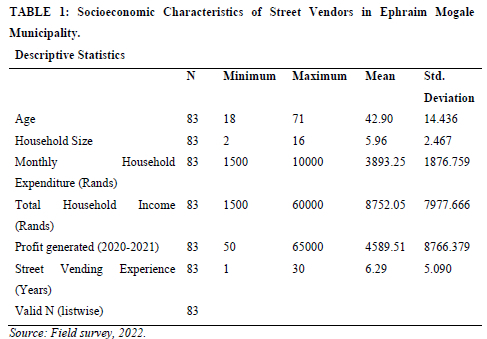
As shown in Table 1, the socioeconomic profiles of street vendors in Marble Hall Town were summarised. The respondents' ages ranged from 18 to 71 years, with a mean age of approximately 43 years. This indicates that a significant portion of vendors are in their prime working years, likely to be active and engaged in income-generating activities. This finding aligns with Tc et al. (2022), who similarly reported that street vendors were about 43.6% in the 35-44 years age group, reflecting the demographic composition typical of informal traders engaged in physically demanding work.
Household sizes varied considerably, ranging from 2 to 16 members, with an average of about 6 persons per household. Such a large average household size, juxtaposed with limited income, can adversely affect the household's overall welfare and living standards. This observation aligns with studies highlighting a lack of involvement by street vendors in family planning or financial management, which may exacerbate economic strain due to uncontrolled family growth and limited resources (Achieng, 2024; Duminy et al., 2021). Large household sizes, when combined with limited income, often lead to a lower standard of living, as resources must be shared among many dependents.
Regarding household expenditure, vendors reported monthly expenses ranging from R1,500 to R10,000, with an average of approximately R3,893. This level of expenditure suggests tight financial management, as households tend to allocate a significant portion of income to essential needs such as utilities, food, and education. The marginal propensity to save, the portion of income not spent on consumption, likely remains low, given the minimal reported disposable income. Sarker et al. (2019) similarly note that street vendors often live below the poverty threshold, earning insufficient income to maintain a comfortable standard of living.
The total monthly household income ranged broadly, with a minimum of R1,500 and a maximum of R60,000, averaging around R8,752. This finding reveals that, despite some variation in income sources, most households depend on less than R9,000 per month, regardless of household size. This figure reflects the informal sector's earnings volatility and vulnerability, consistent with observations by Langry and Rena (2023), who reported that vendors lost income during lockdowns, had irregular incomes, and lacked financial buffers.
Profit margins generated by vendors between 2020 and 2021 varied significantly, ranging from as low as R50 to as high as R65,000, with an average of approximately R4,590. The relatively modest mean profit underscores the negative economic impact of COVID-19 restrictions on informal traders, many of whom experienced sharp declines in daily sales and income (Skinner et al., 2021). The broad range indicates that while some vendors managed to maintain or grow profits, a majority suffered downturns, highlighting the uneven effects of the pandemic across the sector.
Finally, the average years of street vending experience among respondents was approximately six years, with experience ranging from 1 to 30 years. This suggests that many vendors have been engaged in informal trade for a considerable period but may lack progression or diversification in income-generating activities. Ringson and Raniga (2022) support this interpretation, noting that many informal traders in South Africa do not actively upgrade their business skills or diversify their income sources, thereby limiting their potential for growth and resilience to economic shocks.
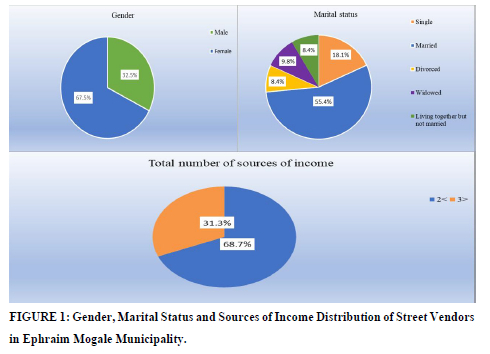
Figure 1 provides an overview of the socioeconomic characteristics of street vendors operating within the Ephraim Mogale Municipality, with particular attention given to gender distribution, marital status, and income sources. The data indicate a significantly higher prevalence of female vendors (67.5%) than male vendors (32.5%), a finding that aligns with research by Mahopo et al. (2022). Their work suggests that women's greater involvement in street vending stems from their adaptability and ability to manage entrepreneurial activities alongside household obligations. In contrast, men are more frequently employed in formal or labour-intensive sectors. Regarding marital status, most vendors are married (55.4%), followed by single (18.1%), widowed (9.8%), divorced (8.4%), and cohabiting (8.4%). This observation mirrors trends documented by Pineda Duque and Castiblanco Moreno (2022), who posit that married individuals frequently participate in vending to augment household finances. An examination of income diversification reveals that the majority (68.7%) of vendors depend on fewer than two income streams, while a smaller proportion (31.3%) utilise more than three. This suggests a substantial reliance on street vending as the primary means of sustenance, a pattern corroborated by Kwiatkowski et al. (2024). In summary, the figure highlights that street vending within the municipality is characterised by a predominantly female workforce, a high proportion of married individuals, and a marked economic dependence on a single income source.
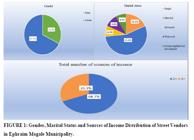
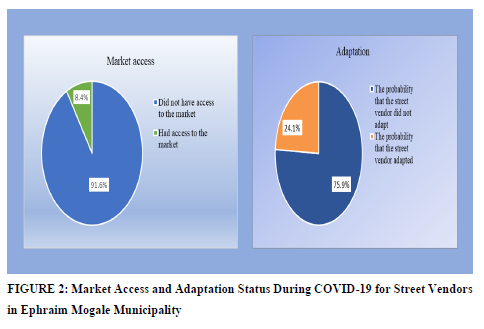
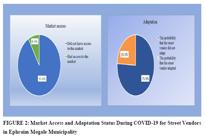
Figure 2 presents an analysis of the COVID-19 pandemic's ramifications on street vendors' market accessibility and adaptive capabilities in Ephraim Mogale Municipality. The data indicate a significant disruption, with 91.6% of vendors experiencing a loss of market access during the pandemic. A mere 8.4% were able to sustain their trading activities. This constraint on access was primarily attributable to mandated lockdowns, mobility restrictions, and the temporary or permanent closure of trading venues, which collectively impeded daily business operations and revenue streams. Consequently, a majority of vendors depended on meagre financial reserves or informal support mechanisms for subsistence, an observation congruent with Sarkar's (2020) findings, which documented that diminished market access often compels vendors to accept reduced prices due to curtailed customer traffic. The figure further shows that a substantial 75.9% of vendors failed to implement any compensatory strategies, while only 24.1% demonstrated the capacity to adjust to the imposed limitations. This inadequate level of adaptation underscores the precarious position of street vendors, whose livelihoods are intrinsically linked to face-to-face interactions and customer foot traffic. These observations are consistent with Toriro and Chirisa (2021), who argue that the street vending sector is particularly susceptible to crises that restrict public mobility, leading to substantial revenue losses and economic volatility.
3.2. Logistic Regression Results
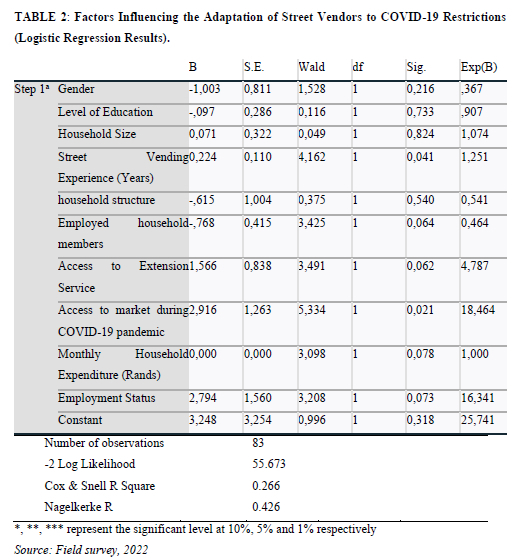
This study investigated the key factors influencing street vendors' adjustment to COVID-19 restrictions in Ephraim Mogale Municipality, Limpopo Province, as detailed in Table 2. A binary logistic regression model was utilised, and the overall model was statistically significant (Omnibus χ2 = 25.703, df = 10, p = 0.004), indicating that the selected predictors collectively influenced the probability of adaptation. The model accounted for between 26.6% (Cox & Snell R2) and 42.6% (Nagelkerke R2) of the variation in adaptive behaviour, reflecting moderate explanatory power (Hosmer et al., 2000). The model achieved convergence after seven iterations, confirming stable parameter estimations.
Consistent with the descriptive trends observed in Figures 1 and 2, the results indicate that street vending experience (p = 0.041; Exp(B) = 1.251) significantly increased the likelihood of adaptation. Vendors with greater experience were 1.25 times more prone to adapt to COVID-19 restrictions than those with less experience. This is in accordance with research by Khuzwayo (2023) and Skinner et al. (2021), who emphasised that vendors with longer engagement in the informal market accumulate valuable business acumen, social capital, and consumer relationships that facilitate resilience during crises. Similarly, Chen et al. (2020) highlighted that informal workers with longer tenure tend to cultivate informal security mechanisms that enable swifter recovery and modification during economic downturns.
Accessibility to markets during the pandemic (p = 0.021; Exp(B) = 18.464) exerted the strongest positive influence on adaptation. Vendors with sustained access were more than 18 times as likely to adapt to COVID-19 restrictions. This finding corroborates Rogan and Skinner (2020) and Mitullah (2021), who documented that spatial and regulatory access to marketplaces was essential for sustaining informal trading activities during lockdowns. As illustrated in Figure 2, vendors that maintained some degree of market accessibility exhibited superior adaptability, underscoring that direct customer contact directly impacted economic resilience and the ability to reorganise business operations under restrictions.
Exposure to extension or support services (p = 0.062; Exp(B) = 4.787), although not statistically significant, also increased the odds of adaptation nearly fivefold. This aligns with Mitullah (2021) and Monitor (2020), who emphasised the importance of support programmes, training, and advisory services in equipping informal traders with health, business, and regulatory knowledge. Similarly, Skinner et al. (2021) and Adepoju (2020) reported that extension services improve informal workers' ability to innovate and adhere to safety measures, thereby fostering business continuity.
Employment status (p = 0.073; Exp(B) = 16.341) was another positive determinant, suggesting that vendors with supplementary or formal income sources were approximately 16 times more likely to adapt. This indicates that diversified livelihoods provide financial safeguards against abrupt income losses. This finding is in agreement with Bhorat et al. (2020) and Alfers and Juergens-Grant (2023), who observed that individuals with multiple revenue streams or supplemental employment were better positioned to maintain informal businesses through cross-subsidisation during crises.
Monthly household expenditure (p = 0.078; Exp(B) = 1.000), while only marginally significant, positively impacted adaptation. Vendors with comparatively higher expenditures were slightly more likely to adjust, reflecting enhanced financial capacity to invest in protective equipment and alternative business practices. This is consistent with Pu et al. (2021) and Aditya and Amri (2023), who found that households with greater economic resilience are better able to navigate income disruptions through strategic spending and resource reallocation.
Interestingly, employed household members (p = 0.064; Exp(B) = 0.464) were negatively correlated with adaptation, implying that vendors with more employed family members were less likely to modify their business strategies. This may stem from a diminished need to adapt when alternative household incomes are available. Similar results were documented by Rogan and Skinner (2020) and Pu et al. (2021), who noted that intra-household income diversification can sometimes reduce individual motivation to adjust entrepreneurially.
Other variables, including gender, educational attainment, household size, and household composition, were statistically insignificant (p > 0.1), suggesting limited impact on adaptation. This is consistent with earlier observations in Figure 1, which showed that while socio-demographic characteristics define engagement patterns, they may not directly govern adaptive behaviour during crises. Overall, the regression results underscore that market accessibility, experience, institutional support, and income diversification are the most crucial drivers of adaptive capacity among street vendors during COVID-19 restrictions, consistent with evidence from regional informal economy studies.
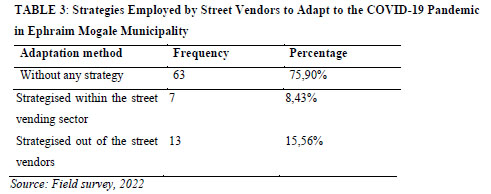
Table 3 indicates that a significant majority (75.90%) of street vendors did not implement any coping mechanisms in response to the pandemic. This observation aligns with prior research demonstrating the profoundly disruptive impact of the pandemic on the economic security of informal workers, especially those engaged in street vending (Rogerson & Rogerson, 2022; Sarkar et al., 2025). A small percentage of vendors (8.43%) employed adaptation strategies within their existing sector, maintaining their businesses by complying with public health regulations, a resilience tactic also documented in studies of the informal sector's response to crises (Megersa, 2020). Furthermore, a portion of the vendors (15.56%) transitioned to other economic endeavours, including home-based enterprises or online commerce, reflecting a wider trend of diversification within the informal sector during the pandemic period (Narula, 2020).
4. CONCLUSIONS
This study examined the determinants of adaptation among street vendors in Ephraim Mogale Municipality, Limpopo Province, towards COVID-19 restrictions. The findings revealed that street vending experience, access to markets during the pandemic, access to extension services, employment status, monthly household expenditure, and the presence of employed household members significantly influenced vendors' ability to adapt.
Experienced vendors and those with uninterrupted market access were more likely to adapt, underscoring the critical role of experience and market access in informal sector resilience. Access to extension services also enhanced adaptation, highlighting the importance of targeted support and information dissemination. Additionally, vendors with alternative income sources or more financially stable households showed greater adaptive capacity, pointing to the value of livelihood diversification in crisis response.
These results emphasise the complex interplay between individual, household, and structural factors in shaping informal workers' responses to unprecedented challenges such as COVID-19. Policymakers and development stakeholders should recognise these determinants when designing interventions to support the informal economy during crises.
5. RECOMMENDATIONS
Ensure Continued Market Access: Authorities should prioritise keeping informal markets operational with appropriate health and safety protocols during pandemics or crises to maintain vendors' livelihoods.
Strengthen Extension and Support Services: Expand and tailor extension services to the informal sector, providing street vendors with timely information on health guidelines, business adaptation strategies, and available government support.
Promote Experience Sharing and Capacity Building: Facilitate peer learning platforms where experienced vendors can share best practices, helping less experienced traders to build resilience and innovate.
Support Livelihood Diversification: Encourage informal workers to diversify income sources through skills training and access to microfinance, reducing vulnerability during economic shocks.
Target Household-Level Interventions: Design support programmes that consider household economic dynamics, recognising that employed household members and expenditure capacity influence adaptive behaviours.
Integrate the Informal Sector into Crisis Planning: Urban planning and public health policies should account for the realities of informal trade, ensuring that restrictions and support measures do not disproportionately disadvantage street vendors.
REFERENCES
- ACHIENG, C.F., 2024. An assessment of enterprise dynamics of women street food vendors in urban informal settlements: The case of Mukuru Kwa Reuben, Nairobi, Kenya. Masters thesis, University of Nairobi.
- ADEPOJU, P., 2020. Nigeria responds to COVID-19; first case detected in sub-Saharan Africa. Nat Med., 26(4): 444-448.
- ADITYA, B. & AMRI, I., 2023. Rethinking informal economy resilience during crisis: Experience from COVID-19 pandemic. Indian J. Labour Econ., 66(3): 711-737.
- ALFERS, L. & JUERGENS-GRANT, F., 2023. Social protection, the COVID-19 crisis, and the informal economy: Lessons from relief for comprehensive social protection. WIDER Working Paper.
- BAMIDELE, F.Y., ABODUNRIN, O.L., IGE, R. & OLADEJO, R.A., 2021. Comparative assessment of young people's psychosocial, economic state and reproductive health needs between total and partial lockdown states of Nigeria. Niger. Health J., 21(2): 87-98.
- BHORAT, H., KÖHLER, T., OOSTHUIZEN, M., STANWIX, B., STEENKAMP, F. & THORNTON, A., 2020. The economics of COVID-19 in South Africa: Early impressions. Development Policy Research Unit, University of Cape Town.
- BHOWMICK, G.D., DHAR, D., NATH, D., GHANGREKAR, M.M., BANERJEE, R., DAS, S. & CHATTERJEE, J., 2020. Coronavirus disease 2019 (COVID-19) outbreak: Some serious consequences with urban and rural water cycle. NPJ Clean Water., 3(1): 32.
- CHAKRABORTY, I. & MAITY, P., 2020. COVID-19 outbreak: Migration, effects on society, global environment and prevention. Sci. Total Environ., 728: 138882.
- CHEN, N., ZHOU, M., DONG, X., QU, J., GONG, F., HAN, Y., QIU, Y., WANG, J., LIU, Y. & WEI, Y., 2020. Epidemiological and clinical characteristics of 99 cases of 2019 novel coronavirus pneumonia in Wuhan, China: A descriptive study. The Lancet., 395(10223): 507-513.
- CRESWELL, J.W., PLANO CLARK, V.L., GUTMANN, M.L. & HANSON, W.E., 2003. Advanced mixed methods research designs. In A. Tashakkori & C. Teddlie (eds.), Sage Handbook of mixed methods in social and behavioral research. Sage Publications, pp. 209-240.
- DARBI, W.P.K., HALL, C.M. & KNOTT, P., 2018. The informal sector: A review and agenda for management research. Int. J. Manag. Rev., 20(2): 301 -324.
-
DIWAKAR, V., 2020. From pandemics to poverty. Hotspots of vulnerability in times of crisis. emerging analysis and ideas. Available from https://odi.org/en/publications/from-pandemics-to-poverty-hotspots-of-vulnerability-in-times-of-crisis/
» https://odi.org/en/publications/from-pandemics-to-poverty-hotspots-of-vulnerability-in-times-of-crisis/ - DUMINY, J., CLELAND, J., HARPHAM, T., MONTGOMERY, M.R., PARNELL, S. & SPEIZER, I.S., 2021. Urban family planning in low-and middle-income countries: A critical scoping review. Front. Glob. Women's Health., 2: 749636.
- DUNFORD, M. & QI, B., 2020. Global reset: COVID-19, systemic rivalry and the global order. Res. Glob., 2: 100021.
- ELKAHWAGY, D.M.A.S., KIRIACOS, C.J. & MANSOUR, M., 2024. Logistic regression and other statistical tools in diagnostic biomarker studies. Clin. Transl. Oncol., 26(9): 2172-2180.
- GHANAD, A., 2023. An overview of quantitative research methods. IJMRA., 6(08): 3794-3803.
- GRANT, S.W., HICKEY, G.L. & HEAD, S.J., 2019. Statistical primer: Multivariable regression considerations and pitfalls. Eur J Cardiothorac Surg., 55(2): 179-185.
- GUAN, W.J., NI, Z.Y., HU, Y., LIANG, W.H., OU, C.Q., HE, J.X., LIU, L., SHAN, H., LEI, C. L. & HUI, D.S., 2020. Clinical characteristics of coronavirus disease 2019 in China. N Engl J Med., 352(18): 1708-1720.
- HARRIS, J.K., 2021. Primer on binary logistic regression. Fam. Med. Community Health., 9(Suppl 1): e001290.
- HOSMER, D.W., LEMESHOW, S. & STURDIVANT, R.X., 2000. Applied logistic regression. New York: Wiley.
- KHUZWAYO, F., 2023. A qualitative analysis of the informal social networks of street traders in the Pretoria Central Business District, South Africa. University of Pretoria.
- KWIATKOWSKI, G., HJALAGER, A.M., OSSOWSKA, L., JANISZEWSKA, D. & KURDYS-KUJAWSKA, A., 2024. The entrepreneurial orientation of exhibitors and vendors at food festivals. J. Policy Res. Tour. Leis. Events., 16(2): 207-226.
- LANGRY, F. & RENA, R., 2023. Socioeconomic implications of the COVID-19 Pandemic and its impact on the South African informal economy. Afr. J. Inter-Multidiscip. Stud., 5(1): 1 -12.
- MAHOPO, T.C., NESAMVUNI, C.N., NESAMVUNI, A.E., DE BRYUN, M., VAN NIEKERK, J. & AMBIKAPATHI, R., 2022. Operational characteristics of women street food vendors in rural South Africa. Front. Public Health., 10: 849059.
- MARTIN, R. & SUNLEY, P., 2020. Regional economic resilience: Evolution and evaluation. In G. Bristow & A. Healy (eds.), Handbook on regional economic resilience. Edward Elgar Publishing, pp. 10-35.
-
MEGERSA, K., 2020. The informal sector and COVID-19. Available from https://opendocs.ids.ac.uk/articles/report/The_Informal_Sector_and_COVID-19/26428138
» https://opendocs.ids.ac.uk/articles/report/The_Informal_Sector_and_COVID-19/26428138 - MITULLAH, W., 2021. Construction workers in Kenya: Straddling with formal and informal social protection models. In L. Riisgaard, W.V. Mitullah & N. Torm (eds.), Social Protection and Informal Workers in Sub-Saharan Africa. Routledge, pp. 197-219.
- MONITOR, I., 2020. COVID-19 and the world of work. Updated estimates and analysis, 27.
- MUNICIPALITY., 2019. Limpopo province. South Africa.
- NARULA, R., 2020. Policy opportunities and challenges from the COVID-19 pandemic for economies with large informal sectors. J. Int. Bus. Policy., 3(3): 302-310.
- PEIMANI, N. & KAMALIPOUR, H., 2022. Informal street vending: A systematic review. Land., 11(6): 829.
- PINEDA DUQUE, J.A. & CASTIBLANCO MORENO, S.E., 2022. Informal entrepreneurship and women's empowerment-the case of street vendors in urban Colombia. Int. J. Gend. Entrep., 14(2): 188-212.
- PU, G., QAMRUZZAMAN, M., MEHTA, A.M., NAQVI, F.N. & KARIM, S., 2021. Innovative finance, technological adaptation and SMEs sustainability: The mediating role of government support during COVID-19 pandemic. Sustain., 13(16): 9218.
- RINGSON, J. & RANIGA, T., 2022. The implications of COVID-19 on informal trading in Gauteng, South Africa. Afr. J. Gov. Dev., 11(1.2): 307-327.
- ROGAN, M. & SKINNER, C., 2020. The COVID-19 crisis and the South African informal economy. Locked out'of livelihoods and employment. National Income Dynamics Study-Coronavirus Rapid Mobile Survey (NIDS-CRAM).
- ROGERSON, C.M. & ROGERSON, J.M., 2022. The first round impacts of COVID-19 for rural tourism in South Africa. Studia Periegetica., 37: 63-86.
- SARKAR, A., 2020. Informal water vendors and the urban poor: Evidence from a Nairobi slum. Water Int., 45(5): 443-457.
- SARKAR, O.T., HASAN, M.A. & SAHA, S.K., 2025. Resilience in the informal economy amidst the COVID-19 crisis: The experience of street vendors in Dhaka, Bangladesh. Urban Plan. Transp. Res., 13(1): 2502001.
- SARKER, M.N.I., RAHMAN, M.Z., CAO, Q. & XU, Z., 2019. Impact of small entrepreneurship on poverty alleviation and sustainable livelihood of street vendors. Int. J. Innov. Appl. Stud., 25(4): 1241-1254.
- SKINNER, A.T., GODWIN, J., ALAMPAY, L.P., LANSFORD, J.E., BACCHINI, D., BORNSTEIN, M.H., DEATER-DECKARD, K., DI GIUNTA, L., DODGE, K.A. & GURDAL, S., 2021. Parent-adolescent relationship quality as a moderator of links between COVID-19 disruption and reported changes in mothers' and young adults' adjustment in five countries. Dev. Psychol., 57(10): 1648.
- SULTANA, N., RAHMAN, M.M. & KHANAM, R., 2022. Informal sector employment and economic growth: Evidence from developing countries in SDG perspective. Sustain., 14(19): 11989.
- MAHOPO, T.C., NESAMVUNI, C.N., NESAMVUNI, E., DE BRUYN, M. & VAN NIEKERK, J.A., 2022. Socioeconomic characteristic of street food vending enterprises in the Vhembe district, Limpopo province. Technium Soc. Sci. J., 29: 419-437.
- THOBEJANE, M.J., 2019. An Assessment of the role of the Local Structures in Development in the Sekhukhune District Municipality of the Limpopo Province. University of South Africa.
- THULARE, M.H. & MOYO, I., 2021. COVID-19 and street traders in the City of uMhlathuze, KwaZulu-Natal, South Africa: On responses and adaptation mechanisms. Cogent Soc. Sci., 7(1): 2006392.
- TOKER, İ., TOKER, A.K., ÖZDEMIR, A.T., ÇELIK, İ., BOL, O. & BÜLBÜL, E., 2022. Vaccination status among patients with the need for emergency hospitalizations related to COVID-19. Am. J. Emerg. Med., 54: 102-106.
- TORIRO, P., & CHIRISA, I. (2021). Vendors on wheels! The changing terrain and manifestation of informality in Harare under Covid-19 pandemic restrictions. Cogent Soc. Sci., 7(1): 1939230.