An Analysis of the Maize Marketing Structure and Its Effects on the Marketing Performance in Zimbabwe: A Case of the Mazowe District
Abstract
The study ascertains the maize marketing structure and its effects on the marketing performance in Zimbabwe. The Structure Conduct Performance model was used as the primary tool of analysis. The results indicated that there were too few buyers in the maize grain market to attain a competitive market. The maize grain trade is concentrated, and a few traders control it. The Herfindahl-Hirschman Index was 0.203, implying a concentrated maize market. The local market channel had a Marketing Efficiency Index of 3.733, compared to 2.322 for the GMB. While both indices were low, the GMB channel was the least efficient compared to the literature standard. The late payment by the GMB has short-circuited the ability of smallholder farmers to generate a cash flow with which to fund their farming and other non-farming activities. The study recommends reducing the number of intermediaries to lessen their influence in the marketing channels and provide more shares to farmers. There is a need to optimise GMB's logistical operations and ensure timely payments to significantly contribute to improving market efficiency, reducing losses, and strengthening the resilience of Zimbabwe's food systems.
Herfindahl-Hirschman Index; Gini Coefficient; Marketing; Efficiency
1. INTRODUCTION
Agriculture plays an important role in the Zimbabwean economy. It contributes 15-18% of the country's Gross Domestic Product (GDP), 40% of its export earnings and 60% of its industrial raw materials (Mutambara, 2016). More than 75% of the population depends on agriculture as producers and employees for their livelihood. The sector is dominated by smallholder farmers, who play a critical role in food and nutrition security by accounting for the bulk of the country's food production. Despite the potential to derive their livelihood from market-oriented agriculture, smallholder farmers often face several obstacles in accessing both input and output markets; these include higher transactional costs, an inefficient information flow, a lack of credit and inadequate access to extension (Mango et al., 2018; Ayele et al., 2017; Thangarasu et al., 2021). Zimbabwean smallholder farmers typically operate on small plots, rely on family labour, and focus on subsistence farming with limited access to resources, markets, and technology. Smallholder farmers differ from commercial farmers by their smaller landholdings, lower productivity, focus on household food security rather than large-scale production and lower market participation. Another potential challenge that can limit the market participation of smallholder farmers relates to how the markets are structured (Demissie et al., 2015). Market structure refers to the characteristics of a market (such as the degree of concentration, the extent of product differentiation, the ability to negotiate and the barriers to entry) that influence the specific action that producers can take to improve their market performance with respect to profitability or efficiency.
This paper adopts a Structure-Conduct-Performance (SCP) approach to ascertain the maize marketing structure in Zimbabwe and its effects on marketing performance. The SCP is defined as the relationship between the market structure and the conduct and performance of the market players. It postulates that the market structure determines behaviour and influences the sector's performance. This paradigm describes how the observable characteristics of a market, or an industry, could affect the behaviour and performance of the market's participants, which, in this case, are the smallholder maize farmers in Zimbabwe. For example, the existence of entry barriers is considered to be a major determinant of the efficiency of the market, since the greater cost of entry makes it easier for existing producers to maintain a monopoly over the profits by charging prices that are above the market-clearing prices (Tung et al., 2010).
The current study builds on the research in previous studies by delving into how the identified aspects of market structure impact the overall performance within the maize sector in Zimbabwe. By examining these connections, this research aims to contribute insights that extend and refine the understanding of how specific elements in the maize marketing structure influence the overall effectiveness and outcome of the maize marketing process of smallholder farmers. This article fills a critical gap in knowledge by providing an in-depth analysis of the maize marketing structure in Zimbabwe, specifically focusing on its effects on marketing performance in the Mazowe District. While literature on Zimbabwe's agricultural sector often highlights challenges such as price volatility, government interventions, and market inefficiencies, there has been limited empirical research that systematically examines the structure of maize markets and how it impacts trader performance locally.
Zimbabwe's maize market has historically been shaped by policy shifts, from state-controlled marketing under the Grain Marketing Board (GMB) to liberalisation efforts that introduced private sector participation. However, market concentration, unequal access to trading opportunities, and income disparities among traders remain largely understudied. By employing the Gini coefficient and Lorenz curve, this study provides a comprehensive assessment of market concentration and income distribution among maize traders in Mazowe District, offering insights that extend beyond national-level analyses to the realities traders face on the ground.
This localised approach is significant because Mazowe District, a key maize-producing region, presents a microcosm of broader national market dynamics. Understanding how the marketing structure influences performance at this level can inform policy decisions to improve efficiency, equity, and competitiveness in Zimbabwe's maize sector. Thus, this article contributes to academic and policy discussions by bridging the gap between macro-level market analysis and the practical challenges maize traders face in the Mazowe district.
In this context, an attempt was made to ascertain the structure, conduct and performance of the maize market, to help frame the policies for the development of an efficient maize market in Zimbabwe, since access to an efficient market is considered to be an essential tool for lifting farmers out of poverty and enhancing their food security.
2. STUDY AREA
This study used cross-sectional household-level data on smallholder maize farmers and maize traders in Zimbabwe. Given the significance of the maize sector in its economy, Zimbabwe provides an interesting case study for maize marketing research. Maize is considered a strategic commodity in the economy, as it is a food security crop and a raw material for the agro-processing industry. The study was conducted in the Mashonaland Central Province, in Natural Region II of Zimbabwe. Natural Region II covers the greater parts of the Mashonaland provinces, where production and productivity are relatively higher than in the other regions. Natural Region II has a rainfall that ranges between 750 mm and 1 000 mm per year, and it includes a significant proportion of the three Mashonaland provinces, at 58 600 km2, or 15% of Zimbabwe's land area (Musemwa et al., 2013). The region is appropriate for intensive farming, typically maize, tobacco, cotton and livestock.
3. SAMPLING AND DATA COLLECTION PROCEDURES
A multi-stage sampling procedure was adopted. Firstly, the province was purposively sampled because it is the second-highest producer of maize in the country (ZIMVAC, 2020; Ministry of Agriculture, 2021). Secondly, the study district was purposively sampled because of the large number of smallholder maize farmers. Thirdly, a sample of smallholder farmers was randomly selected from the district. Random selection of smallholder maize farmers was done because it ensures a representative, unbiased sample, enhancing the validity and reliability of survey results. The random selection approach supports resource-efficient data collection and provides accurate policy and intervention design insights.
A formula developed by Slovin (1960) was used to calculate the sample size requirement for the study. The total number of smallholder communal farmers in the selected district was 8 763. Slovin's computations revealed that the sample size must be 382 smallholder farmers

4. MEASURING THE MARKET STRUCTURE
The Structure-Conduct-Performance (SCP) framework was selected for its ability to analyse the relationship between market structure, participant behaviour, and performance outcomes. The Structure-Conduct-Performance (SCP) framework offers comprehensive insights into market dynamics, identifies efficiency barriers, and informs policies to improve farmer livelihoods. Its adaptability to agricultural contexts was ideal for evaluating smallholder farmers' commercialisation and market participation. In this study, the marketing structure of the maize sector was evaluated, based on the market concentration exercised by maize traders and the barriers to entry of potential traders to the market. The study used the Gini coefficient and the Lorenz curve (a graphical representation of the market share distribution) to measure the market concentration of maize. The combined use of the Gini coefficient and the Lorenz curve in the study provides a comprehensive and complementary approach to analysing income distribution and market concentration among maize traders. The Lorenz curve visually represents the extent of inequality by plotting the cumulative share of income or market sales against the cumulative share of traders, offering a clear picture of how trade opportunities and earnings are distributed.
Meanwhile, the Gini coefficient quantifies this inequality into a single numerical value, allowing for precise comparisons across different trader groups or regions. By utilising both methods, the study effectively captures the level of market concentration and the disparities among maize traders, ensuring a more nuanced understanding of the competitive landscape and income distribution within the sector. The Lorenz curve was used to show the quantitative relationship between the cumulative numbers of maize traders and the cumulative volume of maize sold in the markets. To compute the cumulative number, the volume of maize sold was arranged from the highest to the lowest. The Gini coefficient, or concentration ratio, was derived from the Lorenz curve, and the inequality in the sales distribution amongst the different trader groups was measured.
The Gini coefficient ranges from 0 to 1, with zero indicating perfect equality in the size and distribution of buyers and sellers, and one (1) implying a monopsony/monopoly in the market. A Gini coefficient of 1 means complete inequality.

where G represents the Gini coefficient
X = marketing agents
Y = volume of trade
δΧ = cumulated proportion of marketing agents
δΥ = cumulated proportion of volume of trade
n = number of observations
k = n-1
5. ANALYSIS OF MARKET CONCENTRATION
The concentration index that was used to measure the market concentration was the Herfindahl-Hirschman Index (HHI). It is the weight index of the market share, with the weights being the shares themselves, which attain the value of unity, in the case of a monopoly, and which approach zero, as the number of functionaries with the identical share increases (Thangarasu et al., 2021).

where si represents the market share of trader i.
6. PREFERRED MAIZE MARKETS
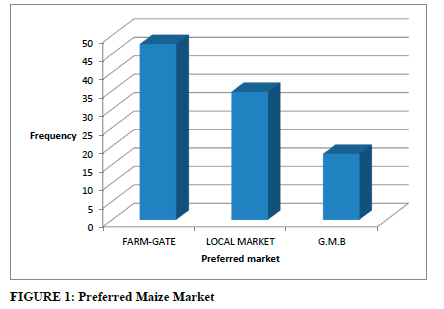
Smallholder farmers in the Mazowe District have three basic decisions to make, regarding the sale of their surplus maize: they can either sell it at the farm gate at a low price, or travel to the local market, where higher prices are offered but some transaction costs are incurred, or selling to the GMB, which offers better prices, but with delayed payment that can take several months. Figure 1 shows the maize markets preferred by smallholder farmers in the Mazowe District.
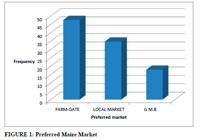
It can be noted in Figure 1 that the popular marketing channel for the smallholder farmers was the farm gate (47.43%), followed by the local market (34.69%). In comparison, the GMB (17.89%) was the least-popular marketing channel amongst the smallholder farmers. These findings concur with those of Osmani and Hossain (2016), Mmbando et al. (2017), Olutonis et al. (2019), Arinloye et al. (2020) and Thangarasu et al. (2021), who noted that the marketing channel preferred by most smallholder farmers was selling their produce at the farm gate. Farmers like to sell at the farm gate because they receive their payments exclusively in US dollars, providing immediate access to a stable currency amid inflation and the volatile economic environment the country has experienced over the past decade. Although the price offered is often not competitive, namely US$240 per ton for the farm gate, compared to US$360 per ton that the GMB offers, the farmers opt for this because of the lack of storage facilities and the low transaction costs incurred when selling at the farm gate. Kim et al. (2014) and Lee et al. (2019) also noted that traditional marketing channels, such as the farm gate, are attractive to farmers because they offer low marketing costs and higher sales, despite the lower prices. The results also concur with the findings of Mgale and Yunxian (2020), who noted that most rural farmers still sell their produce to local collectors because of their fear, or inability, to venture out of the farm gate into the more lucrative markets.
7. MAIZE MARKET STRUCTURE
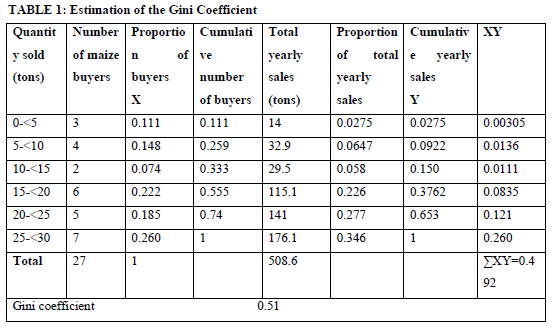
This study used the Lorenz curve and Gini coefficient to determine the grain maize market concentration. A high concentration and inequality indicate an oligopolistic tendency (i.e. a market that is dominated by only a few sellers). In contrast, a low concentration suggests a tendency towards perfect competition (i.e. a market with many buyers and sellers who compete freely), provided that there are no serious barriers to entry into the maize grain market. Oligopolistic behaviour increases as the coefficient approaches 1, while the market becomes most competitive as the Gini coefficient tends to 0. Table 1 shows the results of the Gini coefficient.
Table 1 shows that the randomly selected five wards had 27 maize grain traders. This small number of traders in the study area was attributed to the government's control of maize marketing in Zimbabwe. The traders noted that financial barriers and the lack of adequate space are some of the barriers to market entry. While maize is a controlled commodity, most farmers in the study area prefer to sell to private grain traders, who make fast and efficient payments. The analysis of the number of sellers and buyers in the maize grain market showed only a few maize grain traders. This finding is supported by a Gini coefficient of 0.51 for maize grain, which is shown in Table 1. According to the literature (Tiku et al., 2012; Thangarasu et al., 2021; Ordofa et al., 2021; Thangarasu et al., 2021), a Gini coefficient of 0.51 indicates an oligopsony market structure. The results show that the maize grain trade is highly concentrated and only a few traders control it. These few traders can influence the price of maize on the local market and tend to collude with the prices offered to the smallholder farmers. This was also highlighted by Shonhe (2021) and Chipenda (2023), who noted that the few traders in the market often collude in price setting. This scenario usually leads to price manipulation and collusion, disadvantaging smallholder maize farmers who lack alternative buyers and bargaining power. Studies have shown that traders coordinate pricing strategies to minimise competition and maximise profits, further exacerbating income inequalities among smallholder farmers.
The maize grain traders mentioned that a lack of proper storage facilities and financial capital are the main barriers to entry into the maize grain market. The findings concur with those of Tiku et al. (2012), who found a Gini coefficient of 0.65 and 0.54 for merchants and processors, respectively, which indicated an oligopolistic market structure among the palm oil marketers in Nigeria. The findings are also in agreement with those of Ordofa et al. (2021), who noted a highly concentrated market for the dairy industry in Ethiopia, while Haruna et al. (2012) also identified a highly concentrated tomato market in Ghana, with concentration ratios of 0.58 and 0.64 for wholesalers and retailers, respectively.
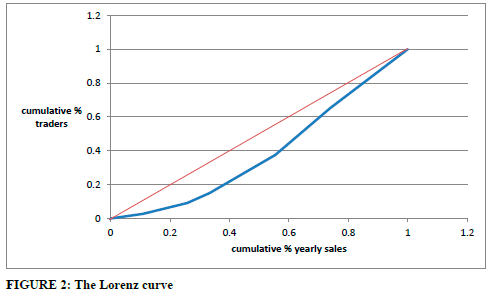
The Lorenz curve was drawn, based on the percentage distribution table of the cumulative traders and the cumulative volume of maize traded (see Figure 2).
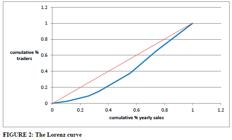
The Lorenz curve, an important tool for the measurement of inequality, relates the cumulative proportion of the volume of maize traded to the cumulative proportion of traders. In this study, the Lorenz curve shows the quantitative relationship between the cumulative number of maize traders and the cumulative volume of maize sold in the markets. It can be noted from Figure 2 that the distribution curve of the volume of maize traded is far from the line of equality, which indicates the prevalence of inequality in the volume of trade. It can be noted from Figure 2 that 40% of the traders account for 60% of the total maize grain traded in the market. In comparison, 20% of the traders account for 40% of the cumulative yearly maize sales, indicating the maize market's oligopolistic nature in the Mazowe District.
The Herfindahl-Hirschman Index for the district was 0.203, which shows a concentrated market. The research findings show that the maize market in the study district is highly concentrated and that only a few traders dominate the maize market. The dominance of only a few buyers in the district implies that there is low competition among the traders, which concurs with the findings of Haruna et al. (2012) and Nzima et al. (2014), who noted that there was a higher market concentration and inefficiency in the agricultural market.
8. MARKETING EFFICIENCY
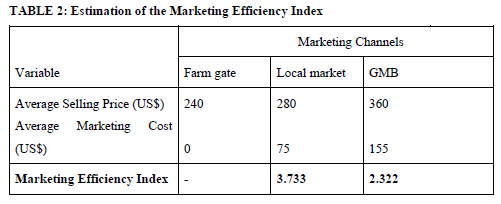
Marketing efficiency is related to the cost of moving goods from the producer to the ultimate consumer and the quantity of services offered. Improved marketing efficiency means a reduced marketing cost, without reducing the quantum of services to the consumer. The results of the selling price, marketing cost and marketing efficiency of maize channels used in the Mazowe District are shown in Table 2.
The marketing costs at the farm gate were nil, because the farmers sold at their farms and they did not incur any transaction costs associated with moving the products to the market. The average farm-gate selling price was $240, which was very low compared to the officially gazetted price of $360. However, most farmers prefer it since the payment method is faster than the local market and the GMB. This leads to the producers selling their maize to private buyers who pay them very little but incur lower transport costs than selling to the GMB. Zimbabwean maize grain producers are exposed to a volatile market; they face great uncertainty and risks, about their grain prices, on the one hand, and their input costs, on the other hand.
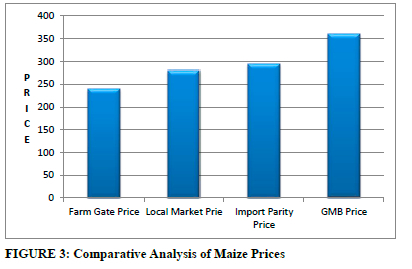
The producer price of maize at the local market was noted to be higher than that at the farm gate; the average price was US$280. The government has announced prices that are equivalent to the import parity price of maize, or even more, but the private traders pay prices below the import parity price, as shown in Figure 3.
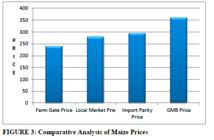
A large proportion of smallholder farmers prefer the local market because the payment method is relatively fast and they can also transport their maize by using their traditional modes of transport. Traditional modes of transport, such as animal-drawn carts, head-loading, bicycles, and pushcarts, are commonly used in rural areas to move goods and people due to their affordability and adaptability to local conditions. While these methods are critical for smallholder farmers with limited infrastructure, they are often inefficient, labour-intensive, and unsuitable for long distances or heavy loads. The maize producer price at the GMB was US$360, which was higher than the average farm-gate price, the import parity price and the local market, as shown in Figure 3. The transactional cost for the marketing channel was very high, at $155. The higher transactional costs were due to the distance to the GMB, the poor road infrastructure and the fact that some farmers had their produce returned to them because it failed to meet the required moisture content level, and a higher batch of deliveries was not accepted because of the higher moisture content.
9. CONCLUSION AND POLICY RECOMMENDATIONS
This study revealed that the existing marketing channels that the smallholder maize grain producers were using were the farm gate, the local market and the Grain Marketing Board. The market structure for maize grain was found to be highly concentrated, and only very few traders controlled it. The Herfindahl-Hirschman Index for the Mazowe District was 0.203, which shows a highly concentrated market. Therefore, this research's findings suggest that the district's maize grain market is oligopolistic, with only a few traders in the district determining the price of maize. The study found that the local market was the most efficient market, with most farmers indicating that the late payments, poor road infrastructure, and the level of bureaucracy experienced at the GMB negatively affected its marketing efficiency.
A transportation and marketing information system should be developed, as it would contribute greatly towards reducing transportation costs and increasing the overall efficiency of the maize marketing system. The number of intermediaries should be reduced, but not all eliminated, to lessen their influence in the marketing channels and to provide more shares to farmers by developing a system of direct selling from the farmers to the consumers in the Mazowe District. It may also help to increase the efficiency of maize marketing.
Farmers should organise themselves into a body that can conduct group marketing. As an organised body, they would acquire a better bargaining power for their products over the middlemen, who manipulate and control the price of maize in the marketing system.
The National Development Strategy 1 (NDS1) emphasises agricultural productivity, rural livelihoods, and food security as key pillars of economic development. The article's findings on the inefficiencies of the Grain Marketing Board (GMB) and the challenges smallholder farmers face in accessing inputs and markets directly align with NDS1's objectives. There is a need to streamline input distribution systems, improve market access, and enhance transparency in GMB operations to support NDS1's vision of modernising agriculture and fostering inclusive growth.
REFERENCES
- ARINLOYE, D.D.A.A., PASCUCCI, G., LINNEMANN, S., COULIBALY, O., HAGELAAR, A.R. & OMTA, O.S.F.W., 2014. Marketing channel selection by smallholder farmers. J. Food Prod. Mark., 21(4): 337-357.
- AYELE, S., ZEMEDU, L. & GEBREMDHIN, D., 2017. Analysis of market structure, conduct and performance of beef cattle: The case of the Dugda District, East Shoa Zone, Oromia Regional State, Ethiopia. J. Biol. Agric. Healthcare., 7(5): 5-11.
- DEMISSIE, B., HUSSIEN, H.K. & KEDIR, A., 2015. Structure, conduct and performance of marketing chains: The case of milk marketing among pastoralists and agro-pastoralists of Eastern Ethiopia. Glob. J. Agric. Ext. Rural Dev., 3(3): 206-213.
-
FOOD AND AGRICULTURAL ORGANISATION (FAO)., 1997. Agricultural and Food Marketing Management. Available from https://www.fao.org/4/w3240e/w3240e00.htm
» https://www.fao.org/4/w3240e/w3240e00.htm - GIROH, D.Y., UMAR, H.Y. & YAKUB, W., 2010. Structure, conduct and performance of farm-gate marketing of natural rubber in the Edo and Delta States, Nigeria. Afr. J. Agric. Res., 5(14): 1780-1783.
- HARUNA, I., NKEGBE, P. & USTARZ, Y., 2012. Structure, conduct and performance of tomato marketing in Ghana. J. Econ. Sustain. Dev., 10(3): 2222-2855.
- KIM, M., CURTIS, K. & YEAGER. I., 2014. An assessment of market strategies for small-scale produce growers. Int. FoodAgribus. Manag. Rev., 17(3): 187-204.
- LEE, B., LIU, J.Y. & CHANG, H.H., 2019. The choice of marketing channel and farm profitability: Empirical evidence from smallholder farmers. Agribusiness Wiley., 36: 402-421.
- MANGO, N., MAPEMBA, L., TCHALE, H., MAKATE, C., DUNJANA, N. & LUNDY, M., 2018. Maize value chain analysis: A case of smallholder maize production and marketing in selected areas of Malawi and Mozambique. Cogent Bus. Manag., 5(1): 1503220.
- MGALE, Y.J. & YUNXIAN Y., 2020. Marketing efficiency and determinants of marketing channel choice by rice farmers in rural Tanzania: Evidence from the Mbeya Region, Tanzania. Aust. J. Agric. Resour. Econ., 64: 1239-1259.
- MMBANDO, F.E., WALE, E.Z. & BAIYEGUNHI, L., 2017. The welfare impacts of market channel by smallholder farmers in Tanzania. Dev. Pract., 27(7): 981-993.
- MMBANDO, F.E., WALE, E.Z. & BAIYEGUNHI, L.J., 2015. Determinants of smallholder farmers participation in maize and pigeon pea markets in Tanzania. Agrekon., 54: 96-119.
- MUSEMWA, L., MUSHUNJE, A., MUCHENJE, V., AGHDASI, F. & ZHOU, L., 2013. Efficiency of resettled farmers in the Mashonaland Central Province of Zimbabwe in Crop Production. Afr. J. Agric. Res., 8(22): 2722-2729.
- MUTAMBARA, J., JIRI, O. & MAKIWA, E., 2016. Agricultural training post land reform in Zimbabwe: Implications and issues. Online J. Afr. Affairs., 2(2): 38-45.
- NZIMA, W.M., DZANJA, J. & KAMWANA, B., 2014. Structure, conduct and performance of the groundnut markets in Northern and Central Malawi: Case studies of the Mzimba and Kasungu Districts. Int. J. Bus. Soc. Sci., 5(6): 130-139.
- NZIMA, W.M. & DZANJA, J., 2015. Efficiency of soybean markets in Malawi: Structure, conduct and performance approach. Int. J. Bus. Soc. Sci., 6(4): 162-170.
- NYIATAGHER, Z.T. & OCHOLI, A., 2015. Profitability and marketing efficiency of maize in Kwande Local Government Area of Benue State, Nigeria. J. Agribus. Rural Dev., 38(4): 803-810.
- ORDOFA, G., ZEMEDU, L. & TEGEGNE, B., 2021. Structure conduct and performance of dairy market in the Ada'a Berga district, Ethiopia. Cogent Bus. Manag., 7(1): 1918878.
- OSMANI, A. & HOSSAIN, E., 2016. Smallholder farmers' market orientation and the factors affecting it in Bangladesh. Econ. Insights-Trends and Challenges., 5: 9-18.
- THANGARASU, S., SENTHILKUMAR, G., SELVAM, S., SUDEEP KUMAR, N.K. & SERMA SARA VANA PANDIAN, A., 2021. Structure, conduct and performance of live animal markets of small ruminants in South India, Acta Agriculturae Scandinavica. Animal Sci., 70: 161-172.
- TIKU, N.E., OLUKOSI, J.O., OMOLEHIN, R.A. & ONIAH, M.O., 2012. The structure, conduct and performance of palm oil marketing in Cross River State, Nigeria. J. Agric. Ext. Rural Dev., 4(20): 569-573.
- TUNG, G., LIN, C. & WANG, C., 2010. The market structure, conduct and performance paradigm re-applied to the international tourist hotel industry. Afr. J. Bus. Manage., 4(6): 1116-1119.
- ZIMBABWE NATIONAL STATISTICAL AGENCY (ZIM STATS)., 2012. Zimbabwe Population Census 2012. Harare.
- ZIMBABWE VULNERABILITY ASSESSMENT COMMITTEE, 2020. National Livelihoods and Nutrition Assessment Report. Harare.