How Effective is the Agricultural Advisory Service Rendered to Land Reform Beneficiaries in South Africa?
Abstract
Agricultural advisory services play a crucial role in enhancing agricultural productivity, ensuring food security, and promoting rural development. Monitoring agricultural advisory services is crucial for enhancing the quality of services provided to farmers, particularly in light of the limitations in delivering agricultural extension services. This article employs descriptive analysis to focus on the agricultural advisory services provided to land reform farms acquired under the Proactive Land Acquisition Strategy (PLAS). The authors draw from an extensive survey consisting of 1,956 PLAS farms conducted in 2018 through face-to-face questionnaire interviews with beneficiary farmers. The inquiry involves a comparison of farm performance between farms that had access to extension service and those that did not receive it. This article examines the effectiveness of these advisory services for beneficiaries of land reform in South Africa. The article examines the role and state of public agricultural advisory services, as well as the factors contributing to their poor performance, drawing on relevant secondary public data and literature. Results show a slight difference between farmers who had access to an agricultural advisory service and those who did not. This indicates a need to enhance agricultural advisory services. Secondly, the article recommends potential solutions to the limited agricultural advisory services, which entail incorporating digital technologies.
Agricultural Extension; Land Reform; Effectiveness; Service Delivery
1. INTRODUCTION
Agricultural advisory services, also known as agricultural extension, play a crucial role in enhancing agricultural productivity, ensuring food security, and promoting rural development. According to Anderson (2008, p. 6), the terms agricultural advisory services and agricultural extension "refer to the entire set of organisations that support and facilitate people engaged in agricultural production to solve problems and to obtain information, skills and technologies to improve their livelihoods". It is expected that through the advisory services farmers use, they will be equipped to improve their agricultural production, which in turn should increase their incomes and welfare.
In South Africa, agricultural advisory service to the majority of smallholders is rendered mainly through the state in the form of the training and visit (T&V) model (Lukhalo, 2017). Most rural smallholders rely on these services to acquire knowledge about new farming technologies. However, many authors have contested the effectiveness of these, and their shortcomings have been admitted by the government itself (DAFF 2014; Maake & Antwi, 2022). This study specifically investigates advisory services rendered to land reform beneficiaries, who now manage commercial farms previously owned by white farmers.
Existing studies have established that in the Eastern Cape and KwaZulu-Natal, 67% of land reform beneficiaries had access to the public agricultural extension service. However, farmers are not content with these public services, as they are willing to pay R618 per month for private agricultural extension services (Loki et al., 2019). This study examined farmers' willingness to pay for extension services aimed at enhancing farm returns in the Eastern Cape and KwaZulu-Natal provinces of South Africa.
Loki et al. (2019) found that younger farmers are more willing to pay for extension services and favour the privatisation of extension services. This speaks to a lack of satisfaction with current extension services. It is therefore necessary, and in the public interest, to assess how the country's extension services are performing, especially since the commercial agricultural sector remains responsible for 90% of South Africa's agricultural output and 10% of employment (Sihlobo, 2023). To achieve a more equitable and productive agricultural sector, extension services to smallholders and new entrants must be improved.
Moreover, Chapter six of the National Development Plan states that to make land reform work, there is a need to 'ensure sustainable production on transferred land by making sure that human capabilities of beneficiaries precede land transfer through incubators, learnerships, apprenticeships, mentoring and accelerated training in agricultural sciences' (NPC, 2011, p. 206).
Therefore, in this commentary article, we aim to shed light on this issue by examining the current state of agricultural advisory services on land reform farms and the extent to which these services are rendered effectively. We then probe and discuss the underlying factors as well as what could be done to improve the service.
2. DATA AND APPROACH
This study utilises secondary data from a 2018 survey of 1,956 land reform farms acquired under PLAS, as well as related literature. PLAS is the current modality of acquiring land for the land redistribution component of the land reform policy adopted in 2006.
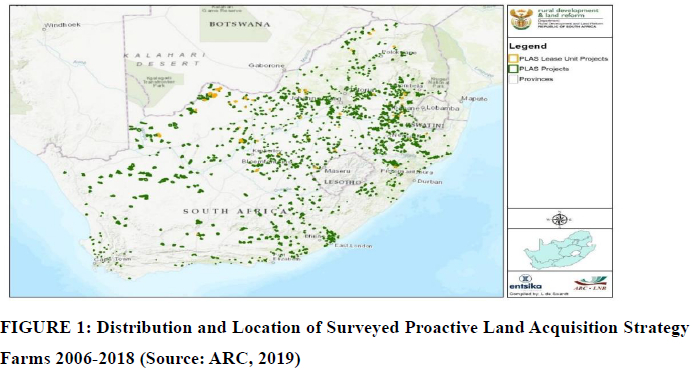
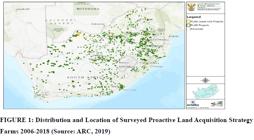
The survey included face-to-face interviews using a standard questionnaire with the main beneficiary, which was conducted by trained enumerators in the local languages and on the specific farm. The GPS coordinates and observations on the farm itself (for example, on infrastructure) were documented. The distribution of these farms across the South African provinces is illustrated in Figure 1.
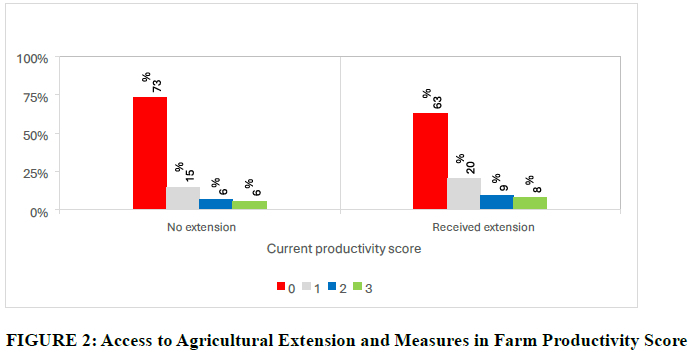
To assess the effectiveness of the agricultural advisory service, we compared the outcomes of farmers who received agricultural advisory services with those who did not within our sample. This was compared against farm performance or partial productivity using production scales. The production scales were calculated based on the farmers' resource potential compared to what was actually produced on the farm. The scoring was conducted by a trans-disciplinary panel of experts, including agricultural economists, rangeland scientists, agronomists, animal scientists, natural resource scientists, and agricultural engineers, all of whom had extensive working experience in the sector. Farms were scored, using a simple system where a score of 0 meant that a farm is non-viable, and that no substantive livelihood can be generated; a score of 1 meant that there was some level of production possible to supplement other income generating activities, a score of 2 meant a farm had sufficient resources to support surplus production; whilst a score of 3, denotes a commercially viable farm, having sufficient, good quality natural resources able to support commercial enterprises.
3. OVERVIEW OF THE ROLE OF AGRICULTURAL ADVISORY SERVICES AND ITS STATE IN SOUTH AFRICA
3.1. Role of Extension
Apart from the "classical" objective of agricultural advisory services to improve agricultural productivity, advisory services are also envisioned to play a role in addressing other agricultural and rural socioeconomic issues. For instance, changes in the global food and agricultural system, growth in non-farm rural employment and agribusiness, constraints imposed by HIV/AIDS, the deterioration of the natural resource base and the emerging need to cope with climate change are subjects that extension services also deal with from time to time (Anderson, 2008).
Furthermore, extension also plays an important role in helping the research establishment tailor technology to the social and agroecological realities of farmers. Extension thus has a dual function in both shortening the distance between scientists and farmers and enhancing communication between them. Extension also plays a key role in facilitating the adoption of technology and its adaptation to local conditions. This is said to be achieved in two ways. Firstly, it will translate information from existing literature and innovations into a format that farmers understand, and secondly, it will help articulate the problems and constraints that farmers face to the research system (Anderson, 2008). The ultimate goal is to help farmers overcome limitations in their enterprises and enhance their decision-making. However, the extent to which this becomes a reality depends on the quality and structure of the advisory service.
3.2. State of Extension in South African Agriculture
To strengthen agricultural advisory services, a set of policy frameworks guides how services should be provided to clients, i.e., norms and standards for agricultural advisory services in South Africa. These guide the provision of services and are based on the following principles: being demand-driven, promotion of equity, flexibility to changing needs, monitoring and evaluation, being participatory, prioritisation of farmers' needs, social and human capital development, strengthening structural partnerships, facilitating skills development and access to technology, improving planning and decision-making, sustainable income generation and the conservation of natural resources (NDA, 2005).
Another policy is the Extension Recovery Plan (ERP), which was developed to revitalise extension and advisory services in the country. The ERP has five strategic objectives, namely: to ensure visibility and accountability of extension, to promote professionalism and improve the image of extension, to recruit extension personnel, to re-skill and re-orientate extension workers, and to provide information and communication technology (ICT) and other resources (DOA, 2011). There is also a National Extension Forum, facilitated by DALRRD, comprising public, private, and NGO-sector stakeholders and role-players within the agri-food system. Each of South Africa's nine provinces has a provincial extension coordinating forum as well as district extension forums throughout the province (DOA, 2014).
Despite these firm guiding policies, our agricultural advisory services are still perceived as weak and ineffective by both farmers and agricultural advisors themselves. For example, a study of 445 farmers in Gauteng found that, among the 16 guiding principles of extension, public extension and advisory services were perceived as effective in only five cases (Maake & Antwi, 2022). In the Karoo, Conradie (2016) investigated the degree to which private sources of information were preferred by livestock farmers over the advice provided by the public extension service and found that only 30% of farmers preferred the state's public extension service. The agricultural advisors themselves also admitted the incompetence of public agricultural advisory services. Zwane et al.'s (2014) study of 324 agricultural advisors indicated that advisors were performing below the expected level.
3.3. Causes of Poor Performance
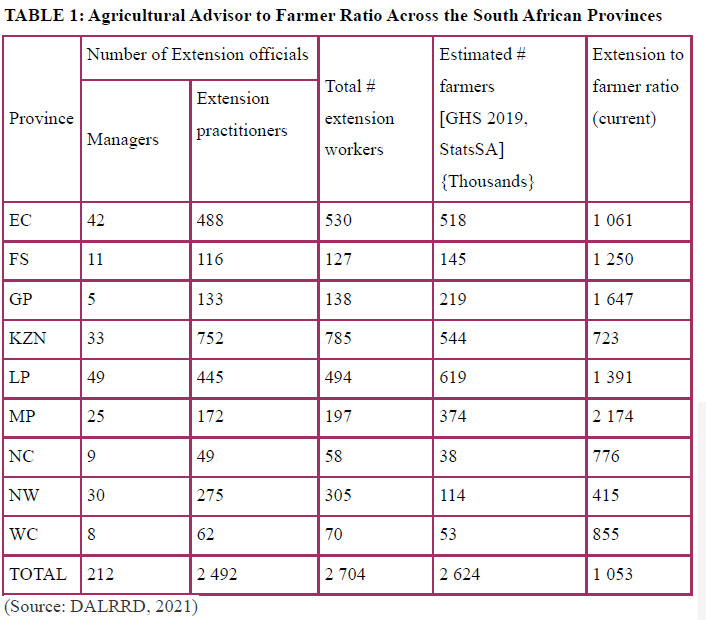
There are numerous accounts for this weak state of public agricultural extension. The first is the extension farmer ratio, as highlighted by Davis et al. (2021), which is a significant challenge. Table 1 shows the extension advisor-to-farmer ratio, where each extension advisor in South Africa serves more than 1000 farmers in most provinces. This ratio exceeds the World Bank's recommended ratio of one advisor for every 500 farmers. Given the importance of this role, the ratio in South Africa highlights the resultant capacity constraints in delivering high-quality services to farmers.
This imbalance between the number of extension advisors and the farming population hampers the effectiveness of extension services. With limited advisors catering to many farmers, personalised assistance and timely support become difficult, leading to a gap in knowledge dissemination and technology adoption. The inability to adequately engage with farmers hinders the collection of feedback and data crucial for evidence-based decision-making and program improvement. Several studies have highlighted the high extension farmer ratio as a significant impediment to effective extension delivery (Myeni et al., 2019; Brown et al., 2018).
Not only does the ration impede the reach of extension services, but it also overburdens existing advisors, limiting their capacity to address the diverse needs of farmers effectively and contributes to workforce burnout. Partly, this problem stems from inadequate investment in recruiting and retaining qualified extension personnel. This strains the delivery of extension services, limiting their reach and effectiveness. The quality of training and the lack of adequate resources to support the agricultural advisors were also expressed by advisors in Limpopo (Zwane et al., 2014).
Budgetary constraints limit the government's ability to recruit and retain an adequate number of extension advisors to meet the needs of the farming population (Lukhalo, 2017). In South Africa, extension services are underfunded, making it challenging to allocate sufficient resources effectively to address the high extension-to-farmer ratio. However, investment in staff, improved training programs, and optimised service delivery mechanisms are needed to serve the needs of farmers better and enhance agricultural productivity.
3.4. Lack of Specialists in Agricultural Extension
The absence of specialists in agriculture advisory services further diminishes the effectiveness of public extension services in South Africa (Loki et al., 2019). Agricultural advisory services encompass various disciplines, including agronomy, livestock management, horticulture, and agribusiness, each requiring specialised knowledge and skills. The implications of a lack of specialisation are significant. Farmers may miss out on tailored solutions and innovations relevant to their specific contexts, leading to inefficiencies and missed opportunities for agricultural development (de Janvry & Sadoulet, 2020).
However, the inability to hire specialists is often rooted in financial constraints. The State's budgetary limitations do not allow the prioritisation of specialist recruitment in agricultural extension (Katiyatiya et al., 2022). Without adequate financial support, agricultural extension services struggle to attract and retain specialists who possess the necessary expertise to address the diverse needs of farmers effectively (Antwi-Agyei et al., 2021).
3.5. Lack of Training to Refresh the Skills of Extension Advisors
Another critical factor contributing to the underperformance of public agricultural extension services is inadequate training or capacity-building initiatives for extension advisors (Agwu et al., 2023). Continuous training and professional development are crucial for extension advisors to stay current with emerging technologies, best practices, and evolving agricultural policies (Raj & Garlapati, 2020). However, this is lacking in South African agricultural extension. Research by von Maltitz et al. (2023) found that extension workers in South Africa lacked the critical skills to perform their responsibilities efficiently. Required skills include specialised technical skills, facilitation and communication skills, as well as soft skills such as critical thinking and problem-solving, and business management and marketing skills.
4. DELIVERING ADVISORY SERVICE TO LAND REFORM BENEFICIARY FARMERS
4.1. Land Reform and Its Beneficiaries
With the transition to democracy, the South African government has committed to resolving the land question through three sub-programs (see the documentation of the Department of Land Affairs [DLA], 1997). The first program focuses on strengthening the tenure rights of farm workers and communal residents, the second aims to restore land that was forcibly taken from its original occupants during the colonial period, and the last sub-program seeks to correct the skewed racial land ownership by redistributing land fairly. This third sub-programme, namely land redistribution, is the focus of this study.
With land redistribution, eligible prospective farmers from previously disadvantaged racial groups apply with DALRRD to be allocated a commercial farm bought by the State from white farmers. The criteria for selecting beneficiaries are unclear, contested by many researchers, and not implemented consistently. However, some improvements have been noted to make the process more transparent and efficient (Zantsi & Greyling, 2021).
According to the 1997 White Paper on Land Reform Policy, land reform beneficiaries should be landless or commercially oriented poor smallholder farmers who wish to engage in smallholder farming and settlement, as well as those who aim to farm on a commercial scale. However, land redistribution has been known to benefit politically connected elites at the expense of the poor and more deserving beneficiaries. Progress in the land redistribution component has been slow, and where land has been redistributed, productivity is generally suboptimal. At a significant number of farms, no productivity is recorded at all (Mtero et al., 2019; Gandidzanwa et al., 2021; ARC, 2019).
4.2.
Role of Agricultural Advisory Services in the Success of Land ReformAfter receiving the farms, mostly on a leasehold contract, beneficiaries often apply for operational funding to work the land. This support is typically provided through the Comprehensive Agricultural Support Programme (CASP). This comprehensive support (CASP) has six key support functions:
• Information and knowledge management.
• Technical and advisory assistance, and regulatory services.
• Marketing and business development.
• Training and capacity building.
• On- and off-farm infrastructure and production inputs.
• Financial assistance (branded MAFISA).
The state has issued other grants to boost productivity on land reform farms, such as the Recapitalisation and Development Program (RECAP). In all these stages of servicing land reform beneficiaries, agricultural advisory is always mentioned.
4.3.
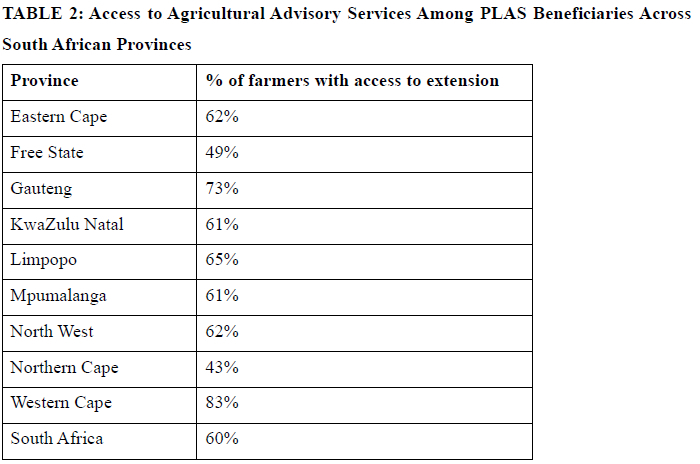
Rendered Extension Service to PLAS Land Reform BeneficiariesOur evaluation of 1,956 PLAS farms purchased between 2006 and 2018 across the country revealed that 60% of PLAS farmers reported access to extension, while the rest (40%) did not receive any extension services (Table 2). There are differences in the access to extension across provinces, with Western Cape PLAS farmers receiving the most extension services (83% of farmers), while in the Northern Cape, only 43% of PLAS farmers in this province receive extension. The State seems to be the major supplier of extension services among PLAS farmers. Approximately 79% of PLAS farmers received these services from the Department of Agriculture, Land Reform and Rural Development (DAFF) and its provincial branches. The rest of the farmers received advisory services from other farmers, commodity groups and agricultural co-operatives.
The most common type of extension service rendered was on production, including agronomy, pest control, animal remedies, and vaccination. Followed by market information and training in the form of demonstration, for example, dosing animals, calibrating a planter, etc. The main model of rendering extension services was the Training and Visit approach.
The effectiveness of extension services is known to be challenging due to issues such as a lack of meaningful contact with farmers, outdated extension methods, limited staff numbers, and low aptitudes among extension staff (Maake & Antwi, 2022). Our analysis revealed that extension provision for PLAS farmers was also challenging. Firstly, extension was infrequent. Of those who had contact with extension services, 53% had these less than four times a year, while only 47% received services at least once a month or on request at least once or twice a year. Secondly, an analysis of the relationship between access to extension and the current productivity of the PLAS farms also revealed that access to extension may not have improved the productivity of PLAS farms. As shown in Figure 2, only 17% of farmers who received extension services produced at medium scale (productivity score 2) and commercial levels1, compared to 12% of those who did not receive any extension services.
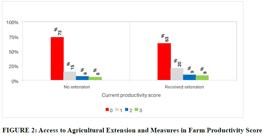
There is a slight difference in the performance of farmers who received extension compared to those who did not. The data depicted in Figure 2 suggest that the presence or absence of extension had little impact on farm performance, as the differences between the two groups were relatively minor.
Access to advisory services is a key factor in successful farming. However, equipping farmers with the necessary information to enable informed decision-making and addressing their limitations is important. Other fundamental structures that need to be in place include access to inputs such as seeds, fertiliser, pesticides, acaricides, animal remedies, and labour. These all require farmers' access to capital. Financial post-settlement support is a cited factor for the lack of productivity in land reform (Zantsi, 2023). In the current modality of redistributing land in South Africa, PLAS beneficiaries are only given lease agreements, not title deeds, which could assist them in securing loans from financial institutions (Verschoor et al., 2023).
5. DISCUSSION AND CONCLUDING REMARKS
The importance of having an effective and well-organised agricultural advisory service cannot be overemphasised, especially in a developing country like South Africa, where the aim is to bridge the gap between commercial agriculture, still dominated by a white minority, and smallholder agriculture practised mostly by the black majority (Zantsi et al., 2022). The imperative goal of land reform is to achieve justice and equity. One of the fundamental differences between established farmers and emerging or smallholder farmers is knowledge and resources; hence, effective advisory services are key to a vibrant, more equitable sector.
However, as we have learned in previous sections, the state and performance of our advisory service are limited, partly due to budgetary constraints and the relatively low number of agricultural advisors. To increase effectiveness would require extensive investment in these two aspects. Higher strategic planning, efficiency and implementation will also be required, especially given national and provincial state budgetary constraints. Also critical is how agricultural support services can utilise the available resources effectively and efficiently.
One option to explore is leveraging digital tools. The majority of South Africans, including older farmers, are now using smartphone applications such as WhatsApp and Facebook (Mdoda et al., 2024). This means they can learn to communicate digitally, through video demonstrations- prepared in local languages. They can also use Apps to lodge queries about their farming operations. For example, if a farmer has a plant or animal disease, this could be identified and addressed through a dedicated application. This could potentially address the challenge of the advisor-to-farmer ratio and the need for advisors to travel long distances. The Agricultural Research Council has designed and developed such apps in collaboration with specialists from major agricultural enterprises.
What needs to be strengthened is communication between the national research sector (ARC) and agricultural advisors in different parts of the country. Investments should be directed towards building capacity in the use of technologies to address the skewed extension advisory-to-farmer ratio, which speaks to the access and reach challenge. Technologies should complement the efforts of extension to capacitate farmers. Technology is not a threat to the extension profession, but rather a catalyst for transforming agriculture by enabling efficiency, sustainability, and profitability. Extension services can play a significant role in rural development and enhanced food security by leveraging the opportunities presented by new technologies.
The objective of this article was to assess the effectiveness of the agricultural advisory service provided to PLAS land reform beneficiaries, as measured by comparing the level of service with farm productivity. We found that agricultural advisory services had a limited impact on farm performance. This confirms the general trend in the literature about public extension. We acknowledge that the impact of extension may be highly dependent on other crucial factors, such as financial post-settlement support.
REFERENCES
- AGRICULTURAL RESEARCH COUNCIL (ARC)., 2019. National PLAS Report: A comprehensive scientific analysis of the PLAS project. Pretoria: Commissioned research by the Department of Agriculture, Land Reform and Rural Development.
- ANDERSON, J.R., 2008. Agricultural Advisory Services. Washington, DC: World Bank.
- ANTWI-AGYEI, P. & STRINGER, L.C., 2021. Improving the effectiveness of agricultural extension services in supporting farmers to adapt to climate change: Insights from northeastern Ghana. Clim. Risk Manag., 32: 100304.
- BROWN, B., NUBERG, I. & LLEWELLYN, R., 2018. Constraints to the utilisation of conservation agriculture in Africa as perceived by agricultural extension service providers. Land Use Policy., 73: 331-340.
- CONRADIE, B.I., 2016. The implications of a weak public extension service for the productivity performance of Karoo Agriculture. S. Afr. J. Agric. Ext., 44(2): 99-109.
- DAVIS, K.E., VON MALTITZ, L., DE BRUYN, M., VAN NIEKERK, J.A. & NGOMANE, T., 2021. South African extension agent competencies and attitudes for the future: Results of a survey. USA: International Food Policy Research Institute.
- DE JANVRY, A. & SADOULET, E., 2020. Using agriculture for development: Supply-and demand-side approaches. World Dev., 133: 105003.
-
DEPARTMENT OF AGRICULTURE, FORESTRY AND FISHERIES (DAFF)., 2014. Draft national policy on extension and advisory services. Available from https://www.daff.gov.za/doaDev/topMenu/National%20Policy.pdf
» https://www.daff.gov.za/doaDev/topMenu/National%20Policy.pdf - DEPARTMENT OF LAND AFFAIRS., 1997. White Paper on South African Land Policy. Pretoria.
- DEPARTMENT OF AGRICULTURE., 2004. Progress report on the implementation of the comprehensive agriculture support programme (CASP). Pretoria.
- DEPARTMENT OF AGRICULTURE., 2005. Norms and standard for extension and advisory services in agriculture. Pretoria.
- DEPARTMENT OF AGRICULTURE, LAND REFORM AND RURAL DEVELOPMENT., 2021. Economic review of the South African agriculture 2020/21. Pretoria: Department of Agriculture, Land Reform and Rural Development.
- GANDIDZANWA, C., VERSCHOOR, A.J. & SACOLO, T., 2021. Evaluating factors affecting performance of land reform beneficiaries in South Africa. Sustain., 13(16): 9325.
- NATIONAL PLANNING COMMISSION (NPC)., 2011. The National Development Plan 2030: Our Future - Make it Work. Pretoria: NPC.
- KATIYATIYA, C.L., MAJAHA, J., CHIKWANHA, O.C., DZAMA, K., KGASAGO, N. & MAPIYE, C., 2022. Drought's implications on agricultural skills in South Africa. Outlook Agri., 51(3): 293-302.
- LOKI, O., MUDHARA, M., PAKELA-JEZILE, Y. & MKHABELA, T.S., 2019. Factors influencing land reform beneficiaries' willingness to pay for extension services in Eastern Cape and KwaZulu-Natal, South Africa. S. Afr. J. Agric. Ext., 47(4): 29-45.
- LUKHALO, T., 2017. An expenditure review of the agricultural extension system in South Africa. Master's thesis, University of Pretoria, Pretoria.
- MAAKE, M.M.S. & ANTWI, M.A., 2022. Farmer's perceptions of effectiveness of public agricultural extension services in South Africa: An exploratory analysis of associated factors. Agric. Food Secur., 11(1): 34.
- MDODA, L., CHRISTIAN, M. & AGBUGBA, I., 2024. Use of information systems (mobile phone app) for enhancing smallholder farmers' productivity in Eastern Cape province, South Africa: Implications on food security. J Knowl Econ., 15: 1993-2009.
- MTERO, F., GUMEDE, N. & RAMANTSIMA, K., 2019. Elite capture in land redistribution in South Africa. Research report no. 55. Institute for Poverty, Land and Agrarian Studies (PLAAS). Cape Town: University of the Western Cape.
- MYENI, L., MOELETSI, M., THAVHANA, M., RANDELA, M. & MOKOENA, L., 2019. Barriers affecting sustainable agricultural productivity of smallholder farmers in the Eastern Free State of South Africa. Sustain., 11(11): 3003.
- SIHLOBO, W., 2023. A country of two agricultures: The disparities, the challenges, and the solutions. Bryanston, UK: Tracey McDonald Publishers.
- VON MALTITZ, L., DAVIS, K., SUVEDI, M., CHANZA, C., AGWU, A.E., SASIDHAR, P.V.K., DIMELU, M.U., LIVERPOOL-TASIE, L.S.O., ANUGWA, I.Q. & TCHUWA, F., 2023. Strengthening Agricultural Extension Training: Process Skills and Competency Gaps in Undergraduate Agricultural Extension Curriculum in South Africa. Partnerships for Innovative Research in Africa (PIRA) Research Report. East Lansing, Michigan, USA: Alliance for African Partnership, Michigan State University.
- VERSCHOOR, A.J., GANDIDZANWA, C., NEWBY, T., COLLETT, A. & VENTER, S., 2023. Proposing a farm assessment toolkit: Evaluating a South African land reform case study. Agrekon., 62(3-4): 215-227.
- ZANTSI, S. & GREYLING, J.C., 2021. Land Redistribution in South Africa's Land Reform Policy: A Better Way to Select Beneficiaries. Agrekon., 60(2): 108-127.
- ZANTSI, S., HLAKANYANE, L. & NKUNJANA, T., 2022. Towards a United South African agriculture: A review of social networking between black smallholder and white commercial farming communities through farmer organisations. IJARS., 17(1): 146170.
- ZANTSI, S., 2023. Land beneficiaries need support, Reform process fails to fill this development gap. S. Afr. J. Soc. Econ. Policy., 90: 30-32.
- ZWANE, E.M., GROENEWALD, I.B. & VAN NIEKERK, J.A., 2014. Critical factors influencing performance of extensionists in Limpopo Department of Agriculture in South Africa. S. Afr. J. Agric. Ext., 42: 49-61.