Farmers' Knowledge, Attitude, and Practices Towards Fertiliser Indicator Pricing Approach in Mvomero District, Tanzania
Abstract
Severe irregularities and implementation challenges in Mvomero District, Tanzania, marred the implementation of the Fertiliser Indicative Pricing Approach (FIPA). However, the questions on the levels offarmers' knowledge, attitudes and practices, knowledge categories that farmers have the least knowledge of, reasons informing attitudes and dominant ineffective FIPA practices are yet to be adequately addressed. This study assessed farmers' awareness, attitudes, and practices; knowledge categories that farmers have the least knowledge; reasons for informing attitudes; and dominant ineffective FIPA practices. Interview schedules and in-depth interviews were conducted during data collection. Qualitative data was analysed using content analysis. Farmers' attitude was gauged using afive-point Likert scale, andfarmers' knowledge, knowledge categories farmers had the least knowledge, reasons informing attitudes and dominant ineffective FIPA practices were described using descriptive statistics. Results revealed that most respondents had low levels of knowledge, unfavourable attitudes and ineffective practices towards FIPA. Also, knowledge categories that farmers had the least knowledge of comprised fertiliser indicative prices, FIPA rules and regulations, and key FIPA actors. Results further indicate that high fertiliser prices, weak FIPA monitoring and low-quality fertiliser were the reasons for unfavourable attitudes. In addition, non-adherence to indicative prices, rules and regulations, and the presence of low-quality fertiliser were the dominant ineffective practices of FIPA. The study generally indicates that farmers' low awareness concerning FIPA is a major threat to FIPA implementation. The findings imply that a lack of farmers' awareness of FIPA contributes to irregularities and underperformance manifested in individualistic opportunistic behaviours. Rogue actors abuse farmers' ignorance of program key result areas by maximising their utility at the expense of the majority of farmers. Concerted efforts should be directed at training and awareness building, effective monitoring and contract enforcement on indicative price and quality standards.
Fertiliser Indicative Price; Knowledge; Attitudes and Practices; Tanzania
1. INTRODUCTION
The contribution of agriculture to the economy of Tanzania cannot be overstated. This sector contributes massively to food production, employment generation, raw materials production for industries and foreign exchange earnings. For instance, in 2021, the sector grew by 3.9%, contributed about 26.1% of the total Gross Domestic Product, employed 65.6% of the active labour force and supported industrial sector raw materials by 65% (URT, 2023).
The use of chemical fertilisers is associated with an increase in agricultural productivity. This is because of their potential effect on soil fertility. According to URT (2023), fertiliser usage in the country stood at 19 kg/ha in the year 2022. This is much lower than the target set by the African Union in the Abuja declaration of at least 50kg/ha. It is also lower than the global average of 135kg/ha and far lower than India, a developing country whose fertiliser use has reached more than 161.58 Kg/ha (FAOSTAT, 2018). This low use of fertiliser in the country is primarily attributed to high prices and limited availability (Cagley et al., 2009; Baltzer & Hansen, 2012).
Since independence, the Tanzanian government has invested in fertiliser programs to ensure fertiliser access and utilisation among smallholder farmers. The assumption is fertiliser access will increase crop productivity, food security, and income. Four fertiliser regimes have been in place so far. They include the universal input subsidy program, fertiliser transport subsidy program, national agricultural input voucher scheme (NAIVS) and fertiliser indicative pricing approach under the Bulk Procurement System (BPS). The universal input subsidy program introduced in 1967 during the Arusha Declaration under the villagisation policy was universal because it covered all farmers. The program featured heavy government intervention, particularly in the input and output marketing system (Nyanda, 2022). Under this system, farmers were provided with subsidised agro-inputs (Baltzer & Hansen, 2012).
The government provided credits for managing farm operations, agricultural extension services, and marketing infrastructure. It also supervised market and food crop prices (Kato, 2016). In the long run, the universal input subsidy programs became more expensive as a result of targeting inefficiencies and heavy dependence on the government budget (Cagley et al., 2009; Pan & Christiaensen, 2011; Baltzer & Hansen, 2012; Mather & Minde, 2016). Economic reforms in the 1980s led to a decrease in subsidies. Hence, smallholder farmers had limited fertiliser access (Cagley et al., 2009). This made the government halt the program and promote fertiliser transport subsidies. This subsidy program was established in 2003 as an anecdote of declining agricultural production due to the withdrawal of government support. The fertiliser transport subsidy was meant to cover the transport, distribution and importation costs (Nyanda, 2022).
The program involved private companies supplying fertilisers to follow structural adjustment policies. Also, the program targeted regions producing staple food. In the long run, the program failed significantly following inefficiencies (Masinjila & Lewis, 2018). Following this massive failure, the government of Tanzania had to introduce the National Agricultural Input Voucher System (NAIVS).
The National Agricultural Input Voucher System (NAIVS) became operational in 2008/2009 as a three-year program (Nyanda, 2022). The major objective of NAIVS was to increase the production of staple food, notably maize and rice, amongst smallholder farmers cultivating not more than one hectare. Smallholder farmers were supposed to purchase fertiliser from selected agro-dealers at a subsidised price using a voucher obtained from the government. Under this system, the government was supposed to distribute vouchers to qualified farmers, coordinate the private sector and re-pay agro-dealers (Mather & Ndyetabula, 2016).
However, the program faced several implementation challenges, including high fertiliser prices, untimely delivery of inputs, non-availability of inputs, low-quality fertilisers, targeting inefficiencies and rent-seeking and opportunistic behaviours among actors along the value chain (Cooksey, 2012). Following these challenges, the government introduced a fertiliser-indicative pricing approach (FIPA) through the bulk procurement system. Also, NAIVS could not be sustainable, hence establishing a fertiliser indicative pricing approach, whereas the private sector would purchase fertilisers in the global market.
The Bulk Procurement System (BPS) was established in 2017. BPS aimed to lower fertiliser prices by reducing the negotiated price (FOB) of fertiliser (Bumb et al., 2021). The system introduced fertiliser-indicative prices. The price was concluded after calculating the tender price, port clearance charges and transportation cost (Bumb et al., 2021). This system of indicative prices was to be implemented jointly with the BPS. Following this system, any agro-dealer or distributor who fails to adhere to the indicative price should face a sanction (Cameron et al., 2017).
The introduction of FIPA aimed to increase access to and improve fertiliser utilisation among smallholder farmers to increase crop productivity, food security and incomes. The idea was that BPS and indicative pricing would reduce fertiliser prices and incentivise smallholder farmers to access and utilise chemical fertilisers (URT, 2016b). However, that was not the case, as indicative prices were not observed at the grassroots level. For instance, during the data collection exercise (July 2021), actual prices were astronomically high; for example, Diammonium Phosphate (DAP) (50kg) and UREA (50kg) were sold at TZS. 118,000 and TZS. 105,000 respectively. The prices are far beyond the indicative price of TZS. 63,929 and TZS. 50,367 for 50kg bags of DAP and UREA, respectively (TFRA, 2021). In addition, the program faced serious irregularities and implementation challenges manifested in cases of non and untimely availability of fertiliser, the presence of low-quality fertiliser, non-adherence to packaging standards, ineffective monitoring and lack of farmers awareness on institutions and the program at large (Cameron et al., 2017; SAGCOT, 2017; Bumb et al., 2021).
Farmers' awareness of institutions governing FIPA implementation matters. For instance, Mather and Ndyetabula (2016) pointed out that lack of knowledge among farmers contributed to cheating, opportunism and poor performance during the implementation of NAIVS. This is because knowledge influences an individual's attitude, and corresponding attitudes influence practices or behaviour (Sharif & Al-Malik, 2010). Similarly, Cagley et al. (2009) contended that a lack of farmers' knowledge concerning agricultural programs leads to low fertiliser uptake in program areas. When farmers know about certain aspects of agricultural technologies, the adoption rate becomes higher (Mbaga-Semgalawe & Folmer, 2000; Goeb & Lupi, 2021; Mgendi et al., 2022). Therefore, this study argues that program training and awareness building are paramount for effectively implementing a fertiliser-indicative pricing approach.
Similarly, Mather and Ndyetabula (2016) pointed out that a lack of knowledge among farmers contributed to elite capture and poor NAIVS performance. Knowledge is critical for the success of an agricultural intervention because it permits farmers to understand key program result areas and avoid opportunistic behaviours among actors along the value chain. Lack of knowledge on the part of farmers may act as a stumbling block to success in any agricultural input intervention. Therefore, this study assessed farmers' knowledge, attitudes, and practices towards FIPA, focusing on FIPA knowledge categories farmers have the least knowledge of, reasons for unfavourable attitudes, and identification of dominant FIPA malpractices.
The existing research in agricultural input service delivery in developing countries, particularly in Tanzania, is centred around the distribution, access and application of agricultural inputs (ACT and Match Maker Associates, 2012) and the supply of inorganic fertilisers to smallholder farmers (IFPRI, 2012). Other studies have focused on inputs subsidy programs on developing private sector agro-inputs markets (Baltzer & Hansen, 2011), the concept of smart subsidies (Minde & Ndlovu, 2007), challenges associated with policy and taxation in agricultural inputs supply value chains (ACT, 2012), fertiliser application by small-scale farmers in the post-colonial Tanzania (Nyanda, 2022). Therefore, this paper attempts to narrow the knowledge gap by assessing farmers' knowledge, attitudes and practices towards the Fertiliser Indicative Pricing Approach (FIPA) in the Mvomero District.
2. MATERIALS AND METHODS
2.1. Description of the Study Area
This study was conducted in Mvomero District, Morogoro Region. Mvomero District is among the seven (7) districts in Morogoro Region. Mvomero District, whose headquarters is located at Wami Sokoine, is administratively divided into four (4) divisions and thirty (30) wards. The climate varies from semi and warm tropical to cool high-altitude tropical. Rainfall is un-moral, with a short rain season from October to December and a long rain season from March to May every year. Rainfall ranges between 700mm in lowland areas to 2300mm in high altitudes and adjacent regions. The altitudes range from 300 - 2300m above sea level (URT, 2015)
The mean monthly temperature is 26oC, between 18°C and 30°C, and rainfall ranges between 600 and 2000mm. The rainfall pattern is divided into two seasons, namely, long rains and short rains seasons. The district economy depends mainly on agriculture, particularly crop production. The district has 549 375 ha of arable land for Agriculture, but only 247 219 hectares are currently effectively utilised. This is equivalent to 45% of the arable land. About 266 400 ha is suitable for animal husbandry. Agriculture remains the residents' primary livelihood source, accounting for 82% of the adult population (URT, 2017). The main crops grown are maize, rice, beans, cowpeas, cassava, pigeon peas, sugarcane, sunflower, tomato and onions.
2.2. Research Design, Sampling Procedures and Sample Size
The study employed a cross-sectional research design with both qualitative (key informant interviews, focus group discussions and observation) and quantitative (questionnaire survey) methods, using a mixed-methods approach. The cross-sectional design allows data to be collected at a single point in time and is commonly used in descriptive studies to determine relationships among variables (Babbie, 1990; Bailey, 1998).
Simple random and purposive sampling procedures were used to select study units. Purposive sampling was used to identify districts, wards, and villages for the study. Criteria used included the production of maize, rice and vegetables. Maize and rice were selected because they are priority food crops, which account for over half of all croplands in Tanzania (IFDC, 2012). Maize and rice were also included because they are staple foods and target crops for several fertiliser programs in Tanzania. The inclusion criteria for vegetables are because they are major crops in the district, particularly in Mgeta and Mlali wards (URT, 2017). Simple random sampling was used to identify farmers in the study area. The procedure is useful in studying large and diverse populations where the costs are reduced because of sequential clustering (Singleton et al., 1993; Kothari, 2004).
Three (3) wards (Mtibwa, Nyandira and Mlali) were purposely selected to participate in the study. The inclusion criteria for the wards and villages at Mvomero were those wards and villages that cultivate maize, rice and vegetables. After that, two (2) villages were selected from the three (3) wards to make a total of six (6) villages (Lukenge, Kidudwe, Nyandira, Ndugutu, Mlali and Kipera).
Thirty (30) respondents from each village were randomly selected. A sub-sample of 30 respondents is the bare minimum for studies in which statistical data analysis is to be done regardless of the population size (Bailey, 1994); hence, a survey sample of 180 respondents was used in this study. This study collected data from smallholder farmers, extension officers, district agricultural officers, agro-dealers, the Ministry of Agriculture, Livestock and Fisheries and the Tanzania Fertiliser Regulatory Authority (TFRA). The rationale for the diversity was to ensure the study gathered all relevant information from diverse stakeholders.
2.3.
Data CollectionBoth primary and secondary data were collected. Qualitative and quantitative methods were used for triangulation. Quantitative data were collected through a survey using questionnaires with both closed and open-ended questions. In contrast, qualitative data were collected through six (6) focus group discussions, each with twelve (12) participants, seven (7) key informant interviews and observations. Secondary data were collected by reviewing documented information about fertiliser indicative pricing, knowledge, attitudes, practices and agricultural input programs. The documents were obtained from the TFRA, Ministry of Agriculture, Mvomero District Council, Sokoine National Agricultural Library and the internet.
2.4.
Measurements and Data Analysis2.4.1. Measurements
2.4.1.1. Knowledge of Fertiliser Indicative Pricing Approach
The farmers' knowledge of fertiliser indicative pricing approach was assessed using seven (7) questions. The questions were centred around fertiliser indicative price, FIPA program objectives, types of fertilisers, rules and regulations, fertiliser quality standards, fertiliser application and FIPA key actors. Each question was assigned ten (10) points, totalling 70 points. Farmers were also asked about which FIPA knowledge categories have the least knowledge. In this regard, responses ranged from one to seven for indicative prices, FIPA objectives, key actors, rules and regulations, fertiliser types, application, and quality standards.
Using IBM-SPSS (v25) under percentile values, knowledge of FIPA scores was cut into three equal groups. Percentile values were used to categorise knowledge on FIPA. Knowledge of FIPA was categorised, in keeping with Muhanga (2015), into Inadequate FIPA Knowledge (IFK) for those who scored below 33.00, Marginal FIPA Knowledge (MFK) with scores ranging from 33.00 to 66.00 and Adequate FIPA Knowledge (AFK) with scores above 66.00.
2.4.1.2. Attitudes Towards Fertiliser Indicative Pricing Approach
The farmers' attitude toward FIPA was assessed by asking the respondents to indicate their disagreements or agreements with six (6) attitudinal statements that described certain aspects of FIPA. Half of the statements had negative connotations, whereas the other half had positive connotations. From the statements, an index score for each respondent was constructed to measure their attitude toward FIPA. For all positive statements, the response "Strongly Agree" was given a weight of 5, while "Agree" was given a weight of 4, "Undecided" was given a weight of 3 and "Disagree" was given a weight of 2 and "Strongly Disagree" was given a weight of 1. For all the negative statements, the response "Strongly Agree" was given a weight of 1, while "Agree" was given a weight of 2, "Undecided" was given a weight of 3 and "Disagree" was given a weight of 4 and "Strongly Disagree" was given a weight of 5.
From the statements, an index of the score for each respondent was constructed to measure the attitude of respondents towards FIPA. Farmers were also asked about the reasons for unfavourable attitudes towards FIPA. This was an open-ended question whereby respondents were required to answer what was correct for them. Multiple response analysis was used to identify reasons for unfavourable attitudes towards FIPA. Using IBM-SPSS (v25) under percentile values, attitudes on FIPA scores were cut into three equal groups. Percentile values were used to categorise attitudes toward FIPA. Attitude on FIPA was categorised into unfavourable FIPA attitude for those who scored less than 15.00, neutral FIPA attitude with scores ranging between 15.00 to 20.00 and favourable FIPA attitude with scores above 20.00.
2.4.1.3. Practices on Fertiliser Indicative Pricing Approach
To examine respondents' practices on FIPA, respondents were required to indicate whether they had ever encountered practices related to FIPA. This required the respondents to indicate their practices 'yes' or 'no'. The responses were recorded as 1 and 2 for No and Yes, respectively. Practices include purchasing fertiliser at an indicative price, purchasing the right quality, reporting malpractices, adhering to rules and regulations, and properly applying fertiliser on farm plots. From the practices, an index score for each respondent was constructed to measure practices on FIPA.
Also, farmers were asked which ineffective practices were dominant in the study area. This was an open-ended question whereby respondents were required to answer what was correct for them. Multiple response analysis was used to identify the dominant ineffective practices. Using IBM-SPSS (v25) under percentile values, practices on FIPA scores were cut into three equal groups. Percentile values were used to categorise practices on FIPA. Practices on FIPA were categorised into ineffective practices on FIPA for those who scored less than 7.00, marginal practices on FIPA with scores ranging between 7.00 to 8.00 and effective practices on FIPA with scores above 8.00.
2.5. Data Analysis
Content analysis was used to analyse data from focus group discussions, observation, and interviews with key informants. This was done through the systematic classification process of coding and identifying themes or patterns. The themes included farmers' knowledge, attitudes, and practices on FIPA. Data collected from surveys were checked for completeness before coding, entering and verifying for analysis. Quantitative data were processed using IBM SPSSv25 and then analysed by computing descriptive statistics to determine frequencies, percentages, statistical means, percentiles and confidence intervals.
3. RESULTS AND DISCUSSION
3.1. Socio-Demographic Characteristics of the Respondents
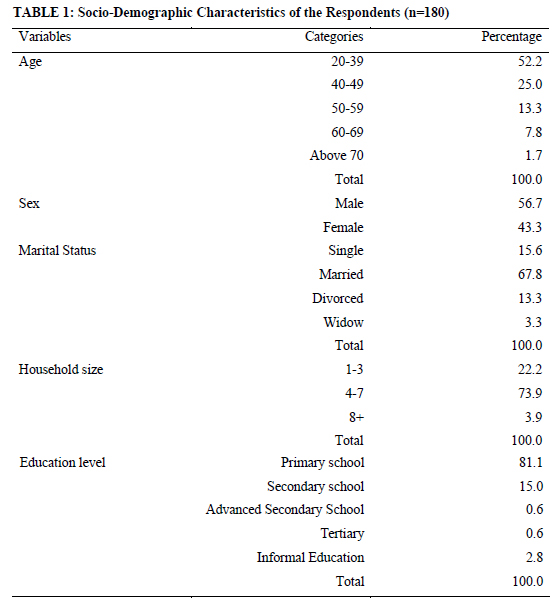
Table 1 presents the respondents' socio-demographic characteristics. Results reveal that most respondents (52.2%) were between 20 and 39 years old, and a few (1.7%) were above 70. Also, the ages of 25%, 13.3% and 7.8% of respondents were between 40 and 49, 50 and 59 and 60 and 69 years, respectively. The results further indicated that 56.7% of the respondents were men and 43.3 % were women. Most respondents (81.1%) had primary education, whereas a few (2.8%) had an informal education.
Furthermore, 15%, 6% and 6% of respondents had secondary school education, advanced secondary school education and tertiary education, respectively. Of the interviewed respondents, the majority (67.8%) were married, whereas 15.6%, 13.3% and 3.3% were single, divorced and widowed, respectively. The majority (73.9%) of the respondents surveyed had between 4 and 7 household members, whereas few (3.9%) had above eight household members. About 22.2% of the respondents had between 1 and 3 household members.
3.2. Farmers' Knowledge of Fertiliser Indicative Pricing Approach
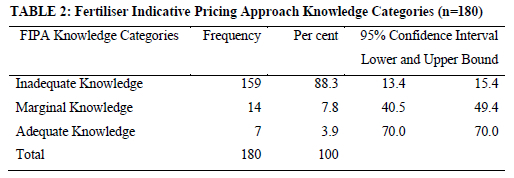
Table 2 presents farmers' knowledge of FIPA into categories; the results indicate that 88.3% (95% CI: 13.4 to 15.4) of the respondents had inadequate knowledge, whereas only 3.9% (95% CI: 70.0 to 70.0) had adequate knowledge. The remaining 7.8% (95% CI: 40.5 to 49.4) had marginal knowledge. A similar trend has been observed from focus group discussions, where farmers do not understand the fertiliser indicative pricing approach as no seminar or training was conducted in their villages. Furthermore, farmers lack an understanding of the fertiliser-indicative price approach. They are unaware of the indicative prices, program objectives, and key actors.
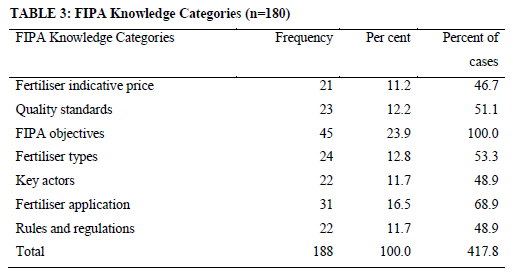
Also, Table 3 presented results on FIPA knowledge categories in which respondents had the least knowledge. Results indicate that 46.7%, 48.9%, 48.9%, and 51.1% of the cases identified fertiliser indicative price, rules and regulations, key actors, and quality standards as FIPA categories that farmers had the slightest knowledge of, respectively.
This study revealed that most smallholder farmers in the study area had inadequate knowledge of the fertiliser indicative pricing approach, specifically, on fertiliser indicative prices, rules and regulations, key actors and fertiliser quality standards. Lack of knowledge among farmers permits agro-dealers to abuse the system and increase prices above the threshold stipulated by the Tanzania Fertiliser Regulatory Authority (TFRA). In addition, TFRA requires only registered agro-dealers to conduct fertiliser business and prohibits the selling of unpacked fertiliser; however, in this study, it was found that unlicensed vendors in retail shops were involved in the fertiliser business and unpacked fertiliser was being sold in the study area. A similar observation was made by Mather and Ndyetabula (2016) when analysing the National Agricultural Input Voucher System (NAIVS), who claimed that farmers lack knowledge of agricultural input programs and, therefore, contribute to elite capture, opportunistic behaviours and poor performance of the program. On the contrary, Malhotra (2013) noted a high general awareness about NAIVS among farmers. However, there was limited awareness about specifics like eligibility criteria and the scheme's exit mechanism. The result supports findings from this study as farmers lack knowledge on specific areas like FIPA objectives, fertiliser application, fertiliser indicative price and quality standards, to mention a few.
Further, there was an absence of training or awareness campaigns on fertiliser indicative pricing approach in the study area. Lack of knowledge reflects the absence of training and awareness campaigns. Knowledge is critical as it enables farmers to understand key program result areas, own the program and avoid opportunistic behaviours among actors along the chain. The finding aligns with Bardhan and Mookherjee's (2000) assertion that a low level of awareness is a determinant of elite capture of vouchers during the implementation of NAIVS. Correspondingly, the result is similar to the observation made by Sharif and Al Malik (2010) that knowledge positively influences an individual's attitude, and in turn, attitude influences practices or behaviour. The findings are also similar to those reported by Mbaga-Semgalawe and Folmer (2000), who found that farmers' participation in extension training and demonstration programs may unlock farmers' potential and enable them to adopt improved production techniques to improve sustainable farm productivity.
Furthermore, in line with our findings, Goeb and Lupi (2021), in their study on the effects of a farmer-to-farmer training program on pesticide knowledge, noted that training improved farmer knowledge, including the most complicated pesticide characteristics that are not easier to learn from experience.
3.3. Farmers' Attitudes Towards Fertiliser Indicative Pricing Approach
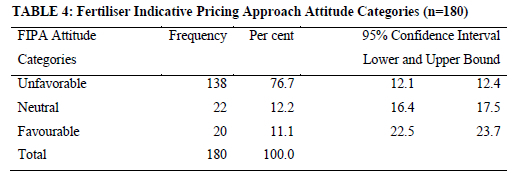
Table 4 presents attitudes towards FIPA into categories. About 76.7% (95% CI: 12.1 to 12.4) had a negative (unfavourable) attitude, whereas only 11.1% (95% CI: 22.5 to 23.7) of the respondents had a positive (favourable) attitude. The remaining 12.2% (95% CI: 16.4 to 17.5) had a neutral (undecided) attitude. The results are similar to those of the focus group discussion, whereas farmers viewed FIPA as useless as they purchased fertiliser at high prices and, in some cases, witnessed the non-availability of fertiliser. Also, farmers purchase low-quality fertilisers. This forces them to apply fertiliser more than once to achieve the desired outcomes. This, in turn, becomes expensive and unbearable to farmers.
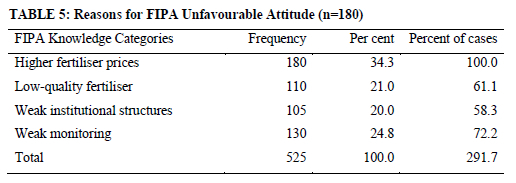
Table 5 presents results on reasons for unfavourable attitudes towards FIPA. The findings indicate that all respondents identified failure to control fertiliser prices as a major reason for farmer's negative attitudes. Also, 72.2%, 61.1% and 58.3% of the cases identified weak monitoring, low fertiliser quality and weak institutional structure as reasons for a negative attitude.
The study revealed that most smallholder farmers in the study area had a negative attitude towards the fertiliser-indicative pricing approach. They have negative feelings, beliefs, and values. High prices, weak program monitoring and adulterated fertiliser in the market exacerbate the negative feeling. The findings are similar to those of Mwaijande (2014) and Mather and Ndyetabula (2016), who found that, during the implementation of NAIVS, fertiliser was sold at high above-subsidised prices, untimely delivery and low-quality fertiliser.
Furthermore, the findings show that farmers' knowledge of FIPA is important in that when farmers are knowledgeable on the fertiliser indicative prices and quality standards, they will play a huge part in program monitoring. Lack of knowledge of program key result areas permits opportunism in the face of substandard fertiliser and weak monitoring. It is these conditions that foster farmers' unfavourable attitudes towards FIPA. The results confirm Sharif and Al Malik's (2010) observation that knowledge positively influences an individual's attitude, and in turn, attitude influences practices or behaviour. Positive attitudes towards agricultural interventions must be supported by effective training, awareness campaigns and program monitoring (Mbaga-Semgalawe & Folmer, 2000; Selejio & Lasway, 2020).
3.4. Farmers' Practices Related to Fertiliser Indicative Pricing Approach
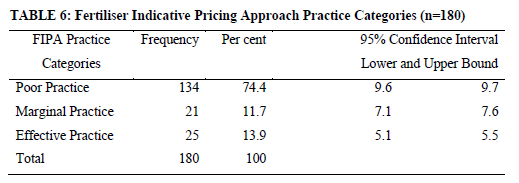
Table 6 presents practices on FIPA into categories. The findings indicate that 74.4% (95% CI: 9.6 to 9.7) of the respondents had ineffective practice, whereas 13.9% (95% CI: 5.1 to 5.5) had effective practice. The remaining 11.7% (95% CI: 7.1 to 7.6) had marginal practice. The survey results are similar to those of the focus group discussion as farmers claim the absence of fertiliser inspectors' operations at the village level, hence purchasing fertiliser at higher prices, low quality, and serious violations of rules and regulations. Farmers reported high fertiliser prices, such that they could not afford to purchase and apply fertiliser to their farm plots. For instance, the actual price of DAP (50kg) was TZS. 118,000, and Urea (50kg) was 105,000, far beyond the indicative price of TZS. 63,929 and TZS. 50,367 for 50kg bags of DAP and UREA, respectively (TFRA, 2021).
The study identified that most smallholder farmers in the study area had ineffective practices towards the fertiliser-indicative pricing approach. Specifically, they do not purchase fertiliser at the stipulated price, adhere to rules and regulations and fail to report malpractices. Apply fertiliser at farm plots, and they purchase low-quality fertiliser. The findings are similar to those reported by Mather and Ndyetabula (2016), who found high prices beyond subsidies and low-quality fertiliser. Similarly, Mwaijande (2014) noted delays in delivery, many incidences of corrupt practices, and other bureaucratic bottlenecks. Furthermore, in line with our findings, Nyanda (2022) noted irregularities, rent-seeking behaviours, and elite capture of the national agricultural input voucher system.
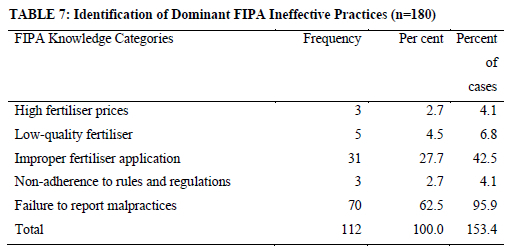
Table 7 presents results on FIPA ineffective practices in the study area. It was found that the dominant FIPA ineffective practices were on fertiliser indicative prices (2.7%), adherence to rules and regulations (2.7%) and low-quality fertiliser.
FGD and KII results further revealed that farmers were unaware of which office to send their complaints to, purchased unpacked fertiliser and experienced unavailability of fertiliser inspectors at ward level. The finding reflects a lack of farmers' knowledge in that they do not know indicative prices, rules and regulations governing FIPA and fertiliser quality standards; hence, malpractices occurred during the implementation of the fertiliser indicative pricing approach. The results are similar to the observation made by Sharif and Al Malik (2010) that practices are regulated by the two constructs of attitude and knowledge. Since farmers possess low FIPA knowledge, they will have a negative attitude, leading to ineffective practice.
4. REFLECTIONS FROM EMPIRICAL LITERATURE REVIEW
Farmers' low level of knowledge on key program result areas breeds unawareness of fertiliser indicative price, rules and regulations, fertiliser quality, and application. It was found that farmers were not aware of the rules and regulations governing the availability, quality, packaging, licencing and registration of agro-dealers, and the policing and monitoring of the program. The low knowledge level allows for cheating and opportunism among actors along the chain. Therefore, individualistic assumptions of utility maximising behaviours spanned in the form of inflated fertiliser prices and adulterated fertiliser in the market, to mention a few. Following that trend, low knowledge levels, cheating and opportunism incite farmers' dissatisfaction and, thus, an unfavourable attitude towards FIPA.
These negative beliefs, feelings, values, and dispositions regarding fertiliser-indicative pricing negatively influence practices. Knowledgeable farmers tend to act and behave in manners that affirm their knowledge level and vice-versa; thus, knowledge level is perhaps a crucial factor in understanding the link between attitude and practices. When farmers have adequate information on fertiliser indicative pricing approach and become knowledgeable about its practices, it is possible to translate such knowledge into implementing it. Third, unfavourable attitudes and low knowledge levels permit ineffective practices towards FIPA.
Farmers' unawareness and unfavourable attitude toward key FIPA program areas encourage FIPA malpractices in non-compliance with fertiliser prices and rules and regulations, ineffective feedback mechanisms, improper fertiliser application, and low-quality fertiliser in the market. Correspondingly, farmer's knowledge of fertiliser indicative pricing approach plays a significant role in determining their attitudes and, eventually, their practices. The results imply that farmers with unfavourable attitudes and low knowledge of FIPA will have ineffective practices.
5. CONCLUSIONS AND RECOMMENDATIONS
The study assessed smallholder farmers' knowledge, attitudes, and practices on fertiliser-indicative pricing approaches in Mvomero District, Tanzania. The findings depict severe shortfalls in training and awareness campaigns under FIPA. Furthermore, a lack of farmers' awareness concerning FIPA can have far-reaching consequences, including unfavourable attitudes and malpractices on the part of farmers. Unscrupulous actors may take advantage of farmers' ignorance and maximise their utility. In addition, the lack of farmers' awareness increases transaction costs and uncertainty in FIPA governance. The above findings indicate that little has been done about farmers' awareness of FIPA. The importance of farmers' awareness of the performance of FIPA cannot be overemphasised. Therefore, stakeholders must make an extra effort to realise FIPA's desired goals through training and sensitisation campaigns to raise the farmers' knowledge, attitudes and practices (KAPs) on fertiliser indicative pricing approach.
Based on the findings discussed above, the study recommends the following to be done by various stakeholders, including government agencies (such as the Ministry of Agriculture), Non-governmental organisations, private sector and research institutions:
i. Train and create awareness of indicative prices, rules and regulations, program objectives, fertiliser application skills, key actors, fertiliser types, and quality standards for smallholder farmers. This will assist in monitoring and contract enforcement.
ii. Fertiliser inspectors should operate at the village level to ensure contract enforcement and monitoring.
iii. Smallholder farmers should be willing to attend sensitisation seminars provided by stakeholders.
The authors hereby declare no conflict of interest in this research.
6. ACKNOWLEDGEMENTS
The authors thank the respondents and Mvomero District Council staff for making this research realistic. Also, the authors thank the enumerators for their extraordinary commitment to this research.
REFERENCES
- ACT AND MATCHMAKER ASSOCIATES., 2012. Distribution, access and application of agricultural inputs. Agricultural Council of Tanzania, Matchmaker and Associates.
- AGRA., 2014. An assessment of agricultural policy and regulatory constraints to agribusiness investment in Burkina Faso, Ethiopia, Ghana, Nigeria and Tanzania. Nairobi, Kenya: Alliance for a Green Revolution in Africa.
- BABBIE, E., 1990. Survey research methods. 2nd edn. Belmonth: Wadsworth.
- BAILEY, B.K., 1994. Methods of social research. New York: The Free Press Cllier-MacMilan Publishers.
- BAILEY, D.K., 1998. Methods of social science research. London: The Free Collier Macmillan Publisher.
- BALTZER, K. & HANSEN, H., 2012. Agricultural input subsidies in Sub-Saharan Africa: Evaluation study. Denmark: Ministry of Foreign Affairs.
- BENSON, T., KIRAMA, S. & SELEJIO, O., 2013. The supply of inorganic fertilisers to smallholder farmers in Tanzania. Washington D.C: International Food Policy Research Institute.
- BARDHAN, P. & MOOKHERJEE, D., 2000. Capture and governance at local and national levels. Am. Econ. Rev., 90(2): 135-139.
- BUMB, B.L., ARIGA, J., ANAND, M., CAMERON, A. & NKONYA, N. M., 2021. Assessment of the fertiliser market and bulk procurement system in the United Republic of Tanzania. Policy Report. Monitoring and analysing food and agriculture policies. Rome: Food and Agriculture Organization.
- CAGLEY, J.H., GUGERTY, P.M.K. & PLOTNICK, P.R., 2009. The political economy of fertiliser policy in Tanzania. Washington, D.C: University of Washington Press.
- COOKSEY, B., 2012. Politics, patronage and projects: The political economy of agricultural policy in Tanzania, FAC Working Paper 40. Brighton: Future Agricultures Consortium.
-
FAO., 2021. The state of food and agriculture. Available from: https://www.fao.org/publications/sofa/sofa-2021/en
» https://www.fao.org/publications/sofa/sofa-2021/en - GOEB, J. & LUPI, F., 2021. Pesticides' true colours: The effects of a farmer-to farmer training program on pesticide knowledge. Michigan: Michigan State University Press.
- IFDC., 2012a. Tanzania fertiliser assessment. muscle shoals. USA: International Fertiliser Development Centre.
- IFPRI., 2012. The supply of inorganic fertilisers to smallholder farmers, evidence for fertiliser policy development. Discussion Paper 01230. Washington D.C: International Food Policy Research Institute.
- KATO, T., 2016. Agricultural input subsidies in sub-Saharan Africa - the case of Tanzania. Doctoral thesis, University of Sussex.
- KOTHARI, C.R., 2004. Research methodology: Methods and techniques. 2nd edn. New Delhi: New Age International Publishers.
- MALHOTRA, K., 2013. National agricultural input voucher scheme (NAIVS 2009-2012), Tanzania: Opportunities for improvement, REPOA Brief No. 40.
- MASINJILA, S. & LEWIS, L., 2018. The future of smallholder farmer support in Tanzania: Where to after the national agricultural input voucher scheme? Johannesburg: African Centre for Biodiversity.
-
MATHER, D. & NDYETABULA, D., 2016. Assessing the drivers of Tanzania's fertiliser subsidy programs from 2003-2016: An application of the kaleidoscope model of policy change. Available from: https://ageconsearch.umn.edu/record/259516
» https://ageconsearch.umn.edu/record/259516 - MBAGA-SEMGALAWE, Z. & FOLMER, H., 2000. Household adoption behaviour of improved soil conservation: The case of the North Pare and West Usambara Mountains of Tanzania. Land Use Policy., 17(4): 321-336.
-
MGENDI, G., MAO, S. & QIAO, F., 2022. Does agricultural training and demonstration matter in technology adoption? The empirical evidence from small rice farmers in Tanzania, technology in society. Available from: https://www.Sciencedirect.com/science/article/abs/pii/_S0160791X22_001658?_via%3_Dihub
» https://www.Sciencedirect.com/science/article/abs/pii/_S0160791X22_001658?_via%3_Dihub - MINDE, I.J. & NDLOVU, P., 2007. How to make agricultural subsidies smart. Paper Prepared for Contribution to the Ministerial Seminar, Regional Strategic Analysis and Knowledge System for Southern Africa (ReSAKSS-SA), Maputo, Mozambique, 8th June, p. 27.
- BALTZER, K. & HANSEN, H., 2011. Agricultural input subsidies in Sub-Saharan Africa: Evaluation study. Ministry of Foreign Affairs of Denmark.
- MWAIJANDE F., 2014. A study on electronic monitoring for the implementation of National Agricultural Inputs Voucher Subsidy Programme. Tanzania: Dar es Salaam.
- NYANDA, S., 2022. Fertiliser application by small-scale farmers in the post-colonial Tanzania: Lessons from the fertiliser subsidy programmes, the sub-Saharan. J. Soc. Sci. Humanit., 1: 23-31.
- PAN, L. & CHRISTIAENSEN, L., 2011. Who Is Vouching for the Input Voucher? Decentralized Targeting and Elite Capture in Tanzania. World Dev., 40(8): 1619-1633.
- RICKER-GILBERT, J., 2020. Inorganic fertiliser uses among smallholder farmers in sub-Saharan Africa: Implications for input subsidy policies. In Y. Gomez, S. Paloma, L. Riesgo & K. Louhichi (eds.), The role of smallholder farms in food and nutrition security. Michigan: Springer International Publishing, p. 17.
- SINGLETON, R.A., STRAITS, B.C. & STRAITS, M.M., 1993. Approaches to social science research. New York: Oxford University Press.
-
SELEJIO, O. & LASWAY, J., 2019. Economic analysis of the adoption of inorganic fertilisers and improved maize seeds in Tanzania. Available from https://www.efdinitiative.org/publications/econo mic-analysis-adoption-inorganic-fertilisers-and-improved-maize-seeds-tanzania
» https://www.efdinitiative.org/publications/econo mic-analysis-adoption-inorganic-fertilisers-and-improved-maize-seeds-tanzania - URT., 2017. Mvomero District Investment Profile. Dodoma: Institute of Rural Development Planning.
- URT., 2018. Agricultural Sector Development Strategy Phase II. Dar es Salaam: Ministry of Agriculture and Food Security.
- WORLD BANK., 2014. Tanzania - public expenditure review: National agricultural input voucher scheme. Washington D.C: World Bank.
- XIE, Z.F., WEI, Q.F. & ZHENG, X.L., 2017. Development of health education evaluation system for patients with colostomy based on KAP model. Chin. J. Health Educ., 33(5): 544-547.