An Investigation of Estate Planning Among Farming Businesses in the Western Cape Province, South Africa
Abstract
Estate planning is one of the important processes in managing a business, and farm owners often avoid it since it deals with emotional and difficult issues. Additionally, studies have highlighted that decision-making on future ownership of many businesses is still poorly understood. This study investigated the extent of the availability of estate plans amongst farmers in the Western Cape Province of South Africa. Interviews were conducted, and data was collected from 42 farmers using structured questionnaires following a mixed-method research design. Descriptive statistics such as mean, frequencies and percentages were employed. The study revealed that the majority (66,67%) of the farmers do not have any estate plan available. In comparison, 47,62% of the farmers were unfamiliar with the estate planning process. In addition, the study also revealed that the businesses own assets with a minimum value of R500 000 to a maximum value of over R2,5 million, showing differences in the commodities across the Western Cape Province. It is recommended that farmers be aware of their responsibilities regarding estate planning, and the Western Cape Department of Agriculture should conduct workshops around the legal side of the business. For funding purposes, the Western Cape Department of Agriculture needs to include conditions related to estate plans in the application forms to prevent the closure of businesses after the recipient's death.
Estate Planning; Family Business; Agribusiness
1. INTRODUCTION
In the Western Cape Province of South Africa, agricultural businesses are important due to their contribution towards job creation and Gross Domestic Product (GDP). According to the World Bank (2023) and Statista Research Department (2023), agriculture contributed 2,4% to the GDP of South Africa, while the sector employed over 860,000 people in 2022. According to recent data, it is highlighted that the sector outperformed all the other sectors between 2012 and 2021 by 44,9% (Western Cape Government, 2022). It was pointed out by Ntshangase et al. (2016) that for sustainability in the agricultural sector to be ensured, future generations have to continue playing a major role in farming. The sustainability of the sector, therefore, relies on existing estate planning. Tauer and Grossman (2002) and Sambrook (2005) define estate planning as the process of deciding how the assets should be distributed to the right people once death comes, whilst it also considers the techniques used to build the estate during life. An important point is made by Van der Merwe (2009), which states that estate planning is a crucial part of succession planning; hence, these two processes should not be divorced.
Recent statistics by Lowder et al. (2016) showed that there are more than 570 million farms globally, mostly family-operated and small. Concerning world farm statistics, approximately 12% of these farms operate on less than 2 hectares; furthermore, family farms operate on 75% of the agricultural land worldwide. Approximately 13 million people are employed by 267,959 businesses legally registered in South Africa (Small Business Institute, 2018). About 19 years ago, 65% of businesses in South Africa were in the agricultural sector, and 90% were family-owned businesses (Venter & Mass, 2005). In contrast, nine years ago, family-owned businesses grew by 5% to 95% (Gouws, 2015). The latter statistics show the importance of family businesses and why businesses must take estate planning very seriously, especially in the farming sector. Therefore, the failure of family-owned businesses could have a negative impact on these statistics. A study by Modise (2011) in the Free State Province indicated that each family's estate and succession plans are unique. This also demonstrated the importance of such planning in the long-term sustainability of businesses.
Previous studies, such as the one conducted by Markowski-Lindsay et al. (2017), show that there are several businesses with no plans regarding the future, while some have only wills and no form of planning for succession. It is further noted that business owners still poorly understand estate planning and decision-making around future ownership. According to Walsh (2011), about 70% of businesses will find it hard to transfer their operations to the second generation. Further, about 90% of the businesses will not make it to the third generation, even though most businesses would like to transfer their businesses to the subsequent generations.
Edobor et al. (2021) highlighted inadequate transition planning by business owners as the most important reason why most businesses struggle to transfer their businesses to the next generation. Small-scale and medium-scale businesses are the backbone of many economies; therefore, estate planning is vital because their failure will negatively affect the economy. Therefore, given the low rate of success in transferring assets in the future to the next generation, it is very important to understand considerations made by the owners at present concerning estate and succession planning. As stated by Edobor et al. (2021), the lack of these plans will affect the contribution that the agribusinesses make towards job creation, export earning and providing food to rural markets. In recent years, the issues of farm succession, retirement, and inheritance have gained significant importance. However, family businesses and farm owners generally find farm succession challenging, putting these discussions on hold for many years. It is highlighted that for farmers, especially males, the issue of thinking about letting go of being the owner can be an issue to their identity. The majority feel that their role in the family, business, and among their peers may be perceived as inferior (Wheeler et al., 2020). The purpose of the study, therefore, is to understand the accessibility/disposal of the estate plans and the rationale behind not having these plans for those farmers who might not have considered their necessity.
2. MATERIALS AND METHODS
2.1. Description of the Study Area
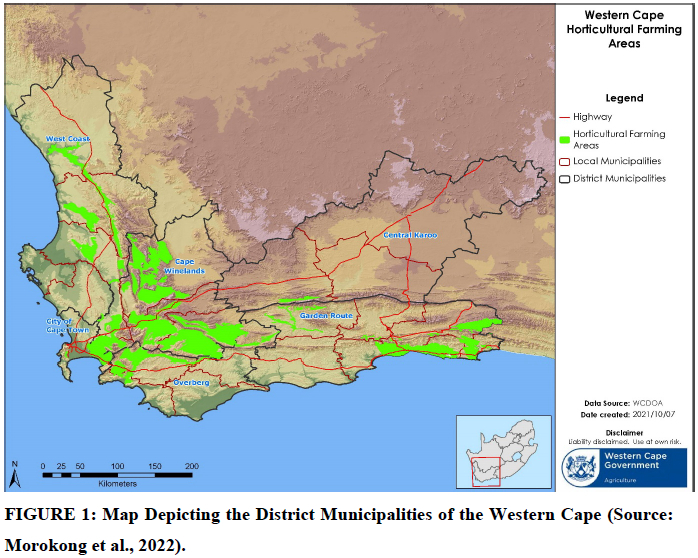
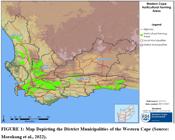
The study was conducted in the Western Cape Province across the six district municipalities with a total of 69 152 prevalence of agricultural households (Statistics South Africa, 2018). The Western Cape is one of the Provinces in South Africa. It has an estimated population which makes up 11,9% of the country's total population, with a life expectancy of 71,7 and 66,3 years for females and males, respectively.
The Western Cape borders the Eastern Cape and the Northern Cape Provinces. It has 25 municipalities, five districts and a metropolitan municipality. It is situated in the Southwest part of South Africa (Morokong et al., 2023). The province of the Western Cape covers approximately an area of 129 462 km2 (Municipalities of South Africa, 2023). The province of the Western Cape is different from the rest of the provinces in terms of climate because the coastal areas have a Mediterranean climate. In contrast, the inland areas experience a semi-desert climate (Morokong et al., 2023). According to the sector profile of the Western Cape agricultural production, there is a total of just over 787 000 hectares that are planted with crops, of which 85,69% of these hectares are based in three districts: the Western Coast, Cape Winelands and the Overberg (Morokong et al., 2023).
2.2. Sampling Procedure
A descriptive research design was adopted to conduct the research. In addition, a mixed research (qualitative and quantitative) method was followed. A mixed method was followed, using qualitative information to get insight into the quantitative results. A total of 42 agribusinesses that are part of the Financial Record Keeping Programme of the Western Cape Department of Agriculture were selected across six district municipalities of the Western Cape. The Financial Record Keeping Programme (FRKP) assist agribusinesses in the Western Cape with proper and accurate financial record-keeping systems in their agribusinesses for sound decision-making. According to the database of the FRKP, 42 agribusinesses are participating in the programme: West Coast (11 agribusinesses), Cape Metro (4 agribusinesses), Cape Winelands (10 agribusinesses), Garden Route (15 agribusinesses), Overberg and Central Karoo (2 agribusinesses). Questionnaires were used as a data collection instrument to collect primary data. Due to the size of the population, all the agribusinesses were interviewed. Therefore, a purposive sampling procedure was used because only agribusinesses that were part of the FRKP were selected.
2.3. Data Analysis
Data that was collected through structured questionnaires was analysed using Statistical Package for the Social Sciences (SPSS), moonstatistics and Microsoft Excel for better visualisation and analysis. Descriptive statistics such as frequency distribution, percentages and means were used to answer the research objectives. Lastly, bivariate correlation and chi-square tabulation were used to determine if there exists a relationship between the size of the agribusiness in terms of the value of assets and the decision to have estate plans in place.
3. RESULTS AND DISCUSSION
3.1. Demographic Characteristics of Agribusinesses
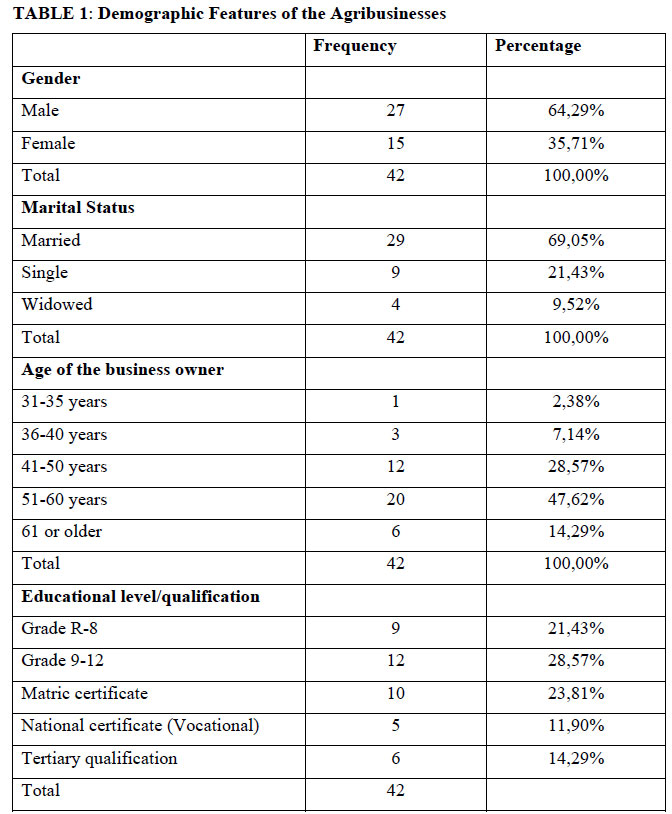
The study results shown in Table 1 on the distribution of gender, marital status, age of the agribusiness owner and educational level showed that just over 64% of the respondents were males. In comparison, the majority (69%) of the business owners were married. In addition, over 61% of the business owners interviewed were over 51. According to Lingani (2022), the agricultural sector is dominated by males, except for subsistence farming, due to the physical nature of farming. Olsson and Martiny (2018) suggest that this could be a result of the gender role beliefs that influence career paths in fields such as agriculture. Other studies, however, have shown an increasing trend of the involvement of females in agriculture, especially due to their characteristics such as patience and meticulousness (Ramadani et al., 2017; Sentuti et al., 2017). Previous studies on marital status, such as that of Siphesihle and Mdoda (2020), agreed with this study's results. In most rural areas, farm owners are married, and this preference increases the likelihood of labourers available to work on the farm, i.e., the wife, husband and children, compared to a single farm owner. According to Muhammad et al. (2019), marriage in rural areas is highly esteemed, with unmarried people known to be irresponsible.
According to Zagata and Sutherland (2015), the total number of older farm owners in rural areas of Europe is relatively very high, and this trend is similar to the findings of this study; i.e. the majority of farms in the Western Cape are managed by farmers who are over the age of 50 years. Additionally, Wheeler et al. (2020) pointed out that farmers tend to retire late or not.
Education has several benefits, and the most important benefit is its important role with respect to the growth and development of sectors, including agriculture (Ashraf & Qasim, 2019). As shown in Table 1, 50% of the respondents had attained a qualification below the matric certificate. The remainder (50%) had either a matric, National Certificate or a tertiary qualification. However, a study by Magasi (2016) had contrasting results as the respondents in a study conducted in Tanzania on transition planning showed that 67% of respondents had tertiary qualifications.
3.2. The Existence of Estate Plans in Agribusinesses
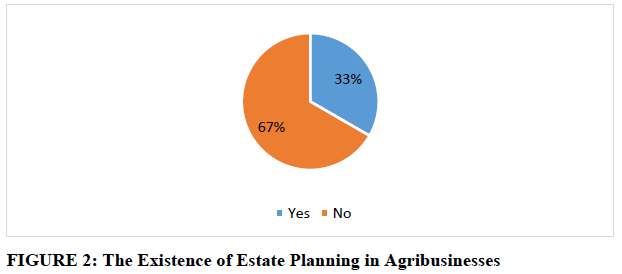
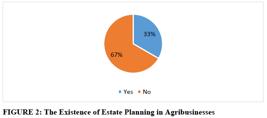
Figure 1 shows the existence/availability of estate plans amongst FRKP agribusinesses in the Western Cape Province. Estate planning ensures that assets are inherited by the designated heirs and not through a verbal agreement. The study's findings show that 67% of the respondents highlighted that they do not have any form of plans regarding inheritance or succession plans, whereas 33% reported that there is an existing estate plan in place. Previous studies concerning issues relating to estate planning had similar results. A study by Earls and Hall (2018) and Lee et al. (2003) reported that only 21%) of the agribusinesses interviewed had estate plans in place, while these studies also reported that no gender differences were noted for heirs.
3.3. Retirement Plans and Awareness of Estate Planning by Agribusiness Owners
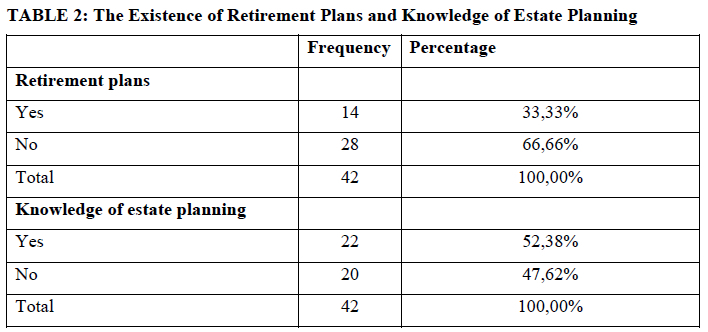
Table 2 shows agribusinesses' retirement plans and agribusiness owners' awareness regarding estate planning. It is noted by Wheeler et al. (2020) that retirement means something different to farmers compared to business owners in other sectors, and there may be different reasons why farmers opt not to retire or decide to retire at a certain age. It is further explained that most farmers view retirement as a concept for urban people because farmers view farming as a lifestyle rather than a business.
The study's findings, as demonstrated by Table 2 show that 67% of the respondents reported that they do not plan to retire from farming, while 33% reported that they would like to retire at an age of 62 years. The results of the study agreed with the study conducted in the United Kingdom by Wheeler et al. (2020), which showed that 19% of the farmers planned to retire at some point. In contrast, Earls and Hall (2018) had the opposite findings regarding retirement plans for farmers. The reasons provided by the FRKP farmers regarding retirement age included health issues because they believe that farming needs a person who is physically fit and healthy; thus, those over 60 years may not be in good condition to look after the farm. Some reported that they would have achieved their goals at 62 years. Concerning the awareness or knowledge of the estate planning process by agribusiness owners, the study showed that about 52% of the respondents reported that they had knowledge or were aware of the process of estate planning. In comparison, 48% mentioned that they had never heard of it. A study by Bell and O'Mary (1986) had similar results about farmers' awareness of the estate planning process in Alabama, USA.
3.4. The Relationship Between the Size of the Business and the Existence of Estate Plans
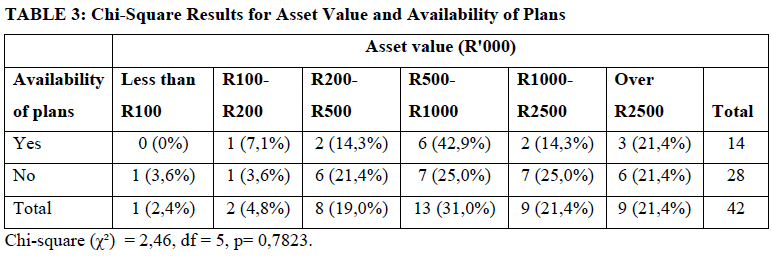
The correlation between the size of the business (asset base) and the availability of estate plans is shown in Table 3. According to Ashok et al. (2004), the business's assets influence the business owner's decision on estate planning. This is the case because, in most instances, dairy or piggery businesses normally have more valuable assets than businesses that produce vegetables. In this study, a chi-square test was used to measure the degree of association between asset value and the existence of estate plans. According to Zafar and Akhtar (2020), a p-value lower than 0.005 in the chi-square calculation is considered significant, while a value of more than 0.005 is considered insignificant. According to the results of the analysis, the correlation between the two variables is not statistically significant (x2= 2.46; df= 5; p= 0.782). The study's results disagree with studies by Ashok et al. (2004) and Wheeler et al. (2020), which noted an association between the likelihood of having an estate/succession plan and the size of a business. The difference in results could be that Ashok et al. (2004) focused on enterprises such as grains, dairy and piggery. In contrast, this study included all the different types of enterprises, i.e. aquaculture, vegetables, fruit, grains, beekeeping, small stock and large stock, and agriprocessing.
4. CONCLUSION
Given the large number of family farms, passing over the farm business to the next generation and keeping it in the family is a very important characteristic in the agricultural sector. Farmers, however, find it very difficult to conclude concerning estate planning because these issues are emotional. It has been highlighted that the issue of passing over the farm to the heirs (younger generation) should not only be viewed as an exercise of arranging legal and financial affairs but also the passing of knowledge to potential successors. The study showed that farmers do not plan to retire from farming, while those few who plan to retire perceive 62 as a suitable age for retirement. In addition, the majority of the farmers do not have any estate plans in place, although the majority of the farmers are aware of estate planning and its processes. The correlation, as analysed by the chi-square test, showed no association between the availability of estate plans and the value of the assets owned by the agribusinesses. It is recommended that farmers normalise the process of estate planning. Farmers who plan not to retire should consider partial retirement, which might influence their decision to have plans in place in case of death. Further research should be conducted to investigate the impact of the non-existence of estate plans on the future operations of agribusinesses.
5. ACKNOWLEDGMENTS
The Western Cape Government, specifically the Western Cape Department of Agriculture, is acknowledged and appreciated for its financial assistance for the research. This research's opinions, conclusions and recommendations are those of the authors and not the Western Cape Government.
REFERENCES
- ASHOK, M.K., HISHAM, E.O.S. & JAMES, J.D., 2004. Succession in family farm business: Empirical evidence from the U.S. farm sector. Selected Paper for Presentation at the AAEA Meeting. 1-4 August. Denver, CO.
- ASHRAF, M. & QASIM, M., 2019. Impact of education on farmers earning: A household survey data analysis. Educ. Res., 10(1): 200-213.
- BELL, S.C. & O'MARY, A.A., 1986. Legal knowledge of estate planning by Alabama farmers. Alabama: Auburn University.
- EARLS, A. & HALL, H.M., 2018. Lessons for succession planning in rural Canada: A review of farm succession plans and available resources in Haldimand County, Ontario. J. Rural Community Dev., 13(4): 25-42.
- EDOBOR, E.W., WIATT, R.D. & MARSHALL, M.I., 2021. Keeping the farm business in the family: The case of farm and non-farm family businesses in the midwestern United States. Int. FoodAgribus. Manag. Rev., 24(6): 921-934.
- GOUWS, A., 2015. Family farming is alive and well: Production. FarmBiz., 1(1): 36-39.
- LEE, Y.G., JASPER, C.R. & GOEBEL, K.P., 2003. A profile of succession planning among family business owners. J. Financ. Couns. Plan., 14(2): 31-41.
- LINGANI, M., 2022. An economic and investment analysis of apiculture in the Cape Winelands District Municipality, South Africa. Master's thesis, Cape Peninsula University of Technology, Bellville.
- LOWDER, S.K., SKOET, J. & RANEY, T., 2016. The number, size, and distribution of farms, smallholder farms, and family farms worldwide. World Develop., 87: 16-29.
- MAGASI, C., 2016. Factors influencing business succession planning among SMEs in Tanzania. Eur. J. Bus. Manag., 8(3): 126-135.
- MARKOWSKI-LINDSAY, M., CATANZARO, P., BELL, K., KITTREDGE, D., LEAHY, J., BUTLER, B., MARKOWITZ, E., MILMAN, A., ZIMMERER, R., ALLRED, S. & SISOCK, M., 2017. Estate planning as a forest stewardship tool: A study of family land ownerships in the northeastern U.S. For. Policy Econ., 83: 36-44.
- MODISE, M., 2011. The role of succession planning in the sustainability of family-owned agri-businesses in South Africa. Master's thesis, University of Pretoria, Pretoria.
- MOROKONG, T., SIBULALI, A. & MURDOCH, J., 2023. Western Cape agricultural sector profile: 2022. Stellenbosch: Western Cape Department of Agriculture.
- MOROKONG, T., SIBULALI, A., MURDOCH, J. & BAREND-JONES, V., 2022. Western Cape agricultural sector profile: 2021. Stellenbosch: Western Cape Department of Agriculture.
- MUHAMMAD, H.U., ADESIJI, G.B., TYABO, I.S., MUHAMMED, Y. & LOKO, A.I., 2019. Assessment of factors influencing the use of information and communication technologies by small-scale farmers in Federal Capital Territory (FCT), Abuja, Nigeria. J. Agric. Environ., 15(2): 61-70.
-
MUNICIPALITIES OF SOUTH AFRICA., 2023. Municipalities of South Africa. Available from https://municipalities.co.za/provinces/view/9/western-cape
» https://municipalities.co.za/provinces/view/9/western-cape - NTSHANGASE, W.M., NGIBA, S.C., VAN NIEKERK, J.A. & ZWANE, E.M., 2016. The impact of succession planning on the sustainability of cane production by small-scale cane growers in the north coast of KwaZulu-Natal, South Africa. S. Afr. J. Agric. Ext., 44(1): 50-58.
-
OLSSON, M. & MARTINY, S.E., 2018. Does exposure to counterstereotypical role models influence girls' and women's gender stereotypes and career choices? A review of social psychological research. Front. Psychol., 9. https://doi.org/10.3389/fpsyg.2018.02264.
» https://doi.org/10.3389/fpsyg.2018.02264 - RAMADANI, V., HISRICH, R.D., ANGGADWITA, G. & ALAMANDA, D.T., 2017. Gender and succession planning: opportunities for females to lead Indonesian family businesses. Int. J. Gend. Entrep., 9(3): 229-251.
- SAMBROOK, S., 2005. Exploring succession planning in small, growing firms. J. Small Bus. Enterp. Dev., 12(4): 579-594.
- SENTUTI, A., CAESERONI, F.M. & CUBICO, S., 2017. Women in family businesses: Recent debates and future directions. Paper presented at the XXXI RENT Conference, Relevance in Entrepreneurship Research. Lund, Sweden.
- SIPHESIHLE, Q. & MDODA, L., 2020. Factors affecting subsistence farming in rural areas of Nyandeni Local Municipality in the Eastern Cape Province. S. Afr. J. Agric. Ext., 48(2): 92-106.
-
SMALL BUSINESS INSTITUTE., 2018. The number of formal micro, small & medium businesses in South Africa. Available from https://www.smallbusinessinstitute.co.za/wp-content/uploads/2018/10/SBIbaselineAlert1final.pdf.
» https://www.smallbusinessinstitute.co.za/wp-content/uploads/2018/10/SBIbaselineAlert1final.pdf -
STATISTA RESEARCH DEPARTMENT., 2023. Employment in agriculture, hunting, forestry and fishing in South Africa from 2013 to 2021. Available from https://www.statista.com/statistics/1134712/employment-in-agriculture-hunting-forestry-and-fishing-in-south-africa/
» https://www.statista.com/statistics/1134712/employment-in-agriculture-hunting-forestry-and-fishing-in-south-africa/ -
STATISTICS SOUTH AFRICA., 2018. Provincial profile: Western Cape Community Survey 2016. Pretoria: Statistics South Africa. Available from https://cs2016.statssa.gov.za/wp-content/uploads/2018/07/WesternCape.pdf
» https://cs2016.statssa.gov.za/wp-content/uploads/2018/07/WesternCape.pdf - TAUER, L.W. & GROSSMAN, D.A., 2002. Estate and succession planning for small business owners. New York: Cornell University.
- VAN DER MERWE, S.P., 2009. An investigation of the determinants of estate and retirement planning in intergenerational family businesses. S. Afr. J. Bus. Manag., 40(3): 51-64.
- VENTER, B.C. & MAAS, G., 2005. The influence of successor-related factors on the succession process in small and medium-sized family businesses. Fam. Bus. Rev., 18(4): 283-303.
- WALSH, G., 2011. Family business succession: Managing the all-important family component. Amstelveen: KPMG.
-
WESTERN CAPE GOVERNMENT., 2022. Provincial Economic Review and Outlook 2022/23. Available from https://www.westerncape.gov.za/provincial-treasury/sites/provincial-treasury.westerncape.gov.za/files/atoms/files/2022%20PERO%20Final%20for%20WEB.pdf
» https://www.westerncape.gov.za/provincial-treasury/sites/provincial-treasury.westerncape.gov.za/files/atoms/files/2022%20PERO%20Final%20for%20WEB.pdf - WHEELER, R., LOBLEY, M. & SOFFE, R., 2020. Farm succession and inheritance in England, Scotland and Northern Ireland. Exeter: Centre for Rural Policy Research.
-
WORLD BANK., 2023. Agricutlre, forestry, and fishing, value added (% of GDP) - South Africa. Available from https://data.worldbank.org/indicator/NV.AGR.TOTL.ZS?locations=ZA
» https://data.worldbank.org/indicator/NV.AGR.TOTL.ZS?locations=ZA - ZAFAR, A. & AKHTAR, G.K.H., 2020. Effect of succession planning on organizational growth. Int. J. Soc. Sci. Human., 59(1): 21-33.
- ZAGATA, L. & SUTHERLAND, L.A., 2015. Deconstructing the 'young farmer problem in Europe': Towards a research agenda. J. Rural Stud., 38: 39-51.