A Correlates of Factors Influencing Succession Plans among Artisanal Fisher Folks in Coastal Areas of Southwest, Nigeria
Abstract
The Nigerian fisheries sector primarily comprises artisanal (inland) and coastal fishing. This makes the actual process of succession complicated. Hence, this research aims to assess the artisanal fisher folks' perception towards succession plans in Coastal Areas of Southwest Nigeria. A purposive sampling technique was used to select 150 artisanal fisher folks from two states, Ogun and Ondo, with the highest fish production figures in Southwest Nigeria. Data were collected through a well-structured interview schedule. The analytical tools include chi-square and Pearson Product-Moment Correlation, frequencies, and percentages. The results show that the mean age was 37.30±12.54, and about (56%) were male. Furthermore, income diversification among the respondents revealed a majority (88.7%) earning between N2,000.00 - N125,101.00, with fishing experience of 6.37±6.20. Most fisher folk (56%) were involved in full-time fishing. The chi-square analysis revealed that educational attainment (x2=24.56 p<=0.05) and involvement in fishing expenditure (x2=29.42) were significant factors associated with the succession plan of artisanal fisher folks. The study illuminates the difficulties confronting succession plans in the study area and highlights areas where government support is needed and how stakeholders can reduce future generational conflicts that may ensue after the death of business owners.
Succession Plan; Fisher folks; Fishing Business
1. INTRODUCTION
Fisheries involve many activities and processes, such as harvesting, processing, preservation, distribution, and marketing (Ameyaw Breckwoldt, Reuter & Aheto, 2020). It involves all the methods of taking the fish from the water to the final consumer. Globally, fish have been acknowledged as an important source of animal protein. At least one billion people in 58 developing countries with low-income food deficits depend on fish as a primary source of animal protein (Food and Agricultural Organisation, 2013). The use of fish as a source of protein to aid the growth and development of both humans and livestock is of utmost importance. Fish contains a very low amount of carbohydrates and mainly comprises proteins, lipids, minerals, and other nitrogenous mixtures (Naeem & Selamoglu, 2023). Fish complements meat, as the latter's cost is beyond what most Nigerians can afford (Adedokun et al., 2006; Oladimeji et al., 2013a).
Fish is the most reliable source of animal protein for the populace, yet millions of people who depend on fish are faced daily with the fear of food shortages (World Fish Center, 2009). Nigeria is blessed with human and natural resources that favour fish production. According to the report of the Federal Department of Fisheries (DFF, 2005), Nigeria is endowed with a coastline of 853 km and over 14 million hectares of inland waters, brackish water, and marine water fisheries resources. Meanwhile, William (2006) identified the fishery sub-sector as one of the untapped potentials in Africa. Otubusin (2011) opined that fish production in Nigeria comes from three sources: artisanal (inland rivers, lakes, coastal, and brackish water), aquaculture (fish farms), and industrial fishing. In 2015, the total domestic production was 1,027,058.00 million metric tons. Artisanal fishery contributed 67.7% (694,867.00mt), aquaculture fishery contributed 30.8% (316,727.00 mt), and industrial fishery contributed 1.5% (15,464.00) (FDF, 2018). However, artisanal fishing is the most important aspect of fishery production in Nigeria and accounts for over 90% of her fishery production.
Artisanal fisheries are fish-catching operations with canoes and simple fishing gear. The artisanal fishery is characterised by using low-technology input fishing gear with a fish catch range of five nautical miles of the seashore (Adesulu & Syndenham, 2002; Adedokun et al., 2006). The fish distribution network is very poor and local market-oriented, with low revenue generation but easy availability of fresh fish to rural communities and consumers along coastal and inland towns and cities.
Errington (1998) reported that inter-generational farm transfer involves three interrelated processes: inheritance, succession, and retirement. In a Nigerian context, inheritance transfers an aged farmer's assets to an identified and trusted successor, mainly at his demise or retirement. At the "causal" retirement stage of the aged farmer, many resources are transferred to the successor after critical and family decisions on the farm have been considered. The assets may be equipment, buildings, barns, crops, hired labour, and, most importantly, farmland. Anecdotally, investigations of intergenerational farm transfer have limited attention to the lack of successors willing to take over, as documented in Ireland and other developed nations (Hernœs et al., 2000; DEFRA, 2002; Bohak, 2011; Ingram & Kirwan, 2011). Also, there is an alarming ageing farming population from census to census, and it was reported that new blood entering the profession is very low (Hennessy & Rehman, 2007; Zagata & Lostak, 2014).
The succession plan has enjoyed a global view from various perspectives with similar or equal concepts, especially in developed countries (United Kingdom, France, Iowa, Australia, Canada, and Finland, among others). In another vein, the actual process of succession is complicated and gradual. It sometimes requires a high sense of acceptance of responsibilities by the successor. It involves the transfer of leadership, managerial control, and ownership of family and farming assets from one generation to another (Goode, 2019).
This study aims to examine the crucial factors related to the succession plans among artisanal fisher folks in the Southwest, Nigeria coastal areas to unveil the sustainability of artisanal fishing in the study area.
Specifically, the objectives were to:
i. Describes the personal characteristics of the respondents.
ii. Identify the succession plans that exist among the respondents.
iii. Determine the respondent's attitude toward the succession plans.
iv. Examine the factors influencing the succession plan among the respondents in the study area.
2. RESEARCH METHODOLOGY
2.1. Study Area
The study was conducted in Southwest, Nigeria, and lies at 100 0' 0" N latitude and 80 0' 0" E longitude. Southwest Nigeria consists of six states, three of which (Ondo, Ogun, and Lagos States) are maritime or coastal states with considerable inland and coastal fishing activities (FDF, 2006; Fasina & Mafimisebi, 2010).
2.2. Sampling Procedures and Data Collection
The respondents were chosen using a multi-stage sampling procedure. In the first stage, a purposive sampling technique was used to select two states, Ondo and Ogun, with the highest fish production figures in Southwest Nigeria (Mafimisebi, Famoofo & Mafimisebi, 2014). In the second stage, the Local Government Area (LGA) with the highest fish production figures was purposively selected from each state. The selected LGAs were Ilaje LGA in Ondo State and Ogun Waterside LGA in Ogun State. In the third stage, two communities were purposively selected (one in which artisanal fishing is the predominant livelihood strategy and another in which coastal fishing preponderates). These communities were Igbokoda and Araromi (Ondo State), Eba-Ijebu, and Akede Nla (Ogun State). The last stage involved randomly selecting 150 respondents from a sampling frame obtained from the respective state Agricultural Development Project (ADP) office. Data collected were subjected to appropriate descriptive and inferential statistical analysis (such as Pearson's Product Moment Correlation and chi-square).
2.3. Cut-Off Point for Factors Influencing Succession Plan
The dependent variable for this study was the succession plan. This was measured by asking the respondents to identify the succession plan they used from a list of 20 coping strategies provided and to indicate the extent to which they adopted them on a four-point scale ranging from Not a factor (1), Mild factor (2), and Huge factor (3). The cut-off points of 2.0 were obtained by adding all the possible scores and dividing by the total number of points (i.e. 1+2+3=6/3). This was used to determine the factors influencing the succession plan that was mostly used. The factor influencing succession plans with a mean score > 2.0 was regarded as a factor primarily influencing respondents. In contrast, those with a mean score < 2.0 were regarded as a factor not influencing respondents. Their factor score was generated to determine the level of factors influencing the succession of respondents. This was categorised into high and low factor levels using the mean score.
2.4. Cut-Off Point for Availability of Succession Plan
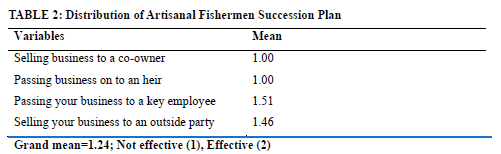
The succession plans were measured by asking the respondents to react to a list of 4 succession plans provided and to indicate the extent to which they adopted them on a two-point scale ranging from not effective (1) to effective (2). The cut-off points of 1.5 were obtained by adding all the possible scores and dividing by the total number of points (i.e. 1+2=3/2). This was used to determine the succession plan available.
2.5. Likert Scale
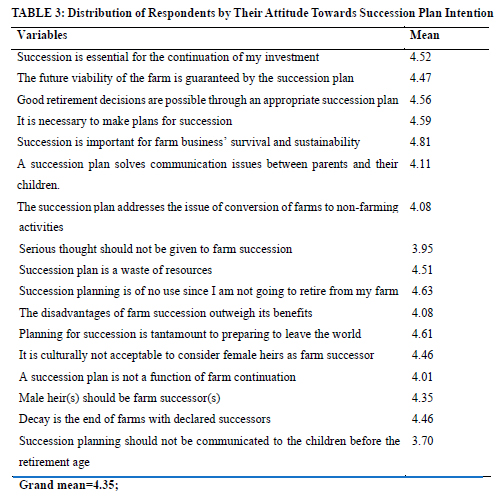
Finally, fisher folk were asked to choose from 17 attitudinal statements using a five-point Likert scale of strongly disagree (SD), disagree (D), indifferent (I), agreed (A), and strongly agree (SD), which was scored 5, 4, 3, 2, and 1, respectively, for positive statements, and 1, 2, 3, 4, and 5, for negative statements. The maximum score for each attitude was 85, while the minimum was 17. The weighted mean score was obtained. Using an equal interval approach, the aggregate score was calculated and used to categorise crop fisher folks' attitude towards the succession plan into favourable, unfavourable, and indifferent attitudes.
3. RESULTS AND DISCUSSION
3.1. Personal Characteristics of the Respondents
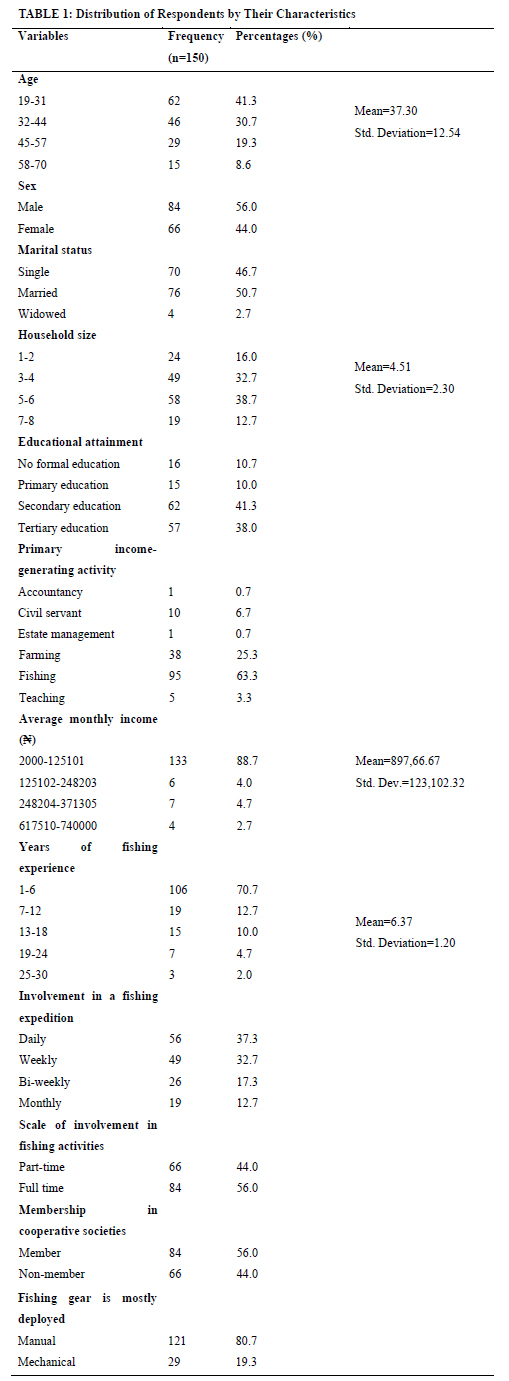
Table 1 shows the average age of the sampled fisherfolk to be 37.30±12.54. This corroborates the report of Ashimolowo, Ojebiyi, Soetan and Oluwa (2022) that most fisher folk were young people of active age for productive activities. This could help in succession planning among artisanal fisherfolks in coastal areas. In addition, slightly above half of the fisher folk (56.0%) were male, meaning that males were better able to cope with the demanding nature of fishing activities than females. Marital status shows that more than half of the fisher folk (50.7%) were married, which could confer some sense of responsibility on the married fisher folk on how to plan their succession with their children. Also, the average household size is 4.51± 2.30, which implies that respondents have a small household size. A significant portion of the sampled respondents (41.3%) had education up to secondary, indicating that most of the fisher folk could read and write to a reasonable extent. This affirmed the findings of Okeowo, Bolarinwa and Ibrahim (2015), and Ikeweinwe et al. (2011) found that fisher folk in Ogun State had completed at least their primary and secondary education. Similarly, most fisher folk (75.0%) preferred fishing as their primary occupation. This implies that fishing is their major occupation, while other occupations were secondary in the study area. This was in tandem with the findings of Ologbon, Idowu, Salmonu and Oluwatayo (2014), who affirmed that in Southwestern Nigeria, almost two-thirds of riverine households are primarily engaged in fishing and natural resource collections. The average monthly income among the respondents was N89766.67 ± N123102.32. This implies that, on average, the shepherds realised substantial income from fishing. The average number of years of fishing experience was 6.37 ± 1.20. This indicates that the respondents lack experience, which may be related to their age, as most were young.
Furthermore, about 37.3 percent of the fisher folk were involved in fishing expeditions daily, while slightly above half (56.0%) were engaged in full-time fishing activity. This implies that most of them were into fishing as their primary occupation. Similarly, about (56.0%) of the fisher folk belonged to a cooperative society. A strategy to address the challenges of mismanaged fisheries, unstable livelihoods, and poverty is to become a cooperative society member to maximise longterm community benefits. This supports the earlier findings of Onyango and Jentoft (2010), Issacs, Onyango and Akintola (2020), and Ndarathi et al. (2021) that successful community-based organisations have a positive impact on communities; the opposite is true for those without. Also, most fisher folks (80.7%) prefer or primarily use manual fishing gear. This conformed with the study of Ali et al. (2023), which found that manual fishing gear is less expensive and some of it is self-fabricated; therefore, fisher folks choose to utilise it.
3.2. Availability of a Succession Plan
Evidence in Table 2 showed the types of succession plans available, indicating a grand mean of 1.24. The results showed that the respondents favourably responded to 2 out of 4 succession plan statements and rated above the succession grand mean score. The statement "passing your business to a key employee" had the highest reception (mean 1.51), indicating that half of the fisherfolks would rather pass their business to a key employee because, although they like continuity when they decide to leave fishing, the potential successor(s) who are supposed to take over the farm have little or no interest in the family business. Previous research among fisher folks confirmed that fisheries actors indicated their hesitation in enabling their children to engage in fisheries activities (Nyiawung et al., 2023; Nyiawung et al., 2022). The result is also consistent with Coleman et al.(2019) research that fisher folks discourage their children from fishing due to hazards associated with the work.
3.3. Attitude of Artisanal Fishermen Towards the Succession Plan
Table 3 shows the perception of the sampled fisher folks toward succession plans, with a grand mean score of 4.35. The perception on statements such as; 'succession is essential for the continuation of my investment' (mean = 4.52); 'future viability of the farm is guaranteed by succession plan' (mean = 4.47); 'good retirement decisions are possible through appropriate succession plan' (mean = 4.56); 'it is necessary to make succession plans' (mean = 4.59); 'succession is important for farm business' survival and sustainability' (mean = 4.81), were seen to be favourable whilst statements such as 'serious thought should not be given to farm succession' (mean= 3.95); 'succession plan is not a function of farm continuation' (mean= 4.01); 'succession planning should not be communicated to the children before the retirement age' (mean= 3.70); 'disadvantages of succession plan outweigh its benefits' (mean= 4.08), and it is culturally not acceptable to consider female heirs as farm successor (mean= 4.46) were not deemed favourable by the sampled respondents.
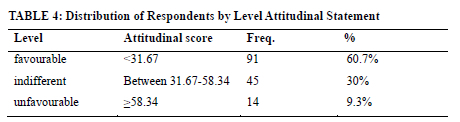
Furthermore, an in-depth analysis of Table 3 using the grand mean score for all the attitudinal statements revealed that the majority (60.3%) of respondents had favourable attitudes, whereas about (29.9%) had an indifferent attitude, and just (9.8%) of respondents had an unfavourable attitude toward succession planning. The findings imply that fisher folks wish to pass the business on to the next generation; however, they also want their children to work in an office instead of staying in the village with them. This aligns with the work of Suh, Efed and Nyiawung (2023), who found that fisher folks in the study area do not want their children to continue in the fishing industry. This is because of difficulties in making a living connected to fishing and the growing effects of climate change, which are the current problems associated with fishing.
3.4. Factors Influencing Succession Plans among Artisanal Fishermen
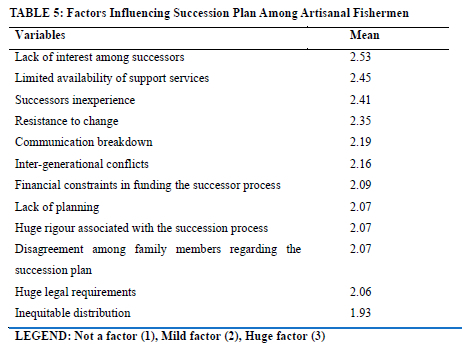
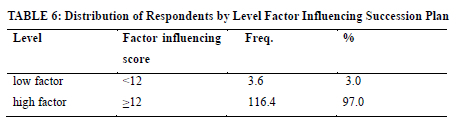
Table 4 reveals the factors influencing succession plans among artisanal fishermen. Different factors were analysed, with lack of interest among successors (2.53), successor's inexperience (2.41), resistance to change (2.35), and limited availability of support services (2.45) being shown to be significant factors influencing succession among artisanal fisher folk. An in-depth analysis used a weighted mean to assess the factors influencing the succession plan. They were categorised into high and low factors. The result in Table 4 shows that the majority (97.0%) of the fisher folks had high factors influencing their succession plan. Also, just 3.0% of the fisher folks had a low factor influencing their succession plan. Trimble and Johnson (2013) found that most fisher folks in Uruguay and Brazil were reluctant to support their children in the fishing industry because of the decreasing fish yield, erratic fish earnings, and limited capacity to support their daily needs.
3.5. Test of Hypotheses
3.5.1. H01: Relationship Between the Succession Plan of Artisanal Fishermen and Their Characteristics
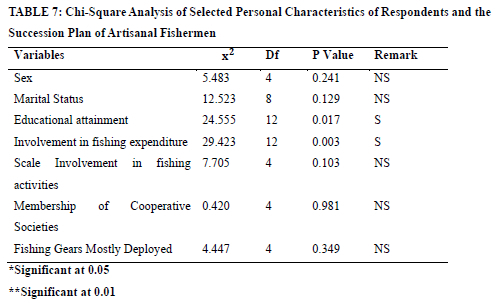
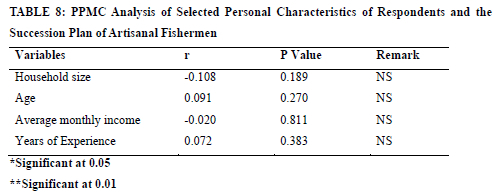
Table 5 shows the results of the chi-square test of the hypothesis, revealing educational qualification (p = 0.017) and involvement in fishing expenditure (p = 0.003) to be statistically significant variables in considering succession plans among the sampled respondents. This implies that educational qualification and involvement in fishing expenditures are functions of factors in the succession plan. It means that the higher the educational qualification and involvement in fishing expenditure, the higher the likelihood of a prospective successor taking over the farm. This result supports the assertion of Suh et al. (2023) that potential successors' years of education significantly influenced their decisions to be successful in fish harvesting activities. Table 5 shows the PPMC results revealing no significant relationship between household size (r = -0.108, p<0.05), age (r = 0.091, p<0.05), average monthly income (r = -0.020, p<0.05), and years of experience (r = 0.072, p<0.05). This also implies that household size, age, average monthly income, and years of experience are not functions of factors in the succession plan.
3.5.2. Results of the Pearson Product-Moment Correlation Analysis of Selected Personal Characteristics of Respondents and the Succession Plan of Artisanal Fishermen
Evidence in Table 6 shows that household size, age, average monthly income, and years of experience were not significantly related to the succession plan.
3.5.3. H02: The Relationship Between the Attitude of Artisanal Fishermen and the Succession Plan
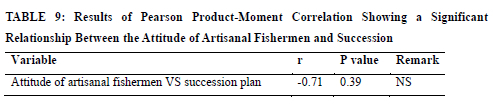
Results in Table 7 showed the PPMC analysis between the perception of artisanal fishermen and succession plans. The results show no significant relationship between the perception of artisanal fishermen and their succession plan (r = -0.71, p = 0.39). Although aged farmers show a favourable perception toward a succession plan, their succession plan has not been influenced because of the low interest of prospective successors in taking over the farm. These findings support the work of Morgan (2013), who found that invariably, this discourages the children from considering taking over the fishing business since most farmers want their children to pursue careers other than fishing.
4. CONCLUSION
The study finds that because their prospective successors had no interest in fishing and were unwilling to take over the enterprise, most artisanal fisher folks had low intentions regarding succession. Fisher folks in the studied area don't seem to have well-thought-out succession plans, even though this is essential to maintaining business sustainability and competitive advantage. The enterprise has been impacted by square pegs being put in round holes due to a lack of succession planning. This explains why fishing operations, which did well in the past, are currently doing poorly and are practically nonexistent. The research indicates that fisher folks know how important succession planning is to a seamless leadership handoff between forebears.
The research clearly shows that fisher folks understand the critical role that succession planning plays in ensuring a seamless transfer of leadership between predecessors and successors. However, the research also indicates that the children of fisher folks have not prioritised the succession plan, as evidenced by high factors negatively impacting the succession plan for 97.0 percent of the fisher folks.
5. RECOMMENDATIONS
It was recommended that artisanal fisher folks in the study area and Nigeria at large should endeavour to commence planning for succession by selecting and grooming potential successor(s) because having no plan for their potential successor(s) might result in future generational conflicts in the family, but having it will ensure farming continuity. These will increase the number of fisher folks with succession plans and reduce the number of enterprises closed down.
REFERENCES
- ADEDOKUN, O.A., ADERETI, F.O. & OPELE, A.I., 2006. Factors influencing the adoption of fisheries innovations by artisanal fishermen in coastal areas of Ogun State, Nigeria. J. Appl. Sci. Res, 2(11): 966-971.
- ADESULU, E.A. & SYDENHAM, D.H., 2002. The freshwater fishes and fisheries of Nigeria. Lagos: Macmillan Publishers.
- ALI, S.M., BILAME, O. & NGUSA, D., 2023. An assessment of the potentials of artisanal fisheries in spearheading the blue economy transformation in Zanzibar Islands. Glob. J. Agric. Sci., 22(2023): 23-35.
- AMEYAW, A.B., BRECKWOLDT, A., REUTER, H. & AHETO, D.W., 2020. From fish to cash: Analysing the role of women in fisheries in the western region of Ghana. Mar. Policy., 113(103790).
- ASHIMOLOWO, O.R., OJEBIYI, W.G., SOETAN, O.J. & OLUWA, K.A., 2022. Assessment of healthcare utilization among fishing households in coastal areas of Lagos State. Niger. Agric. J., 5(1): 149-158.
- COLEMAN, J., CAROTHERS, C., DONKERSLOOT, R., RINGER, D., CULLENBERG, P. & BATEMAN, A., 2019. Alaska's next generation of potential fishermen: A survey of youth attitudes towards fishing and community in Bristol Bay and the Kodiak Archipelago. Marit. Stud., 18(1): 47-63.
- ERRINGTON, A.J., 1998. The intergenerational transfer of managerial control in the farm-family business: A comparative study of England, France and Canada. J. Agric. Educ. Ext., 5(2): 123-36.
-
FASINA, O. & MAFIMISEBI, T.E., 2010. Contribution of children in artisanal fisheries to households' poverty alleviation in Ondo State, Nigeria. Available from http://ir.library.oregonstate.edu/xmlui/bitstream/handle/1957/38685/104.pdf?sequence=1
» http://ir.library.oregonstate.edu/xmlui/bitstream/handle/1957/38685/104.pdf?sequence=1 - FOOD & AGRICULTURAL ORGANISATION., 2013. Youth and agriculture: Key challenges and concrete solutions. Rome: FAO.
- FEDERAL DEPARTMENT OF FISHERIES., 2008. Fisheries Statistics of Nigeria. (1995 -2007).
-
GOODE, F., 2019. Succession planning. Available from https://www.farrellgoode.com.au/services/succession-planning/
» https://www.farrellgoode.com.au/services/succession-planning/ - HENNESSY, T.C. & REHMAN, T., 2007. An investigation into factors affecting the occupational choices of nominated farm heirs in Ireland. J. Agric. Econ., 58(1): 61-75.
- HERNES, E., SOLLIE, M. & STR0M, S., 2000. Early retirement and economic incentives. Scand. J. Econ., 102(3): 481-502.
- INGRAM, J. & KIRWAN, J., 2011. Matching new entrants and retiring farmers through farm joint ventures: Insights from the Fresh Start Initiative in Cornwall, UK. Land Use Policy., 28(4): 917-927.
-
ISSACS, M., ONYANGO, P. & AKINTOLA, S.L., 2020. Small-scale fisheries in Africa: A regional portrait. Canada: TBTI Global Publication Series. Available from from https://tbti-global.net/.
» https://tbti-global.net/ - IKEWEINWE, N.B., IDOWU, A.A., BAMIDELE, N.A., OTUBUSIN, S. & FADIPE, E.O., (2011). Effect of socio-economic factors on fish catch in Lower Ogun River, Isheri-Olofin and Ihsasi, Ogun State, Nigeria. Int. J. Agric. Manag. Dev., 1(4): 247-257.
-
MAFIMISEBI, T.E., FAMOOFO, A. & MAFİMİSEBI, O., 2014. Awareness and Utilisation of Indigenous Knowledge Systems in Artisanal and Coastal Fishing in Southwest, Nigeria. Available from https://ir.library.oregonstate.edu/downloads/ks65hd65c
» https://ir.library.oregonstate.edu/downloads/ks65hd65c - MORGAN, R.D., 2013. Exploring how fishermen respond to the challenges facing the fishing industry: A study of diversification and multiple-job holding in the English Channel fishery. Unpublished doctoral thesis, University of Portsmouth.
- NAEEM, M.Y. & SELAMOGLU, Z., 2023. Fish as a significant source of nutrients. Public Health Nutr., 6(4): 1-14.
- OKEOWO, T.A., BOLARINWA, J.B. & IBRAHIM, D., 2015. Socio-economic analysis of artisanal fishing and dominant fish species in lagoon waters of Epe and Badagry areas of Lagos State. Int. J. Res. Agric. Forest., 2(3): 38-45.
- OLOGBON, O.A.C., IDOWU, A.O., SALMONU, K.K. & OLUWATAYO, I.B., 2014. Incidence of multidimensional poverty among riverine households in Southwestern Nigeria. J. Agric. Sci., 6(5): 167-179.
- ONYANGO, P. & JENTOFT, S., 2010. Assessing Poverty in Small-scale Fisheries in Lake Victoria Tanzania. Fish and Fishers., 11: 250-263.
- OTUBUSIN, S.O., 2011. Inaugural lecture: Fish! Fish!! Fish!! Department of Aquaculture and Fisheries Management, College of Environmental Resources Management, University of Agriculture, Abeokuta, Nigeria, pp: 45-55.
- NDARATHI, J., MUNGA, C., HUGE, J. & DAHDOUH GUEBAS, F., 2021. A socio-ecological system perspective on trade interactions within artisanal fisheries in coastal Kenya. West. Indian Ocean J. Mar. Sci., 19(2): 29-43.
- NYIAWUNG, R.A., BENNETT, N.J. & LORING, P.A., 2023. Understanding change, complexities, and governability challenges in small-scale fisheries: A case study of Limbe, Cameroon, Central Africa. Marit. Stud., 22(1): 7.
- NYIAWUNG, R.A., AYILU, R.K., SUH, N.N., NGWANG, N.N., VARNIE, F. & LORING, P.A., 2022. COVID-19 and small-scale fisheries in Africa: Impacts on livelihoods and the fish value chain in Cameroon and Liberia. Mar. Policy., 141: 05104.
-
SUH, N.N., EFED, B.T. & NYIAWUNG, R.A., 2023. Youth recruitment and retainment in small-scale fisheries: Factors influencing succession and participation decisions in Cameroon. Aquac Fish Fish, 3: 424-434. https://doi.org/10.1002/aff2.129.
» https://doi.org/10.1002/aff2.129 - TRIMBLE, M. & JOHNSON, D., 2013. Artisanal fishing as an undesirable way of life? The implications for governance of fishers' wellbeing aspirations in coastal Uruguay and southeastern Brazil. Mar. Policy., 37: 37-44.